Abrasive Flow Machining
( AFM )
Goals
Getting basic knowledge about AFM
Clasification ofAFM
◦ One-wayAFM
◦ Two-wayAFM
◦ OrbitalAFM
Application areas ofAFM
Research areas ofAFM
Outline
What isAFM ?
Why asmooth surface?
Classification ofAFM machine
Key Components ofAFM Process
Process input Parameters
Operating Range
Properties ofAFM
One-way AFM (advantages)
T
wo-wayAFM (advantages)
Orbital AFM (advantages)
Monitoring ofAFM Process
Research Areas ofAFM
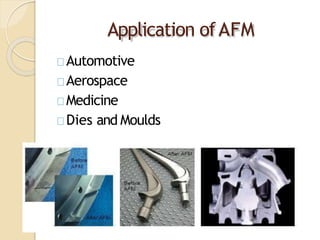
Applications ofAFM
Summary
References
What is AFM ?
Developed method in 1960s, by Extrude Hone Corporation
• AFM can
Polish and deburr parts internally
Through holes
Intersecting holes
Calibrate fuelinjection nozzles to aspecific flow rate
A method to radius difficult to reach surfaces like intricate
geometries
Produce surface finish (Ra) as good as 0,05 µm deburr holes as
small as 0,2 mm radius edges from 0,025 mm to 1,5 mm
Widely used finishing process to finish complicated shapes and
profiles
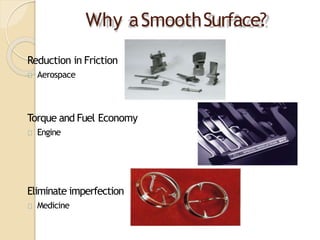
Why aSmoothSurface?
Reduction in Friction
Aerospace
Torque and Fuel Economy
Engine
Eliminate imperfection
Medicine
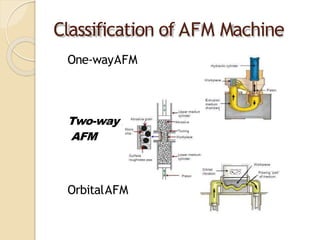
Classification of AFM Machine
One-wayAFM
Two-way AFM
AFM
OrbitalAFM
Key Components of
AFM Process
Machine :One –way AFM,Two-wayAFM,
OrbitalAFM
Tooling: Workpiece - Drill bit - Fixture
plate - Fixture - Piston - Cylinder
Abrasive medium:The medium that is
needed to be polished, deburred or finished.
Process Input Parameters ofAFM
Extrusion Pressure
Number of cycles
Grit composition andT
ype
Tooling
Fixture design
Operating range of AFM
Easy flowability
Better self deformability
Fine abrading capability
Layer thickness of material removed is, order of
about 1µm to 10 µm
Best surface finish that has been achived as 50nm
and tolerances +/-0,5 µm
Properties ofAFM
Deburring ,radiusing, and polishing are performed
simultaneously in asingle operation
AFM can produce true round radii even on
complex edges
Reduces surface roughness by 75 to 90 % on cast
and machined surfaces
AFM can process dozens of holes or multiple
passages parts simultaneously with uniform results
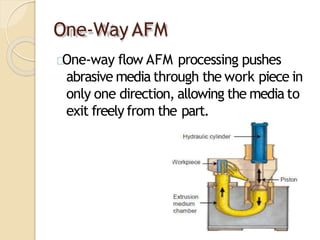
One-Way AFM
One-way flow AFM processing pushes
abrasive media through the work piece in
only one direction, allowing the media to
exit freely from the part.
The advantages of OneWay AFM
Faster cycle processing
Easy clean-up
Media temperature control generally not
required
Able to process larger parts
Simpler tooling and part change-over
Accurately replicates air or liquids natural
flow
Does not encapsulate workpart in media
Two-WayAFM
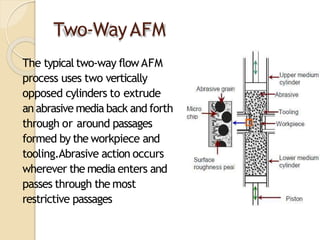
The typical two-way flowAFM
process uses two vertically
opposed cylinders to extrude
anabrasive media back and forth
through or around passages
formed by the workpiece and
tooling.Abrasive action occurs
wherever the media enters and
passes through the most
restrictive passages
Advantages of Two-WayAFM
Excellent process control
Can finish both ID and OD ofcomponent
Good control of radius generation
Fully automated system capabilities
Faster setup &quick-change tooling
Faster change-over of media
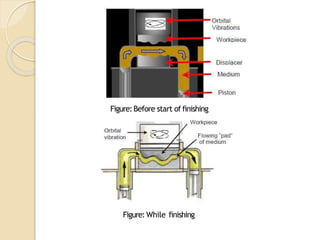
OrbitalAFM
Surface and edge finishing are achieved by
rapid, low-amplitude, oscillations of the
work piece relative to a self-forming elastic
plastic abrasive polishing tool.
The tool is a pad or layer of abrasive-laden
elastic plastic medium (similar to that used
in two way abrasive flow finishing), but
typically higher in viscosity and more in
elastic.
Figure:Before start of finishing
Figure:While finishing
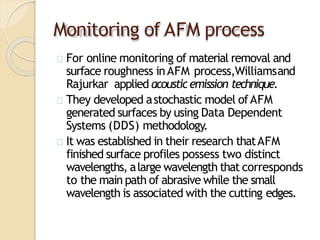
Monitoring of AFM process
For online monitoring of material removal and
surface roughness inAFM process,Williamsand
Rajurkar applied acousticemission technique.
They developed astochastic model ofAFM
generated surfaces by using Data Dependent
Systems (DDS) methodology.
It was established in their research thatAFM
finished surface profiles possess two distinct
wavelengths, alarge wavelength that corresponds
to the main path of abrasive while the small
wavelength is associated with the cutting edges.
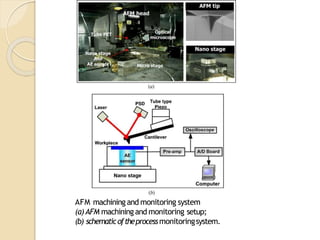
AFM machining and monitoring system
(a)AFM machining and monitoring setup;
(b) schematicoftheprocessmonitoringsystem.
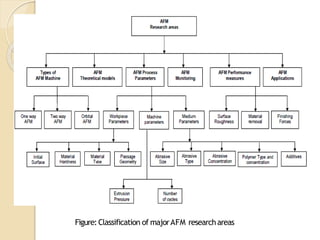
Figure:Classification of majorAFM researchareas
Application ofAFM
Automotive
Aerospace
Medicine
Dies and Moulds
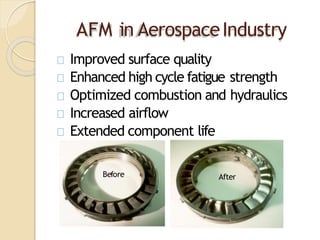
AFM in AerospaceIndustry
Improved surface quality
Enhanced high cycle fatigue strength
Optimized combustion and hydraulics
Increased airflow
Extended component life
Before After
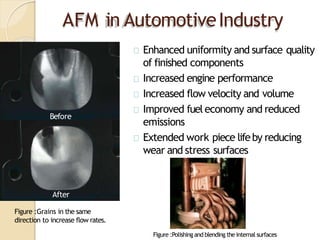
AFM in AutomotiveIndustry
Enhanced uniformity and surface quality
of finished components
Increased engine performance
Increased flow velocity and volume
Improved fuel economy and reduced
emissions
Extended work piece lifeby reducing
wear and stress surfaces
Before
After
Figure :Grains in the same
direction to increase flow rates.
Figure :Polishing and blending the internal surfaces
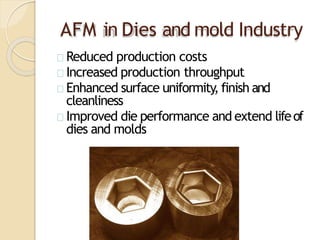
AFM in Dies and mold Industry
Reduced production costs
Increased production throughput
Enhanced surface uniformity, finish and
cleanliness
Improved die performance and extend lifeof
dies and molds
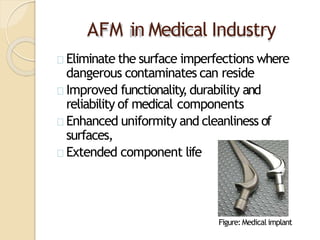
AFM in Medical Industry
Eliminate the surface imperfections where
dangerous contaminates can reside
Improved functionality,durability and
reliability of medical components
Enhanced uniformity and cleanliness of
surfaces,
Extended component life
Figure:Medical implant
Summary
Possible to control and select the intensity and location of abrasion
Produces uniform, repeatable and predictable results on an
impressive range of finishing operations.
Maintain flexibility and jobs which require hours of highly skilled
hand polishing can be processed in afew minutes
Process used in aerospace, medical and automobile industries
Better surface roughness values and tight tolerances.
Disadvantage of this process is low finishing rate
Better performance is achieved ifthe process is monitored online.
Improve surface quality
Reduction in Friction
Eliminate imperfection
References
M.Ravi Sankar,V.K.Jain*,J.Ramkumar,Abrasive flow
machining (AFM): AnOverview
http://www.extrudehone.com/afmpro.html
http://www.abrasive-flow-machining.com/
Rhoades L.J.,Kohut T.A.,Nokovich N.P.,YandaD.W.,
Unidirectional abrasive flow machining, US patent
number 5,367,833, Nov 29th,1994.
Rhoades L.J.,Abrasive flow machining,Manufacturing
Engineering, (1988),pp.75-78.
Williams R.E.,Acoustic Emission Characteristics of
Abrasive Flow Machining,Transaction of the ASME, 120,
(1998), 264- 271.

Abrasive flow machning

  • 1.
  • 2.
    Goals Getting basic knowledgeabout AFM Clasification ofAFM ◦ One-wayAFM ◦ Two-wayAFM ◦ OrbitalAFM Application areas ofAFM Research areas ofAFM
  • 3.
    Outline What isAFM ? Whyasmooth surface? Classification ofAFM machine Key Components ofAFM Process Process input Parameters Operating Range Properties ofAFM One-way AFM (advantages) T wo-wayAFM (advantages) Orbital AFM (advantages) Monitoring ofAFM Process Research Areas ofAFM Applications ofAFM Summary References
  • 4.
    What is AFM? Developed method in 1960s, by Extrude Hone Corporation • AFM can Polish and deburr parts internally Through holes Intersecting holes Calibrate fuelinjection nozzles to aspecific flow rate A method to radius difficult to reach surfaces like intricate geometries Produce surface finish (Ra) as good as 0,05 µm deburr holes as small as 0,2 mm radius edges from 0,025 mm to 1,5 mm Widely used finishing process to finish complicated shapes and profiles
  • 5.
    Why aSmoothSurface? Reduction inFriction Aerospace Torque and Fuel Economy Engine Eliminate imperfection Medicine
  • 6.
    Classification of AFMMachine One-wayAFM Two-way AFM AFM OrbitalAFM
  • 7.
    Key Components of AFMProcess Machine :One –way AFM,Two-wayAFM, OrbitalAFM Tooling: Workpiece - Drill bit - Fixture plate - Fixture - Piston - Cylinder Abrasive medium:The medium that is needed to be polished, deburred or finished.
  • 8.
    Process Input ParametersofAFM Extrusion Pressure Number of cycles Grit composition andT ype Tooling Fixture design
  • 9.
    Operating range ofAFM Easy flowability Better self deformability Fine abrading capability Layer thickness of material removed is, order of about 1µm to 10 µm Best surface finish that has been achived as 50nm and tolerances +/-0,5 µm
  • 10.
    Properties ofAFM Deburring ,radiusing,and polishing are performed simultaneously in asingle operation AFM can produce true round radii even on complex edges Reduces surface roughness by 75 to 90 % on cast and machined surfaces AFM can process dozens of holes or multiple passages parts simultaneously with uniform results
  • 11.
    One-Way AFM One-way flowAFM processing pushes abrasive media through the work piece in only one direction, allowing the media to exit freely from the part.
  • 12.
    The advantages ofOneWay AFM Faster cycle processing Easy clean-up Media temperature control generally not required Able to process larger parts Simpler tooling and part change-over Accurately replicates air or liquids natural flow Does not encapsulate workpart in media
  • 13.
    Two-WayAFM The typical two-wayflowAFM process uses two vertically opposed cylinders to extrude anabrasive media back and forth through or around passages formed by the workpiece and tooling.Abrasive action occurs wherever the media enters and passes through the most restrictive passages
  • 14.
    Advantages of Two-WayAFM Excellentprocess control Can finish both ID and OD ofcomponent Good control of radius generation Fully automated system capabilities Faster setup &quick-change tooling Faster change-over of media
  • 15.
    OrbitalAFM Surface and edgefinishing are achieved by rapid, low-amplitude, oscillations of the work piece relative to a self-forming elastic plastic abrasive polishing tool. The tool is a pad or layer of abrasive-laden elastic plastic medium (similar to that used in two way abrasive flow finishing), but typically higher in viscosity and more in elastic.
  • 16.
    Figure:Before start offinishing Figure:While finishing
  • 17.
    Monitoring of AFMprocess For online monitoring of material removal and surface roughness inAFM process,Williamsand Rajurkar applied acousticemission technique. They developed astochastic model ofAFM generated surfaces by using Data Dependent Systems (DDS) methodology. It was established in their research thatAFM finished surface profiles possess two distinct wavelengths, alarge wavelength that corresponds to the main path of abrasive while the small wavelength is associated with the cutting edges.
  • 18.
    AFM machining andmonitoring system (a)AFM machining and monitoring setup; (b) schematicoftheprocessmonitoringsystem.
  • 19.
  • 20.
  • 21.
    AFM in AerospaceIndustry Improvedsurface quality Enhanced high cycle fatigue strength Optimized combustion and hydraulics Increased airflow Extended component life Before After
  • 22.
    AFM in AutomotiveIndustry Enhanceduniformity and surface quality of finished components Increased engine performance Increased flow velocity and volume Improved fuel economy and reduced emissions Extended work piece lifeby reducing wear and stress surfaces Before After Figure :Grains in the same direction to increase flow rates. Figure :Polishing and blending the internal surfaces
  • 23.
    AFM in Diesand mold Industry Reduced production costs Increased production throughput Enhanced surface uniformity, finish and cleanliness Improved die performance and extend lifeof dies and molds
  • 24.
    AFM in MedicalIndustry Eliminate the surface imperfections where dangerous contaminates can reside Improved functionality,durability and reliability of medical components Enhanced uniformity and cleanliness of surfaces, Extended component life Figure:Medical implant
  • 25.
    Summary Possible to controland select the intensity and location of abrasion Produces uniform, repeatable and predictable results on an impressive range of finishing operations. Maintain flexibility and jobs which require hours of highly skilled hand polishing can be processed in afew minutes Process used in aerospace, medical and automobile industries Better surface roughness values and tight tolerances. Disadvantage of this process is low finishing rate Better performance is achieved ifthe process is monitored online. Improve surface quality Reduction in Friction Eliminate imperfection
  • 27.
    References M.Ravi Sankar,V.K.Jain*,J.Ramkumar,Abrasive flow machining(AFM): AnOverview http://www.extrudehone.com/afmpro.html http://www.abrasive-flow-machining.com/ Rhoades L.J.,Kohut T.A.,Nokovich N.P.,YandaD.W., Unidirectional abrasive flow machining, US patent number 5,367,833, Nov 29th,1994. Rhoades L.J.,Abrasive flow machining,Manufacturing Engineering, (1988),pp.75-78. Williams R.E.,Acoustic Emission Characteristics of Abrasive Flow Machining,Transaction of the ASME, 120, (1998), 264- 271.