NTMM
By S K Mondal
Need for Unconventional Processes
 New materials having high strength and hardness, such as
nimonic alloys and alloys with alloying elements such as
tungsten, molybdenum, and columbium are difficult to
machine by the traditional methods.
 By conventional machining the MRR reduces with an
increase in the work material hardness.
 Need for development of non-traditional machining
processes which utilize other methods such as
electrochemical processes for the material removal.
Need for Unconventional Processes
 Complex shapes.
 A very high accuracy is desired besides the complexity of
the surface to be machined.
In Unconventional Machining
 Different forms of energy directly applied to the
workpiece to have shape transformation or material
removal from work surface.
 No chips, No lay pattern on work surface, no direct
physical contact between the tool and the workpiece .
 The tool material does not have to be harder than the
work material.
 Tool forces do not increase as the work material gets
harder.
 Economic metal removal rate does not decrease as the
work material gets harder.
Classification of NTMM
The Non-traditional Machining Methods are classified
according to the major energy sources employed in
machining.
1. Thermal Energy Methods
2. Electro - Chemical Energy Method
3. Chemical Energy Methods
4. Mechanical Energy Methods
1. Thermal Energy Methods
 Electrical discharge machining (EDM)
 Laser beam Machining (LBM)
 Plasma Arc Machining (PAM)
 Electron Beam Machining(EBM)
 Ion Beam Machining (IBM)
2. Electro - Chemical Energy Method
 Electro-Chemical Machining (ECM)
 Electro-Chemical grinding (ECG)
 Electro-Chemical Honing (ECH)
 Electro-Chemical Deburring (ECD)
3. Chemical Energy Methods
These methods involve controlled etching of the
workpiece material in contact with a chemical solution.
 Chemical Machining Method (CHM).
4. Mechanical Energy Methods
 Ultra Sonic Machining (USM)
 Abrasive Jet Machining (AJM)
 Water Jet Machining (WJM)
GATE-2014
The process utilizing mainly thermal energy for
removing material is
(a) Ultrasonic Machining
(b) Electrochemical Machining
(c) Abrasive Jet Machining
(d) Laser Beam Machining
Some Observations
 EDM has the lowest specific power requirement and can
achieve sufficient accuracy.
 ECM has the highest metal removal rate, MRR.
 USM and AJM have low MRR and combined with high
tool wear, are used for non-metal cutting.
 LBM and EBM have high penetration rates with low
MRR and, therefore, are commonly used for micro
drilling, sheet cutting, and welding.
 CHM is used for manufacturing PCB and other shallow
components.
 PAM can be used for clean, rapid cuts and profiles in
almost all plates upto 20 cm thick with 5o to 10o taper.
Shapes Cutting Capability
The various NTMM have some special shape cutting
capability as given below:
1. Micro-machining and Drilling : LBM and EBM
2. Cavity sinking and standard Hole Drilling: EDM and
USM
3. Fine hole drilling and Contour Machining: ECM
4. Clean, rapid Cuts and Profiles: PAM
5. Shallow Pocketing: AJM
GATE-2014
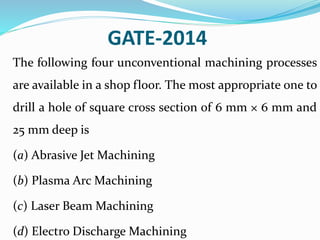
The following four unconventional machining processes
are available in a shop floor. The most appropriate one to
drill a hole of square cross section of 6 mm × 6 mm and
25 mm deep is
(a) Abrasive Jet Machining
(b) Plasma Arc Machining
(c) Laser Beam Machining
(d) Electro Discharge Machining
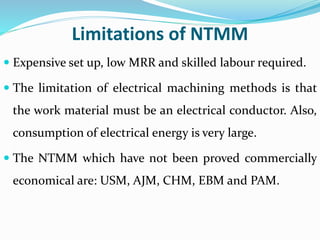
Limitations of NTMM
 Expensive set up, low MRR and skilled labour required.
 The limitation of electrical machining methods is that
the work material must be an electrical conductor. Also,
consumption of electrical energy is very large.
 The NTMM which have not been proved commercially
economical are: USM, AJM, CHM, EBM and PAM.
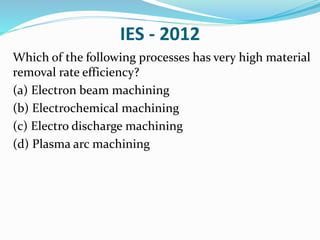
IES - 2012
Which of the following processes has very high material
removal rate efficiency?
(a) Electron beam machining
(b) Electrochemical machining
(c) Electro discharge machining
(d) Plasma arc machining
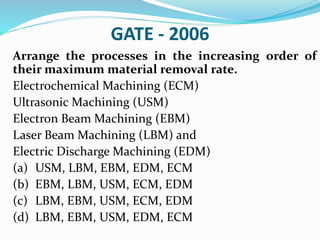
GATE - 2006
Arrange the processes in the increasing order of
their maximum material removal rate.
Electrochemical Machining (ECM)
Ultrasonic Machining (USM)
Electron Beam Machining (EBM)
Laser Beam Machining (LBM) and
Electric Discharge Machining (EDM)
(a) USM, LBM, EBM, EDM, ECM
(b) EBM, LBM, USM, ECM, EDM
(c) LBM, EBM, USM, ECM, EDM
(d) LBM, EBM, USM, EDM, ECM
IES - 2007
Consider the following statements in relation to the
unconventional machining processes:
1. Different forms of energy directly applied to the
piece to have shape transformation or material removal
from work surface.
2. Relative motion between the work and the tool is
essential.
3. Cutting tool is not in physical contact with work
piece.
(a) 1 and 2 only (b) 1, 2 and 3 only
(c) 2 and 3 only (d) 1 and 3 only
IES - 2009
Which one of the following statements is correct in
respect of unconventional machining processes?
(a) The cutting tool is in direct contact with the job
(b) The tool material needs to be harder than the job
material
(c) The tool is never in contact with the job
(d) There has to be a relative motion between the tool
and the job
IAS - 2002
Match List I (Processes) with List II (Tolerances
obtained) and select the correct answer using the codes
given below the Lists:
List I List II
(Processes) (Tolerances obtained)
A. Plasma Arc machining 1. 7·5 microns
B. Laser Beam machining 2. 25 microns
C. Abrasive Jet machining 3. 50 microns
D. Ultrasonic machining 4. 125 microns
Codes:A B C D A B C D
(a) 4 1 3 2 (b) 3 2 4 1
(c) 4 2 3 1 (d) 3 1 4 2
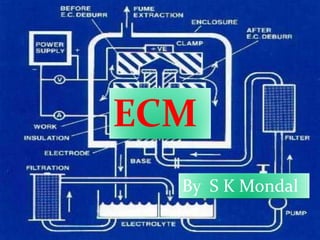
ECM
By S K Mondal
Electrochemical Machining
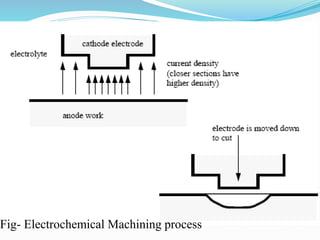
 Electrochemical machining is the reverse of electro
plating
 The work-piece is made the anode, which is placed in
close proximity to an electrode (cathode), and a high-
amperage direct current is passed between them through
an electrolyte, such as salt water, flowing in the anode-
cathode gap.
 Metal is removed by anodic dissolution and is carried
away in the form of a hydroxide in the electrolyte for
recycling or recovery.
 MRR in ECM depends on atomic weight of work material
Fig- Electrochemical Machining process
Electrochemical Machining
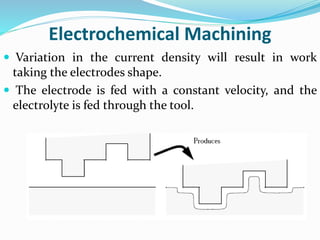
 Variation in the current density will result in work
taking the electrodes shape.
 The electrode is fed with a constant velocity, and the
electrolyte is fed through the tool.
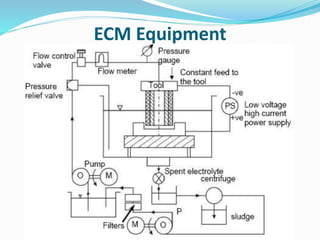
ECM Equipment
ECM Equipment
 Supply Voltage 2 to 35 V DC and Current 500 to 40,000 A
 The tool-to-work gap needs to be maintained at a very
small value 0.1 to 0.25 mm. A servo drive is provided on
the tool axis for this purpose.
 The electrolyte needs to be pumped through this gap at
high pressures ranging from 0.70 to 3.00 MPa. This
introduces a large amount of load on the machine,
because of the large working areas involved. Hence the
machine structure will have to be made rigid to a
withstand such forces.
ECM Equipment
 The electrolyte consists of the metal debris removed
from the anode, which will have to be filtered before it is
re-pumped into the system.
 Also a large amount of heat is generated during the
electrolysis, which heats up the electrolyte, and hence it
needs to be cooled.
Electrolyte
The electrolyte is so chosen that the anode (workpiece)
is dissolved but no deposition takes place on the cathode
(tool).
Properties electrolyte should be
1. High electrical conductivity
2. Low viscosity
3. High specific heat
4. Chemical stability
5. Resistance to formation of passivating film on
workpiece surface
6. Non-corrosive and non-toxic
7. Inexpensive and readily available
For ECM of steel NaCl is used as the electrolyte.
Tool
The properties of tool materials should be:
1. High electrical and thermal comductivity
2. Easy machinability
3. Good shiffness
4. High corrosion resistance
 Tool materials: Copper, brass, bronze, Al, Stainless
Steel, Cupro nickel, etc.
 Material wear / Tool wear: Infinite
IES-2015 Conventional
Explain the principle of Electro Chemical machining
process with the help of a diagram.
[10 Marks]
Advantages
1. Complex three-dimensional surfaces can be machined
accurately. Good for low machinability or complicated
shapes.
2. As ECM leads to atomic level dissolution, the surface
finish is excellent (Ra 0.2 to 0.6 μm) with almost stress
free machined surface and without any thermal
damage.
3. The tool wear is practically nil which results in a large
number of components produced per tool.
4. MRR is highest (1600 mm3/min) among NTMM and
comparable with conventional machining.
Disadvantages
1. Use of corrosive media as electrolytes makes it difficult to
handle.
2. Sharp interior edges and corners (< 0.2 mm radius) are
difficult to produce.
3. Very expensive machine.
4. Forces are large with this method because of fluid pumping
forces.
5. Very high specific energy consumption (about 150 times
that required for conventional processes),
6. Not applicable with electrically non-conducting materials
and jobs with very small dimensions
7. Lower fatigue strength
Applications
 Any electrically conductive work material irrespective
of their hardness, strength or even thermal properties.
 The machining surface can be situated at any
inaccessible.
 Shape application – blind complex cavities, curved
surfaces, through cutting, large through cavities.
 It is used for the machining of the gas turbine blades.
 Die sinking
 Profiling and contouring
 Trepanning
 Grinding
 Drilling
 Micro-machining
ISRO-2009
The machining process in which the work picce is
dissolved into an electrolyte solution is called
(a) Electro-chemical machining
(b) Ultrasonic machining
(c) Electro-discharge machining
(d) Laser machining
PSU
ECM cannot be undertaken for
(a) steel
(b) Nickel based superalloy
(c) Al2O3
(d) Titanium alloy
PSU
Commercial ECM is carried out at a combination
of
(a) low voltage high current
(b) low current low voltage
(c) high current high voltage
(d) low current low voltage
IAS-2011 Main
What is the principle of electro-chemical
machining (ECM)?
What are the advantages and disadvantages of
ECM over conventional drilling?
Comment on the surface finish and the accuracy of
the ECM.
[20-Marks]
ECM Calculations
Faraday’s laws state that,
m =
Where m = weight (g) of a material
I = current (A)
t = time (sec)
E = gram equivalent weight of the
material
F = constant of proportionality –
Faraday (96,500 coulombs)
It E
F
ECM Calculations
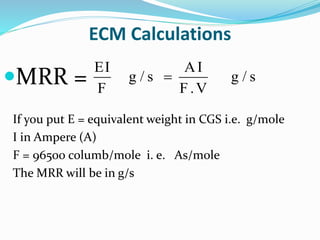
MRR =
If you put E = equivalent weight in CGS i.e. g/mole
I in Ampere (A)
F = 96500 columb/mole i. e. As/mole
The MRR will be in g/s

EI AI
g / s g / s
F F.V
ECM Calculations
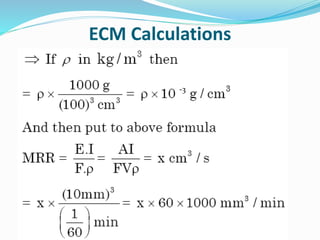
-3
ECM Calculations
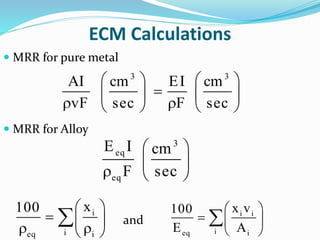
 MRR for pure metal
 MRR for Alloy
   
   
    
3 3
AI cm EI cm
vF sec F sec
 
 
  
3
eq
eq
E I cm
F sec
 
  
  
 i
ieq i
x100  
  
 
 i i
ieq i
x v100
E A
and
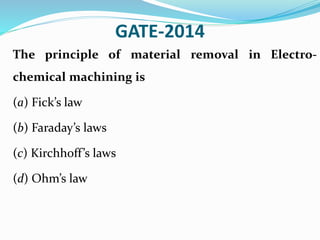
GATE-2014
The principle of material removal in Electro-
chemical machining is
(a) Fick’s law
(b) Faraday’s laws
(c) Kirchhoff’s laws
(d) Ohm’s law
Example
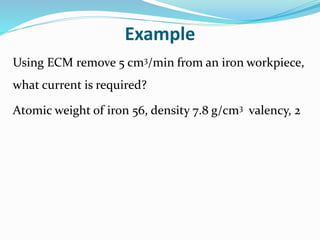
Using ECM remove 5 cm3/min from an iron workpiece,
what current is required?
Atomic weight of iron 56, density 7.8 g/cm3 valency, 2
GATE-2008 (PI)
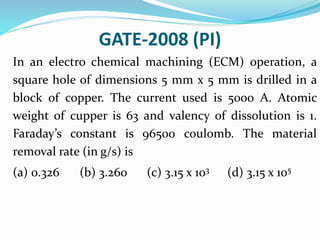
In an electro chemical machining (ECM) operation, a
square hole of dimensions 5 mm x 5 mm is drilled in a
block of copper. The current used is 5000 A. Atomic
weight of cupper is 63 and valency of dissolution is 1.
Faraday’s constant is 96500 coulomb. The material
removal rate (in g/s) is
(a) 0.326 (b) 3.260 (c) 3.15 x 10³ (d) 3.15 x 10⁵
GATE – 2011 (PI)
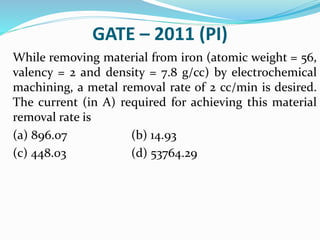
While removing material from iron (atomic weight = 56,
valency = 2 and density = 7.8 g/cc) by electrochemical
machining, a metal removal rate of 2 cc/min is desired.
The current (in A) required for achieving this material
removal rate is
(a) 896.07 (b) 14.93
(c) 448.03 (d) 53764.29
Example
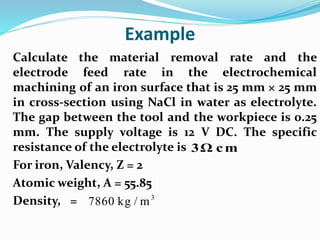
Calculate the material removal rate and the
electrode feed rate in the electrochemical
machining of an iron surface that is 25 mm × 25 mm
in cross-section using NaCl in water as electrolyte.
The gap between the tool and the workpiece is 0.25
mm. The supply voltage is 12 V DC. The specific
resistance of the electrolyte is
For iron, Valency, Z = 2
Atomic weight, A = 55.85
Density, =
3Ω cm
3
7860 kg / m
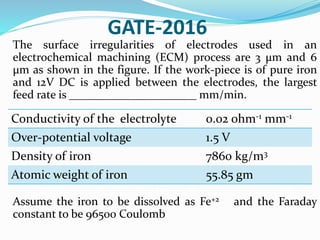
GATE-2016
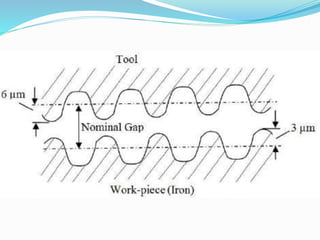
The surface irregularities of electrodes used in an
electrochemical machining (ECM) process are 3 μm and 6
μm as shown in the figure. If the work-piece is of pure iron
and 12V DC is applied between the electrodes, the largest
feed rate is ______________________ mm/min.
Assume the iron to be dissolved as Fe+2 and the Faraday
constant to be 96500 Coulomb
Conductivity of the electrolyte 0.02 ohm-1 mm-1
Over-potential voltage 1.5 V
Density of iron 7860 kg/m3
Atomic weight of iron 55.85 gm
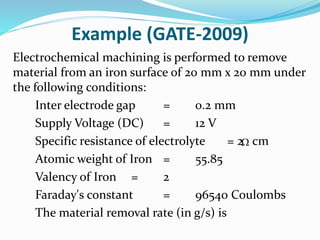
Example (GATE-2009)
Electrochemical machining is performed to remove
material from an iron surface of 20 mm x 20 mm under
the following conditions:
Inter electrode gap = 0.2 mm
Supply Voltage (DC) = 12 V
Specific resistance of electrolyte = 2 cm
Atomic weight of Iron = 55.85
Valency of Iron = 2
Faraday's constant = 96540 Coulombs
The material removal rate (in g/s) is

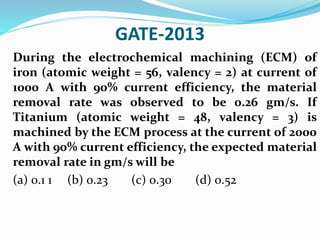
GATE-2013
During the electrochemical machining (ECM) of
iron (atomic weight = 56, valency = 2) at current of
1000 A with 90% current efficiency, the material
removal rate was observed to be 0.26 gm/s. If
Titanium (atomic weight = 48, valency = 3) is
machined by the ECM process at the current of 2000
A with 90% current efficiency, the expected material
removal rate in gm/s will be
(a) 0.1 1 (b) 0.23 (c) 0.30 (d) 0.52
Example
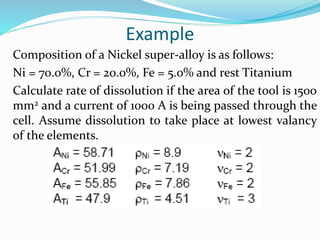
Composition of a Nickel super-alloy is as follows:
Ni = 70.0%, Cr = 20.0%, Fe = 5.0% and rest Titanium
Calculate rate of dissolution if the area of the tool is 1500
mm2 and a current of 1000 A is being passed through the
cell. Assume dissolution to take place at lowest valancy
of the elements.
GATE - 2008
A researcher conducts electrochemical machining
(ECM) on a binary alloy (density 6000 kg/m3) of iron
(atomic weight 56, valency 2) and metal P (atomic
weight 24, valency 4). Faraday's constant = 96500
coulomb/mole. Volumetric material removal rate of
the alloy is 50 mm3/s at a current of 2000 A. The
percentage of the metal P in the alloy is closest to
(a) 40 (b) 25 (c) 15 (d) 79
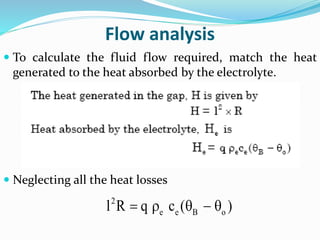
Flow analysis
 To calculate the fluid flow required, match the heat
generated to the heat absorbed by the electrolyte.
 Neglecting all the heat losses
2
e e B ol R q c ( )    
Example
The electrochemical machining of an iron surface that is
25 mm × 25 mm in cross-section using NaCl in water as
electrolyte. The gap between the tool and the workpiece
is 0.25 mm. The supply voltage is 12 V DC. The specific
resistance of the electrolyte is 3 Ωcm.
Estimate the electrolyte flow rate. Specific heat of the
electrolyte is given as 0.997 cal/g˚C. The ambient
temperature is 35˚C and the electrolyte boiling
temperature, is 95˚C.
Density, = 7860 kg/m3
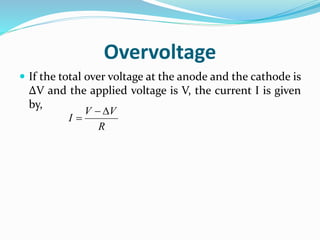
Overvoltage
 If the total over voltage at the anode and the cathode is
ΔV and the applied voltage is V, the current I is given
by,
R
VV
I


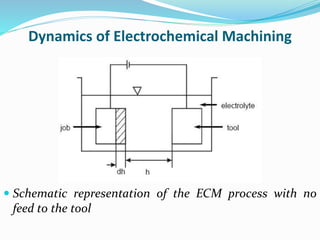
Dynamics of Electrochemical Machining
 Schematic representation of the ECM process with no
feed to the tool
Notes
Notes
Notes
Example
In ECM operation of pure iron an equilibrium gap of 2
mm is to be kept. Determine supply voltage, if the total
overvoltage is 2.5 V. The resistivity of the electrolyte is 50
Ω-mm and the set feed rate is 0.25 mm/min.
GATE – 2007 (PI)
Which one of the following process conditions
leads to higher MRR in ECM process?
(a) higher current, larger atomic weight
(b) higher valency, lower current
(c) lower atomic weight, lower valency
(d) higher valency, lower atomic weight
Electrochemical Grinding (ECG)
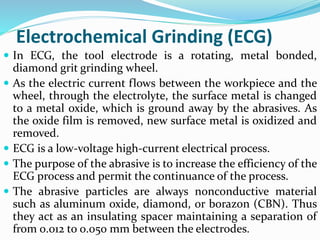
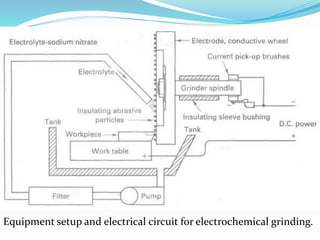
 In ECG, the tool electrode is a rotating, metal bonded,
diamond grit grinding wheel.
 As the electric current flows between the workpiece and the
wheel, through the electrolyte, the surface metal is changed
to a metal oxide, which is ground away by the abrasives. As
the oxide film is removed, new surface metal is oxidized and
removed.
 ECG is a low-voltage high-current electrical process.
 The purpose of the abrasive is to increase the efficiency of the
ECG process and permit the continuance of the process.
 The abrasive particles are always nonconductive material
such as aluminum oxide, diamond, or borazon (CBN). Thus
they act as an insulating spacer maintaining a separation of
from 0.012 to 0.050 mm between the electrodes.
Equipment setup and electrical circuit for electrochemical grinding.
Electrochemical Grinding (ECG)
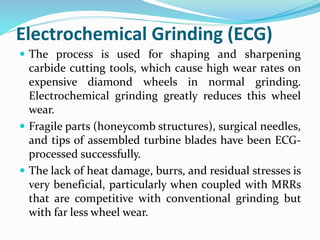
 The process is used for shaping and sharpening
carbide cutting tools, which cause high wear rates on
expensive diamond wheels in normal grinding.
Electrochemical grinding greatly reduces this wheel
wear.
 Fragile parts (honeycomb structures), surgical needles,
and tips of assembled turbine blades have been ECG-
processed successfully.
 The lack of heat damage, burrs, and residual stresses is
very beneficial, particularly when coupled with MRRs
that are competitive with conventional grinding but
with far less wheel wear.
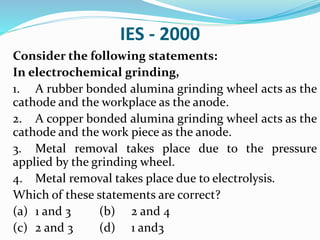
IES - 2000
Consider the following statements:
In electrochemical grinding,
1. A rubber bonded alumina grinding wheel acts as the
cathode and the workplace as the anode.
2. A copper bonded alumina grinding wheel acts as the
cathode and the work piece as the anode.
3. Metal removal takes place due to the pressure
applied by the grinding wheel.
4. Metal removal takes place due to electrolysis.
Which of these statements are correct?
(a) 1 and 3 (b) 2 and 4
(c) 2 and 3 (d) 1 and3
Other Electrochemical processes
 Electrochemical polishing
 Electrochemical hole-drilling
 Electrochemical Deburring
GATE - 2001
In ECM, the material removal is due to
(a) Corrosion
(b) Erosion
(c) Fusion
(d) Ion displacement
The primary mechanism of material removal in
electrochemical machining (ECM) is
a) chemical corrosion
b) etching
c) ionic dissolution
d) spark erosion
GATE-2015
GATE - 1997
Selection electrolyte for ECM is as follows:
(a) Non-passivating electrolyte for stock removal and
passivating electrolyte for finish control
(b) Passivating electrolyte for stock removal and non-
passivating electrolyte for finish control
(c) Selection of electrolyte is dependent on current
density
(d) Electrolyte selection is based on tool- work
electrodes
GATE - 1992
The two main criteria for selecting the electrolyte in
Electrochemical Machining (ECM) is that the
electrolyte should
(a) Be chemically stable
(b) Not allow dissolution of cathode material
(c) Not allow dissolution of anode material
(d) Have high electrical conductivity
GATE - 1997
Inter electrode gap in ECG is controlled by
(a) Controlling the pressure of electrolyte flow
(b) Controlling the applied static load
(c) Controlling the size of diamond particle in the wheel
(d) Controlling the texture of the work piece
IES - 2002
Assertion (A): In ECM, the shape of the cavity is the
mirror image of the tool, but unlike EDM, the tool
wear in ECM is less.
Reason (R): The tool in ECM is a cathode.
(a) Both A and R are individually true and R is the
correct explanation of A
(b) Both A and R are individually true but R is not the
correct explanation of A
(c) A is true but R is false
(d) A is false but R is true
IES - 1997
Which one of the following processes does not
cause tool wear?
(a) Ultrasonic machining
(b) Electrochemical machining
(c) Electric discharge machining
(d) Anode mechanical machining
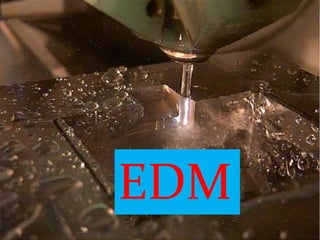
EDM
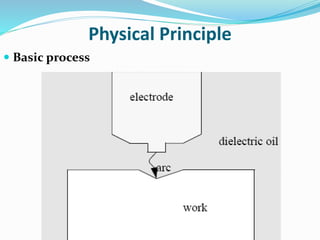
Physical Principle
 Basic process
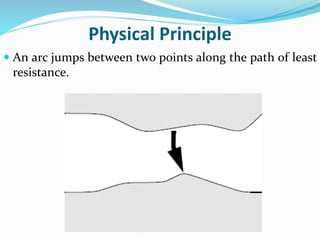
Physical Principle
 An arc jumps between two points along the path of least
resistance.
Physical Principle
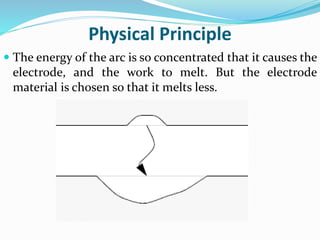
 The energy of the arc is so concentrated that it causes the
electrode, and the work to melt. But the electrode
material is chosen so that it melts less.
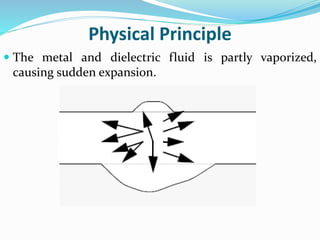
Physical Principle
 The metal and dielectric fluid is partly vaporized,
causing sudden expansion.
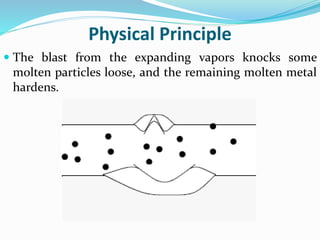
Physical Principle
 The blast from the expanding vapors knocks some
molten particles loose, and the remaining molten metal
hardens.
Characteristics of EDM
 Mechanics of material removal - melting and
evaporation aided by cavitation.
 The process is based on melting temperature, not
hardness, so some very hard materials can be machined
this way.
 The arc that jumps heats the metal, and about 1 to 10% of
the molten metal goes into the fluid. The melted metal
then recast layer is about 1 to 30 μm thick, and is
generally hard and rough.
 The electrode workpiece gap is in the range of 10 μm to
100 μm.
Characteristics of EDM
 Uses Voltage of 60 to 300 V to give a transient arc lasting
from 0.1 μ s to 8 ms.
 Typical cycle time is 20 ms or less, up to millions of
cycles may be required for completion of the part.
 Rotating the wire in an orbital direction will,
- Increase accuracy in form and surface finish
- Decrease electrode wear
 Surface finish obtained 0.25 μm
EDM Tool
Prime requirements EDM tool Material
1. It should be electrically conductive.
2. It should have good machinability, thus allowing
easy manufacture of complex shapes.
3. It should have low erosion rate or good work to tool
wear ratio.
4. It should have low electrical resistance.
5. It should have high melting point.
6. It should have high electron emission.
EDM Tool
The usual choices for tool (electrode) materials are
 Copper,
 brass,
 alloys of zinc and tin,
 hardened plain carbon steel,
 copper tungsten,
 silver tungsten,
 tungsten carbide,
 copper graphite, and graphite.
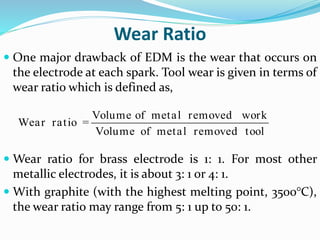
Wear Ratio
 One major drawback of EDM is the wear that occurs on
the electrode at each spark. Tool wear is given in terms of
wear ratio which is defined as,
 Wear ratio for brass electrode is 1: 1. For most other
metallic electrodes, it is about 3: 1 or 4: 1.
 With graphite (with the highest melting point, 3500°C),
the wear ratio may range from 5: 1 up to 50: 1.
Volume of metal removed work
Wear ratio =
Volume of metal removed tool
Servo-Mechanism
 The gap between the tool and work has a critical
importance. As the workpiece is machined, this gap
tends to increase. For optimum machining efficiency,
this gap should be maintained constant. This is done by
servo- mechanism which controls the movement of the
electrode.
Dielectric Fluid
 Fluid is used to act as a dielectric, and to help carry away
debris.
 If the fluid is pumped through and out the end of the
electrode, particles will push out, and mainly collect at
the edges. They will lower the dielectric resistance,
resulting in more arcs. As a result the holes will be
conical.
 If fluid is vacuum pumped into the electrode tip, straight
holes will result.
 Quite often kerosene-based oil.
 The dielectric fluid is circulated through the tool at a
pressure of 0.35 N/m2 or less. To free it from eroded
metal particles, it is circulated through a filter.
IES 2011 Conventional
Discuss the effects of insufficient dielectric and
electrolyte circulation in the inter-electrode gap on the
Electric Discharge machining and Electro Chemical
Machining process respectively. [5 Marks]
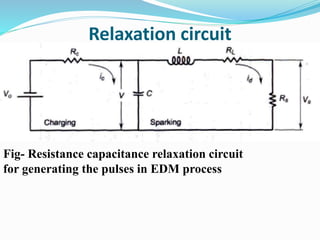
Relaxation circuit
Fig- Resistance capacitance relaxation circuit
for generating the pulses in EDM process
Formulae
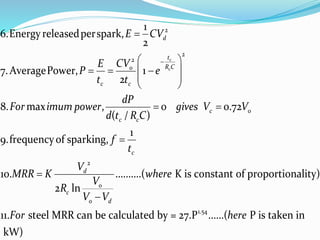
o
1. Thevoltageacrossthegapatany time , (1 )
[WhereV =Voltageof powersupply,
R Resistanceof charging circuit
C= Capacitanceof charging circuit]
2.Timeconstant,
3.Charging time(Timerequiredtogapvoltag
c
t
R C
o
c
c
t V V e
R C

 


etoreach V )
ln
4.Dischargevoltage, (1 )
5.Charging current,
c
c
c
d
o
c c
o d
t
R C
d o
t
R Co
c
c
V
t R C
V V
V V e
V
i e
R


 
  
 
 

2
2
2
0
2
1
6.Energyreleasedperspark,
2
7.AveragePower, 1
2
8. max , 0 0.72
( / )
1
9.frequencyof sparking,
10. ..........( K is cons
2 ln
c
c
d
t
R Co
c c
c
c c
c
d
o
c
o d
E CV
CVE
P e
t t
dP
For imum power gives V V
d t R C
f
t
V
MRR K where
V
R
V V


 
   
 
 
 



1.54
tant of proportionality)
11. steel MRR can be calculated by = 27.P ......( P is taken in
kW)
For here
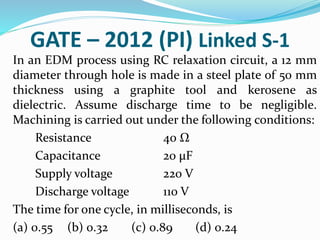
GATE – 2012 (PI) Linked S-1
In an EDM process using RC relaxation circuit, a 12 mm
diameter through hole is made in a steel plate of 50 mm
thickness using a graphite tool and kerosene as
dielectric. Assume discharge time to be negligible.
Machining is carried out under the following conditions:
Resistance 40 Ω
Capacitance 20 μF
Supply voltage 220 V
Discharge voltage 110 V
The time for one cycle, in milliseconds, is
(a) 0.55 (b) 0.32 (c) 0.89 (d) 0.24
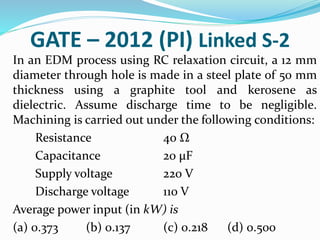
GATE – 2012 (PI) Linked S-2
In an EDM process using RC relaxation circuit, a 12 mm
diameter through hole is made in a steel plate of 50 mm
thickness using a graphite tool and kerosene as
dielectric. Assume discharge time to be negligible.
Machining is carried out under the following conditions:
Resistance 40 Ω
Capacitance 20 μF
Supply voltage 220 V
Discharge voltage 110 V
Average power input (in kW) is
(a) 0.373 (b) 0.137 (c) 0.218 (d) 0.500
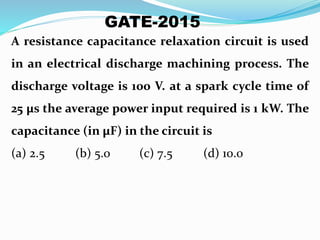
A resistance capacitance relaxation circuit is used
in an electrical discharge machining process. The
discharge voltage is 100 V. at a spark cycle time of
25 μs the average power input required is 1 kW. The
capacitance (in μF) in the circuit is
(a) 2.5 (b) 5.0 (c) 7.5 (d) 10.0
GATE-2015
Advantages
1. Hardness, toughness or brittleness of the material
poses no problems. Due to this EDM can be used for
machining materials that are too hard or brittle to be
machined by conventional methods.
2. The method does not leave any chips or burrs on the
work piece.
3. Cutting forces are virtually zero, so very delicate and
fine work can be done.
4. The process dimension repeatability and surface finish
obtained in finishing are extremely good.
5. The characteristic surface obtained, which is made up
of craters, helps in better oil retention. This improves
die life.
Disadvantages
1. Only electrically conductive materials can be machined
by EDM. Thus non - metallic, such as plastics, ceramics
or glass, cannot be machined by EDM.
2. Electrode wear and over-cut are serious problems.
3. A re-hardened, highly stressed zone is produced on the
work surface by the heat generated during machining.
This brittle layer can cause serious problems when the
part is put into service.
4. Perfectly square corners cannot be made by EDM.
5. High specific energy consumption (about 50 times that
in conventional machining)
6. MRR is quite low
Applications
 EDM can be used for machining any material that is
electrically conductive, thus including metals, alloys and
most carbides.
 EDM is widely used for machining burr free intricate
shapes, narrow slots and blind cavities etc., for example,
sinking of dies for moulding, die casting, plastic
moulding, wire drawing, compacting, cold heading,
forging, extrusion and press tools.
Applications
 EDM is particularly useful when dealing with internal
cuts that are hard to get tools into. Machining tends to
work best with external cuts.
 Almost any geometry (negative of tool geometry) can be
generated on a workpiece if a suitable tool can be
fabricated (the use of punch as a tool to machine its own
mating die is commonly employed in EDM method).
Applications
 The method is also employed for blanking parts from sheets,
cutting off rods of materials, flat or form grinding and
sharpening of tools, cutters and broaches.
 In EDM method, small holes, about 0.13 mm, in
diameter and as deep as 20mm diameters can be drilled
with virtually no bending or drifting of hole. Due to this,
EDM is particularly useful for machining of small holes,
orifices or slots in diesel-fuel injection nozzles, or in aircraft
engines, air brake valves and so on.
IES 2009 Conventional
i. What is the principle of metal removal in EDM
process?
ii. Describe the process with the help of sketch.
iii. List advantages and limitations of the system.
[ 15 marks]
GATE - 1994
Electric discharge machining is more efficient
process than Electrochemical machining for
producing large non-circular holes.
The above statement is
(a) True
(b) False
(c) Cant say
(d) Insufficient data
Wire EDM
 Wire EDM is a special form of EDM wherein the
electrode is a continuously moving conductive wire.
 A thin wire of brass, tungsten, or copper is used as an
electrode.
 The electrode wire is typically made with a 0.05 to 0.25-
mm diameter, which is wire electrode wound between
the two spools.
 Deionized water is used as the dielectric.
Wire EDM
 This process is much faster than electrode EDM.
 This process is widely used for the manufacture of
punches, dies, and stripper plates, with modern
machines capable of cutting die relief, intricate
openings, tight radius contours, and corners routinely.
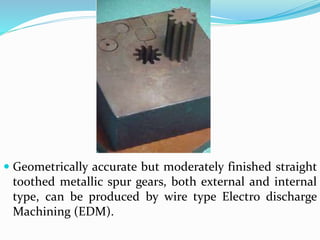
 Geometrically accurate but moderately finished straight
toothed metallic spur gears, both external and internal
type, can be produced by wire type Electro discharge
Machining (EDM).
GATE-2014 (PI)
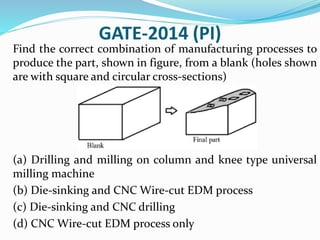
Find the correct combination of manufacturing processes to
produce the part, shown in figure, from a blank (holes shown
are with square and circular cross-sections)
(a) Drilling and milling on column and knee type universal
milling machine
(b) Die-sinking and CNC Wire-cut EDM process
(c) Die-sinking and CNC drilling
(d) CNC Wire-cut EDM process only
GATE-2016
In a wire-cut EDM process the necessary conditions
that have to be met for making a successful cut are
that
(a) wire and sample are electrically non-conducting
(b) wire and sample are electrically conducting
(c) wire is electrically conducting and sample is
electrically non-conducting
(d) sample is electrically conducting and wire is
electrically non-conducting
Electric Discharge Grinding (EDG)
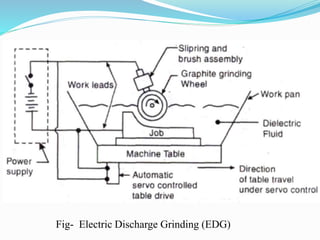
 EDG is similar to EDM except that the electrode is a
rotating wheel (usually graphite).
 Positively charged work pieces are immersed in or
flooded by a dielectric fluid and fed past the negatively
charged wheel by servo-controlled machine table.
 Metal is removed by intermittent high frequency
electrical discharges passing through the gap between
wheel and workpiece.
 Each spark discharge melts or vaporizes a small amount
of metal from the workpiece surface, producing a small
crate at the discharge sit, as in EDM.
Fig- Electric Discharge Grinding (EDG)
Electric Discharge Grinding (EDG)
 The spark gap is normally held at 0.013 to 0.076 mm
 The graphite wheel is rotated at 0.5 to 3 m/s
The method can be used for
1. External cylindrical grinding, internal grinding and
surface grinding.
2. Grinding carbide and steel at the same time without
wheel loading.
3. Grinding thin sections where abrasive wheel pressures
might cause distortion.
4. Grinding brittle materials or fragile parts where
abrasive materials might cause fracturing.
IES - 2012
Statement (I): In Electro Discharge Machining (EDM)
process, tool is made cathode and work piece anode
Statement (II): In this process if both electrodes are made of
same material, greatest erosion takes place upon anode
(a) Both Statement (I) and Statement (II) are individually
true and Statement (II) is the correct explanation of
Statement (I)
(b) Both Statement (I) and Statement (II) are individually
true but Statement (II) is not the correct explanation of
Statement (I)
(c) Statement (I) is true but Statement (II) is false
(d) Statement (I) is false but Statement (II) is true
GATE - 2004
The mechanism of material removal in EDM
process is
(a) Melting and Evaporation
(b) Melting and Corrosion
(c) Erosion and Cavitation
(d) Cavitation and Evaporation
GATE - 2003
As tool and work are not in contact in EDM process
(a) No relative motion occurs between them
(b) No wear of tool occurs
(c) No power is consumed during metal cutting
(d) No force between tool and work occurs
GATE - 1999
In Electro-Discharge Machining (EDM), the tool is
made of
(a) Copper (b) High Speed Steel
(c) Cast Iron (d) Plain Carbon Steel
GATE-2010 (PI)
Keeping all other parameters unchanged, the tool
wear in electrical discharge machining (EDM) would
be less if the tool material has
(a) high thermal conductivity and high specific heat
(b) high thermal conductivity and low specific heat
(c) low thermal conductivity and low specific heat
(d) low thermal conductivity and high specific heat
GATE - 2007
In electro discharge machining (EDM), if the
thermal conductivity of tool is high and the specific
heat of work piece is low, then the tool wear rate
and material removal rate are expected to be
respectively
(a) High and high (b) Low and low
(c) High and low (d) Low and high
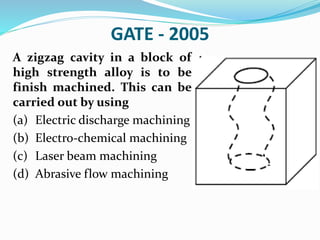
GATE - 2005
A zigzag cavity in a block of
high strength alloy is to be
finish machined. This can be
carried out by using
(a) Electric discharge machining
(b) Electro-chemical machining
(c) Laser beam machining
(d) Abrasive flow machining
IES - 2005
Which of the following is/are used as low wearing
tool material(s) in electric discharge machining?
(a) Copper and brass
(b) Aluminium and graphite
(c) Silver tungsten and copper tungsten
(d) Cast iron
GATE- 2000
Deep hole drilling of small diameter, say 0.2 mm is
done with EDM by selecting the tool material as
(a) Copper wire (b) Tungsten wire
(c) Brass wire (d) Tungsten carbide
GATE – 2009 (PI)
A titanium sheet of 5.0 mm thickness is cut by wire
– cut EDM process using a wire of 1.0 mm diameter.
A uniform spark gap of 0.5 mm on both sides of the
wire is maintained during cutting operation. If the
feed rate of the wire into the sheet is 20 mm/min,
the material removal rate (in mm3/min) will be
(a) 150 (b) 200 (c) 300 (d) 400
Ultrasonic Machining
By S K Mondal
Ultrasonic Machining
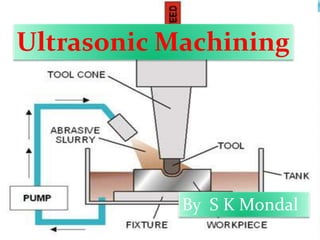
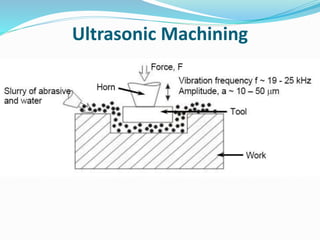
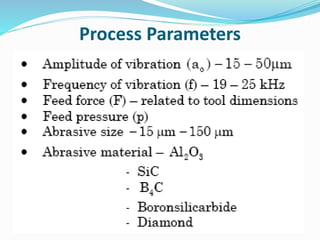
 In ultrasonic machining, a tool of desired shape vibrates at an
ultrasonic frequency (19 ~ 25 kHz) with an amplitude of
around 15 – 50 μm over the workpiece.
 Generally the tool is pressed downward with a feed force, F.
Between the tool and workpiece, the machining zone is
flooded with hard abrasive particles generally in the form of
water based slurry.
 As the tool vibrates over the workpiece, the abrasive particles
act as the indenters and indent both the work material and
the tool. The abrasive particles, as they indent, the work
material, would remove the same, particularly if the work
material is brittle, due to crack initiation, propagation and
brittle fracture of the material.
Ultrasonic Machining
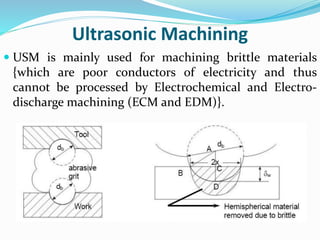
 USM is mainly used for machining brittle materials
{which are poor conductors of electricity and thus
cannot be processed by Electrochemical and Electro-
discharge machining (ECM and EDM)}.
Ultrasonic Machining
 At full indentation, the indentation depth in the work
material is characterized by δw. Due to the indentation,
as the work material is brittle, brittle fracture takes place
leading to hemi-spherical fracture of diameter ‘2x’ under
the contact zone.
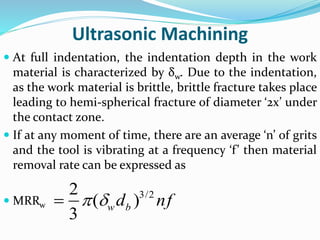
 If at any moment of time, there are an average ‘n’ of grits
and the tool is vibrating at a frequency ‘f’ then material
removal rate can be expressed as
 MRRw
3/22
( )
3
w bd nf 
Process Parameters
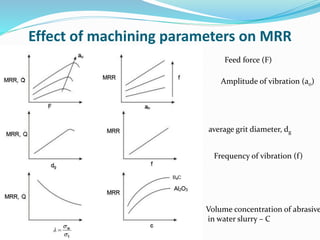
Effect of machining parameters on MRR
Amplitude of vibration (ao)
Frequency of vibration (f)
Feed force (F)
Volume concentration of abrasive
in water slurry – C
average grit diameter, dg
GATE-2016
In an ultrasonic machining (USM) process, the
material removal rate (MRR) is plotted as a function
of the feed force of the USM tool. With increasing
feed force, the MRR exhibits the following
behaviour:
(a) increasing linearly
(b) decreases linearly
(c) does not change
(d) first increases and then decreases
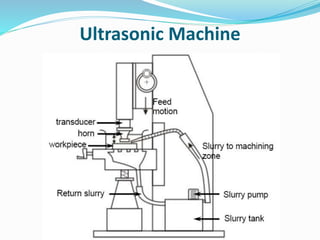
Ultrasonic Machine
Ultrasonic Machine
 The basic mechanical structure of an USM is very similar
to a drill press.
 It has additional features to carry out USM of brittle
work material.
 The workpiece is mounted on a vice, which can be
located at the desired position under the tool using a 2
axis table.
 The table can further be lowered or raised to
accommodate work of different thickness.
 Slurry delivery and return system
Ultrasonic Machine
 Feed mechanism to provide a downward feed force on
the tool during machining
 The transducer, which generates the ultrasonic vibration
 The horn or concentrator, which mechanically amplifies
the vibration to the required amplitude of 15 – 50 μm and
accommodates the tool at its tip.
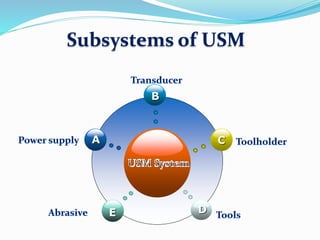
Subsystems of USM
B
E
C
D
A
Transducer
 The ultrasonic vibrations are produced by the
transducer. The transducer is driven by suitable signal
generator followed by power amplifier. The transducer
for USM works on the following principle
 Piezoelectric effect
 Magnetostrictive effect
 Electrostrictive effect
 Magnetostrictive transducers are most popular and
robust amongst all.
GATE -2010 (PI)
Ultrasonic machines, used in material removal processes,
require ultrasonic transducers. The transducers works on
different working principles. One of the working principles
of such ultrasonic transducers is based on
(a) eddy current effect (b) Seebeck effect
(c) piezo-resistive effect (d) piezo-electric effect
Tool holder or Horn
 Its function is to increase the tool vibration amplitude
and to match the vibrator to the acoustic load.
 It must be constructed of a material with good acoustic
properties and be highly resistant to fatigue cracking.
 Monel and titanium have good acoustic properties and
are often used together with stainless steel, which is
cheaper.
Tool
 Tools should be constructed from relatively ductile
materials.
 The harder the tool material, the faster its wear rate will
be.
Limitations
 Low MRR
 Rather high tool wear
 Low depth of hole
Applications
 Used for machining hard and brittle metallic alloys,
semiconductors, glass, ceramics, carbides etc.
 Used for machining round, square, irregular shaped
holes and surface impressions.
 Machining, wire drawing, punching or small blanking
dies.
Note
 The following material is generally machined by USM
(i) Glass
(ii) Silicon
(iii) Germanium
 Tool in USM is generally made of Steel
GATE - 1994
Ultrasonic machining is about the best process for
making holes in glass which are comparable in size
with the thickness of the sheet.
The above statement is
(a) True
(b) False
(c) Cant say
(d) Insufficient data
IES 2011
USM has good machining performance for :
(a) Al
(b) Steel
(c) Super alloys
(d) Refractory material
GATE - 1993
In ultrasonic machining process, the material
removal rate will be higher for materials with
(a) Higher toughness (b) Higher ductility
(c) Lower toughness (d) Higher fracture strain
GATE - 1992
In Ultrasonic Machining (USM) the material
removal rate would
(a) Increase
(b) Decrease
(c) Increase and then decrease
(d) decrease and then increase
with increasing mean grain diameter of the abrasive
material.
IES - 2009
By which one of the following processes the
metering holes in injector nozzles of diesel engines
can be suitably made?
(a) Ultrasonic machining
(b) Abrasive jet machining
(c) Electron beam machining
(d) Chemical machining
IES - 2006
During ultrasonic machining, the metal removal is
achieved by
(a) High frequency eddy currents
(b) high frequency sound waves
(c) Hammering action of abrasive particles
(d) Rubbing action between tool and workpiece
IAS - 1996
During ultrasonic machining, the metal removal is
affected by the
(a) Hammering action of abrasive particles
(b) Rubbing action between tool and workpiece
(c) High frequency sound waves
(d) High frequency eddy currents
GATE-2016 (PI)
Consider the following statements.
(P) Electrolyte is used in Electro-chemical machining.
(Q) Electrolyte is used in Electrical discharge machining.
(R) Abrasive-slurry is used in Ultrasonic machining.
(S) Abrasive-slurry is used in Abrasive jet machining.
Among the above statements, the correct ones are
(a) P and R only (b) Q and S only
(c) Q, R and S only (d) P and Q only
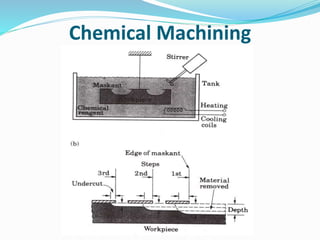
Chemical Machining
 Chemicals are used to dissolve material
 Masks are used to control attack
 Most common use is circuit boards and plates for
printing.
 Cutting speed of 0.0025-0.1 mm/minute – very slow
Chemical Machining
Photo-Chemical Machining
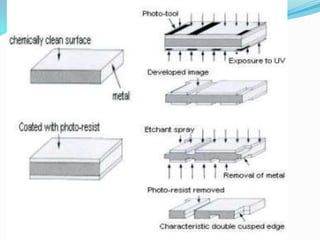
 PCM is a material removal process using chemicals
(etchants) to produce high precision parts.
 This process is also known as Photo Etching, Chemical
Blanking and Photo Chemical Milling.
 Coat both sides of the plate with photoresist.
(photoresist is a polymer that adheres to the metal when
exposed to UV light).
 Spray metal with etchant or dip it in hot acidic solution
to etch all material other than part covered with
photoresist (1-15 min.).
 Rinse the plate to ensure photoresist and etchant
removal.
Photo-Chemical Machining
151
Laser Beam Machining
152
Laser Beam Machining
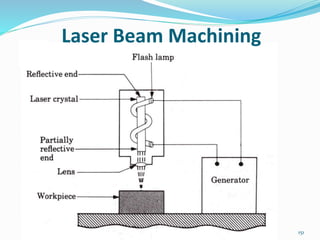
 LASER- Light amplification by stimulated emission of
radiation.
 Applications of lasers include cutting and welding. These
applications involve the use of solid-state lasers capable of
focusing sufficient power to melt or sublimate the work
material.
 Light for measurement applications are low-power gas
lasers such as helium-neon, which emits light in the visible
range.
 Direct laser beam against surface of workpiece, as in laser
welding
 Successive pulses from laser gun vaporize tiny bits of
workpiece
 Location of laser beam controlled by computer
153
Laser Beam Machining
 Workpiece need not be conductive
 Cuts are tapered
 Gotta trap overshoot from laser beam
 Produces large remelt zone
 Can produce holes as small as 0.0005 mm diameter
 Can produce deep holes
 Used to produce cooling holes in blades/vanes for jet
engines
154
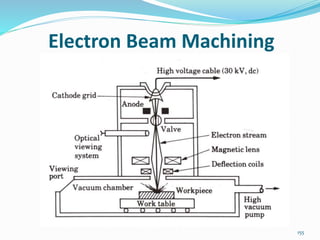
Electron Beam Machining
 Workpiece placed in vacuum chamber to minimize
electron collision with air molecules.
 High-voltage (150 KV) electron beam directed toward
workpiece upto velocity 200,000 Km/s
 Beam can be focused using an electromagnetic lens to 10
to 200 μm and a density of 6500 GW/mm2
 Energy of electron beam melts/ vaporizes selected
region of workpiece
 Good for narrow holes and slots, a hole in a sheet 1.25
mm thick up to 125 micro m diameter can be cut almost
instantly with a taper of 2 to 4 degrees
 Similar process to EB welding
155
Electron Beam Machining
IFS-2011
Write the advantages, limitations and applications of
electron beam machining. What is the safety problem
connected with EBM?
[5-Marks]
GATE-2016
The non-traditional machining process that
essentially requires vacuum is
(a) electron beam machining
(b) electro chemical machining
(c) electro chemical discharge machining
(d) electro discharge machining
158
Plasma Arc Cutting
 Plasma is a stream of ionized gas
 Typical temperatures are very high
 Same process as plasma welding, without filler metal
 Torch movement controlled by computer
 Power requirements depend on material being cut,
plus depth of cut
 Recast layer is deeper than with other processes
159
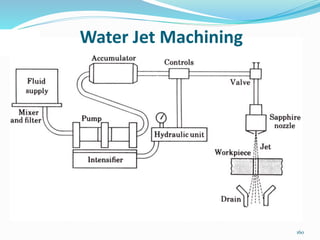
Water Jet Machining
 Narrow jet of water directed, at high pressure and
velocity, against surface of workpiece
 Jet of water erodes surface of workpiece, thereby
cutting workpiece
 Computer control to achieve shape
160
Water Jet Machining
161
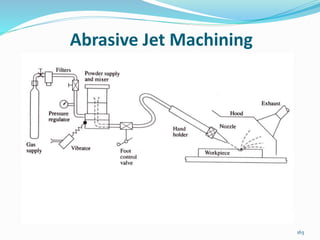
Abrasive Jet Machining (Dry)
 It is similar to sand blasting, except that a very narrow jet of
gas and abrasive particles achieves localized cutting.
 It removes material through the eroding action of a high
velocity stream of abrasive-laden gas.
 The gas is first compressed and mixed with the abrasive
powder in a mixing chamber and passed through outlet
nozzle.
 Computer is used to position the jet.
 Gas Pressure about 7 atm
 Velocity of jet about 300 m/s
 Jet Diameter 0.12 mm to 1.25 mm
 Abrasive used: Al2O3 , SiC with particle size 10 to 50 µm
 Tool (nozzle) material – tungsten carbide or sapphire
 Tool (nozzle) Life – about 30 hours
GATE-2013 (PI)
In water jet machining, the water jet is issued
through a 0.3 mm diameter orifice at a pressure of
400 MPa. The density of water is 1000 kg/m3. The
coefficient of discharge is 1.0. Neglecting all losses
during water jet formation through the orifice, the
power of the water jet in KW is
(a) 25.3 (b) 50.6 (c) 75.9 (d) 101.2
163
Abrasive Jet Machining
Advantages of AJM
 Can be used in any material, conductive, non-
conductive, ductile or brittle
 Good dimensional accuracy (±0.05 mm)
 Good Surface finish – 0.25 to 1.25 µm
 Due to cooling action of gas stream no thermal damage
on the work surface
 Due to negligible force delicate workpiece can be
machined.
Disadvantages of AJM
 Low MRR
 Possibility of stray cutting
 Embedding of abrasive particles in soft workpiece
 Dust control needed
Application of AJM
 Cutting and drilling on metal foils and thin
sections of ceramics and glass
 Intricate holes in electronic components such as
resistor paths in insulation
 Engraving of characters on toughened glass
automobile windows
 Cleaning, polishing and deburring the surface
GATE -2012 Same Q in GATE-2012 (PI)
In abrasive jet machining, as the distance between
the nozzle tip and the work surface increases, the
material removal rate
(a) increases continuously.
(b) decreases continuously.
(c) decreases, becomes stable and then increases.
(d) increases, becomes stable and then decreases.
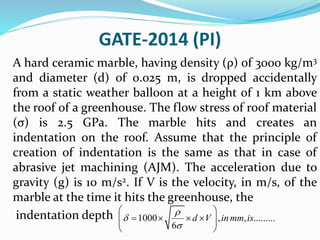
GATE-2014 (PI)
A hard ceramic marble, having density (ρ) of 3000 kg/m3
and diameter (d) of 0.025 m, is dropped accidentally
from a static weather balloon at a height of 1 km above
the roof of a greenhouse. The flow stress of roof material
(σ) is 2.5 GPa. The marble hits and creates an
indentation on the roof. Assume that the principle of
creation of indentation is the same as that in case of
abrasive jet machining (AJM). The acceleration due to
gravity (g) is 10 m/s2. If V is the velocity, in m/s, of the
marble at the time it hits the greenhouse, the
indentation depth 1000 , , .........
6
d V inmm is



 
     
 
GATE-2016 (PI)
In abrasive water jet machining, the velocity of water at the
exit of the orifice, before mixing with abrasives, is 800 m/s.
The mass flow rate of water is 3.4 kg/min. The abrasives are
added to the water jet at a rate of 0.6 kg/min with negligible
velocity. Assume that at the end of the focusing tube,
abrasive particles and water come out with equal velocity.
Consider that there is no air in the abrasive water jet.
Assuming conservation of momentum, the velocity (in m/s)
of the abrasive water jet at the end of the focusing tube is
_________.
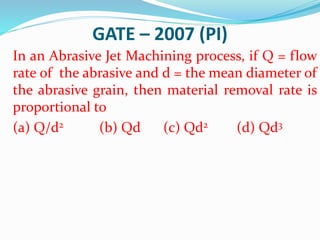
GATE – 2007 (PI)
In an Abrasive Jet Machining process, if Q = flow
rate of the abrasive and d = the mean diameter of
the abrasive grain, then material removal rate is
proportional to
(a) Q/d2 (b) Qd (c) Qd2 (d) Qd3
IAS-2011 Main
State the mechanism of cutting by abrasive jet.
What are the advantages and disadvantages of
AJM ? Mention two applications.
[10-Marks]
IFS-2011
What are the disadvantages of abrasive jet machining?
Write some of its applications.
[5-Marks]
Abrasive WJ Cutting
 Used to cut much harder materials
 Water is not used directly to cut material as in Pure,
instead water is used to accelerate abrasive particles which
do the cutting
 80-mesh garnet (sandpaper) is typically used though 50
and 120-mesh is also used
 Standoff distance between mixing tube and workpart is
typically 0.010-0.200 – important to keep to a minimum to
keep a good surface finish
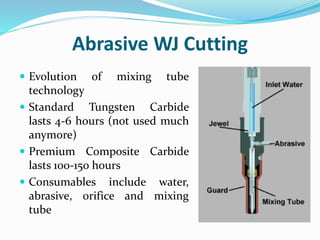
Abrasive WJ Cutting
 Evolution of mixing tube
technology
 Standard Tungsten Carbide
lasts 4-6 hours (not used much
anymore)
 Premium Composite Carbide
lasts 100-150 hours
 Consumables include water,
abrasive, orifice and mixing
tube
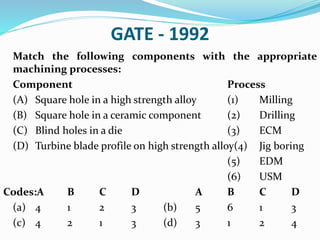
GATE - 1992
Match the following components with the appropriate
machining processes:
Component Process
(A) Square hole in a high strength alloy (1) Milling
(B) Square hole in a ceramic component (2) Drilling
(C) Blind holes in a die (3) ECM
(D) Turbine blade profile on high strength alloy(4) Jig boring
(5) EDM
(6) USM
Codes:A B C D A B C D
(a) 4 1 2 3 (b) 5 6 1 3
(c) 4 2 1 3 (d) 3 1 2 4
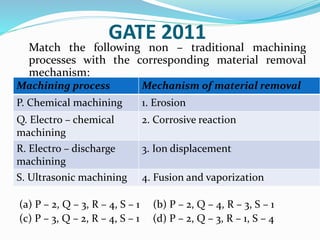
GATE 2011
Match the following non – traditional machining
processes with the corresponding material removal
mechanism:
(a) P – 2, Q – 3, R – 4, S – 1 (b) P – 2, Q – 4, R – 3, S – 1
(c) P – 3, Q – 2, R – 4, S – 1 (d) P – 2, Q – 3, R – 1, S – 4
Machining process Mechanism of material removal
P. Chemical machining 1. Erosion
Q. Electro – chemical
machining
2. Corrosive reaction
R. Electro – discharge
machining
3. Ion displacement
S. Ultrasonic machining 4. Fusion and vaporization
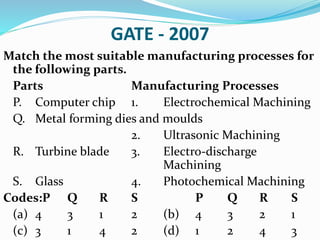
GATE - 2007
Match the most suitable manufacturing processes for
the following parts.
Parts Manufacturing Processes
P. Computer chip 1. Electrochemical Machining
Q. Metal forming dies and moulds
2. Ultrasonic Machining
R. Turbine blade 3. Electro-discharge
Machining
S. Glass 4. Photochemical Machining
Codes:P Q R S P Q R S
(a) 4 3 1 2 (b) 4 3 2 1
(c) 3 1 4 2 (d) 1 2 4 3
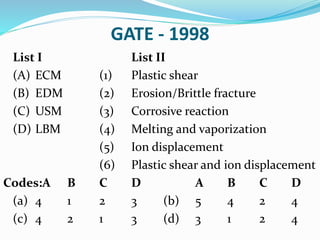
GATE - 1998
List I List II
(A) ECM (1) Plastic shear
(B) EDM (2) Erosion/Brittle fracture
(C) USM (3) Corrosive reaction
(D) LBM (4) Melting and vaporization
(5) Ion displacement
(6) Plastic shear and ion displacement
Codes:A B C D A B C D
(a) 4 1 2 3 (b) 5 4 2 4
(c) 4 2 1 3 (d) 3 1 2 4
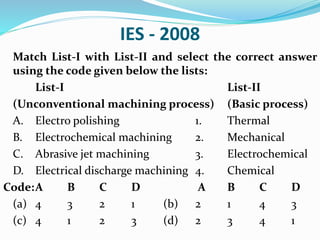
IES - 2008
Match List-I with List-II and select the correct answer
using the code given below the lists:
List-I List-II
(Unconventional machining process) (Basic process)
A. Electro polishing 1. Thermal
B. Electrochemical machining 2. Mechanical
C. Abrasive jet machining 3. Electrochemical
D. Electrical discharge machining 4. Chemical
Code:A B C D A B C D
(a) 4 3 2 1 (b) 2 1 4 3
(c) 4 1 2 3 (d) 2 3 4 1
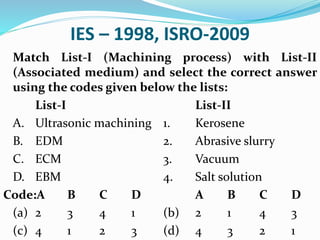
IES – 1998, ISRO-2009
Match List-I (Machining process) with List-II
(Associated medium) and select the correct answer
using the codes given below the lists:
List-I List-II
A. Ultrasonic machining 1. Kerosene
B. EDM 2. Abrasive slurry
C. ECM 3. Vacuum
D. EBM 4. Salt solution
Code:A B C D A B C D
(a) 2 3 4 1 (b) 2 1 4 3
(c) 4 1 2 3 (d) 4 3 2 1
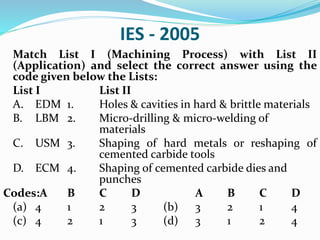
IES - 2005
Match List I (Machining Process) with List II
(Application) and select the correct answer using the
code given below the Lists:
List I List II
A. EDM 1. Holes & cavities in hard & brittle materials
B. LBM 2. Micro-drilling & micro-welding of
materials
C. USM 3. Shaping of hard metals or reshaping of
cemented carbide tools
D. ECM 4. Shaping of cemented carbide dies and
punches
Codes:A B C D A B C D
(a) 4 1 2 3 (b) 3 2 1 4
(c) 4 2 1 3 (d) 3 1 2 4
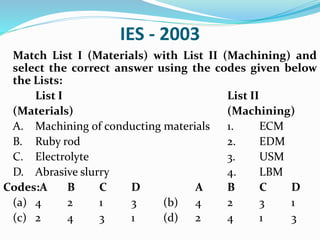
IES - 2003
Match List I (Materials) with List II (Machining) and
select the correct answer using the codes given below
the Lists:
List I List II
(Materials) (Machining)
A. Machining of conducting materials 1. ECM
B. Ruby rod 2. EDM
C. Electrolyte 3. USM
D. Abrasive slurry 4. LBM
Codes:A B C D A B C D
(a) 4 2 1 3 (b) 4 2 3 1
(c) 2 4 3 1 (d) 2 4 1 3
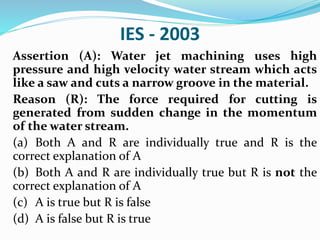
IES - 2003
Assertion (A): Water jet machining uses high
pressure and high velocity water stream which acts
like a saw and cuts a narrow groove in the material.
Reason (R): The force required for cutting is
generated from sudden change in the momentum
of the water stream.
(a) Both A and R are individually true and R is the
correct explanation of A
(b) Both A and R are individually true but R is not the
correct explanation of A
(c) A is true but R is false
(d) A is false but R is true
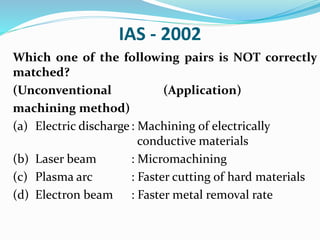
IAS - 2002
Which one of the following pairs is NOT correctly
matched?
(Unconventional (Application)
machining method)
(a) Electric discharge: Machining of electrically
conductive materials
(b) Laser beam : Micromachining
(c) Plasma arc : Faster cutting of hard materials
(d) Electron beam : Faster metal removal rate
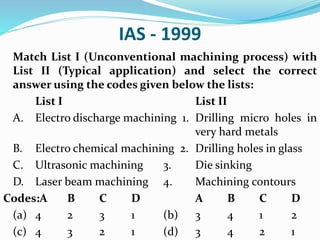
IAS - 1999
Match List I (Unconventional machining process) with
List II (Typical application) and select the correct
answer using the codes given below the lists:
List I List II
A. Electro discharge machining 1. Drilling micro holes in
very hard metals
B. Electro chemical machining 2. Drilling holes in glass
C. Ultrasonic machining 3. Die sinking
D. Laser beam machining 4. Machining contours
Codes:A B C D A B C D
(a) 4 2 3 1 (b) 3 4 1 2
(c) 4 3 2 1 (d) 3 4 2 1
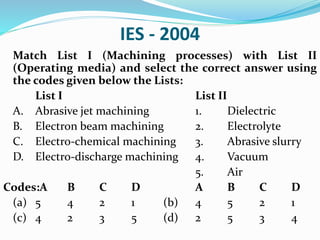
IES - 2004
Match List I (Machining processes) with List II
(Operating media) and select the correct answer using
the codes given below the Lists:
List I List II
A. Abrasive jet machining 1. Dielectric
B. Electron beam machining 2. Electrolyte
C. Electro-chemical machining 3. Abrasive slurry
D. Electro-discharge machining 4. Vacuum
5. Air
Codes:A B C D A B C D
(a) 5 4 2 1 (b) 4 5 2 1
(c) 4 2 3 5 (d) 2 5 3 4
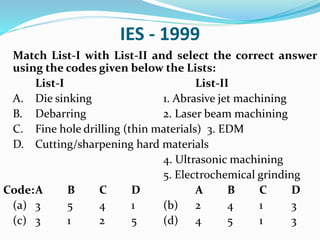
IES - 1999
Match List-I with List-II and select the correct answer
using the codes given below the Lists:
List-I List-II
A. Die sinking 1. Abrasive jet machining
B. Debarring 2. Laser beam machining
C. Fine hole drilling (thin materials) 3. EDM
D. Cutting/sharpening hard materials
4. Ultrasonic machining
5. Electrochemical grinding
Code:A B C D A B C D
(a) 3 5 4 1 (b) 2 4 1 3
(c) 3 1 2 5 (d) 4 5 1 3
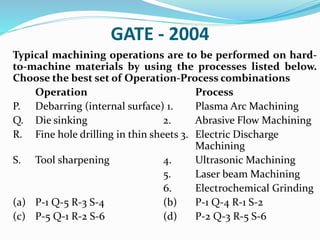
GATE - 2004
Typical machining operations are to be performed on hard-
to-machine materials by using the processes listed below.
Choose the best set of Operation-Process combinations
Operation Process
P. Debarring (internal surface) 1. Plasma Arc Machining
Q. Die sinking 2. Abrasive Flow Machining
R. Fine hole drilling in thin sheets 3. Electric Discharge
Machining
S. Tool sharpening 4. Ultrasonic Machining
5. Laser beam Machining
6. Electrochemical Grinding
(a) P-1 Q-5 R-3 S-4 (b) P-1 Q-4 R-1 S-2
(c) P-5 Q-1 R-2 S-6 (d) P-2 Q-3 R-5 S-6

Ch 12 unconventional machining

  • 1.
  • 2.
    Need for UnconventionalProcesses  New materials having high strength and hardness, such as nimonic alloys and alloys with alloying elements such as tungsten, molybdenum, and columbium are difficult to machine by the traditional methods.  By conventional machining the MRR reduces with an increase in the work material hardness.  Need for development of non-traditional machining processes which utilize other methods such as electrochemical processes for the material removal.
  • 3.
    Need for UnconventionalProcesses  Complex shapes.  A very high accuracy is desired besides the complexity of the surface to be machined.
  • 4.
    In Unconventional Machining Different forms of energy directly applied to the workpiece to have shape transformation or material removal from work surface.  No chips, No lay pattern on work surface, no direct physical contact between the tool and the workpiece .  The tool material does not have to be harder than the work material.  Tool forces do not increase as the work material gets harder.  Economic metal removal rate does not decrease as the work material gets harder.
  • 5.
    Classification of NTMM TheNon-traditional Machining Methods are classified according to the major energy sources employed in machining. 1. Thermal Energy Methods 2. Electro - Chemical Energy Method 3. Chemical Energy Methods 4. Mechanical Energy Methods
  • 6.
    1. Thermal EnergyMethods  Electrical discharge machining (EDM)  Laser beam Machining (LBM)  Plasma Arc Machining (PAM)  Electron Beam Machining(EBM)  Ion Beam Machining (IBM)
  • 7.
    2. Electro -Chemical Energy Method  Electro-Chemical Machining (ECM)  Electro-Chemical grinding (ECG)  Electro-Chemical Honing (ECH)  Electro-Chemical Deburring (ECD)
  • 8.
    3. Chemical EnergyMethods These methods involve controlled etching of the workpiece material in contact with a chemical solution.  Chemical Machining Method (CHM).
  • 9.
    4. Mechanical EnergyMethods  Ultra Sonic Machining (USM)  Abrasive Jet Machining (AJM)  Water Jet Machining (WJM)
  • 10.
    GATE-2014 The process utilizingmainly thermal energy for removing material is (a) Ultrasonic Machining (b) Electrochemical Machining (c) Abrasive Jet Machining (d) Laser Beam Machining
  • 11.
    Some Observations  EDMhas the lowest specific power requirement and can achieve sufficient accuracy.  ECM has the highest metal removal rate, MRR.  USM and AJM have low MRR and combined with high tool wear, are used for non-metal cutting.  LBM and EBM have high penetration rates with low MRR and, therefore, are commonly used for micro drilling, sheet cutting, and welding.  CHM is used for manufacturing PCB and other shallow components.  PAM can be used for clean, rapid cuts and profiles in almost all plates upto 20 cm thick with 5o to 10o taper.
  • 12.
    Shapes Cutting Capability Thevarious NTMM have some special shape cutting capability as given below: 1. Micro-machining and Drilling : LBM and EBM 2. Cavity sinking and standard Hole Drilling: EDM and USM 3. Fine hole drilling and Contour Machining: ECM 4. Clean, rapid Cuts and Profiles: PAM 5. Shallow Pocketing: AJM
  • 13.
    GATE-2014 The following fourunconventional machining processes are available in a shop floor. The most appropriate one to drill a hole of square cross section of 6 mm × 6 mm and 25 mm deep is (a) Abrasive Jet Machining (b) Plasma Arc Machining (c) Laser Beam Machining (d) Electro Discharge Machining
  • 14.
    Limitations of NTMM Expensive set up, low MRR and skilled labour required.  The limitation of electrical machining methods is that the work material must be an electrical conductor. Also, consumption of electrical energy is very large.  The NTMM which have not been proved commercially economical are: USM, AJM, CHM, EBM and PAM.
  • 15.
    IES - 2012 Whichof the following processes has very high material removal rate efficiency? (a) Electron beam machining (b) Electrochemical machining (c) Electro discharge machining (d) Plasma arc machining
  • 16.
    GATE - 2006 Arrangethe processes in the increasing order of their maximum material removal rate. Electrochemical Machining (ECM) Ultrasonic Machining (USM) Electron Beam Machining (EBM) Laser Beam Machining (LBM) and Electric Discharge Machining (EDM) (a) USM, LBM, EBM, EDM, ECM (b) EBM, LBM, USM, ECM, EDM (c) LBM, EBM, USM, ECM, EDM (d) LBM, EBM, USM, EDM, ECM
  • 17.
    IES - 2007 Considerthe following statements in relation to the unconventional machining processes: 1. Different forms of energy directly applied to the piece to have shape transformation or material removal from work surface. 2. Relative motion between the work and the tool is essential. 3. Cutting tool is not in physical contact with work piece. (a) 1 and 2 only (b) 1, 2 and 3 only (c) 2 and 3 only (d) 1 and 3 only
  • 18.
    IES - 2009 Whichone of the following statements is correct in respect of unconventional machining processes? (a) The cutting tool is in direct contact with the job (b) The tool material needs to be harder than the job material (c) The tool is never in contact with the job (d) There has to be a relative motion between the tool and the job
  • 19.
    IAS - 2002 MatchList I (Processes) with List II (Tolerances obtained) and select the correct answer using the codes given below the Lists: List I List II (Processes) (Tolerances obtained) A. Plasma Arc machining 1. 7·5 microns B. Laser Beam machining 2. 25 microns C. Abrasive Jet machining 3. 50 microns D. Ultrasonic machining 4. 125 microns Codes:A B C D A B C D (a) 4 1 3 2 (b) 3 2 4 1 (c) 4 2 3 1 (d) 3 1 4 2
  • 20.
    ECM By S KMondal
  • 21.
    Electrochemical Machining  Electrochemicalmachining is the reverse of electro plating  The work-piece is made the anode, which is placed in close proximity to an electrode (cathode), and a high- amperage direct current is passed between them through an electrolyte, such as salt water, flowing in the anode- cathode gap.  Metal is removed by anodic dissolution and is carried away in the form of a hydroxide in the electrolyte for recycling or recovery.  MRR in ECM depends on atomic weight of work material
  • 22.
  • 23.
    Electrochemical Machining  Variationin the current density will result in work taking the electrodes shape.  The electrode is fed with a constant velocity, and the electrolyte is fed through the tool.
  • 24.
  • 25.
    ECM Equipment  SupplyVoltage 2 to 35 V DC and Current 500 to 40,000 A  The tool-to-work gap needs to be maintained at a very small value 0.1 to 0.25 mm. A servo drive is provided on the tool axis for this purpose.  The electrolyte needs to be pumped through this gap at high pressures ranging from 0.70 to 3.00 MPa. This introduces a large amount of load on the machine, because of the large working areas involved. Hence the machine structure will have to be made rigid to a withstand such forces.
  • 26.
    ECM Equipment  Theelectrolyte consists of the metal debris removed from the anode, which will have to be filtered before it is re-pumped into the system.  Also a large amount of heat is generated during the electrolysis, which heats up the electrolyte, and hence it needs to be cooled.
  • 27.
    Electrolyte The electrolyte isso chosen that the anode (workpiece) is dissolved but no deposition takes place on the cathode (tool). Properties electrolyte should be 1. High electrical conductivity 2. Low viscosity 3. High specific heat 4. Chemical stability 5. Resistance to formation of passivating film on workpiece surface 6. Non-corrosive and non-toxic 7. Inexpensive and readily available
  • 28.
    For ECM ofsteel NaCl is used as the electrolyte.
  • 29.
    Tool The properties oftool materials should be: 1. High electrical and thermal comductivity 2. Easy machinability 3. Good shiffness 4. High corrosion resistance  Tool materials: Copper, brass, bronze, Al, Stainless Steel, Cupro nickel, etc.  Material wear / Tool wear: Infinite
  • 30.
    IES-2015 Conventional Explain theprinciple of Electro Chemical machining process with the help of a diagram. [10 Marks]
  • 31.
    Advantages 1. Complex three-dimensionalsurfaces can be machined accurately. Good for low machinability or complicated shapes. 2. As ECM leads to atomic level dissolution, the surface finish is excellent (Ra 0.2 to 0.6 μm) with almost stress free machined surface and without any thermal damage. 3. The tool wear is practically nil which results in a large number of components produced per tool. 4. MRR is highest (1600 mm3/min) among NTMM and comparable with conventional machining.
  • 32.
    Disadvantages 1. Use ofcorrosive media as electrolytes makes it difficult to handle. 2. Sharp interior edges and corners (< 0.2 mm radius) are difficult to produce. 3. Very expensive machine. 4. Forces are large with this method because of fluid pumping forces. 5. Very high specific energy consumption (about 150 times that required for conventional processes), 6. Not applicable with electrically non-conducting materials and jobs with very small dimensions 7. Lower fatigue strength
  • 33.
    Applications  Any electricallyconductive work material irrespective of their hardness, strength or even thermal properties.  The machining surface can be situated at any inaccessible.  Shape application – blind complex cavities, curved surfaces, through cutting, large through cavities.  It is used for the machining of the gas turbine blades.  Die sinking  Profiling and contouring  Trepanning  Grinding  Drilling  Micro-machining
  • 34.
    ISRO-2009 The machining processin which the work picce is dissolved into an electrolyte solution is called (a) Electro-chemical machining (b) Ultrasonic machining (c) Electro-discharge machining (d) Laser machining
  • 35.
    PSU ECM cannot beundertaken for (a) steel (b) Nickel based superalloy (c) Al2O3 (d) Titanium alloy
  • 36.
    PSU Commercial ECM iscarried out at a combination of (a) low voltage high current (b) low current low voltage (c) high current high voltage (d) low current low voltage
  • 37.
    IAS-2011 Main What isthe principle of electro-chemical machining (ECM)? What are the advantages and disadvantages of ECM over conventional drilling? Comment on the surface finish and the accuracy of the ECM. [20-Marks]
  • 38.
    ECM Calculations Faraday’s lawsstate that, m = Where m = weight (g) of a material I = current (A) t = time (sec) E = gram equivalent weight of the material F = constant of proportionality – Faraday (96,500 coulombs) It E F
  • 39.
    ECM Calculations MRR = Ifyou put E = equivalent weight in CGS i.e. g/mole I in Ampere (A) F = 96500 columb/mole i. e. As/mole The MRR will be in g/s  EI AI g / s g / s F F.V
  • 40.
  • 41.
    ECM Calculations  MRRfor pure metal  MRR for Alloy              3 3 AI cm EI cm vF sec F sec        3 eq eq E I cm F sec          i ieq i x100         i i ieq i x v100 E A and
  • 42.
    GATE-2014 The principle ofmaterial removal in Electro- chemical machining is (a) Fick’s law (b) Faraday’s laws (c) Kirchhoff’s laws (d) Ohm’s law
  • 43.
    Example Using ECM remove5 cm3/min from an iron workpiece, what current is required? Atomic weight of iron 56, density 7.8 g/cm3 valency, 2
  • 44.
    GATE-2008 (PI) In anelectro chemical machining (ECM) operation, a square hole of dimensions 5 mm x 5 mm is drilled in a block of copper. The current used is 5000 A. Atomic weight of cupper is 63 and valency of dissolution is 1. Faraday’s constant is 96500 coulomb. The material removal rate (in g/s) is (a) 0.326 (b) 3.260 (c) 3.15 x 10³ (d) 3.15 x 10⁵
  • 45.
    GATE – 2011(PI) While removing material from iron (atomic weight = 56, valency = 2 and density = 7.8 g/cc) by electrochemical machining, a metal removal rate of 2 cc/min is desired. The current (in A) required for achieving this material removal rate is (a) 896.07 (b) 14.93 (c) 448.03 (d) 53764.29
  • 46.
    Example Calculate the materialremoval rate and the electrode feed rate in the electrochemical machining of an iron surface that is 25 mm × 25 mm in cross-section using NaCl in water as electrolyte. The gap between the tool and the workpiece is 0.25 mm. The supply voltage is 12 V DC. The specific resistance of the electrolyte is For iron, Valency, Z = 2 Atomic weight, A = 55.85 Density, = 3Ω cm 3 7860 kg / m
  • 47.
    GATE-2016 The surface irregularitiesof electrodes used in an electrochemical machining (ECM) process are 3 μm and 6 μm as shown in the figure. If the work-piece is of pure iron and 12V DC is applied between the electrodes, the largest feed rate is ______________________ mm/min. Assume the iron to be dissolved as Fe+2 and the Faraday constant to be 96500 Coulomb Conductivity of the electrolyte 0.02 ohm-1 mm-1 Over-potential voltage 1.5 V Density of iron 7860 kg/m3 Atomic weight of iron 55.85 gm
  • 49.
    Example (GATE-2009) Electrochemical machiningis performed to remove material from an iron surface of 20 mm x 20 mm under the following conditions: Inter electrode gap = 0.2 mm Supply Voltage (DC) = 12 V Specific resistance of electrolyte = 2 cm Atomic weight of Iron = 55.85 Valency of Iron = 2 Faraday's constant = 96540 Coulombs The material removal rate (in g/s) is 
  • 50.
    GATE-2013 During the electrochemicalmachining (ECM) of iron (atomic weight = 56, valency = 2) at current of 1000 A with 90% current efficiency, the material removal rate was observed to be 0.26 gm/s. If Titanium (atomic weight = 48, valency = 3) is machined by the ECM process at the current of 2000 A with 90% current efficiency, the expected material removal rate in gm/s will be (a) 0.1 1 (b) 0.23 (c) 0.30 (d) 0.52
  • 51.
    Example Composition of aNickel super-alloy is as follows: Ni = 70.0%, Cr = 20.0%, Fe = 5.0% and rest Titanium Calculate rate of dissolution if the area of the tool is 1500 mm2 and a current of 1000 A is being passed through the cell. Assume dissolution to take place at lowest valancy of the elements.
  • 52.
    GATE - 2008 Aresearcher conducts electrochemical machining (ECM) on a binary alloy (density 6000 kg/m3) of iron (atomic weight 56, valency 2) and metal P (atomic weight 24, valency 4). Faraday's constant = 96500 coulomb/mole. Volumetric material removal rate of the alloy is 50 mm3/s at a current of 2000 A. The percentage of the metal P in the alloy is closest to (a) 40 (b) 25 (c) 15 (d) 79
  • 53.
    Flow analysis  Tocalculate the fluid flow required, match the heat generated to the heat absorbed by the electrolyte.  Neglecting all the heat losses 2 e e B ol R q c ( )    
  • 54.
    Example The electrochemical machiningof an iron surface that is 25 mm × 25 mm in cross-section using NaCl in water as electrolyte. The gap between the tool and the workpiece is 0.25 mm. The supply voltage is 12 V DC. The specific resistance of the electrolyte is 3 Ωcm. Estimate the electrolyte flow rate. Specific heat of the electrolyte is given as 0.997 cal/g˚C. The ambient temperature is 35˚C and the electrolyte boiling temperature, is 95˚C. Density, = 7860 kg/m3
  • 55.
    Overvoltage  If thetotal over voltage at the anode and the cathode is ΔV and the applied voltage is V, the current I is given by, R VV I  
  • 56.
    Dynamics of ElectrochemicalMachining  Schematic representation of the ECM process with no feed to the tool
  • 57.
  • 58.
  • 59.
  • 60.
    Example In ECM operationof pure iron an equilibrium gap of 2 mm is to be kept. Determine supply voltage, if the total overvoltage is 2.5 V. The resistivity of the electrolyte is 50 Ω-mm and the set feed rate is 0.25 mm/min.
  • 61.
    GATE – 2007(PI) Which one of the following process conditions leads to higher MRR in ECM process? (a) higher current, larger atomic weight (b) higher valency, lower current (c) lower atomic weight, lower valency (d) higher valency, lower atomic weight
  • 62.
    Electrochemical Grinding (ECG) In ECG, the tool electrode is a rotating, metal bonded, diamond grit grinding wheel.  As the electric current flows between the workpiece and the wheel, through the electrolyte, the surface metal is changed to a metal oxide, which is ground away by the abrasives. As the oxide film is removed, new surface metal is oxidized and removed.  ECG is a low-voltage high-current electrical process.  The purpose of the abrasive is to increase the efficiency of the ECG process and permit the continuance of the process.  The abrasive particles are always nonconductive material such as aluminum oxide, diamond, or borazon (CBN). Thus they act as an insulating spacer maintaining a separation of from 0.012 to 0.050 mm between the electrodes.
  • 63.
    Equipment setup andelectrical circuit for electrochemical grinding.
  • 64.
    Electrochemical Grinding (ECG) The process is used for shaping and sharpening carbide cutting tools, which cause high wear rates on expensive diamond wheels in normal grinding. Electrochemical grinding greatly reduces this wheel wear.  Fragile parts (honeycomb structures), surgical needles, and tips of assembled turbine blades have been ECG- processed successfully.  The lack of heat damage, burrs, and residual stresses is very beneficial, particularly when coupled with MRRs that are competitive with conventional grinding but with far less wheel wear.
  • 65.
    IES - 2000 Considerthe following statements: In electrochemical grinding, 1. A rubber bonded alumina grinding wheel acts as the cathode and the workplace as the anode. 2. A copper bonded alumina grinding wheel acts as the cathode and the work piece as the anode. 3. Metal removal takes place due to the pressure applied by the grinding wheel. 4. Metal removal takes place due to electrolysis. Which of these statements are correct? (a) 1 and 3 (b) 2 and 4 (c) 2 and 3 (d) 1 and3
  • 66.
    Other Electrochemical processes Electrochemical polishing  Electrochemical hole-drilling  Electrochemical Deburring
  • 67.
    GATE - 2001 InECM, the material removal is due to (a) Corrosion (b) Erosion (c) Fusion (d) Ion displacement
  • 68.
    The primary mechanismof material removal in electrochemical machining (ECM) is a) chemical corrosion b) etching c) ionic dissolution d) spark erosion GATE-2015
  • 69.
    GATE - 1997 Selectionelectrolyte for ECM is as follows: (a) Non-passivating electrolyte for stock removal and passivating electrolyte for finish control (b) Passivating electrolyte for stock removal and non- passivating electrolyte for finish control (c) Selection of electrolyte is dependent on current density (d) Electrolyte selection is based on tool- work electrodes
  • 70.
    GATE - 1992 Thetwo main criteria for selecting the electrolyte in Electrochemical Machining (ECM) is that the electrolyte should (a) Be chemically stable (b) Not allow dissolution of cathode material (c) Not allow dissolution of anode material (d) Have high electrical conductivity
  • 71.
    GATE - 1997 Interelectrode gap in ECG is controlled by (a) Controlling the pressure of electrolyte flow (b) Controlling the applied static load (c) Controlling the size of diamond particle in the wheel (d) Controlling the texture of the work piece
  • 72.
    IES - 2002 Assertion(A): In ECM, the shape of the cavity is the mirror image of the tool, but unlike EDM, the tool wear in ECM is less. Reason (R): The tool in ECM is a cathode. (a) Both A and R are individually true and R is the correct explanation of A (b) Both A and R are individually true but R is not the correct explanation of A (c) A is true but R is false (d) A is false but R is true
  • 73.
    IES - 1997 Whichone of the following processes does not cause tool wear? (a) Ultrasonic machining (b) Electrochemical machining (c) Electric discharge machining (d) Anode mechanical machining
  • 74.
  • 75.
  • 76.
    Physical Principle  Anarc jumps between two points along the path of least resistance.
  • 77.
    Physical Principle  Theenergy of the arc is so concentrated that it causes the electrode, and the work to melt. But the electrode material is chosen so that it melts less.
  • 78.
    Physical Principle  Themetal and dielectric fluid is partly vaporized, causing sudden expansion.
  • 79.
    Physical Principle  Theblast from the expanding vapors knocks some molten particles loose, and the remaining molten metal hardens.
  • 80.
    Characteristics of EDM Mechanics of material removal - melting and evaporation aided by cavitation.  The process is based on melting temperature, not hardness, so some very hard materials can be machined this way.  The arc that jumps heats the metal, and about 1 to 10% of the molten metal goes into the fluid. The melted metal then recast layer is about 1 to 30 μm thick, and is generally hard and rough.  The electrode workpiece gap is in the range of 10 μm to 100 μm.
  • 81.
    Characteristics of EDM Uses Voltage of 60 to 300 V to give a transient arc lasting from 0.1 μ s to 8 ms.  Typical cycle time is 20 ms or less, up to millions of cycles may be required for completion of the part.  Rotating the wire in an orbital direction will, - Increase accuracy in form and surface finish - Decrease electrode wear  Surface finish obtained 0.25 μm
  • 82.
    EDM Tool Prime requirementsEDM tool Material 1. It should be electrically conductive. 2. It should have good machinability, thus allowing easy manufacture of complex shapes. 3. It should have low erosion rate or good work to tool wear ratio. 4. It should have low electrical resistance. 5. It should have high melting point. 6. It should have high electron emission.
  • 83.
    EDM Tool The usualchoices for tool (electrode) materials are  Copper,  brass,  alloys of zinc and tin,  hardened plain carbon steel,  copper tungsten,  silver tungsten,  tungsten carbide,  copper graphite, and graphite.
  • 84.
    Wear Ratio  Onemajor drawback of EDM is the wear that occurs on the electrode at each spark. Tool wear is given in terms of wear ratio which is defined as,  Wear ratio for brass electrode is 1: 1. For most other metallic electrodes, it is about 3: 1 or 4: 1.  With graphite (with the highest melting point, 3500°C), the wear ratio may range from 5: 1 up to 50: 1. Volume of metal removed work Wear ratio = Volume of metal removed tool
  • 85.
    Servo-Mechanism  The gapbetween the tool and work has a critical importance. As the workpiece is machined, this gap tends to increase. For optimum machining efficiency, this gap should be maintained constant. This is done by servo- mechanism which controls the movement of the electrode.
  • 86.
    Dielectric Fluid  Fluidis used to act as a dielectric, and to help carry away debris.  If the fluid is pumped through and out the end of the electrode, particles will push out, and mainly collect at the edges. They will lower the dielectric resistance, resulting in more arcs. As a result the holes will be conical.  If fluid is vacuum pumped into the electrode tip, straight holes will result.  Quite often kerosene-based oil.  The dielectric fluid is circulated through the tool at a pressure of 0.35 N/m2 or less. To free it from eroded metal particles, it is circulated through a filter.
  • 87.
    IES 2011 Conventional Discussthe effects of insufficient dielectric and electrolyte circulation in the inter-electrode gap on the Electric Discharge machining and Electro Chemical Machining process respectively. [5 Marks]
  • 88.
    Relaxation circuit Fig- Resistancecapacitance relaxation circuit for generating the pulses in EDM process
  • 89.
    Formulae o 1. Thevoltageacrossthegapatany time, (1 ) [WhereV =Voltageof powersupply, R Resistanceof charging circuit C= Capacitanceof charging circuit] 2.Timeconstant, 3.Charging time(Timerequiredtogapvoltag c t R C o c c t V V e R C      etoreach V ) ln 4.Dischargevoltage, (1 ) 5.Charging current, c c c d o c c o d t R C d o t R Co c c V t R C V V V V e V i e R            
  • 90.
    2 2 2 0 2 1 6.Energyreleasedperspark, 2 7.AveragePower, 1 2 8. max, 0 0.72 ( / ) 1 9.frequencyof sparking, 10. ..........( K is cons 2 ln c c d t R Co c c c c c c d o c o d E CV CVE P e t t dP For imum power gives V V d t R C f t V MRR K where V R V V                  1.54 tant of proportionality) 11. steel MRR can be calculated by = 27.P ......( P is taken in kW) For here
  • 91.
    GATE – 2012(PI) Linked S-1 In an EDM process using RC relaxation circuit, a 12 mm diameter through hole is made in a steel plate of 50 mm thickness using a graphite tool and kerosene as dielectric. Assume discharge time to be negligible. Machining is carried out under the following conditions: Resistance 40 Ω Capacitance 20 μF Supply voltage 220 V Discharge voltage 110 V The time for one cycle, in milliseconds, is (a) 0.55 (b) 0.32 (c) 0.89 (d) 0.24
  • 92.
    GATE – 2012(PI) Linked S-2 In an EDM process using RC relaxation circuit, a 12 mm diameter through hole is made in a steel plate of 50 mm thickness using a graphite tool and kerosene as dielectric. Assume discharge time to be negligible. Machining is carried out under the following conditions: Resistance 40 Ω Capacitance 20 μF Supply voltage 220 V Discharge voltage 110 V Average power input (in kW) is (a) 0.373 (b) 0.137 (c) 0.218 (d) 0.500
  • 93.
    A resistance capacitancerelaxation circuit is used in an electrical discharge machining process. The discharge voltage is 100 V. at a spark cycle time of 25 μs the average power input required is 1 kW. The capacitance (in μF) in the circuit is (a) 2.5 (b) 5.0 (c) 7.5 (d) 10.0 GATE-2015
  • 94.
    Advantages 1. Hardness, toughnessor brittleness of the material poses no problems. Due to this EDM can be used for machining materials that are too hard or brittle to be machined by conventional methods. 2. The method does not leave any chips or burrs on the work piece. 3. Cutting forces are virtually zero, so very delicate and fine work can be done. 4. The process dimension repeatability and surface finish obtained in finishing are extremely good. 5. The characteristic surface obtained, which is made up of craters, helps in better oil retention. This improves die life.
  • 95.
    Disadvantages 1. Only electricallyconductive materials can be machined by EDM. Thus non - metallic, such as plastics, ceramics or glass, cannot be machined by EDM. 2. Electrode wear and over-cut are serious problems. 3. A re-hardened, highly stressed zone is produced on the work surface by the heat generated during machining. This brittle layer can cause serious problems when the part is put into service. 4. Perfectly square corners cannot be made by EDM. 5. High specific energy consumption (about 50 times that in conventional machining) 6. MRR is quite low
  • 96.
    Applications  EDM canbe used for machining any material that is electrically conductive, thus including metals, alloys and most carbides.  EDM is widely used for machining burr free intricate shapes, narrow slots and blind cavities etc., for example, sinking of dies for moulding, die casting, plastic moulding, wire drawing, compacting, cold heading, forging, extrusion and press tools.
  • 97.
    Applications  EDM isparticularly useful when dealing with internal cuts that are hard to get tools into. Machining tends to work best with external cuts.  Almost any geometry (negative of tool geometry) can be generated on a workpiece if a suitable tool can be fabricated (the use of punch as a tool to machine its own mating die is commonly employed in EDM method).
  • 98.
    Applications  The methodis also employed for blanking parts from sheets, cutting off rods of materials, flat or form grinding and sharpening of tools, cutters and broaches.  In EDM method, small holes, about 0.13 mm, in diameter and as deep as 20mm diameters can be drilled with virtually no bending or drifting of hole. Due to this, EDM is particularly useful for machining of small holes, orifices or slots in diesel-fuel injection nozzles, or in aircraft engines, air brake valves and so on.
  • 99.
    IES 2009 Conventional i.What is the principle of metal removal in EDM process? ii. Describe the process with the help of sketch. iii. List advantages and limitations of the system. [ 15 marks]
  • 100.
    GATE - 1994 Electricdischarge machining is more efficient process than Electrochemical machining for producing large non-circular holes. The above statement is (a) True (b) False (c) Cant say (d) Insufficient data
  • 101.
    Wire EDM  WireEDM is a special form of EDM wherein the electrode is a continuously moving conductive wire.  A thin wire of brass, tungsten, or copper is used as an electrode.  The electrode wire is typically made with a 0.05 to 0.25- mm diameter, which is wire electrode wound between the two spools.  Deionized water is used as the dielectric.
  • 103.
    Wire EDM  Thisprocess is much faster than electrode EDM.  This process is widely used for the manufacture of punches, dies, and stripper plates, with modern machines capable of cutting die relief, intricate openings, tight radius contours, and corners routinely.
  • 104.
     Geometrically accuratebut moderately finished straight toothed metallic spur gears, both external and internal type, can be produced by wire type Electro discharge Machining (EDM).
  • 105.
    GATE-2014 (PI) Find thecorrect combination of manufacturing processes to produce the part, shown in figure, from a blank (holes shown are with square and circular cross-sections) (a) Drilling and milling on column and knee type universal milling machine (b) Die-sinking and CNC Wire-cut EDM process (c) Die-sinking and CNC drilling (d) CNC Wire-cut EDM process only
  • 106.
    GATE-2016 In a wire-cutEDM process the necessary conditions that have to be met for making a successful cut are that (a) wire and sample are electrically non-conducting (b) wire and sample are electrically conducting (c) wire is electrically conducting and sample is electrically non-conducting (d) sample is electrically conducting and wire is electrically non-conducting
  • 107.
    Electric Discharge Grinding(EDG)  EDG is similar to EDM except that the electrode is a rotating wheel (usually graphite).  Positively charged work pieces are immersed in or flooded by a dielectric fluid and fed past the negatively charged wheel by servo-controlled machine table.  Metal is removed by intermittent high frequency electrical discharges passing through the gap between wheel and workpiece.  Each spark discharge melts or vaporizes a small amount of metal from the workpiece surface, producing a small crate at the discharge sit, as in EDM.
  • 108.
  • 109.
    Electric Discharge Grinding(EDG)  The spark gap is normally held at 0.013 to 0.076 mm  The graphite wheel is rotated at 0.5 to 3 m/s The method can be used for 1. External cylindrical grinding, internal grinding and surface grinding. 2. Grinding carbide and steel at the same time without wheel loading. 3. Grinding thin sections where abrasive wheel pressures might cause distortion. 4. Grinding brittle materials or fragile parts where abrasive materials might cause fracturing.
  • 110.
    IES - 2012 Statement(I): In Electro Discharge Machining (EDM) process, tool is made cathode and work piece anode Statement (II): In this process if both electrodes are made of same material, greatest erosion takes place upon anode (a) Both Statement (I) and Statement (II) are individually true and Statement (II) is the correct explanation of Statement (I) (b) Both Statement (I) and Statement (II) are individually true but Statement (II) is not the correct explanation of Statement (I) (c) Statement (I) is true but Statement (II) is false (d) Statement (I) is false but Statement (II) is true
  • 111.
    GATE - 2004 Themechanism of material removal in EDM process is (a) Melting and Evaporation (b) Melting and Corrosion (c) Erosion and Cavitation (d) Cavitation and Evaporation
  • 112.
    GATE - 2003 Astool and work are not in contact in EDM process (a) No relative motion occurs between them (b) No wear of tool occurs (c) No power is consumed during metal cutting (d) No force between tool and work occurs
  • 113.
    GATE - 1999 InElectro-Discharge Machining (EDM), the tool is made of (a) Copper (b) High Speed Steel (c) Cast Iron (d) Plain Carbon Steel
  • 114.
    GATE-2010 (PI) Keeping allother parameters unchanged, the tool wear in electrical discharge machining (EDM) would be less if the tool material has (a) high thermal conductivity and high specific heat (b) high thermal conductivity and low specific heat (c) low thermal conductivity and low specific heat (d) low thermal conductivity and high specific heat
  • 115.
    GATE - 2007 Inelectro discharge machining (EDM), if the thermal conductivity of tool is high and the specific heat of work piece is low, then the tool wear rate and material removal rate are expected to be respectively (a) High and high (b) Low and low (c) High and low (d) Low and high
  • 116.
    GATE - 2005 Azigzag cavity in a block of high strength alloy is to be finish machined. This can be carried out by using (a) Electric discharge machining (b) Electro-chemical machining (c) Laser beam machining (d) Abrasive flow machining
  • 117.
    IES - 2005 Whichof the following is/are used as low wearing tool material(s) in electric discharge machining? (a) Copper and brass (b) Aluminium and graphite (c) Silver tungsten and copper tungsten (d) Cast iron
  • 118.
    GATE- 2000 Deep holedrilling of small diameter, say 0.2 mm is done with EDM by selecting the tool material as (a) Copper wire (b) Tungsten wire (c) Brass wire (d) Tungsten carbide
  • 119.
    GATE – 2009(PI) A titanium sheet of 5.0 mm thickness is cut by wire – cut EDM process using a wire of 1.0 mm diameter. A uniform spark gap of 0.5 mm on both sides of the wire is maintained during cutting operation. If the feed rate of the wire into the sheet is 20 mm/min, the material removal rate (in mm3/min) will be (a) 150 (b) 200 (c) 300 (d) 400
  • 120.
  • 121.
  • 122.
    Ultrasonic Machining  Inultrasonic machining, a tool of desired shape vibrates at an ultrasonic frequency (19 ~ 25 kHz) with an amplitude of around 15 – 50 μm over the workpiece.  Generally the tool is pressed downward with a feed force, F. Between the tool and workpiece, the machining zone is flooded with hard abrasive particles generally in the form of water based slurry.  As the tool vibrates over the workpiece, the abrasive particles act as the indenters and indent both the work material and the tool. The abrasive particles, as they indent, the work material, would remove the same, particularly if the work material is brittle, due to crack initiation, propagation and brittle fracture of the material.
  • 123.
    Ultrasonic Machining  USMis mainly used for machining brittle materials {which are poor conductors of electricity and thus cannot be processed by Electrochemical and Electro- discharge machining (ECM and EDM)}.
  • 124.
    Ultrasonic Machining  Atfull indentation, the indentation depth in the work material is characterized by δw. Due to the indentation, as the work material is brittle, brittle fracture takes place leading to hemi-spherical fracture of diameter ‘2x’ under the contact zone.  If at any moment of time, there are an average ‘n’ of grits and the tool is vibrating at a frequency ‘f’ then material removal rate can be expressed as  MRRw 3/22 ( ) 3 w bd nf 
  • 125.
  • 126.
    Effect of machiningparameters on MRR Amplitude of vibration (ao) Frequency of vibration (f) Feed force (F) Volume concentration of abrasive in water slurry – C average grit diameter, dg
  • 127.
    GATE-2016 In an ultrasonicmachining (USM) process, the material removal rate (MRR) is plotted as a function of the feed force of the USM tool. With increasing feed force, the MRR exhibits the following behaviour: (a) increasing linearly (b) decreases linearly (c) does not change (d) first increases and then decreases
  • 128.
  • 129.
    Ultrasonic Machine  Thebasic mechanical structure of an USM is very similar to a drill press.  It has additional features to carry out USM of brittle work material.  The workpiece is mounted on a vice, which can be located at the desired position under the tool using a 2 axis table.  The table can further be lowered or raised to accommodate work of different thickness.  Slurry delivery and return system
  • 130.
    Ultrasonic Machine  Feedmechanism to provide a downward feed force on the tool during machining  The transducer, which generates the ultrasonic vibration  The horn or concentrator, which mechanically amplifies the vibration to the required amplitude of 15 – 50 μm and accommodates the tool at its tip.
  • 131.
  • 132.
    Transducer  The ultrasonicvibrations are produced by the transducer. The transducer is driven by suitable signal generator followed by power amplifier. The transducer for USM works on the following principle  Piezoelectric effect  Magnetostrictive effect  Electrostrictive effect  Magnetostrictive transducers are most popular and robust amongst all.
  • 133.
    GATE -2010 (PI) Ultrasonicmachines, used in material removal processes, require ultrasonic transducers. The transducers works on different working principles. One of the working principles of such ultrasonic transducers is based on (a) eddy current effect (b) Seebeck effect (c) piezo-resistive effect (d) piezo-electric effect
  • 134.
    Tool holder orHorn  Its function is to increase the tool vibration amplitude and to match the vibrator to the acoustic load.  It must be constructed of a material with good acoustic properties and be highly resistant to fatigue cracking.  Monel and titanium have good acoustic properties and are often used together with stainless steel, which is cheaper.
  • 135.
    Tool  Tools shouldbe constructed from relatively ductile materials.  The harder the tool material, the faster its wear rate will be.
  • 136.
    Limitations  Low MRR Rather high tool wear  Low depth of hole
  • 137.
    Applications  Used formachining hard and brittle metallic alloys, semiconductors, glass, ceramics, carbides etc.  Used for machining round, square, irregular shaped holes and surface impressions.  Machining, wire drawing, punching or small blanking dies.
  • 138.
    Note  The followingmaterial is generally machined by USM (i) Glass (ii) Silicon (iii) Germanium  Tool in USM is generally made of Steel
  • 139.
    GATE - 1994 Ultrasonicmachining is about the best process for making holes in glass which are comparable in size with the thickness of the sheet. The above statement is (a) True (b) False (c) Cant say (d) Insufficient data
  • 140.
    IES 2011 USM hasgood machining performance for : (a) Al (b) Steel (c) Super alloys (d) Refractory material
  • 141.
    GATE - 1993 Inultrasonic machining process, the material removal rate will be higher for materials with (a) Higher toughness (b) Higher ductility (c) Lower toughness (d) Higher fracture strain
  • 142.
    GATE - 1992 InUltrasonic Machining (USM) the material removal rate would (a) Increase (b) Decrease (c) Increase and then decrease (d) decrease and then increase with increasing mean grain diameter of the abrasive material.
  • 143.
    IES - 2009 Bywhich one of the following processes the metering holes in injector nozzles of diesel engines can be suitably made? (a) Ultrasonic machining (b) Abrasive jet machining (c) Electron beam machining (d) Chemical machining
  • 144.
    IES - 2006 Duringultrasonic machining, the metal removal is achieved by (a) High frequency eddy currents (b) high frequency sound waves (c) Hammering action of abrasive particles (d) Rubbing action between tool and workpiece
  • 145.
    IAS - 1996 Duringultrasonic machining, the metal removal is affected by the (a) Hammering action of abrasive particles (b) Rubbing action between tool and workpiece (c) High frequency sound waves (d) High frequency eddy currents
  • 146.
    GATE-2016 (PI) Consider thefollowing statements. (P) Electrolyte is used in Electro-chemical machining. (Q) Electrolyte is used in Electrical discharge machining. (R) Abrasive-slurry is used in Ultrasonic machining. (S) Abrasive-slurry is used in Abrasive jet machining. Among the above statements, the correct ones are (a) P and R only (b) Q and S only (c) Q, R and S only (d) P and Q only
  • 147.
    Chemical Machining  Chemicalsare used to dissolve material  Masks are used to control attack  Most common use is circuit boards and plates for printing.  Cutting speed of 0.0025-0.1 mm/minute – very slow
  • 148.
  • 149.
    Photo-Chemical Machining  PCMis a material removal process using chemicals (etchants) to produce high precision parts.  This process is also known as Photo Etching, Chemical Blanking and Photo Chemical Milling.  Coat both sides of the plate with photoresist. (photoresist is a polymer that adheres to the metal when exposed to UV light).  Spray metal with etchant or dip it in hot acidic solution to etch all material other than part covered with photoresist (1-15 min.).  Rinse the plate to ensure photoresist and etchant removal.
  • 150.
  • 151.
  • 152.
    152 Laser Beam Machining LASER- Light amplification by stimulated emission of radiation.  Applications of lasers include cutting and welding. These applications involve the use of solid-state lasers capable of focusing sufficient power to melt or sublimate the work material.  Light for measurement applications are low-power gas lasers such as helium-neon, which emits light in the visible range.  Direct laser beam against surface of workpiece, as in laser welding  Successive pulses from laser gun vaporize tiny bits of workpiece  Location of laser beam controlled by computer
  • 153.
    153 Laser Beam Machining Workpiece need not be conductive  Cuts are tapered  Gotta trap overshoot from laser beam  Produces large remelt zone  Can produce holes as small as 0.0005 mm diameter  Can produce deep holes  Used to produce cooling holes in blades/vanes for jet engines
  • 154.
    154 Electron Beam Machining Workpiece placed in vacuum chamber to minimize electron collision with air molecules.  High-voltage (150 KV) electron beam directed toward workpiece upto velocity 200,000 Km/s  Beam can be focused using an electromagnetic lens to 10 to 200 μm and a density of 6500 GW/mm2  Energy of electron beam melts/ vaporizes selected region of workpiece  Good for narrow holes and slots, a hole in a sheet 1.25 mm thick up to 125 micro m diameter can be cut almost instantly with a taper of 2 to 4 degrees  Similar process to EB welding
  • 155.
  • 156.
    IFS-2011 Write the advantages,limitations and applications of electron beam machining. What is the safety problem connected with EBM? [5-Marks]
  • 157.
    GATE-2016 The non-traditional machiningprocess that essentially requires vacuum is (a) electron beam machining (b) electro chemical machining (c) electro chemical discharge machining (d) electro discharge machining
  • 158.
    158 Plasma Arc Cutting Plasma is a stream of ionized gas  Typical temperatures are very high  Same process as plasma welding, without filler metal  Torch movement controlled by computer  Power requirements depend on material being cut, plus depth of cut  Recast layer is deeper than with other processes
  • 159.
    159 Water Jet Machining Narrow jet of water directed, at high pressure and velocity, against surface of workpiece  Jet of water erodes surface of workpiece, thereby cutting workpiece  Computer control to achieve shape
  • 160.
  • 161.
    161 Abrasive Jet Machining(Dry)  It is similar to sand blasting, except that a very narrow jet of gas and abrasive particles achieves localized cutting.  It removes material through the eroding action of a high velocity stream of abrasive-laden gas.  The gas is first compressed and mixed with the abrasive powder in a mixing chamber and passed through outlet nozzle.  Computer is used to position the jet.  Gas Pressure about 7 atm  Velocity of jet about 300 m/s  Jet Diameter 0.12 mm to 1.25 mm  Abrasive used: Al2O3 , SiC with particle size 10 to 50 µm  Tool (nozzle) material – tungsten carbide or sapphire  Tool (nozzle) Life – about 30 hours
  • 162.
    GATE-2013 (PI) In waterjet machining, the water jet is issued through a 0.3 mm diameter orifice at a pressure of 400 MPa. The density of water is 1000 kg/m3. The coefficient of discharge is 1.0. Neglecting all losses during water jet formation through the orifice, the power of the water jet in KW is (a) 25.3 (b) 50.6 (c) 75.9 (d) 101.2
  • 163.
  • 164.
    Advantages of AJM Can be used in any material, conductive, non- conductive, ductile or brittle  Good dimensional accuracy (±0.05 mm)  Good Surface finish – 0.25 to 1.25 µm  Due to cooling action of gas stream no thermal damage on the work surface  Due to negligible force delicate workpiece can be machined.
  • 165.
    Disadvantages of AJM Low MRR  Possibility of stray cutting  Embedding of abrasive particles in soft workpiece  Dust control needed
  • 166.
    Application of AJM Cutting and drilling on metal foils and thin sections of ceramics and glass  Intricate holes in electronic components such as resistor paths in insulation  Engraving of characters on toughened glass automobile windows  Cleaning, polishing and deburring the surface
  • 167.
    GATE -2012 SameQ in GATE-2012 (PI) In abrasive jet machining, as the distance between the nozzle tip and the work surface increases, the material removal rate (a) increases continuously. (b) decreases continuously. (c) decreases, becomes stable and then increases. (d) increases, becomes stable and then decreases.
  • 168.
    GATE-2014 (PI) A hardceramic marble, having density (ρ) of 3000 kg/m3 and diameter (d) of 0.025 m, is dropped accidentally from a static weather balloon at a height of 1 km above the roof of a greenhouse. The flow stress of roof material (σ) is 2.5 GPa. The marble hits and creates an indentation on the roof. Assume that the principle of creation of indentation is the same as that in case of abrasive jet machining (AJM). The acceleration due to gravity (g) is 10 m/s2. If V is the velocity, in m/s, of the marble at the time it hits the greenhouse, the indentation depth 1000 , , ......... 6 d V inmm is             
  • 169.
    GATE-2016 (PI) In abrasivewater jet machining, the velocity of water at the exit of the orifice, before mixing with abrasives, is 800 m/s. The mass flow rate of water is 3.4 kg/min. The abrasives are added to the water jet at a rate of 0.6 kg/min with negligible velocity. Assume that at the end of the focusing tube, abrasive particles and water come out with equal velocity. Consider that there is no air in the abrasive water jet. Assuming conservation of momentum, the velocity (in m/s) of the abrasive water jet at the end of the focusing tube is _________.
  • 170.
    GATE – 2007(PI) In an Abrasive Jet Machining process, if Q = flow rate of the abrasive and d = the mean diameter of the abrasive grain, then material removal rate is proportional to (a) Q/d2 (b) Qd (c) Qd2 (d) Qd3
  • 171.
    IAS-2011 Main State themechanism of cutting by abrasive jet. What are the advantages and disadvantages of AJM ? Mention two applications. [10-Marks]
  • 172.
    IFS-2011 What are thedisadvantages of abrasive jet machining? Write some of its applications. [5-Marks]
  • 173.
    Abrasive WJ Cutting Used to cut much harder materials  Water is not used directly to cut material as in Pure, instead water is used to accelerate abrasive particles which do the cutting  80-mesh garnet (sandpaper) is typically used though 50 and 120-mesh is also used  Standoff distance between mixing tube and workpart is typically 0.010-0.200 – important to keep to a minimum to keep a good surface finish
  • 174.
    Abrasive WJ Cutting Evolution of mixing tube technology  Standard Tungsten Carbide lasts 4-6 hours (not used much anymore)  Premium Composite Carbide lasts 100-150 hours  Consumables include water, abrasive, orifice and mixing tube
  • 175.
    GATE - 1992 Matchthe following components with the appropriate machining processes: Component Process (A) Square hole in a high strength alloy (1) Milling (B) Square hole in a ceramic component (2) Drilling (C) Blind holes in a die (3) ECM (D) Turbine blade profile on high strength alloy(4) Jig boring (5) EDM (6) USM Codes:A B C D A B C D (a) 4 1 2 3 (b) 5 6 1 3 (c) 4 2 1 3 (d) 3 1 2 4
  • 176.
    GATE 2011 Match thefollowing non – traditional machining processes with the corresponding material removal mechanism: (a) P – 2, Q – 3, R – 4, S – 1 (b) P – 2, Q – 4, R – 3, S – 1 (c) P – 3, Q – 2, R – 4, S – 1 (d) P – 2, Q – 3, R – 1, S – 4 Machining process Mechanism of material removal P. Chemical machining 1. Erosion Q. Electro – chemical machining 2. Corrosive reaction R. Electro – discharge machining 3. Ion displacement S. Ultrasonic machining 4. Fusion and vaporization
  • 177.
    GATE - 2007 Matchthe most suitable manufacturing processes for the following parts. Parts Manufacturing Processes P. Computer chip 1. Electrochemical Machining Q. Metal forming dies and moulds 2. Ultrasonic Machining R. Turbine blade 3. Electro-discharge Machining S. Glass 4. Photochemical Machining Codes:P Q R S P Q R S (a) 4 3 1 2 (b) 4 3 2 1 (c) 3 1 4 2 (d) 1 2 4 3
  • 178.
    GATE - 1998 ListI List II (A) ECM (1) Plastic shear (B) EDM (2) Erosion/Brittle fracture (C) USM (3) Corrosive reaction (D) LBM (4) Melting and vaporization (5) Ion displacement (6) Plastic shear and ion displacement Codes:A B C D A B C D (a) 4 1 2 3 (b) 5 4 2 4 (c) 4 2 1 3 (d) 3 1 2 4
  • 179.
    IES - 2008 MatchList-I with List-II and select the correct answer using the code given below the lists: List-I List-II (Unconventional machining process) (Basic process) A. Electro polishing 1. Thermal B. Electrochemical machining 2. Mechanical C. Abrasive jet machining 3. Electrochemical D. Electrical discharge machining 4. Chemical Code:A B C D A B C D (a) 4 3 2 1 (b) 2 1 4 3 (c) 4 1 2 3 (d) 2 3 4 1
  • 180.
    IES – 1998,ISRO-2009 Match List-I (Machining process) with List-II (Associated medium) and select the correct answer using the codes given below the lists: List-I List-II A. Ultrasonic machining 1. Kerosene B. EDM 2. Abrasive slurry C. ECM 3. Vacuum D. EBM 4. Salt solution Code:A B C D A B C D (a) 2 3 4 1 (b) 2 1 4 3 (c) 4 1 2 3 (d) 4 3 2 1
  • 181.
    IES - 2005 MatchList I (Machining Process) with List II (Application) and select the correct answer using the code given below the Lists: List I List II A. EDM 1. Holes & cavities in hard & brittle materials B. LBM 2. Micro-drilling & micro-welding of materials C. USM 3. Shaping of hard metals or reshaping of cemented carbide tools D. ECM 4. Shaping of cemented carbide dies and punches Codes:A B C D A B C D (a) 4 1 2 3 (b) 3 2 1 4 (c) 4 2 1 3 (d) 3 1 2 4
  • 182.
    IES - 2003 MatchList I (Materials) with List II (Machining) and select the correct answer using the codes given below the Lists: List I List II (Materials) (Machining) A. Machining of conducting materials 1. ECM B. Ruby rod 2. EDM C. Electrolyte 3. USM D. Abrasive slurry 4. LBM Codes:A B C D A B C D (a) 4 2 1 3 (b) 4 2 3 1 (c) 2 4 3 1 (d) 2 4 1 3
  • 183.
    IES - 2003 Assertion(A): Water jet machining uses high pressure and high velocity water stream which acts like a saw and cuts a narrow groove in the material. Reason (R): The force required for cutting is generated from sudden change in the momentum of the water stream. (a) Both A and R are individually true and R is the correct explanation of A (b) Both A and R are individually true but R is not the correct explanation of A (c) A is true but R is false (d) A is false but R is true
  • 184.
    IAS - 2002 Whichone of the following pairs is NOT correctly matched? (Unconventional (Application) machining method) (a) Electric discharge: Machining of electrically conductive materials (b) Laser beam : Micromachining (c) Plasma arc : Faster cutting of hard materials (d) Electron beam : Faster metal removal rate
  • 185.
    IAS - 1999 MatchList I (Unconventional machining process) with List II (Typical application) and select the correct answer using the codes given below the lists: List I List II A. Electro discharge machining 1. Drilling micro holes in very hard metals B. Electro chemical machining 2. Drilling holes in glass C. Ultrasonic machining 3. Die sinking D. Laser beam machining 4. Machining contours Codes:A B C D A B C D (a) 4 2 3 1 (b) 3 4 1 2 (c) 4 3 2 1 (d) 3 4 2 1
  • 186.
    IES - 2004 MatchList I (Machining processes) with List II (Operating media) and select the correct answer using the codes given below the Lists: List I List II A. Abrasive jet machining 1. Dielectric B. Electron beam machining 2. Electrolyte C. Electro-chemical machining 3. Abrasive slurry D. Electro-discharge machining 4. Vacuum 5. Air Codes:A B C D A B C D (a) 5 4 2 1 (b) 4 5 2 1 (c) 4 2 3 5 (d) 2 5 3 4
  • 187.
    IES - 1999 MatchList-I with List-II and select the correct answer using the codes given below the Lists: List-I List-II A. Die sinking 1. Abrasive jet machining B. Debarring 2. Laser beam machining C. Fine hole drilling (thin materials) 3. EDM D. Cutting/sharpening hard materials 4. Ultrasonic machining 5. Electrochemical grinding Code:A B C D A B C D (a) 3 5 4 1 (b) 2 4 1 3 (c) 3 1 2 5 (d) 4 5 1 3
  • 188.
    GATE - 2004 Typicalmachining operations are to be performed on hard- to-machine materials by using the processes listed below. Choose the best set of Operation-Process combinations Operation Process P. Debarring (internal surface) 1. Plasma Arc Machining Q. Die sinking 2. Abrasive Flow Machining R. Fine hole drilling in thin sheets 3. Electric Discharge Machining S. Tool sharpening 4. Ultrasonic Machining 5. Laser beam Machining 6. Electrochemical Grinding (a) P-1 Q-5 R-3 S-4 (b) P-1 Q-4 R-1 S-2 (c) P-5 Q-1 R-2 S-6 (d) P-2 Q-3 R-5 S-6