Download to read offline





![CONT.…
• Example 1]: ABG : pH = 7.39, PaCO2 = 51 mm Hg, PaO2 = 59 mm Hg, HCO3 = 30 mEq/L and SaO2 =
90%, on room air.
1. pH is in the normal range, so use 7.40 as a cutoff point, in which case it is <7.40 so acidosis is present.
2. The PaCO2 is elevated indicating a respiratory acidosis, and the HCO3 is elevated indicating a metabolic
alkalosis.
3. The value consistent with the pH is the PaCO2. Therefore, this is a primary respiratory acidosis. The
acid-base that is inconsistent with the pH is the HCO3, as it is elevated indicating a metabolic alkalosis,
so there is compensation signifying a primary disorder that is not acute because it takes days for metabolic
compensation to be effective.
4. Last, the PaO2 is decreased indicating an abnormality with oxygenation. However, a history and physical
will help delineate the severity and urgency of required interventions, if any.](https://image.slidesharecdn.com/abgs-201031193002/85/Abgs-8-320.jpg)
![CONT.…
• Example 2[6]: ABG : pH = 7.45, PaCO2 = 32 mm Hg, PaO2 = 138 mm Hg, HCO3 = 23
mEq/L, the base deficit = 1 mEq/L, and SaO2 is 92%, on room air.
1. pH is in the normal range. Using 7.40 as a cutoff point, it is >7.40 so alkalemia is present.
2. The PaCO2 is decreased indicating a respiratory alkalosis and the HCO3 is normal but on the
low end of normal.
3. The value consistent with the pH is the PaCO2. Therefore, this is a primary respiratory
alkalosis. The HCO3 is in the range of normal and, thus, not inconsistent with the pH, so there
is a lack of compensation.
4. Last, the PaO2 is within the normal range, so there is no abnormality in oxygenation](https://image.slidesharecdn.com/abgs-201031193002/85/Abgs-9-320.jpg)

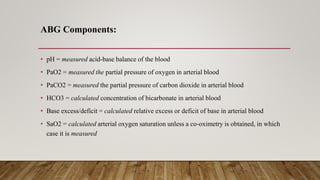
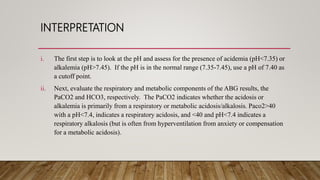
An arterial blood gas (ABG) analysis assesses a patient's acid-base status, oxygenation, and ventilation. It measures pH, partial pressures of oxygen and carbon dioxide, and calculates bicarbonate and oxygen saturation. ABG interpretation first identifies acidemia or alkalemia and then uses carbon dioxide and bicarbonate levels to determine if the primary disturbance is respiratory or metabolic, and whether compensation has occurred. Abnormal values are then evaluated in context of the patient's history and physical exam.


