“Renewable Plus” Presentation
                             February 2011
                             Eamonn McCormick – CEO

                             Eamonn@TriModalEnergy.Com
                             310-382-0453
Copyright © Tri Modal 2010
Company Background
• Created in 2010 by long time energy professionals
• Backed by Norwegian investors
• Focused on planning and optimization of “Wind/Solar/fossil” generation
  portfolios
• Goal is to assist “industry consortiums” to deliver “Firm/Shapable
  Renewable Energy Product” we call “Renewable Plus”


Copyright © Tri Modal 2010
Current Environment is Challenging
1. Recession:
      A significant drop in energy growth in all regions and indeed in areas like Phoenix
           demand has dropped vis a vis 2006 levels.
      Impacted the wind industry growth for the first time since the early 2000's. Indeed
           number of MWs this year is estimated to be 40% down on last year.
      Sluggish recovery means more focus on optimization of existing assets, replacement
           of existing plants, reducing costs of renewable and planning for the mid to long
           term rather than shorter term traditional wind projects
2. Regulatory situation has not developed at the Federal level slowing growth further
      National RPS
      Federal GHG standards
      Little regulatory stimulus to the market.
3. The industry is stretched by credit crises and other initiatives such as smart grid.
4. There is a significant overhang of renewable projects from 2008/2009 that is depressing
    interest in new projects
5. Many states are facing increased technical challenges integrating higher percentages of
    wind.
6. Large European players like Acciona retrenching as they are impacted by fall in Euro
    and financial crisis at home

Copyright © Tri Modal 2010
Implications

•   The implication is that buyers and investors are reluctant to invest or sign
    PPAs for high cost traditional wind farms and are in a “wait and see” attitude

•   Game is changing due to a need to address
     – Long term cost & demand implications of sluggish recovery
     – “Interstate” transmission projects and which are likely to evolve
     – Changing technology
     – “Renewables integration” with existing infrastructure
     – Need to address “Reliability” as renewables increase as % of the
       generation capacity

•   What we have determined is that the industry requires a new approach that
    will provide strategic advantage over competitors both in the short, medium
    and longer term.

Copyright © Tri Modal 2010
Questions?

    It is clear that the current US wind industry is locked into a high cost
    business model. The key to future success is determined by:

      1. How can we lower cost of wind and solar?
      2. How can we add more value to wind and solar?
      3. How can we reduce wind integration costs and reliability issues?
      4. How can we optimize existing fossil generation portfolio?
      5. How can we combine wind/solar/fossil to create a new highly competitive
         product that is more akin to traditional fossil generation?
      6. How can we create an optimized business model for generators that attracts
         strategic customers?
      7. How can this generation model be used to attract strategic transmission
         partners?
      8. What kind of new “renewable plus” generation entity is required?
Copyright © Tri Modal 2010
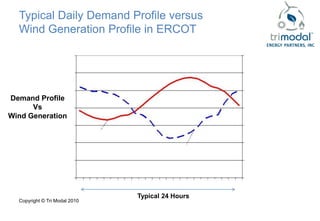
Typical Daily Demand Profile versus
  Wind Generation Profile in ERCOT


Demand Profile
      Vs
Wind Generation


                               Typical 24 Hours
  Copyright © Tri Modal 2010
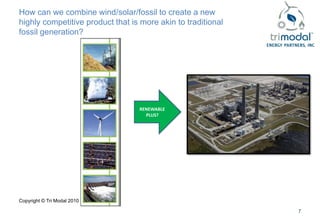
How can we combine wind/solar/fossil to create a new
highly competitive product that is more akin to traditional
fossil generation?


                                  RENEWABLE
                                    PLUS?


Copyright © Tri Modal 2010

                                                              7
The Renewable Plus Consortium Example
                              Utility Customer


                  Firm/Shapable Renewable Energy Product


                                 Renewable
                                   Plus
                                  Gen Co.


Copyright © Tri Modal 2010

                       Wind    Solar   Fossil& Nuclear   Storage
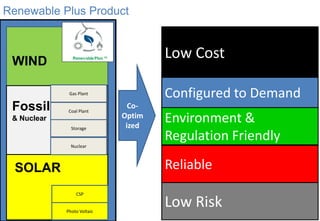
Renewable Plus Product


 WIND
                                              Low Cost

                       Gas Plant              Configured to Demand
 Fossil                Coal Plant
                                        Co-
 & Nuclear                            Optim
                                       ized
                                              Environment &
                        Storage

                                              Regulation Friendly
                        Nuclear


  SOLAR                                       Reliable
                           CSP
  Copyright © Tri Modal 2010

                      Photo Voltaic
                                              Low Risk
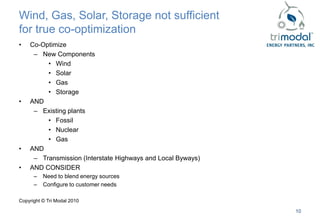
Wind, Gas, Solar, Storage not sufficient
for true co-optimization
•   Co-Optimize
     – New Components
         • Wind
         • Solar
         • Gas
         • Storage
•   AND
     – Existing plants
         • Fossil
         • Nuclear
         • Gas
•   AND
     – Transmission (Interstate Highways and Local Byways)
•   AND CONSIDER
      –   Need to blend energy sources
      –   Configure to customer needs

Copyright © Tri Modal 2010

                                                             10
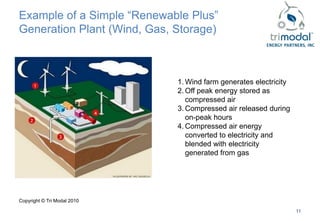
Example of a Simple “Renewable Plus”
Generation Plant (Wind, Gas, Storage)


                             1. Wind farm generates electricity
                             2. Off peak energy stored as
                                compressed air
                             3. Compressed air released during
                                on-peak hours
                             4. Compressed air energy
                                converted to electricity and
                                blended with electricity
                                generated from gas


Copyright © Tri Modal 2010

                                                                  11
Renewable Plus Generation Consortium
– Back to an old approach to generation
• Assuming it is possible via the “Renewable Plus” approach to
  combine “renewables and traditional generation” to create a
  “renewable plus plant” that operates at low cost like a
  traditional “dispatchable plant”
• Then:
      – We can use the proven utility model of utilities forming consortiums to build
        major “dispatchable plants”
      – Similar approach to proven Nuclear and Coal Plant model (like Palo Verde)
        where “consortium” owns and operates the plant based on their aggregated
        needs
      – No longer makes sense for independent small scale renewables as plant
        needs to be engineered to exact “consortium” specifications
      – Approach can be used to plan for retirement of large old coal based generation
        while minimizing cost, increasing “green” energy and optimizing gas and
        nuclear assets
Copyright © Tri Modal 2010

                                                                                    12
Advantages of “Renewable Plus” Product
• Higher value to customer
      –   Lower reserve margin costs
      –   Lower transmission costs
      –   Lower ancillary services costs
      –   Lower wind integration costs
      –   Lower integrated energy costs
      –   Lower risk
•   Both the “renewable plus” optimization achieves higher PPAs
•   Higher probability to get transmission capacity faster
•   Increases value of wind projects and gas/CAES plant
•   Improves wind sales by bundling with value added services
•   Attracts additional buyers
•   Most attractive to utilities rather than pure retail energy providers (REPS)
•   Results in market dominance
Copyright © Tri Modal 2010
Optimization


    The optimization uses a multi-year mixed integer
    programming algorithm to minimize costs over the planning
    horizon, subject to customer demand, security and other
    constraints, and customer ancillary service procurement
    requirements.


Copyright © Tri Modal 2010

                                                                14
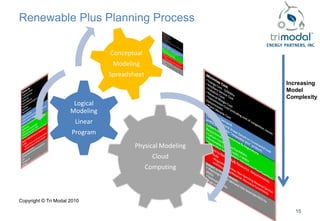
Renewable Plus Planning Process

                                 Conceptual
                                  Modeling
                                 Spreadsheet
                                                             Increasing
                                                             Model
                                                             Complexity
                       Logical
                      Modeling
                        Linear
                      Program
                                         Physical Modeling
                                                 Cloud
                                               Computing


Copyright © Tri Modal 2010

                                                               15
Summary

• Configurable “Renewable Plus” product is the key to the next generation of
  renewable generators
• Initial market feedback is very positive from potential partners
• Renewable Plus business model will be anchored by Consortium Lead
• Powerful customer led consortiums will ensure Consortium Lead have the
  correct US partners in order to succeed and gain market dominance


Copyright © Tri Modal 2010

Renewable Plus

  • 1.
    “Renewable Plus” Presentation February 2011 Eamonn McCormick – CEO Eamonn@TriModalEnergy.Com 310-382-0453 Copyright © Tri Modal 2010
  • 2.
    Company Background • Createdin 2010 by long time energy professionals • Backed by Norwegian investors • Focused on planning and optimization of “Wind/Solar/fossil” generation portfolios • Goal is to assist “industry consortiums” to deliver “Firm/Shapable Renewable Energy Product” we call “Renewable Plus” Copyright © Tri Modal 2010
  • 3.
    Current Environment isChallenging 1. Recession: A significant drop in energy growth in all regions and indeed in areas like Phoenix demand has dropped vis a vis 2006 levels. Impacted the wind industry growth for the first time since the early 2000's. Indeed number of MWs this year is estimated to be 40% down on last year. Sluggish recovery means more focus on optimization of existing assets, replacement of existing plants, reducing costs of renewable and planning for the mid to long term rather than shorter term traditional wind projects 2. Regulatory situation has not developed at the Federal level slowing growth further National RPS Federal GHG standards Little regulatory stimulus to the market. 3. The industry is stretched by credit crises and other initiatives such as smart grid. 4. There is a significant overhang of renewable projects from 2008/2009 that is depressing interest in new projects 5. Many states are facing increased technical challenges integrating higher percentages of wind. 6. Large European players like Acciona retrenching as they are impacted by fall in Euro and financial crisis at home Copyright © Tri Modal 2010
  • 4.
    Implications • The implication is that buyers and investors are reluctant to invest or sign PPAs for high cost traditional wind farms and are in a “wait and see” attitude • Game is changing due to a need to address – Long term cost & demand implications of sluggish recovery – “Interstate” transmission projects and which are likely to evolve – Changing technology – “Renewables integration” with existing infrastructure – Need to address “Reliability” as renewables increase as % of the generation capacity • What we have determined is that the industry requires a new approach that will provide strategic advantage over competitors both in the short, medium and longer term. Copyright © Tri Modal 2010
  • 5.
    Questions? It is clear that the current US wind industry is locked into a high cost business model. The key to future success is determined by: 1. How can we lower cost of wind and solar? 2. How can we add more value to wind and solar? 3. How can we reduce wind integration costs and reliability issues? 4. How can we optimize existing fossil generation portfolio? 5. How can we combine wind/solar/fossil to create a new highly competitive product that is more akin to traditional fossil generation? 6. How can we create an optimized business model for generators that attracts strategic customers? 7. How can this generation model be used to attract strategic transmission partners? 8. What kind of new “renewable plus” generation entity is required? Copyright © Tri Modal 2010
  • 6.
    Typical Daily DemandProfile versus Wind Generation Profile in ERCOT Demand Profile Vs Wind Generation Typical 24 Hours Copyright © Tri Modal 2010
  • 7.
    How can wecombine wind/solar/fossil to create a new highly competitive product that is more akin to traditional fossil generation? RENEWABLE PLUS? Copyright © Tri Modal 2010 7
  • 8.
    The Renewable PlusConsortium Example Utility Customer Firm/Shapable Renewable Energy Product Renewable Plus Gen Co. Copyright © Tri Modal 2010 Wind Solar Fossil& Nuclear Storage
  • 9.
    Renewable Plus Product WIND Low Cost Gas Plant Configured to Demand Fossil Coal Plant Co- & Nuclear Optim ized Environment & Storage Regulation Friendly Nuclear SOLAR Reliable CSP Copyright © Tri Modal 2010 Photo Voltaic Low Risk
  • 10.
    Wind, Gas, Solar,Storage not sufficient for true co-optimization • Co-Optimize – New Components • Wind • Solar • Gas • Storage • AND – Existing plants • Fossil • Nuclear • Gas • AND – Transmission (Interstate Highways and Local Byways) • AND CONSIDER – Need to blend energy sources – Configure to customer needs Copyright © Tri Modal 2010 10
  • 11.
    Example of aSimple “Renewable Plus” Generation Plant (Wind, Gas, Storage) 1. Wind farm generates electricity 2. Off peak energy stored as compressed air 3. Compressed air released during on-peak hours 4. Compressed air energy converted to electricity and blended with electricity generated from gas Copyright © Tri Modal 2010 11
  • 12.
    Renewable Plus GenerationConsortium – Back to an old approach to generation • Assuming it is possible via the “Renewable Plus” approach to combine “renewables and traditional generation” to create a “renewable plus plant” that operates at low cost like a traditional “dispatchable plant” • Then: – We can use the proven utility model of utilities forming consortiums to build major “dispatchable plants” – Similar approach to proven Nuclear and Coal Plant model (like Palo Verde) where “consortium” owns and operates the plant based on their aggregated needs – No longer makes sense for independent small scale renewables as plant needs to be engineered to exact “consortium” specifications – Approach can be used to plan for retirement of large old coal based generation while minimizing cost, increasing “green” energy and optimizing gas and nuclear assets Copyright © Tri Modal 2010 12
  • 13.
    Advantages of “RenewablePlus” Product • Higher value to customer – Lower reserve margin costs – Lower transmission costs – Lower ancillary services costs – Lower wind integration costs – Lower integrated energy costs – Lower risk • Both the “renewable plus” optimization achieves higher PPAs • Higher probability to get transmission capacity faster • Increases value of wind projects and gas/CAES plant • Improves wind sales by bundling with value added services • Attracts additional buyers • Most attractive to utilities rather than pure retail energy providers (REPS) • Results in market dominance Copyright © Tri Modal 2010
  • 14.
    Optimization The optimization uses a multi-year mixed integer programming algorithm to minimize costs over the planning horizon, subject to customer demand, security and other constraints, and customer ancillary service procurement requirements. Copyright © Tri Modal 2010 14
  • 15.
    Renewable Plus PlanningProcess Conceptual Modeling Spreadsheet Increasing Model Complexity Logical Modeling Linear Program Physical Modeling Cloud Computing Copyright © Tri Modal 2010 15
  • 16.
    Summary • Configurable “RenewablePlus” product is the key to the next generation of renewable generators • Initial market feedback is very positive from potential partners • Renewable Plus business model will be anchored by Consortium Lead • Powerful customer led consortiums will ensure Consortium Lead have the correct US partners in order to succeed and gain market dominance Copyright © Tri Modal 2010