INTRODUCTION
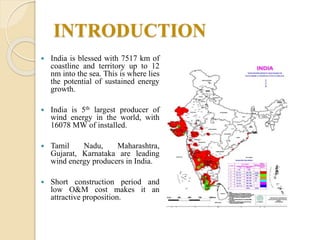
 India is blessed with 7517 km of
coastline and territory up to 12
nm into the sea. This is where lies
the potential of sustained energy
growth.
 India is 5th largest producer of
wind energy in the world, with
16078 MW of installed.
 Tamil Nadu, Maharashtra,
Gujarat, Karnataka are leading
wind energy producers in India.
 Short construction period and
low O&M cost makes it an
attractive proposition.
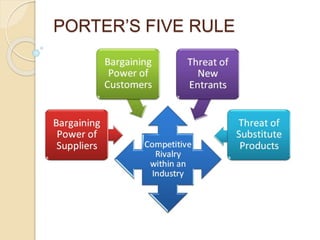
PORTER’S FIVE RULE
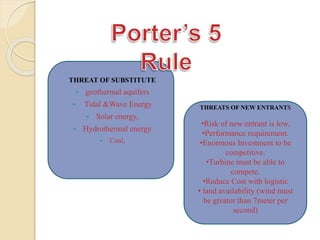
THREAT OF SUBSTITUTE
 geothermal aquifers
 Tidal &Wave Energy
 Solar energy,
 Hydrothermal energy
 Coal,
THREATS OF NEW ENTRANTS
•Risk of new entrant is low.
•Performance requirement.
•Enormous Investment to be
competitive.
•Turbine must be able to
compete.
•Reduce Cost with logistic
• land availability (wind must
be greater than 7meter per
second)
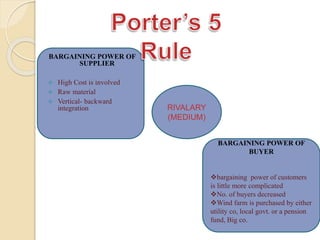
BARGAINING POWER OF
SUPPLIER
 High Cost is involved
 Raw material
 Vertical- backward
integration
BARGAINING POWER OF
BUYER
bargaining power of customers
is little more complicated
No. of buyers decreased
Wind farm is purchased by either
utility co, local govt. or a pension
fund, Big co.
RIVALARY
(MEDIUM)
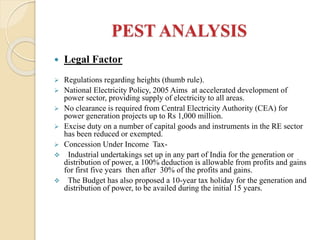
PEST ANALYSIS
 Legal Factor
 Regulations regarding heights (thumb rule).
 National Electricity Policy, 2005 Aims at accelerated development of
power sector, providing supply of electricity to all areas.
 No clearance is required from Central Electricity Authority (CEA) for
power generation projects up to Rs 1,000 million.
 Excise duty on a number of capital goods and instruments in the RE sector
has been reduced or exempted.
 Concession Under Income Tax-
 Industrial undertakings set up in any part of India for the generation or
distribution of power, a 100% deduction is allowable from profits and gains
for first five years then after 30% of the profits and gains.
 The Budget has also proposed a 10-year tax holiday for the generation and
distribution of power, to be availed during the initial 15 years.
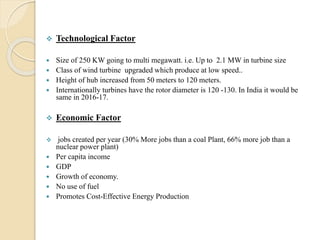
 Technological Factor
 Size of 250 KW going to multi megawatt. i.e. Up to 2.1 MW in turbine size
 Class of wind turbine upgraded which produce at low speed..
 Height of hub increased from 50 meters to 120 meters.
 Internationally turbines have the rotor diameter is 120 -130. In India it would be
same in 2016-17.
 Economic Factor
 jobs created per year (30% More jobs than a coal Plant, 66% more job than a
nuclear power plant)
 Per capita income
 GDP
 Growth of economy.
 No use of fuel
 Promotes Cost-Effective Energy Production
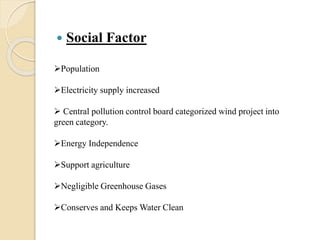
 Social Factor
Population
Electricity supply increased
 Central pollution control board categorized wind project into
green category.
Energy Independence
Support agriculture
Negligible Greenhouse Gases
Conserves and Keeps Water Clean
INDUSTRY ATTRACTIVENESS
 With modern technology we can capture wind efficiently.
 Once the wind turbine builds the energy is produces does not cause
green house gases, or other pollutants.
 Free, renewable resource
 No harmful emissions
 Minimal land use
 Remote areas that are not connected to the electricity power grid can
use wind energy We can use our own supply
 Wind turbines are available in a range of sizes which means a vast
range of people and businessman can used.
 Single households to small to small town and villages can make good
use of range of wind turbines available today.
CONCLUSION
 Wind mill = connect- invest- jobs
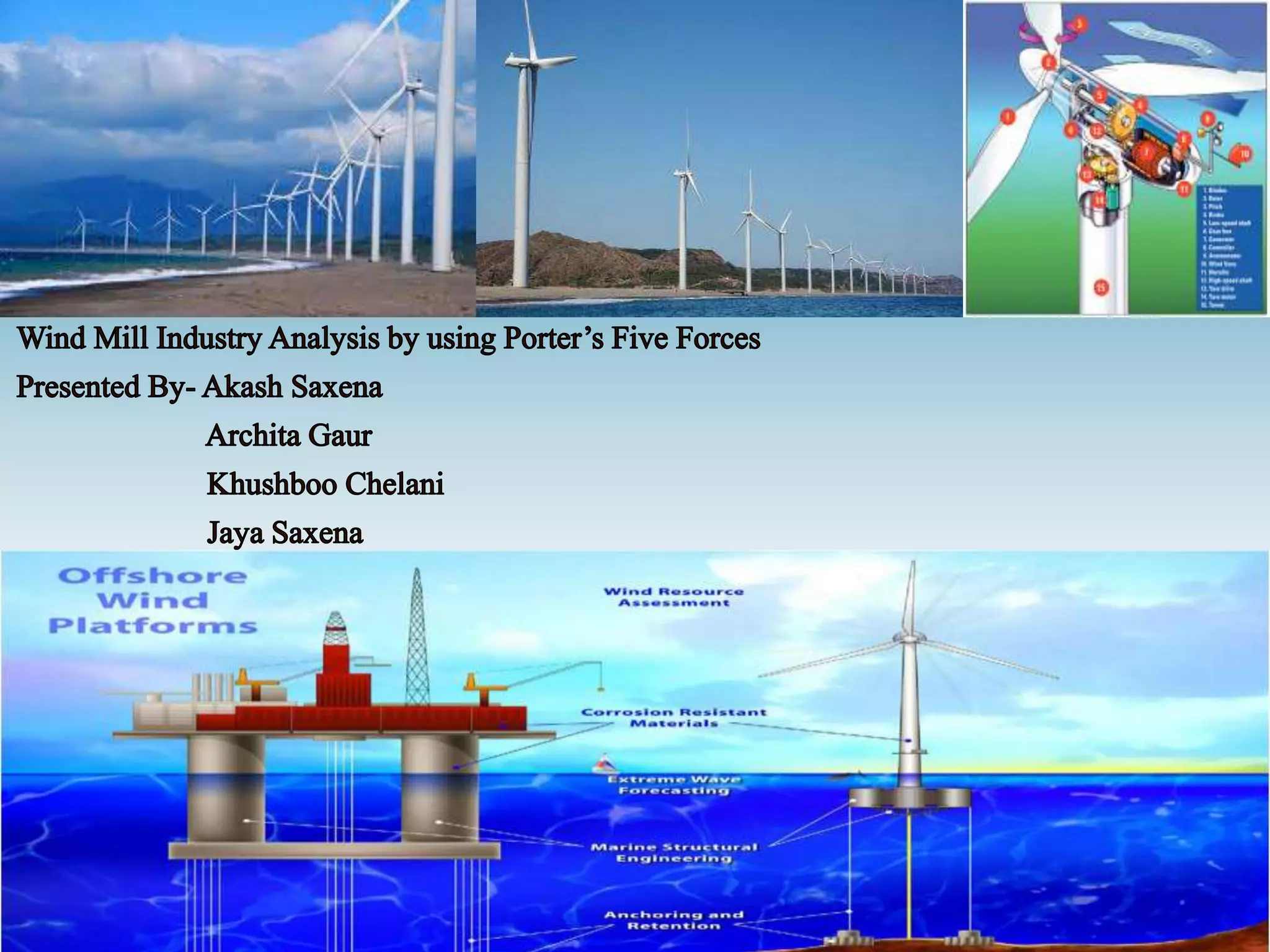
Wind Mill Industry Analysis by Using Porter's Five Model

Wind Mill Industry Analysis by Using Porter's Five Model

  • 2.
    INTRODUCTION  India isblessed with 7517 km of coastline and territory up to 12 nm into the sea. This is where lies the potential of sustained energy growth.  India is 5th largest producer of wind energy in the world, with 16078 MW of installed.  Tamil Nadu, Maharashtra, Gujarat, Karnataka are leading wind energy producers in India.  Short construction period and low O&M cost makes it an attractive proposition.
  • 3.
  • 4.
    THREAT OF SUBSTITUTE geothermal aquifers  Tidal &Wave Energy  Solar energy,  Hydrothermal energy  Coal, THREATS OF NEW ENTRANTS •Risk of new entrant is low. •Performance requirement. •Enormous Investment to be competitive. •Turbine must be able to compete. •Reduce Cost with logistic • land availability (wind must be greater than 7meter per second)
  • 5.
    BARGAINING POWER OF SUPPLIER High Cost is involved  Raw material  Vertical- backward integration BARGAINING POWER OF BUYER bargaining power of customers is little more complicated No. of buyers decreased Wind farm is purchased by either utility co, local govt. or a pension fund, Big co. RIVALARY (MEDIUM)
  • 6.
    PEST ANALYSIS  LegalFactor  Regulations regarding heights (thumb rule).  National Electricity Policy, 2005 Aims at accelerated development of power sector, providing supply of electricity to all areas.  No clearance is required from Central Electricity Authority (CEA) for power generation projects up to Rs 1,000 million.  Excise duty on a number of capital goods and instruments in the RE sector has been reduced or exempted.  Concession Under Income Tax-  Industrial undertakings set up in any part of India for the generation or distribution of power, a 100% deduction is allowable from profits and gains for first five years then after 30% of the profits and gains.  The Budget has also proposed a 10-year tax holiday for the generation and distribution of power, to be availed during the initial 15 years.
  • 7.
     Technological Factor Size of 250 KW going to multi megawatt. i.e. Up to 2.1 MW in turbine size  Class of wind turbine upgraded which produce at low speed..  Height of hub increased from 50 meters to 120 meters.  Internationally turbines have the rotor diameter is 120 -130. In India it would be same in 2016-17.  Economic Factor  jobs created per year (30% More jobs than a coal Plant, 66% more job than a nuclear power plant)  Per capita income  GDP  Growth of economy.  No use of fuel  Promotes Cost-Effective Energy Production
  • 8.
     Social Factor Population Electricitysupply increased  Central pollution control board categorized wind project into green category. Energy Independence Support agriculture Negligible Greenhouse Gases Conserves and Keeps Water Clean
  • 9.
    INDUSTRY ATTRACTIVENESS  Withmodern technology we can capture wind efficiently.  Once the wind turbine builds the energy is produces does not cause green house gases, or other pollutants.  Free, renewable resource  No harmful emissions  Minimal land use  Remote areas that are not connected to the electricity power grid can use wind energy We can use our own supply  Wind turbines are available in a range of sizes which means a vast range of people and businessman can used.  Single households to small to small town and villages can make good use of range of wind turbines available today.
  • 10.
    CONCLUSION  Wind mill= connect- invest- jobs