White paper
October 2012
stability – power integration – battery – energy-generation – flywheel – decarbonization – energy
– solar – variability – unpredictability – dependency – photovoltaic – UHVDC – control – pumped
bility – assessment – planning – storage technologies – generation forecast – operational enhan
and response – modeling – electrical energy storage – alternating current – contingency analys
ent – induction generator – transmission network – energy efficiency – heat recovery – electrotec
ysis – strategy – electricity market – renewables – energy access – grid operator – grid infrastructure –
pact – coordination – energy market operators – transmission planning body – challenges – st
ogen – policy-makers – regulators – industry – research community – energy access – grid arch
-fuel-cost – energy cost – interconnection – power fluctuations – black-out – geopolitics – distributio
ADA – generation portfolio – grid operation – hydro – variable generation – steam – solar concentrat
– intermittency – location – dependent – grid owner – wind speed – supply and demand – voltage
cast – weather – dispatchable load – nuclear – transmission capacity – sunlight – load management
rol – frequency regulation – spinning reserve – black-start capacity – Smart Grid – remote lo
rtainty – deterministic – complexity – micro-grid – power output – power conversion – steam
mal energy – solar tower – parabolic through – linear Fresnel reflector system – parabolic dish
casting – spatial aggregation – system security – reliability – monitoring – co-generation –
uations – power exchange – real-time – fault ride-through capability – frequency drop – grid-friendl
ronics – ramping – curtailment – pitch regulation – inertial response – dynamic modeling –
-shifting – AMI – electric vehicles – cyber-security – grid stability – power integration –
gy-generation – flywheel – decarbonization – energy security – wind – solar – variability – unpredi
endency – photovoltaic – UHVDC – control – pumped storage - flexibility – assessment – planning
nologies – generation forecast – operational enhancement – demand response – modeling – electri
ge – alternating current – contingency analysis – direct current – induction generator – transmissio
nergy efficiency – heat recovery – electrotechnology – analysis – strategy – electricity market – ren
gy access – grid operator – grid infrastructure – synthesis – impact – coordination – energy market o
mission planning body – challenges – standards – hydrogen - policy-makers – regulators – industry
munity – energy access – grid architecture – zero-fuel-cost – energy cost – interconnection
uations – black-out – geopolitics – distribution – utility – SCADA – generation portfolio – grid operatio
iable generation – steam – solar concentrating power – PV – intermittency – location – dependent – g
nd speed – supply and demand – voltage support – forecast – weather – dispatchable load –
mission capacity – sunlight – load management – voltage control – frequency regulation – spinning
k-start capacity – Smart Grid – remote locations – uncertainty – deterministic – complexity – mi
er output – power conversion – steam turbine – thermal energy – solar tower – parabolic throug
nel reflector system – parabolic dish – power forecasting – spatial aggregation – system security – r
itoring – co-generation – balancing fluctuations – power exchange – real-time – fault ride-through c
uency drop – grid-friendly – power electronics – ramping – curtailment – pitch regulation – inertial r
mic modeling – UHVAC – load-shifting – AMI – electric vehicles – cyber-security
Grid integration of large-capacity
Renewable Energy sources and use of
large-capacity Electrical Energy Storage
Âź
2 E x e c u t i v e s u m m a r y
The present White Paper is the third in a series
whose purpose is to ensure that the IEC can
continue to contribute with its standards and
conformity assessment services to the solution
of global problems in electrotechnology. The
White Papers are developed by the IEC MSB
(Market Strategy Board), responsible for
analyzing and understanding the IEC’s market
so as to prepare the IEC strategically to face
the future.
The proportion of renewable energies (RE) is
called upon to increase in all major electricity
markets. The reasons for this are not examined
closely here, since they have been fully treated
elsewhere. This paper explores what is needed
to integrate large quantities of renewables
into existing electricity grids, given various
characteristics and difficulties which necessarily
accompany such a change. Section 2 examines
these characteristics, describes the difficulties
and analyzes the consequent challenges for
grid operators as well as for producers of
electricity, both renewable and conventional.
Section 3 shows today’s methods and
responses to the challenges. These are
extensive and applied widely and professionally;
the section nevertheless concludes that they
will not suffice as the proportion of renewables
grows to 15 %, 25 % or even 35 % of the energy
in some grids.
Thus section 4, one of the two core chapters of
the paper, covers all the research, investment
and other tools without which large-scale
renewables cannot be successfully integrated.
These range from what renewable generation
needs to provide in order to be accepted,
through all the control and infrastructure the grid
itself needs in order to cope, to the realization
that conventional generation facilities also need
to contribute significantly to make the whole
exercise a success.
The second core part of the paper is section 5
on electrical energy storage (EES), and it
extensively uses the results of the IEC White
Paper on this subject published in 2011. It turns
out that the various challenges and difficulties
covered in section 2, and even more the
avenues for the future sketched out in section 4,
either depend on the use of storage or at least
can benefit from it. Section 5 therefore outlines
its use and usefulness for the integration of
renewables and concludes – in harmony with
the White Paper on storage – that significant
developments are required in this area as well.
The following section, section 6, briefly surveys
the contribution that standards already make
and can make in the future to solving the issues
covered elsewhere.
Section 7 starts with a brief conclusion. Its thrust
is that the electricity community knows in broad
outline what will be needed to integrate large-
scale renewables, but that many elements are
not yet in place and much effort will be required.
There follow recommendations addressed to
the IEC’s partners, in both the public and private
sector, and to the IEC’s own structures. The
IEC MSB believes that future implementation
of these recommendations is the factor which
will constitute the greatest added value of the
present White Paper.
This White Paper was written by a project team under
the MSB, in particular the experts of the State Grid
Corporation of China (CN) and RASEI (the Renewable
and Sustainable Energy Institute) in the University of
Colorado at Boulder and NREL (US).
3
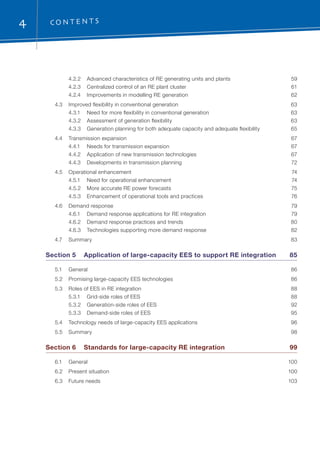
List of abbreviations	 6
Section 1	 Introduction	 9
Section 2	 RE generation: the present, the future and the integration
challenges	13
	 2.1	 Drivers of RE development	 14
	 2.1.1	Decarbonization	 14
	 2.1.2	 Energy security	 15
	 2.1.3	 Expanding energy access	 16
	 2.2	 Present status of RE generation and future projections	 18
	 2.2.1	 Wind energy	 19
	 2.2.2	 Solar energy	 22
	 2.3	 RE grid integration challenges	 25
	 2.3.1	 Non-controllable variability	 28
	 2.3.2	 Partial unpredictability	 29
	 2.3.3	 Locational dependency	 30
Section 3	 Present: state of the art in integrating large-capacity RE	 31
	 3.1	General	 32
	 3.2	 RE generation technology	 32
	 3.2.1	 Wind power generation	 32
	 3.2.2	 PV power generation	 38
	 3.2.3	 Concentrated solar power generation	 40
	 3.3	 Transmission technology	 43
	 3.3.1	 AC transmission	 43
	 3.3.2	 VSC-HVDC transmission	 45
	 3.4	 Operational technologies and practices	 46
	 3.4.1	 Power forecasting	 46
	 3.4.2	 Operational practices	 50
Section 4	 Future: technical solutions for integrating
more large-capacity RE	 57
	 4.1	General	 58
	 4.2	 Grid-friendly RE generation	 59
	 4.2.1	 Need for grid-friendly RE generation	 59
4 C O N T E N TS
	 4.2.2	 Advanced characteristics of RE generating units and plants	 59
	 4.2.3	 Centralized control of an RE plant cluster	 61
	 4.2.4	 Improvements in modelling RE generation	 62
	 4.3	 Improved flexibility in conventional generation	 63
	 4.3.1	 Need for more flexibility in conventional generation	 63
	 4.3.2	 Assessment of generation flexibility	 63
	 4.3.3	 Generation planning for both adequate capacity and adequate flexibility	 65
	 4.4	 Transmission expansion	 67
	 4.4.1	 Needs for transmission expansion	 67
	 4.4.2	 Application of new transmission technologies	 67
	 4.4.3	 Developments in transmission planning	 72
	 4.5	 Operational enhancement	 74
	 4.5.1	 Need for operational enhancement	 74
	 4.5.2	 More accurate RE power forecasts	 75
	 4.5.3	 Enhancement of operational tools and practices	 76
	 4.6	 Demand response	 79
	 4.6.1	 Demand response applications for RE integration	 79
	 4.6.2	 Demand response practices and trends	 80
	 4.6.3	 Technologies supporting more demand response	 82
	 4.7	Summary	 83
Section 5	 Application of large-capacity EES to support RE integration	 85
	 5.1	General	 86
	 5.2	 Promising large-capacity EES technologies	 86
	 5.3	 Roles of EES in RE integration	 88
	 5.3.1	 Grid-side roles of EES	 88
	 5.3.2	 Generation-side roles of EES	 92
	 5.3.3	 Demand-side roles of EES	 95
	 5.4	 Technology needs of large-capacity EES applications	 96
	 5.5	Summary	 98
Section 6	 Standards for large-capacity RE integration	 99
	 6.1	General	 100
	 6.2	 Present situation	 100
	 6.3	 Future needs	 103
5
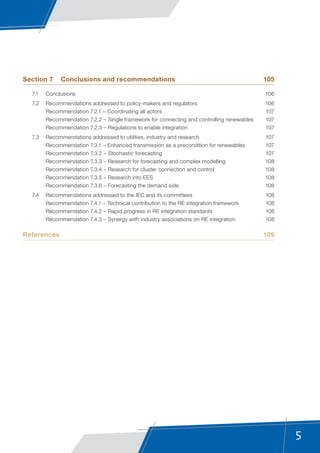
Section 7	 Conclusions and recommendations	 105
	 7.1	Conclusions	 106
	 7.2	 Recommendations addressed to policy-makers and regulators	 106
	 Recommendation 7.2.1 – Coordinating all actors	 107
	 Recommendation 7.2.2 – Single framework for connecting and controlling renewables	 107
	 Recommendation 7.2.3 – Regulations to enable integration	 107
	 7.3	 Recommendations addressed to utilities, industry and research	 107
	 Recommendation 7.3.1 – Enhanced transmission as a precondition for renewables	 107
	 Recommendation 7.3.2 – Stochastic forecasting	 107
	 Recommendation 7.3.3 – Research for forecasting and complex modelling	 108
	 Recommendation 7.3.4 – Research for cluster connection and control	 108
	 Recommendation 7.3.5 – Research into EES	 108
	 Recommendation 7.3.6 – Forecasting the demand side	 108
	 7.4	 Recommendations addressed to the IEC and its committees	 108
	 Recommendation 7.4.1 – Technical contribution to the RE integration framework	 108
	 Recommendation 7.4.2 – Rapid progress in RE integration standards	 108
	 Recommendation 7.4.3 – Synergy with industry associations on RE integration	 108
References	109
6 L i s t o f a b b r e v i at i on s
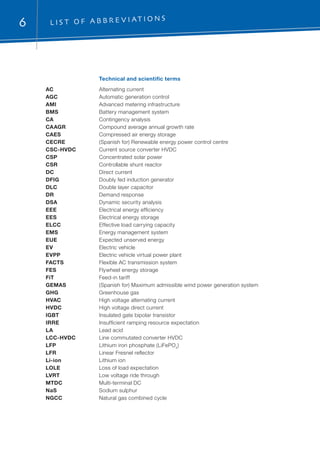
	 Technical and scientific terms
AC	 Alternating current
AGC	 Automatic generation control
AMI	 Advanced metering infrastructure
BMS	 Battery management system
CA	 Contingency analysis
CAAGR	 Compound average annual growth rate
CAES	 Compressed air energy storage
CECRE	 (Spanish for) Renewable energy power control centre
CSC-HVDC	 Current source converter HVDC
CSP	 Concentrated solar power
CSR	 Controllable shunt reactor
DC	 Direct current
DFIG	 Doubly fed induction generator
DLC	 Double layer capacitor
DR	 Demand response
DSA	 Dynamic security analysis
EEE	 Electrical energy efficiency
EES	 Electrical energy storage
ELCC	 Effective load carrying capacity
EMS	 Energy management system
EUE	 Expected unserved energy
EV	 Electric vehicle
EVPP	 Electric vehicle virtual power plant
FACTS	 Flexible AC transmission system
FES	 Flywheel energy storage
FiT	 Feed-in tariff
GEMAS	 (Spanish for) Maximum admissible wind power generation system
GHG	 Greenhouse gas
HVAC	 High voltage alternating current
HVDC	 High voltage direct current
IGBT	 Insulated gate bipolar transistor
IRRE	 Insufficient ramping resource expectation
LA	 Lead acid
LCC-HVDC	 Line commutated converter HVDC
LFP	 Lithium iron phosphate (LiFePO4
)
LFR	 Linear Fresnel reflector
Li-ion	 Lithium ion
LOLE	 Loss of load expectation
LVRT	 Low voltage ride through
MTDC	 Multi-terminal DC
NaS	 Sodium sulphur
NGCC	 Natural gas combined cycle
7
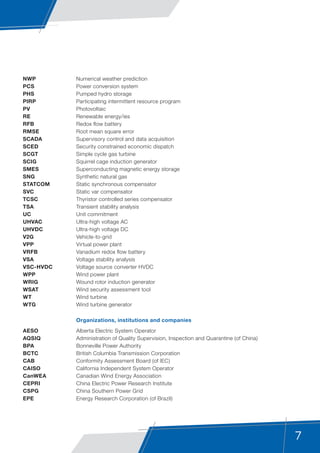
NWP	 Numerical weather prediction
PCS	 Power conversion system
PHS	 Pumped hydro storage
PIRP	 Participating intermittent resource program
PV	Photovoltaic
RE	 Renewable energy/ies
RFB	 Redox flow battery
RMSE	 Root mean square error
SCADA	 Supervisory control and data acquisition
SCED	 Security constrained economic dispatch
SCGT	 Simple cycle gas turbine
SCIG	 Squirrel cage induction generator
SMES	 Superconducting magnetic energy storage
SNG	 Synthetic natural gas
STATCOM	 Static synchronous compensator
SVC	 Static var compensator
TCSC	 Thyristor controlled series compensator
TSA 	 Transient stability analysis
UC	 Unit commitment
UHVAC	 Ultra-high voltage AC
UHVDC	 Ultra-high voltage DC
V2G	Vehicle-to-grid
VPP	 Virtual power plant
VRFB	 Vanadium redox flow battery
VSA 	 Voltage stability analysis
VSC-HVDC	 Voltage source converter HVDC
WPP	 Wind power plant
WRIG	 Wound rotor induction generator
WSAT	 Wind security assessment tool
WT	 Wind turbine
WTG	 Wind turbine generator
	 Organizations, institutions and companies
AESO	 Alberta Electric System Operator
AQSIQ	 Administration of Quality Supervision, Inspection and Quarantine (of China)
BPA	 Bonneville Power Authority
BCTC	 British Columbia Transmission Corporation
CAB	 Conformity Assessment Board (of IEC)
CAISO	 California Independent System Operator
CanWEA	 Canadian Wind Energy Association
CEPRI	 China Electric Power Research Institute
CSPG	 China Southern Power Grid
EPE	 Energy Research Corporation (of Brazil)
8 L i s t o f a b b r e v i at i on s
EWEA	 European Wind Energy Association
FERC	 Federal Energy Regulatory Commission (of US)
GIVAR	 Grid Integration of Variable Renewables Project (of IEA)
IEA	 International Energy Agency
IEC	 International Electrotechnical Commission
IEEE	 Institute of Electrical and Electronics Engineers
IOU	 Investor-owned utility
IPCC	 Intergovernmental Panel on Climate Change
ISO	 International Organization for Standardization
ISO 	 Independent system operator
IVGTF	 Integration of Variable Generation Task Force (of NERC)
JWD	 Japan Wind Development Co.
MSB	 Market Strategy Board (of IEC)
NDRC	 National Development and Reform Commission (of China)
NEA	 National Energy Administration (of China)
NERC	 North American Electric Reliability Corporation
OECD	 Organisation for Economic Co-operation and Development
ONS	 The Operator of the National Electricity System (of Brazil)
NYISO	 New York Independent System Operator
PES	 Power & Energy Society (of IEEE)
PMA	 Power marketing administration
REE	 Red Eléctrica de España
RTO	 Regional transmission organization
SAC	 Standardization Administration of China
SGCC	 State Grid Corporation of China
SMB	 Standardization Management Board (of IEC)
TC	 Technical Committee (of IEC)
TEPCO	 Tokyo Electric Power Company
TSC	 TSO Security Cooperation
TSO	 Transmission system operator
UWIG	 Utility Wing Integration Group
WAPA	 Western Area Power Administration (of US)
WECC	 Western Electricity Coordinating Council
Introduction
SECTION 1
S E C T I O N 1	
Introduction10
This report discusses the challenges of
synthesizing the development and operation of
RE and EES resources with the planning and
operation of the rest of the power grid, including
existing generation resources, customer
requirements and the transmission system itself.
The generation of electricity from RE sources
includes technologies such as hydropower,
wind power, solar power, tidal and wave power,
geothermal power, and power from renewable
biomass. Wind and solar power are the focus
of this report, for two reasons. First, they are
among the renewable generation types – wind,
solar, and wave – that are subject to natural
variability in their energy sources. This variability
creates distinct challenges for integration into the
larger power system, namely nondispatchability.
Secondly, wind and solar are relatively mature for
use in large capacities and in wide areas, and so
have a significant impact on the power grid that
is likely to increase over time.
Integration of RE is a poly-nodal problem
involving multiple decision-makers at a variety
of spatial and temporal scales and widely
varying degrees of coordination. These
decision-makers include operators of RE and
energy storage resources, grid operators,
energy market operators and transmission
planning bodies. As such, grid integration is
not performed by any one entity in the power
system, but instead involves the actions of a
variety of entities, some highly coordinated and
others discrete. The burgeoning development
of smart grids adds still more tools, options and
players to the mix. Many of these actors engage
with various technology standards, practices,
procedures and policies for the operation of
individual generators, RE clusters, substations,
and the broader electrical energy system.
This report, produced by the International
Electrotechnical Commission (IEC) Market
Strategy Board (MSB), is the third in a series of
MSB White Papers which already includes:
1) Coping with the Energy Challenge (September
2010), hereafter referred to as the “MSB EEE
Report”;
2) Electrical Energy Storage (December 2011),
hereafter referred to as the “MSB EES
Report”.
The report’s primary goal is to provide a
comprehensive, global view on the state
of the art and future directions for grid
integration of large-capacity RE sources
and the application of large-capacity energy
storage for that purpose. It is directed towards
the IEC’s partners worldwide, as well as to
its own Standardization Management Board
(SMB) and Conformity Assessment Board
(CAB), such that they may act to support
grid integration efforts around the world and
provide guidance to the electric utility industry
and policy-makers.
The report is divided into seven sections:
(1) Introduction; (2) RE generation: the present,
the future and the integration challenges;
(3) Present: state of the art in integrating large-
capacity RE; (4) Future: technical solutions
for integrating more large-capacity RE;
(5) Application of large-capacity EES to support
RE integration; (6) Standards for large-capacity
RE integration; and (7) Conclusions and
recommendations. Sections 1 and 2 provide
background information about the report, the
state of RE generation, and the challenges of
integrating RE sources into the grid. Section 3
11
describes the key practices and technologies
presently involved in grid integration of large-
capacity RE. Section 4, the heart of the report,
explores the future technology and practice
needs of the grid as RE penetration increases.
Section 5 discusses the role of energy storage
as a supportive technology for grid integration
of RE, and maps its supportive roles onto the
general needs identified in Section 4. Section 6
connects the information from the previous
five sections with relevant IEC standards
activities, and identifies future standards
needs. Section 7 provides a strategic overview
and recommendations to the relevant policy-
makers, regulators, power utilities, industry
and research communities, as well as the
IEC’s own committees.
RE generation:
the present, the future and
the integration challenges
SECTION 2
14 S E C T I O N 2	
RE generation: the present, the future and the integration challenges
2.1	 Drivers of RE development
RE is a growing component of electricity grids
around the world due to its contributions to
(1) energy system decarbonization, (2) long-
term energy security, and (3) expansion of
energy access to new energy consumers in the
developing world. As stated in the MSB EEE
Report:
In short: the challenge is ensuring energy
availability and preserving the environment. The
key elements are the following:
1)	 Stabilizing climate impact from fossil fuel use
2)	Meeting the energy demand of a growing
population
3)	Bringing electricity to the 1.6 B people
without access
4)	Ensuring stable and secure energy access
for all nations
5)	 Transporting electricity long distances from
where it is generated to where it is used.
[msb10]
RE is implicated in all of these elements, and is
critical to transforming energy grids to meet the
environmental, economic and social challenges
of the future. Globally, RE’s share of electricity
generation will increase substantially over the
next two decades and beyond. Indeed, this is
already occurring: governmental action at the
international, national and subnational levels has
created a wide variety of laws and policies to
promote RE development. These include:
‱	 carbon taxes: taxation of greenhouse gas
emissions, so as to internalize the climate-
disruption costs of fossil-fuel use;
‱	 cap-and-trade systems: provision of
tradable annual emissions allowances to
greenhouse gas emitters coupled with
reduction in the quantities of allowances
issued each year;
‱	 RE goals: mandates requiring load-serving
entities to source a specified proportion of
energy sold from renewable sources;
‱	 feed-in tariffs (FiTs): guaranteed wholesale
prices for RE coupled with a requirement
that load-serving entities take renewable
power whenever it is available;
‱	 tax credits: credits against taxable income
for generation or installation of RE;
‱	 the development of smart grids: advances
in the architecture, functionality and
regulation of electricity grids so as to
enable higher penetrations of RE; and
‱	 removal of long-standing fossil fuel
subsidies.
We will discuss the major public policy drivers
behind RE development in turn.
2.1.1	Decarbonization
The need to address global climate change,
a worldwide environmental phenomenon that
will affect everyone on the planet, is the most
public driving force for RE deployment. The
Intergovernmental Panel on Climate Change
(IPCC), the world’s leading authority on climate
change science, states in its Synthesis Report
to the Fourth Assessment Report that “warming
of the climate system is unequivocal, as is
now evident from observations of increases
in global average air and ocean temperatures,
widespread melting of snow and ice and rising
global average sea level”, and that “most of the
global average warming over the past 50 years
is very likely due to anthropogenic greenhouse
gas (GHG) increases and it is likely that there is a
discernible human-induced warming averaged
over each continent (except Antarctica).”
15
The MSB EEE Report notes that CO2
emissions
related to energy use account for 70 % of total
GHG emissions, and that emissions related
to electricity generation approach half of that
[msb10]. Consequently, governments have
enacted policies to curb GHG emissions from
the power sector. Because electricity generated
from RE produces no GHG emissions,
increasing penetrations of RE onto the electrical
grid contribute to a decarbonization of the
electricity system: a reduction in GHGs emitted
per unit of energy produced. Energy system
decarbonization in turn slows the increase in
concentrations of GHGs in the atmosphere and
thereby mitigates the resultant radiative forcing
of the climate system.
In recent years, the ostensible progress of climate
change policies has stalled at the international
level, with a lack of hard commitments to
emission reductions from some large emitters.
Nevertheless, many countries have developed
incremental policies to promote RE development
in the absence of full international agreement. For
example, nearly 30 states in the USA have enacted
their own RE goals in the absence of federal
action; Germany has long used aggressive feed-in
tariff requirements that oblige power companies
to purchase renewably-generated energy at
fixed rates; and China has set a capacity goal of
150 GW-180 GW of wind power and 20 GW of
solar photovoltaic (PV) power for 2020. These
goals and policies will result in significant growth in
RE that will affect the operation of the power grid.
2.1.2	 Energy security
Driven by the wind, the sun and the waves, RE
has no fuel costs. This zero-fuel-cost aspect
of RE manifests itself in two benefits. First,
average energy costs tend to decline over time
for renewable generation, as variable costs are
limited to operations and maintenance and do not
include fuel. Secondly, RE assets are insulated
from fluctuations in fossil fuel prices, which are
historically volatile and subject to geopolitical
disruptions. Coal, gas and oil-fired generation
costs, in contrast, increase when the cost of the
relevant fuel increases. Figure 2-1 depicts the
International Energy Agency’s (IEA) projections1
for the share of world electricity generation by
fuel up to 2035, and shows a displacement of
coal and oil-based generation’s shares by wind,
biomass and other renewables as governments
continue to promote RE.
Because fossil fuel supplies are both unevenly
distributed and ultimately exhaustible, many
countries have identified a long-term energy-
security proposition in gradually decreasing
dependenceonthemintheproductionofelectricity.
In comparison to fossil resources, renewable
resources are better distributed throughout the
world and do not diminish as they are used. A
country’s investment in RE results in a zero-fuel-
cost generation resource that is domestically
located. Thus even countries with substantial fossil
fuel resources, such as China, have set aggressive
wind power targets. And despite a recent boom
in natural gas production in the USA, states have
made no indication of any intent to remove RE
goals. RE can also prove useful for short-term
energy security concerns. Many electric utilities
have diversified their generation mixes with
renewables so as to hedge against volatile fossil
fuel prices on the oil, gas and coal markets.
1
	 These projections come from IEA’s New Policies
Scenario, the centrepiece of IEA’s analysis in its
World Energy Outlook. The new policies scenario
accounts for future policy developments that drive
world energy sources toward greater sustainability.
16 S E C T I O N 2	
RE generation: the present, the future and the integration challenges
2.1.3	 Expanding energy access
Energy demand in developing countries is
growing rapidly (see Figure 2-2). IEA’s New
Policies Scenario projects electricity demand in
non-OECD countries to increase at a compound
average annual growth rate (CAAGR) of 3.5 %
to 2035. Total non-OECD electricity demand
nearly triples from 8 000 TWh in 2009 to almost
20 000 TWh by 2035 (see Figure 2-3). Asian
electricity demand grows the most rapidly,
with a 4.2 % CAAGR in the same period. In
addition to the needs outlined in the previous
subsections for cleaner energy and more
secure energy, the world simply needs more
energy as more people in the developing world
gain access to it.
As global energy demand increases, RE
provides one means among many of adding
energy assets to the system alongside growth
of other resources. IEA’s New Policies Scenario
projects a near tripling of global use of RE, from
3 900 TWh in 2009 to 11 100 TWh in 2035,
and growth in renewables accounts for nearly
half of the total increase in generation by 2035.
Indeed, under this scenario, a full third of global
electricity generation will be supplied by RE
(including hydroelectricity) by 2035. Figure
2-4 provides a breakdown of incremental
renewables growth by technology. Note the
large increase in wind power.
2009
2020
2035
20 043 TWh
27 881 TWh
36 250 TWh
0 %
Coal Gas Oil Nuclear Biomass Hydro Wind Other renewables
20 % 40 % 60 % 80 % 100 %
Figure 2-1 – Share of world electricity generation by fuel in IEA’s New Policies Scenario
[weo11]
17
18 000
16 000
14 000
12 000
10 000
8 000
6 000
4 000
2 000
0
Other OECD
Mtoe
European Union
United States
Other non-OECD
Middle East
India
China
Inter-regional
(bunkers)
1990 2000 2010 2020 2030 2035
Figure 2-3 – Electricity demand by region in IEA's WEO 2011 Scenario (TWh)
[weo11]
Figure 2-2 – World primary energy demand by region in IEA’s New Policies Scenario
[weo11]
18 S E C T I O N 2	
RE generation: the present, the future and the integration challenges
While a world where a majority of electricity
generation is based on renewable sources
is far beyond the horizon, it is clear that the
confluence of government policy, utility planning
and global demand growth has the potential
to increase penetrations of RE substantially
on electricity grids worldwide. This shift in
generation portfolios will have profound effects
on the operation of the grid, which will in turn
affect the operation of RE resources themselves
as well as the operation of other resources and
equipment connected to the grid.
2.2	 Present status of RE
generation and future
projections
At 3  902 TWh, RE accounted for 19.46 % of
the world’s electricity generation in 2009.
Hydroelectricity, by far the largest contributor
among the renewables, accounted for over
83 % of that share. Biomass, wind and solar PV
combined accounted for only 15 % of the global
8 000
7 000
6 000
5 000
4 000
3 000
2 000
1 000
0
TWh
2015 2020 2025 2030 2035
30 %
32 %
34 %
36 %
38 %
40 %
42 %
44 %
46 %
Other renewables
Solar PV
Biomass and waste
Hydro
Wind
Share of renewables
in total increase in
generation (right axis)
Figure 2-4 – Incremental global renewables-based electricity generation relative to 2009 by
technology in IEA’s New Policies Scenario
[weo11]
RE contribution, or 2.9 % of world electricity
generation [weo11]. Thus, while RE as a whole
comprises a substantial portion of global
electricity generation, the proportion of RE that
comes from variable sources such as wind
and solar is still relatively limited. Consequently
most power system operators to date have had
relatively small amounts of variable generation
to integrate. As we examine here, however, the
situation may change materially by 2035.
The IEA projects that global electricity production
from renewables (including hydroelectricity)
will grow to 8 108 TWh by 2025, an over-
100 % increase from 2009. By 2035, that figure
rises to 11 100 TWh, as illustrated in Figure
2-5. These estimates are based on IEA’s New
Policies Scenario, which takes into account
recently announced commitments and plans,
even if they are yet to be formally adopted
and implemented [weo11]. The New Policies
Scenario is the central scenario for IEA’s World
Energy Outlook 2011, and assumes a global
CO2
price of 30 USD to 45 USD per tonne.
19
0
2 000
4 000
6 000
8 000
10 000
12 000
TWh
1990
2 317
3 902
5 394
6 712
8 108
9 540
11 100
2009 2015 2020 2025 2030 2035
3 000
2 000
1 000
0
US
OECD
Japan
Russia
China
India
MiddleEast
Africa
Latin
Brazil
1990
2009
2015
2020
2025
2030
2035Country/Region
TWh
Figures 2-5 and 2-6 – RE generation globally and by country/region to 2035
[weo11]
Figure 2-6 displays the projected growth of RE
generation by region or country [weo11]. Notably,
while the USA, OECD Europe, Latin America
and China have relatively similar numbers
in 2009, the growth rates are dramatically
different. China’s growth substantially outpaces
OECD Europe’s, and OECD Europe’s growth
substantially outpaces that of the USA and
Latin America. Africa and the Middle East
see relatively little growth in renewables. India
exhibits an aggressive growth rate, but begins
2009 with smaller numbers than other regions,
and so does not see the same degree of
absolute growth as neighbouring China.
It is important to note that charts in this
subsection referring to present RE capacities
reflect the state of the market in 2009, which
is the most recent year for which present data
is available from the IEA. However, RE capacity
has already expanded substantially since then,
with some notable developments in 2010. We
discuss these developments in the text when
relevant.
2.2.1	 Wind energy
Wind energy plants around the world produced
273 TWh of electricity in 2009, from an estimated
installed capacity of 159 GW. IEA's estimates
of 2009 wind energy generation and capacity
by region and country are provided in Figures
2-7 and 2-8 [weo11]. Wind power developments
in 2010 have been substantial: China installed
over 16 GW of new wind capacity in 2010,
bringing its total to 42 GW. This exceeded the
US 2010 total of 40 GW, and made China the
world leader in wind capacity for the first time.
Europe installed nearly 10 GW of wind in 2010,
bringing its total capacity to 86 GW, over half of
which is located in Germany and Spain [smp11].
20 S E C T I O N 2	
RE generation: the present, the future and the integration challenges
IEA’s New Policies Scenario projects 1 282 TWh
of annual wind-generated electricity globally by
2020 [weo11], a 369 % increase from 2009. By
2030 that figure reaches 2 182 TWh, a near-
doubling of the 2020 estimate over the course
of a decade, as shown in Figure 2-9 [weo11].
In terms of capacity, IEA projects growth from
159 GW in 2009 to 582 GW in 2020, reaching
1 102 GW by 2035, as shown in Figure 2-10
[weo11].
160
140
120
100
80
US
OECDEurope
Japan
Russia
China
India
MiddleEast
Africa
LatinAmerica
Brazil
60
40
20
0
74 35
76
2 0 0 1 1 1
26
11
135
3 0 0 2 2 1
27
Country/Region
US
OECDEurope
Japan
Russia
China
India
MiddleEast
Africa
LatinAmerica
Brazil
0
10
20
30
40
50
60
70
80
Country/Region
TWh
GW
18
0
500
1 000
1 500
2 000
2 500
3 000
4
273
835
1 282
159
397
582
752
921
1 102
1 724
2 182
2 703
1990
2009
2015
2020
2025
2030
2035
2009
2015
2020
2025
2030
2035
TWh
0
200
400
600
800
1 000
1 200
GWh
Figures 2-7 and 2-8 – Wind energy generation and capacity by country/region in 2009
[weo11]
Figures 2-9 and 2-10 – Global wind energy generation and capacity projections to 2035
[weo11]
21
0
100
200
300
400
500
600
700
800
900
US
OECD
Japan
Russia
China
India
MiddleEast
Africa
Latin
Brazil
1990
2009
2015
2020
2025
2030
2035
Country/Region
TWh
Figure 2-11 – Wind energy generation to 2035 by region/country
[weo11]
Wind capacity growth over this period is
dominated overwhelmingly by China, OECD
Europe and the USA, as shown in Figure 2-11.
Indeed, while the current disparity between
these countries and the rest of the world in wind
capacity is stark, it is dwarfed by future growth
estimates, by which the leaders will outpace the
others by orders of magnitude. OECD Europe
and China maintain growth in lockstep through
2035, leaving the USA somewhat behind, though
still a major player. It is also apparent that Latin
America’s growth in renewables overall does not
translate to a significant growth in wind.
Regionally, the OECD European countries
together show the strongest wind growth, slightly
outpacing China. 76 GW of European wind
power produced 135 TWh of electricity in 2009
[weo11]. Germany, Spain, Italy and France are
the major contributors to wind energy capacity
in this region [gwe10]. In Europe, the majority of
wind farms developed during the past ten years
have been onshore and small-capacity. With
many wind-rich areas now thoroughly exploited,
European wind developers are turning their
attention to large-capacity offshore wind farms
with centralized integration to the power grid.
By 2020, IEA projects wind capacity of 209 GW
and 449 TWh of generation in Europe. By 2030,
capacity reaches 289 GW and generation
reaches 675 TWh [weo11]. Germany has set a
target of 45.75 GW of wind capacity for 2020
[ger10], and Spain a target of 38 GW [esp10].
These plans contribute substantially to Europe’s
regional estimate, particularly in the next decade.
If we examine single countries rather than
regions, China is the world’s tour de force in
wind power development. 26 GW of wind power
supplied 27 TWh of electricity in China in 2009,
ranking it third globally in wind capacity. A year
later, China had jumped into first place with a
total of 42 GW in 2010 [smp11] [weo11]. China
is set to lead the world in wind generation and
wind capacity by 2035. The IEA predicts China
will produce 388 TWh of electricity from wind in
2020, and the National Energy Administration
(NEA) of China has set a target of 150-180 GW of
wind capacity by the same date [sgc12], which
matches IEA’s estimate of China’s installed wind
capacity of 180 GW. By 2030, IEA projects that
China will reach 280 GW of wind capacity, just
behind estimates for the combined European
countries [weo11].
22 S E C T I O N 2	
RE generation: the present, the future and the integration challenges
US wind capacity stood at 35 GW in 2009,
generating 74 TWh of electricity [weo11]. Most
of US wind capacity is concentrated in the
states of Texas, Iowa, California, Michigan
and Washington, and is onshore [wpa12].
As a result of declining energy demand, an
economic recession and a precipitous drop in
North American natural gas prices, the USA
did not keep pace with Europe and China in
2010, installing only 5 GW to Europe’s 10 GW
and China’s 16 GW. Still, the USA is expected to
remain a significant player in wind. IEA projects
that US wind generation will grow to 165 TWh
by 2015, more than double its 2009 value. By
2030, the capacity grows to 388 TWh from
151 GW [weo11].
Japan’s 2 GW of wind capacity produced
3 TWh of electricity in 2009 [weo11]. IEA
estimates Japanese wind capacity to grow to
7 GW by 2020, producing 18 TWh of electricity,
and to 15 GW by 2030, producing 41 TWh of
electricity [weo11]. Though these numbers are
dwarfed by those from geographically larger
regions such as China, OECD Europe and the
USA, it is worth noting that the expected rate
of increase of wind generation and capacity on
the Japanese grid is dramatic: generation is
expected to grow by 650 % between 2009 and
2030 under the IEA's New Policies Scenario.
The figures above do not differentiate between
onshore and offshore wind. However, the sorts
of integration challenges presented may differ
between onshore and offshore wind projects,
specifically with regard to the need for special
transmission technologies for offshore plants. We
therefore briefly examine the offshore segment
of the wind market, which at present exists
almost entirely in Europe, with a few projects in
China. Europe’s offshore wind capacity stood
at 4 GW at the end of 2011, with an additional
6 GW under construction at the time and 17 GW
consented to by EU member states [ewe11]. The
majority of these projects are in the UK, Denmark
and Germany, with some projects in Belgium,
the Netherlands and Sweden. The European
Wind Energy Association (EWEA), an industry
association, projects that Europe will have 40 GW
of offshore wind by 2020 producing 148 TWh of
energy, and 150 GW producing 562 TWh by 2030.
While industry estimates must be taken with the
proverbial grain of salt, these numbers at least
plausibly harmonize with IEA’s OECD European
wind (off- and onshore) projections of 209 GW by
2020 and 298 GW by 2030. EWEA itself identifies
the availability of high voltage direct current
transmission (HVDC) as a critical bottleneck for
the development of offshore wind in Europe.
2.2.2 Solar energy
Grid-relevant solar energy technologies can be
divided into two types: PV and concentrated
solar power (CSP). PV generates electricity
directly, converting sunlight to electricity
through a semiconductor such as silicon. CSP
technologies produce electricity by reflecting
and concentrating sunlight onto a fluid, which
then heats and boils water, the steam from which
then drives a turbine that produces electricity.
Presently, CSP has a lower contribution to RE
production than solar PV. We will discuss each
market in turn, beginning with the larger PV
market.
Solar PV generated 20 TWh of electricity from
22 GW of global capacity in 2009 (see Figures 2-12
and 2-13) [weo11]. The OECD Europe region far
surpassed all other regions in both capacity
and generation, despite its relatively weak solar
23
resource. This apparent discrepancy is explained
by highly favourable policy environments for solar
PV in many European countries.
Though solar PV capacity is many times smaller
than wind capacity at present, it is expected to
grow at a faster pace than wind over the next
several decades. The IEA projects solar PV
generation of 230 TWh from 184 GW of capacity
in 2020, an over 1000 % generation increase from
2009. By 2030, those figures reach 551 TWh and
385 GW, more than double the 2020 estimates.
Figures 2-14 and 2-15 display IEA's projections
for solar PV energy production to 2035 [weo11].
0
2
4
6
8
10
12
14
16
0
2
4
6
8
10
12
14
16
18
TWh
GW
2
14
17
3
2
3
US OECD
Europe
Country/Region
Japan US OECD
Europe
Country/Region
Japan
0
100
200
300
400
500
600
700
800
1990
US OECD
Europe
Japan Russia China India Middle
East
Africa Latin
America
Brazil
2009 2015 2020 2025 2030 2035
TWhTWh
0 20
126
230
369
551
741
1990
2009
2015
2020
2025
2030
2035
0
20
40
60
80
100
120
140
160
180
Country/Region
Figures 2-12 and 2-13 – Solar PV energy generation and capacity in 2009 by country/region
[weo11]
Figures 2-14 and 2-15 – Energy generation from solar PV globally and by country/region
[weo11]
24 S E C T I O N 2	
RE generation: the present, the future and the integration challenges
In the OECD Europe region, solar PV produced
14 TWh of electricity from 17 GW of solar
PV capacity in 2009 [weo11]. Favourable
government policies and pricing have led to
higher penetrations, particularly in Spain, Italy
and Germany. In Germany, the government has
opted for a feed-in tariff, in which the utilities
pay the owner of a solar PV system a set tariff
for renewable power over a period of time
[obo12]. Consequently, solar PV provided 3 %
of the total power in Germany in 2011 [eck11].
Germany led the world in PV capacity in 2009
with 9 785 MW. Spain’s 2009 capacity figure,
at 3 386 MW, was lower but still substantial in
comparison to other countries [epa10]. Italy
has ramped up solar PV capacity dramatically
since then, reaching 12 750 MW and producing
10 TWh of energy in 2011 [gse12].
IEA projects 90 TWh from 84 GW of OECD
European capacity by 2020 and 139 TWh from
115 GW by 2030 [weo11]. Germany expects
its solar PV capacity to reach 52 GW by 2020
[ger10], and Spain estimates 8.4 GW by the
same year [esp10]. It is worth noting that
Europe’s generation capacity factors (the ratio of
energy generated from a given unit of power) for
solar PV are lower than those for the USA. This
disparity is explained by differences in the quality
of the resource: the USA receives much more
sunlight than Europe. Nevertheless, Europe’s
policy environment provides substantially more
support to solar power, particularly in Germany
and Spain, than does the US policy environment,
explaining the capacity estimate differences as
well as the ultimately higher generation estimates
for Europe.
US solar PV generated 2 TWh of electricity from
2 GW of capacity in 2009 [weo11]. IEA estimates
US solar PV generation at 38 TWh from 25 GW
of capacity in 2020 and 81 TWh from 50 GW of
capacity in 2030. [weo11] Note that the 2030
estimate for US solar PV capacity is roughly a
third of estimated US wind power capacity in
the same year.
Japan generated 3 TWh of its electricity from
solar PV sources in 2009 from 3 GW of capacity
[weo11]. By 2010, Japan had increased its
solar PV capacity to 3.6 GW. This increase
is attributable to a subsidy programme for
residential PV system installations and another
programme to purchase surplus PV power from
small systems at double the retail electricity
price [yam11]. IEA projects 18 TWh of electricity
from 17 GW of Japanese solar PV by 2020, and
32 TWh from 28 GW by 2030 [weo11].
China did not produce any significant amounts
of electricity from solar PV in 2009, but
that is changing rapidly, as it has become a
manufacturing leader in the technology. IEA
projects that China will produce 29 TWh from
20 GW of solar PV by 2020, and 89 TWh from
58 GW by 2030 [weo11]. This places China
behind the USA in solar PV generation in
2020, but ahead of it by 2030 [weo11]. China’s
National Development and Reform Commission
has set targets for China to achieve 10 GW
of solar capacity in 2015, and 50 GW of solar
capacity installed by 2020 [won11].
CSP’s market is much smaller than wind
power or solar PV, and it is less challenging
to integrate into the power system due to its
thermal aspects, which reduce variability in
output. CSP produced 1 TWh of electricity in
2009 from a global capacity of 1 GW, located
primarily in the USA, though Spain has since
taken the lead [weo11].
25
CSP generation estimates are lower than those
for PV, but exhibit similar strength in growth
rates. IEA projects 52 TWh of CSP-generated
energy from 14 GW of capacity in 2020, and
167 TWh from 45 GW in 2030. Figure 2-16
displays IEA’s projections for global CSP
generation to 2035 [weo11].
Spain led the world in 2010 in CSP capacity at
over 632 MW. Spanish CSP capacity grew by
400 MW in 2010 due to a Royal Decree from the
Spanish government that provided incentives
for solar energy. In 2011, it began construction
on nearly 1 GW of additional CSP capacity
[rep11]. IEA projects 14 TWh of electricity from
4 GW of CSP sources in OECD Europe by 2020.
In 2030, that rises to 36 TWh from 10 GW. The
Spanish government, however, estimates that
Spain alone will install 5 GW of CSP to produce
15.35 TWh by 2020, more than IEA’s projection
for all of Europe [esp10].
IEA projections for US CSP closely track those
for OECD Europe, with 14 TWh from 4 GW in
2020, and 30 TWh from 8 GW in 2030.
2.3 RE grid integration challenges
Wind and solar generation both experience
intermittency, a combination of non-controllable
variability and partial unpredictability, and
depend on resources that are location-
dependent [per11]. These three distinct aspects,
explained below, each create distinct challenges
for generation owners and grid operators in
integrating wind and solar generation.
‱	 Non-controllable variability: Wind and
solar output varies in a way that generation
operators cannot control, because wind
speeds and available sunlight may vary
from moment to moment, affecting
moment-to-moment power output. This
fluctuation in power output results in the
need for additional energy to balance
supply and demand on the grid on an
instantaneous basis, as well as ancillary
services such as frequency regulation
and voltage support. Figure 2-17 provides
a graphical example of hourly wind power
variability.
0
100
200
300
400
1990
1 1
24
52
92
167
307
2009 2015 2020 2025 2030 2035
TWh
Figure 2-16 – Global CSP energy generation to 2035
[weo11]
26 S E C T I O N 2	
RE generation: the present, the future and the integration challenges
‱	 Partial unpredictability: The availability
of wind and sunlight is partially
unpredictable. A wind turbine may only
produce electricity when the wind is
blowing, and solar PV systems require the
presence of sunlight in order to operate.
Figure 2-18 shows how actual wind power
can differ from forecasts, even when
multiple forecast scenarios are considered.
Unpredictability can be managed through
improved weather and generation
forecasting technologies, the maintenance
of reserves that stand ready to provide
additional power when RE generation
produces less energy than predicted, and
the availability of dispatchable load to “soak
up” excess power when RE generation
produces more energy than predicted.
‱	 Location dependence: The best wind
and solar resources are based in specific
locationsand,unlikecoal,gas,oiloruranium,
cannot be transported to a generation site
that is grid-optimal. Generation must be co-
located with the resource itself, and often
these locations are far from the places
where the power will ultimately be used.
New transmission capacity is often required
to connect wind and solar resources to
the rest of the grid. Transmission costs
are especially important for offshore wind
resources, and such lines often necessitate
the use of special technologies not found
in land-based transmission lines. The global
map in Figure 2-19 displays the latest data
on mean land-based wind speeds around
the world.
Figure 2-17 – Hourly wind power output on 29 different days in April 2005 at the Tehachapi
wind plant in California
[haw06]
27
Figure 2-18 – Example of a day-ahead forecast scenario tree for the wind power forecast for
the PJM region of the United States
[mei10]
Figure 2-19 – Global mean wind speed at 80 m altitude
[tie12]
0
5000
10000
15000
20000
25000
30000
1 3 5 7 9 11 13 15 17 19 21 23 25 27 29 31 33 35Forecast hour [h]
Windpowerproduction[MW]
Scenario 1 Scenario 2 Scenario 3 Scenario 4 Scenario 5
Scenario 6 Expected Value Realized Value
28 S E C T I O N 2	
RE generation: the present, the future and the integration challenges
Because the presence of wind and sunlight are
both temporally and spatially outside human
control, integrating wind and solar generation
resources into the electricity grid involves
managing other controllable operations that may
affect many other parts of the grid, including
conventional generation. These operations
and activities occur along a multitude of time
scales, from seconds to years, and include new
dispatch strategies for rampable generation
resources, load management, provision of
ancillary services for frequency and voltage
control, expansion of transmission capacity,
utilization of energy storage technologies, and
linking of grid operator dispatch planning with
weather and resource forecasting [per11].
The essential insight to integration of variable
RE is that its variability imposes the need for
greater flexibility on the rest of the grid, from
other (controllable) generators to transmission
capacity to loads. Discussion of variable
generation operation alone is insufficient to
describe the full impact of high penetrations
of RE on power system operation. Thus this
report explores RE integration from both a plant
operator and a system operator perspective,
so as to identify the full range of operations
involved.
2.3.1 Non-controllable variability
Variability in the context of wind and solar
resources refers to the fact that their output is
not constant. It is distinct from unpredictability,
which we discuss in the following section. Even
if operators could predict the output of wind
and solar plants perfectly, that output would still
be variable, and pose specific challenges to the
grid operator, which we introduce here [per11].
On the seconds to minutes time scale, grid
operators must deal with fluctuations in frequency
and voltage on the transmission system that, if left
unchecked, would damage the system as well as
equipment on it. To do so, operators may order
generators to inject power (active or reactive) into
the grid not for sale to consumers, but in order to
balance the actual and forecasted generation of
power, which is necessary to maintain frequency
and voltage on the grid. These ancillary services go
by a plethora of names and specific descriptions.
Typical services for an impressionistic overview
include:
‱	 frequency regulation: occurs on a
seconds-to-minutes basis, and is done
through automatic generation control
(AGC) signals to generators;
‱	 spinning reserves: generators available to
provide power typically within 10 minutes.
These reserves are used when another
generator on the system goes down or
deactivates unexpectedly;
‱	 non-spinning reserves: these generators
serve the same function as spinning
reserves, but have a slower response time;
‱	 voltage support: generators used for
reactive power to raise voltage when
necessary;
‱	 black-start capacity: generators available
to re-start the power system in case of a
cascading black-out.
Additionally, grid operators must track loads
– demand for electricity on the consumption
side of the grid – and ensure that generation
matches load at all times. This load following
function becomes particularly important at
times of day when demand for electricity
increases substantially, such as morning, a hot
afternoon, or evening. Load following may be
provided through a class of ancillary service or
29
through a “fast energy market”, depending on
the system operator.
These functions are not new. Grid operators
have been regulating frequency and voltage,
maintaining reserves and following shifts in load
since the development of the electricity grid.
This is because loads themselves are variable,
and even conventional, controllable generation
experiences problems and cannot perform as
scheduled all of the time. Consumers demand
electricity in ways that, while predictable, are not
controllable and have some degree of variability.
Thus wind and solar generation does not introduce
entirely novel problems with which operators have
never grappled. Indeed, at low penetrations, the
integration challenges are primarily device and
local-grid specific, such as subsynchronous
resonance and harmonics, which the turbine itself
may cause. These issues are explained in greater
detail in section 3, and their solutions tend to be
device-specific rather than grid-level.
However, high penetrations of wind and solar
generation will add more variability to the energy
system than grid operators have traditionally
managed in the past, and thus increase demand
forancillaryservicesandbalancingenergyoverall.
It is more difficult, and sometimes impossible, to
manage such challenges at the device level, and
so grid-level actions, technologies and strategies
are often needed. Wind and solar resources in
sufficient amounts may also complicate load
following functions when large demand shifts
coincide with weather events that alter power
output from wind or solar resources. Grid
operators located in more remote regions and
serving smaller loads may have less flexibility
to provide ancillary services and load following
than their larger counterparts. Compounding
matters, plentiful RE resources are often located
in these remote locations. The IEA and other
bodies have recommended consolidation of grid
operators, in order to integrate RE sources over
larger areas and so reduce the variance of the
power produced, as well as easing of market
restrictions on sales of ancillary services as a
solution to this problem [iea09].
2.3.2 Partial unpredictability
Partial unpredictability, also called uncertainty,
is distinct from variability. The variability of wind
and solar generation is ever-present, a result of
reliance on the ever-changing wind and sun, and
affects the system at the moment-to-moment
time scale as a cloud passes over a PV plant
or the wind drops. Partial unpredictability, on
the other hand, refers to our inability to predict
with exactness whether the wind and sun will be
generally available for energy production an hour
or a day from now. This hour-to-day uncertainty
is significant because grid operators manage
the great majority of energy on the grid through
“unit commitment”, the process of scheduling
generation in advance, generally hours to a full
day ahead of time, in order to meet the expected
load. When actual production does not match
the forecast, the grid operator must balance the
difference. RE generation increases the cost of
this function by increasing the spread between
predicted and supplied energy, a cost that is
ultimately borne by consumers.
Unit commitment at present is largely
deterministic, meaning that once a generator is
scheduled to run, its full capacity is expected
to be available for use. This practice reflects
the relative predictability and controllability of
traditional coal, gas and hydropower generation
resources. Operators ensure the availability of
30 S E C T I O N 2	
RE generation: the present, the future and the integration challenges
reserves – generators that withhold the supply of
energy and so stand ready to balance the system
in an emergency – so as to protect against a
potential transmission line or generator outage.
But the process of unit commitment and the
calculation of reserves needed to ensure reliability
becomes more complex when dealing with
stochastic (uncertain) generation, whose output
at the committed time carries some degree of
uncertainty. Forecasting technologies aim to
predict weather and thus generation output
from wind and solar resources at various time-
scales more accurately, and communicate those
predictions to grid operators in a manner that
allows the operator to more effectively schedule
and dispatch resources. Properly anticipating
wind and solar output levels allows the operator
to modify the scheduling of other generators so as
to more optimally utilize all assets under the grid
operator’spurview.Theoperatormust,forexample,
ensure that reserves are available not only to cover
transmission line or generator outages, but also
to respond to still unanticipated changes in wind
and solar output. Assisting the operator in this
process are advanced unit commitment methods,
which aim to prepare the system for multiple
potential and uncertain outcomes that cannot
be predicted by the forecasting technologies.
Unlike deterministic unit commitment processes,
advanced unit commitment methods must take
into account the stochastic nature of wind and
solar generation and their relative concentration
on the system in recommending the scheduling of
other resources. Ultimately, the goal of advanced
unit commitment is to cost-effectively maintain
sufficient flexibility on the system, such that the
integration of RE resources neither exposes the
system to unacceptable reliability risks nor over-
schedules reserves in a way that unnecessarily
burns fuel and emits pollution.
2.3.3 Locational dependency
Far removed from the day-to-day management
of the grid is its long-term planning – specifically
the siting and utilization of new transmission
lines. Here RE generation plays a significant role
and introduces new challenges. Because wind
and solar resources are often located in remote
locations, far from load centres, developing
sufficient transmission to move RE to markets
is critical to their integration.
Transmission planning processes are highly varied,
and tend to be influenced by regional politics.
For example, a transmission line may provide
capacity for energy produced in one country or
state, passed through another, and consumed
in yet another. These disparities in generation
capacity, transmission location and load size
between locations can make the development
of transmission for RE contentious and complex,
particularly with respect to cost allocation.
Because new transmission lines built out to RE
generation resources will carry primarily renewably
generated, variable and partially unpredictable
electricity, technical needs arise regarding the
transmission technology to be used.
On the other hand, distributed energy resources
provide for an alternative vision of the future grid,
where energy is generated and used locally on
a micro-grid, avoiding the cost of line losses
and the high capital cost of transmission lines.
In such a schema, the electricity grid could be
conceptualized as a collection of independent
micro-grids with vastly reduced long-distance
energy transmission needs.
Present: state of the art in
integrating large-capacity RE
SECTION 3
32 S E C T I O N 3
Present: state of the art in integrating large-capacity RE
Figure 3-1 – A standard WTG with three blades and horizontal axis
(SGCC)
3.1	General
Although on a system-wide level RE power
plants generate electricity just like any other
power plants, RE power has quite distinctive
characteristics in generation, transmission
and operation technology when compared to
conventional generation. Understanding these
distinctive characteristics and their interaction
with the other parts of the power system is the
basis for the integration of large-capacity RE
power in the grid.
In this chapter, the state of the art of the
technologies and practices related to large-
capacity RE integration is described to facilitate
the understanding of their interaction with the
power grid. This discussion is further divided
into the RE generation technology itself, the
transmission technology and the operational
technology and practices.
3.2	 RE generation technology
3.2.1	 Wind power generation
1) Basics of wind power generation
Wind turbine generators (WTGs) extract energy
from wind and convert it into electricity via an
aerodynamic rotor, which is connected by a
transmission system to an electric generator
[iea11]. Today’s mainstream WTGs have three
blades rotating on a horizontal axis, upwind of
the tower (see Figures 3-1 and 3-2). Two-blade
WTGs (see Figure 3-3) and vertical-axis WTGs
(see Figure 3-4) are also available.
33
In general, a WTG can begin to produce power
in winds of about 3 m/s and reach its maximum
output around 10 m/s to 13 m/s. Power output
from a WTG increases by the third power of
wind speed, i.e. a 10 % increase in wind speed
increases available energy by 33 %, and is
directly proportional to the rotor-swept area (the
area swept by the rotating blades). Power output
can be controlled both by rotating the nacelle
horizontally (yawing) to adapt to changes in
wind direction, and rotating the blades around
their long axes (pitching) to adapt to changes in
wind strength.
The capacity of WTGs has doubled
approximately every five years, but a slowdown
in this rate is likely for onshore applications due
to transport, weight and installation constraints.
Typical commercial WTGs at present have a
capacity of 1.5 MW-3 MW; larger ones can
reach 5 MW-6 MW, with a rotor diameter of up
to 126 metres [iea11].
Since a single WTG has limited capacity, much
less than a conventional power generator, a wind
power plant (WPP, usually called “wind farm”)
Rotor Blade
How Wind Power Works Horizontal-axis Turbine
Nacelle
Hub
Tower
Transformer
Rotor Hub
Low-speed
Shaft
High-speed
Shaft
Gearbox
Brake Brake Generator
Figure 3-3 – Two-blade WTG
(Ming Yang)
Figure 3-4 – Vertical-axis turbine
(Xu Ji)
Figure 3-2 – Structure diagram of a WTG
(HowStuffworks)
34 S E C T I O N 3
Present: state of the art in integrating large-capacity RE
normally consists of many WTGs connected
together by overhead lines or cables. Their
power output is collected and transmitted to
the grid through an alternating current (AC) or
Power Grid
Step-up
transformer
Wind
turbine
Overhead
line or cable
Low voltage busbar
High voltage busbar
Figure 3-5 – Structure diagram of a wind farm
(SGCC)
direct current (DC) line, after voltage step-up
at the substation in the WPP (see Figure 3-5).
Some WPPs now have a capacity comparable
to that of conventional power generators.
2) Types and characteristics of major
WTGs
WTGs currently in operation mainly include
the following four types. Each type has some
unique characteristics due to its features in
topology [ewe05] [ner09] [sge11].
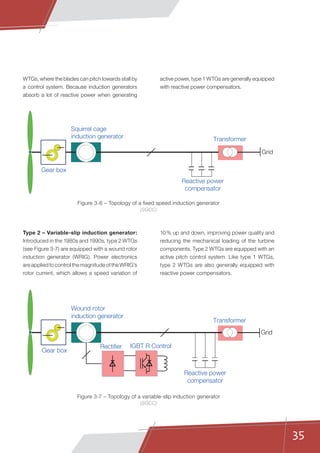
Type 1 – Fixed speed induction generator:
Introduced and widely used in the 1980s, type 1
WTGs (see Figure 3-6) are based on a squirrel
cage induction generator (SCIG). They can only
slightly vary their rotation speed (1 %-2 %), i.e.
they are almost “fixed speed”, thus their output
fluctuates as wind speed varies. To alleviate
this problem, a double-speed version of the
type 1 WTG was developed. Original type 1 WTGs
have few control options but passive stall. Active
stall designs can be adopted in improved type 1
35
WTGs, where the blades can pitch towards stall by
a control system. Because induction generators
absorb a lot of reactive power when generating
active power, type 1 WTGs are generally equipped
with reactive power compensators.
Grid
Squirrel cage
induction generator
Gear box
Reactive power
compensator
Transformer
Grid
Wound rotor
induction generator
Gear box
Transformer
Reactive power
compensator
Rectifier IGBT R Control
Figure 3-6 – Topology of a fixed speed induction generator
(SGCC)
Figure 3-7 – Topology of a variable-slip induction generator
(SGCC)
Type 2 – Variable-slip induction generator:
Introduced in the 1980s and 1990s, type 2 WTGs
(see Figure 3-7) are equipped with a wound rotor
induction generator (WRIG). Power electronics
are applied to control the magnitude of the WRIG’s
rotor current, which allows a speed variation of
10 % up and down, improving power quality and
reducing the mechanical loading of the turbine
components. Type 2 WTGs are equipped with an
active pitch control system. Like type 1 WTGs,
type 2 WTGs are also generally equipped with
reactive power compensators.
36 S E C T I O N 3
Present: state of the art in integrating large-capacity RE
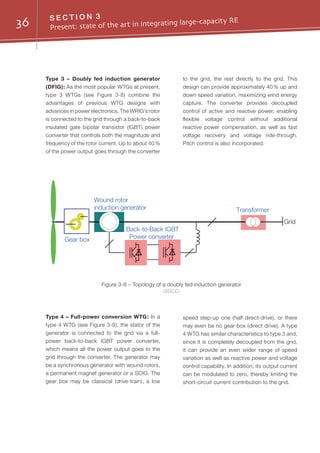
Type 3 – Doubly fed induction generator
(DFIG): As the most popular WTGs at present,
type 3 WTGs (see Figure 3-8) combine the
advantages of previous WTG designs with
advances in power electronics. The WRIG’s rotor
is connected to the grid through a back-to-back
insulated gate bipolar transistor (IGBT) power
converter that controls both the magnitude and
frequency of the rotor current. Up to about 40 %
of the power output goes through the converter
to the grid, the rest directly to the grid. This
design can provide approximately 40 % up and
down speed variation, maximizing wind energy
capture. The converter provides decoupled
control of active and reactive power, enabling
flexible voltage control without additional
reactive power compensation, as well as fast
voltage recovery and voltage ride-through.
Pitch control is also incorporated.
Grid
Gear box
Transformer
Back-to-Back IGBT
Power converter
Wound rotor
induction generator
Figure 3-8 – Topology of a doubly fed induction generator
(SGCC)
Type 4 – Full-power conversion WTG: In a
type 4 WTG (see Figure 3-9), the stator of the
generator is connected to the grid via a full-
power back-to-back IGBT power converter,
which means all the power output goes to the
grid through the converter. The generator may
be a synchronous generator with wound rotors,
a permanent magnet generator or a SCIG. The
gear box may be classical (drive-train), a low
speed step-up one (half direct-drive), or there
may even be no gear box (direct drive). A type
4 WTG has similar characteristics to type 3 and,
since it is completely decoupled from the grid,
it can provide an even wider range of speed
variation as well as reactive power and voltage
control capability. In addition, its output current
can be modulated to zero, thereby limiting the
short-circuit current contribution to the grid.
37
3) Offshore wind power generation
Offshore sites generally have better wind
resources than onshore sites, so WTGs
installed in offshore sites can achieve
significantly more full-load hours. Offshore
wind farm development can also relax many
constraints faced by onshore wind farms, such
as transport and land occupation. Today’s
offshore WTGs are essentially large onshore
ones with, for example, enhanced corrosion
protection. A specific offshore wind power
industry is developing and a specific offshore
supply chain is emerging [iea11]. A number of
WTG manufacturers have now developed large
WTGs with a capacity of more than 3 MW for
the offshore wind power market, and some
have been installed for trials. Future WTGs will
be even larger and specially tailored for offshore
applications. Offshore wind farms will also
be large in scale compared to onshore wind
farms. For instance, several planned projects
in the North Sea and the East China Sea have
capacities of well over 1 000 MW.
However, a number of issues make the
construction of offshore wind farms more
challenging and costly than onshore wind
farms, such as support structures for the large
turbines, difficult weather conditions, lengthy
and costly transmission cables and extended
transmission systems, high wind speed and
deep water, environmental issues and the
impact on other marine stakeholders [iea11].
In spite of this, offshore wind power is growing
and will grow more rapidly in the future with
improvements in the technology.
Grid
Synchronous
or induction
generator
Gear box
Transformer
Back-to-Back IGBT
Power converter
Figure 3-10 – The Shanghai Donghaidaqiao
offshore wind farm
(SGCC)
Figure 3-9 – Topology of a full-power conversion WTG
(SGCC)
38 S E C T I O N 3
Present: state of the art in integrating large-capacity RE
3.2.2	 PV power generation
1) Basics of PV power generation
Made of semiconductor materials, a photovoltaic
(PV) cell directly converts solar energy into
direct-current electricity. When sunlight shines
on an individual PV cell, the energy that the
cell absorbs from the sunlight is transferred to
electrons in the atoms of the semiconductor
material. These energized electrons then
become a part of the electrical current in the
circuit, generating electricity.
PV cells are connected in series and in parallel
to one another to form PV modules with
capacities of typically 50 W-200 W. PV modules,
combined with a set of additional application-
dependent system components (e.g. inverters,
sun trackers, batteries, electrical components
and mounting systems), form a PV system,
which is highly modular, with capacities ranging
from a few watts to tens of megawatts [iea11].
Large utility-scale PV systems are usually called
PV power stations. The structure diagram of a
PV power station is given in Figure 3-11.
Power grid
Step-up
transformer
PV panel
Cable
Lower voltage busbar
High voltage busbar
AC
DC
AC
DC
AC
DC
Inverter Inverter Inverter
Figure 3-11 – Structure diagram of a PV power station
39
2) Types of PV power generation
technologies
According to the materials and design, current
PV power generation technologies can be
classified into crystalline silicon, thin-film and
concentrating PV (see Figures 3-12 and 3-13).
Crystalline silicon PV is currently the best-
established PV technology, with an energy
conversion efficiency of up to 20 %. More
recently, thin-film PV, which can also use non-
silicon semiconductor materials, is gaining
attention. Although thin-film PV generally has a
lower efficiency than silicon PV (around 11 %),
it is less expensive and less energy-intensive to
manufacture and is also more flexible for versatile
applications. Concentrating PV, in which sunlight
is concentrated and strengthened by a lens
before it reaches the PV cells, is on the edge of
entering full market deployment. Concentrating
PV can reach an efficiency of up to 40 %. Other
technologies, such as organic PV cells, are still in
the research phase [hts09] [iea11].
Figure 3-12 – Thin-film and silicon PV
Figure 3-13 – Concentrating PV
(SGCC)
(a) A-Si Thin-film PV (b) Polycrystalline silicon PV
40 S E C T I O N 3
Present: state of the art in integrating large-capacity RE
3) Characteristics of PV power generation
One of the key components of PV systems
is the inverter. DC output from PV systems is
changed into AC by inverters. The performance
of the inverter is especially important for grid-
connected PV power plants, since it directly
influences whether the PV power plant can
meet the requirements of grid operation. Most
inverters have low voltage ride through (LVRT)
and flexible active and reactive power control
capabilities. However, since there is no rotating
component, PV systems cannot supply inertia
support to the power system.
Compared to CSP described below, PV power
generation (except for concentrating PV) has
the advantage that it can use not only direct
sunlight but also the diffuse component of
sunlight to generate electricity, which allows
its effective deployment in many more regions.
Compared to wind power generation, PV power
generation is less challenging for grid integration
because sunlight is more predictable than wind.
Up to now, the comparatively high cost of PV
power generation has been the main barrier to
its mass deployment [iea11].
3.2.3	 Concentrated solar power
generation
1) Basics of CSP generation
CSP generation, also known as solar thermal
power generation, is much like conventional
thermal power generation that converts thermal
energy into electricity, but differs in how the
thermal energy is obtained. CSP plants use
various mirror configurations (with a sun tracking
system) to reflect and concentrate direct-beam
sunlight to heat the working fluid flows (such as
air, water, oil or molten salt) in the receivers to a
high temperature, thus converting solar energy
into thermal energy (see Figure 3-14).
receiver
reflector
directsolarbeam
radiation
Figure 3-14 – Principle of obtaining thermal
energy in CSP
[dlr05]
Using a generator driven by a steam turbine, gas
turbine or heat engine, this thermal energy is
then converted into electricity. CSP plants may
also be equipped with thermal energy storage
systems for operating during cloudy periods or
at night. A typical stand-alone CSP plant has a
configuration such as that in Figure 3-15.
41
A CSP plant can also be designed as a hybrid
system that uses fossil fuel to supplement the
thermal output during low solar radiation periods
(see Figure 3-16), making the plant output
more stable and dispatchable. It can also be
integrated with a conventional combined-cycle
plant to improve energy efficiency.
Collector Field
Storage
Tank
Solar Steam
Generator
Turbine
Grid
Condenser
Heat Transfer Fluid
Steam
Generator
Collector Field
Storage
Tank
HTF
Heater
Solar Steam
Generator
Boiler
Turbine / Generator
Grid
Condenser
Fuel
Fuel
Heat Transfer Fluid (HTF)
Steam
Figure 3-15 – Stand-alone CSP plant
[gre12]
Figure 3-16 – Hybrid CSP plant
[gre12]
42 S E C T I O N 3
Present: state of the art in integrating large-capacity RE
2) Types of CSP generation technologies
According to how the solar energy is collected,
present CSP technologies can be classified into
four major types [dlr05] [hts09] [iea11]: parabolic
trough, linear Fresnel reflector, solar tower and
parabolic dish systems (see Figure 3-17).
‱	 Parabolic trough systems use long
rows of parabolic mirrors to reflect and
concentrate sunlight beams onto a linear
receiver tube that contains the working
fluids
‱	 Linear Fresnel reflector systems use
long rows of flat or slightly curved mirrors
to concentrate the sunlight beams onto
a downward-facing linear receiver tube
fixed in space above the mirrors
‱	 Solar tower systems, also known as
central receiver systems, use numerous
large, flat mirrors to concentrate sunlight
beams onto a receiver at the top of a
tower
‱	 Parabolic dish systems, also known as
dish/engine systems, concentrate sunlight
Figure 3-17 – Types of CSP technologies
[dlr05]
(a) Parabolic trough system
(b) Linear Fresnel reflector (LFR)
(c) Solar tower
(d) Parabolic dish
43
beams onto the focal point of a single
dish, where the receiver and an engine/
generator (such as a Stirling machine or a
micro-turbine) are installed
The capacity of parabolic trough, linear Fresnel
reflector and solar tower systems can reach
hundreds of megawatts, while the capacity of
dish/engine systems is generally in the 10 kW
range, suitable only for distributed generation.
The solar-to-electricity efficiency of parabolic
trough systems has been demonstrated to be
about 10 %-15 %, with a perspective of reaching
about 18 % in the medium term.
3) Characteristics of CSP generation
CSP is advantageous in that it offers a utility-
scale, dispatchable and firm RE option. With the
inherent energy storage capability in the form
of heat that can be used to generate electricity
up to hours later, and with further support from
additional thermal storage systems or a hybrid
system design, CSP plants can continue to
produce stable electricity even when clouds
block the sun or the sun sets. So it is much less
challenging to integrate CSP than wind or PV
generation into power systems.
Although CSP has better performance for grid
integration, the relatively immature technology
and the high cost are currently limiting its large-
scale deployment.
One disadvantage of CSP is that it requires
strong direct sunlight. As a result, adequate CSP
resources are generally limited to semi-arid, hot
regions or deserts. At the same time, like other
thermal power generation plants, CSP requires
water for cooling and condensation, which
means a tremendous challenge in exploiting
CSP resources in arid regions. Dry cooling (with
air) is an effective alternative, but with higher
costs and lower operating efficiencies.
3.3 Transmission technology
Large-capacity RE generation plants are
usually far from load centres, and they therefore
need long-distance power transmission. Up to
now, AC transmission has been used for large-
capacity RE power transmission, and voltage
source converter high voltage DC (VSC-HVDC)
transmission has been used for offshore wind
power integration. Examples will be given in
this section. Ultra-high voltage AC (UHVAC) and
current source converter HV/UHVDC (CSC-
HV/UHVDC) are planned to be used in large-
capacity RE power transmission; these will be
described in section 4.
3.3.1 AC transmission
AC transmission is a mature technology.
The capacity of an AC transmission line is
proportional to the square of the voltage level
and inversely proportional to the impedance of
the line, which increases with the transmission
distance. To achieve a large increase in the
transmission capacity of long-distance AC
lines, a natural way is to raise the voltage level.
The approximate transmission capacities and
distances of different voltage-level AC lines
are listed in Table 3-1 [sgc07]. For small-to-
medium scale RE power plants, transmission
lines below 330 kV are usually used. For large-
scale, long-distance RE power, transmission
lines above 500 kV are usually needed. Some
examples of AC transmission above 500 kV
for RE integration in China and the USA are
described below.
44 S E C T I O N 3
Present: state of the art in integrating large-capacity RE
1) USA
Currently, three major 500 kV transmission
projects are under construction or have been
approved in Southern California for RE power
transmission [ete11], a summary of which is
given in Table 3-2.
2) China
In November 2010, a 2 398 km double-circuit
750 kV transmission line was commissioned for
the interconnection of the Xinjiang power grid
and the Northwest power grid as well as for the
transmission of the phase I Jiuquan wind power
base. Jiuquan wind power base phase I has an
installed capacity of 5 160 MW. A small portion
is locally consumed, while most is transmitted
to the load centre of the Northwest power grid
(see Figure 3-18). A second 750 kV transmission
corridor is now under construction. 500 kV
transmission lines have also been built for the
Jilin wind power base in Northeast China.
Table 3-1 – Typical transmission capacities and distances of different voltage-level AC lines
Table 3-2 – Three AC transmission projects in California for RE power transmission
Voltage level (kV) Capacity (MW) Distance (km)
110 10-50 50-150
220 100-500 100-300
330 200-800 200-600
500 1 000-1 500 150-850
765 2 000-2 500 Above 500
Project
RE integration
capacity provided
by project (MW)
Transmission
line length
(km)
Purpose
Sunrise Power Link 1 700 196
Enhance grid connection between
Imperial Valley and San Diego,
transmitting wind, solar and
geothermal power from Imperial Valley
and Arizona to San Diego
Tehachapi
Renewable
Transmission Project
5 850 530
Transmitting wind and solar power in
Tehachapi area
Colorado River
Devers Valley (CDV)
4 700 270
Transmitting wind and solar power
in the Blythe area between California
and Arizona
45
3.3.2 VSC-HVDC transmission
IGBT-based VSC-HVDC differs from the
conventional thyristor-based current source
converter HVDC (CSC-HVDC, also known
as line commutated converter HVDC (LCC-
HVDC)) in that it is self-commutated via control
circuits driven by pulse-width modulation, while
CSC-HVDC is line-commutated, i.e. switched
off when the thyristor is reversely-biased from
the AC voltage [wei11]. Compared to CSC-
HVDC, VSC-HVDC offers among others the
following major advantages [vsc10]:
1) It can rapidly control both real and reactive
power, independently, within its rated MVA
capacity. As a result, it can transmit very low
and even zero active power, which is suited to
the frequent and wide-range output fluctuation
of RE generation, while CSC-HVDC is limited by
minimum startup power. VSC-HVDC terminals
can generate or absorb a given amount of
reactive power as instructed or according to
the voltage level of the connected AC grid,
providing excellent voltage support, while CSC-
HVDC terminals always absorb reactive power
when working, requiring large amounts of
reactive power compensation.
2) It can rapidly reverse the reactive power
direction merely by reversing the current
direction, without changing the voltage polarity
as CSC-HVDC requires. It therefore needs no
changes in the topology and strategy of the
converter station control system.
3) It does not require support from the connected
AC grid for commutation as CSC-HVDC does,
and can therefore be connected to weak or even
passive AC grids, while CSC-HVDC requires the
connected AC grid to be sufficiently strong.
Due to these advantages, VSC-HVDC is desirable
for RE integration, especially for offshore wind
power, as well as for grid interconnection and
power supply to isolated systems and to crowded
metropolitan areas. The fast development of
RE has led to a rapid increase in VSC-HVDC
projects in recent years. Some VSC-HVDC
projects commissioned for RE integration are
listed in Table 3-3. There were also 12 VSC-
HVDC transmission projects under construction
all over the world at the end of October, 2011.
From 2009 onwards, the total capacity of VSC-
HVDC projects under construction in the world
has reached 10 GW, which is four times higher
than that of the projects built before 2009.
Xinjiang
Load centre
Jiuquan wind power base
Over 1 000 km
Figure 3-18 – Transmission of the phase I Jiuquan wind power base, Northwest China
(SGCC)
46 S E C T I O N 3
Present: state of the art in integrating large-capacity RE
3.4	 Operational technologies
and practices
This section focuses on operational technologies
and practices related to wind power, since wind
power generation is currently the most widely
deployed large-capacity RE generation and has
significant impacts on power system operations.
Much has been done to address these impacts
by researchers and grid operators worldwide.
Similar technologies and practices can also be
used for PV and solar thermal power generation.
For the operation of power systems with high
penetration of large-capacity RE generation, RE
power forecasting is critical for grid operators
to carry out operational planning studies and
ensure that adequate resources are available
for managing the variability of RE output.
3.4.1	 Power forecasting
1) Forecasting methods
Based on the time scale of the forecast, wind
power forecasting can be classified as ultra-
short-term forecasting, short-term forecasting
and medium/long-term forecasting. Short-term
forecasting is currently the most widely used,
with a time scale up to 48-72h. The principle
of short-term wind power forecasting is shown
in Figure 3-19. Present methods for short-
term wind power forecasting generally include
physical methods, statistical methods, and a
hybrid of the two.
‱	 Physical methods start with a numerical
weather prediction (NWP) model, which
provides the expected wind speed and
direction at a future point in time. Further
steps include the application of the NWP
model results to the wind farm site, the
conversion of the local wind speed to
power, and the further application of the
forecast to a whole region [ewe05].
‱	 Statistical methods first establish the
relationship between the historical NWP
data and the historical power output data
of wind farms via one or more learning
algorithms, and then predict the wind farm
power output based on this relationship.
The advantages and disadvantages of the two
types of method are shown in Table 3-4.
Table 3-3 – VSC-HVDC projects commissioned for RE integration
Year Project Country MW / kV / km Remarks
1999 Gotland Sweden 50 / ±80 / 70
Onshore wind power integration
(voltage support)
2000 TjÊreborg Denmark 7.2 / ±9 / 4.3
Onshore wind power integration
(testing for offshore wind power
integration)
2009 Nord E.ON 1 Germany 400 / ±150 / 203 Offshore wind power integration
2011 Shanghai Nanhui China 18 / ±30 / 10 Offshore wind power integration
47
Figure 3-19 – Principle of short-term wind power forecasting
(SGCC)
Numerical weather
prediction (NWP)
Forecast program
Power output
forecast
Some of the major short-term wind power
forecasting programs available on the market
are listed in Table 3-5. Although the current
programs are already able to provide valuable
forecast results, further improvement is eagerly
expected [ewe05].
Methods Advantages Disadvantages
Physical
methods
‱	 Require no historical power output
data for the wind farms; suitable for
new wind farms.
‱	 Based on detailed analysis of each
atmospheric process; the forecasting
model can be optimized to obtain
more accurate forecasts.
‱	 Very sensitive to systematic
errors caused by incorrect initial
information.
Statistical
methods
‱	 High accuracy can be achieved if
high-quality data can be obtained.
‱	 Self-adjustment can be made to give
appropriate output even if the input is
not included in the training set.
‱	 Require a great deal of highly
consistent historical data.
‱	 Work like a black box, difficult
to understand the learning and
decision-making process and
optimize the model.
Table 3-4 – Advantages and disadvantages of two forecasting methods
48 S E C T I O N 3
Present: state of the art in integrating large-capacity RE
Table 3-5 – Overview of short-term wind power forecasting programs
Program Developer Methods Country
Operational
since
Prediktor
RISO National Laboratory
(DK)
Physical
Spain, Denmark,
Ireland, Germany, USA
1994
WPPT
IMM, Technical University
of Denmark
Statistical
Denmark (East and
West)
1994
Previento
University of Oldenburg
and Energy  Meteo
System (DE)
Physical Germany 2002
AWPPS (More-
Care)
Armines/Ecole des Mines
de Paris (F)
Statistical,
Fuzzy-ANN
Ireland, Crete (Greece),
Madeira (Portugal)
1998,2002
RAL (More-
Care)
RAL (UK) Statistical Ireland --
Sipreolico
University of Carlos III,
Madrid; Red Eléctrica de
España
Statistical 4 GW, Spain 2002
Local Pred-
RegioPred
CENER (ES) Physical Spain 2001
Casandra Gamesa (ES) Physical Spain, Portugal, USA 2003
GH Forecaster Garrad Hassan (UK)
Physical and
Statistical
Spain, Ireland, UK, USA,
Australia
2004
eWind TrueWind (USA)
Physical and
Statistical
Spain (represented
though Meteosim), USA
1998
HIRPOM
University College
Cork, Ireland; Danish
Meteorological Institute
Statistical Under development --
AWPT ISET (DE)
Statistical,
ANN
15 GW, Germany 2001
AleaWind Aleasoft (ES) Statistical Spain 2004
Scirocco Aeolis (NL) Physical Netherlands, Spain 2004
Meteologica MBB Physical Spain 2004
Meteotemp No specific model name Physical Spain 2004
WPFS CEPRI
Physical and
Statistical
China 2009
49
2) Forecast accuracy
The accuracy of wind power forecasting can
be measured by different indices. Root mean
square error (RMSE) normalized to the installed
wind power is most commonly used. Regardless
of the forecasting method used, the forecast
error (RMSE) for a single wind farm is between
10 % and 20 % of the installed wind power
capacity for a horizon of 36 hours [ewe05].
Spatial aggregation greatly reduces forecast
errors, just as it reduces variability. As seen in
Figure 3-20, the level of accuracy improves as
the size of the region considered for forecasting
increases. This is due to spatial smoothing
effects. The error reduction shown along the
vertical axis in Figure 3-20 is the ratio between
the RMSE of a regional prediction and the RMSE
of forecasting for a single site, and is based on the
measured power production of 40 wind farms in
Germany. Aggregation over a 750 km region may
reduce forecasting error by about 50 % [eis11]. If
forecasting is scaled up to apply to the aggregated
wind power of a large area, the forecast error
(RMSE) can drop to below 10 % [ewe05].
On the other hand, the forecast error increases
as the time horizon of the forecast increases,
as shown in Figure 3-21, which also shows the
improvement in forecasting techniques over the
years. Generally, the error for 1-2 hours ahead
for a single farm forecast can be about 5 %-7 %,
and can reach 20 % for day-ahead forecasts.
Figure 3-20 – Decrease of wind forecast error
for aggregated wind power production
[hol09] (energy  meteo systems)
Figure 3-21 – Wind forecast error as a percentage of wind production, as a function
of the time forward from the present
[uei10]
0
0.2
0.4
0.6
0.8
1
0 500 1 000 1 500 2 000
Errorreduction
Region size (km)
Meanabsoluteerror/meanproduction(%)
WIND FORECAST EVOLUTION – 2005-2008 (DATA FROM RED ELECTRICA ESPANA)
40
35
30
25
20
15
10
5
0
0 1 4 7 10 13 16 19 22 25
Hours
28 31 34 37 40 43 46 49
2007
2006
2005
2008
50 S E C T I O N 3
Present: state of the art in integrating large-capacity RE
3.4.2	 Operational practices
Due to the differences in RE generation
development, the conventional generation fleet,
grid structure as well as market and institutional
environments, the operational practices
related to RE integration are quite different in
different countries or regions. Some operational
practices related to wind power integration in
major countries are briefly introduced below.
1) China
According to the Renewable Energy Law and
related regulations, wind power (and other
renewables) should be given first priority in
generation scheduling and dispatching under
normal power system operating conditions. To
meet this requirement, grid operators consider
predicted wind power generation in the mid-to-
long term, day-ahead and intra-day operation
planning processes and fully exploit flexibility
from conventional power plants, as well as the
capacity of inter-grid tie-lines to accommodate
the maximum wind power while maintaining
system security and reliability (see Figure 3-22)
[sgc11] [wei11].
The requirement is also emphasized for
WPPs to be equipped with control and
monitoring systems; these serve to enhance
their controllability and provide operational
information to grid operators. To date, all
grid-connected WPPs have been equipped
with control and monitoring systems that can
communicate with the dispatching centres in
real time.
Wind power forecasting systems have been
deployed in several regional or provincial
dispatching centres in the State Grid Corporation
of China (SGCC), but only about 30 WPPs have
established a plant-level wind power forecasting
system, a situation needing to be improved by
more stringent management. A SGCC NWP
centre has also been established in the China
Electric Power Research Institute (CEPRI) to
provide weather information needed by the
wind power forecasting systems. Based on
wind power forecasting at different time scales,
a “wind power optimal dispatching decision
support system” had been developed and put
into operation in the dispatching centre of the
Jilin provincial power grid (see Figure 3-23).
Figure 3-22 – System operation in China taking wind power into account
[sgc11]
Mid-long term
Forecast
Day-ahead
forecast
Intra-day
forecast
Wind power forecast
Wind energy
scheduling
Day-ahead
scheduling of
WPPs
Real-time
control of WPPs
Entire grid
Operation planning,
Unit commitment
Wind/Conventional power plant dispatch
Day-ahead scheduling
of conventional plants
Real-time control of
conventional plants
Entire grid
Entire grid
and WPP
and WPP
51
Figure 3-23 – The “wind power optimal dispatching decision support system” in Jilin
[sgc11]
WP information
input
Day-head  real
time WP plan
WP forecasting WPP control
Security analysis
regarding WP
Analysis and display
of WP operation data
D5000 dispatching platform
AVC
AGC
2) Denmark
Energinet.dk, the transmission system operator
(TSO) of Denmark, mainly uses two wind power
forecast tools: one external and one internal. The
external forecast tool gives a 0-12 hour forecast
every 5 minutes and a 0-48 hour forecast every
hour. The input to the forecasting includes four
different numerical weather predictions. The
internal forecast tool includes a 0-6 hour short-
term forecast and a 12-36 hour day-ahead
forecast.
A well-functioning power market and an
automatic dispatching system have been
established throughout the north European
power system including Denmark, through
which the hydropower in Norway and Sweden
is often used to balance the wind power in
Denmark. Figure 3-24 shows the monitoring
curves of power generation and exchange,
where line A is total power production based
on individual 5-minute schedules from all
power plants, lines B are exchange plans with
neighbouring grids (Western part of Denmark
(DK1) to SvK in Sweden, DK1 to Tennet in
Germany, DK1 to ENDK in Denmark and DK1 to
SN in Norway, from top to bottom). In general,
the Nordic Power System can be balanced by
trading: the additional electricity produced by
WPPs is purchased at a low price and sold to
the other grids at a higher price. In addition
co-generation plants and electric boilers play
an important role in winter in balancing the
fluctuations caused by large-scale wind power.
52 S E C T I O N 3
Present: state of the art in integrating large-capacity RE
3) Germany
Three of the four TSOs in Germany (50Hertz,
Tennet, Amprion and ENBW) have established
wind power forecasting systems, covering
approximately 98 % of Germany’s wind
power capacity. For example, the Amprion
company has set up a Front Office to manage
the operation of the forecasting system and
optimize the forecast results by a combination
tool (see Figure 3-25). Amprion shares wind
power forecasting data (day-ahead and ultra-
short-term) with other members of TSC (TSO
Security Cooperation).
In September 2004, the German “Renewable
Energy Sources Act” amendment introduced
a new mechanism for wind power balancing,
which requires each system operator to
contribute to balancing the whole country's
wind power output in proportion to the size of
its regional grid.
This mechanism allocates wind power and the
associated fluctuation to each system operator
in real time. It is more equitable in the distribution
of balance services and related costs. The four
system operators have developed a real-time
wind power monitoring system to determine
the wind power balancing capacity that every
system operator should be responsible for.
In fact, as concerns wind power, the regional
grids have integrated into a single large grid in
Germany.
In certain areas, the wind power output will
sometimes exceed the transmission capacity of
the grid, and the grid managers have a legal
obligation to increase power transmission
capacity. In the interim period before the
additional capacity objectives are achieved, the
grid managers can require the wind farms to
reduce their power output or shut down some
of the wind turbines.
Figure 3-24 – Monitoring power generation and power exchange with neighbouring grids
[sad11]
A
B
53
4) Japan
Japan’s power system consists of two parts, the
Western 60 Hz network and the Eastern 50 Hz
network, which are interconnected through
frequency converter stations. The Eastern
network consists of three utilities: the Hokkaido
Electric Power Company (EP), Tohoku EP
and Tokyo Electric Power Company (TEPCO).
Hokkaido EP is interconnected with Tohoku EP
through DC submarine cables, and Tohoku EP
and TEPCO are connected by a 500 kV double-
circuit AC transmission line (see Figure 3-26).
The areas suitable for wind power generation
are limited by geographical factors, and they are
unfortunately concentrated in areas whose system
capacities are comparatively small. Most wind
resources are located in the smaller Hokkaido
and Tohoku EP areas, where peak demand is
around 5 GW and 15 GW respectively. In the
area of TEPCO, which has an electricity demand
of 60 GW including the Tokyo metropolitan area,
there are few suitable locations for wind power.
This situation poses a challenge for wind power
integration, since the amount of RE that can be
integrated into a grid depends on the capacity of
the network where the RE is located.
To enhance wind power integration, one option
is to use inter-ties between utilities efficiently
to balance wind power generation output. In
2010, collaboration schemes were launched by
the three utilities for timely sharing of the wind
power forecasts in the Hokkaido and Tohoku
EP areas, and closely monitoring the power flow
of all the inter-ties from Hokkaido EP to TEPCO.
If there is room for extra power flow in the inter-
ties and other grid conditions permit, wind
power generated in the Hokkaido and Tohoku
EP areas can be transmitted to TEPCO, with
the output of the thermal power plants being
reduced accordingly to absorb the incoming
wind power. These collaboration schemes will
improve the utilities’ capability to accommodate
wind power, but the capability is limited by the
capacity of the inter-ties. When the capacity of
the inter-ties is insufficient, excess wind power
generation has to be curtailed.
Figure 3-25 – Schematic of a combination tool for wind power forecast
(Amprion Company)
Weighting of the forecats
and combination
Optimal forecast of wind power
for specific weather situation
Wind power Prediction - Combination tool
Classification of the
weather situation
54 S E C T I O N 3
Present: state of the art in integrating large-capacity RE
5) Spain
Red Eléctrica de España (REE), the only grid
company in Spain, has established the world's
first RE power control centre (CECRE in
Spanish), which is responsible for scheduling
and controlling national RE generation.
Wind farms are also required to set up real-time
control centres, and the control centres of the
wind farms with an installed capacity greater
than 10 MW must connect directly to CECRE,
as shown in Figure 3-27. These control centres
must be able to control wind power output
according to setting values issued by CECRE
within 15 minutes at any time. For power system
security reasons, if necessary, REE has the
right to reduce the wind power output.
CECRE carries out three-phase permanent
fault simulation on the 70 different substations’
buses every 20 minutes, using an assessment
programme named GEMAS (Maximum
Admissible Wind Power Generation System).
On one hand, it can determine the maximum
RE which the entire system can accommodate
while still guaranteeing system security. On the
other hand, using an optimization method, it
can calculate the maximum output of each wind
farm. The resulting setting thus calculated is
sent by CECRE to every control centre. Figure
3-28 shows typical scheduled and actual wind
power output curves in a day.
Figure 3-26 – Three utilities in the eastern half of Japan
55
wind facilities to self-schedule according to
shared forecasting technologies. The New York
Independent System Operator (NYISO) requires
wind farms to behave like conventional power
in order to participate in real-time electricity
markets: in certain circumstances, the wind
farm must reduce output power or be fined if
it exceeds the value specified in scheduling
instructions.
6) USA
Due to different grid composition, rules and wind
power penetration, the various regional grids of
the USA have developed widely varying wind
power scheduling, dispatch and operational
mechanisms. For example, the California
Independent System Operator (CAISO), as
a leader in state-of-the-art mechanisms,
has developed a Participating Intermittent
Resource Program (PIRP) that allows individual
Figure 3-27 – Interconnection between wind farms and CECRE
(REE)
Figure 3-28 – Scheduled and actual daily curves of wind power output
VSAT
HUB
CECRE
Wind Farm
ADSLControl
center
Tele
control
Special channel
Point
to
point
18:08 set point
change 23Ă 11
19:07 End
18:17 new set
point 11Ă 8 18:27 new set
point 8Ă 12
18:52 new set
point 12Ă 23
56 S E C T I O N 3
Present: state of the art in integrating large-capacity RE
In the western portions of the USA outside
CAISO, which follow reliability standards
set by the Western Electricity Coordinating
Council (WECC), an even greater degree
of diversity is present. Because of a lack of
organized, open electricity markets, the WECC
is primarily managed by vertically-integrated
investor-owned utilities (IOUs), federally owned
power marketing administrations (PMAs),
and municipal and rural utilities that primarily
purchase power at wholesale to serve local
loads. Each utility has its own scheduling
and dispatch procedures according to
the peculiarities of its generation mix, and
energy trading between utilities is difficult
and dominated by long-term power-purchase
agreements. Nevertheless, many utilities
integrate renewables into day-ahead, hour-
ahead, and real-time scheduling procedures,
much like the open markets of the Eastern
Interconnect and the CAISO. Rule changes are
underway in the WECC, and utilities with higher
proportions of renewable power are pressing
for more robust energy imbalance markets in
order to ease RE integration costs. Though it
is the least-organized of US power markets,
the WECC is of critical importance to the USA
due to its high resource concentrations of RE
and the presence of very large federal PMAs
such as the Western Area Power Administration
(WAPA) and the Bonneville Power Authority
(BPA), which are under the direction of the US
Department of Energy.
Future: technical solutions
for integrating more
large-capacity RE
SECTION 4
58 S E C T I O N 4	
Future: technical solutions for integrating more large-capacity RE
4.1	General
As we have seen, integrating more large-
capacity RE into the grid brings variability and
uncertainty. At the same time, there will continue
to be unexpected disturbances stemming from
load variation, grid faults and conventional
generation outages. Worldwide studies and
experience in recent years have shown that new
technical solutions are needed to address this
conjunction of difficulties. The new solutions
will include new technologies, methods and
practices, applied in order to provide more
flexibility and improve the efficiency of power
systems, constantly balancing generation and
load. Only this will make the power systems
reliable and maintain security of supply, i.e.
avoid any interruption in the supply of power.
The required power system flexibility can be
achieved on the generation side, from both
RE generation and conventional generation. It
should first be pursued using grid-friendly RE
generation. This means mitigating the impacts of
RE generation on the power system, enabling it
to contribute to system reliability and stability by
improving its design and control technologies.
However, the amount of flexibility which can be
achieved by this approach is limited. Flexibility
from conventional generation is currently the
major source of power system flexibility, and is
generally referred to as “generation flexibility”.
Flexibility can also be achieved from the load
side through demand response, and from
energy storage that can act as either generation
or load (see Figure 4-1). In addition to adding
new flexibility, existing flexibility can be better
exploited by operational enhancement within
a balancing area, and can be shared in wider
geographic footprints by cooperation between,
or consolidation of, smaller balancing areas,
supported by transmission expansion.
The application of energy storage to support
large-capacity RE integration will be discussed
separately in section 5, while the other solutions
mentioned will be discussed in this section.
Figure 4-1 – System flexibility vs. variability and uncertainty
(SGCC)
Variability and
uncertainty
System
flexibility
Conventional generation outages Conventional generation
flexibility
Grid faults
RE output fluctuation
Load variation
Grid -friendly RE generation
Demand response
EES
59
4.2	 Grid-friendly RE generation
4.2.1	 Need for grid-friendly RE
generation
At the beginning of its development RE
generation technology focused more on tapping
the maximum power from RE resources. It
neglected to make any contribution to power
system reliability and stability and in the absence
of standards and incentives was not designed
to operate in a coordinated fashion with the rest
of the system. As long as RE penetration is low
this is manageable and can be accepted by
power system operators. But as RE generation
penetration grows, and especially as the
capacity of RE power plants becomes larger
and larger, this will have a serious impact on
system operation.
For example, in 2011 several serious wind
turbine disconnection incidents occurred
in China due to the lack of fault ride-through
capability (see 4.2.2), including one at the
Jiuquan wind power base on February 24,
which led to the disconnection of 598 wind
turbines from the grid (840.43 MW of power
output) and a significant frequency drop.
Therefore it is becoming increasingly important
that RE generation should play a greater role
in helping to maintain system reliability and
stability, and this may be increasingly required
by interconnection standards. Technologies
have been developed and are continuously
improving at the generating unit, plant and
plant cluster level to make RE generation more
predictable, controllable and dispatchable, or in
other words more grid-friendly.
4.2.2	 Advanced characteristics of RE
generating units and plants
Development of power electronics and
mechanical engineering technologies, as well
as the design of proper control strategies,
have enabled wind generating units to possess
performance comparable or even superior
to those of conventional thermal or hydro
generating units. Some advanced operational
capabilities of wind generating units and the
methods to achieve them are cited below from
[ner09] and [bac11] with minor modifications.
Most of these capabilities can also be achieved
for solar PV generating units since they share
many technical characteristics with wind turbine
generators, especially the inverter-based ones.
1) Voltage/Var control and regulation
Reactive power support and power factor control
can be provided either through a built-in capability
(available for wind generating units types 3 and 4)
or through a combination of switched capacitor
banks and power electronic based transmission
technologies such as static var compensator
(SVC) and static synchronous compensator
(STATCOM) (flexible AC transmission system
(FACTS) equipment as discussed in 4.4.2,
applicable to all types of wind generating units).
2) Fault ride-through
The ability is needed to survive (ride through)
specific low and high voltage/frequency ranges
and durations caused by faults or disturbances
in the power system. Voltage ride-through can be
achieved with all modern wind generating units,
mainly through modifications to the controls. In
some cases, with older type 1 or type 2 wind
60 S E C T I O N 4	
Future: technical solutions for integrating more large-capacity RE
Figure 4-2 – Typical structure of a “grid-friendly” wind power plant
(SGCC)
Power grid
Step-up
transformer
Low voltage busbar
High voltage busbar
SCADA
Reactive
power
compensation
Fault ride-through
control
Active power /
Frequency control
Other control
Reactive power /
Voltage control
Wind farm controller
Communication
module
Dispatch Centre
Command, Data
Measurement
Power
Communication
module
generating units at weak short-circuit nodes in
the transmission system, there may be a need
for additional transmission equipment.
3) Active power control, ramping and
curtailment
This can be achieved through unit control
mechanisms for wind turbine units with active-
stall or pitch control, or discrete tripping of units.
4) Primary frequency regulation
Primary frequency regulation can be supplied
by all units that are equipped with some form of
pitch regulation (i.e. active-stall or pitch control).
5) Inertial response
Inertial response is inherent in type 1 and type 2
units, and can be achieved through supplemental
controls in the converter to emulate inertial
behaviour for type 3 and type 4 units.
6) Short-circuit current control
All inverter-based variable generators have a built-
in capability to limit the fault current to a level that
does not exceed 150 % of the full load current.
For grid integration it is important to view RE
generation at the plant level. An RE power plant
is not just a simple collection of RE generating
units, but is also supported by many other
components and systems so as to function like
a conventional power plant. Based on advanced
generating units, these characteristics can also
be achieved at the plant level. Plant-level reactive
power compensation, accurate RE generation
output forecasting, the presence of monitoring,
control and data communication systems, as well
as properly designed relay protection schemes all
help to improve the predictability, controllability
and dispatchability of RE power plants. An
example of the typical structure of a “grid-friendly”
wind power plant is given in Figure 4-2 [sge11].
61
750 kV Anxi
substation
750kV
Jiuquan
substation
#1
#2
#3
#4
#5
#6
#7 #8
#9
#10200 MW
200MW
200 MW
200MW
200MW
200MW
200 MW
200 MW
200MW200 MW
200 MW
200MW
300 MW
200MW
200 MW
200MW
280 km
330kV
substation
330 kV line
750 kV line
Wind power plant
200 MW
35 kV line
4.2.3	 Centralized control of an RE plant
cluster
The areas with the best RE resources may see
the development of RE power bases with many
RE power plants located adjacent to each other.
A schematic diagram of the Jiuquan Wind Power
Base in Northwest China is given in Figure 4-3
as an example. It is organized in several layers:
arrays of wind turbine generators form a wind
power plant, several plants are connected to
a 330 kV collection substation through 35 kV
lines, and several collection substations are
further connected to a final 750 kV integration
substation through 330 kV transmission lines
of tens of kilometres. In other words, a large-
capacity RE power base may consist of several
RE plant clusters.
The control of the RE power plants in such
a cluster must be coordinated if operational
problems are to be avoided. Taking reactive
Figure 4-3 – Schematic diagram of the Jiuquan Wind Power Base, Gansu, China
(SGCC)
power control as an example [pei12]: with
multiple wind plants having requirements to
provide reactive power and control grid voltages,
problems have emerged when the voltage and
reactive power controllers in nearby plants have
been incompatible, resulting in poor voltage
control and counterproductive reactive power
flows. There have been numerous reports of
one or more plants at maximum reactive power
output while neighbouring plants are absorbing
reactive power. To avoid this kind of situation,
centralized cluster control is an attractive solution.
A centralized cluster control system, configured
in a multi-layer structure such as that depicted in
Figure 4-4, can be used to coordinate the active
and reactive power control of a RE power plant
cluster, just as cascaded hydro power plants on
a river are controlled. Such a centralized cluster
control system, the so-called Large Wind Power
Plants Cluster Active Power Intelligent Control
System, has been developed and deployed at
the Jiuquan Wind Power Base [sgc11].
62 S E C T I O N 4	
Future: technical solutions for integrating more large-capacity RE
4.2.4	 Improvements in modelling RE
generation
In order to represent accurately the static,
dynamic as well as short-circuit performance
of RE generators, plants and clusters and their
impacts on power systems, appropriate models
of the different types of RE generation are
needed.
Up to now, most RE generation modelling efforts
have been carried out at the generator level
[aba11] [bac11] [mma11]. Although RE generator
manufacturers have long been developing and
refining models to improve their generator
design – these are typically user-written
proprietary models on commercial software
platforms – it has now been recognized that
publicly available industry-standard models,
similar to those available for conventional
generation, are needed for planning studies.
Significant progress has been made towards
industry-standard models by the task forces or
working groups under WECC, the Institute of
Electrical and Electronics Engineers (IEEE), the
Utility Wing Integration Group (UWIG) and the
North American Electric Reliability Corporation
(NERC), with the development and distribution
of generic dynamic models for wind turbine
generators. These are models with general
model structures that allow for representation
of wind turbine generators of the same type,
regardless of manufacturer, by selecting
appropriate model parameters. WECC and
IEC groups are moving forwards to refine
and validate these generic models, for which
collaboration between the power engineering
community and wind turbine manufacturers is
necessary. Efforts to develop generic models
for PV have also begun. However, regarding RE
Dispatching centre
Cluster control
station #1
Cluster control
substation #1
Plant
executive
station #1
Cluster control
station #2
Cluster control
#N
Cluster control
#1
Cluster control
#N
Plant
executive
station #N
Plant
executive
station #1
Plant
executive
station #N
Plant
executive
station #1
Plant
executive
station #N
Plant
executive
station #1
Plant
executive
station #N
substation substation substation
Figure 4-4 – RE power plant cluster control system structure
(SGCC)
63
generator modelling, a great deal of research
still needs to be carried out, e.g. to determine
the short-circuit contribution of different types
of RE generators, and to represent the more
advanced and rapidly developing control
characteristics of RE generation, such as those
described in 4.2.2.
IEEE and IEC groups have started to expand
efforts in generic dynamic modelling for
entire wind power plants, including control
and auxiliary equipment [mfc11]. Modelling of
large-scale wind power plants is particularly
challenging due to the fact that they may
consist of tens or even hundreds of individual
generators, distributed over the large footprints
of the plants, and the requirement of being
represented as a single equivalent unit in power
system simulations for simplicity. Techniques
are needed to aggregate the individual
generator models while considering the spatial
and temporal interaction among the generators.
Techniques are also needed to represent all the
cables connecting all the generators as a single
equivalent circuit, and to test the validity of the
equivalent model as a whole. Extending this
modelling work to huge clusters of wind power
plants, such as the 10 GW-scale wind power
bases in China, will be even more difficult.
4.3	 Improved flexibility in
conventional generation
4.3.1	 Need for more flexibility in
conventional generation
Although system flexibility can also be achieved
through demand response and energy storage
as well as through grid-friendly RE generation,
it may take decades for low-cost, large-scale
storage to mature (with the exception of the
widely used but topographically restricted
pumped hydro storage), and demand response
as a flexibility resource is still in its infancy.
Flexibility in conventional power plants (generally
referred to as “generation flexibility”) is therefore
the major source of power system flexibility, and
“the need for increased generation flexibility is
central to the challenges posed by intermittent
renewables” [eis11]. The need for generation
flexibility differs in different countries and regions
due to their different existing generation mix.
Generally, hydro power plants with a reservoir
are most flexible, followed by gas-fired power
plants, then coal-fired power plants and
last nuclear power plants, but it is difficult to
measure flexibility so as to allow use of the
measurements in generation planning.
4.3.2	 Assessment of generation flexibility
1) Flexibility of conventional power plants
The relevant technical characteristics of
conventional power plants that contribute to
operational flexibility are the cycling, ramping and
partial loading capabilities. Cycling capability
is a generator’s ability for frequent and fast
startup or shutdown. Ramping capability is the
rate at which a generator can change its output,
either upwards or downwards. Partial loading
capability is the minimum output level at which
a generator can be stably operated, as well as
the efficiency when operating at different output
levels lower than rated capacity. Due to the
differences in design and technology, different
types of power plants have different levels of
operational flexibility, implying varying impacts
on equipment health, service life, operational
costs and GHG emissions.
64 S E C T I O N 4	
Future: technical solutions for integrating more large-capacity RE
Hydro power plants with reservoirs are very
flexible in operation. They can be easily and
quickly started up or shut down with little impact
on equipment health or service life. They can start
from off-duty status and ramp to full-loading status
in several minutes, and change their capacity
by 50 % in fractions of a minute. Their minimum
output can be very low, which means a regulation
range of near 100 % capacity. However, output
and hence the flexibility contribution of hydro
power plants can be influenced by seasonal
factors (drought and flooding seasons) as well
as non-electricity-sector requirements such as
flood and drought control or environmental and
navigational considerations.
Gas-fired power plants, including natural
gas combined cycle (NGCC) and simple cycle
gas turbine (SCGT) plants, are also flexible
generation resources. Current designs of
SCGTs in operation are able to ramp to 100 MW-
150 MW in 10 minutes, and NGCC plants in
60 to 80 minutes. New NGCC designs with an
increased focus on the ability to operate in a
system with a large proportion of intermittent
renewables are expected to produce 150 MW
in 10 minutes and to ramp to full load in 30
minutes. The ramping rate of NGCC and SCGT
plants is generally up to 8 % per minute. NGCC
plants can reduce their output to 80 % of
capacity with only a minimal heat rate penalty,
but with increasing efficiency losses at lower
outputs [eis11].
Coal-fired power plants have limited
operational flexibility. They are not suitable for
frequent cycling since they may take several
hours to start up or shut down. Their ramping
rates are generally only 1 %-3 % per minute;
new large-capacity generators can reach 5 %
per minute. Their minimum output is generally
70 %-80 % of capacity; new large-capacity or
specially designed peaking generators can go
down to 50 % or lower, but lower output will lead
to higher fuel consumption per kWh generated.
An example is given in Table 4-1 [npg10]. The
flexibility of specific coal-fired power plants
can be influenced by their size, age, operating
pressure, fuel quality and the control systems
installed [eis11].
Table 4-1 – Standard coal consumption of typical 600 MW and 1 000 MW generators
at different loading levels
Loading level
(% of rated capacity)
Standard coal consumption (g/kWh)
1 000 MW ultra-supercritical
generators
600 MW ultra-supercritical
generators
40 % 306 311
50 % 298 303
75 % 287 290
100 % 282 284
65
Nuclear power plants also have limited
operational flexibility and are less used for ramping
for economic reasons. Relatively new nuclear
reactorscandown-ramp20 %oftotaloutputwithin
an hour, but require six to eight hours to ramp
up to full load. Nuclear plant ramping operations
are not fully automated, creating opportunities
for operator error. Although operational costs for
nuclear plants running at partial load versus full
load do not significantly differ, they need to run
as base load units at high output levels to recover
their high capital costs [eis11].
With more large-capacity RE generation being
integrated into power systems, not only the
flexible hydro and gas-fired power plants are
required to adjust their output more frequently,
the coal-fired and nuclear power plants
traditionally operated mainly as base load units
are also shifting to more flexible operation
paradigms. Much effort is needed to better
understand the impact of flexible operation
on the technical, economic and environmental
performance of conventional power plants,
especially thermal power plants, hence to
support the improvement in equipment design,
retrofit and daily operation, as well as the design
of necessary financial incentives.
2) Measuring generation flexibility
The need for more generation flexibility is
well recognized. However, there is currently
a lack of metrics, methods and tools to
measure the flexibility and its related cost of
provision, determine the flexibility required,
and optimize the generation resources to
provide the required flexibility with minimal
cost, all of which would be needed to support
the planning and operation of power systems
with more large-capacity RE. It is much more
difficult to measure generation flexibility than to
measure the adequacy of generation capacity;
the former is more complicated and requires
more data and detailed modelling [trp11].
Collaboration between grid operators and
the research community is desirable to foster
efforts to develop more rigorous methods and
tools to accurately quantify, monitor and assess
the degree of flexibility in a given power system
for a given level of RE penetration [sad11].
The research community has started to
respond to the need for power system flexibility
measurement. The emphasis is on generation
flexibility,currentlythemajorflexibilityresource,but
efforts also include using demand response and
energy storage for flexibility. The Integration of
Variable Generation Task Force (IVGTF) under the
NERC in 2010 released a special report on the
flexibility requirements and metrics for variable
generation [ner10], which discussed the metrics
and approaches for flexibility measurement. The
IEA Grid Integration of Variable Renewables
(GIVAR) project has proposed a semi-quantitative
method supported by qualitatively described
limiting constraints on flexible resources to
assess system flexibility, and a subsequent
project specially targeting the quantification of
system flexibility is expected [fat11]. The Alberta
Electric System Operator (AESO) has developed
a dispatch decision support tool, incorporating
wind power forecasting, to measure system
flexibility and help operators to manage the
increased variability and uncertainty [pao11].
4.3.3	 Generation planning for both
adequate capacity and adequate
flexibility
In power systems with higher variability and
uncertainty due to the integration of more
66 S E C T I O N 4	
Future: technical solutions for integrating more large-capacity RE
Figure 4-5 – Generation planning process incorporating flexibility assessment
[trp11]
large-capacity RE, it is becoming increasingly
important for the generation planning process
to consider not only the adequacy of generation
capacity, but also the adequacy of generation
flexibility. Simply having a specified number of
megawatts of capacity may not be adequate
for system security if that capacity is not flexible
enough to respond to system variability [aba11].
1) Planning for adequate generation
capacity
For capacity planning, the calculation of the
“capacity value” (also known as “capacity credit”)
of RE generation has been recognized as a major
issue. The capacity value of a generation resource
can be defined as the amount of additional load
that can be served due to its addition while
maintaining existing levels of reliability. The
calculation of the capacity value of RE generation
is much more difficult than that of conventional
generation due to its inherent variability and
uncertainty. Research on this issue has received
much attention. Both the IEEE Power  Energy
Society (PES) and the NERC IVGTF have
established task forces to study it. A rigourous
“effective load-carrying capacity” (ELCC) method
based on reliability simulation as well as several
approximate methods have been proposed for
wind power capacity value calculation, and are
being extended to solar power. But there remain a
number of problems, including the representation
of other types of generation in the calculation,
the accuracy of approximate methods and the
requirement of high-quality wind, solar and
synchronized demand data for the ELCC method
to produce reliable results [bac11] [cvw11].
2) Generation planning considering
flexibility at the system level
In order to consider flexibility requirements, a
new paradigm of generation planning is needed.
One example is the approach proposed in
[trp11], adding a flexibility assessment stage into
the planning process, as shown in Figure 4-5.
It starts from the relatively simple traditional
capacity adequacy calculation, using metrics
such as loss of load expectation (LOLE) and
expected unserved energy (EUE), to form an
initial generation portfolio, and then moves to the
more data-intensive system flexibility assessment
and production cost simulation stages. Both of
these stages involve computation-intensive unit
commitment and economic dispatch studies.
This three-stage approach is designed to reflect
the aims of the planning process, i.e. to provide a
reliable, operable, least-cost generation portfolio
for the given study period. If excessive or
inadequate flexibility is observed, the generation
portfolio or unit commitment model can be
altered and the whole process iterated, in order
to find a better generation portfolio that meets
Capacity
adequacy
assessment
System flexibility
assessment
Production cost
simulation
Generation
portfolio
If portfolio is unreliable in operation
67
the dual aims of minimizing cost and meeting a
specified flexibility standard.
Again, the system flexibility assessment is
possible only when metrics measuring flexibility
in the planning context are available, which
is currently not the case. A good start is the
metric named “insufficient ramping resource
expectation” (IRRE) developed by the IEA, which
applies principles similar to those underlying the
LOLE metric for capacity adequacy calculation.
3) Generation planning considering
flexibility at resource site level
Besides incorporating flexibility considerations
into generation planning at the system level,
special designs can also be used at resource
site level to exploit the flexibility of conventional
generation in order to compensate for the
variability and uncertainty of RE.
Such an approach is intended for some wind
power bases in China, where the so-called
“wind-fire bundling” design has been proposed
(see Figures 4-9 and 4-10): coal-fired power
plants are planned near a wind power base
and will share its transmission lines. Wind
power output fluctuations can be smoothed
out by adjusting coal-fired production; thus
the utilization of the transmission line can be
improved as compared to transmitting only
wind power and the average cost of electricity
at the receiving end can be reduced [sgc11].
4.4	 Transmission expansion
4.4.1	 Needs for transmission expansion
Accommodation of large-capacity RE
generation needs large-scale transmission
grid expansion and reinforcement for the
following reasons:
1) Grid expansion and inter-regional connection
are needed to transmit the energy generated by
large-capacity RE sources, which are generally
located far from load centres and the existing
grid.
2) Through grid expansion, the geographic
diversity of RE generation can be exploited
to smooth out their aggregated variability
and uncertainty and to reduce the RE power
forecast error.
3) Grid expansion and reinforcement can
support interconnection between balancing
areas, hence facilitating their cooperation or
consolidation to share flexibility resources.
As shown in [smp11], transmission for RE
integration is an issue everywhere for both
technical and regulatory reasons. An inability to
solve the transmission problem will jeopardize
the achievement of RE goals, and drive up the
cost to reliably integrate these new resources
into power systems.
4.4.2	 Application of new transmission
technologies
1) Higher voltage level AC transmission:
UHVAC
UHVAC transmission lines with rated voltage
levels of 1 150 kV or 1 000 kV were built and
commissioned by the former Soviet Union and
Japan in the 1980s and 1990s, but then operated
at a 500 kV voltage level for practical reasons.
China is now leading the research and application
of 1 000 kV UHVAC transmission, which seems a
desirable technology to meet the need for large-
scale, long-distance power transmission from the
68 S E C T I O N 4	
Future: technical solutions for integrating more large-capacity RE
large coal, hydro, wind and solar energy bases in
the northern and western regions to the central and
eastern regions with huge and still fast-growing
electricity demand. The first 640 km single-circuit
Jindongnan-Nanyang-Jingmen 1 000 kV UHVAC
test and demonstration transmission project was
commissioned in 2009, the reinforcement which
followed was completed at the end of 2011, and
it can now transmit 5 000 MW of power stably.
Some UHVAC projects have been planned to form
part of the large-capacity, long-distance wind
power transmission installation from the West-
Inner Mongolia and Hebei wind power base in
Northern China [sgc11]. UHVAC has also attracted
attention from other emerging large economies
facing similar energy delivery challenges, such as
India [tea07].
A single-circuit 1 000 kV AC line can transmit
4 000 MW to 5 000 MW over an economic
distance of 1 000 km to 1 500 km. Compared
to 500 kV AC transmission, 1 000 kV AC
transmission has many advantages in improving
transmission capacity and distance, reducing
power loss, reducing land use and saving cost,
as shown in Table 4-2 [sin06] [tgy06]. For RE
energy transmission, UHVAC is mainly suitable
for transmitting power from on-shore RE plants
using overhead lines.
2) More flexible AC transmission: FACTS
Based on advanced power electronic technologies
and innovative designs, FACTS equipment can
be applied to improve the capacity, stability and
flexibility of AC transmission, making it more
capable of transmitting large-capacity RE. For
example, thyristor controlled series compensators
(TCSCs) can be installed in transmission lines to
reduce electrical distance, increase damping and
mitigate system oscillation; SVC, STATCOM and
controllable shunt reactors (CSRs) can be shunt-
installed on substation buses to solve the reactive
power compensationandvoltagecontrolproblems
which are common in RE integration due to their
output fluctuation. SVCs or STATCOMs may
also be used to improve the performance of RE
power plants to meet integration requirements on
reactive power and voltage control, while keeping
the design of RE generators relatively simple.
It was noticed when studying the integration of
the Jiuquan wind power base in Northwest China
that the large wind power output fluctuations
would cause large voltage fluctuations in the
whole network, especially at the nodes in the
transmission corridor. To stabilize voltage, many
voltage-regulating devices must act frequently
and in a well-coordinated way, which is harmful
for the equipment and difficult to implement. In
order to solve this problem, a 750 kV CSR was
installed on the Dunhuang substation’s 750 kV
bus (see Figure 4-6), with field testing completed
at the end of 2011. Developed by CEPRI, it has a
capacity of 300 Mvar and 4 controllable grades:
100 %, 75 %, 50 % and 25 %; the adjustment
range is 25 %-100 %.
Table 4-2 – Comparison between 1 000 kV and 500 kV AC transmission: gain factors
Item
Typical
capacity
Economic
distance
Power Loss
Corridor width
per kW
Comprehensive
construction
cost per kW
1 000 kV/500 kV 4~5 1.5~2 1/4 1/3 3/4
69
3) Higher voltage level DC transmission:
UHVDC
CSC-HVDC is a conventional HVDC transmission
technology that is relatively mature and has long
been used for long-distance, large-capacity
power transmission without midway drop points,
as well as for the interconnection of asynchronous
power networks. Compared to AC transmission,
it has advantages such as lower loss, lower
line cost, narrower corridor and rapid power
control capabilities. Like AC transmission, DC
transmission is also progressing in the direction
of ultra-high voltage levels for larger-capacity and
longer-distance power delivery. Again, China is
leading in the application of ultra-high voltage DC
(UHVDC) transmission. The 1 907 km, 6 400 MW,
±800 kV UHVDC demonstration project from
Xiangjiaba to Shanghai was commissioned in
April 2010. SGCC has planned to build more than
ten ±800 kV or ±1 100 kV lines to transmit power
from the wind power bases in Xinjiang, Gansu and
Inner Mongolia to the Northeast-Central China
load centres, ranging in length from 1 600 km to
2 700 km [sgc11], as shown in Figure 4-7.
Figure 4-6 – 750 kV CSR at the Dunhuang substation, NW China
(SGCC)
Figure 4-7 – UHVDC transmission plan for some 10 GW-level wind power bases in China
(SGCC)
800 kV-DC
1000 kV-DC
1100 kV-DC
North China Grid
Mengdong
MengxiXinjiang
Jiuquan
Northwest China Grid
Central China Grid East China Grid
70 S E C T I O N 4	
Future: technical solutions for integrating more large-capacity RE
Figure 4-8 – Design for transmitting wind power only with HVDC
(SGCC)
Figure 4-9 – “Wind-fire bundling” design with HVDC transmission
(SGCC)
Figure 4-10 – “Wind-fire bundling” design with HVDC transmission and local grid
(SGCC)
AC
DC AC
DC
Load centre
HVDC
Wind power base
AC
DC AC
DC
Coal power base
power base
Load centre
HVDC
Wind
AC
DC AC
DC
Local grid
Coal power base
power base
Load centre
HVDC
Wind
However, there are still some problems in
the use of CSC-HVDC or UHVDC to transmit
RE [hsh12]. For example, when HVDC lines
are used to transmit only wind power to load
centres (see Figure 4-8), not only the low
utilization rate problem mentioned in 4.3.3, but
also the minimum startup power of the HVDC
lines and problems in frequency stability and
voltage stability require more research.
The “wind-fire bundling” design (see Figure 4-9)
can withstand common wind disturbances,
but if wind speeds change rapidly frequency
is difficult to control. Without strong voltage
support, outages on the sending end may
lead to voltage collapse and disconnection of
wind generators, depending on the electrical
distance between coal and wind power plants.
With voltage support from the local AC grid
(see Figure 4-10), the stability problems can be
mitigated, but attention should be paid to the
impact of wind power fluctuation on the local
grid.
71
4) More flexible DC transmission: from
VSC-HVDC to MTDC and DC grids
The major advantages of VSC-HVDC as
compared to conventional CSC-HVDC described
in 3.3.2 make it not only suitable for application
in RE integration, but also more convenient to
form multi-terminal DC (MTDC). Three or more
converter stations are linked to each other with
DC lines, each interacting with an AC grid, which
facilitates flexible multi-grid interconnection and
even DC grids. These will be useful in future RE
integration where multiple resource sites and
multiple receiving ends are involved.
The preference for VSC-HVDC for relatively
long-distance offshore wind power integration is
presented in Figure 4-11. It is clear that for short
distances and relatively low power high voltage
alternating current (HVAC) technology will
suffice. As power as well as distance increases,
HVAC should be augmented with FACTS devices
in order to compensate for HVAC losses and to
provide stability support. In order to connect
remote offshore wind power plants to a grid,
VSC-HVDC technology is preferred.
In order to tap large quantities of offshore wind
power from the North Sea, a transnational
offshore grid based on multi-terminal VSC-
HVDC has been proposed. A simulation
benchmark test system has been developed to
facilitate detailed investigations into operational
questions, as shown in Figure 4-12. Study
results show that extensive coordination of
control systems is essential, both in order to
avoid unwanted DC loop flows and to find the
location of the optimal slack node in the system,
which also depends on the selection criteria
chosen [coc11]. Multi-terminal VSC-HVDC has
also been adopted in the design of the Tres
Amigas Super Station project proposed in the
USA to interconnect its Eastern, Western and
Texas power grids, as well as to fully exploit the
abundant RE resources near the project site
[ete11] [tgs12]. In EU’s Super Grid plan, MTDC
and DC grids based on VSC-HVDC technology
will also play an important role.
Figure 4-11 – Transmission technologies for
integrating offshore wind power
[ern11]
Figure 4-12 – Benchmark test system for the
European transnational offshore grid
[coc11]
VSC Offshore Grid
VSC Country Interconnectors
ac Offshore Grid
Onshore
Grid NL
Onshore
Grid DE
Onshore
Grid DK
Onshore
Grid NOR
NOR
DK
DE
NL
295 MW
200 MW
210 MW
©
600 MW
300 MW
468 MW
282 MW
303 MW
1,648 MW
600 MW
1,000 MW
1,000 MW
∑
=
–5,000
M
W
700 MW
Cobra – 700 MW
1,400
M
W
NordLink–1,400MW
Hub NL
Hub DE
Hub DK
72 S E C T I O N 4	
Future: technical solutions for integrating more large-capacity RE
To date, VSC-HVDC has not reached voltage or
capacity as high as CSC-HVDC, and VSC-HVDC
terminals also suffer from higher power loss.
VSC-HVDC transmission with voltage levels less
than ±150 kV and capacity less than 200 MW
is relatively mature. VSC-HVDC transmission
projects with voltage levels of 350 kV and
capacity of 400 MW have been commissioned,
but they are still much smaller than recent
±800 kV, 6 400 MW CSC-HVDC projects.
The power loss in a VSC-HVDC converter
station is typically 1 %-6 % currently, much
higher than the 0.5 %-1 % loss of a CSC-HVDC
converter station. Predominantly VSC-HVDC
installations use cables as the transmission
medium, although a 350 kV VSC-HVDC using
overhead lines has been commissioned by ABB
in Namibia at the Caprivi Link. One of the limits
imposed on the power transfer capability of a
VSC-based HVDC system lies in the capability
of DC power cables. Predominantly DC power
cables are used with VSC-HVDC connections
to help ease right-of-way discussions, and
they are the only option for offshore VSC-
HVDC connections. However, with the option of
overhead lines for VSC-HVDC, power levels can
increase as VSC technology advances. Finally,
since most VSC-HVDC projects have been
operating for only a few years, the overall long-
term security and reliability of VSC-HVDC also
remain to be proved over time, as with any new
type of technology.
4.4.3	 Developments in transmission
planning
1) Current practice in transmission
planning
Up to now, transmission planning has
mainly been based on expert judgment
and deterministic simulations based on
mathematical models of the power network
and its components. For one scenario of load
forecast and generation portfolio for the year
studied, transmission alternatives are first
proposed by planning experts, then extensive
simulations are performed, including power
flow, stability and short-circuit studies, among
others, under typical normal and contingency
situations (generally “worst cases”), to verify
whether the deterministic planning criteria
can be met. If not, modifications are made to
the alternatives and simulations are re-run.
For technically viable alternatives, economic
comparisons may be made to find the best
one. In some cases, in order to account for
uncertainty, several scenarios of load forecast
and generation portfolio may be considered as
a so-called “sensitivity analysis” or “scenario
method”.
2) Towards probabilistic transmission
planning
The necessity of probabilistic transmission
planning has been acknowledged in the
research and industry community, following the
realization that deterministic planning methods
may not be able to reflect the probabilistic
nature of outage and system parameters, and
that the widely used N-1 security criterion
may be insufficient to capture the real “worst
case”, for which a corresponding risk analysis
is necessary. As the separation of generation
and transmission planning resulting from power
market restructuring has made deterministic
transmission planning less meaningful, the
increasing uncertainty introduced by large-
capacity RE integration is making the need for
probabilistic transmission planning more urgent
[bac11] [mit11] [pts11].
73
Rather than replacing traditional deterministic
transmission planning, probabilistic planning is
called to complement it by adding probabilistic
planning criteria and evaluation in the planning
processes, as shown in the conceptual flow
chart in Figure 4-13.
Probabilistic planning criteria, tools and
techniques have been developed for
probabilistic transmission planning over the
past several decades; however, they will require
critical review for completeness and applicability
before they can become accepted by industry.
More research on additional probabilistic
planning techniques is required. High-quality,
high-resolution datasets of RE generation are
also necessary; they are currently very limited
and difficult to obtain [ner09].
Figure 4-13 – Conceptual flow chart of probabilistic transmission planning
[pts11]
Initial 7 alternatives
5 alternatives
3 alternatives
The best alternative
Environmental, societal,
and political assessment
Deterministic technical
analysis, including N-1
principal
Probabilistic reliability
evaluation
Probabilistic economic
analysis
74 S E C T I O N 4	
Future: technical solutions for integrating more large-capacity RE
4.5	 Operational enhancement
4.5.1	 Need for operational enhancement
When resource capacity and flexibility as well as
transmission availability have been determined
by the planning process, it is operations’
responsibility to manoeuver all the system
capabilities to cope with the variability and
uncertainty resulting from the integration of large-
capacity RE generation. The operations process,
as a broad concept distinct from planning, can
be further divided into scheduling, dispatch and
control processes (see Figure 4-14).
The operation of modern power systems is
supported by a physical layer supervisory
control and data acquisition (SCADA) system
and an application layer energy management
system (EMS). The SCADA system covers most
of the spread-out elements in a power system,
with sensors to monitor their operational
conditions and report them to the operations
centre through communications channels.
The EMS residing in the operations centre
exploits the information collected by the SCADA
system to analyze the situation and reveal any
problems in the power system, make security
and economic dispatch and control decisions,
and send real-time commands to control the
relevant system elements through the SCADA
system. Since modern power systems rely
heavily on computerized communications and
control for operations, they have evolved into
cyber-physical systems.
Figure 4-14 – Typical processes of power system planning and operation
(SGCC)
Planning
Scheduling
Dispatch
Control
RealtimeFuture
What: Generation and transmission planning
Who: System planners
Time frame: Years into future
What: Unit commitment, Maintenance scheduling, etc.
Who: Operational planners
Time frame: Hours to days, Seasonal, Annual
What: Economic dispatch, Contingency analysis, etc.
Who: System operators
Time frame: Minutes to hours
What: Automatic frequency/voltage control,
relay protection, load shedding, etc.
Who: Automatic equipment and control systems
Time frame: Seconds to minutes
Operation
75
Historically, various operational tools (EMS
applications)havebeendevelopedanddeployed
to successfully address the existing variability
and uncertainty in power systems. As variability
and uncertainty increase substantially due to
the integration of large-capacity RE generation,
enhancements have to be made to major
operational tools as well as some operational
practices; the development and incorporation
of more accurate RE power forecasting is critical
to most of these enhancements. The integration
of large-capacity RE generation may also pose
more challenges to cyber-security.
4.5.2	 More accurate RE power forecasts
As described in section 3.4.1, many wind
power forecast methods and programs have
been developed in the last two decades, and
the forecast accuracy has been significantly
improved, especially for short-term forecasts.
However, the forecast accuracy is still low as
compared to load demand forecasts, especially
for day-ahead and longer time horizons. In
addition, the need to forecast significant weather
events and provide probabilistic information
along with forecast results is not well addressed.
Listed below are some directions for improving
forecast accuracy and the value of forecasting
in operations [atp11] [ner09] [pei12] [sad11].
1) Model and data improvement
Improvements in atmospheric observation and
numerical weather prediction models are critical
for improving RE power forecast accuracy; here,
a promising avenue is collaboration among
related sectors at national and international
levels to improve boundary-layer weather
forecasts. Collection and processing of high
quality meteorological and electrical data from
RE power plants, both historical and real-time,
is also essential, and for this purpose four-
dimensional data assimilation technology may
play an important role.
2) Centralized forecast and ensemble
forecast
Centralized forecasting at system level can
improve forecast accuracy as compared to
plant-level forecasts, thanks to the spatial
smoothing effect mentioned in section 3.4.1.
It is also beneficial for error reduction that the
single centralized forecasting system should
receive input data from several commercial
forecast providers and combine them to form a
single ensemble forecast.
3) High-resolution plant-level forecast
and nodal injection forecast
While centralized forecasting is the best
approach for system-level forecasts, high-
resolution separate forecasts at different RE
power plants are also very important for RE
generation dispatch, and for determining the
power injected into each delivery node in the
power system for managing transmission
congestion.
4) Ramp events forecast and situational
awareness
Forecasting of ramp events, sudden and large
RE generation output changes caused by severe
weather events, is of great importance to provide
situational awareness to grid operators and help
decision-making. However, the definition and
forecast methods of ramp events need more
research before ramp event forecasts can be
integrated into forecasting products.
76 S E C T I O N 4	
Future: technical solutions for integrating more large-capacity RE
5) Human forecast
System operators may become good human
forecasters after accumulating years of
experience. They sometimes outperform
advanced forecasting tools. More research
is needed into how best to combine human
forecasts with computed forecasts.
6) Probabilistic forecast
By providing not only the value but also the
probability of expected RE power production
or ramp events, probabilistic forecasts could
become very valuable for system operations.
4.5.3	 Enhancement of operational tools
and practices
Power system operation is the field that sees
the most prominent and direct impacts of
large-capacity RE integration. Many aspects of
enhancements to operational tools and practices
have been discussed in the literature [coc11]
[ner09] [opp11] [sad11] [sin12]. Briefly cited below
are some major enhancements related to EMS
applications. The underlying principle behind
these developments is to improve operators’
situational awareness by evaluating potential
events and their impacts, and to provide operators
with guidance on possible mitigating measures.
1) Unit commitment
Detailed unit commitment (UC) studies are
normally conducted one day ahead, to determine
what amount and types of conventional
generation units should be available at what
time to ensure the desired generation capacity,
and also enough flexibility to address system
variability and uncertainty. With increased levels
of RE generation it is recognized that UC will
not be effective unless the RE power forecast
is taken into account, and that it should be run
more frequently, say every 4 to 6 hours or at
even shorter intervals, or alternatively each time
a new RE power forecast is provided.
2) Contingency analysis
Contingency analysis (CA) assesses the impacts
of potential contingencies, which are normally
outages of different grid components, under
certain operating conditions. With increased levels
of RE generation, the contingency set must be
augmented to include those extreme ramp events
which are due to RE and outages of RE power
plants. Information from the RE power forecast is
needed to determine potential contingencies.
3) Online dynamic security analysis
Online dynamic security analysis (DSA) has
been implemented in many power system
control centres to help operators make the
right operational decisions. It evaluates system
security and stability limits based on near-real-
time network topology and operating conditions,
such as the transmission line thermal limits and
the system voltage/transient/frequency stability.
By incorporating the RE power forecast and
modelling, an online DSA system can be adapted
to cope with the operational risks and challenges
resulting from increased levels of RE generation.
As an example of such a tool, the wind security
assessment tool (WSAT) implemented in
EirGrid’s control centre (see Figure 4-15) is used
to assess the instantaneous secure amount
of wind generation based on voltage stability
analysis (VSA) and transient stability analysis
(TSA) under normal operating conditions and
credible faults.
77
4) Security constrained economic dispatch
Security constrained economic dispatch
(SCED) determines how to dispatch generators
to produce electricity at the lowest cost subject
to reliability requirements and operational limits
on generation and transmission facilities. It
is now evolving to accommodate two major
directions of power system development: the
increase in high penetration RE generation
and the development of demand response
and smart grid applications (see 4.6). As
described in 4.3, more flexibility is needed
from conventional generation to integrate high
levels of large-capacity RE generation, and the
increased ramping and cycling requirements of
thermal power plants will lead to a significant
increase in their operational costs. These costs
have to be better understood before they can
be taken into account to improve the economic
dispatch process.
5) Automatic generation control
AGC is a centralized system designed to
ensure real-time generation/load balance
and frequency stability, by regulating the
power output of selected generation units
and exchanging power on tie-lines between
different power systems or control areas.
Existing AGC algorithms need to be modified
so that, based on RE power forecasts, they
may address the variability and uncertainty
of RE generation. There is also an increasing
requirement to regulate the output of RE
power plants in addition to that of conventional
generation units, based on the advanced
control capabilities and the monitoring, control
Figure 4-15 – Wind Security Assessment Tool (WSAT) structure
[sin12]
Other
information
WSAT Manager
Near real-time
wind limits
Security
violation details
Wind
forecast
Real-time
system
snapshot
Real-time
contingencies
Input Data
Results display
Pythoninterface
Study
WSAT
Online
VSAT
Online
TSAT
Security assessment
78 S E C T I O N 4	
Future: technical solutions for integrating more large-capacity RE
and data communication systems for RE power
plants described in section 4.2.
6) Stochastic operations and risk-based
decision making
To address the increased uncertainty,
including that related to RE power forecasts,
many researchers believe that future EMS
applications should make greater use of
stochastic modelling techniques. Stochastic
UC, stochastic SCED and stochastic optimal
power flow, for example, should be feasible
by taking advantage of the greater computing
power now available. Risk-based decision
making techniques are also needed to improve
the current deterministic and binary decision-
making process; for this, research on how to
quantify the relevant operational risks and the
severity of contingencies such as extreme ramp
events is critical.
7) Security and defence generally
“Security” in DSA and SCED (see above)
mainly refers to the physical aspects of power
system security, or security of supply. As a
cyber-physical system, the power system also
faces cyber-security challenges, including
the reliability of the communications systems
serving the power system, and protection of
critical information related to power system
monitoring and control as well as confidential
customer information [top12]. Failures in
cyber-security, especially those caused by
malicious cyber attacks on the control system,
may damage power system elements and
endanger the physical power system’s security
of supply. Since large-capacity RE power
plants are usually remotely located and consist
of many widely-distributed, small-capacity
generating units, the cyber-security of their
control systems may require more attention.
Although substantial efforts have been made
by some organizations to address control
system security, such as the power system data
communication standard protocols developed
by IEC Technical Committee (TC) 57 and widely
used in power equipment, SCADA and EMS,
cyber vulnerability is still a salient problem,
and is becoming even more complex with the
development of smart grids [iig12] [sic12].
Moreover, as power systems, meteorological
systems, communications networks, water,
commerce, etc., the so-called “critical
infrastructures”, become more closely
integrated, it becomes increasingly important
that the security protocols in one sector are
considered within the broader context of the
security protocols in connected sectors, as
well as the security needs of the country and
region. This issue involves harmonization of
cyber-security policies both vertically (e.g.
from system operation down to individual
wind turbine control) and horizontally (e.g.
from the power grid to emergency services
and telecommunications). With regard to RE
integration, this would suggest a need for
integrated security policies between weather
forecast systems and power system operation,
specifically dispatch. For example, a highly
secure power grid system with high RE
concentrations could still be quite vulnerable
to an attack that targets the country’s weather
forecasting service, either disrupting forecasting
or providing false forecast data. A grid operator
who relied on such data might find himself in
serious trouble, beyond simple variations in
forecast.
79
4.6	 Demand response
4.6.1	 Demand response applications for
RE integration
Demand response (DR), the development and
extension of traditional demand-side management
or load management practices, is recognized as
a key application of the smart grid. Currently the
USA is far in the lead in research and application
of DR, with Europe, China and other countries
catching up [jef11]. The US Federal Energy
Regulatory Commission’s (FERC) definition of
DR is: “Changes in electric use by demand-side
resources from their normal consumption patterns
in response to changes in the price of electricity,
or to incentive payments designed to induce lower
electricity use at times of high wholesale market
prices or when system reliability is jeopardized”
[adr11]. While this definition covers well the
current DR practices in the USA, it may not be
able to reflect DR’s evolving capabilities, including
those expected to support RE integration.
AsREpenetrationrises,DR’svalueasanadditional
source of power system flexibility to compensate
for the variability and uncertainty of RE generation
will increase. For example, REE (Spain) created
a demand-side management department in
2007 in order to promote demand management
mechanisms such as interruptible service, electric
vehicle integration, smart metering and time-of-
use tariffs. These mechanisms, used together,
are expected to enhance the ability of the system
to integrate increasing quantities of RE [coc11].
DR can help RE integration in two main ways,
load shifting and balancing.
1) Load shifting
DR can be deployed to transfer a part of the
load to off-peak periods to absorb excess
RE generation, particularly for wind power
generation, which often exhibits inverse-
peaking characteristics: generating more
power during off-peak periods and less power
during peak demand periods. At off-peak
periods, conventional generation plants are
often already reduced to their minimum output,
and the insufficiency in demand will make wind
power curtailment inevitable, reducing wind
power plants’ capacity utilization efficiency and
preventing the replacement of fossil-fuelled
power generation for emission reduction.
Shifting load to off-peak periods also brings
additional energy efficiency and cost benefits
for customers. For example, Denmark has
implemented zero- and negative-spot electricity
prices to encourage customers to use electricity
during hours of excess wind generation, and
has planned for increased integration between
the transport, heating and electricity sectors
to find new sources of off-peak load for wind
energy [coc11].
2) Demand-side balancing services
Fast-acting DR can be deployed to help balance
generation and load in real time. Loads can
be aggregated and directed to respond very
quickly and therefore be capable of following
the fast ramps of RE generation, reducing the
need for ramping capability from conventional
generation [ded10]. Some system operators
are already using DR to counter down-ramps
of RE generation, showing flexibility potentially
equal to conventional generation options. But
different types of load have different response
capabilities and different costs of response,
and more research is needed to identify the
true aggregate value and capability of DR in this
area [ner09].
80 S E C T I O N 4	
Future: technical solutions for integrating more large-capacity RE
4.6.2	 Demand response practices and
trends
The practices of DR vary not only among
different countries due to differences in
electricity markets, technological development
and goals for deploying DR, but also inside the
boundaries of certain countries. The leading
DR programmes in the USA can generally be
classified into two categories: dispatchable
programmes and reactive programmes [mit11].
a) Dispatchable programmes, also known
as load management or control programmes,
allow direct control of load responses by the
grid operator or a third-party aggregator. An
incentive is often offered to customers in return
for participation.
b) Reactive programmes rely on customers’
voluntary responses to a variety of signals
communicated to them. The most common
signal used at present is price, although other
types of information, such as environmental
signals or neighbourhood-comparative data,
may prove useful in the future. Reactive
programmes can further be divided into
wholesale programmes administered by
independent system operators (ISOs) and
regional transmission organizations (RTOs), and
retail programmes that present customers with
retail prices carefully determined by specific
time-varying pricing structures.
Each of the dispatchable, wholesale and retail
reactive programme categories consists of
several types of programmes, as shown in
Figure 4-16. According to a recent survey [adr11],
they respectively contributed to approximately
62 %, 27 % and 8 % of the nation’s potential
peak load reduction (aggregate load enrolled
in DR programmes). Although dispatchable
programmes still represent a high proportion of
enrolment, the advent of smart metres, which
allow for two-way information flows between
customers and utilities, has enabled the growth of
reactive programmes and increased engagement
with residential and commercial customers.
Figure 4-16 – Types of DR programmes in the USA
(SGCC)
Load control
programmes
(62 %)
Emergency payment programmes (25 %)
Demand
response
Wholesale
programmes
(27 %)
Retail
programmes
(8 % )
Interruptible tariff programmes (20 %)
Direct load control programs (17 %)
Capacity market programmes
Energy price programmes
Ancillary service programmes
Critical peak pricing programmes
Peak time rebate programmes
Real-time pricing programmes
Time-of-use prices programmes
(Dispatchable programmes)
(Reactive programmes)
81
From the practices in the USA some trends in
DR development can be identified, as illustrated
in Figure 4-17. The objective of deploying DR
has been to go further than simply improving
system reliability, and extend towards improving
system efficiency and then system flexibility.
The frequency with which DR is called upon
has been extending from emergency use to
daily use and further to real-time use. The
participants in DR have been extending from
large industrial and commercial customers to
smaller commercial and residential customers,
with more aggregators acting as intermediaries
between utility or grid operators and individual
customers. Finally, DR has been extending
from one direction to both directions: from
downwards, reducing load only, to both
upwards and downwards, either increasing or
reducing load as required.
1) DR for improving system reliability
The earliest and most commonly practiced
DR focuses on system reliability. A customer,
often a large industrial facility, agrees to reduce
load to guarantee system reliability under peak
demand conditions or other emergency system
events, and is paid an incentive for doing so.
Since they are designed for emergency use,
these DR programmes are infrequently called
upon.
2) DR for improving system efficiency
More recently the focus of DR has been
increasingly placed on system efficiency. Many
DR programmes have begun to focus on non-
crisis peak shaving – flattening load curves
to improve the efficiency of long-term power
system capacity use, since the generation,
transmission and distribution capacity of a
power system is sized to meet the expected
peak demand.
3) DR for improving system flexibility
This emerging application of DR is very important
for supporting RE integration, as mentioned in
4.6.1. For this purpose, automated and fast-
acting dispatchable programmes are more
effective and reactive programmes, particularly
Figure 4-17 – Trends in DR development (“extending” rather than “replacing”)
(SGCC)
System
reliability Objective
Frequency
of calling
Participants
Direction
Demand
response
System
efficiency
System
flexibility
Emergency
use
Daily use
Real-time
use
Large
customers
Small customers
(with aggregators)
Downward
only
Downward or
upward
82 S E C T I O N 4	
Future: technical solutions for integrating more large-capacity RE
price-mediated retail programmes, may be
less effective. Changes to market rules and
reliability standards are also required in some
regions, to allow DR to participate in providing
balancing services [mit11]. This application of
DR is further envisioned in [ded10] as demand
dispatch, which is expected to perform many of
the same ancillary services currently provided
by conventional power plants. Potential loads
that are suitable for demand dispatch are
those that, when remotely controlled, would go
largely unnoticed by the customers, such as
electric hot water heaters, heating-ventilation-
air conditioning systems and electric vehicles.
4.6.3	 Technologies supporting more
demand response
Although the success of DR programmes
depends to a very large extent on effective
commercial arrangements (including rate
structures and pricing schemes) and on an
accurate evaluation of cost-effectiveness, some
new technologies are physically essential for
DR to function or to function better. We discuss
these briefly here.
1) Advanced metering infrastructure
technology
Advanced metering infrastructure (AMI)
technology, commonly known as “smart
metering”, permits fine-grained communication
of system conditions to customers and fine-
grained measurement of customer responses
via two-way communications between the
customer and the utility. It is the technical
foundation for engaging more DR, especially
from smaller customers in the future. It allows
customers to receive information signals from
utilities involving price, environmental impact
and other aspects, and utilities to receive time-
of-use data that reveals how much energy
customers use at any given time [mit11].
2) “Behind-the-meter” technologies
AMI and home area networks also enable the
use of a host of consumer-side technologies
for building or home energy management, such
as controllable appliances, monitoring and
analysis of energy use, and price-responsive
thermostats. These technologies can enable
smaller commercial and residential customers
to respond more actively to price or other
supply-side signals. However, currently they are
relatively immature and costly [mit11].
3) Electric vehicles
Plug-in electric vehicles (EVs) are being
promoted in a variety of useful roles. Not only
are EVs low-emission, but they also have the
potential to function as storage facilities from
which energy can be dispatched to the grid or
the home; they can be a dispatchable, night-
time load to soak up excess wind energy; and
they can provide balancing energy and ancillary
services for RE integration.
4) Cyber-security solutions
Since DR involves the coordinated reaction or
control of a large number of loads using very
many communications messages, there are
serious concerns with the cyber-security risk.
First, private customer information such as that
concerning living habits might be vulnerable;
this concern has led to public opposition to AMI
and DR in some places. Secondly, information
can be intentionally modified or faked to gain
a financial advantage by fraud. Even more
seriously from the system operation point of
view, there are concerns that DR could be
83
manipulated so as to damage power system
stability and security of supply, for example a
large amount of load maliciously driven up or
down. Therefore the success of DR depends
on managing these risks through development
of technologies, standards, policies and laws.
The cyber-security solution must be an integral
part of any DR programme from the beginning.
4.7 Summary
1) In order to address the increased variability
and uncertainty brought about by integrating
higher levels of large-capacity RE, the power
system must become more flexible so as
to maintain a constant balance between
generation and load.
2) Power system flexibility can be achieved from
the generation side (both RE generation and
conventional generation), from the load side,
and through EES acting as either generation
or load. It can be better exploited if system
operating technologies and practices are
improved, and based on control shared over
wider geographic areas with the support of
transmission expansion.
3) RE generation can be made more predictable,
controllable and dispatchable, or in other
words more grid-friendly, by improving the
design, operation and modelling technology
at the generating unit, plant and plant cluster
level.
4) Flexibility in conventional generation is the
major source of power system flexibility
currently and for the foreseeable future.
Future generation planning should consider
both capacity and flexibility. Different kinds
of power plants have different degrees of
flexibility, but it is difficult to quantify their
flexibility and that of the overall system.
5) Higher-voltage-level transmission and the
power-electronics-based FACTS and DC
transmission technologies are paving the
way for the transmission expansion needed
everywhere for accommodating more large-
capacity RE generation. The development of
probabilistic transmission planning methods
is also desirable for the more uncertain future.
6) Improvements in operational technologies
and practices should be made at each
stage in power system operation, namely in
scheduling, dispatch and control. Of these,
the development of more accurate RE
generation forecasting and its incorporation
into the scheduling and dispatch tools is the
most important.
7) Demand response, supported by new
smart grid, smart building and smart home
technologies, is a promising source of power
system flexibility in the future, but is still in
its infancy. The rate at which it will mature
and be widely applied depends heavily on
an understanding of customer behaviour
underlying the load demand, as well as on
institutional and commercial innovations.
8) The integration of large-capacity RE and
the application of demand response and
other smart grid technologies will bring more
challenges in cyber-security. Harmonization
of cyber-security solutions is required
both vertically within the power sector and
horizontally across sectors such as power,
communications and weather forecast
systems.
Application of large-capacity
EES to support RE integration
SECTION 5
86 S E C T I O N 5	
Application of large-capacity EES to support RE integration
5.1	General
This section examines the many uses of large-
capacity energy storage to meet grid needs in
the integration of large-capacity RE. Section 4
identified the need for greater flexibility in
power systems as RE penetrations rise, and
divided sources of flexibility into grid-friendly
RE generation, generation flexibility, demand
response, system operation, and transmission
expansion. Here we revisit the first three
concepts with an emphasis on energy storage
as a means of providing generation flexibility for
the grid, RE generation flexibility, and flexibility
through demand response via electric vehicles.
Energy storage, due to its tremendous range
of uses and configurations, may assist RE
integration in any number of ways. These uses
include, inter alia, matching generation to loads
through time-shifting; balancing the grid through
ancillary services, load-following, and load-
levelling; managing uncertainty in RE generation
through reserves; and smoothing output from
individual RE plants. We do not examine energy
storage technologies themselves in great detail
here, as the MSB EES Report [msb11] has
already done so. Nor do we cover applications of
energy storage for purposes not directly related
to RE integration. Please refer to the MSB EES
Report for a detailed and thorough discussion
of all relevant energy storage technologies and
their entire scope of use.
5.2	 Promising large-capacity EES
technologies
The universe of energy storage applications
maps closely to the challenges of integrating RE
into the grid. In the same way that RE integration
creates needs at a variety of temporal scales,
different types of energy storage are suited
to different discharge times, from seconds to
seasons. The tremendous application range of
storage is shown in Figure 5-1.
Figure 5-1 – Comparison of rated power, energy content and discharge time of different EES technologies
[msb11]
87
The suitability of an energy storage resource for
a particular discharge time-frame is determined
by its power density and energy density. Power
density refers to the energy storage technology’s
ability to provide instantaneous power. A higher
power density indicates that the technology can
discharge large amounts of power on demand.
Energy density refers to the ability of the
technology to provide continuous energy over a
period of time. A high energy density indicates
that the technology can discharge energy
for long periods. Generally, energy storage
technologies with the highest power densities
tend to have the lower energy densities; they
can discharge enormous amounts of power, but
only for a short time. Likewise, technologies with
the highest energy densities tend to have lower
power densities; they can discharge energy for a
long time, but cannot provide massive amounts
of power immediately. This quality gives rise to
a division of energy storage technologies into
categories based on discharge times. While the
categories are general and nearly always admit
of exceptions, they are useful in conceptualizing
how many roles storage can play with respect
to renewables integration.
Short discharge time resources discharge
for seconds or minutes, and have an energy-to-
power ratio (kWh/kW) of less than 1. Examples
include double layer capacitors (DLCs),
superconducting magnetic energy storage
(SMES), and flywheels (FES). These resources
can provide instantaneous frequency regulation
services to the grid that mitigate the impact of
RE’s uncontrollable variability.
Medium discharge time resources discharge
for minutes to hours, and have an energy-to-
power ratio of between 1 and 10. This category
is dominated by batteries, namely lead acid (LA),
lithium ion (Li-ion), and sodium sulphur (NaS),
though flywheels may also be used. Medium
discharge time resources are useful for power
quality and reliability, power balancing and load-
following, reserves, consumer-side time-shifting,
andgeneration-sideoutputsmoothing.Moreover,
specific batteries may be designed so as to
optimize for power density or energy density. As
such, they are relevant to both the uncontrollable
variability and partial unpredictability that RE
generation brings to the grid.
Medium-to-long discharge time resources
discharge for hours to days, and have energy-to-
power ratios of between 5 and 30. They include
pumped hydro storage (PHS), compressed air
energy storage (CAES), and redox flow batteries
(RFBs). RFBs are particularly flexible in their
design, as designers may independently scale
the battery’s power density and energy density by
adjusting the size of the cell stacks or the volume
of electrolytes, respectively. Technologies in this
category are useful primarily for load-following
and time-shifting, and can assist RE integration
by hedging against weather uncertainties and
solving diurnal mismatch of wind generation and
peak loads.
Long discharge time resources may
discharge for days to months, and have
energy-to-power ratios of over 10. They include
hydrogen and synthetic natural gas (SNG).
Technologies in this category are thought to
be useful for seasonal time-shifting, and due
to their expense and inefficiency will likely see
deployment only when RE penetrations are
very large. For example, large amounts of solar
power on the grid will produce large amounts of
energy in the summer months, but significantly
less in the winter. Storing excess generation in
the summer as hydrogen or SNG and converting
88 S E C T I O N 5	
Application of large-capacity EES to support RE integration
it back to electricity in the winter would allow
a time-shift of generation from one season
to the next. Such technologies can assist RE
integration in the long term by deferring the need
for transmission expansion and interconnection
that arises due to the locational dependency of
renewable resources.
5.3	 Roles of EES in RE integration
5.3.1	 Grid-side roles of EES
The widest range of uses for EES lies in services
to the grid operator in providing generation
flexibility. These services also represent – from
the grid operator’s perspective – the optimal
use of storage as a tool to mitigate variability
and uncertainty for an entire grid, rather than
for specific loads or generation assets. The
optimality arises from the fact that integration
of large amounts of wind and solar energy
over large geographic areas results in lower
net variability and output uncertainty than the
integration of a single RE plant, and so the need
for services overall is reduced.
Nevertheless, it is simplistic to expect that this
will be the only use of energy storage for RE
integration that emerges in future grids. Indeed,
the grid operator’s is not the only perspective
that is important or relevant. Individual RE
generators or plants facing specific incentive
policies or isolated grids may find it in their best
interests to co-locate generation and storage
to level output prior to grid integration. On the
demand side, expanded use of electric vehicles
may provide substantial aggregate energy
storage to the grid even if the storage resource
itself appears sub-optimal to the grid operator.
We avoid making any specific judgments or
predictions about exactly what the distribution
of uses will or ought to be for EES in assisting
RE integration, and instead simply present all of
the potential uses from a variety of perspectives.
The actual use of EES in various countries in
the future will vary significantly depending on
government policies, utility strategies, social
and cultural factors, and the peculiarities of
each particular grid.
Table 5-1 describes various grid-side roles of
energy storage and their relevance to large-
capacity RE integration challenges, along with
some examples of EES technologies currently
in use. These examples are impressionistic: the
suitability of an EES technology for a particular
use is highly context-dependent and will vary
according to the needs of the grid operator and
the specific design of the EES.
1) Grid-side EES case study: The national
wind power, solar power, energy storage
and transmission demonstration
project, Zhangbei, China
The national wind power, solar power, energy
storage and transmission demonstration project
is co-sponsored by the Ministry of Finance,
the Ministry of Science and Technology, the
National Energy Bureau and SGCC. The project
is located in North Zhangjiakou. The wind and
solar resources are rich, but the local load is
small and the installation is far away from the
Beijing-Tianjin-Tangshan load centre. Thus
the energy must be transmitted to the load
centre by a high-voltage and long-distance
transmission network. This project exemplifies
the basic characteristics of RE development
in China, and is a typical project for studying
the problem of accommodating large-scale
renewable power.
89
Table 5-1 – Grid-side roles of EES
[msb11] [tre10]
Role Time scale(s) Description Benefits to RE integration
Examples of EES
technologies
Time shifting / Arbitrage /
Load levelling
Hours to days
EES allows storage of off-
peak energy and release
during high-demand
period
A solution to diurnal
generation cycles that do not
match load cycles
NaS batteries,
CAES, PHS, RFB
Seasonal shifting Months
EES stores energy
for months at a time,
releasing it at times of the
year when RE output is
typically lower
Allows use of renewably-
generated energy year-
round, reducing reliance
on traditional generation
in seasons with, e.g., low
sunlight
Hydrogen, SNG
Load following / Ramping
Minutes to
hours
EES follows hourly
changes in demand
throughout the day
May mitigate partial
unpredictability in RE output
during critical load times
Batteries, flywheels,
PHS, CAES, RFB
Power quality
and stability
 1 second
Provision of reactive
power to the grid to
handle voltage spikes,
sags and harmonics
Mitigates voltage instability
and harmonics caused
or exacerbated by
uncontrollable variability of
RE generation
LA batteries, NaS
batteries, flywheels,
RFB
Operating reserves
Frequency regulation
Seconds to
minutes
A fast-response increase
or decrease in energy
output to stabilize
frequency
Mitigates uncontrollable
moment-to-moment
variability in RE generation
output
Li-ion batteries, NaS
batteries, flywheels,
PHS (with advanced
variable speed
control)
Spinning Reserves ~10 Minutes
A fast-response
increase or decrease in
energy output to cover
a contingency, e.g.
generator failure
Mitigates partial
unpredictability of RE
generation output, providing
(or removing) energy when
the RE resource does not
perform as expected
PHS, flywheels,
batteries
Supplemental reserves
Minutes to
hours
A slower response
resource that comes
online to replace a
spinning reserve
Provides firm power in the
event of an especially severe
and long-lasting drop in RE
output. Use for RE integration
is expected to be infrequent
and low-value
PHS
Efficient use of
transmission network
Minutes to
hours
EES can help grid
operators defer
transmission system
upgrades through time-
shifting and more efficient
operating reserves
Reduced transmission
costs, mitigates locational
dependency challenges of
RE generation
Li-ion
Isolated grid support
Seconds to
hours
EES can assist in the
integration of RE on small
power grids, such as
those in use on islands
Time-shifting and power-
quality applications to
mitigate variability and
unpredictability of RE
generation
LA batteries
Emergency power supply
/ Black start
Minutes to
hours
EES may be used to
re-start the power
system in the event of a
catastrophic failure
No specific benefit accrues
to RE integration, but storage
resources may nonetheless
provide black start capability
to the grid
LA batteries
90 S E C T I O N 5	
Application of large-capacity EES to support RE integration
The planned capacity of the project is 500 MW
wind power, 100 MW PV power and 110 MW
energy storage. Phase I of the project, which
was completed in 2011, consists of 100 MW
wind power, 40 MW PV power and 20 MW
energy storage. In order to test the performance
of different types of battery storage, three
types of battery storage are used in the 20 MW
energy storage station: 14 MW of lithium iron
phosphate (LiFePO4
, LFP) batteries, 4 MW of
NaS batteries and 2 MW of vanadium redox
flow batteries (VRFBs).
The architecture of the phase I project is shown
in Figure 5-2. Through a panoramic intelligent
optimal control system, panoramic monitoring,
intelligent optimization, comprehensive control
and smooth mode-switching between wind,
solar and storage, the project has met targets
of output smoothing, schedule following, load
levelling and frequency regulation. The storage
system has contributed to making the wind
farm and PV station more grid-friendly.
2) Grid-side EES case study: Battery
storage in Southern China
A demonstration lithium iron phosphate battery
storage station has been built in Shenzhen for
both commercial and research purposes. The
storage station was planned to have a capacity
of 10 MW/40 MWh, divided equally into two
phases. 4 MW/16 MWh of the phase I project
has already been put into operation, and of the
rest 1 MW/4 MWh will be installed in 2012. It is
managed by the Peak/Frequency Regulation and
Generation Company, a subordinate company of
the China Southern Power Grid (CSPG) which
is responsible for the construction, operation,
maintenance and management of the peak/
frequency regulating power plants in CSPG,
including several hydro power plants and all
pumped-hydro storage power plants.
Figure 5-2 – Architecture of the national wind power, solar power, energy storage and transmission
demonstration project, Phase I
(SGCC)
20 MW storage40 MW PV station100 MW wind farm
220 kV Smart
substation
Strong smart grid
Panoramic intelligent optimal control system
AC 35 kV
AC AC
DC DC
Two-way
conversion
Legends:
AC 220 kV
AC 35 kV
Control signal
Panoramic intelligent optimal control
system can realize the panoramic
monitoring and intelligent optimization of
the wind farm, PV station and storage
system according to the dispatch schedule,
wind power forecast and solar power
forecast . It can also automatically
configure and seamlessly switch from one
operation mode to another .
7 operation modes of
wind-solar-storage
combination
Wind
Solar
Wind +storage
Solar+storage
Wind +solar +
storage
Wind +solar
Storage
91
Battery units are connected at the 10 kV bus
of the 110 kV Biling substation via 10/0.4 kV
transformers, as shown in Figure 5-3. A battery
unit consists of battery, power conversion
system (PCS) and battery management system
(BMS). The storage station can work in several
modes. It can adjust its output according to a
scheduled curve given by the dispatch centre
or a fixed curve for load levelling, or participate
in advanced regulation and backup services.
For example, the load forecast curve at the
Biling substation of one day with and without
load shifting by the storage station is shown in
Figure 5-4.
Figure 5-3 – Architecture of the Biling energy storage station
(BYD)
Figure 5-4 – A daily load forecast curve at the Biling substation with/without storage
(BYD)
Storage Unit
(PCS
Battery
BMS)
Storage Unit
(PCS
Battery
BMS)
Storage Unit
(PCS
Battery
BMS)
Storage Unit
(PCS
Battery
BMS)
LV Switch
MV Switch
LV Switch
MV Switch
LV Switch
MV Switch
0.4kV 0.4kV 0.4kV
Storage Unit
(PCS
Battery
BMS)
Storage Unit
(PCS
Battery
BMS)
10 kV
1,250 kVA 1,250 kVA 1,250 kVA
20
25
0
:00
2
:00
4
:00
6
:00
8
:0010
:00
12
:00
14
:00
16
:0018
:00
20
:0022
:00
30
35
40
45
50
Power
(MW)
Time
Daily load forecast
Load forecast after
load shifting
92 S E C T I O N 5	
Application of large-capacity EES to support RE integration
3) Grid-side EES case study: Multi-
application use of pumped hydro
storage in Taiwan
Though PHS is historically associated with
time-shifting, newer units offer a considerably
expanded range of operation, including the use
of PHS for operating reserves such as frequency
regulation and spinning reserves. The Taiwan
Power System, for example, contains ten PHS
units: four 250 MW units located at the Ming-Hu
hydro plant and six 267 MW units located at the
Ming-Tan hydro plant.
Because Taiwan’s grid is isolated, it must
guarantee sufficient operating reserves to
maintain system frequency without load-
shedding in the event of the failure of its
largest generating unit. In Taiwan’s case, this
largest unit is 950 MW, a substantial portion of
Taiwan’s 34 630 MW of capacity. Taiwan thus
uses PHS units in daily operations for both
time-shifting and operating reserve functions
simultaneously. During peak demand periods,
the PHS units are operated in generating mode,
supplying both frequency regulation through
automatic generation control of the turbine
speed and a reduction in system operating
costs by replacing peaking generators. During
off-peak periods, PHS units operate in pumping
mode to consume surplus energy, and also
offer emergency reserves by way of PHS load-
shedding. That is, if a large generator fails in an
off-peak period, the PHS’s load from pumping
may be immediately shed to stabilize system
frequency [rvp08].
5.3.2	 Generation-side roles of EES
Operators of RE generation plants may use
energy storage technologies to assist in the
integration of a particular plant, or of several
plants that feed into the same substation. Using
the terminology of section 4, EES used in this
fashion serves to improve the grid-friendliness
of RE generation itself. It is important to
understand that generation-side use of energy
storage is not simply a shift in ownership of
the storage resource, but an entirely different
role for storage from that envisioned by grid-
side use of EES. Rather than using EES as a
tool to balance an entire power grid, an RE
generation plant may use EES to provide
integration applications prior to grid integration,
either at the plant or substation level. While the
technical requirements of generation-side EES
applications are similar to those of grid-side
EES, greater flexibility is required of generation
side EES facilities, because a single RE plant
exhibits greater variability and uncertainty than
many RE plants aggregated on the same grid.
This means that dedicating EES facilities to
specific RE generation results in proportionately
higher costs than using EES to balance net
variability and uncertainty on the grid. For
isolated and geographically-constrained grids,
Figure 5-5 – A PHS plant in Taiwan
[tem12]
93
however, co-location of RE generation and EES
may be an attractive option, as balancing such
grids through interregional trading, conventional
backup capacity or demand-side management
is more challenging than for larger and more
interconnected grids.
Essentially, generation-side use of EES aims
to transform an uncontrollably variable and
partially unpredictable resource into a controlled
and predictable one – it turns RE generation
into something that looks very much like
conventional energy generation. Such an RE
generation resource is said to be dispatchable. It
may also play a role in effectively utilizing limited
transmission capacity, particularly where the
RE generation is located on an isolated or weak
grid. Generation-side uses of EES include:
‱	 Time shifting. The dedicated energy
storage facility stores energy whenever
its generator produces it, and stands
ready to dispatch energy to the grid
when needed. This can make RE output
both predictable to grid operators and
co-temporal to demand. Time shifting
functions require EES facilities to store
large quantities of energy for significant
periods of time, from hours to days. NaS
batteries exemplify the qualities needed
for this function: they may store relatively
large amounts of energy efficiently for
hours at a time as well as ramp quickly, as
shown in Figure 5-6. Storage efficiency is
very important for economical operation
of time shifting, as an inefficient storage
facility will lose significant portions of the
energy it time-shifts. Efficiency varies
greatly by EES technology and also by the
operation profile, as is covered in detail in
the MSB EES Report.
Figure 5-6 – Comparison of battery output and duration
(NGK)
Li-ion batteryMobile PC Electric vehicle
System output [kW] Large capacity・Long hours
NAS battery
500 kW

More than 10 000 kW
several hours
10
100
1 000
10 000
100 000
0 2 4 6 8
Time [hours]
1
Lead-acid battery
Li-ion battery
stationary
Capacitor
fly wheel
94 S E C T I O N 5	
Application of large-capacity EES to support RE integration
‱	 Output smoothing/flattening. Even
when RE generation is producing energy at
a time when it is needed, the EES resource
may be used to smooth out fluctuations in
frequency and voltage that result from the
inherently variable nature of RE generation.
Smoothing functions require ramping
capability – the ability to rapidly change
power output or uptake in order to regulate
the output of the RE plant. When RE
output spikes, the EES technology must
be capable of storing the excess energy
quickly. Conversely, when output suddenly
drops, the storage system must be able
to release energy quickly to provide extra
power, keeping the plant output stable.
The necessary function of storage facilities
varies according to the requirements.
In some cases just smoothing output is
satisfactory, but in other cases output
is required to be kept at the fixed values.
Output smoothing at the plant level reduces
the need for power quality and ancillary
services on the grid itself.
‱	 Transmission utilization efficiency.
Because RE generation is location-
dependent, sufficient transmission may
not be available to move energy to loads. It
is often the case that transmission may be
available, but it may be heavily congested.
Generation-side EES resources may allow
for more efficient use of transmission
capacity by allowing an RE generation
facility to wait to use the transmission line
until congestion has cleared.
1) Case study of EES support of RE plant
integration in Japan
In 2008, Japan Wind Development Co. (JWD)
began operating the first commercial “Wind
and NAS Battery Hybrid System” (see Figures
5-7 and 5-8). This plant consists of 51 MW
(1 500 kW × 34 units) of wind turbines and
34 MW (2 000 kW × 17 units) of NAS batteries.
The NAS battery application regulates the output
of the plant to produce more electricity during
high demand (price) periods, and less during
low demand (price) periods. Output can also be
reduced when system conditions require. JWD
has operated its wind and EES technologies in
combination according to plan for 3 years.
Figure 5-7 – JWD’s wind and NAS battery hybrid system in Japan
(NGK)
95
5.3.3	 Demand-side roles of EES
Energy storage has a number of applications
for energy consumers; time-shifting to reduce
consumption of grid electricity at peak times,
firm power for off-grid, renewably-powered
homes or critical industrial applications, and
emergency power supply are a few examples.
These applications, however, are related more
to the needs of the consumer than to solving
particular challenges related to the integration
of large-capacity RE. In seeking demand-side
EES technologies that directly relate to large-
capacity RE integration, only one critical type
emerges: electric vehicles.
EVs are significant to RE integration because
of the potential for aggregation. While a single
EV can store a relatively small amount of
energy, many EVs all plugged into the grid at
the same time may someday be operated as
a single large energy-storage device, or virtual
power plant (VPP). As such an electric vehicle
virtual power plant (EVPP) may provide both
time-shifting and other energy applications to
store RE at times of low demand and release
it to meet peak demand, as well as operating
reserves such as frequency regulation service,
increasing quantities of which are needed as
more variable RE generation is added to a
system [mev09]. Such functions are referred to
as vehicle-to-grid (V2G) systems.
EVPPs providing V2G services must satisfy the
requirements of both vehicle owners and grid
operators. By aggregating individual vehicles into
a single controllable EES resource, an EVPP can
potentially achieve this balancing act, bidding and
providing ancillary services at all times without
locking a vehicle owner into a charging station
from which she or he cannot depart at will. Thus
the vehicle owner is not inconvenienced and
the grid operator may treat the EVPP as though
it were a conventional provider of ancillary
services [tec10]. Aggregation also allows for the
creation of a large enough virtual facility to meet
the capacity requirements of many ancillary
service markets, which are often too high for an
individual EV to satisfy.
Figure 5-8 – Compensation for intermittent RE
(NGK)
Compensation for intermittent renewable energy
Energy shift
Solar power
Wind power
Flat operation
Shifting a firm capacity to higher demand period
Smoothing and energy
shifting by NAS
PowerPower
PVoutput
Power
Charge
Discharge
96 S E C T I O N 5	
Application of large-capacity EES to support RE integration
EVPPs are still conceptual in nature, and involve
significant complexities that are beyond the
scope of this report. A number of modelling
efforts are presently examining EVPP feasibility
and architecture. One of the more robust and RE-
integration relevant modelling efforts is located on
the Danish island of Bornholm, which relies heavily
on wind turbines with 30 MW of wind capacity that
services 22 % of the island’s load. The EDISON
project on Bornholm aims to coordinate charging
and discharging of EVs so as to optimize utilization
of wind energy on the island’s grid. Successfully
implementing V2G functionality so as to support
grid integration of RE will require a host of new
standards and grid codes [evf10] [gcr09].
5.4	 Technology needs of large-
capacity EES applications
The interconnection and facility management
needs of EES technologies are discussed at
length in the MSB EES Report, and these needs
do not change considerably when EES is used
to support RE integration. Consequently, we
do not cover those issues again here. Rather,
this section focuses on a larger-scale inquiry
as to the role of EES in assisting RE integration
on a specific electricity grid. That is, how can
a prospective operator of an EES facility – be it
grid-side, generation-side, or demand-side VPP –
determine whether and how to design, place and
utilize the facility? What type of storage to install,
and with what capacity, depends on how that
storage will be used. How it is used depends on
where it is located and the specifics of the power
system that it serves. Where it is located depends
on both what type of storage is being installed
and on the siting of other future generation.
EES technologies tend to be flexible; they can
provide multiple services within a number of
time scales, as explained above. A PHS plant
with a variable-speed turbine, for example, may
participate in both time-shifting functions and
frequency regulation. Its design specifications
Figure 5-9 – Bornholm’s distribution grid and power plant locations
[evf10]
97
are likely to change depending on the proportion
of operations that fall under time-shifting and
the proportion of operations that fall under
regulation. Those proportions, in turn, depend
on the generation profiles and interconnection
status of electricity grids, which will change
substantially over the coming decades.
Because an EES technology can draw on a
number of value streams which themselves
may be met by other means, there is a need for
optimization of storage placement and use within
the context of the power system as a whole, both
today and into the future. Research on storage
optimization is already under way, but there
is relatively little convergence or organization
of results at the moment. In 2009 alone, over
500 published articles applied optimization
algorithms to RE in some way, but a review of
the literature demonstrates the experimental
and highly varied topics and approaches of the
researchers [oma11]. An “optimal” optimization
strategy that is ready for global, commercial-
scale use has yet to emerge for low-carbon
energy system planning.
In addition to their present lack of convergence,
an impressionistic review of several popular
storage-specific optimization studies reveals
a focus on optimizing economic dispatch
decisions for a specific type of storage facility
on a known grid configuration, often a simplified
or isolated grid [ede10] [mlt10] [ops08] [sco12]
[vce03]. These studies treat the installation of
an EES facility as an a priori decision. In other
words, they assume a storage facility, and then
go about determining its optimal operation.
This is not to say that such optimization studies
are not necessary and useful – they are most
certainly both, particularly to grid operators
working with existing or planned EES facilities.
But there is a need for peer-reviewed,
consensus-supported optimization tools at
a higher level of abstraction. Such tools could
provide commercial-level decision support
for the planning of storage on the grid at a
pre-installation stage from a more global
perspective, and across larger time scales.
Indeed, when considering the long-term needs
of global electricity grids as they accommodate
ever-increasing penetrations of variable RE, the
decision of when and where to place certain
kinds of energy storage in the first place is a
primary question. The HOMER optimization
model for distributed power, which allows a user
to evaluate economic and technical feasibility
for a wide range of remote, stand-alone and
distributed generation applications, represents a
potential starting point for developing such tools
[hey12].
Based on the topics discussed throughout this
paper, an EES planning and decision tool for
utilities and facility developers might consider
the following factors, both at present and in
future scenarios:
‱	 amounts and net variability of RE
generation on the grid;
‱	 interconnectivity of the grid to other grids,
and balancing capabilities between them;
‱	 conventional backup capacity available
and desirable;
‱	 demand-side management applications
and capabilities;
‱	 system costs or market prices for
operating reserves, power quality
services, and balancing energy;
‱	 time-shifting/arbitrage potential in relevant
energy markets; and
‱	 technological capabilities and flexibility of
various EES technologies.
98 S E C T I O N 5	
Application of large-capacity EES to support RE integration
Such an analysis would provide a clearer picture
of the need for EES on a particular grid as
compared to other solutions to RE integration,
as well as a sense of its likely future uses. This
knowledge in turn may inform utility or facility-
owner decisions about where to place EES, in
what amounts, and how to use the technology.
5.5	Summary
EES may serve as a source of flexibility for the
integration of RE in a wide variety of ways, from
improving the grid-friendliness of RE generation
itself through increasing generation flexibility
to providing demand response from electric
vehicles. These represent the near-term uses
of energy storage as one means among many
of providing system flexibility. In the medium
term, energy storage may allow, through both
balancing and time-shifting functions, for more
effective and full utilization of transmission
lines and thus assist in transmission expansion
and siting to RE resource areas. In the longer
term, energy storage may influence energy
system planning in unique and profound ways.
Large-scale, long-term energy storage such as
hydrogen and synthetic natural gas may provide
a means of storing seasonally-produced RE
for months or years and thus serve the need
for dispatchable and controllable generation
that is currently met through fossil fuels. The
cost of such storage is currently considered
prohibitively expensive and the energy
penalties too high by many system operators
and governments. Advances in technology and
shifts in the politics of energy may be necessary
before such a future becomes likely.
Standards for large-capacity
RE integration
SECTION 6
100 S E C T I O N 6
Standards for large-capacity RE integration
6.1	General
Besides improvements in the technologies,
methods and operational practices described
in sections 4 and 5, improvement in standards
is another important aspect of supporting the
integration of more large-capacity RE generation
while maintaining power system reliability
and stability. Many device-level standards
have already been developed, such as the
IEC 61400 series on wind turbines developed
by IEC TC 88 and the IEC 60904 series on
PV devices developed by IEC TC 82. These
standards are very important for promoting
the development of wind and solar PV power
generation technologies. A new TC, IEC TC 117,
was also established in 2011 for solar thermal
power plants.
But for grid integration, more relevant are the
system-level integration standards prescribing
the performance of RE power plants and
their interaction with the power system, such
as the requirements for the interconnection,
design, modelling, testing, monitoring, control
and operation of RE power plants. Since solar
thermal power plants use steam-turbine-driven
synchronous generators and standards for
them can therefore easily be adapted from
those for conventional thermal power plants,
this section focuses on integration standards
for large-capacity wind and PV power plants.
6.2	 Present situation
Currently, RE integration standards mainly
exist at the national level or grid company
level. Based on experiences and lessons
learned from the past and from other countries
[pei12], many countries or grid companies
have been updating their general grid codes,
or developing separate standards documents
such as requirements or guidelines, to meet the
demands of fast-growing wind and PV power
generation. Some standards for wind power
plant interconnection in some major countries
are listed in Table 6-1. Some of the grid codes
also include requirements for PV power
integration, since they are intended to address
the interconnection of all kinds of generation as
well as loads (i.e. all customers of the grid). The
major integration standards for wind and PV
power in China are listed in Table 6-2, including
national, industry-wide and grid company level
standards.
101
Table 6-1 – Some wind power plant interconnection standards in some major countries
Country Issued by/in
Numbering or
version
Title
Brazil
ONS/2008
Brazilian Grid Codes
( Procedimentos de Rede )
EPE/2009
Guidelines for wind power generation
expansion in Brazil
Canada
Manitoba Hydro/2009 Version 2
Transmission system interconnection
requirements
Hydro-Québec/2009
Transmission provider requirements for the
connection of power plants to the Hydro-
Québec transmission system
BCTC/2008 Revision 0
60 kV to 500 kV technical interconnection
requirements for power generators
CanWEA/2006 CanWEA base code
AESO Alberta/2004 Revision 0 Wind power facility technical requirements
Denmark
Elkraft System and
Eltra/2004
Regulation TF 3.2.5
Technical regulation for the properties and
the regulation of wind turbines connected to
grids with voltages above 100 kV
Germany E.ON Netz/2006 Grid code high and extra high voltage
Ireland EirGrid / 2009 Version 3.4 EirGrid grid code
Japan
Ministry of Economy,
Trade and Industry/2004
Guidelines of technical requirements for
system interconnection for maintaining power
quality
Japan Electric
Association/2010
Grid interconnection code
Ministry of Economy,
Trade and Industry/2009
Ministerial ordinance setting technical
standards concerning wind power generation
facilities
Japan Electric
Association/2001
Wind turbine generator code
Spain REE/2006 P. O. 12.3
Installations connected to a power
transmission system and generating
equipment: minimum design requirements,
equipment, operations, commissioning and
safety
UK
National Grid Electricity
Transmission plc/2010
Issue 4 Revision 5 The grid code
USA FERC/2005
RM05-4-001;
Order No. 661-A
Interconnection for wind energy
102 S E C T I O N 6
Standards for large-capacity RE integration
Table 6-2 – Major integration standards for wind and PV power in China
Issued by Numbering Title Notes
AQSIQ GB/T 19963-2011
Technical rules for connecting wind farm
to power system
National standard, replacing
GB/Z 19963-2005
NEA NB/T 31003-2011
Design regulations for large-scale wind
power connecting to the system
Industry-wide standard
NDRC DL/T 5383-2007
Technical specification for wind power
plant design
Industry-wide standard
SGCC Q/GDW 392-2009
Technical rules for connecting wind farm
into power grid
Grid company standard
SGCC Q/GDW 432-2010
Specification for wind power dispatch
and operation management
Grid company standard
SGCC Q/GDW 588-2011
Functional specification for wind power
forecasting
Grid company standard
SGCC Q/GDW xxx-201x
Technical rules for wind farm reactive
power configuration and voltage control
Grid company standard,
in process of approval
SGCC Q/GDW xxx-201x
Standard for wind farm dispatch and
operation information exchange
Grid company standard,
in process of approval
SGCC Q/GDW xxx-201x
Procedure for wind turbine grid
compatibility testing
Grid company standard,
in process of approval
AQSIQ, SAC GB/Z 19964-2005
Technical rules for connecting PV power
station to power system
National standard,
under revision
SGCC Q/GDW 480-2010
Technical rules for PV power station
connected to power grid
Grid company standard
SGCC Q/GDW 618-2011
Test procedures for PV power station
connected to power grid
Grid company standard
SGCC Q/GDW xxx-201x
Technical specification for PV power
station power forecast
Grid company standard,
in process of approval
Since their intention is to solve similar problems,
the contents of integration standards in different
countries or grid companies are often similar.
For example, most of the wind power plant
interconnection standards contain requirements
for the following aspects:
(1)	Voltage range for continuous operation
(2)	Frequency range for continuous operation
(3)	Active power set point and ramp rate control
(4)	Reactive power (power factor) control and
voltage regulation
(5)	LVRT
(6)	Power quality, e.g. flicker, harmonics, voltage
fluctuation.
However, owing to the differences among the
countries and grid companies and how their
grids are managed, as well as the different
103
features and development stages of RE
power generation, these integration standards
may also differ in much of their contents and
especially in the specific values of certain
requirements. For example, the newly updated
GB/T 19963-2011 (replacing GB/Z 19963-
2005) in China, which was issued at the end of
2011 and entered into force on 1 June 2012, also
sets out requirements on the number of circuits
connecting power plants to the grid, generation
forecast and report, configuration of reactive
power compensation, provision of simulation
models and parameters, communication with
the grid operator, and provision of field test
reports. To take the low-voltage ride-through
requirement as a specific example, Figure 6-1
shows the differences among major countries
or grid companies. In addition to the LVRT
requirement, some countries or grid companies
(e.g. E.ON Netz in Germany) also require wind
power plants to provide reactive power during
a fault period to help system voltage recovery.
6.3	 Future needs
In order to support the integration of more large-
capacity RE generation, much standardization
effort is needed. Since it would not be useful to
discuss detailed technical requirements here,
some important general considerations are
given below.
1)	Standards should be developed and kept
continuously updated to reflect advances in
RE generation technology and encourage
RE to become more grid-friendly, with
performance comparable or even superior
to that of conventional generators. For
example, the ability of wind power plants
to provide zero-voltage ride-through is
becoming an industry norm, high-voltage
ride-through is under discussion, and inertial
response may also be required in the near
future [pei12] [sra12].
Figure 6-1 – Differences in LVRT requirements in major countries or grid companies
(SGCC)
-0.2
0.0
0.2
0.4
0.6
0.8
Time (s)
0-0.2 0.2 0.4 0.6 0.8 1.0
ELTRA  ELKRAFT E.ON Type 1 FERC REE
1.2 1.4 1.6 1.8 2.0 2.2 2.4
1.0
2.6 2.8 3.0 3.2 3.4
China
104 S E C T I O N 6
Standards for large-capacity RE integration
2)	Interconnection standards should place
performance requirements at the plant level
or at the point of interconnection rather than
interfere in how these requirements are met
within the RE power plant. RE power plants
should be treated as closely as possible in
the same way as conventional power plants
for equity and simplicity, while appreciating
the unique features of RE power generation.
3)	Interconnection standards should also
consider anticipated as well as existing
conditions, aggregate impacts, and the
effects of displacing conventional generation
by RE generation. It is difficult to modify
requirements on existing facilities after the
fact [opp11].
4)	Besides interconnection standards,
standards or best-practice documents are
also needed in the whole planning, design,
commissioning and operation process for
RE integration, such as modelling, testing,
communications, monitoring, control,
generation forecast, scheduling and
dispatch. For example, the Typical Design of
Wind Farm Electrical Systems [tpd11] issued
by SGCC in August 2011 has provided
modular design guidance for wind power
plants in China to meet the interconnection
performance requirements in an efficient
and cost-effective way. The IEEE PES Wind
and Solar Plant Collector System Design
Working Group is also planning to initiate
standards-making activities on wind power
plant collector system design [aba11]. In this
work, the collector system of a wind power
plant is informally defined as “everything in
the power plant that is not a wind turbine
generator”, which is similar to the concept of
“electrical system” used by SGCC.
5)	 Early experience in distributed RE integration
may be helpful for developing standards for
large-capacity RE integration, but large-
capacity RE integration differs in many
respects from distributed RE integration
and should be treated very differently. One
example is that the current standards for
relatively small-capacity PV power plants
may not be applicable to large-capacity
desert PV power plants. Another example is
the conflict between the LVRT requirements
of FERC Order NO. 661-A and IEEE
Standard 1547 for distributed resources
interconnection [bac11].
6)	In addition to continuing the development
of device-level standards, the IEC should
make an effort to develop system-level,
performance-oriented RE integration
standards, based on relevant national,
regional or grid company standards.
Although the challenges and practices of
RE integration differ substantially among
different countries, there are many common
issues and interests. To enable this to
happen, platforms for worldwide research,
discussion and exchange of experiences
are needed. To facilitate communication,
developing a common language and
terminology for RE integration might be a
good starting point.
7)	 Other, supporting standards are also needed
in related technologies, such as MTDC
and DC grids as well as demand response
[des10], but they are only indirectly relevant.
The IEC and other standardization bodies in
some cases already have groups addressing
them.
Conclusions and
recommendations
SECTION 7
106 S E C T I O N 7
Conclusions and recommendations
7.1	Conclusions
Renewable energies, driven by climate change,
fuel security and other motives, will be providing
more and more of our electricity in the future.
They represent an opportunity and a risk. The
opportunity is not the subject of the present
paper; it is assumed simply that excellent reasons
exist for the share of renewables in the energy mix
to grow considerably, and that they will therefore
do so. The risk stems from characteristics of
certain renewables which make them difficult to
incorporate into our current electricity system.
It is only the renewables (and their large-scale
use) presenting that risk which are dealt with
here, for together with many others it is the IEC’s
responsibility to help the world community cope
with the risk. The renewable energies in question
are wind and solar – both photovoltaic and
thermal – and the risk is that if they are present on
a large scale their variability and unpredictability
will prevent the correct functioning of the whole
electricity supply grid.
We have seen that the more renewables we
feed into the grid, the more difficult the grid and
its electrical properties will be to control and to
operate efficiently. The risks include frequency
and voltage fluctuations and outages, as well as
major inefficiencies and waste. Much is already
known and done to stay in control, but it is
not enough for the 15 %, 25 % or even 35 % of
variable renewables some grids will contain over
the next decades. Section 4 shows that “grid-
friendly” renewable generation and “renewable-
friendly” grids are both needed, and suggests
some methods for achieving them. These
include improved forecasting of the likely energy
available, flexibility and reserves to guarantee
supply and the grid’s electrical characteristics,
information and fast reactions to enable
constant control, and enhanced transmission
capability to adjust the grid without wasting
energy. A constant in many of the methods is
that the availability of large-scale EES will make
them easier to apply, so the lessons from the
IEC’s preceding White Paper on that subject
have been very useful in the current one.
Two fundamental conclusions may be drawn.
First, we understand, to a certain extent, what will
be needed to cope with large-scale renewables
in the grid – but we do not yet have what we
need. Very considerable efforts will be needed
to obtain it, whether it is knowledge, practical
experience, tools, guidance or investment.
Secondly, neither theoretical knowledge nor
practical experience is enough if it is applied by
just those who know, or just those who have the
experience, separately in their own domains.
That is happening today, and it will obviously
not be able to cope with the increase in
renewables. Instead, it will be required to attack
the problem together, across borders and
areas of responsibility, basing the solutions on
common research, tools and infrastructure, and
in particular on common rules and international
standards. The problem is too complex for any
other approach to work.
7.2	 Recommendations addressed
to policy-makers and
regulators
In addition to the recommendations below,
those already formulated in the two previous IEC
White Papers remain relevant for the present
case, in particular Recommendations 5.5.1,
5.5.4, 5.5.5, 5.6.2 and 5.7.2 from the MSB EES
Report, and Recommendations 8.2.1, 8.2.3,
8.2.4 and 8.2.9 from the MSB EEE Report.
107
Recommendation 7.2.1 – Coordinating all
actors
Since integrating large-scale RE requires
many actions – at different timescales, levels
of control and points in the generation life
cycle – and the tools and infrastructure must
be provided by many actors both public and
private, the IEC recommends governments
and intergovernmental organizations to
take responsibility for uniting all the relevant
stakeholders in a single effort to set the rules,
develop the standards and take the decisions
needed.
Recommendation 7.2.2 – Single
framework for connecting and controlling
renewables
The interdependence of the different parts of
any grid with a high proportion of renewables,
such as the renewable sources themselves, the
control centres at various levels and central and
distributed storage, requires one framework
into which the connection rules, pricing
and investment incentives and operational
standards will all fit. The IEC recommends that
such a framework, which will be simultaneously
technical and policy-related and must leave the
necessary room for different policies in different
economies, be worked out internationally under
governmental leadership.
Recommendation 7.2.3 – Regulations to
enable integration
The IEC recommends regulators to frame
connection rules and incentives (in pricing and
for investments) in harmony with the framework
called for in Recommendation 7.2.2, so that
solving every different aspect of the problems
of integrating renewables may be encouraged
rather than obstructed by regulations. In
particular regulators should encourage the
implementation of larger balancing areas (fully-
connected grids under central control), without
neglecting local power quality, so as to enable
the concerted operators to reduce average
variability in generation. They should also set
up stable and predictable financial incentives
which make the best technical and public-policy
solutions simultaneously the most attractive
ones financially.
7.3	 Recommendations addressed
to utilities, industry and
research
Recommendation 7.3.1 – Enhanced
transmission as a precondition for
renewables
The IEC recommends that transmission
infrastructures should be developed
appropriately and in time, in cooperation
between utilities and renewable generation
developers, well in advance of any steep rise
in the proportion of renewables. In most cases
the integration of renewables cannot take place
without a corresponding enhancement. UHVAC
and (U)HVDC techniques, where feasible, have
an increasingly wide application.
Recommendation 7.3.2 – Stochastic
forecasting
The IEC recommends significant effort to
be put into developing and operating with
stochastic forecasting techniques in addition to
deterministic algorithms, despite their novelty
in the historical context. When combined with
the ability to react fast to forecast errors, they
promise better optimization of the entire park of
generation resources.
108 S E C T I O N 7
Conclusions and recommendations
Recommendation 7.3.3 – Research for
forecasting and complex modelling
The IEC recommends industry, utilities and
research institutions to develop the renewable
integration scenarios sketched in the present
paper, in particular for forecasting and for
modelling grid behaviour with a view to control
algorithms, and push research forward rapidly
so that experience can be gained and the
algorithms refined.
Recommendation 7.3.4 – Research for
cluster connection and control
The IEC recommends industry and researchers
to develop the electronics and the techniques
for active power/frequency control, reactive
power/voltage control and multilevel control for
the whole of a large RE plant cluster (generation
units, plants, substations and the cluster).
Recommendation 7.3.5 – Research into
EES
The IEC recommends industry, research
institutes and utilities to put significant effort into
developing EES so as to support the integration
of large RE systems into electric grids.
Recommendation 7.3.6 – Forecasting the
demand side
The IEC recommends industry, research
institutes and utilities to develop models and
forecasting techniques for the demand side
in order to develop more reliable dispatching
programmes.
7.4	 Recommendations addressed
to the IEC and its committees
Recommendation 7.4.1 – Technical
contribution to the RE integration
framework
The MSB recommends the IEC to take an active
part in the development of the framework called
for in Recommendation 7.2.2, cooperating with
governments and international bodies and
taking responsibility for the technical portions.
Recommendation 7.4.2 – Rapid progress
in RE integration standards
The MSB recommends the SMB to implement
the list of future needs given in section 6.3 of
the present paper, paying particular attention to
the harmonization of already existing national or
regional standards under the framework.
Recommendation 7.4.3 – Synergy with
industry associations on RE integration
The MSB recommends the SMB to encourage
TCs to follow developments at the global
industry level. Many industry associations are
active in this area and produce studies and
position papers which contribute certain views
of the problems. Standardization efforts should
take account of these efforts.
References
110 R e f e r e n c e s
[aba11]	 Richard Piwko, et al.: A Blast of Activity: Wind Power at the IEEE Power  Energy Society,
IEEE Power  Energy Magazine, 9(6), p26-35, Nov/Dec 2011.
[adr11]	 Federal Energy Regulatory Commission: 2010 Assessment of Demand Response and
Advanced Metering, p21, Staff Report, Feb 2011.
[atp11]	 Mark Ahlstrom, et al.: Atmospheric Pressure: Weather, Wind Forecasting, and Energy Market
Operations, IEEE Power  Energy Magazine, 9(6), p97-107, Nov/Dec 2011.
[bac11]	 Mark G. Lauby, et al.: Balancing Act: NERC’s Integration of Variable Generation Task Force
Plans for a Less Predictable Future, IEEE Power  Energy Magazine, 9(6), p75-85, Nov/Dec
2011.
[coc11]	 Hannele Holttinen, et al.: Currents of Change: European Experience and Perspectives with
High Wind Penetration Levels, IEEE Power  Energy Magazine, 9(6), p47-59, Nov/Dec 2011.
[cvw11]	 Task Force on the Capacity Value of Wind Power, IEEE Power and Energy Society, et al.:
Capacity Value of Wind Power, IEEE Transactions on Power Systems, 26(2), p564-572, May
2011.
[ded10]	 Alec Brooks, et al.: Demand Dispatch: Using Real-Time Control of Demand to Help Balance
Generation and Load, IEEE Power  Energy Magazine, 8(3), p20-29, May/June 2010.
[des10]	 Scott Coe, et al.: Demanding Standards: Developing Uniformity in Wholesale Demand
Response Communications to Enhance Industry Growth, IEEE Power  Energy Magazine,
8(3), p55-59, May/June 2010.
[dlr05]	 German Aerospace Center, et al: Concentrating Solar Power for the Mediterranean Region,
Report, April 2005.
[eck11]	 V. Eckert: http://af.reuters.com/article/commoditiesNews/idAFL6E7NT1WK20111229?page
Number=2virtualBrandChannel=0, Article 2011, Accessed 29 March 2012.
[ede10]	 S. You, et al.: Economic Dispatch of Electric Energy Storage with Multi-service Provision,
IPEC 2010.
[eis11]	 Douglas Todd: Managing Large-Scale Penetration of Intermittent Renewables, MITEI
Symposium on Managing Large-Scale Penetration of Intermittent Renewables, Cambridge/
U.S.A, 20 April 2011.
[epa10]	 European Photovoltaic Association: Global Market Outlook for Photovoltaics until 2014,
Report, May 2010.
[ern11]	 Ernst Scholtz: Grid Integration of Renewables: Challenges and Technologies, MITEI
Symposium on Managing Large-Scale Penetration of Intermittent Renewables, Cambridge/
U.S.A, 20 April 2011.
[esp10]	 Gobierno de España: Spain's National Renewable Energy Action Plan, Report, 2010.
[ete11]	 Yi Zhang, et al.: Overview of the Practice of Renewable Generation Integration and
Transmission Planning in North America, Energy Technology and Economics, 2011, 23(8),
p1-7, 23, in Chinese.
[evf10]	 C. Binding, et al.: Electric Vehicle Fleet Integration in the Danish EDISON Project – A Virtual
Power Plant on the Island of Bornholm, IBM Research Report RZ 3761 (2010) # 99771.
111
[ewe05]	 The European Wind Energy Association: Large Scale Integration of Wind Energy in The
European Power Supply: Analysis, Issues and Recommendations, Report, Dec 2005.
[ewe11]	 The European Wind Energy Association: Wind in Our Sails: The coming of Europe’s Offshore
Wind Energy Industry, Report, 2011.
[fat11]	 Aidan Tuohy, et al. Flexibility Assessment Tool: IEA Grid Integration of Variable Renewables
Project, IEEE Power  Energy Society General Meeting Power System Flexibility Panel, 2011.
[gcr09]	 EDISON Consortium: Report: WP2.7 Grid Codes and Regulation Related to EVs, Report,
2009.
[ger10]	 Federal Republic of Germany: National Renewable Energy Action Plan in accordance with
Directive 2009/28/EC on the promotion of the use of energy from renewable sources, Report,
2010.
[gre12]	Webpage: http://www.greenrhinoenergy.com/solar/technologies/cst_systems.php,
Accessed 27 May 2012.
[gse12]	 GSE Group: Osservatorio Statistico, http://www.gse.it/it/Dati %20e %20Bilanci/
Osservatorio %20statistico/Pages/default.aspx, Accessed 18 July 2012.
[gwe10]	 Global Wind Energy Council: Global Wind Energy Outlook 2010, Report, October 2010.
[haw06]	 D. Hawkins, et al.: Evolving Role of Wind Forecasting in Market Operation at the CAISO,
Power Systems Conference and Exposition, pp. 234-238, Atlanta/U.S.A, 29 October-1
November 2006.
[hey12]	 Homer Energy: http://www.homerenergy.com, Accessed 23 July 2012.
[hol09]	 H. Hollttinen, et al. Design and operation of power systems with large amounts of wind
power, Final report, IEA Wind Task 25, 2009.
[hsh12]	 Hong Shen: Transmission of large scale wind power in China. IEC Workshop on Grid
Integration of Large-capacity Renewable Energy and Large-capacity Energy Storage,
University of Colorado at Boulder, March 2012.
[hts09]	 Benjamin Kroposki, et al. Harnessing the Sun: An Overview of Solar Technologies, IEEE
Power  Energy Magazine, 7(3), p22-33, May/June 2009.
[iea09]	 S. Inage: Prospects for Large-Scale Energy Storage in Decarbonized Power Grids,
International Energy Agency Working Paper, 2009.
[iea11]	 Adam Brown, et al: Renewable Energy: Markets and Prospects by Technology, International
Energy Agency Information Paper, 2011.
[iig12]	 Chen-Ching Liu, et al.: Intruders in the Grid: Cyber-vulnerability and Mitigation Studies Using
a SCADA Test Bed. IEEE Power  Energy Magazine, 10(1), p58-66, Jan/Feb 2012.
[jef11]	 Jeff St. John: Is Europe Ready for Automated Demand Response?, Greentechmedia, 7 Oct 2011.
[mei10]	 P. Meibom, et al.: Advanced Unit Commitment Strategies in the United States Eastern
Interconnection, 9th Annual International Workshop on Large-Scale Integration of Wind
Power into Power Systems as well as on Transmission Networks for Offshore Wind Power
Plants, Quebec/Canada, 18-19 October 2010.
112 R e f e r e n c e s
[mev09]	 M. Caramanis, et al.: Management of Electric Vehicle Charging to Mitigate Renewable
Generation Intermittency and Distribution Network Congestion, Joint 48th IEEE Conference
on Decision and Control and 28th Chinese Control Conference, 2009.
[mfc11]	 Robert Zavadil, et al. Models for Change: Ensuring System Reliability in the Age of Large
Wind Power Plants, IEEE Power  Energy Magazine, 9(6), p88-90, Nov/Dec 2011.
[mit11]	 Massachusetts Institute of Technology: The Future of The Electric Grid, Report, 2011.
[mlt10]	 G. Corso: Multi-objective long term optimal dispatch of Distributed Energy Resources in
micro-grids, UPEC 2010.
[mma11]	 Abraham Ellis, et al.: Model Makers: Simulating PV Systems in Transmission and Distribution
Planning, IEEE Power  Energy Magazine, 9(3), p55-61, May/June 2011.
[msb10]	 International Electrotechnical Commission Market Strategy Board: Coping with the Energy
Challenge: The IEC’s role from 2010 to 2030, White Paper, September 2010.
[msb11]	 International Electrotechnical Commission Market Strategy Board: Electrical Energy Storage,
White Paper, December 2011.
[ner09]	 North American Electric Reliability Corporation, Integration of Variable Generation Task
Force: Accommodating High Levels of Variable Generation, Report, April 2009.
[ner10]	 North American Electric Reliability Corporation, Integration of Variable Generation Task
Force: Flexibility Requirements and Metrics for Variable Generation, Report, Aug 2010.
[npg10]	 Northwest Power Grid, State Grid Corporation of China: Power Demand Forecast, Power
and Electricity Balancing, and Load Following Capability Analysis of the Northwest Power
Grid in the 12th Five-year Plan Period, Report, 2010, in Chinese.
[obo12]	 1BOG Blog, How Solar Feed-in Tariffs (FiTs) Work, http://solarfinancing.1bog.org/feed-in-
tariffs/, Accessed 13 Feb 2012.
[oma11]	 R. Banos, et al.: Optimization methods applied to renewable and sustainable energy: A
Review, Renewable and Sustainable Energy Reviews 15 (2011) p1753-1766.
[opp11]	 North American Electric Reliability Corporation, Integration of Variable Generation Task
Force: Operating Practices, Procedures, and Tools, Report, Mar 2011.
[ops08]	 P.D. Brown: Optimization of Pumped Storage Capacity in an Isolated Power System with
Large Renewable Penetration, IEEE Transactions on Power Systems 23 (2008), p523-531.
[pao11]	 John H Kehler, et al.: Planning and Operational Considerations for Power System Flexibility,
IEEE PES General Meeting Power System Flexibility Panel, 2011.
[pei12]	 Richard Piwko, et al.: Penetrating Insights: Lessons Learned from Large-Scale Wind Power
Integration, IEEE Power  Energy Magazine, 10(2), p44-52, Mar/Apr 2012.
[per11]	 I. Perez-Arriaga: Managing Large Scale Penetration of Intermittent Renewables, MITEI
Symposium on Managing Large-Scale Penetration of Intermittent Renewables, Cambridge/
U.S.A, 20 April 2011.
[pts11]	 Wenuan Li: Probabilistic Transmission System Planning, Book, IEEE-Press, 2011.
113
[rep11]	 Renewable Energy Policy Network for the 21st Century: Renewables 2011 Global Status
Report, Report, July 2011.
[rvp08]	 C.C. Wu, et al.: Role and Value of Pumped Storage Units in an Ancillary Services Market
for Isolated Power Systems – Simulation in the Taiwan Power System, IEEE Transactions of
Industry Applications, 44(6), Nov/Dec 2008.
[sad11]	 Lawrence E. Jones: Strategies and Decision Support System for Integrating Variable
Resources in Control Centers for Reliable Grid Operations: Global Best Practices, Examples
of Excellence and Lessons Learned, Report, Alstom Grid Inc., 2011.
[sco12]	 J. Hill, et al.: System constraints on optimal dispatch schedule for battery storage systems,
IEEE PES Innovative Smart Grid Technologies 2012.
[sgc07]	Webpage: http://www.sgcc.com.cn/dlkp/dlhb/kpzs/sbdssjbzs/61089.shtml, Accessed 11
March 2012.
[sgc11]	 State Grid Corporation of China: Promoting Wind Power Development in China, White Paper,
Apr 2011.
[sgc12]	 State Grid Corporation of China: http://www.sgcc.com.cn/ywlm/mediacenter/
corporatenews/04/245999.shtml, Article 2011, Accessed 29 March 2012.
[sge11]	 State Grid Energy Research Institute, Vestas Wind Energy Technology (China): Integrated
Solution Strategies for Coordinated Wind Power and Grid Development-International
Experiences and China Practices, Report, Oct 2011.
[sic12]	 Julie Hull, et al.: Staying in control: Cybersecurity and the Modern Electric Grid, IEEE Power
 Energy Magazine, 10(1), p41-48, Jan/Feb 2012.
[sin06]	Webpage: http://finance.sina.com.cn/roll/20061201/09091074144.shtml, Accessed 15 April
2012.
[sin12]	 Ivan M. Dudurych, et al.: Safety in Numbers: Online Security Analysis of Power Grids with
High Wind Penetration, IEEE Power  Energy Magazine, 10(2), p62-70, Mar/Apr 2012.
[smp11]	 J. Smith, B. Parsons: Wind Integration: Much Has Changed in Two Years, IEEE Power Energy
Magazine, 9(6), p18-25, Nov/Dec 2011.
[sra12]	 North American Electric Reliability Corporation, Integration of Variable Generation Task
Force: Special Reliability Assessment: Interconnection Requirements for Variable Generation,
Report, Mar 2012.
[tea07]	 Mukhopadhyay S.: Towards electricity for all: transmission planning for the growth of India's
power system, IEEE Power  Energy Magazine, 5(3), p71-78, May/June 2007.
[tec10]	 C. Quinn, D. Zimmerle, T.H. Bradley: The effect of communication architecture on the
availability, reliability, and economics of plug-in hybrid electric vehicle-to-grid ancillary
services, Journal of Power Sciences 195 (2010), p1500-1509.
[tem12]	 Taiwan Electrical and Mechanical Engineering Services (TEMES): www.temes.com.tw/
Item03_EN.htm, Accessed 23 July 2012.
114 R e f e r e n c e s
[tgs12]	 Mark Reynolds, et al.: The Golden Spike: Advanced Power Electronics Enables Renewable
Development Across NERC Regions, IEEE Power  Energy Magazine, 10(2), p71-78, Mar/
Apr 2012.
[tgy06]	Webpage: http://www.sgcc.com.cn/ztzl/tgyzl/tgyzs/default.shtml, Accessed 15 April 2012.
[tie12]	Webpage: http://www.3tier.com/en/, Accessed 29 March 2012.
[top12]	 Daniel E. Nordell: Terms of Protection: The Many Faces of Smart Grid Security, IEEE Power
 Energy Magazine, 10(1), p18-23, Jan/Feb 2012.
[tpd11]	 State Grid Corporation of China: Typical Design of Wind Farm Electrical Systems. China
Electric Power Press, 2011, Book in Chinese.
[tre10]	 P. Denholm, E. Ela, B. Kirby, M. Milligan: The Role of Energy Storage with Renewable
Electricity Generation, U.S. National Renewable Energy Laboratory Technical Report NREL/
TP-6A2-47187, Report, 2010.
[trp11]	 Eamonn Lannoye, et al.: The Role of Power System Flexibility in Generation Planning, IEEE
PES General Meeting Power System Flexibility Panel, 2011.
[uei10]	 The Union of the Electricity Industry: Integrating Intermittent Renewable Sources in the EU
Electricity System by 2020: Challenges and Solutions, Report, 2010.
[vce03]	 G. Bathurst, G. Strbac: Value of Combining Energy Storage and Wind in Short-term Energy
and Balancing Markets, Electric Power Systems Research 67 (2003), p1-8.
[vsc10]	 Guangfu Tang: VSC-HVDC Based High Voltage DC Transmission Technology, Book, China
Electric Power Press, 2010, in Chinese.
[wei11]	 Liping Jiang, et al. Wind Energy in China: Status and Prospects, IEEE Power  Energy
Magazine, 9(6), p36-46, Nov/Dec 2011.
[weo11]	 International Energy Agency: World Energy Outlook 2011 © OECD/IEA 2011.
[won11]	 F. Wong, C. Yixin: http://af.reuters.com/article/energyOilNews/idAFL3E7G5546 20110506,
Article 2011, Accessed 29 March 2012.
[wpa12]	 Webpage Wind Powering America: http://www.windpoweringamerica.gov/wind_ installed_
capacity.asp, Accessed 29 March 2012.	
[yam11]	 M. Yamamoto, O. Ikki: Nation Survey Report of PV Power Applications in Japan, Report,
International Energy Agency, 17 June 2011.
Âź
International
Electrotechnical
Commission
3, rue de Varembé
P.O. Box 131
CH-1211 Geneva 20
Switzerland
Tel.: +41 22 919 02 11
Fax: +41 22 919 03 00
info@iec.ch
www.iec.ch
Copyright © IEC 2012. All rights reserved.
ISBN 978-2-8322-0340-8
CHF 50.-

Grid Integration Of Large Scale!

  • 1.
    White paper October 2012 stability– power integration – battery – energy-generation – flywheel – decarbonization – energy – solar – variability – unpredictability – dependency – photovoltaic – UHVDC – control – pumped bility – assessment – planning – storage technologies – generation forecast – operational enhan and response – modeling – electrical energy storage – alternating current – contingency analys ent – induction generator – transmission network – energy efficiency – heat recovery – electrotec ysis – strategy – electricity market – renewables – energy access – grid operator – grid infrastructure – pact – coordination – energy market operators – transmission planning body – challenges – st ogen – policy-makers – regulators – industry – research community – energy access – grid arch -fuel-cost – energy cost – interconnection – power fluctuations – black-out – geopolitics – distributio ADA – generation portfolio – grid operation – hydro – variable generation – steam – solar concentrat – intermittency – location – dependent – grid owner – wind speed – supply and demand – voltage cast – weather – dispatchable load – nuclear – transmission capacity – sunlight – load management rol – frequency regulation – spinning reserve – black-start capacity – Smart Grid – remote lo rtainty – deterministic – complexity – micro-grid – power output – power conversion – steam mal energy – solar tower – parabolic through – linear Fresnel reflector system – parabolic dish casting – spatial aggregation – system security – reliability – monitoring – co-generation – uations – power exchange – real-time – fault ride-through capability – frequency drop – grid-friendl ronics – ramping – curtailment – pitch regulation – inertial response – dynamic modeling – -shifting – AMI – electric vehicles – cyber-security – grid stability – power integration – gy-generation – flywheel – decarbonization – energy security – wind – solar – variability – unpredi endency – photovoltaic – UHVDC – control – pumped storage - flexibility – assessment – planning nologies – generation forecast – operational enhancement – demand response – modeling – electri ge – alternating current – contingency analysis – direct current – induction generator – transmissio nergy efficiency – heat recovery – electrotechnology – analysis – strategy – electricity market – ren gy access – grid operator – grid infrastructure – synthesis – impact – coordination – energy market o mission planning body – challenges – standards – hydrogen - policy-makers – regulators – industry munity – energy access – grid architecture – zero-fuel-cost – energy cost – interconnection uations – black-out – geopolitics – distribution – utility – SCADA – generation portfolio – grid operatio iable generation – steam – solar concentrating power – PV – intermittency – location – dependent – g nd speed – supply and demand – voltage support – forecast – weather – dispatchable load – mission capacity – sunlight – load management – voltage control – frequency regulation – spinning k-start capacity – Smart Grid – remote locations – uncertainty – deterministic – complexity – mi er output – power conversion – steam turbine – thermal energy – solar tower – parabolic throug nel reflector system – parabolic dish – power forecasting – spatial aggregation – system security – r itoring – co-generation – balancing fluctuations – power exchange – real-time – fault ride-through c uency drop – grid-friendly – power electronics – ramping – curtailment – pitch regulation – inertial r mic modeling – UHVAC – load-shifting – AMI – electric vehicles – cyber-security Grid integration of large-capacity Renewable Energy sources and use of large-capacity Electrical Energy Storage ¼
  • 2.
    2 E xe c u t i v e s u m m a r y The present White Paper is the third in a series whose purpose is to ensure that the IEC can continue to contribute with its standards and conformity assessment services to the solution of global problems in electrotechnology. The White Papers are developed by the IEC MSB (Market Strategy Board), responsible for analyzing and understanding the IEC’s market so as to prepare the IEC strategically to face the future. The proportion of renewable energies (RE) is called upon to increase in all major electricity markets. The reasons for this are not examined closely here, since they have been fully treated elsewhere. This paper explores what is needed to integrate large quantities of renewables into existing electricity grids, given various characteristics and difficulties which necessarily accompany such a change. Section 2 examines these characteristics, describes the difficulties and analyzes the consequent challenges for grid operators as well as for producers of electricity, both renewable and conventional. Section 3 shows today’s methods and responses to the challenges. These are extensive and applied widely and professionally; the section nevertheless concludes that they will not suffice as the proportion of renewables grows to 15 %, 25 % or even 35 % of the energy in some grids. Thus section 4, one of the two core chapters of the paper, covers all the research, investment and other tools without which large-scale renewables cannot be successfully integrated. These range from what renewable generation needs to provide in order to be accepted, through all the control and infrastructure the grid itself needs in order to cope, to the realization that conventional generation facilities also need to contribute significantly to make the whole exercise a success. The second core part of the paper is section 5 on electrical energy storage (EES), and it extensively uses the results of the IEC White Paper on this subject published in 2011. It turns out that the various challenges and difficulties covered in section 2, and even more the avenues for the future sketched out in section 4, either depend on the use of storage or at least can benefit from it. Section 5 therefore outlines its use and usefulness for the integration of renewables and concludes – in harmony with the White Paper on storage – that significant developments are required in this area as well. The following section, section 6, briefly surveys the contribution that standards already make and can make in the future to solving the issues covered elsewhere. Section 7 starts with a brief conclusion. Its thrust is that the electricity community knows in broad outline what will be needed to integrate large- scale renewables, but that many elements are not yet in place and much effort will be required. There follow recommendations addressed to the IEC’s partners, in both the public and private sector, and to the IEC’s own structures. The IEC MSB believes that future implementation of these recommendations is the factor which will constitute the greatest added value of the present White Paper. This White Paper was written by a project team under the MSB, in particular the experts of the State Grid Corporation of China (CN) and RASEI (the Renewable and Sustainable Energy Institute) in the University of Colorado at Boulder and NREL (US).
  • 3.
    3 List of abbreviations 6 Section 1 Introduction 9 Section 2 RE generation: the present, the future and the integration challenges 13 2.1 Drivers of RE development 14 2.1.1 Decarbonization 14 2.1.2 Energy security 15 2.1.3 Expanding energy access 16 2.2 Present status of RE generation and future projections 18 2.2.1 Wind energy 19 2.2.2 Solar energy 22 2.3 RE grid integration challenges 25 2.3.1 Non-controllable variability 28 2.3.2 Partial unpredictability 29 2.3.3 Locational dependency 30 Section 3 Present: state of the art in integrating large-capacity RE 31 3.1 General 32 3.2 RE generation technology 32 3.2.1 Wind power generation 32 3.2.2 PV power generation 38 3.2.3 Concentrated solar power generation 40 3.3 Transmission technology 43 3.3.1 AC transmission 43 3.3.2 VSC-HVDC transmission 45 3.4 Operational technologies and practices 46 3.4.1 Power forecasting 46 3.4.2 Operational practices 50 Section 4 Future: technical solutions for integrating more large-capacity RE 57 4.1 General 58 4.2 Grid-friendly RE generation 59 4.2.1 Need for grid-friendly RE generation 59
  • 4.
    4 C ON T E N TS 4.2.2 Advanced characteristics of RE generating units and plants 59 4.2.3 Centralized control of an RE plant cluster 61 4.2.4 Improvements in modelling RE generation 62 4.3 Improved flexibility in conventional generation 63 4.3.1 Need for more flexibility in conventional generation 63 4.3.2 Assessment of generation flexibility 63 4.3.3 Generation planning for both adequate capacity and adequate flexibility 65 4.4 Transmission expansion 67 4.4.1 Needs for transmission expansion 67 4.4.2 Application of new transmission technologies 67 4.4.3 Developments in transmission planning 72 4.5 Operational enhancement 74 4.5.1 Need for operational enhancement 74 4.5.2 More accurate RE power forecasts 75 4.5.3 Enhancement of operational tools and practices 76 4.6 Demand response 79 4.6.1 Demand response applications for RE integration 79 4.6.2 Demand response practices and trends 80 4.6.3 Technologies supporting more demand response 82 4.7 Summary 83 Section 5 Application of large-capacity EES to support RE integration 85 5.1 General 86 5.2 Promising large-capacity EES technologies 86 5.3 Roles of EES in RE integration 88 5.3.1 Grid-side roles of EES 88 5.3.2 Generation-side roles of EES 92 5.3.3 Demand-side roles of EES 95 5.4 Technology needs of large-capacity EES applications 96 5.5 Summary 98 Section 6 Standards for large-capacity RE integration 99 6.1 General 100 6.2 Present situation 100 6.3 Future needs 103
  • 5.
    5 Section 7 Conclusionsand recommendations 105 7.1 Conclusions 106 7.2 Recommendations addressed to policy-makers and regulators 106 Recommendation 7.2.1 – Coordinating all actors 107 Recommendation 7.2.2 – Single framework for connecting and controlling renewables 107 Recommendation 7.2.3 – Regulations to enable integration 107 7.3 Recommendations addressed to utilities, industry and research 107 Recommendation 7.3.1 – Enhanced transmission as a precondition for renewables 107 Recommendation 7.3.2 – Stochastic forecasting 107 Recommendation 7.3.3 – Research for forecasting and complex modelling 108 Recommendation 7.3.4 – Research for cluster connection and control 108 Recommendation 7.3.5 – Research into EES 108 Recommendation 7.3.6 – Forecasting the demand side 108 7.4 Recommendations addressed to the IEC and its committees 108 Recommendation 7.4.1 – Technical contribution to the RE integration framework 108 Recommendation 7.4.2 – Rapid progress in RE integration standards 108 Recommendation 7.4.3 – Synergy with industry associations on RE integration 108 References 109
  • 6.
    6 L is t o f a b b r e v i at i on s Technical and scientific terms AC Alternating current AGC Automatic generation control AMI Advanced metering infrastructure BMS Battery management system CA Contingency analysis CAAGR Compound average annual growth rate CAES Compressed air energy storage CECRE (Spanish for) Renewable energy power control centre CSC-HVDC Current source converter HVDC CSP Concentrated solar power CSR Controllable shunt reactor DC Direct current DFIG Doubly fed induction generator DLC Double layer capacitor DR Demand response DSA Dynamic security analysis EEE Electrical energy efficiency EES Electrical energy storage ELCC Effective load carrying capacity EMS Energy management system EUE Expected unserved energy EV Electric vehicle EVPP Electric vehicle virtual power plant FACTS Flexible AC transmission system FES Flywheel energy storage FiT Feed-in tariff GEMAS (Spanish for) Maximum admissible wind power generation system GHG Greenhouse gas HVAC High voltage alternating current HVDC High voltage direct current IGBT Insulated gate bipolar transistor IRRE Insufficient ramping resource expectation LA Lead acid LCC-HVDC Line commutated converter HVDC LFP Lithium iron phosphate (LiFePO4 ) LFR Linear Fresnel reflector Li-ion Lithium ion LOLE Loss of load expectation LVRT Low voltage ride through MTDC Multi-terminal DC NaS Sodium sulphur NGCC Natural gas combined cycle
  • 7.
    7 NWP Numerical weatherprediction PCS Power conversion system PHS Pumped hydro storage PIRP Participating intermittent resource program PV Photovoltaic RE Renewable energy/ies RFB Redox flow battery RMSE Root mean square error SCADA Supervisory control and data acquisition SCED Security constrained economic dispatch SCGT Simple cycle gas turbine SCIG Squirrel cage induction generator SMES Superconducting magnetic energy storage SNG Synthetic natural gas STATCOM Static synchronous compensator SVC Static var compensator TCSC Thyristor controlled series compensator TSA Transient stability analysis UC Unit commitment UHVAC Ultra-high voltage AC UHVDC Ultra-high voltage DC V2G Vehicle-to-grid VPP Virtual power plant VRFB Vanadium redox flow battery VSA Voltage stability analysis VSC-HVDC Voltage source converter HVDC WPP Wind power plant WRIG Wound rotor induction generator WSAT Wind security assessment tool WT Wind turbine WTG Wind turbine generator Organizations, institutions and companies AESO Alberta Electric System Operator AQSIQ Administration of Quality Supervision, Inspection and Quarantine (of China) BPA Bonneville Power Authority BCTC British Columbia Transmission Corporation CAB Conformity Assessment Board (of IEC) CAISO California Independent System Operator CanWEA Canadian Wind Energy Association CEPRI China Electric Power Research Institute CSPG China Southern Power Grid EPE Energy Research Corporation (of Brazil)
  • 8.
    8 L is t o f a b b r e v i at i on s EWEA European Wind Energy Association FERC Federal Energy Regulatory Commission (of US) GIVAR Grid Integration of Variable Renewables Project (of IEA) IEA International Energy Agency IEC International Electrotechnical Commission IEEE Institute of Electrical and Electronics Engineers IOU Investor-owned utility IPCC Intergovernmental Panel on Climate Change ISO International Organization for Standardization ISO Independent system operator IVGTF Integration of Variable Generation Task Force (of NERC) JWD Japan Wind Development Co. MSB Market Strategy Board (of IEC) NDRC National Development and Reform Commission (of China) NEA National Energy Administration (of China) NERC North American Electric Reliability Corporation OECD Organisation for Economic Co-operation and Development ONS The Operator of the National Electricity System (of Brazil) NYISO New York Independent System Operator PES Power & Energy Society (of IEEE) PMA Power marketing administration REE Red Eléctrica de España RTO Regional transmission organization SAC Standardization Administration of China SGCC State Grid Corporation of China SMB Standardization Management Board (of IEC) TC Technical Committee (of IEC) TEPCO Tokyo Electric Power Company TSC TSO Security Cooperation TSO Transmission system operator UWIG Utility Wing Integration Group WAPA Western Area Power Administration (of US) WECC Western Electricity Coordinating Council
  • 9.
  • 10.
    S E CT I O N 1 Introduction10 This report discusses the challenges of synthesizing the development and operation of RE and EES resources with the planning and operation of the rest of the power grid, including existing generation resources, customer requirements and the transmission system itself. The generation of electricity from RE sources includes technologies such as hydropower, wind power, solar power, tidal and wave power, geothermal power, and power from renewable biomass. Wind and solar power are the focus of this report, for two reasons. First, they are among the renewable generation types – wind, solar, and wave – that are subject to natural variability in their energy sources. This variability creates distinct challenges for integration into the larger power system, namely nondispatchability. Secondly, wind and solar are relatively mature for use in large capacities and in wide areas, and so have a significant impact on the power grid that is likely to increase over time. Integration of RE is a poly-nodal problem involving multiple decision-makers at a variety of spatial and temporal scales and widely varying degrees of coordination. These decision-makers include operators of RE and energy storage resources, grid operators, energy market operators and transmission planning bodies. As such, grid integration is not performed by any one entity in the power system, but instead involves the actions of a variety of entities, some highly coordinated and others discrete. The burgeoning development of smart grids adds still more tools, options and players to the mix. Many of these actors engage with various technology standards, practices, procedures and policies for the operation of individual generators, RE clusters, substations, and the broader electrical energy system. This report, produced by the International Electrotechnical Commission (IEC) Market Strategy Board (MSB), is the third in a series of MSB White Papers which already includes: 1) Coping with the Energy Challenge (September 2010), hereafter referred to as the “MSB EEE Report”; 2) Electrical Energy Storage (December 2011), hereafter referred to as the “MSB EES Report”. The report’s primary goal is to provide a comprehensive, global view on the state of the art and future directions for grid integration of large-capacity RE sources and the application of large-capacity energy storage for that purpose. It is directed towards the IEC’s partners worldwide, as well as to its own Standardization Management Board (SMB) and Conformity Assessment Board (CAB), such that they may act to support grid integration efforts around the world and provide guidance to the electric utility industry and policy-makers. The report is divided into seven sections: (1) Introduction; (2) RE generation: the present, the future and the integration challenges; (3) Present: state of the art in integrating large- capacity RE; (4) Future: technical solutions for integrating more large-capacity RE; (5) Application of large-capacity EES to support RE integration; (6) Standards for large-capacity RE integration; and (7) Conclusions and recommendations. Sections 1 and 2 provide background information about the report, the state of RE generation, and the challenges of integrating RE sources into the grid. Section 3
  • 11.
    11 describes the keypractices and technologies presently involved in grid integration of large- capacity RE. Section 4, the heart of the report, explores the future technology and practice needs of the grid as RE penetration increases. Section 5 discusses the role of energy storage as a supportive technology for grid integration of RE, and maps its supportive roles onto the general needs identified in Section 4. Section 6 connects the information from the previous five sections with relevant IEC standards activities, and identifies future standards needs. Section 7 provides a strategic overview and recommendations to the relevant policy- makers, regulators, power utilities, industry and research communities, as well as the IEC’s own committees.
  • 13.
    RE generation: the present,the future and the integration challenges SECTION 2
  • 14.
    14 S EC T I O N 2 RE generation: the present, the future and the integration challenges 2.1 Drivers of RE development RE is a growing component of electricity grids around the world due to its contributions to (1) energy system decarbonization, (2) long- term energy security, and (3) expansion of energy access to new energy consumers in the developing world. As stated in the MSB EEE Report: In short: the challenge is ensuring energy availability and preserving the environment. The key elements are the following: 1) Stabilizing climate impact from fossil fuel use 2) Meeting the energy demand of a growing population 3) Bringing electricity to the 1.6 B people without access 4) Ensuring stable and secure energy access for all nations 5) Transporting electricity long distances from where it is generated to where it is used. [msb10] RE is implicated in all of these elements, and is critical to transforming energy grids to meet the environmental, economic and social challenges of the future. Globally, RE’s share of electricity generation will increase substantially over the next two decades and beyond. Indeed, this is already occurring: governmental action at the international, national and subnational levels has created a wide variety of laws and policies to promote RE development. These include: ‱ carbon taxes: taxation of greenhouse gas emissions, so as to internalize the climate- disruption costs of fossil-fuel use; ‱ cap-and-trade systems: provision of tradable annual emissions allowances to greenhouse gas emitters coupled with reduction in the quantities of allowances issued each year; ‱ RE goals: mandates requiring load-serving entities to source a specified proportion of energy sold from renewable sources; ‱ feed-in tariffs (FiTs): guaranteed wholesale prices for RE coupled with a requirement that load-serving entities take renewable power whenever it is available; ‱ tax credits: credits against taxable income for generation or installation of RE; ‱ the development of smart grids: advances in the architecture, functionality and regulation of electricity grids so as to enable higher penetrations of RE; and ‱ removal of long-standing fossil fuel subsidies. We will discuss the major public policy drivers behind RE development in turn. 2.1.1 Decarbonization The need to address global climate change, a worldwide environmental phenomenon that will affect everyone on the planet, is the most public driving force for RE deployment. The Intergovernmental Panel on Climate Change (IPCC), the world’s leading authority on climate change science, states in its Synthesis Report to the Fourth Assessment Report that “warming of the climate system is unequivocal, as is now evident from observations of increases in global average air and ocean temperatures, widespread melting of snow and ice and rising global average sea level”, and that “most of the global average warming over the past 50 years is very likely due to anthropogenic greenhouse gas (GHG) increases and it is likely that there is a discernible human-induced warming averaged over each continent (except Antarctica).”
  • 15.
    15 The MSB EEEReport notes that CO2 emissions related to energy use account for 70 % of total GHG emissions, and that emissions related to electricity generation approach half of that [msb10]. Consequently, governments have enacted policies to curb GHG emissions from the power sector. Because electricity generated from RE produces no GHG emissions, increasing penetrations of RE onto the electrical grid contribute to a decarbonization of the electricity system: a reduction in GHGs emitted per unit of energy produced. Energy system decarbonization in turn slows the increase in concentrations of GHGs in the atmosphere and thereby mitigates the resultant radiative forcing of the climate system. In recent years, the ostensible progress of climate change policies has stalled at the international level, with a lack of hard commitments to emission reductions from some large emitters. Nevertheless, many countries have developed incremental policies to promote RE development in the absence of full international agreement. For example, nearly 30 states in the USA have enacted their own RE goals in the absence of federal action; Germany has long used aggressive feed-in tariff requirements that oblige power companies to purchase renewably-generated energy at fixed rates; and China has set a capacity goal of 150 GW-180 GW of wind power and 20 GW of solar photovoltaic (PV) power for 2020. These goals and policies will result in significant growth in RE that will affect the operation of the power grid. 2.1.2 Energy security Driven by the wind, the sun and the waves, RE has no fuel costs. This zero-fuel-cost aspect of RE manifests itself in two benefits. First, average energy costs tend to decline over time for renewable generation, as variable costs are limited to operations and maintenance and do not include fuel. Secondly, RE assets are insulated from fluctuations in fossil fuel prices, which are historically volatile and subject to geopolitical disruptions. Coal, gas and oil-fired generation costs, in contrast, increase when the cost of the relevant fuel increases. Figure 2-1 depicts the International Energy Agency’s (IEA) projections1 for the share of world electricity generation by fuel up to 2035, and shows a displacement of coal and oil-based generation’s shares by wind, biomass and other renewables as governments continue to promote RE. Because fossil fuel supplies are both unevenly distributed and ultimately exhaustible, many countries have identified a long-term energy- security proposition in gradually decreasing dependenceonthemintheproductionofelectricity. In comparison to fossil resources, renewable resources are better distributed throughout the world and do not diminish as they are used. A country’s investment in RE results in a zero-fuel- cost generation resource that is domestically located. Thus even countries with substantial fossil fuel resources, such as China, have set aggressive wind power targets. And despite a recent boom in natural gas production in the USA, states have made no indication of any intent to remove RE goals. RE can also prove useful for short-term energy security concerns. Many electric utilities have diversified their generation mixes with renewables so as to hedge against volatile fossil fuel prices on the oil, gas and coal markets. 1 These projections come from IEA’s New Policies Scenario, the centrepiece of IEA’s analysis in its World Energy Outlook. The new policies scenario accounts for future policy developments that drive world energy sources toward greater sustainability.
  • 16.
    16 S EC T I O N 2 RE generation: the present, the future and the integration challenges 2.1.3 Expanding energy access Energy demand in developing countries is growing rapidly (see Figure 2-2). IEA’s New Policies Scenario projects electricity demand in non-OECD countries to increase at a compound average annual growth rate (CAAGR) of 3.5 % to 2035. Total non-OECD electricity demand nearly triples from 8 000 TWh in 2009 to almost 20 000 TWh by 2035 (see Figure 2-3). Asian electricity demand grows the most rapidly, with a 4.2 % CAAGR in the same period. In addition to the needs outlined in the previous subsections for cleaner energy and more secure energy, the world simply needs more energy as more people in the developing world gain access to it. As global energy demand increases, RE provides one means among many of adding energy assets to the system alongside growth of other resources. IEA’s New Policies Scenario projects a near tripling of global use of RE, from 3 900 TWh in 2009 to 11 100 TWh in 2035, and growth in renewables accounts for nearly half of the total increase in generation by 2035. Indeed, under this scenario, a full third of global electricity generation will be supplied by RE (including hydroelectricity) by 2035. Figure 2-4 provides a breakdown of incremental renewables growth by technology. Note the large increase in wind power. 2009 2020 2035 20 043 TWh 27 881 TWh 36 250 TWh 0 % Coal Gas Oil Nuclear Biomass Hydro Wind Other renewables 20 % 40 % 60 % 80 % 100 % Figure 2-1 – Share of world electricity generation by fuel in IEA’s New Policies Scenario [weo11]
  • 17.
    17 18 000 16 000 14000 12 000 10 000 8 000 6 000 4 000 2 000 0 Other OECD Mtoe European Union United States Other non-OECD Middle East India China Inter-regional (bunkers) 1990 2000 2010 2020 2030 2035 Figure 2-3 – Electricity demand by region in IEA's WEO 2011 Scenario (TWh) [weo11] Figure 2-2 – World primary energy demand by region in IEA’s New Policies Scenario [weo11]
  • 18.
    18 S EC T I O N 2 RE generation: the present, the future and the integration challenges While a world where a majority of electricity generation is based on renewable sources is far beyond the horizon, it is clear that the confluence of government policy, utility planning and global demand growth has the potential to increase penetrations of RE substantially on electricity grids worldwide. This shift in generation portfolios will have profound effects on the operation of the grid, which will in turn affect the operation of RE resources themselves as well as the operation of other resources and equipment connected to the grid. 2.2 Present status of RE generation and future projections At 3  902 TWh, RE accounted for 19.46 % of the world’s electricity generation in 2009. Hydroelectricity, by far the largest contributor among the renewables, accounted for over 83 % of that share. Biomass, wind and solar PV combined accounted for only 15 % of the global 8 000 7 000 6 000 5 000 4 000 3 000 2 000 1 000 0 TWh 2015 2020 2025 2030 2035 30 % 32 % 34 % 36 % 38 % 40 % 42 % 44 % 46 % Other renewables Solar PV Biomass and waste Hydro Wind Share of renewables in total increase in generation (right axis) Figure 2-4 – Incremental global renewables-based electricity generation relative to 2009 by technology in IEA’s New Policies Scenario [weo11] RE contribution, or 2.9 % of world electricity generation [weo11]. Thus, while RE as a whole comprises a substantial portion of global electricity generation, the proportion of RE that comes from variable sources such as wind and solar is still relatively limited. Consequently most power system operators to date have had relatively small amounts of variable generation to integrate. As we examine here, however, the situation may change materially by 2035. The IEA projects that global electricity production from renewables (including hydroelectricity) will grow to 8 108 TWh by 2025, an over- 100 % increase from 2009. By 2035, that figure rises to 11 100 TWh, as illustrated in Figure 2-5. These estimates are based on IEA’s New Policies Scenario, which takes into account recently announced commitments and plans, even if they are yet to be formally adopted and implemented [weo11]. The New Policies Scenario is the central scenario for IEA’s World Energy Outlook 2011, and assumes a global CO2 price of 30 USD to 45 USD per tonne.
  • 19.
    19 0 2 000 4 000 6000 8 000 10 000 12 000 TWh 1990 2 317 3 902 5 394 6 712 8 108 9 540 11 100 2009 2015 2020 2025 2030 2035 3 000 2 000 1 000 0 US OECD Japan Russia China India MiddleEast Africa Latin Brazil 1990 2009 2015 2020 2025 2030 2035Country/Region TWh Figures 2-5 and 2-6 – RE generation globally and by country/region to 2035 [weo11] Figure 2-6 displays the projected growth of RE generation by region or country [weo11]. Notably, while the USA, OECD Europe, Latin America and China have relatively similar numbers in 2009, the growth rates are dramatically different. China’s growth substantially outpaces OECD Europe’s, and OECD Europe’s growth substantially outpaces that of the USA and Latin America. Africa and the Middle East see relatively little growth in renewables. India exhibits an aggressive growth rate, but begins 2009 with smaller numbers than other regions, and so does not see the same degree of absolute growth as neighbouring China. It is important to note that charts in this subsection referring to present RE capacities reflect the state of the market in 2009, which is the most recent year for which present data is available from the IEA. However, RE capacity has already expanded substantially since then, with some notable developments in 2010. We discuss these developments in the text when relevant. 2.2.1 Wind energy Wind energy plants around the world produced 273 TWh of electricity in 2009, from an estimated installed capacity of 159 GW. IEA's estimates of 2009 wind energy generation and capacity by region and country are provided in Figures 2-7 and 2-8 [weo11]. Wind power developments in 2010 have been substantial: China installed over 16 GW of new wind capacity in 2010, bringing its total to 42 GW. This exceeded the US 2010 total of 40 GW, and made China the world leader in wind capacity for the first time. Europe installed nearly 10 GW of wind in 2010, bringing its total capacity to 86 GW, over half of which is located in Germany and Spain [smp11].
  • 20.
    20 S EC T I O N 2 RE generation: the present, the future and the integration challenges IEA’s New Policies Scenario projects 1 282 TWh of annual wind-generated electricity globally by 2020 [weo11], a 369 % increase from 2009. By 2030 that figure reaches 2 182 TWh, a near- doubling of the 2020 estimate over the course of a decade, as shown in Figure 2-9 [weo11]. In terms of capacity, IEA projects growth from 159 GW in 2009 to 582 GW in 2020, reaching 1 102 GW by 2035, as shown in Figure 2-10 [weo11]. 160 140 120 100 80 US OECDEurope Japan Russia China India MiddleEast Africa LatinAmerica Brazil 60 40 20 0 74 35 76 2 0 0 1 1 1 26 11 135 3 0 0 2 2 1 27 Country/Region US OECDEurope Japan Russia China India MiddleEast Africa LatinAmerica Brazil 0 10 20 30 40 50 60 70 80 Country/Region TWh GW 18 0 500 1 000 1 500 2 000 2 500 3 000 4 273 835 1 282 159 397 582 752 921 1 102 1 724 2 182 2 703 1990 2009 2015 2020 2025 2030 2035 2009 2015 2020 2025 2030 2035 TWh 0 200 400 600 800 1 000 1 200 GWh Figures 2-7 and 2-8 – Wind energy generation and capacity by country/region in 2009 [weo11] Figures 2-9 and 2-10 – Global wind energy generation and capacity projections to 2035 [weo11]
  • 21.
    21 0 100 200 300 400 500 600 700 800 900 US OECD Japan Russia China India MiddleEast Africa Latin Brazil 1990 2009 2015 2020 2025 2030 2035 Country/Region TWh Figure 2-11 –Wind energy generation to 2035 by region/country [weo11] Wind capacity growth over this period is dominated overwhelmingly by China, OECD Europe and the USA, as shown in Figure 2-11. Indeed, while the current disparity between these countries and the rest of the world in wind capacity is stark, it is dwarfed by future growth estimates, by which the leaders will outpace the others by orders of magnitude. OECD Europe and China maintain growth in lockstep through 2035, leaving the USA somewhat behind, though still a major player. It is also apparent that Latin America’s growth in renewables overall does not translate to a significant growth in wind. Regionally, the OECD European countries together show the strongest wind growth, slightly outpacing China. 76 GW of European wind power produced 135 TWh of electricity in 2009 [weo11]. Germany, Spain, Italy and France are the major contributors to wind energy capacity in this region [gwe10]. In Europe, the majority of wind farms developed during the past ten years have been onshore and small-capacity. With many wind-rich areas now thoroughly exploited, European wind developers are turning their attention to large-capacity offshore wind farms with centralized integration to the power grid. By 2020, IEA projects wind capacity of 209 GW and 449 TWh of generation in Europe. By 2030, capacity reaches 289 GW and generation reaches 675 TWh [weo11]. Germany has set a target of 45.75 GW of wind capacity for 2020 [ger10], and Spain a target of 38 GW [esp10]. These plans contribute substantially to Europe’s regional estimate, particularly in the next decade. If we examine single countries rather than regions, China is the world’s tour de force in wind power development. 26 GW of wind power supplied 27 TWh of electricity in China in 2009, ranking it third globally in wind capacity. A year later, China had jumped into first place with a total of 42 GW in 2010 [smp11] [weo11]. China is set to lead the world in wind generation and wind capacity by 2035. The IEA predicts China will produce 388 TWh of electricity from wind in 2020, and the National Energy Administration (NEA) of China has set a target of 150-180 GW of wind capacity by the same date [sgc12], which matches IEA’s estimate of China’s installed wind capacity of 180 GW. By 2030, IEA projects that China will reach 280 GW of wind capacity, just behind estimates for the combined European countries [weo11].
  • 22.
    22 S EC T I O N 2 RE generation: the present, the future and the integration challenges US wind capacity stood at 35 GW in 2009, generating 74 TWh of electricity [weo11]. Most of US wind capacity is concentrated in the states of Texas, Iowa, California, Michigan and Washington, and is onshore [wpa12]. As a result of declining energy demand, an economic recession and a precipitous drop in North American natural gas prices, the USA did not keep pace with Europe and China in 2010, installing only 5 GW to Europe’s 10 GW and China’s 16 GW. Still, the USA is expected to remain a significant player in wind. IEA projects that US wind generation will grow to 165 TWh by 2015, more than double its 2009 value. By 2030, the capacity grows to 388 TWh from 151 GW [weo11]. Japan’s 2 GW of wind capacity produced 3 TWh of electricity in 2009 [weo11]. IEA estimates Japanese wind capacity to grow to 7 GW by 2020, producing 18 TWh of electricity, and to 15 GW by 2030, producing 41 TWh of electricity [weo11]. Though these numbers are dwarfed by those from geographically larger regions such as China, OECD Europe and the USA, it is worth noting that the expected rate of increase of wind generation and capacity on the Japanese grid is dramatic: generation is expected to grow by 650 % between 2009 and 2030 under the IEA's New Policies Scenario. The figures above do not differentiate between onshore and offshore wind. However, the sorts of integration challenges presented may differ between onshore and offshore wind projects, specifically with regard to the need for special transmission technologies for offshore plants. We therefore briefly examine the offshore segment of the wind market, which at present exists almost entirely in Europe, with a few projects in China. Europe’s offshore wind capacity stood at 4 GW at the end of 2011, with an additional 6 GW under construction at the time and 17 GW consented to by EU member states [ewe11]. The majority of these projects are in the UK, Denmark and Germany, with some projects in Belgium, the Netherlands and Sweden. The European Wind Energy Association (EWEA), an industry association, projects that Europe will have 40 GW of offshore wind by 2020 producing 148 TWh of energy, and 150 GW producing 562 TWh by 2030. While industry estimates must be taken with the proverbial grain of salt, these numbers at least plausibly harmonize with IEA’s OECD European wind (off- and onshore) projections of 209 GW by 2020 and 298 GW by 2030. EWEA itself identifies the availability of high voltage direct current transmission (HVDC) as a critical bottleneck for the development of offshore wind in Europe. 2.2.2 Solar energy Grid-relevant solar energy technologies can be divided into two types: PV and concentrated solar power (CSP). PV generates electricity directly, converting sunlight to electricity through a semiconductor such as silicon. CSP technologies produce electricity by reflecting and concentrating sunlight onto a fluid, which then heats and boils water, the steam from which then drives a turbine that produces electricity. Presently, CSP has a lower contribution to RE production than solar PV. We will discuss each market in turn, beginning with the larger PV market. Solar PV generated 20 TWh of electricity from 22 GW of global capacity in 2009 (see Figures 2-12 and 2-13) [weo11]. The OECD Europe region far surpassed all other regions in both capacity and generation, despite its relatively weak solar
  • 23.
    23 resource. This apparentdiscrepancy is explained by highly favourable policy environments for solar PV in many European countries. Though solar PV capacity is many times smaller than wind capacity at present, it is expected to grow at a faster pace than wind over the next several decades. The IEA projects solar PV generation of 230 TWh from 184 GW of capacity in 2020, an over 1000 % generation increase from 2009. By 2030, those figures reach 551 TWh and 385 GW, more than double the 2020 estimates. Figures 2-14 and 2-15 display IEA's projections for solar PV energy production to 2035 [weo11]. 0 2 4 6 8 10 12 14 16 0 2 4 6 8 10 12 14 16 18 TWh GW 2 14 17 3 2 3 US OECD Europe Country/Region Japan US OECD Europe Country/Region Japan 0 100 200 300 400 500 600 700 800 1990 US OECD Europe Japan Russia China India Middle East Africa Latin America Brazil 2009 2015 2020 2025 2030 2035 TWhTWh 0 20 126 230 369 551 741 1990 2009 2015 2020 2025 2030 2035 0 20 40 60 80 100 120 140 160 180 Country/Region Figures 2-12 and 2-13 – Solar PV energy generation and capacity in 2009 by country/region [weo11] Figures 2-14 and 2-15 – Energy generation from solar PV globally and by country/region [weo11]
  • 24.
    24 S EC T I O N 2 RE generation: the present, the future and the integration challenges In the OECD Europe region, solar PV produced 14 TWh of electricity from 17 GW of solar PV capacity in 2009 [weo11]. Favourable government policies and pricing have led to higher penetrations, particularly in Spain, Italy and Germany. In Germany, the government has opted for a feed-in tariff, in which the utilities pay the owner of a solar PV system a set tariff for renewable power over a period of time [obo12]. Consequently, solar PV provided 3 % of the total power in Germany in 2011 [eck11]. Germany led the world in PV capacity in 2009 with 9 785 MW. Spain’s 2009 capacity figure, at 3 386 MW, was lower but still substantial in comparison to other countries [epa10]. Italy has ramped up solar PV capacity dramatically since then, reaching 12 750 MW and producing 10 TWh of energy in 2011 [gse12]. IEA projects 90 TWh from 84 GW of OECD European capacity by 2020 and 139 TWh from 115 GW by 2030 [weo11]. Germany expects its solar PV capacity to reach 52 GW by 2020 [ger10], and Spain estimates 8.4 GW by the same year [esp10]. It is worth noting that Europe’s generation capacity factors (the ratio of energy generated from a given unit of power) for solar PV are lower than those for the USA. This disparity is explained by differences in the quality of the resource: the USA receives much more sunlight than Europe. Nevertheless, Europe’s policy environment provides substantially more support to solar power, particularly in Germany and Spain, than does the US policy environment, explaining the capacity estimate differences as well as the ultimately higher generation estimates for Europe. US solar PV generated 2 TWh of electricity from 2 GW of capacity in 2009 [weo11]. IEA estimates US solar PV generation at 38 TWh from 25 GW of capacity in 2020 and 81 TWh from 50 GW of capacity in 2030. [weo11] Note that the 2030 estimate for US solar PV capacity is roughly a third of estimated US wind power capacity in the same year. Japan generated 3 TWh of its electricity from solar PV sources in 2009 from 3 GW of capacity [weo11]. By 2010, Japan had increased its solar PV capacity to 3.6 GW. This increase is attributable to a subsidy programme for residential PV system installations and another programme to purchase surplus PV power from small systems at double the retail electricity price [yam11]. IEA projects 18 TWh of electricity from 17 GW of Japanese solar PV by 2020, and 32 TWh from 28 GW by 2030 [weo11]. China did not produce any significant amounts of electricity from solar PV in 2009, but that is changing rapidly, as it has become a manufacturing leader in the technology. IEA projects that China will produce 29 TWh from 20 GW of solar PV by 2020, and 89 TWh from 58 GW by 2030 [weo11]. This places China behind the USA in solar PV generation in 2020, but ahead of it by 2030 [weo11]. China’s National Development and Reform Commission has set targets for China to achieve 10 GW of solar capacity in 2015, and 50 GW of solar capacity installed by 2020 [won11]. CSP’s market is much smaller than wind power or solar PV, and it is less challenging to integrate into the power system due to its thermal aspects, which reduce variability in output. CSP produced 1 TWh of electricity in 2009 from a global capacity of 1 GW, located primarily in the USA, though Spain has since taken the lead [weo11].
  • 25.
    25 CSP generation estimatesare lower than those for PV, but exhibit similar strength in growth rates. IEA projects 52 TWh of CSP-generated energy from 14 GW of capacity in 2020, and 167 TWh from 45 GW in 2030. Figure 2-16 displays IEA’s projections for global CSP generation to 2035 [weo11]. Spain led the world in 2010 in CSP capacity at over 632 MW. Spanish CSP capacity grew by 400 MW in 2010 due to a Royal Decree from the Spanish government that provided incentives for solar energy. In 2011, it began construction on nearly 1 GW of additional CSP capacity [rep11]. IEA projects 14 TWh of electricity from 4 GW of CSP sources in OECD Europe by 2020. In 2030, that rises to 36 TWh from 10 GW. The Spanish government, however, estimates that Spain alone will install 5 GW of CSP to produce 15.35 TWh by 2020, more than IEA’s projection for all of Europe [esp10]. IEA projections for US CSP closely track those for OECD Europe, with 14 TWh from 4 GW in 2020, and 30 TWh from 8 GW in 2030. 2.3 RE grid integration challenges Wind and solar generation both experience intermittency, a combination of non-controllable variability and partial unpredictability, and depend on resources that are location- dependent [per11]. These three distinct aspects, explained below, each create distinct challenges for generation owners and grid operators in integrating wind and solar generation. ‱ Non-controllable variability: Wind and solar output varies in a way that generation operators cannot control, because wind speeds and available sunlight may vary from moment to moment, affecting moment-to-moment power output. This fluctuation in power output results in the need for additional energy to balance supply and demand on the grid on an instantaneous basis, as well as ancillary services such as frequency regulation and voltage support. Figure 2-17 provides a graphical example of hourly wind power variability. 0 100 200 300 400 1990 1 1 24 52 92 167 307 2009 2015 2020 2025 2030 2035 TWh Figure 2-16 – Global CSP energy generation to 2035 [weo11]
  • 26.
    26 S EC T I O N 2 RE generation: the present, the future and the integration challenges ‱ Partial unpredictability: The availability of wind and sunlight is partially unpredictable. A wind turbine may only produce electricity when the wind is blowing, and solar PV systems require the presence of sunlight in order to operate. Figure 2-18 shows how actual wind power can differ from forecasts, even when multiple forecast scenarios are considered. Unpredictability can be managed through improved weather and generation forecasting technologies, the maintenance of reserves that stand ready to provide additional power when RE generation produces less energy than predicted, and the availability of dispatchable load to “soak up” excess power when RE generation produces more energy than predicted. ‱ Location dependence: The best wind and solar resources are based in specific locationsand,unlikecoal,gas,oiloruranium, cannot be transported to a generation site that is grid-optimal. Generation must be co- located with the resource itself, and often these locations are far from the places where the power will ultimately be used. New transmission capacity is often required to connect wind and solar resources to the rest of the grid. Transmission costs are especially important for offshore wind resources, and such lines often necessitate the use of special technologies not found in land-based transmission lines. The global map in Figure 2-19 displays the latest data on mean land-based wind speeds around the world. Figure 2-17 – Hourly wind power output on 29 different days in April 2005 at the Tehachapi wind plant in California [haw06]
  • 27.
    27 Figure 2-18 –Example of a day-ahead forecast scenario tree for the wind power forecast for the PJM region of the United States [mei10] Figure 2-19 – Global mean wind speed at 80 m altitude [tie12] 0 5000 10000 15000 20000 25000 30000 1 3 5 7 9 11 13 15 17 19 21 23 25 27 29 31 33 35Forecast hour [h] Windpowerproduction[MW] Scenario 1 Scenario 2 Scenario 3 Scenario 4 Scenario 5 Scenario 6 Expected Value Realized Value
  • 28.
    28 S EC T I O N 2 RE generation: the present, the future and the integration challenges Because the presence of wind and sunlight are both temporally and spatially outside human control, integrating wind and solar generation resources into the electricity grid involves managing other controllable operations that may affect many other parts of the grid, including conventional generation. These operations and activities occur along a multitude of time scales, from seconds to years, and include new dispatch strategies for rampable generation resources, load management, provision of ancillary services for frequency and voltage control, expansion of transmission capacity, utilization of energy storage technologies, and linking of grid operator dispatch planning with weather and resource forecasting [per11]. The essential insight to integration of variable RE is that its variability imposes the need for greater flexibility on the rest of the grid, from other (controllable) generators to transmission capacity to loads. Discussion of variable generation operation alone is insufficient to describe the full impact of high penetrations of RE on power system operation. Thus this report explores RE integration from both a plant operator and a system operator perspective, so as to identify the full range of operations involved. 2.3.1 Non-controllable variability Variability in the context of wind and solar resources refers to the fact that their output is not constant. It is distinct from unpredictability, which we discuss in the following section. Even if operators could predict the output of wind and solar plants perfectly, that output would still be variable, and pose specific challenges to the grid operator, which we introduce here [per11]. On the seconds to minutes time scale, grid operators must deal with fluctuations in frequency and voltage on the transmission system that, if left unchecked, would damage the system as well as equipment on it. To do so, operators may order generators to inject power (active or reactive) into the grid not for sale to consumers, but in order to balance the actual and forecasted generation of power, which is necessary to maintain frequency and voltage on the grid. These ancillary services go by a plethora of names and specific descriptions. Typical services for an impressionistic overview include: ‱ frequency regulation: occurs on a seconds-to-minutes basis, and is done through automatic generation control (AGC) signals to generators; ‱ spinning reserves: generators available to provide power typically within 10 minutes. These reserves are used when another generator on the system goes down or deactivates unexpectedly; ‱ non-spinning reserves: these generators serve the same function as spinning reserves, but have a slower response time; ‱ voltage support: generators used for reactive power to raise voltage when necessary; ‱ black-start capacity: generators available to re-start the power system in case of a cascading black-out. Additionally, grid operators must track loads – demand for electricity on the consumption side of the grid – and ensure that generation matches load at all times. This load following function becomes particularly important at times of day when demand for electricity increases substantially, such as morning, a hot afternoon, or evening. Load following may be provided through a class of ancillary service or
  • 29.
    29 through a “fastenergy market”, depending on the system operator. These functions are not new. Grid operators have been regulating frequency and voltage, maintaining reserves and following shifts in load since the development of the electricity grid. This is because loads themselves are variable, and even conventional, controllable generation experiences problems and cannot perform as scheduled all of the time. Consumers demand electricity in ways that, while predictable, are not controllable and have some degree of variability. Thus wind and solar generation does not introduce entirely novel problems with which operators have never grappled. Indeed, at low penetrations, the integration challenges are primarily device and local-grid specific, such as subsynchronous resonance and harmonics, which the turbine itself may cause. These issues are explained in greater detail in section 3, and their solutions tend to be device-specific rather than grid-level. However, high penetrations of wind and solar generation will add more variability to the energy system than grid operators have traditionally managed in the past, and thus increase demand forancillaryservicesandbalancingenergyoverall. It is more difficult, and sometimes impossible, to manage such challenges at the device level, and so grid-level actions, technologies and strategies are often needed. Wind and solar resources in sufficient amounts may also complicate load following functions when large demand shifts coincide with weather events that alter power output from wind or solar resources. Grid operators located in more remote regions and serving smaller loads may have less flexibility to provide ancillary services and load following than their larger counterparts. Compounding matters, plentiful RE resources are often located in these remote locations. The IEA and other bodies have recommended consolidation of grid operators, in order to integrate RE sources over larger areas and so reduce the variance of the power produced, as well as easing of market restrictions on sales of ancillary services as a solution to this problem [iea09]. 2.3.2 Partial unpredictability Partial unpredictability, also called uncertainty, is distinct from variability. The variability of wind and solar generation is ever-present, a result of reliance on the ever-changing wind and sun, and affects the system at the moment-to-moment time scale as a cloud passes over a PV plant or the wind drops. Partial unpredictability, on the other hand, refers to our inability to predict with exactness whether the wind and sun will be generally available for energy production an hour or a day from now. This hour-to-day uncertainty is significant because grid operators manage the great majority of energy on the grid through “unit commitment”, the process of scheduling generation in advance, generally hours to a full day ahead of time, in order to meet the expected load. When actual production does not match the forecast, the grid operator must balance the difference. RE generation increases the cost of this function by increasing the spread between predicted and supplied energy, a cost that is ultimately borne by consumers. Unit commitment at present is largely deterministic, meaning that once a generator is scheduled to run, its full capacity is expected to be available for use. This practice reflects the relative predictability and controllability of traditional coal, gas and hydropower generation resources. Operators ensure the availability of
  • 30.
    30 S EC T I O N 2 RE generation: the present, the future and the integration challenges reserves – generators that withhold the supply of energy and so stand ready to balance the system in an emergency – so as to protect against a potential transmission line or generator outage. But the process of unit commitment and the calculation of reserves needed to ensure reliability becomes more complex when dealing with stochastic (uncertain) generation, whose output at the committed time carries some degree of uncertainty. Forecasting technologies aim to predict weather and thus generation output from wind and solar resources at various time- scales more accurately, and communicate those predictions to grid operators in a manner that allows the operator to more effectively schedule and dispatch resources. Properly anticipating wind and solar output levels allows the operator to modify the scheduling of other generators so as to more optimally utilize all assets under the grid operator’spurview.Theoperatormust,forexample, ensure that reserves are available not only to cover transmission line or generator outages, but also to respond to still unanticipated changes in wind and solar output. Assisting the operator in this process are advanced unit commitment methods, which aim to prepare the system for multiple potential and uncertain outcomes that cannot be predicted by the forecasting technologies. Unlike deterministic unit commitment processes, advanced unit commitment methods must take into account the stochastic nature of wind and solar generation and their relative concentration on the system in recommending the scheduling of other resources. Ultimately, the goal of advanced unit commitment is to cost-effectively maintain sufficient flexibility on the system, such that the integration of RE resources neither exposes the system to unacceptable reliability risks nor over- schedules reserves in a way that unnecessarily burns fuel and emits pollution. 2.3.3 Locational dependency Far removed from the day-to-day management of the grid is its long-term planning – specifically the siting and utilization of new transmission lines. Here RE generation plays a significant role and introduces new challenges. Because wind and solar resources are often located in remote locations, far from load centres, developing sufficient transmission to move RE to markets is critical to their integration. Transmission planning processes are highly varied, and tend to be influenced by regional politics. For example, a transmission line may provide capacity for energy produced in one country or state, passed through another, and consumed in yet another. These disparities in generation capacity, transmission location and load size between locations can make the development of transmission for RE contentious and complex, particularly with respect to cost allocation. Because new transmission lines built out to RE generation resources will carry primarily renewably generated, variable and partially unpredictable electricity, technical needs arise regarding the transmission technology to be used. On the other hand, distributed energy resources provide for an alternative vision of the future grid, where energy is generated and used locally on a micro-grid, avoiding the cost of line losses and the high capital cost of transmission lines. In such a schema, the electricity grid could be conceptualized as a collection of independent micro-grids with vastly reduced long-distance energy transmission needs.
  • 31.
    Present: state ofthe art in integrating large-capacity RE SECTION 3
  • 32.
    32 S EC T I O N 3 Present: state of the art in integrating large-capacity RE Figure 3-1 – A standard WTG with three blades and horizontal axis (SGCC) 3.1 General Although on a system-wide level RE power plants generate electricity just like any other power plants, RE power has quite distinctive characteristics in generation, transmission and operation technology when compared to conventional generation. Understanding these distinctive characteristics and their interaction with the other parts of the power system is the basis for the integration of large-capacity RE power in the grid. In this chapter, the state of the art of the technologies and practices related to large- capacity RE integration is described to facilitate the understanding of their interaction with the power grid. This discussion is further divided into the RE generation technology itself, the transmission technology and the operational technology and practices. 3.2 RE generation technology 3.2.1 Wind power generation 1) Basics of wind power generation Wind turbine generators (WTGs) extract energy from wind and convert it into electricity via an aerodynamic rotor, which is connected by a transmission system to an electric generator [iea11]. Today’s mainstream WTGs have three blades rotating on a horizontal axis, upwind of the tower (see Figures 3-1 and 3-2). Two-blade WTGs (see Figure 3-3) and vertical-axis WTGs (see Figure 3-4) are also available.
  • 33.
    33 In general, aWTG can begin to produce power in winds of about 3 m/s and reach its maximum output around 10 m/s to 13 m/s. Power output from a WTG increases by the third power of wind speed, i.e. a 10 % increase in wind speed increases available energy by 33 %, and is directly proportional to the rotor-swept area (the area swept by the rotating blades). Power output can be controlled both by rotating the nacelle horizontally (yawing) to adapt to changes in wind direction, and rotating the blades around their long axes (pitching) to adapt to changes in wind strength. The capacity of WTGs has doubled approximately every five years, but a slowdown in this rate is likely for onshore applications due to transport, weight and installation constraints. Typical commercial WTGs at present have a capacity of 1.5 MW-3 MW; larger ones can reach 5 MW-6 MW, with a rotor diameter of up to 126 metres [iea11]. Since a single WTG has limited capacity, much less than a conventional power generator, a wind power plant (WPP, usually called “wind farm”) Rotor Blade How Wind Power Works Horizontal-axis Turbine Nacelle Hub Tower Transformer Rotor Hub Low-speed Shaft High-speed Shaft Gearbox Brake Brake Generator Figure 3-3 – Two-blade WTG (Ming Yang) Figure 3-4 – Vertical-axis turbine (Xu Ji) Figure 3-2 – Structure diagram of a WTG (HowStuffworks)
  • 34.
    34 S EC T I O N 3 Present: state of the art in integrating large-capacity RE normally consists of many WTGs connected together by overhead lines or cables. Their power output is collected and transmitted to the grid through an alternating current (AC) or Power Grid Step-up transformer Wind turbine Overhead line or cable Low voltage busbar High voltage busbar Figure 3-5 – Structure diagram of a wind farm (SGCC) direct current (DC) line, after voltage step-up at the substation in the WPP (see Figure 3-5). Some WPPs now have a capacity comparable to that of conventional power generators. 2) Types and characteristics of major WTGs WTGs currently in operation mainly include the following four types. Each type has some unique characteristics due to its features in topology [ewe05] [ner09] [sge11]. Type 1 – Fixed speed induction generator: Introduced and widely used in the 1980s, type 1 WTGs (see Figure 3-6) are based on a squirrel cage induction generator (SCIG). They can only slightly vary their rotation speed (1 %-2 %), i.e. they are almost “fixed speed”, thus their output fluctuates as wind speed varies. To alleviate this problem, a double-speed version of the type 1 WTG was developed. Original type 1 WTGs have few control options but passive stall. Active stall designs can be adopted in improved type 1
  • 35.
    35 WTGs, where theblades can pitch towards stall by a control system. Because induction generators absorb a lot of reactive power when generating active power, type 1 WTGs are generally equipped with reactive power compensators. Grid Squirrel cage induction generator Gear box Reactive power compensator Transformer Grid Wound rotor induction generator Gear box Transformer Reactive power compensator Rectifier IGBT R Control Figure 3-6 – Topology of a fixed speed induction generator (SGCC) Figure 3-7 – Topology of a variable-slip induction generator (SGCC) Type 2 – Variable-slip induction generator: Introduced in the 1980s and 1990s, type 2 WTGs (see Figure 3-7) are equipped with a wound rotor induction generator (WRIG). Power electronics are applied to control the magnitude of the WRIG’s rotor current, which allows a speed variation of 10 % up and down, improving power quality and reducing the mechanical loading of the turbine components. Type 2 WTGs are equipped with an active pitch control system. Like type 1 WTGs, type 2 WTGs are also generally equipped with reactive power compensators.
  • 36.
    36 S EC T I O N 3 Present: state of the art in integrating large-capacity RE Type 3 – Doubly fed induction generator (DFIG): As the most popular WTGs at present, type 3 WTGs (see Figure 3-8) combine the advantages of previous WTG designs with advances in power electronics. The WRIG’s rotor is connected to the grid through a back-to-back insulated gate bipolar transistor (IGBT) power converter that controls both the magnitude and frequency of the rotor current. Up to about 40 % of the power output goes through the converter to the grid, the rest directly to the grid. This design can provide approximately 40 % up and down speed variation, maximizing wind energy capture. The converter provides decoupled control of active and reactive power, enabling flexible voltage control without additional reactive power compensation, as well as fast voltage recovery and voltage ride-through. Pitch control is also incorporated. Grid Gear box Transformer Back-to-Back IGBT Power converter Wound rotor induction generator Figure 3-8 – Topology of a doubly fed induction generator (SGCC) Type 4 – Full-power conversion WTG: In a type 4 WTG (see Figure 3-9), the stator of the generator is connected to the grid via a full- power back-to-back IGBT power converter, which means all the power output goes to the grid through the converter. The generator may be a synchronous generator with wound rotors, a permanent magnet generator or a SCIG. The gear box may be classical (drive-train), a low speed step-up one (half direct-drive), or there may even be no gear box (direct drive). A type 4 WTG has similar characteristics to type 3 and, since it is completely decoupled from the grid, it can provide an even wider range of speed variation as well as reactive power and voltage control capability. In addition, its output current can be modulated to zero, thereby limiting the short-circuit current contribution to the grid.
  • 37.
    37 3) Offshore windpower generation Offshore sites generally have better wind resources than onshore sites, so WTGs installed in offshore sites can achieve significantly more full-load hours. Offshore wind farm development can also relax many constraints faced by onshore wind farms, such as transport and land occupation. Today’s offshore WTGs are essentially large onshore ones with, for example, enhanced corrosion protection. A specific offshore wind power industry is developing and a specific offshore supply chain is emerging [iea11]. A number of WTG manufacturers have now developed large WTGs with a capacity of more than 3 MW for the offshore wind power market, and some have been installed for trials. Future WTGs will be even larger and specially tailored for offshore applications. Offshore wind farms will also be large in scale compared to onshore wind farms. For instance, several planned projects in the North Sea and the East China Sea have capacities of well over 1 000 MW. However, a number of issues make the construction of offshore wind farms more challenging and costly than onshore wind farms, such as support structures for the large turbines, difficult weather conditions, lengthy and costly transmission cables and extended transmission systems, high wind speed and deep water, environmental issues and the impact on other marine stakeholders [iea11]. In spite of this, offshore wind power is growing and will grow more rapidly in the future with improvements in the technology. Grid Synchronous or induction generator Gear box Transformer Back-to-Back IGBT Power converter Figure 3-10 – The Shanghai Donghaidaqiao offshore wind farm (SGCC) Figure 3-9 – Topology of a full-power conversion WTG (SGCC)
  • 38.
    38 S EC T I O N 3 Present: state of the art in integrating large-capacity RE 3.2.2 PV power generation 1) Basics of PV power generation Made of semiconductor materials, a photovoltaic (PV) cell directly converts solar energy into direct-current electricity. When sunlight shines on an individual PV cell, the energy that the cell absorbs from the sunlight is transferred to electrons in the atoms of the semiconductor material. These energized electrons then become a part of the electrical current in the circuit, generating electricity. PV cells are connected in series and in parallel to one another to form PV modules with capacities of typically 50 W-200 W. PV modules, combined with a set of additional application- dependent system components (e.g. inverters, sun trackers, batteries, electrical components and mounting systems), form a PV system, which is highly modular, with capacities ranging from a few watts to tens of megawatts [iea11]. Large utility-scale PV systems are usually called PV power stations. The structure diagram of a PV power station is given in Figure 3-11. Power grid Step-up transformer PV panel Cable Lower voltage busbar High voltage busbar AC DC AC DC AC DC Inverter Inverter Inverter Figure 3-11 – Structure diagram of a PV power station
  • 39.
    39 2) Types ofPV power generation technologies According to the materials and design, current PV power generation technologies can be classified into crystalline silicon, thin-film and concentrating PV (see Figures 3-12 and 3-13). Crystalline silicon PV is currently the best- established PV technology, with an energy conversion efficiency of up to 20 %. More recently, thin-film PV, which can also use non- silicon semiconductor materials, is gaining attention. Although thin-film PV generally has a lower efficiency than silicon PV (around 11 %), it is less expensive and less energy-intensive to manufacture and is also more flexible for versatile applications. Concentrating PV, in which sunlight is concentrated and strengthened by a lens before it reaches the PV cells, is on the edge of entering full market deployment. Concentrating PV can reach an efficiency of up to 40 %. Other technologies, such as organic PV cells, are still in the research phase [hts09] [iea11]. Figure 3-12 – Thin-film and silicon PV Figure 3-13 – Concentrating PV (SGCC) (a) A-Si Thin-film PV (b) Polycrystalline silicon PV
  • 40.
    40 S EC T I O N 3 Present: state of the art in integrating large-capacity RE 3) Characteristics of PV power generation One of the key components of PV systems is the inverter. DC output from PV systems is changed into AC by inverters. The performance of the inverter is especially important for grid- connected PV power plants, since it directly influences whether the PV power plant can meet the requirements of grid operation. Most inverters have low voltage ride through (LVRT) and flexible active and reactive power control capabilities. However, since there is no rotating component, PV systems cannot supply inertia support to the power system. Compared to CSP described below, PV power generation (except for concentrating PV) has the advantage that it can use not only direct sunlight but also the diffuse component of sunlight to generate electricity, which allows its effective deployment in many more regions. Compared to wind power generation, PV power generation is less challenging for grid integration because sunlight is more predictable than wind. Up to now, the comparatively high cost of PV power generation has been the main barrier to its mass deployment [iea11]. 3.2.3 Concentrated solar power generation 1) Basics of CSP generation CSP generation, also known as solar thermal power generation, is much like conventional thermal power generation that converts thermal energy into electricity, but differs in how the thermal energy is obtained. CSP plants use various mirror configurations (with a sun tracking system) to reflect and concentrate direct-beam sunlight to heat the working fluid flows (such as air, water, oil or molten salt) in the receivers to a high temperature, thus converting solar energy into thermal energy (see Figure 3-14). receiver reflector directsolarbeam radiation Figure 3-14 – Principle of obtaining thermal energy in CSP [dlr05] Using a generator driven by a steam turbine, gas turbine or heat engine, this thermal energy is then converted into electricity. CSP plants may also be equipped with thermal energy storage systems for operating during cloudy periods or at night. A typical stand-alone CSP plant has a configuration such as that in Figure 3-15.
  • 41.
    41 A CSP plantcan also be designed as a hybrid system that uses fossil fuel to supplement the thermal output during low solar radiation periods (see Figure 3-16), making the plant output more stable and dispatchable. It can also be integrated with a conventional combined-cycle plant to improve energy efficiency. Collector Field Storage Tank Solar Steam Generator Turbine Grid Condenser Heat Transfer Fluid Steam Generator Collector Field Storage Tank HTF Heater Solar Steam Generator Boiler Turbine / Generator Grid Condenser Fuel Fuel Heat Transfer Fluid (HTF) Steam Figure 3-15 – Stand-alone CSP plant [gre12] Figure 3-16 – Hybrid CSP plant [gre12]
  • 42.
    42 S EC T I O N 3 Present: state of the art in integrating large-capacity RE 2) Types of CSP generation technologies According to how the solar energy is collected, present CSP technologies can be classified into four major types [dlr05] [hts09] [iea11]: parabolic trough, linear Fresnel reflector, solar tower and parabolic dish systems (see Figure 3-17). ‱ Parabolic trough systems use long rows of parabolic mirrors to reflect and concentrate sunlight beams onto a linear receiver tube that contains the working fluids ‱ Linear Fresnel reflector systems use long rows of flat or slightly curved mirrors to concentrate the sunlight beams onto a downward-facing linear receiver tube fixed in space above the mirrors ‱ Solar tower systems, also known as central receiver systems, use numerous large, flat mirrors to concentrate sunlight beams onto a receiver at the top of a tower ‱ Parabolic dish systems, also known as dish/engine systems, concentrate sunlight Figure 3-17 – Types of CSP technologies [dlr05] (a) Parabolic trough system (b) Linear Fresnel reflector (LFR) (c) Solar tower (d) Parabolic dish
  • 43.
    43 beams onto thefocal point of a single dish, where the receiver and an engine/ generator (such as a Stirling machine or a micro-turbine) are installed The capacity of parabolic trough, linear Fresnel reflector and solar tower systems can reach hundreds of megawatts, while the capacity of dish/engine systems is generally in the 10 kW range, suitable only for distributed generation. The solar-to-electricity efficiency of parabolic trough systems has been demonstrated to be about 10 %-15 %, with a perspective of reaching about 18 % in the medium term. 3) Characteristics of CSP generation CSP is advantageous in that it offers a utility- scale, dispatchable and firm RE option. With the inherent energy storage capability in the form of heat that can be used to generate electricity up to hours later, and with further support from additional thermal storage systems or a hybrid system design, CSP plants can continue to produce stable electricity even when clouds block the sun or the sun sets. So it is much less challenging to integrate CSP than wind or PV generation into power systems. Although CSP has better performance for grid integration, the relatively immature technology and the high cost are currently limiting its large- scale deployment. One disadvantage of CSP is that it requires strong direct sunlight. As a result, adequate CSP resources are generally limited to semi-arid, hot regions or deserts. At the same time, like other thermal power generation plants, CSP requires water for cooling and condensation, which means a tremendous challenge in exploiting CSP resources in arid regions. Dry cooling (with air) is an effective alternative, but with higher costs and lower operating efficiencies. 3.3 Transmission technology Large-capacity RE generation plants are usually far from load centres, and they therefore need long-distance power transmission. Up to now, AC transmission has been used for large- capacity RE power transmission, and voltage source converter high voltage DC (VSC-HVDC) transmission has been used for offshore wind power integration. Examples will be given in this section. Ultra-high voltage AC (UHVAC) and current source converter HV/UHVDC (CSC- HV/UHVDC) are planned to be used in large- capacity RE power transmission; these will be described in section 4. 3.3.1 AC transmission AC transmission is a mature technology. The capacity of an AC transmission line is proportional to the square of the voltage level and inversely proportional to the impedance of the line, which increases with the transmission distance. To achieve a large increase in the transmission capacity of long-distance AC lines, a natural way is to raise the voltage level. The approximate transmission capacities and distances of different voltage-level AC lines are listed in Table 3-1 [sgc07]. For small-to- medium scale RE power plants, transmission lines below 330 kV are usually used. For large- scale, long-distance RE power, transmission lines above 500 kV are usually needed. Some examples of AC transmission above 500 kV for RE integration in China and the USA are described below.
  • 44.
    44 S EC T I O N 3 Present: state of the art in integrating large-capacity RE 1) USA Currently, three major 500 kV transmission projects are under construction or have been approved in Southern California for RE power transmission [ete11], a summary of which is given in Table 3-2. 2) China In November 2010, a 2 398 km double-circuit 750 kV transmission line was commissioned for the interconnection of the Xinjiang power grid and the Northwest power grid as well as for the transmission of the phase I Jiuquan wind power base. Jiuquan wind power base phase I has an installed capacity of 5 160 MW. A small portion is locally consumed, while most is transmitted to the load centre of the Northwest power grid (see Figure 3-18). A second 750 kV transmission corridor is now under construction. 500 kV transmission lines have also been built for the Jilin wind power base in Northeast China. Table 3-1 – Typical transmission capacities and distances of different voltage-level AC lines Table 3-2 – Three AC transmission projects in California for RE power transmission Voltage level (kV) Capacity (MW) Distance (km) 110 10-50 50-150 220 100-500 100-300 330 200-800 200-600 500 1 000-1 500 150-850 765 2 000-2 500 Above 500 Project RE integration capacity provided by project (MW) Transmission line length (km) Purpose Sunrise Power Link 1 700 196 Enhance grid connection between Imperial Valley and San Diego, transmitting wind, solar and geothermal power from Imperial Valley and Arizona to San Diego Tehachapi Renewable Transmission Project 5 850 530 Transmitting wind and solar power in Tehachapi area Colorado River Devers Valley (CDV) 4 700 270 Transmitting wind and solar power in the Blythe area between California and Arizona
  • 45.
    45 3.3.2 VSC-HVDC transmission IGBT-basedVSC-HVDC differs from the conventional thyristor-based current source converter HVDC (CSC-HVDC, also known as line commutated converter HVDC (LCC- HVDC)) in that it is self-commutated via control circuits driven by pulse-width modulation, while CSC-HVDC is line-commutated, i.e. switched off when the thyristor is reversely-biased from the AC voltage [wei11]. Compared to CSC- HVDC, VSC-HVDC offers among others the following major advantages [vsc10]: 1) It can rapidly control both real and reactive power, independently, within its rated MVA capacity. As a result, it can transmit very low and even zero active power, which is suited to the frequent and wide-range output fluctuation of RE generation, while CSC-HVDC is limited by minimum startup power. VSC-HVDC terminals can generate or absorb a given amount of reactive power as instructed or according to the voltage level of the connected AC grid, providing excellent voltage support, while CSC- HVDC terminals always absorb reactive power when working, requiring large amounts of reactive power compensation. 2) It can rapidly reverse the reactive power direction merely by reversing the current direction, without changing the voltage polarity as CSC-HVDC requires. It therefore needs no changes in the topology and strategy of the converter station control system. 3) It does not require support from the connected AC grid for commutation as CSC-HVDC does, and can therefore be connected to weak or even passive AC grids, while CSC-HVDC requires the connected AC grid to be sufficiently strong. Due to these advantages, VSC-HVDC is desirable for RE integration, especially for offshore wind power, as well as for grid interconnection and power supply to isolated systems and to crowded metropolitan areas. The fast development of RE has led to a rapid increase in VSC-HVDC projects in recent years. Some VSC-HVDC projects commissioned for RE integration are listed in Table 3-3. There were also 12 VSC- HVDC transmission projects under construction all over the world at the end of October, 2011. From 2009 onwards, the total capacity of VSC- HVDC projects under construction in the world has reached 10 GW, which is four times higher than that of the projects built before 2009. Xinjiang Load centre Jiuquan wind power base Over 1 000 km Figure 3-18 – Transmission of the phase I Jiuquan wind power base, Northwest China (SGCC)
  • 46.
    46 S EC T I O N 3 Present: state of the art in integrating large-capacity RE 3.4 Operational technologies and practices This section focuses on operational technologies and practices related to wind power, since wind power generation is currently the most widely deployed large-capacity RE generation and has significant impacts on power system operations. Much has been done to address these impacts by researchers and grid operators worldwide. Similar technologies and practices can also be used for PV and solar thermal power generation. For the operation of power systems with high penetration of large-capacity RE generation, RE power forecasting is critical for grid operators to carry out operational planning studies and ensure that adequate resources are available for managing the variability of RE output. 3.4.1 Power forecasting 1) Forecasting methods Based on the time scale of the forecast, wind power forecasting can be classified as ultra- short-term forecasting, short-term forecasting and medium/long-term forecasting. Short-term forecasting is currently the most widely used, with a time scale up to 48-72h. The principle of short-term wind power forecasting is shown in Figure 3-19. Present methods for short- term wind power forecasting generally include physical methods, statistical methods, and a hybrid of the two. ‱ Physical methods start with a numerical weather prediction (NWP) model, which provides the expected wind speed and direction at a future point in time. Further steps include the application of the NWP model results to the wind farm site, the conversion of the local wind speed to power, and the further application of the forecast to a whole region [ewe05]. ‱ Statistical methods first establish the relationship between the historical NWP data and the historical power output data of wind farms via one or more learning algorithms, and then predict the wind farm power output based on this relationship. The advantages and disadvantages of the two types of method are shown in Table 3-4. Table 3-3 – VSC-HVDC projects commissioned for RE integration Year Project Country MW / kV / km Remarks 1999 Gotland Sweden 50 / ±80 / 70 Onshore wind power integration (voltage support) 2000 TjĂŠreborg Denmark 7.2 / ±9 / 4.3 Onshore wind power integration (testing for offshore wind power integration) 2009 Nord E.ON 1 Germany 400 / ±150 / 203 Offshore wind power integration 2011 Shanghai Nanhui China 18 / ±30 / 10 Offshore wind power integration
  • 47.
    47 Figure 3-19 –Principle of short-term wind power forecasting (SGCC) Numerical weather prediction (NWP) Forecast program Power output forecast Some of the major short-term wind power forecasting programs available on the market are listed in Table 3-5. Although the current programs are already able to provide valuable forecast results, further improvement is eagerly expected [ewe05]. Methods Advantages Disadvantages Physical methods ‱ Require no historical power output data for the wind farms; suitable for new wind farms. ‱ Based on detailed analysis of each atmospheric process; the forecasting model can be optimized to obtain more accurate forecasts. ‱ Very sensitive to systematic errors caused by incorrect initial information. Statistical methods ‱ High accuracy can be achieved if high-quality data can be obtained. ‱ Self-adjustment can be made to give appropriate output even if the input is not included in the training set. ‱ Require a great deal of highly consistent historical data. ‱ Work like a black box, difficult to understand the learning and decision-making process and optimize the model. Table 3-4 – Advantages and disadvantages of two forecasting methods
  • 48.
    48 S EC T I O N 3 Present: state of the art in integrating large-capacity RE Table 3-5 – Overview of short-term wind power forecasting programs Program Developer Methods Country Operational since Prediktor RISO National Laboratory (DK) Physical Spain, Denmark, Ireland, Germany, USA 1994 WPPT IMM, Technical University of Denmark Statistical Denmark (East and West) 1994 Previento University of Oldenburg and Energy Meteo System (DE) Physical Germany 2002 AWPPS (More- Care) Armines/Ecole des Mines de Paris (F) Statistical, Fuzzy-ANN Ireland, Crete (Greece), Madeira (Portugal) 1998,2002 RAL (More- Care) RAL (UK) Statistical Ireland -- Sipreolico University of Carlos III, Madrid; Red ElĂ©ctrica de España Statistical 4 GW, Spain 2002 Local Pred- RegioPred CENER (ES) Physical Spain 2001 Casandra Gamesa (ES) Physical Spain, Portugal, USA 2003 GH Forecaster Garrad Hassan (UK) Physical and Statistical Spain, Ireland, UK, USA, Australia 2004 eWind TrueWind (USA) Physical and Statistical Spain (represented though Meteosim), USA 1998 HIRPOM University College Cork, Ireland; Danish Meteorological Institute Statistical Under development -- AWPT ISET (DE) Statistical, ANN 15 GW, Germany 2001 AleaWind Aleasoft (ES) Statistical Spain 2004 Scirocco Aeolis (NL) Physical Netherlands, Spain 2004 Meteologica MBB Physical Spain 2004 Meteotemp No specific model name Physical Spain 2004 WPFS CEPRI Physical and Statistical China 2009
  • 49.
    49 2) Forecast accuracy Theaccuracy of wind power forecasting can be measured by different indices. Root mean square error (RMSE) normalized to the installed wind power is most commonly used. Regardless of the forecasting method used, the forecast error (RMSE) for a single wind farm is between 10 % and 20 % of the installed wind power capacity for a horizon of 36 hours [ewe05]. Spatial aggregation greatly reduces forecast errors, just as it reduces variability. As seen in Figure 3-20, the level of accuracy improves as the size of the region considered for forecasting increases. This is due to spatial smoothing effects. The error reduction shown along the vertical axis in Figure 3-20 is the ratio between the RMSE of a regional prediction and the RMSE of forecasting for a single site, and is based on the measured power production of 40 wind farms in Germany. Aggregation over a 750 km region may reduce forecasting error by about 50 % [eis11]. If forecasting is scaled up to apply to the aggregated wind power of a large area, the forecast error (RMSE) can drop to below 10 % [ewe05]. On the other hand, the forecast error increases as the time horizon of the forecast increases, as shown in Figure 3-21, which also shows the improvement in forecasting techniques over the years. Generally, the error for 1-2 hours ahead for a single farm forecast can be about 5 %-7 %, and can reach 20 % for day-ahead forecasts. Figure 3-20 – Decrease of wind forecast error for aggregated wind power production [hol09] (energy meteo systems) Figure 3-21 – Wind forecast error as a percentage of wind production, as a function of the time forward from the present [uei10] 0 0.2 0.4 0.6 0.8 1 0 500 1 000 1 500 2 000 Errorreduction Region size (km) Meanabsoluteerror/meanproduction(%) WIND FORECAST EVOLUTION – 2005-2008 (DATA FROM RED ELECTRICA ESPANA) 40 35 30 25 20 15 10 5 0 0 1 4 7 10 13 16 19 22 25 Hours 28 31 34 37 40 43 46 49 2007 2006 2005 2008
  • 50.
    50 S EC T I O N 3 Present: state of the art in integrating large-capacity RE 3.4.2 Operational practices Due to the differences in RE generation development, the conventional generation fleet, grid structure as well as market and institutional environments, the operational practices related to RE integration are quite different in different countries or regions. Some operational practices related to wind power integration in major countries are briefly introduced below. 1) China According to the Renewable Energy Law and related regulations, wind power (and other renewables) should be given first priority in generation scheduling and dispatching under normal power system operating conditions. To meet this requirement, grid operators consider predicted wind power generation in the mid-to- long term, day-ahead and intra-day operation planning processes and fully exploit flexibility from conventional power plants, as well as the capacity of inter-grid tie-lines to accommodate the maximum wind power while maintaining system security and reliability (see Figure 3-22) [sgc11] [wei11]. The requirement is also emphasized for WPPs to be equipped with control and monitoring systems; these serve to enhance their controllability and provide operational information to grid operators. To date, all grid-connected WPPs have been equipped with control and monitoring systems that can communicate with the dispatching centres in real time. Wind power forecasting systems have been deployed in several regional or provincial dispatching centres in the State Grid Corporation of China (SGCC), but only about 30 WPPs have established a plant-level wind power forecasting system, a situation needing to be improved by more stringent management. A SGCC NWP centre has also been established in the China Electric Power Research Institute (CEPRI) to provide weather information needed by the wind power forecasting systems. Based on wind power forecasting at different time scales, a “wind power optimal dispatching decision support system” had been developed and put into operation in the dispatching centre of the Jilin provincial power grid (see Figure 3-23). Figure 3-22 – System operation in China taking wind power into account [sgc11] Mid-long term Forecast Day-ahead forecast Intra-day forecast Wind power forecast Wind energy scheduling Day-ahead scheduling of WPPs Real-time control of WPPs Entire grid Operation planning, Unit commitment Wind/Conventional power plant dispatch Day-ahead scheduling of conventional plants Real-time control of conventional plants Entire grid Entire grid and WPP and WPP
  • 51.
    51 Figure 3-23 –The “wind power optimal dispatching decision support system” in Jilin [sgc11] WP information input Day-head real time WP plan WP forecasting WPP control Security analysis regarding WP Analysis and display of WP operation data D5000 dispatching platform AVC AGC 2) Denmark Energinet.dk, the transmission system operator (TSO) of Denmark, mainly uses two wind power forecast tools: one external and one internal. The external forecast tool gives a 0-12 hour forecast every 5 minutes and a 0-48 hour forecast every hour. The input to the forecasting includes four different numerical weather predictions. The internal forecast tool includes a 0-6 hour short- term forecast and a 12-36 hour day-ahead forecast. A well-functioning power market and an automatic dispatching system have been established throughout the north European power system including Denmark, through which the hydropower in Norway and Sweden is often used to balance the wind power in Denmark. Figure 3-24 shows the monitoring curves of power generation and exchange, where line A is total power production based on individual 5-minute schedules from all power plants, lines B are exchange plans with neighbouring grids (Western part of Denmark (DK1) to SvK in Sweden, DK1 to Tennet in Germany, DK1 to ENDK in Denmark and DK1 to SN in Norway, from top to bottom). In general, the Nordic Power System can be balanced by trading: the additional electricity produced by WPPs is purchased at a low price and sold to the other grids at a higher price. In addition co-generation plants and electric boilers play an important role in winter in balancing the fluctuations caused by large-scale wind power.
  • 52.
    52 S EC T I O N 3 Present: state of the art in integrating large-capacity RE 3) Germany Three of the four TSOs in Germany (50Hertz, Tennet, Amprion and ENBW) have established wind power forecasting systems, covering approximately 98 % of Germany’s wind power capacity. For example, the Amprion company has set up a Front Office to manage the operation of the forecasting system and optimize the forecast results by a combination tool (see Figure 3-25). Amprion shares wind power forecasting data (day-ahead and ultra- short-term) with other members of TSC (TSO Security Cooperation). In September 2004, the German “Renewable Energy Sources Act” amendment introduced a new mechanism for wind power balancing, which requires each system operator to contribute to balancing the whole country's wind power output in proportion to the size of its regional grid. This mechanism allocates wind power and the associated fluctuation to each system operator in real time. It is more equitable in the distribution of balance services and related costs. The four system operators have developed a real-time wind power monitoring system to determine the wind power balancing capacity that every system operator should be responsible for. In fact, as concerns wind power, the regional grids have integrated into a single large grid in Germany. In certain areas, the wind power output will sometimes exceed the transmission capacity of the grid, and the grid managers have a legal obligation to increase power transmission capacity. In the interim period before the additional capacity objectives are achieved, the grid managers can require the wind farms to reduce their power output or shut down some of the wind turbines. Figure 3-24 – Monitoring power generation and power exchange with neighbouring grids [sad11] A B
  • 53.
    53 4) Japan Japan’s powersystem consists of two parts, the Western 60 Hz network and the Eastern 50 Hz network, which are interconnected through frequency converter stations. The Eastern network consists of three utilities: the Hokkaido Electric Power Company (EP), Tohoku EP and Tokyo Electric Power Company (TEPCO). Hokkaido EP is interconnected with Tohoku EP through DC submarine cables, and Tohoku EP and TEPCO are connected by a 500 kV double- circuit AC transmission line (see Figure 3-26). The areas suitable for wind power generation are limited by geographical factors, and they are unfortunately concentrated in areas whose system capacities are comparatively small. Most wind resources are located in the smaller Hokkaido and Tohoku EP areas, where peak demand is around 5 GW and 15 GW respectively. In the area of TEPCO, which has an electricity demand of 60 GW including the Tokyo metropolitan area, there are few suitable locations for wind power. This situation poses a challenge for wind power integration, since the amount of RE that can be integrated into a grid depends on the capacity of the network where the RE is located. To enhance wind power integration, one option is to use inter-ties between utilities efficiently to balance wind power generation output. In 2010, collaboration schemes were launched by the three utilities for timely sharing of the wind power forecasts in the Hokkaido and Tohoku EP areas, and closely monitoring the power flow of all the inter-ties from Hokkaido EP to TEPCO. If there is room for extra power flow in the inter- ties and other grid conditions permit, wind power generated in the Hokkaido and Tohoku EP areas can be transmitted to TEPCO, with the output of the thermal power plants being reduced accordingly to absorb the incoming wind power. These collaboration schemes will improve the utilities’ capability to accommodate wind power, but the capability is limited by the capacity of the inter-ties. When the capacity of the inter-ties is insufficient, excess wind power generation has to be curtailed. Figure 3-25 – Schematic of a combination tool for wind power forecast (Amprion Company) Weighting of the forecats and combination Optimal forecast of wind power for specific weather situation Wind power Prediction - Combination tool Classification of the weather situation
  • 54.
    54 S EC T I O N 3 Present: state of the art in integrating large-capacity RE 5) Spain Red ElĂ©ctrica de España (REE), the only grid company in Spain, has established the world's first RE power control centre (CECRE in Spanish), which is responsible for scheduling and controlling national RE generation. Wind farms are also required to set up real-time control centres, and the control centres of the wind farms with an installed capacity greater than 10 MW must connect directly to CECRE, as shown in Figure 3-27. These control centres must be able to control wind power output according to setting values issued by CECRE within 15 minutes at any time. For power system security reasons, if necessary, REE has the right to reduce the wind power output. CECRE carries out three-phase permanent fault simulation on the 70 different substations’ buses every 20 minutes, using an assessment programme named GEMAS (Maximum Admissible Wind Power Generation System). On one hand, it can determine the maximum RE which the entire system can accommodate while still guaranteeing system security. On the other hand, using an optimization method, it can calculate the maximum output of each wind farm. The resulting setting thus calculated is sent by CECRE to every control centre. Figure 3-28 shows typical scheduled and actual wind power output curves in a day. Figure 3-26 – Three utilities in the eastern half of Japan
  • 55.
    55 wind facilities toself-schedule according to shared forecasting technologies. The New York Independent System Operator (NYISO) requires wind farms to behave like conventional power in order to participate in real-time electricity markets: in certain circumstances, the wind farm must reduce output power or be fined if it exceeds the value specified in scheduling instructions. 6) USA Due to different grid composition, rules and wind power penetration, the various regional grids of the USA have developed widely varying wind power scheduling, dispatch and operational mechanisms. For example, the California Independent System Operator (CAISO), as a leader in state-of-the-art mechanisms, has developed a Participating Intermittent Resource Program (PIRP) that allows individual Figure 3-27 – Interconnection between wind farms and CECRE (REE) Figure 3-28 – Scheduled and actual daily curves of wind power output VSAT HUB CECRE Wind Farm ADSLControl center Tele control Special channel Point to point 18:08 set point change 23à11 19:07 End 18:17 new set point 11à8 18:27 new set point 8à12 18:52 new set point 12à23
  • 56.
    56 S EC T I O N 3 Present: state of the art in integrating large-capacity RE In the western portions of the USA outside CAISO, which follow reliability standards set by the Western Electricity Coordinating Council (WECC), an even greater degree of diversity is present. Because of a lack of organized, open electricity markets, the WECC is primarily managed by vertically-integrated investor-owned utilities (IOUs), federally owned power marketing administrations (PMAs), and municipal and rural utilities that primarily purchase power at wholesale to serve local loads. Each utility has its own scheduling and dispatch procedures according to the peculiarities of its generation mix, and energy trading between utilities is difficult and dominated by long-term power-purchase agreements. Nevertheless, many utilities integrate renewables into day-ahead, hour- ahead, and real-time scheduling procedures, much like the open markets of the Eastern Interconnect and the CAISO. Rule changes are underway in the WECC, and utilities with higher proportions of renewable power are pressing for more robust energy imbalance markets in order to ease RE integration costs. Though it is the least-organized of US power markets, the WECC is of critical importance to the USA due to its high resource concentrations of RE and the presence of very large federal PMAs such as the Western Area Power Administration (WAPA) and the Bonneville Power Authority (BPA), which are under the direction of the US Department of Energy.
  • 57.
    Future: technical solutions forintegrating more large-capacity RE SECTION 4
  • 58.
    58 S EC T I O N 4 Future: technical solutions for integrating more large-capacity RE 4.1 General As we have seen, integrating more large- capacity RE into the grid brings variability and uncertainty. At the same time, there will continue to be unexpected disturbances stemming from load variation, grid faults and conventional generation outages. Worldwide studies and experience in recent years have shown that new technical solutions are needed to address this conjunction of difficulties. The new solutions will include new technologies, methods and practices, applied in order to provide more flexibility and improve the efficiency of power systems, constantly balancing generation and load. Only this will make the power systems reliable and maintain security of supply, i.e. avoid any interruption in the supply of power. The required power system flexibility can be achieved on the generation side, from both RE generation and conventional generation. It should first be pursued using grid-friendly RE generation. This means mitigating the impacts of RE generation on the power system, enabling it to contribute to system reliability and stability by improving its design and control technologies. However, the amount of flexibility which can be achieved by this approach is limited. Flexibility from conventional generation is currently the major source of power system flexibility, and is generally referred to as “generation flexibility”. Flexibility can also be achieved from the load side through demand response, and from energy storage that can act as either generation or load (see Figure 4-1). In addition to adding new flexibility, existing flexibility can be better exploited by operational enhancement within a balancing area, and can be shared in wider geographic footprints by cooperation between, or consolidation of, smaller balancing areas, supported by transmission expansion. The application of energy storage to support large-capacity RE integration will be discussed separately in section 5, while the other solutions mentioned will be discussed in this section. Figure 4-1 – System flexibility vs. variability and uncertainty (SGCC) Variability and uncertainty System flexibility Conventional generation outages Conventional generation flexibility Grid faults RE output fluctuation Load variation Grid -friendly RE generation Demand response EES
  • 59.
    59 4.2 Grid-friendly REgeneration 4.2.1 Need for grid-friendly RE generation At the beginning of its development RE generation technology focused more on tapping the maximum power from RE resources. It neglected to make any contribution to power system reliability and stability and in the absence of standards and incentives was not designed to operate in a coordinated fashion with the rest of the system. As long as RE penetration is low this is manageable and can be accepted by power system operators. But as RE generation penetration grows, and especially as the capacity of RE power plants becomes larger and larger, this will have a serious impact on system operation. For example, in 2011 several serious wind turbine disconnection incidents occurred in China due to the lack of fault ride-through capability (see 4.2.2), including one at the Jiuquan wind power base on February 24, which led to the disconnection of 598 wind turbines from the grid (840.43 MW of power output) and a significant frequency drop. Therefore it is becoming increasingly important that RE generation should play a greater role in helping to maintain system reliability and stability, and this may be increasingly required by interconnection standards. Technologies have been developed and are continuously improving at the generating unit, plant and plant cluster level to make RE generation more predictable, controllable and dispatchable, or in other words more grid-friendly. 4.2.2 Advanced characteristics of RE generating units and plants Development of power electronics and mechanical engineering technologies, as well as the design of proper control strategies, have enabled wind generating units to possess performance comparable or even superior to those of conventional thermal or hydro generating units. Some advanced operational capabilities of wind generating units and the methods to achieve them are cited below from [ner09] and [bac11] with minor modifications. Most of these capabilities can also be achieved for solar PV generating units since they share many technical characteristics with wind turbine generators, especially the inverter-based ones. 1) Voltage/Var control and regulation Reactive power support and power factor control can be provided either through a built-in capability (available for wind generating units types 3 and 4) or through a combination of switched capacitor banks and power electronic based transmission technologies such as static var compensator (SVC) and static synchronous compensator (STATCOM) (flexible AC transmission system (FACTS) equipment as discussed in 4.4.2, applicable to all types of wind generating units). 2) Fault ride-through The ability is needed to survive (ride through) specific low and high voltage/frequency ranges and durations caused by faults or disturbances in the power system. Voltage ride-through can be achieved with all modern wind generating units, mainly through modifications to the controls. In some cases, with older type 1 or type 2 wind
  • 60.
    60 S EC T I O N 4 Future: technical solutions for integrating more large-capacity RE Figure 4-2 – Typical structure of a “grid-friendly” wind power plant (SGCC) Power grid Step-up transformer Low voltage busbar High voltage busbar SCADA Reactive power compensation Fault ride-through control Active power / Frequency control Other control Reactive power / Voltage control Wind farm controller Communication module Dispatch Centre Command, Data Measurement Power Communication module generating units at weak short-circuit nodes in the transmission system, there may be a need for additional transmission equipment. 3) Active power control, ramping and curtailment This can be achieved through unit control mechanisms for wind turbine units with active- stall or pitch control, or discrete tripping of units. 4) Primary frequency regulation Primary frequency regulation can be supplied by all units that are equipped with some form of pitch regulation (i.e. active-stall or pitch control). 5) Inertial response Inertial response is inherent in type 1 and type 2 units, and can be achieved through supplemental controls in the converter to emulate inertial behaviour for type 3 and type 4 units. 6) Short-circuit current control All inverter-based variable generators have a built- in capability to limit the fault current to a level that does not exceed 150 % of the full load current. For grid integration it is important to view RE generation at the plant level. An RE power plant is not just a simple collection of RE generating units, but is also supported by many other components and systems so as to function like a conventional power plant. Based on advanced generating units, these characteristics can also be achieved at the plant level. Plant-level reactive power compensation, accurate RE generation output forecasting, the presence of monitoring, control and data communication systems, as well as properly designed relay protection schemes all help to improve the predictability, controllability and dispatchability of RE power plants. An example of the typical structure of a “grid-friendly” wind power plant is given in Figure 4-2 [sge11].
  • 61.
    61 750 kV Anxi substation 750kV Jiuquan substation #1 #2 #3 #4 #5 #6 #7#8 #9 #10200 MW 200MW 200 MW 200MW 200MW 200MW 200 MW 200 MW 200MW200 MW 200 MW 200MW 300 MW 200MW 200 MW 200MW 280 km 330kV substation 330 kV line 750 kV line Wind power plant 200 MW 35 kV line 4.2.3 Centralized control of an RE plant cluster The areas with the best RE resources may see the development of RE power bases with many RE power plants located adjacent to each other. A schematic diagram of the Jiuquan Wind Power Base in Northwest China is given in Figure 4-3 as an example. It is organized in several layers: arrays of wind turbine generators form a wind power plant, several plants are connected to a 330 kV collection substation through 35 kV lines, and several collection substations are further connected to a final 750 kV integration substation through 330 kV transmission lines of tens of kilometres. In other words, a large- capacity RE power base may consist of several RE plant clusters. The control of the RE power plants in such a cluster must be coordinated if operational problems are to be avoided. Taking reactive Figure 4-3 – Schematic diagram of the Jiuquan Wind Power Base, Gansu, China (SGCC) power control as an example [pei12]: with multiple wind plants having requirements to provide reactive power and control grid voltages, problems have emerged when the voltage and reactive power controllers in nearby plants have been incompatible, resulting in poor voltage control and counterproductive reactive power flows. There have been numerous reports of one or more plants at maximum reactive power output while neighbouring plants are absorbing reactive power. To avoid this kind of situation, centralized cluster control is an attractive solution. A centralized cluster control system, configured in a multi-layer structure such as that depicted in Figure 4-4, can be used to coordinate the active and reactive power control of a RE power plant cluster, just as cascaded hydro power plants on a river are controlled. Such a centralized cluster control system, the so-called Large Wind Power Plants Cluster Active Power Intelligent Control System, has been developed and deployed at the Jiuquan Wind Power Base [sgc11].
  • 62.
    62 S EC T I O N 4 Future: technical solutions for integrating more large-capacity RE 4.2.4 Improvements in modelling RE generation In order to represent accurately the static, dynamic as well as short-circuit performance of RE generators, plants and clusters and their impacts on power systems, appropriate models of the different types of RE generation are needed. Up to now, most RE generation modelling efforts have been carried out at the generator level [aba11] [bac11] [mma11]. Although RE generator manufacturers have long been developing and refining models to improve their generator design – these are typically user-written proprietary models on commercial software platforms – it has now been recognized that publicly available industry-standard models, similar to those available for conventional generation, are needed for planning studies. Significant progress has been made towards industry-standard models by the task forces or working groups under WECC, the Institute of Electrical and Electronics Engineers (IEEE), the Utility Wing Integration Group (UWIG) and the North American Electric Reliability Corporation (NERC), with the development and distribution of generic dynamic models for wind turbine generators. These are models with general model structures that allow for representation of wind turbine generators of the same type, regardless of manufacturer, by selecting appropriate model parameters. WECC and IEC groups are moving forwards to refine and validate these generic models, for which collaboration between the power engineering community and wind turbine manufacturers is necessary. Efforts to develop generic models for PV have also begun. However, regarding RE Dispatching centre Cluster control station #1 Cluster control substation #1 Plant executive station #1 Cluster control station #2 Cluster control #N Cluster control #1 Cluster control #N Plant executive station #N Plant executive station #1 Plant executive station #N Plant executive station #1 Plant executive station #N Plant executive station #1 Plant executive station #N substation substation substation Figure 4-4 – RE power plant cluster control system structure (SGCC)
  • 63.
    63 generator modelling, agreat deal of research still needs to be carried out, e.g. to determine the short-circuit contribution of different types of RE generators, and to represent the more advanced and rapidly developing control characteristics of RE generation, such as those described in 4.2.2. IEEE and IEC groups have started to expand efforts in generic dynamic modelling for entire wind power plants, including control and auxiliary equipment [mfc11]. Modelling of large-scale wind power plants is particularly challenging due to the fact that they may consist of tens or even hundreds of individual generators, distributed over the large footprints of the plants, and the requirement of being represented as a single equivalent unit in power system simulations for simplicity. Techniques are needed to aggregate the individual generator models while considering the spatial and temporal interaction among the generators. Techniques are also needed to represent all the cables connecting all the generators as a single equivalent circuit, and to test the validity of the equivalent model as a whole. Extending this modelling work to huge clusters of wind power plants, such as the 10 GW-scale wind power bases in China, will be even more difficult. 4.3 Improved flexibility in conventional generation 4.3.1 Need for more flexibility in conventional generation Although system flexibility can also be achieved through demand response and energy storage as well as through grid-friendly RE generation, it may take decades for low-cost, large-scale storage to mature (with the exception of the widely used but topographically restricted pumped hydro storage), and demand response as a flexibility resource is still in its infancy. Flexibility in conventional power plants (generally referred to as “generation flexibility”) is therefore the major source of power system flexibility, and “the need for increased generation flexibility is central to the challenges posed by intermittent renewables” [eis11]. The need for generation flexibility differs in different countries and regions due to their different existing generation mix. Generally, hydro power plants with a reservoir are most flexible, followed by gas-fired power plants, then coal-fired power plants and last nuclear power plants, but it is difficult to measure flexibility so as to allow use of the measurements in generation planning. 4.3.2 Assessment of generation flexibility 1) Flexibility of conventional power plants The relevant technical characteristics of conventional power plants that contribute to operational flexibility are the cycling, ramping and partial loading capabilities. Cycling capability is a generator’s ability for frequent and fast startup or shutdown. Ramping capability is the rate at which a generator can change its output, either upwards or downwards. Partial loading capability is the minimum output level at which a generator can be stably operated, as well as the efficiency when operating at different output levels lower than rated capacity. Due to the differences in design and technology, different types of power plants have different levels of operational flexibility, implying varying impacts on equipment health, service life, operational costs and GHG emissions.
  • 64.
    64 S EC T I O N 4 Future: technical solutions for integrating more large-capacity RE Hydro power plants with reservoirs are very flexible in operation. They can be easily and quickly started up or shut down with little impact on equipment health or service life. They can start from off-duty status and ramp to full-loading status in several minutes, and change their capacity by 50 % in fractions of a minute. Their minimum output can be very low, which means a regulation range of near 100 % capacity. However, output and hence the flexibility contribution of hydro power plants can be influenced by seasonal factors (drought and flooding seasons) as well as non-electricity-sector requirements such as flood and drought control or environmental and navigational considerations. Gas-fired power plants, including natural gas combined cycle (NGCC) and simple cycle gas turbine (SCGT) plants, are also flexible generation resources. Current designs of SCGTs in operation are able to ramp to 100 MW- 150 MW in 10 minutes, and NGCC plants in 60 to 80 minutes. New NGCC designs with an increased focus on the ability to operate in a system with a large proportion of intermittent renewables are expected to produce 150 MW in 10 minutes and to ramp to full load in 30 minutes. The ramping rate of NGCC and SCGT plants is generally up to 8 % per minute. NGCC plants can reduce their output to 80 % of capacity with only a minimal heat rate penalty, but with increasing efficiency losses at lower outputs [eis11]. Coal-fired power plants have limited operational flexibility. They are not suitable for frequent cycling since they may take several hours to start up or shut down. Their ramping rates are generally only 1 %-3 % per minute; new large-capacity generators can reach 5 % per minute. Their minimum output is generally 70 %-80 % of capacity; new large-capacity or specially designed peaking generators can go down to 50 % or lower, but lower output will lead to higher fuel consumption per kWh generated. An example is given in Table 4-1 [npg10]. The flexibility of specific coal-fired power plants can be influenced by their size, age, operating pressure, fuel quality and the control systems installed [eis11]. Table 4-1 – Standard coal consumption of typical 600 MW and 1 000 MW generators at different loading levels Loading level (% of rated capacity) Standard coal consumption (g/kWh) 1 000 MW ultra-supercritical generators 600 MW ultra-supercritical generators 40 % 306 311 50 % 298 303 75 % 287 290 100 % 282 284
  • 65.
    65 Nuclear power plantsalso have limited operational flexibility and are less used for ramping for economic reasons. Relatively new nuclear reactorscandown-ramp20 %oftotaloutputwithin an hour, but require six to eight hours to ramp up to full load. Nuclear plant ramping operations are not fully automated, creating opportunities for operator error. Although operational costs for nuclear plants running at partial load versus full load do not significantly differ, they need to run as base load units at high output levels to recover their high capital costs [eis11]. With more large-capacity RE generation being integrated into power systems, not only the flexible hydro and gas-fired power plants are required to adjust their output more frequently, the coal-fired and nuclear power plants traditionally operated mainly as base load units are also shifting to more flexible operation paradigms. Much effort is needed to better understand the impact of flexible operation on the technical, economic and environmental performance of conventional power plants, especially thermal power plants, hence to support the improvement in equipment design, retrofit and daily operation, as well as the design of necessary financial incentives. 2) Measuring generation flexibility The need for more generation flexibility is well recognized. However, there is currently a lack of metrics, methods and tools to measure the flexibility and its related cost of provision, determine the flexibility required, and optimize the generation resources to provide the required flexibility with minimal cost, all of which would be needed to support the planning and operation of power systems with more large-capacity RE. It is much more difficult to measure generation flexibility than to measure the adequacy of generation capacity; the former is more complicated and requires more data and detailed modelling [trp11]. Collaboration between grid operators and the research community is desirable to foster efforts to develop more rigorous methods and tools to accurately quantify, monitor and assess the degree of flexibility in a given power system for a given level of RE penetration [sad11]. The research community has started to respond to the need for power system flexibility measurement. The emphasis is on generation flexibility,currentlythemajorflexibilityresource,but efforts also include using demand response and energy storage for flexibility. The Integration of Variable Generation Task Force (IVGTF) under the NERC in 2010 released a special report on the flexibility requirements and metrics for variable generation [ner10], which discussed the metrics and approaches for flexibility measurement. The IEA Grid Integration of Variable Renewables (GIVAR) project has proposed a semi-quantitative method supported by qualitatively described limiting constraints on flexible resources to assess system flexibility, and a subsequent project specially targeting the quantification of system flexibility is expected [fat11]. The Alberta Electric System Operator (AESO) has developed a dispatch decision support tool, incorporating wind power forecasting, to measure system flexibility and help operators to manage the increased variability and uncertainty [pao11]. 4.3.3 Generation planning for both adequate capacity and adequate flexibility In power systems with higher variability and uncertainty due to the integration of more
  • 66.
    66 S EC T I O N 4 Future: technical solutions for integrating more large-capacity RE Figure 4-5 – Generation planning process incorporating flexibility assessment [trp11] large-capacity RE, it is becoming increasingly important for the generation planning process to consider not only the adequacy of generation capacity, but also the adequacy of generation flexibility. Simply having a specified number of megawatts of capacity may not be adequate for system security if that capacity is not flexible enough to respond to system variability [aba11]. 1) Planning for adequate generation capacity For capacity planning, the calculation of the “capacity value” (also known as “capacity credit”) of RE generation has been recognized as a major issue. The capacity value of a generation resource can be defined as the amount of additional load that can be served due to its addition while maintaining existing levels of reliability. The calculation of the capacity value of RE generation is much more difficult than that of conventional generation due to its inherent variability and uncertainty. Research on this issue has received much attention. Both the IEEE Power Energy Society (PES) and the NERC IVGTF have established task forces to study it. A rigourous “effective load-carrying capacity” (ELCC) method based on reliability simulation as well as several approximate methods have been proposed for wind power capacity value calculation, and are being extended to solar power. But there remain a number of problems, including the representation of other types of generation in the calculation, the accuracy of approximate methods and the requirement of high-quality wind, solar and synchronized demand data for the ELCC method to produce reliable results [bac11] [cvw11]. 2) Generation planning considering flexibility at the system level In order to consider flexibility requirements, a new paradigm of generation planning is needed. One example is the approach proposed in [trp11], adding a flexibility assessment stage into the planning process, as shown in Figure 4-5. It starts from the relatively simple traditional capacity adequacy calculation, using metrics such as loss of load expectation (LOLE) and expected unserved energy (EUE), to form an initial generation portfolio, and then moves to the more data-intensive system flexibility assessment and production cost simulation stages. Both of these stages involve computation-intensive unit commitment and economic dispatch studies. This three-stage approach is designed to reflect the aims of the planning process, i.e. to provide a reliable, operable, least-cost generation portfolio for the given study period. If excessive or inadequate flexibility is observed, the generation portfolio or unit commitment model can be altered and the whole process iterated, in order to find a better generation portfolio that meets Capacity adequacy assessment System flexibility assessment Production cost simulation Generation portfolio If portfolio is unreliable in operation
  • 67.
    67 the dual aimsof minimizing cost and meeting a specified flexibility standard. Again, the system flexibility assessment is possible only when metrics measuring flexibility in the planning context are available, which is currently not the case. A good start is the metric named “insufficient ramping resource expectation” (IRRE) developed by the IEA, which applies principles similar to those underlying the LOLE metric for capacity adequacy calculation. 3) Generation planning considering flexibility at resource site level Besides incorporating flexibility considerations into generation planning at the system level, special designs can also be used at resource site level to exploit the flexibility of conventional generation in order to compensate for the variability and uncertainty of RE. Such an approach is intended for some wind power bases in China, where the so-called “wind-fire bundling” design has been proposed (see Figures 4-9 and 4-10): coal-fired power plants are planned near a wind power base and will share its transmission lines. Wind power output fluctuations can be smoothed out by adjusting coal-fired production; thus the utilization of the transmission line can be improved as compared to transmitting only wind power and the average cost of electricity at the receiving end can be reduced [sgc11]. 4.4 Transmission expansion 4.4.1 Needs for transmission expansion Accommodation of large-capacity RE generation needs large-scale transmission grid expansion and reinforcement for the following reasons: 1) Grid expansion and inter-regional connection are needed to transmit the energy generated by large-capacity RE sources, which are generally located far from load centres and the existing grid. 2) Through grid expansion, the geographic diversity of RE generation can be exploited to smooth out their aggregated variability and uncertainty and to reduce the RE power forecast error. 3) Grid expansion and reinforcement can support interconnection between balancing areas, hence facilitating their cooperation or consolidation to share flexibility resources. As shown in [smp11], transmission for RE integration is an issue everywhere for both technical and regulatory reasons. An inability to solve the transmission problem will jeopardize the achievement of RE goals, and drive up the cost to reliably integrate these new resources into power systems. 4.4.2 Application of new transmission technologies 1) Higher voltage level AC transmission: UHVAC UHVAC transmission lines with rated voltage levels of 1 150 kV or 1 000 kV were built and commissioned by the former Soviet Union and Japan in the 1980s and 1990s, but then operated at a 500 kV voltage level for practical reasons. China is now leading the research and application of 1 000 kV UHVAC transmission, which seems a desirable technology to meet the need for large- scale, long-distance power transmission from the
  • 68.
    68 S EC T I O N 4 Future: technical solutions for integrating more large-capacity RE large coal, hydro, wind and solar energy bases in the northern and western regions to the central and eastern regions with huge and still fast-growing electricity demand. The first 640 km single-circuit Jindongnan-Nanyang-Jingmen 1 000 kV UHVAC test and demonstration transmission project was commissioned in 2009, the reinforcement which followed was completed at the end of 2011, and it can now transmit 5 000 MW of power stably. Some UHVAC projects have been planned to form part of the large-capacity, long-distance wind power transmission installation from the West- Inner Mongolia and Hebei wind power base in Northern China [sgc11]. UHVAC has also attracted attention from other emerging large economies facing similar energy delivery challenges, such as India [tea07]. A single-circuit 1 000 kV AC line can transmit 4 000 MW to 5 000 MW over an economic distance of 1 000 km to 1 500 km. Compared to 500 kV AC transmission, 1 000 kV AC transmission has many advantages in improving transmission capacity and distance, reducing power loss, reducing land use and saving cost, as shown in Table 4-2 [sin06] [tgy06]. For RE energy transmission, UHVAC is mainly suitable for transmitting power from on-shore RE plants using overhead lines. 2) More flexible AC transmission: FACTS Based on advanced power electronic technologies and innovative designs, FACTS equipment can be applied to improve the capacity, stability and flexibility of AC transmission, making it more capable of transmitting large-capacity RE. For example, thyristor controlled series compensators (TCSCs) can be installed in transmission lines to reduce electrical distance, increase damping and mitigate system oscillation; SVC, STATCOM and controllable shunt reactors (CSRs) can be shunt- installed on substation buses to solve the reactive power compensationandvoltagecontrolproblems which are common in RE integration due to their output fluctuation. SVCs or STATCOMs may also be used to improve the performance of RE power plants to meet integration requirements on reactive power and voltage control, while keeping the design of RE generators relatively simple. It was noticed when studying the integration of the Jiuquan wind power base in Northwest China that the large wind power output fluctuations would cause large voltage fluctuations in the whole network, especially at the nodes in the transmission corridor. To stabilize voltage, many voltage-regulating devices must act frequently and in a well-coordinated way, which is harmful for the equipment and difficult to implement. In order to solve this problem, a 750 kV CSR was installed on the Dunhuang substation’s 750 kV bus (see Figure 4-6), with field testing completed at the end of 2011. Developed by CEPRI, it has a capacity of 300 Mvar and 4 controllable grades: 100 %, 75 %, 50 % and 25 %; the adjustment range is 25 %-100 %. Table 4-2 – Comparison between 1 000 kV and 500 kV AC transmission: gain factors Item Typical capacity Economic distance Power Loss Corridor width per kW Comprehensive construction cost per kW 1 000 kV/500 kV 4~5 1.5~2 1/4 1/3 3/4
  • 69.
    69 3) Higher voltagelevel DC transmission: UHVDC CSC-HVDC is a conventional HVDC transmission technology that is relatively mature and has long been used for long-distance, large-capacity power transmission without midway drop points, as well as for the interconnection of asynchronous power networks. Compared to AC transmission, it has advantages such as lower loss, lower line cost, narrower corridor and rapid power control capabilities. Like AC transmission, DC transmission is also progressing in the direction of ultra-high voltage levels for larger-capacity and longer-distance power delivery. Again, China is leading in the application of ultra-high voltage DC (UHVDC) transmission. The 1 907 km, 6 400 MW, ±800 kV UHVDC demonstration project from Xiangjiaba to Shanghai was commissioned in April 2010. SGCC has planned to build more than ten ±800 kV or ±1 100 kV lines to transmit power from the wind power bases in Xinjiang, Gansu and Inner Mongolia to the Northeast-Central China load centres, ranging in length from 1 600 km to 2 700 km [sgc11], as shown in Figure 4-7. Figure 4-6 – 750 kV CSR at the Dunhuang substation, NW China (SGCC) Figure 4-7 – UHVDC transmission plan for some 10 GW-level wind power bases in China (SGCC) 800 kV-DC 1000 kV-DC 1100 kV-DC North China Grid Mengdong MengxiXinjiang Jiuquan Northwest China Grid Central China Grid East China Grid
  • 70.
    70 S EC T I O N 4 Future: technical solutions for integrating more large-capacity RE Figure 4-8 – Design for transmitting wind power only with HVDC (SGCC) Figure 4-9 – “Wind-fire bundling” design with HVDC transmission (SGCC) Figure 4-10 – “Wind-fire bundling” design with HVDC transmission and local grid (SGCC) AC DC AC DC Load centre HVDC Wind power base AC DC AC DC Coal power base power base Load centre HVDC Wind AC DC AC DC Local grid Coal power base power base Load centre HVDC Wind However, there are still some problems in the use of CSC-HVDC or UHVDC to transmit RE [hsh12]. For example, when HVDC lines are used to transmit only wind power to load centres (see Figure 4-8), not only the low utilization rate problem mentioned in 4.3.3, but also the minimum startup power of the HVDC lines and problems in frequency stability and voltage stability require more research. The “wind-fire bundling” design (see Figure 4-9) can withstand common wind disturbances, but if wind speeds change rapidly frequency is difficult to control. Without strong voltage support, outages on the sending end may lead to voltage collapse and disconnection of wind generators, depending on the electrical distance between coal and wind power plants. With voltage support from the local AC grid (see Figure 4-10), the stability problems can be mitigated, but attention should be paid to the impact of wind power fluctuation on the local grid.
  • 71.
    71 4) More flexibleDC transmission: from VSC-HVDC to MTDC and DC grids The major advantages of VSC-HVDC as compared to conventional CSC-HVDC described in 3.3.2 make it not only suitable for application in RE integration, but also more convenient to form multi-terminal DC (MTDC). Three or more converter stations are linked to each other with DC lines, each interacting with an AC grid, which facilitates flexible multi-grid interconnection and even DC grids. These will be useful in future RE integration where multiple resource sites and multiple receiving ends are involved. The preference for VSC-HVDC for relatively long-distance offshore wind power integration is presented in Figure 4-11. It is clear that for short distances and relatively low power high voltage alternating current (HVAC) technology will suffice. As power as well as distance increases, HVAC should be augmented with FACTS devices in order to compensate for HVAC losses and to provide stability support. In order to connect remote offshore wind power plants to a grid, VSC-HVDC technology is preferred. In order to tap large quantities of offshore wind power from the North Sea, a transnational offshore grid based on multi-terminal VSC- HVDC has been proposed. A simulation benchmark test system has been developed to facilitate detailed investigations into operational questions, as shown in Figure 4-12. Study results show that extensive coordination of control systems is essential, both in order to avoid unwanted DC loop flows and to find the location of the optimal slack node in the system, which also depends on the selection criteria chosen [coc11]. Multi-terminal VSC-HVDC has also been adopted in the design of the Tres Amigas Super Station project proposed in the USA to interconnect its Eastern, Western and Texas power grids, as well as to fully exploit the abundant RE resources near the project site [ete11] [tgs12]. In EU’s Super Grid plan, MTDC and DC grids based on VSC-HVDC technology will also play an important role. Figure 4-11 – Transmission technologies for integrating offshore wind power [ern11] Figure 4-12 – Benchmark test system for the European transnational offshore grid [coc11] VSC Offshore Grid VSC Country Interconnectors ac Offshore Grid Onshore Grid NL Onshore Grid DE Onshore Grid DK Onshore Grid NOR NOR DK DE NL 295 MW 200 MW 210 MW © 600 MW 300 MW 468 MW 282 MW 303 MW 1,648 MW 600 MW 1,000 MW 1,000 MW ∑ = –5,000 M W 700 MW Cobra – 700 MW 1,400 M W NordLink–1,400MW Hub NL Hub DE Hub DK
  • 72.
    72 S EC T I O N 4 Future: technical solutions for integrating more large-capacity RE To date, VSC-HVDC has not reached voltage or capacity as high as CSC-HVDC, and VSC-HVDC terminals also suffer from higher power loss. VSC-HVDC transmission with voltage levels less than ±150 kV and capacity less than 200 MW is relatively mature. VSC-HVDC transmission projects with voltage levels of 350 kV and capacity of 400 MW have been commissioned, but they are still much smaller than recent ±800 kV, 6 400 MW CSC-HVDC projects. The power loss in a VSC-HVDC converter station is typically 1 %-6 % currently, much higher than the 0.5 %-1 % loss of a CSC-HVDC converter station. Predominantly VSC-HVDC installations use cables as the transmission medium, although a 350 kV VSC-HVDC using overhead lines has been commissioned by ABB in Namibia at the Caprivi Link. One of the limits imposed on the power transfer capability of a VSC-based HVDC system lies in the capability of DC power cables. Predominantly DC power cables are used with VSC-HVDC connections to help ease right-of-way discussions, and they are the only option for offshore VSC- HVDC connections. However, with the option of overhead lines for VSC-HVDC, power levels can increase as VSC technology advances. Finally, since most VSC-HVDC projects have been operating for only a few years, the overall long- term security and reliability of VSC-HVDC also remain to be proved over time, as with any new type of technology. 4.4.3 Developments in transmission planning 1) Current practice in transmission planning Up to now, transmission planning has mainly been based on expert judgment and deterministic simulations based on mathematical models of the power network and its components. For one scenario of load forecast and generation portfolio for the year studied, transmission alternatives are first proposed by planning experts, then extensive simulations are performed, including power flow, stability and short-circuit studies, among others, under typical normal and contingency situations (generally “worst cases”), to verify whether the deterministic planning criteria can be met. If not, modifications are made to the alternatives and simulations are re-run. For technically viable alternatives, economic comparisons may be made to find the best one. In some cases, in order to account for uncertainty, several scenarios of load forecast and generation portfolio may be considered as a so-called “sensitivity analysis” or “scenario method”. 2) Towards probabilistic transmission planning The necessity of probabilistic transmission planning has been acknowledged in the research and industry community, following the realization that deterministic planning methods may not be able to reflect the probabilistic nature of outage and system parameters, and that the widely used N-1 security criterion may be insufficient to capture the real “worst case”, for which a corresponding risk analysis is necessary. As the separation of generation and transmission planning resulting from power market restructuring has made deterministic transmission planning less meaningful, the increasing uncertainty introduced by large- capacity RE integration is making the need for probabilistic transmission planning more urgent [bac11] [mit11] [pts11].
  • 73.
    73 Rather than replacingtraditional deterministic transmission planning, probabilistic planning is called to complement it by adding probabilistic planning criteria and evaluation in the planning processes, as shown in the conceptual flow chart in Figure 4-13. Probabilistic planning criteria, tools and techniques have been developed for probabilistic transmission planning over the past several decades; however, they will require critical review for completeness and applicability before they can become accepted by industry. More research on additional probabilistic planning techniques is required. High-quality, high-resolution datasets of RE generation are also necessary; they are currently very limited and difficult to obtain [ner09]. Figure 4-13 – Conceptual flow chart of probabilistic transmission planning [pts11] Initial 7 alternatives 5 alternatives 3 alternatives The best alternative Environmental, societal, and political assessment Deterministic technical analysis, including N-1 principal Probabilistic reliability evaluation Probabilistic economic analysis
  • 74.
    74 S EC T I O N 4 Future: technical solutions for integrating more large-capacity RE 4.5 Operational enhancement 4.5.1 Need for operational enhancement When resource capacity and flexibility as well as transmission availability have been determined by the planning process, it is operations’ responsibility to manoeuver all the system capabilities to cope with the variability and uncertainty resulting from the integration of large- capacity RE generation. The operations process, as a broad concept distinct from planning, can be further divided into scheduling, dispatch and control processes (see Figure 4-14). The operation of modern power systems is supported by a physical layer supervisory control and data acquisition (SCADA) system and an application layer energy management system (EMS). The SCADA system covers most of the spread-out elements in a power system, with sensors to monitor their operational conditions and report them to the operations centre through communications channels. The EMS residing in the operations centre exploits the information collected by the SCADA system to analyze the situation and reveal any problems in the power system, make security and economic dispatch and control decisions, and send real-time commands to control the relevant system elements through the SCADA system. Since modern power systems rely heavily on computerized communications and control for operations, they have evolved into cyber-physical systems. Figure 4-14 – Typical processes of power system planning and operation (SGCC) Planning Scheduling Dispatch Control RealtimeFuture What: Generation and transmission planning Who: System planners Time frame: Years into future What: Unit commitment, Maintenance scheduling, etc. Who: Operational planners Time frame: Hours to days, Seasonal, Annual What: Economic dispatch, Contingency analysis, etc. Who: System operators Time frame: Minutes to hours What: Automatic frequency/voltage control, relay protection, load shedding, etc. Who: Automatic equipment and control systems Time frame: Seconds to minutes Operation
  • 75.
    75 Historically, various operationaltools (EMS applications)havebeendevelopedanddeployed to successfully address the existing variability and uncertainty in power systems. As variability and uncertainty increase substantially due to the integration of large-capacity RE generation, enhancements have to be made to major operational tools as well as some operational practices; the development and incorporation of more accurate RE power forecasting is critical to most of these enhancements. The integration of large-capacity RE generation may also pose more challenges to cyber-security. 4.5.2 More accurate RE power forecasts As described in section 3.4.1, many wind power forecast methods and programs have been developed in the last two decades, and the forecast accuracy has been significantly improved, especially for short-term forecasts. However, the forecast accuracy is still low as compared to load demand forecasts, especially for day-ahead and longer time horizons. In addition, the need to forecast significant weather events and provide probabilistic information along with forecast results is not well addressed. Listed below are some directions for improving forecast accuracy and the value of forecasting in operations [atp11] [ner09] [pei12] [sad11]. 1) Model and data improvement Improvements in atmospheric observation and numerical weather prediction models are critical for improving RE power forecast accuracy; here, a promising avenue is collaboration among related sectors at national and international levels to improve boundary-layer weather forecasts. Collection and processing of high quality meteorological and electrical data from RE power plants, both historical and real-time, is also essential, and for this purpose four- dimensional data assimilation technology may play an important role. 2) Centralized forecast and ensemble forecast Centralized forecasting at system level can improve forecast accuracy as compared to plant-level forecasts, thanks to the spatial smoothing effect mentioned in section 3.4.1. It is also beneficial for error reduction that the single centralized forecasting system should receive input data from several commercial forecast providers and combine them to form a single ensemble forecast. 3) High-resolution plant-level forecast and nodal injection forecast While centralized forecasting is the best approach for system-level forecasts, high- resolution separate forecasts at different RE power plants are also very important for RE generation dispatch, and for determining the power injected into each delivery node in the power system for managing transmission congestion. 4) Ramp events forecast and situational awareness Forecasting of ramp events, sudden and large RE generation output changes caused by severe weather events, is of great importance to provide situational awareness to grid operators and help decision-making. However, the definition and forecast methods of ramp events need more research before ramp event forecasts can be integrated into forecasting products.
  • 76.
    76 S EC T I O N 4 Future: technical solutions for integrating more large-capacity RE 5) Human forecast System operators may become good human forecasters after accumulating years of experience. They sometimes outperform advanced forecasting tools. More research is needed into how best to combine human forecasts with computed forecasts. 6) Probabilistic forecast By providing not only the value but also the probability of expected RE power production or ramp events, probabilistic forecasts could become very valuable for system operations. 4.5.3 Enhancement of operational tools and practices Power system operation is the field that sees the most prominent and direct impacts of large-capacity RE integration. Many aspects of enhancements to operational tools and practices have been discussed in the literature [coc11] [ner09] [opp11] [sad11] [sin12]. Briefly cited below are some major enhancements related to EMS applications. The underlying principle behind these developments is to improve operators’ situational awareness by evaluating potential events and their impacts, and to provide operators with guidance on possible mitigating measures. 1) Unit commitment Detailed unit commitment (UC) studies are normally conducted one day ahead, to determine what amount and types of conventional generation units should be available at what time to ensure the desired generation capacity, and also enough flexibility to address system variability and uncertainty. With increased levels of RE generation it is recognized that UC will not be effective unless the RE power forecast is taken into account, and that it should be run more frequently, say every 4 to 6 hours or at even shorter intervals, or alternatively each time a new RE power forecast is provided. 2) Contingency analysis Contingency analysis (CA) assesses the impacts of potential contingencies, which are normally outages of different grid components, under certain operating conditions. With increased levels of RE generation, the contingency set must be augmented to include those extreme ramp events which are due to RE and outages of RE power plants. Information from the RE power forecast is needed to determine potential contingencies. 3) Online dynamic security analysis Online dynamic security analysis (DSA) has been implemented in many power system control centres to help operators make the right operational decisions. It evaluates system security and stability limits based on near-real- time network topology and operating conditions, such as the transmission line thermal limits and the system voltage/transient/frequency stability. By incorporating the RE power forecast and modelling, an online DSA system can be adapted to cope with the operational risks and challenges resulting from increased levels of RE generation. As an example of such a tool, the wind security assessment tool (WSAT) implemented in EirGrid’s control centre (see Figure 4-15) is used to assess the instantaneous secure amount of wind generation based on voltage stability analysis (VSA) and transient stability analysis (TSA) under normal operating conditions and credible faults.
  • 77.
    77 4) Security constrainedeconomic dispatch Security constrained economic dispatch (SCED) determines how to dispatch generators to produce electricity at the lowest cost subject to reliability requirements and operational limits on generation and transmission facilities. It is now evolving to accommodate two major directions of power system development: the increase in high penetration RE generation and the development of demand response and smart grid applications (see 4.6). As described in 4.3, more flexibility is needed from conventional generation to integrate high levels of large-capacity RE generation, and the increased ramping and cycling requirements of thermal power plants will lead to a significant increase in their operational costs. These costs have to be better understood before they can be taken into account to improve the economic dispatch process. 5) Automatic generation control AGC is a centralized system designed to ensure real-time generation/load balance and frequency stability, by regulating the power output of selected generation units and exchanging power on tie-lines between different power systems or control areas. Existing AGC algorithms need to be modified so that, based on RE power forecasts, they may address the variability and uncertainty of RE generation. There is also an increasing requirement to regulate the output of RE power plants in addition to that of conventional generation units, based on the advanced control capabilities and the monitoring, control Figure 4-15 – Wind Security Assessment Tool (WSAT) structure [sin12] Other information WSAT Manager Near real-time wind limits Security violation details Wind forecast Real-time system snapshot Real-time contingencies Input Data Results display Pythoninterface Study WSAT Online VSAT Online TSAT Security assessment
  • 78.
    78 S EC T I O N 4 Future: technical solutions for integrating more large-capacity RE and data communication systems for RE power plants described in section 4.2. 6) Stochastic operations and risk-based decision making To address the increased uncertainty, including that related to RE power forecasts, many researchers believe that future EMS applications should make greater use of stochastic modelling techniques. Stochastic UC, stochastic SCED and stochastic optimal power flow, for example, should be feasible by taking advantage of the greater computing power now available. Risk-based decision making techniques are also needed to improve the current deterministic and binary decision- making process; for this, research on how to quantify the relevant operational risks and the severity of contingencies such as extreme ramp events is critical. 7) Security and defence generally “Security” in DSA and SCED (see above) mainly refers to the physical aspects of power system security, or security of supply. As a cyber-physical system, the power system also faces cyber-security challenges, including the reliability of the communications systems serving the power system, and protection of critical information related to power system monitoring and control as well as confidential customer information [top12]. Failures in cyber-security, especially those caused by malicious cyber attacks on the control system, may damage power system elements and endanger the physical power system’s security of supply. Since large-capacity RE power plants are usually remotely located and consist of many widely-distributed, small-capacity generating units, the cyber-security of their control systems may require more attention. Although substantial efforts have been made by some organizations to address control system security, such as the power system data communication standard protocols developed by IEC Technical Committee (TC) 57 and widely used in power equipment, SCADA and EMS, cyber vulnerability is still a salient problem, and is becoming even more complex with the development of smart grids [iig12] [sic12]. Moreover, as power systems, meteorological systems, communications networks, water, commerce, etc., the so-called “critical infrastructures”, become more closely integrated, it becomes increasingly important that the security protocols in one sector are considered within the broader context of the security protocols in connected sectors, as well as the security needs of the country and region. This issue involves harmonization of cyber-security policies both vertically (e.g. from system operation down to individual wind turbine control) and horizontally (e.g. from the power grid to emergency services and telecommunications). With regard to RE integration, this would suggest a need for integrated security policies between weather forecast systems and power system operation, specifically dispatch. For example, a highly secure power grid system with high RE concentrations could still be quite vulnerable to an attack that targets the country’s weather forecasting service, either disrupting forecasting or providing false forecast data. A grid operator who relied on such data might find himself in serious trouble, beyond simple variations in forecast.
  • 79.
    79 4.6 Demand response 4.6.1 Demand response applications for RE integration Demand response (DR), the development and extension of traditional demand-side management or load management practices, is recognized as a key application of the smart grid. Currently the USA is far in the lead in research and application of DR, with Europe, China and other countries catching up [jef11]. The US Federal Energy Regulatory Commission’s (FERC) definition of DR is: “Changes in electric use by demand-side resources from their normal consumption patterns in response to changes in the price of electricity, or to incentive payments designed to induce lower electricity use at times of high wholesale market prices or when system reliability is jeopardized” [adr11]. While this definition covers well the current DR practices in the USA, it may not be able to reflect DR’s evolving capabilities, including those expected to support RE integration. AsREpenetrationrises,DR’svalueasanadditional source of power system flexibility to compensate for the variability and uncertainty of RE generation will increase. For example, REE (Spain) created a demand-side management department in 2007 in order to promote demand management mechanisms such as interruptible service, electric vehicle integration, smart metering and time-of- use tariffs. These mechanisms, used together, are expected to enhance the ability of the system to integrate increasing quantities of RE [coc11]. DR can help RE integration in two main ways, load shifting and balancing. 1) Load shifting DR can be deployed to transfer a part of the load to off-peak periods to absorb excess RE generation, particularly for wind power generation, which often exhibits inverse- peaking characteristics: generating more power during off-peak periods and less power during peak demand periods. At off-peak periods, conventional generation plants are often already reduced to their minimum output, and the insufficiency in demand will make wind power curtailment inevitable, reducing wind power plants’ capacity utilization efficiency and preventing the replacement of fossil-fuelled power generation for emission reduction. Shifting load to off-peak periods also brings additional energy efficiency and cost benefits for customers. For example, Denmark has implemented zero- and negative-spot electricity prices to encourage customers to use electricity during hours of excess wind generation, and has planned for increased integration between the transport, heating and electricity sectors to find new sources of off-peak load for wind energy [coc11]. 2) Demand-side balancing services Fast-acting DR can be deployed to help balance generation and load in real time. Loads can be aggregated and directed to respond very quickly and therefore be capable of following the fast ramps of RE generation, reducing the need for ramping capability from conventional generation [ded10]. Some system operators are already using DR to counter down-ramps of RE generation, showing flexibility potentially equal to conventional generation options. But different types of load have different response capabilities and different costs of response, and more research is needed to identify the true aggregate value and capability of DR in this area [ner09].
  • 80.
    80 S EC T I O N 4 Future: technical solutions for integrating more large-capacity RE 4.6.2 Demand response practices and trends The practices of DR vary not only among different countries due to differences in electricity markets, technological development and goals for deploying DR, but also inside the boundaries of certain countries. The leading DR programmes in the USA can generally be classified into two categories: dispatchable programmes and reactive programmes [mit11]. a) Dispatchable programmes, also known as load management or control programmes, allow direct control of load responses by the grid operator or a third-party aggregator. An incentive is often offered to customers in return for participation. b) Reactive programmes rely on customers’ voluntary responses to a variety of signals communicated to them. The most common signal used at present is price, although other types of information, such as environmental signals or neighbourhood-comparative data, may prove useful in the future. Reactive programmes can further be divided into wholesale programmes administered by independent system operators (ISOs) and regional transmission organizations (RTOs), and retail programmes that present customers with retail prices carefully determined by specific time-varying pricing structures. Each of the dispatchable, wholesale and retail reactive programme categories consists of several types of programmes, as shown in Figure 4-16. According to a recent survey [adr11], they respectively contributed to approximately 62 %, 27 % and 8 % of the nation’s potential peak load reduction (aggregate load enrolled in DR programmes). Although dispatchable programmes still represent a high proportion of enrolment, the advent of smart metres, which allow for two-way information flows between customers and utilities, has enabled the growth of reactive programmes and increased engagement with residential and commercial customers. Figure 4-16 – Types of DR programmes in the USA (SGCC) Load control programmes (62 %) Emergency payment programmes (25 %) Demand response Wholesale programmes (27 %) Retail programmes (8 % ) Interruptible tariff programmes (20 %) Direct load control programs (17 %) Capacity market programmes Energy price programmes Ancillary service programmes Critical peak pricing programmes Peak time rebate programmes Real-time pricing programmes Time-of-use prices programmes (Dispatchable programmes) (Reactive programmes)
  • 81.
    81 From the practicesin the USA some trends in DR development can be identified, as illustrated in Figure 4-17. The objective of deploying DR has been to go further than simply improving system reliability, and extend towards improving system efficiency and then system flexibility. The frequency with which DR is called upon has been extending from emergency use to daily use and further to real-time use. The participants in DR have been extending from large industrial and commercial customers to smaller commercial and residential customers, with more aggregators acting as intermediaries between utility or grid operators and individual customers. Finally, DR has been extending from one direction to both directions: from downwards, reducing load only, to both upwards and downwards, either increasing or reducing load as required. 1) DR for improving system reliability The earliest and most commonly practiced DR focuses on system reliability. A customer, often a large industrial facility, agrees to reduce load to guarantee system reliability under peak demand conditions or other emergency system events, and is paid an incentive for doing so. Since they are designed for emergency use, these DR programmes are infrequently called upon. 2) DR for improving system efficiency More recently the focus of DR has been increasingly placed on system efficiency. Many DR programmes have begun to focus on non- crisis peak shaving – flattening load curves to improve the efficiency of long-term power system capacity use, since the generation, transmission and distribution capacity of a power system is sized to meet the expected peak demand. 3) DR for improving system flexibility This emerging application of DR is very important for supporting RE integration, as mentioned in 4.6.1. For this purpose, automated and fast- acting dispatchable programmes are more effective and reactive programmes, particularly Figure 4-17 – Trends in DR development (“extending” rather than “replacing”) (SGCC) System reliability Objective Frequency of calling Participants Direction Demand response System efficiency System flexibility Emergency use Daily use Real-time use Large customers Small customers (with aggregators) Downward only Downward or upward
  • 82.
    82 S EC T I O N 4 Future: technical solutions for integrating more large-capacity RE price-mediated retail programmes, may be less effective. Changes to market rules and reliability standards are also required in some regions, to allow DR to participate in providing balancing services [mit11]. This application of DR is further envisioned in [ded10] as demand dispatch, which is expected to perform many of the same ancillary services currently provided by conventional power plants. Potential loads that are suitable for demand dispatch are those that, when remotely controlled, would go largely unnoticed by the customers, such as electric hot water heaters, heating-ventilation- air conditioning systems and electric vehicles. 4.6.3 Technologies supporting more demand response Although the success of DR programmes depends to a very large extent on effective commercial arrangements (including rate structures and pricing schemes) and on an accurate evaluation of cost-effectiveness, some new technologies are physically essential for DR to function or to function better. We discuss these briefly here. 1) Advanced metering infrastructure technology Advanced metering infrastructure (AMI) technology, commonly known as “smart metering”, permits fine-grained communication of system conditions to customers and fine- grained measurement of customer responses via two-way communications between the customer and the utility. It is the technical foundation for engaging more DR, especially from smaller customers in the future. It allows customers to receive information signals from utilities involving price, environmental impact and other aspects, and utilities to receive time- of-use data that reveals how much energy customers use at any given time [mit11]. 2) “Behind-the-meter” technologies AMI and home area networks also enable the use of a host of consumer-side technologies for building or home energy management, such as controllable appliances, monitoring and analysis of energy use, and price-responsive thermostats. These technologies can enable smaller commercial and residential customers to respond more actively to price or other supply-side signals. However, currently they are relatively immature and costly [mit11]. 3) Electric vehicles Plug-in electric vehicles (EVs) are being promoted in a variety of useful roles. Not only are EVs low-emission, but they also have the potential to function as storage facilities from which energy can be dispatched to the grid or the home; they can be a dispatchable, night- time load to soak up excess wind energy; and they can provide balancing energy and ancillary services for RE integration. 4) Cyber-security solutions Since DR involves the coordinated reaction or control of a large number of loads using very many communications messages, there are serious concerns with the cyber-security risk. First, private customer information such as that concerning living habits might be vulnerable; this concern has led to public opposition to AMI and DR in some places. Secondly, information can be intentionally modified or faked to gain a financial advantage by fraud. Even more seriously from the system operation point of view, there are concerns that DR could be
  • 83.
    83 manipulated so asto damage power system stability and security of supply, for example a large amount of load maliciously driven up or down. Therefore the success of DR depends on managing these risks through development of technologies, standards, policies and laws. The cyber-security solution must be an integral part of any DR programme from the beginning. 4.7 Summary 1) In order to address the increased variability and uncertainty brought about by integrating higher levels of large-capacity RE, the power system must become more flexible so as to maintain a constant balance between generation and load. 2) Power system flexibility can be achieved from the generation side (both RE generation and conventional generation), from the load side, and through EES acting as either generation or load. It can be better exploited if system operating technologies and practices are improved, and based on control shared over wider geographic areas with the support of transmission expansion. 3) RE generation can be made more predictable, controllable and dispatchable, or in other words more grid-friendly, by improving the design, operation and modelling technology at the generating unit, plant and plant cluster level. 4) Flexibility in conventional generation is the major source of power system flexibility currently and for the foreseeable future. Future generation planning should consider both capacity and flexibility. Different kinds of power plants have different degrees of flexibility, but it is difficult to quantify their flexibility and that of the overall system. 5) Higher-voltage-level transmission and the power-electronics-based FACTS and DC transmission technologies are paving the way for the transmission expansion needed everywhere for accommodating more large- capacity RE generation. The development of probabilistic transmission planning methods is also desirable for the more uncertain future. 6) Improvements in operational technologies and practices should be made at each stage in power system operation, namely in scheduling, dispatch and control. Of these, the development of more accurate RE generation forecasting and its incorporation into the scheduling and dispatch tools is the most important. 7) Demand response, supported by new smart grid, smart building and smart home technologies, is a promising source of power system flexibility in the future, but is still in its infancy. The rate at which it will mature and be widely applied depends heavily on an understanding of customer behaviour underlying the load demand, as well as on institutional and commercial innovations. 8) The integration of large-capacity RE and the application of demand response and other smart grid technologies will bring more challenges in cyber-security. Harmonization of cyber-security solutions is required both vertically within the power sector and horizontally across sectors such as power, communications and weather forecast systems.
  • 85.
    Application of large-capacity EESto support RE integration SECTION 5
  • 86.
    86 S EC T I O N 5 Application of large-capacity EES to support RE integration 5.1 General This section examines the many uses of large- capacity energy storage to meet grid needs in the integration of large-capacity RE. Section 4 identified the need for greater flexibility in power systems as RE penetrations rise, and divided sources of flexibility into grid-friendly RE generation, generation flexibility, demand response, system operation, and transmission expansion. Here we revisit the first three concepts with an emphasis on energy storage as a means of providing generation flexibility for the grid, RE generation flexibility, and flexibility through demand response via electric vehicles. Energy storage, due to its tremendous range of uses and configurations, may assist RE integration in any number of ways. These uses include, inter alia, matching generation to loads through time-shifting; balancing the grid through ancillary services, load-following, and load- levelling; managing uncertainty in RE generation through reserves; and smoothing output from individual RE plants. We do not examine energy storage technologies themselves in great detail here, as the MSB EES Report [msb11] has already done so. Nor do we cover applications of energy storage for purposes not directly related to RE integration. Please refer to the MSB EES Report for a detailed and thorough discussion of all relevant energy storage technologies and their entire scope of use. 5.2 Promising large-capacity EES technologies The universe of energy storage applications maps closely to the challenges of integrating RE into the grid. In the same way that RE integration creates needs at a variety of temporal scales, different types of energy storage are suited to different discharge times, from seconds to seasons. The tremendous application range of storage is shown in Figure 5-1. Figure 5-1 – Comparison of rated power, energy content and discharge time of different EES technologies [msb11]
  • 87.
    87 The suitability ofan energy storage resource for a particular discharge time-frame is determined by its power density and energy density. Power density refers to the energy storage technology’s ability to provide instantaneous power. A higher power density indicates that the technology can discharge large amounts of power on demand. Energy density refers to the ability of the technology to provide continuous energy over a period of time. A high energy density indicates that the technology can discharge energy for long periods. Generally, energy storage technologies with the highest power densities tend to have the lower energy densities; they can discharge enormous amounts of power, but only for a short time. Likewise, technologies with the highest energy densities tend to have lower power densities; they can discharge energy for a long time, but cannot provide massive amounts of power immediately. This quality gives rise to a division of energy storage technologies into categories based on discharge times. While the categories are general and nearly always admit of exceptions, they are useful in conceptualizing how many roles storage can play with respect to renewables integration. Short discharge time resources discharge for seconds or minutes, and have an energy-to- power ratio (kWh/kW) of less than 1. Examples include double layer capacitors (DLCs), superconducting magnetic energy storage (SMES), and flywheels (FES). These resources can provide instantaneous frequency regulation services to the grid that mitigate the impact of RE’s uncontrollable variability. Medium discharge time resources discharge for minutes to hours, and have an energy-to- power ratio of between 1 and 10. This category is dominated by batteries, namely lead acid (LA), lithium ion (Li-ion), and sodium sulphur (NaS), though flywheels may also be used. Medium discharge time resources are useful for power quality and reliability, power balancing and load- following, reserves, consumer-side time-shifting, andgeneration-sideoutputsmoothing.Moreover, specific batteries may be designed so as to optimize for power density or energy density. As such, they are relevant to both the uncontrollable variability and partial unpredictability that RE generation brings to the grid. Medium-to-long discharge time resources discharge for hours to days, and have energy-to- power ratios of between 5 and 30. They include pumped hydro storage (PHS), compressed air energy storage (CAES), and redox flow batteries (RFBs). RFBs are particularly flexible in their design, as designers may independently scale the battery’s power density and energy density by adjusting the size of the cell stacks or the volume of electrolytes, respectively. Technologies in this category are useful primarily for load-following and time-shifting, and can assist RE integration by hedging against weather uncertainties and solving diurnal mismatch of wind generation and peak loads. Long discharge time resources may discharge for days to months, and have energy-to-power ratios of over 10. They include hydrogen and synthetic natural gas (SNG). Technologies in this category are thought to be useful for seasonal time-shifting, and due to their expense and inefficiency will likely see deployment only when RE penetrations are very large. For example, large amounts of solar power on the grid will produce large amounts of energy in the summer months, but significantly less in the winter. Storing excess generation in the summer as hydrogen or SNG and converting
  • 88.
    88 S EC T I O N 5 Application of large-capacity EES to support RE integration it back to electricity in the winter would allow a time-shift of generation from one season to the next. Such technologies can assist RE integration in the long term by deferring the need for transmission expansion and interconnection that arises due to the locational dependency of renewable resources. 5.3 Roles of EES in RE integration 5.3.1 Grid-side roles of EES The widest range of uses for EES lies in services to the grid operator in providing generation flexibility. These services also represent – from the grid operator’s perspective – the optimal use of storage as a tool to mitigate variability and uncertainty for an entire grid, rather than for specific loads or generation assets. The optimality arises from the fact that integration of large amounts of wind and solar energy over large geographic areas results in lower net variability and output uncertainty than the integration of a single RE plant, and so the need for services overall is reduced. Nevertheless, it is simplistic to expect that this will be the only use of energy storage for RE integration that emerges in future grids. Indeed, the grid operator’s is not the only perspective that is important or relevant. Individual RE generators or plants facing specific incentive policies or isolated grids may find it in their best interests to co-locate generation and storage to level output prior to grid integration. On the demand side, expanded use of electric vehicles may provide substantial aggregate energy storage to the grid even if the storage resource itself appears sub-optimal to the grid operator. We avoid making any specific judgments or predictions about exactly what the distribution of uses will or ought to be for EES in assisting RE integration, and instead simply present all of the potential uses from a variety of perspectives. The actual use of EES in various countries in the future will vary significantly depending on government policies, utility strategies, social and cultural factors, and the peculiarities of each particular grid. Table 5-1 describes various grid-side roles of energy storage and their relevance to large- capacity RE integration challenges, along with some examples of EES technologies currently in use. These examples are impressionistic: the suitability of an EES technology for a particular use is highly context-dependent and will vary according to the needs of the grid operator and the specific design of the EES. 1) Grid-side EES case study: The national wind power, solar power, energy storage and transmission demonstration project, Zhangbei, China The national wind power, solar power, energy storage and transmission demonstration project is co-sponsored by the Ministry of Finance, the Ministry of Science and Technology, the National Energy Bureau and SGCC. The project is located in North Zhangjiakou. The wind and solar resources are rich, but the local load is small and the installation is far away from the Beijing-Tianjin-Tangshan load centre. Thus the energy must be transmitted to the load centre by a high-voltage and long-distance transmission network. This project exemplifies the basic characteristics of RE development in China, and is a typical project for studying the problem of accommodating large-scale renewable power.
  • 89.
    89 Table 5-1 –Grid-side roles of EES [msb11] [tre10] Role Time scale(s) Description Benefits to RE integration Examples of EES technologies Time shifting / Arbitrage / Load levelling Hours to days EES allows storage of off- peak energy and release during high-demand period A solution to diurnal generation cycles that do not match load cycles NaS batteries, CAES, PHS, RFB Seasonal shifting Months EES stores energy for months at a time, releasing it at times of the year when RE output is typically lower Allows use of renewably- generated energy year- round, reducing reliance on traditional generation in seasons with, e.g., low sunlight Hydrogen, SNG Load following / Ramping Minutes to hours EES follows hourly changes in demand throughout the day May mitigate partial unpredictability in RE output during critical load times Batteries, flywheels, PHS, CAES, RFB Power quality and stability 1 second Provision of reactive power to the grid to handle voltage spikes, sags and harmonics Mitigates voltage instability and harmonics caused or exacerbated by uncontrollable variability of RE generation LA batteries, NaS batteries, flywheels, RFB Operating reserves Frequency regulation Seconds to minutes A fast-response increase or decrease in energy output to stabilize frequency Mitigates uncontrollable moment-to-moment variability in RE generation output Li-ion batteries, NaS batteries, flywheels, PHS (with advanced variable speed control) Spinning Reserves ~10 Minutes A fast-response increase or decrease in energy output to cover a contingency, e.g. generator failure Mitigates partial unpredictability of RE generation output, providing (or removing) energy when the RE resource does not perform as expected PHS, flywheels, batteries Supplemental reserves Minutes to hours A slower response resource that comes online to replace a spinning reserve Provides firm power in the event of an especially severe and long-lasting drop in RE output. Use for RE integration is expected to be infrequent and low-value PHS Efficient use of transmission network Minutes to hours EES can help grid operators defer transmission system upgrades through time- shifting and more efficient operating reserves Reduced transmission costs, mitigates locational dependency challenges of RE generation Li-ion Isolated grid support Seconds to hours EES can assist in the integration of RE on small power grids, such as those in use on islands Time-shifting and power- quality applications to mitigate variability and unpredictability of RE generation LA batteries Emergency power supply / Black start Minutes to hours EES may be used to re-start the power system in the event of a catastrophic failure No specific benefit accrues to RE integration, but storage resources may nonetheless provide black start capability to the grid LA batteries
  • 90.
    90 S EC T I O N 5 Application of large-capacity EES to support RE integration The planned capacity of the project is 500 MW wind power, 100 MW PV power and 110 MW energy storage. Phase I of the project, which was completed in 2011, consists of 100 MW wind power, 40 MW PV power and 20 MW energy storage. In order to test the performance of different types of battery storage, three types of battery storage are used in the 20 MW energy storage station: 14 MW of lithium iron phosphate (LiFePO4 , LFP) batteries, 4 MW of NaS batteries and 2 MW of vanadium redox flow batteries (VRFBs). The architecture of the phase I project is shown in Figure 5-2. Through a panoramic intelligent optimal control system, panoramic monitoring, intelligent optimization, comprehensive control and smooth mode-switching between wind, solar and storage, the project has met targets of output smoothing, schedule following, load levelling and frequency regulation. The storage system has contributed to making the wind farm and PV station more grid-friendly. 2) Grid-side EES case study: Battery storage in Southern China A demonstration lithium iron phosphate battery storage station has been built in Shenzhen for both commercial and research purposes. The storage station was planned to have a capacity of 10 MW/40 MWh, divided equally into two phases. 4 MW/16 MWh of the phase I project has already been put into operation, and of the rest 1 MW/4 MWh will be installed in 2012. It is managed by the Peak/Frequency Regulation and Generation Company, a subordinate company of the China Southern Power Grid (CSPG) which is responsible for the construction, operation, maintenance and management of the peak/ frequency regulating power plants in CSPG, including several hydro power plants and all pumped-hydro storage power plants. Figure 5-2 – Architecture of the national wind power, solar power, energy storage and transmission demonstration project, Phase I (SGCC) 20 MW storage40 MW PV station100 MW wind farm 220 kV Smart substation Strong smart grid Panoramic intelligent optimal control system AC 35 kV AC AC DC DC Two-way conversion Legends: AC 220 kV AC 35 kV Control signal Panoramic intelligent optimal control system can realize the panoramic monitoring and intelligent optimization of the wind farm, PV station and storage system according to the dispatch schedule, wind power forecast and solar power forecast . It can also automatically configure and seamlessly switch from one operation mode to another . 7 operation modes of wind-solar-storage combination Wind Solar Wind +storage Solar+storage Wind +solar + storage Wind +solar Storage
  • 91.
    91 Battery units areconnected at the 10 kV bus of the 110 kV Biling substation via 10/0.4 kV transformers, as shown in Figure 5-3. A battery unit consists of battery, power conversion system (PCS) and battery management system (BMS). The storage station can work in several modes. It can adjust its output according to a scheduled curve given by the dispatch centre or a fixed curve for load levelling, or participate in advanced regulation and backup services. For example, the load forecast curve at the Biling substation of one day with and without load shifting by the storage station is shown in Figure 5-4. Figure 5-3 – Architecture of the Biling energy storage station (BYD) Figure 5-4 – A daily load forecast curve at the Biling substation with/without storage (BYD) Storage Unit (PCS Battery BMS) Storage Unit (PCS Battery BMS) Storage Unit (PCS Battery BMS) Storage Unit (PCS Battery BMS) LV Switch MV Switch LV Switch MV Switch LV Switch MV Switch 0.4kV 0.4kV 0.4kV Storage Unit (PCS Battery BMS) Storage Unit (PCS Battery BMS) 10 kV 1,250 kVA 1,250 kVA 1,250 kVA 20 25 0 :00 2 :00 4 :00 6 :00 8 :0010 :00 12 :00 14 :00 16 :0018 :00 20 :0022 :00 30 35 40 45 50 Power (MW) Time Daily load forecast Load forecast after load shifting
  • 92.
    92 S EC T I O N 5 Application of large-capacity EES to support RE integration 3) Grid-side EES case study: Multi- application use of pumped hydro storage in Taiwan Though PHS is historically associated with time-shifting, newer units offer a considerably expanded range of operation, including the use of PHS for operating reserves such as frequency regulation and spinning reserves. The Taiwan Power System, for example, contains ten PHS units: four 250 MW units located at the Ming-Hu hydro plant and six 267 MW units located at the Ming-Tan hydro plant. Because Taiwan’s grid is isolated, it must guarantee sufficient operating reserves to maintain system frequency without load- shedding in the event of the failure of its largest generating unit. In Taiwan’s case, this largest unit is 950 MW, a substantial portion of Taiwan’s 34 630 MW of capacity. Taiwan thus uses PHS units in daily operations for both time-shifting and operating reserve functions simultaneously. During peak demand periods, the PHS units are operated in generating mode, supplying both frequency regulation through automatic generation control of the turbine speed and a reduction in system operating costs by replacing peaking generators. During off-peak periods, PHS units operate in pumping mode to consume surplus energy, and also offer emergency reserves by way of PHS load- shedding. That is, if a large generator fails in an off-peak period, the PHS’s load from pumping may be immediately shed to stabilize system frequency [rvp08]. 5.3.2 Generation-side roles of EES Operators of RE generation plants may use energy storage technologies to assist in the integration of a particular plant, or of several plants that feed into the same substation. Using the terminology of section 4, EES used in this fashion serves to improve the grid-friendliness of RE generation itself. It is important to understand that generation-side use of energy storage is not simply a shift in ownership of the storage resource, but an entirely different role for storage from that envisioned by grid- side use of EES. Rather than using EES as a tool to balance an entire power grid, an RE generation plant may use EES to provide integration applications prior to grid integration, either at the plant or substation level. While the technical requirements of generation-side EES applications are similar to those of grid-side EES, greater flexibility is required of generation side EES facilities, because a single RE plant exhibits greater variability and uncertainty than many RE plants aggregated on the same grid. This means that dedicating EES facilities to specific RE generation results in proportionately higher costs than using EES to balance net variability and uncertainty on the grid. For isolated and geographically-constrained grids, Figure 5-5 – A PHS plant in Taiwan [tem12]
  • 93.
    93 however, co-location ofRE generation and EES may be an attractive option, as balancing such grids through interregional trading, conventional backup capacity or demand-side management is more challenging than for larger and more interconnected grids. Essentially, generation-side use of EES aims to transform an uncontrollably variable and partially unpredictable resource into a controlled and predictable one – it turns RE generation into something that looks very much like conventional energy generation. Such an RE generation resource is said to be dispatchable. It may also play a role in effectively utilizing limited transmission capacity, particularly where the RE generation is located on an isolated or weak grid. Generation-side uses of EES include: ‱ Time shifting. The dedicated energy storage facility stores energy whenever its generator produces it, and stands ready to dispatch energy to the grid when needed. This can make RE output both predictable to grid operators and co-temporal to demand. Time shifting functions require EES facilities to store large quantities of energy for significant periods of time, from hours to days. NaS batteries exemplify the qualities needed for this function: they may store relatively large amounts of energy efficiently for hours at a time as well as ramp quickly, as shown in Figure 5-6. Storage efficiency is very important for economical operation of time shifting, as an inefficient storage facility will lose significant portions of the energy it time-shifts. Efficiency varies greatly by EES technology and also by the operation profile, as is covered in detail in the MSB EES Report. Figure 5-6 – Comparison of battery output and duration (NGK) Li-ion batteryMobile PC Electric vehicle System output [kW] Large capacity・Long hours NAS battery 500 kW  More than 10 000 kW several hours 10 100 1 000 10 000 100 000 0 2 4 6 8 Time [hours] 1 Lead-acid battery Li-ion battery stationary Capacitor fly wheel
  • 94.
    94 S EC T I O N 5 Application of large-capacity EES to support RE integration ‱ Output smoothing/flattening. Even when RE generation is producing energy at a time when it is needed, the EES resource may be used to smooth out fluctuations in frequency and voltage that result from the inherently variable nature of RE generation. Smoothing functions require ramping capability – the ability to rapidly change power output or uptake in order to regulate the output of the RE plant. When RE output spikes, the EES technology must be capable of storing the excess energy quickly. Conversely, when output suddenly drops, the storage system must be able to release energy quickly to provide extra power, keeping the plant output stable. The necessary function of storage facilities varies according to the requirements. In some cases just smoothing output is satisfactory, but in other cases output is required to be kept at the fixed values. Output smoothing at the plant level reduces the need for power quality and ancillary services on the grid itself. ‱ Transmission utilization efficiency. Because RE generation is location- dependent, sufficient transmission may not be available to move energy to loads. It is often the case that transmission may be available, but it may be heavily congested. Generation-side EES resources may allow for more efficient use of transmission capacity by allowing an RE generation facility to wait to use the transmission line until congestion has cleared. 1) Case study of EES support of RE plant integration in Japan In 2008, Japan Wind Development Co. (JWD) began operating the first commercial “Wind and NAS Battery Hybrid System” (see Figures 5-7 and 5-8). This plant consists of 51 MW (1 500 kW × 34 units) of wind turbines and 34 MW (2 000 kW × 17 units) of NAS batteries. The NAS battery application regulates the output of the plant to produce more electricity during high demand (price) periods, and less during low demand (price) periods. Output can also be reduced when system conditions require. JWD has operated its wind and EES technologies in combination according to plan for 3 years. Figure 5-7 – JWD’s wind and NAS battery hybrid system in Japan (NGK)
  • 95.
    95 5.3.3 Demand-side rolesof EES Energy storage has a number of applications for energy consumers; time-shifting to reduce consumption of grid electricity at peak times, firm power for off-grid, renewably-powered homes or critical industrial applications, and emergency power supply are a few examples. These applications, however, are related more to the needs of the consumer than to solving particular challenges related to the integration of large-capacity RE. In seeking demand-side EES technologies that directly relate to large- capacity RE integration, only one critical type emerges: electric vehicles. EVs are significant to RE integration because of the potential for aggregation. While a single EV can store a relatively small amount of energy, many EVs all plugged into the grid at the same time may someday be operated as a single large energy-storage device, or virtual power plant (VPP). As such an electric vehicle virtual power plant (EVPP) may provide both time-shifting and other energy applications to store RE at times of low demand and release it to meet peak demand, as well as operating reserves such as frequency regulation service, increasing quantities of which are needed as more variable RE generation is added to a system [mev09]. Such functions are referred to as vehicle-to-grid (V2G) systems. EVPPs providing V2G services must satisfy the requirements of both vehicle owners and grid operators. By aggregating individual vehicles into a single controllable EES resource, an EVPP can potentially achieve this balancing act, bidding and providing ancillary services at all times without locking a vehicle owner into a charging station from which she or he cannot depart at will. Thus the vehicle owner is not inconvenienced and the grid operator may treat the EVPP as though it were a conventional provider of ancillary services [tec10]. Aggregation also allows for the creation of a large enough virtual facility to meet the capacity requirements of many ancillary service markets, which are often too high for an individual EV to satisfy. Figure 5-8 – Compensation for intermittent RE (NGK) Compensation for intermittent renewable energy Energy shift Solar power Wind power Flat operation Shifting a firm capacity to higher demand period Smoothing and energy shifting by NAS PowerPower PVoutput Power Charge Discharge
  • 96.
    96 S EC T I O N 5 Application of large-capacity EES to support RE integration EVPPs are still conceptual in nature, and involve significant complexities that are beyond the scope of this report. A number of modelling efforts are presently examining EVPP feasibility and architecture. One of the more robust and RE- integration relevant modelling efforts is located on the Danish island of Bornholm, which relies heavily on wind turbines with 30 MW of wind capacity that services 22 % of the island’s load. The EDISON project on Bornholm aims to coordinate charging and discharging of EVs so as to optimize utilization of wind energy on the island’s grid. Successfully implementing V2G functionality so as to support grid integration of RE will require a host of new standards and grid codes [evf10] [gcr09]. 5.4 Technology needs of large- capacity EES applications The interconnection and facility management needs of EES technologies are discussed at length in the MSB EES Report, and these needs do not change considerably when EES is used to support RE integration. Consequently, we do not cover those issues again here. Rather, this section focuses on a larger-scale inquiry as to the role of EES in assisting RE integration on a specific electricity grid. That is, how can a prospective operator of an EES facility – be it grid-side, generation-side, or demand-side VPP – determine whether and how to design, place and utilize the facility? What type of storage to install, and with what capacity, depends on how that storage will be used. How it is used depends on where it is located and the specifics of the power system that it serves. Where it is located depends on both what type of storage is being installed and on the siting of other future generation. EES technologies tend to be flexible; they can provide multiple services within a number of time scales, as explained above. A PHS plant with a variable-speed turbine, for example, may participate in both time-shifting functions and frequency regulation. Its design specifications Figure 5-9 – Bornholm’s distribution grid and power plant locations [evf10]
  • 97.
    97 are likely tochange depending on the proportion of operations that fall under time-shifting and the proportion of operations that fall under regulation. Those proportions, in turn, depend on the generation profiles and interconnection status of electricity grids, which will change substantially over the coming decades. Because an EES technology can draw on a number of value streams which themselves may be met by other means, there is a need for optimization of storage placement and use within the context of the power system as a whole, both today and into the future. Research on storage optimization is already under way, but there is relatively little convergence or organization of results at the moment. In 2009 alone, over 500 published articles applied optimization algorithms to RE in some way, but a review of the literature demonstrates the experimental and highly varied topics and approaches of the researchers [oma11]. An “optimal” optimization strategy that is ready for global, commercial- scale use has yet to emerge for low-carbon energy system planning. In addition to their present lack of convergence, an impressionistic review of several popular storage-specific optimization studies reveals a focus on optimizing economic dispatch decisions for a specific type of storage facility on a known grid configuration, often a simplified or isolated grid [ede10] [mlt10] [ops08] [sco12] [vce03]. These studies treat the installation of an EES facility as an a priori decision. In other words, they assume a storage facility, and then go about determining its optimal operation. This is not to say that such optimization studies are not necessary and useful – they are most certainly both, particularly to grid operators working with existing or planned EES facilities. But there is a need for peer-reviewed, consensus-supported optimization tools at a higher level of abstraction. Such tools could provide commercial-level decision support for the planning of storage on the grid at a pre-installation stage from a more global perspective, and across larger time scales. Indeed, when considering the long-term needs of global electricity grids as they accommodate ever-increasing penetrations of variable RE, the decision of when and where to place certain kinds of energy storage in the first place is a primary question. The HOMER optimization model for distributed power, which allows a user to evaluate economic and technical feasibility for a wide range of remote, stand-alone and distributed generation applications, represents a potential starting point for developing such tools [hey12]. Based on the topics discussed throughout this paper, an EES planning and decision tool for utilities and facility developers might consider the following factors, both at present and in future scenarios: ‱ amounts and net variability of RE generation on the grid; ‱ interconnectivity of the grid to other grids, and balancing capabilities between them; ‱ conventional backup capacity available and desirable; ‱ demand-side management applications and capabilities; ‱ system costs or market prices for operating reserves, power quality services, and balancing energy; ‱ time-shifting/arbitrage potential in relevant energy markets; and ‱ technological capabilities and flexibility of various EES technologies.
  • 98.
    98 S EC T I O N 5 Application of large-capacity EES to support RE integration Such an analysis would provide a clearer picture of the need for EES on a particular grid as compared to other solutions to RE integration, as well as a sense of its likely future uses. This knowledge in turn may inform utility or facility- owner decisions about where to place EES, in what amounts, and how to use the technology. 5.5 Summary EES may serve as a source of flexibility for the integration of RE in a wide variety of ways, from improving the grid-friendliness of RE generation itself through increasing generation flexibility to providing demand response from electric vehicles. These represent the near-term uses of energy storage as one means among many of providing system flexibility. In the medium term, energy storage may allow, through both balancing and time-shifting functions, for more effective and full utilization of transmission lines and thus assist in transmission expansion and siting to RE resource areas. In the longer term, energy storage may influence energy system planning in unique and profound ways. Large-scale, long-term energy storage such as hydrogen and synthetic natural gas may provide a means of storing seasonally-produced RE for months or years and thus serve the need for dispatchable and controllable generation that is currently met through fossil fuels. The cost of such storage is currently considered prohibitively expensive and the energy penalties too high by many system operators and governments. Advances in technology and shifts in the politics of energy may be necessary before such a future becomes likely.
  • 99.
    Standards for large-capacity REintegration SECTION 6
  • 100.
    100 S EC T I O N 6 Standards for large-capacity RE integration 6.1 General Besides improvements in the technologies, methods and operational practices described in sections 4 and 5, improvement in standards is another important aspect of supporting the integration of more large-capacity RE generation while maintaining power system reliability and stability. Many device-level standards have already been developed, such as the IEC 61400 series on wind turbines developed by IEC TC 88 and the IEC 60904 series on PV devices developed by IEC TC 82. These standards are very important for promoting the development of wind and solar PV power generation technologies. A new TC, IEC TC 117, was also established in 2011 for solar thermal power plants. But for grid integration, more relevant are the system-level integration standards prescribing the performance of RE power plants and their interaction with the power system, such as the requirements for the interconnection, design, modelling, testing, monitoring, control and operation of RE power plants. Since solar thermal power plants use steam-turbine-driven synchronous generators and standards for them can therefore easily be adapted from those for conventional thermal power plants, this section focuses on integration standards for large-capacity wind and PV power plants. 6.2 Present situation Currently, RE integration standards mainly exist at the national level or grid company level. Based on experiences and lessons learned from the past and from other countries [pei12], many countries or grid companies have been updating their general grid codes, or developing separate standards documents such as requirements or guidelines, to meet the demands of fast-growing wind and PV power generation. Some standards for wind power plant interconnection in some major countries are listed in Table 6-1. Some of the grid codes also include requirements for PV power integration, since they are intended to address the interconnection of all kinds of generation as well as loads (i.e. all customers of the grid). The major integration standards for wind and PV power in China are listed in Table 6-2, including national, industry-wide and grid company level standards.
  • 101.
    101 Table 6-1 –Some wind power plant interconnection standards in some major countries Country Issued by/in Numbering or version Title Brazil ONS/2008 Brazilian Grid Codes ( Procedimentos de Rede ) EPE/2009 Guidelines for wind power generation expansion in Brazil Canada Manitoba Hydro/2009 Version 2 Transmission system interconnection requirements Hydro-QuĂ©bec/2009 Transmission provider requirements for the connection of power plants to the Hydro- QuĂ©bec transmission system BCTC/2008 Revision 0 60 kV to 500 kV technical interconnection requirements for power generators CanWEA/2006 CanWEA base code AESO Alberta/2004 Revision 0 Wind power facility technical requirements Denmark Elkraft System and Eltra/2004 Regulation TF 3.2.5 Technical regulation for the properties and the regulation of wind turbines connected to grids with voltages above 100 kV Germany E.ON Netz/2006 Grid code high and extra high voltage Ireland EirGrid / 2009 Version 3.4 EirGrid grid code Japan Ministry of Economy, Trade and Industry/2004 Guidelines of technical requirements for system interconnection for maintaining power quality Japan Electric Association/2010 Grid interconnection code Ministry of Economy, Trade and Industry/2009 Ministerial ordinance setting technical standards concerning wind power generation facilities Japan Electric Association/2001 Wind turbine generator code Spain REE/2006 P. O. 12.3 Installations connected to a power transmission system and generating equipment: minimum design requirements, equipment, operations, commissioning and safety UK National Grid Electricity Transmission plc/2010 Issue 4 Revision 5 The grid code USA FERC/2005 RM05-4-001; Order No. 661-A Interconnection for wind energy
  • 102.
    102 S EC T I O N 6 Standards for large-capacity RE integration Table 6-2 – Major integration standards for wind and PV power in China Issued by Numbering Title Notes AQSIQ GB/T 19963-2011 Technical rules for connecting wind farm to power system National standard, replacing GB/Z 19963-2005 NEA NB/T 31003-2011 Design regulations for large-scale wind power connecting to the system Industry-wide standard NDRC DL/T 5383-2007 Technical specification for wind power plant design Industry-wide standard SGCC Q/GDW 392-2009 Technical rules for connecting wind farm into power grid Grid company standard SGCC Q/GDW 432-2010 Specification for wind power dispatch and operation management Grid company standard SGCC Q/GDW 588-2011 Functional specification for wind power forecasting Grid company standard SGCC Q/GDW xxx-201x Technical rules for wind farm reactive power configuration and voltage control Grid company standard, in process of approval SGCC Q/GDW xxx-201x Standard for wind farm dispatch and operation information exchange Grid company standard, in process of approval SGCC Q/GDW xxx-201x Procedure for wind turbine grid compatibility testing Grid company standard, in process of approval AQSIQ, SAC GB/Z 19964-2005 Technical rules for connecting PV power station to power system National standard, under revision SGCC Q/GDW 480-2010 Technical rules for PV power station connected to power grid Grid company standard SGCC Q/GDW 618-2011 Test procedures for PV power station connected to power grid Grid company standard SGCC Q/GDW xxx-201x Technical specification for PV power station power forecast Grid company standard, in process of approval Since their intention is to solve similar problems, the contents of integration standards in different countries or grid companies are often similar. For example, most of the wind power plant interconnection standards contain requirements for the following aspects: (1) Voltage range for continuous operation (2) Frequency range for continuous operation (3) Active power set point and ramp rate control (4) Reactive power (power factor) control and voltage regulation (5) LVRT (6) Power quality, e.g. flicker, harmonics, voltage fluctuation. However, owing to the differences among the countries and grid companies and how their grids are managed, as well as the different
  • 103.
    103 features and developmentstages of RE power generation, these integration standards may also differ in much of their contents and especially in the specific values of certain requirements. For example, the newly updated GB/T 19963-2011 (replacing GB/Z 19963- 2005) in China, which was issued at the end of 2011 and entered into force on 1 June 2012, also sets out requirements on the number of circuits connecting power plants to the grid, generation forecast and report, configuration of reactive power compensation, provision of simulation models and parameters, communication with the grid operator, and provision of field test reports. To take the low-voltage ride-through requirement as a specific example, Figure 6-1 shows the differences among major countries or grid companies. In addition to the LVRT requirement, some countries or grid companies (e.g. E.ON Netz in Germany) also require wind power plants to provide reactive power during a fault period to help system voltage recovery. 6.3 Future needs In order to support the integration of more large- capacity RE generation, much standardization effort is needed. Since it would not be useful to discuss detailed technical requirements here, some important general considerations are given below. 1) Standards should be developed and kept continuously updated to reflect advances in RE generation technology and encourage RE to become more grid-friendly, with performance comparable or even superior to that of conventional generators. For example, the ability of wind power plants to provide zero-voltage ride-through is becoming an industry norm, high-voltage ride-through is under discussion, and inertial response may also be required in the near future [pei12] [sra12]. Figure 6-1 – Differences in LVRT requirements in major countries or grid companies (SGCC) -0.2 0.0 0.2 0.4 0.6 0.8 Time (s) 0-0.2 0.2 0.4 0.6 0.8 1.0 ELTRA ELKRAFT E.ON Type 1 FERC REE 1.2 1.4 1.6 1.8 2.0 2.2 2.4 1.0 2.6 2.8 3.0 3.2 3.4 China
  • 104.
    104 S EC T I O N 6 Standards for large-capacity RE integration 2) Interconnection standards should place performance requirements at the plant level or at the point of interconnection rather than interfere in how these requirements are met within the RE power plant. RE power plants should be treated as closely as possible in the same way as conventional power plants for equity and simplicity, while appreciating the unique features of RE power generation. 3) Interconnection standards should also consider anticipated as well as existing conditions, aggregate impacts, and the effects of displacing conventional generation by RE generation. It is difficult to modify requirements on existing facilities after the fact [opp11]. 4) Besides interconnection standards, standards or best-practice documents are also needed in the whole planning, design, commissioning and operation process for RE integration, such as modelling, testing, communications, monitoring, control, generation forecast, scheduling and dispatch. For example, the Typical Design of Wind Farm Electrical Systems [tpd11] issued by SGCC in August 2011 has provided modular design guidance for wind power plants in China to meet the interconnection performance requirements in an efficient and cost-effective way. The IEEE PES Wind and Solar Plant Collector System Design Working Group is also planning to initiate standards-making activities on wind power plant collector system design [aba11]. In this work, the collector system of a wind power plant is informally defined as “everything in the power plant that is not a wind turbine generator”, which is similar to the concept of “electrical system” used by SGCC. 5) Early experience in distributed RE integration may be helpful for developing standards for large-capacity RE integration, but large- capacity RE integration differs in many respects from distributed RE integration and should be treated very differently. One example is that the current standards for relatively small-capacity PV power plants may not be applicable to large-capacity desert PV power plants. Another example is the conflict between the LVRT requirements of FERC Order NO. 661-A and IEEE Standard 1547 for distributed resources interconnection [bac11]. 6) In addition to continuing the development of device-level standards, the IEC should make an effort to develop system-level, performance-oriented RE integration standards, based on relevant national, regional or grid company standards. Although the challenges and practices of RE integration differ substantially among different countries, there are many common issues and interests. To enable this to happen, platforms for worldwide research, discussion and exchange of experiences are needed. To facilitate communication, developing a common language and terminology for RE integration might be a good starting point. 7) Other, supporting standards are also needed in related technologies, such as MTDC and DC grids as well as demand response [des10], but they are only indirectly relevant. The IEC and other standardization bodies in some cases already have groups addressing them.
  • 105.
  • 106.
    106 S EC T I O N 7 Conclusions and recommendations 7.1 Conclusions Renewable energies, driven by climate change, fuel security and other motives, will be providing more and more of our electricity in the future. They represent an opportunity and a risk. The opportunity is not the subject of the present paper; it is assumed simply that excellent reasons exist for the share of renewables in the energy mix to grow considerably, and that they will therefore do so. The risk stems from characteristics of certain renewables which make them difficult to incorporate into our current electricity system. It is only the renewables (and their large-scale use) presenting that risk which are dealt with here, for together with many others it is the IEC’s responsibility to help the world community cope with the risk. The renewable energies in question are wind and solar – both photovoltaic and thermal – and the risk is that if they are present on a large scale their variability and unpredictability will prevent the correct functioning of the whole electricity supply grid. We have seen that the more renewables we feed into the grid, the more difficult the grid and its electrical properties will be to control and to operate efficiently. The risks include frequency and voltage fluctuations and outages, as well as major inefficiencies and waste. Much is already known and done to stay in control, but it is not enough for the 15 %, 25 % or even 35 % of variable renewables some grids will contain over the next decades. Section 4 shows that “grid- friendly” renewable generation and “renewable- friendly” grids are both needed, and suggests some methods for achieving them. These include improved forecasting of the likely energy available, flexibility and reserves to guarantee supply and the grid’s electrical characteristics, information and fast reactions to enable constant control, and enhanced transmission capability to adjust the grid without wasting energy. A constant in many of the methods is that the availability of large-scale EES will make them easier to apply, so the lessons from the IEC’s preceding White Paper on that subject have been very useful in the current one. Two fundamental conclusions may be drawn. First, we understand, to a certain extent, what will be needed to cope with large-scale renewables in the grid – but we do not yet have what we need. Very considerable efforts will be needed to obtain it, whether it is knowledge, practical experience, tools, guidance or investment. Secondly, neither theoretical knowledge nor practical experience is enough if it is applied by just those who know, or just those who have the experience, separately in their own domains. That is happening today, and it will obviously not be able to cope with the increase in renewables. Instead, it will be required to attack the problem together, across borders and areas of responsibility, basing the solutions on common research, tools and infrastructure, and in particular on common rules and international standards. The problem is too complex for any other approach to work. 7.2 Recommendations addressed to policy-makers and regulators In addition to the recommendations below, those already formulated in the two previous IEC White Papers remain relevant for the present case, in particular Recommendations 5.5.1, 5.5.4, 5.5.5, 5.6.2 and 5.7.2 from the MSB EES Report, and Recommendations 8.2.1, 8.2.3, 8.2.4 and 8.2.9 from the MSB EEE Report.
  • 107.
    107 Recommendation 7.2.1 –Coordinating all actors Since integrating large-scale RE requires many actions – at different timescales, levels of control and points in the generation life cycle – and the tools and infrastructure must be provided by many actors both public and private, the IEC recommends governments and intergovernmental organizations to take responsibility for uniting all the relevant stakeholders in a single effort to set the rules, develop the standards and take the decisions needed. Recommendation 7.2.2 – Single framework for connecting and controlling renewables The interdependence of the different parts of any grid with a high proportion of renewables, such as the renewable sources themselves, the control centres at various levels and central and distributed storage, requires one framework into which the connection rules, pricing and investment incentives and operational standards will all fit. The IEC recommends that such a framework, which will be simultaneously technical and policy-related and must leave the necessary room for different policies in different economies, be worked out internationally under governmental leadership. Recommendation 7.2.3 – Regulations to enable integration The IEC recommends regulators to frame connection rules and incentives (in pricing and for investments) in harmony with the framework called for in Recommendation 7.2.2, so that solving every different aspect of the problems of integrating renewables may be encouraged rather than obstructed by regulations. In particular regulators should encourage the implementation of larger balancing areas (fully- connected grids under central control), without neglecting local power quality, so as to enable the concerted operators to reduce average variability in generation. They should also set up stable and predictable financial incentives which make the best technical and public-policy solutions simultaneously the most attractive ones financially. 7.3 Recommendations addressed to utilities, industry and research Recommendation 7.3.1 – Enhanced transmission as a precondition for renewables The IEC recommends that transmission infrastructures should be developed appropriately and in time, in cooperation between utilities and renewable generation developers, well in advance of any steep rise in the proportion of renewables. In most cases the integration of renewables cannot take place without a corresponding enhancement. UHVAC and (U)HVDC techniques, where feasible, have an increasingly wide application. Recommendation 7.3.2 – Stochastic forecasting The IEC recommends significant effort to be put into developing and operating with stochastic forecasting techniques in addition to deterministic algorithms, despite their novelty in the historical context. When combined with the ability to react fast to forecast errors, they promise better optimization of the entire park of generation resources.
  • 108.
    108 S EC T I O N 7 Conclusions and recommendations Recommendation 7.3.3 – Research for forecasting and complex modelling The IEC recommends industry, utilities and research institutions to develop the renewable integration scenarios sketched in the present paper, in particular for forecasting and for modelling grid behaviour with a view to control algorithms, and push research forward rapidly so that experience can be gained and the algorithms refined. Recommendation 7.3.4 – Research for cluster connection and control The IEC recommends industry and researchers to develop the electronics and the techniques for active power/frequency control, reactive power/voltage control and multilevel control for the whole of a large RE plant cluster (generation units, plants, substations and the cluster). Recommendation 7.3.5 – Research into EES The IEC recommends industry, research institutes and utilities to put significant effort into developing EES so as to support the integration of large RE systems into electric grids. Recommendation 7.3.6 – Forecasting the demand side The IEC recommends industry, research institutes and utilities to develop models and forecasting techniques for the demand side in order to develop more reliable dispatching programmes. 7.4 Recommendations addressed to the IEC and its committees Recommendation 7.4.1 – Technical contribution to the RE integration framework The MSB recommends the IEC to take an active part in the development of the framework called for in Recommendation 7.2.2, cooperating with governments and international bodies and taking responsibility for the technical portions. Recommendation 7.4.2 – Rapid progress in RE integration standards The MSB recommends the SMB to implement the list of future needs given in section 6.3 of the present paper, paying particular attention to the harmonization of already existing national or regional standards under the framework. Recommendation 7.4.3 – Synergy with industry associations on RE integration The MSB recommends the SMB to encourage TCs to follow developments at the global industry level. Many industry associations are active in this area and produce studies and position papers which contribute certain views of the problems. Standardization efforts should take account of these efforts.
  • 109.
  • 110.
    110 R ef e r e n c e s [aba11] Richard Piwko, et al.: A Blast of Activity: Wind Power at the IEEE Power Energy Society, IEEE Power Energy Magazine, 9(6), p26-35, Nov/Dec 2011. [adr11] Federal Energy Regulatory Commission: 2010 Assessment of Demand Response and Advanced Metering, p21, Staff Report, Feb 2011. [atp11] Mark Ahlstrom, et al.: Atmospheric Pressure: Weather, Wind Forecasting, and Energy Market Operations, IEEE Power Energy Magazine, 9(6), p97-107, Nov/Dec 2011. [bac11] Mark G. Lauby, et al.: Balancing Act: NERC’s Integration of Variable Generation Task Force Plans for a Less Predictable Future, IEEE Power Energy Magazine, 9(6), p75-85, Nov/Dec 2011. [coc11] Hannele Holttinen, et al.: Currents of Change: European Experience and Perspectives with High Wind Penetration Levels, IEEE Power Energy Magazine, 9(6), p47-59, Nov/Dec 2011. [cvw11] Task Force on the Capacity Value of Wind Power, IEEE Power and Energy Society, et al.: Capacity Value of Wind Power, IEEE Transactions on Power Systems, 26(2), p564-572, May 2011. [ded10] Alec Brooks, et al.: Demand Dispatch: Using Real-Time Control of Demand to Help Balance Generation and Load, IEEE Power Energy Magazine, 8(3), p20-29, May/June 2010. [des10] Scott Coe, et al.: Demanding Standards: Developing Uniformity in Wholesale Demand Response Communications to Enhance Industry Growth, IEEE Power Energy Magazine, 8(3), p55-59, May/June 2010. [dlr05] German Aerospace Center, et al: Concentrating Solar Power for the Mediterranean Region, Report, April 2005. [eck11] V. Eckert: http://af.reuters.com/article/commoditiesNews/idAFL6E7NT1WK20111229?page Number=2virtualBrandChannel=0, Article 2011, Accessed 29 March 2012. [ede10] S. You, et al.: Economic Dispatch of Electric Energy Storage with Multi-service Provision, IPEC 2010. [eis11] Douglas Todd: Managing Large-Scale Penetration of Intermittent Renewables, MITEI Symposium on Managing Large-Scale Penetration of Intermittent Renewables, Cambridge/ U.S.A, 20 April 2011. [epa10] European Photovoltaic Association: Global Market Outlook for Photovoltaics until 2014, Report, May 2010. [ern11] Ernst Scholtz: Grid Integration of Renewables: Challenges and Technologies, MITEI Symposium on Managing Large-Scale Penetration of Intermittent Renewables, Cambridge/ U.S.A, 20 April 2011. [esp10] Gobierno de España: Spain's National Renewable Energy Action Plan, Report, 2010. [ete11] Yi Zhang, et al.: Overview of the Practice of Renewable Generation Integration and Transmission Planning in North America, Energy Technology and Economics, 2011, 23(8), p1-7, 23, in Chinese. [evf10] C. Binding, et al.: Electric Vehicle Fleet Integration in the Danish EDISON Project – A Virtual Power Plant on the Island of Bornholm, IBM Research Report RZ 3761 (2010) # 99771.
  • 111.
    111 [ewe05] The EuropeanWind Energy Association: Large Scale Integration of Wind Energy in The European Power Supply: Analysis, Issues and Recommendations, Report, Dec 2005. [ewe11] The European Wind Energy Association: Wind in Our Sails: The coming of Europe’s Offshore Wind Energy Industry, Report, 2011. [fat11] Aidan Tuohy, et al. Flexibility Assessment Tool: IEA Grid Integration of Variable Renewables Project, IEEE Power Energy Society General Meeting Power System Flexibility Panel, 2011. [gcr09] EDISON Consortium: Report: WP2.7 Grid Codes and Regulation Related to EVs, Report, 2009. [ger10] Federal Republic of Germany: National Renewable Energy Action Plan in accordance with Directive 2009/28/EC on the promotion of the use of energy from renewable sources, Report, 2010. [gre12] Webpage: http://www.greenrhinoenergy.com/solar/technologies/cst_systems.php, Accessed 27 May 2012. [gse12] GSE Group: Osservatorio Statistico, http://www.gse.it/it/Dati %20e %20Bilanci/ Osservatorio %20statistico/Pages/default.aspx, Accessed 18 July 2012. [gwe10] Global Wind Energy Council: Global Wind Energy Outlook 2010, Report, October 2010. [haw06] D. Hawkins, et al.: Evolving Role of Wind Forecasting in Market Operation at the CAISO, Power Systems Conference and Exposition, pp. 234-238, Atlanta/U.S.A, 29 October-1 November 2006. [hey12] Homer Energy: http://www.homerenergy.com, Accessed 23 July 2012. [hol09] H. Hollttinen, et al. Design and operation of power systems with large amounts of wind power, Final report, IEA Wind Task 25, 2009. [hsh12] Hong Shen: Transmission of large scale wind power in China. IEC Workshop on Grid Integration of Large-capacity Renewable Energy and Large-capacity Energy Storage, University of Colorado at Boulder, March 2012. [hts09] Benjamin Kroposki, et al. Harnessing the Sun: An Overview of Solar Technologies, IEEE Power Energy Magazine, 7(3), p22-33, May/June 2009. [iea09] S. Inage: Prospects for Large-Scale Energy Storage in Decarbonized Power Grids, International Energy Agency Working Paper, 2009. [iea11] Adam Brown, et al: Renewable Energy: Markets and Prospects by Technology, International Energy Agency Information Paper, 2011. [iig12] Chen-Ching Liu, et al.: Intruders in the Grid: Cyber-vulnerability and Mitigation Studies Using a SCADA Test Bed. IEEE Power Energy Magazine, 10(1), p58-66, Jan/Feb 2012. [jef11] Jeff St. John: Is Europe Ready for Automated Demand Response?, Greentechmedia, 7 Oct 2011. [mei10] P. Meibom, et al.: Advanced Unit Commitment Strategies in the United States Eastern Interconnection, 9th Annual International Workshop on Large-Scale Integration of Wind Power into Power Systems as well as on Transmission Networks for Offshore Wind Power Plants, Quebec/Canada, 18-19 October 2010.
  • 112.
    112 R ef e r e n c e s [mev09] M. Caramanis, et al.: Management of Electric Vehicle Charging to Mitigate Renewable Generation Intermittency and Distribution Network Congestion, Joint 48th IEEE Conference on Decision and Control and 28th Chinese Control Conference, 2009. [mfc11] Robert Zavadil, et al. Models for Change: Ensuring System Reliability in the Age of Large Wind Power Plants, IEEE Power Energy Magazine, 9(6), p88-90, Nov/Dec 2011. [mit11] Massachusetts Institute of Technology: The Future of The Electric Grid, Report, 2011. [mlt10] G. Corso: Multi-objective long term optimal dispatch of Distributed Energy Resources in micro-grids, UPEC 2010. [mma11] Abraham Ellis, et al.: Model Makers: Simulating PV Systems in Transmission and Distribution Planning, IEEE Power Energy Magazine, 9(3), p55-61, May/June 2011. [msb10] International Electrotechnical Commission Market Strategy Board: Coping with the Energy Challenge: The IEC’s role from 2010 to 2030, White Paper, September 2010. [msb11] International Electrotechnical Commission Market Strategy Board: Electrical Energy Storage, White Paper, December 2011. [ner09] North American Electric Reliability Corporation, Integration of Variable Generation Task Force: Accommodating High Levels of Variable Generation, Report, April 2009. [ner10] North American Electric Reliability Corporation, Integration of Variable Generation Task Force: Flexibility Requirements and Metrics for Variable Generation, Report, Aug 2010. [npg10] Northwest Power Grid, State Grid Corporation of China: Power Demand Forecast, Power and Electricity Balancing, and Load Following Capability Analysis of the Northwest Power Grid in the 12th Five-year Plan Period, Report, 2010, in Chinese. [obo12] 1BOG Blog, How Solar Feed-in Tariffs (FiTs) Work, http://solarfinancing.1bog.org/feed-in- tariffs/, Accessed 13 Feb 2012. [oma11] R. Banos, et al.: Optimization methods applied to renewable and sustainable energy: A Review, Renewable and Sustainable Energy Reviews 15 (2011) p1753-1766. [opp11] North American Electric Reliability Corporation, Integration of Variable Generation Task Force: Operating Practices, Procedures, and Tools, Report, Mar 2011. [ops08] P.D. Brown: Optimization of Pumped Storage Capacity in an Isolated Power System with Large Renewable Penetration, IEEE Transactions on Power Systems 23 (2008), p523-531. [pao11] John H Kehler, et al.: Planning and Operational Considerations for Power System Flexibility, IEEE PES General Meeting Power System Flexibility Panel, 2011. [pei12] Richard Piwko, et al.: Penetrating Insights: Lessons Learned from Large-Scale Wind Power Integration, IEEE Power Energy Magazine, 10(2), p44-52, Mar/Apr 2012. [per11] I. Perez-Arriaga: Managing Large Scale Penetration of Intermittent Renewables, MITEI Symposium on Managing Large-Scale Penetration of Intermittent Renewables, Cambridge/ U.S.A, 20 April 2011. [pts11] Wenuan Li: Probabilistic Transmission System Planning, Book, IEEE-Press, 2011.
  • 113.
    113 [rep11] Renewable EnergyPolicy Network for the 21st Century: Renewables 2011 Global Status Report, Report, July 2011. [rvp08] C.C. Wu, et al.: Role and Value of Pumped Storage Units in an Ancillary Services Market for Isolated Power Systems – Simulation in the Taiwan Power System, IEEE Transactions of Industry Applications, 44(6), Nov/Dec 2008. [sad11] Lawrence E. Jones: Strategies and Decision Support System for Integrating Variable Resources in Control Centers for Reliable Grid Operations: Global Best Practices, Examples of Excellence and Lessons Learned, Report, Alstom Grid Inc., 2011. [sco12] J. Hill, et al.: System constraints on optimal dispatch schedule for battery storage systems, IEEE PES Innovative Smart Grid Technologies 2012. [sgc07] Webpage: http://www.sgcc.com.cn/dlkp/dlhb/kpzs/sbdssjbzs/61089.shtml, Accessed 11 March 2012. [sgc11] State Grid Corporation of China: Promoting Wind Power Development in China, White Paper, Apr 2011. [sgc12] State Grid Corporation of China: http://www.sgcc.com.cn/ywlm/mediacenter/ corporatenews/04/245999.shtml, Article 2011, Accessed 29 March 2012. [sge11] State Grid Energy Research Institute, Vestas Wind Energy Technology (China): Integrated Solution Strategies for Coordinated Wind Power and Grid Development-International Experiences and China Practices, Report, Oct 2011. [sic12] Julie Hull, et al.: Staying in control: Cybersecurity and the Modern Electric Grid, IEEE Power Energy Magazine, 10(1), p41-48, Jan/Feb 2012. [sin06] Webpage: http://finance.sina.com.cn/roll/20061201/09091074144.shtml, Accessed 15 April 2012. [sin12] Ivan M. Dudurych, et al.: Safety in Numbers: Online Security Analysis of Power Grids with High Wind Penetration, IEEE Power Energy Magazine, 10(2), p62-70, Mar/Apr 2012. [smp11] J. Smith, B. Parsons: Wind Integration: Much Has Changed in Two Years, IEEE Power Energy Magazine, 9(6), p18-25, Nov/Dec 2011. [sra12] North American Electric Reliability Corporation, Integration of Variable Generation Task Force: Special Reliability Assessment: Interconnection Requirements for Variable Generation, Report, Mar 2012. [tea07] Mukhopadhyay S.: Towards electricity for all: transmission planning for the growth of India's power system, IEEE Power Energy Magazine, 5(3), p71-78, May/June 2007. [tec10] C. Quinn, D. Zimmerle, T.H. Bradley: The effect of communication architecture on the availability, reliability, and economics of plug-in hybrid electric vehicle-to-grid ancillary services, Journal of Power Sciences 195 (2010), p1500-1509. [tem12] Taiwan Electrical and Mechanical Engineering Services (TEMES): www.temes.com.tw/ Item03_EN.htm, Accessed 23 July 2012.
  • 114.
    114 R ef e r e n c e s [tgs12] Mark Reynolds, et al.: The Golden Spike: Advanced Power Electronics Enables Renewable Development Across NERC Regions, IEEE Power Energy Magazine, 10(2), p71-78, Mar/ Apr 2012. [tgy06] Webpage: http://www.sgcc.com.cn/ztzl/tgyzl/tgyzs/default.shtml, Accessed 15 April 2012. [tie12] Webpage: http://www.3tier.com/en/, Accessed 29 March 2012. [top12] Daniel E. Nordell: Terms of Protection: The Many Faces of Smart Grid Security, IEEE Power Energy Magazine, 10(1), p18-23, Jan/Feb 2012. [tpd11] State Grid Corporation of China: Typical Design of Wind Farm Electrical Systems. China Electric Power Press, 2011, Book in Chinese. [tre10] P. Denholm, E. Ela, B. Kirby, M. Milligan: The Role of Energy Storage with Renewable Electricity Generation, U.S. National Renewable Energy Laboratory Technical Report NREL/ TP-6A2-47187, Report, 2010. [trp11] Eamonn Lannoye, et al.: The Role of Power System Flexibility in Generation Planning, IEEE PES General Meeting Power System Flexibility Panel, 2011. [uei10] The Union of the Electricity Industry: Integrating Intermittent Renewable Sources in the EU Electricity System by 2020: Challenges and Solutions, Report, 2010. [vce03] G. Bathurst, G. Strbac: Value of Combining Energy Storage and Wind in Short-term Energy and Balancing Markets, Electric Power Systems Research 67 (2003), p1-8. [vsc10] Guangfu Tang: VSC-HVDC Based High Voltage DC Transmission Technology, Book, China Electric Power Press, 2010, in Chinese. [wei11] Liping Jiang, et al. Wind Energy in China: Status and Prospects, IEEE Power Energy Magazine, 9(6), p36-46, Nov/Dec 2011. [weo11] International Energy Agency: World Energy Outlook 2011 © OECD/IEA 2011. [won11] F. Wong, C. Yixin: http://af.reuters.com/article/energyOilNews/idAFL3E7G5546 20110506, Article 2011, Accessed 29 March 2012. [wpa12] Webpage Wind Powering America: http://www.windpoweringamerica.gov/wind_ installed_ capacity.asp, Accessed 29 March 2012. [yam11] M. Yamamoto, O. Ikki: Nation Survey Report of PV Power Applications in Japan, Report, International Energy Agency, 17 June 2011.
  • 116.
    Ÿ International Electrotechnical Commission 3, rue deVarembé P.O. Box 131 CH-1211 Geneva 20 Switzerland Tel.: +41 22 919 02 11 Fax: +41 22 919 03 00 info@iec.ch www.iec.ch Copyright © IEC 2012. All rights reserved. ISBN 978-2-8322-0340-8 CHF 50.-