IOSR Journal of Computer Engineering (IOSR-JCE)
e-ISSN: 2278-0661,p-ISSN: 2278-8727, Volume 18, Issue 2, Ver. I (Mar-Apr. 2016), PP 01-09
www.iosrjournals.org
DOI: 10.9790/0661-18210109 www.iosrjournals.org 1 | Page
A Rapid and Reliable Receiver for Warning Delivery in
Vehicular Ad-Hoc Networks
Anseena A S, Shameem Ansar A
PG student, TKM College of Engineering Kollam, Kerala university, India
Assistant Professor TKM College of Engineering Kollam, Kerala university, India
Abstract: Vehicular ad-hoc networks (VANETs) are known for highly mobile and frequently disconnected
characteristics. To improve safety, a warning message in VANETs should be delivered both reliably and urgently.
In the existing solution, we make consensus of receiver by assigning rank, and the best forwarder is selected by
distance to the centroid of the neighbors in need of message. The proposed work aims at overcoming the above
limitations. Here the best receiver is selected by the ranking based on the energy of the nodes and also the distance
to the centroid of the neighbors. An Epidemic routing is used to improve the performance. Each vehicle maintains
a neighbor table, which stores the information overheard from the periodic beacon messages. In order to get the
packet we should get the summary vector of it. The proposed method has been simulated and tested and the results
indicate that the proposed system shows high reliability and enhances timeliness. It also provides higher packet
delivery ratio and a lower control overhead.
Index Terms: VANETs, location-assisted, epidemic routing, mobility, summary vector.
I. Introduction
Vehicular Ad-hoc Networks (VANETs) are special Mobile Ad-hoc Networks (MANETs), in which
nodes are vehicles equipped with wireless communication. There is no centralized administration to deliver data.
Due to the high dynamicity of underlying network topology, and intermittent connectivity VANETs raise new
challenges to the design of data communication protocol.
To send message from a source node to all other nodes in a network, Broadcasting is the message delivery
task. Many important VANET services, ranging from safety applications to location-based advertisement, rely on
the reliability and efficiency of underlying broadcast protocols. Applications have different requirements on
broadcast protocol design. Location-based advertisement emphasizes reliability in order to achieve higher
coverage of vehicles, while warning delivery, which broadcasts emergent information to approaching vehicles,
requires both low propagation delay and reliability.
We propose a broadcasting scheme based on best Receiver, which is a fully distributed and effective
warning delivery algorithm suitable for VANETs with all mobility and density scenarios. Ranking is the key idea
behind our proposed work. Receiving node retransmits immediately if it considers itself as the best forwarder. We
adopt flexible receiver consensus, which can be applied in1-D, 2-D or even 3-D scenarios, rather than selecting
best forwarders by the sender. Once a node receives a broadcast message, based on its local knowledge, it ranks the
potential (and known) forwarders according to their geographical locations. Ranking is based on distance to an
ideal forwarder, located at the centroid of (remaining) neighboring vehicles and energy of the vehicles believed to
need the message. In addition to this ranking, an epidemic routing is used to improve the performance.
Each node considers itself as a potential forwarder picks up a time slot according to its ranking .Time
delays are calculated, and all the known candidates are ranked by these timers resulting in zero delay. The best
forwarder retransmits immediately after it receives the packet, while other nodes would take action if better ones
fail to fulfill their duties. Otherwise they will update the reception information and reassess the need for further
retransmissions. Rapid and reliable receiver for on-time warning delivery in vehicular ad-hoc networks exhibits its
basic advantages and great potentials in assuring reliability and timeliness. To the best of our knowledge, this is the
first broadcast protocol in VANETs solving broadcast storm and aiming at perfect timeliness in 1D, 2D and 3D
scenarios. Previous works are only for sender-oriented approaches. It is the first and best receiver-oriented
approach with instant retransmission without any time delay.
A Rapid and Reliable Receiver for Warning Delivery in Vehicular Ad-Hoc Networks
DOI: 10.9790/0661-18210109 www.iosrjournals.org 2 | Page
The main aim of Epidemic Routing [10] is to provide message delivery with high probability and
minimizing resource consumption. Epidemic routing distributes application messages to hosts, called carriers,
within connected portions of ad hoc networks. Messages are quickly transmitted upon the connected portions of the
network. Due to the mobility of nodes, Epidemic Routing then relies upon the carriers coming into contact with
another connected portion of the network. At this point, the message spreads to an additional island of nodes.
Through this transitive transmission of data, warning messages have a high probability to reach their destination
without time delay. Figure 1 depicts Epidemic Routing at a high level, with mobile nodes represented as dark
circles and their wireless communication range shown as a dotted circle extending from the source. In Figure 1(a),
a source, S, needs to transmit a message to a destination, D, but there is no connected path between S and D. S
transmits its messages to its two neighbors, C1 and C2, within the same communication range. After sometime, as
shown in Figure 1(b), C2 comes into direct communication range with another host, C3, and transmits the message
to it. C3 is in direct range of D and finally sends the message to its destination.
This paper is structured as follows: Section 2 discuss about the review of related work. Section 3
describes the protocol design and features of our proposed work. Section 4 describes how epidemic routing is
implemented in our proposed work. Section 5 Discuss about the implementation details and finally concluded our
work.
Figure 1: A source, S, wishes to transmit a message to destination but there is no connected path in (a).
Carriers, C1- C3 are leveraged to transitively deliver the message to its destination at another point in time
as shown in (b).
II. Related Work
Current approaches includes receiver-oriented and sender –oriented approach. In both approaches
immediate retransmissions lead to contention and collision occurs in neighboring nodes [2], which degrades
reliability. Existing solutions to this problem is not applicable to our proposed work due to the high reception rate
and time delay.
2.1 Receiver-Oriented Approach
Existing receiver-oriented approaches are based on local timers. These timers differentiate the broadcast
time of each node by setting different timeslot. After receiving broadcast message each node starts its timer, and
retransmits the message when the timer expires. Delay at every hop reduces the propagation and thus degrades
time. One example of existing receiver oriented approach is Multi-hop Vehicular Broadcast scheme. In this method
a threshold value of distance is set such that nodes further than this threshold value do not compete to retransmit.
A Rapid and Reliable Receiver for Warning Delivery in Vehicular Ad-Hoc Networks
DOI: 10.9790/0661-18210109 www.iosrjournals.org 3 | Page
By short- range sensors MHVB detects congestion and increases the waiting time of the congested vehicles (which
is inversely proportional to the number of vehicles in the communication range. This method increases the time
delay
2.2 Sender-Oriented Approach
Sender oriented -approach [4]-[7] strongly achieve instant retransmissions. Sender dedicates one or more
neighbors as forwarders, and they can be able to retransmit immediately. The dedicated forwarder may not receive
the request to forward, or may not be a neighbor anymore. Sender-oriented approaches suffer from low message
reception rates in VANETs. In sender-oriented approach, for the fast propagation without any delay farthest node
is selected as forwarder. In our work, we consider Acknowledgment based forwarder selection algorithm. Nodes
attach their acknowledgments in their beacons. Nodes are selected by assigning rank based on this
acknowledgment. So our work can be implemented in 2-D and 3-D scenarios with low propagation delay and
timeliness.
Protocol Design
We assume that vehicles are GPS-enabled. Following DSRC/WAVE standard [18], each vehicle
periodically (e.g., every 300 ms) broadcasts a beacon containing basic information including geographic position.
Nodes also use one bit in their beacons to exchange their CDS status so that a node's CDS status can be locally
computed.
We use a round to refer to the period between two consecutive beacons. Nodes send beacons (and start
their round) at different times to avoid collisions. Each round is divided into T time slots; one slot suffices to fit
warning message.
This work consists of four components:
* Acknowledgement-based neighbor elimination :- It guarantees reliability while reducing the number of
retransmissions.
* Location Based Ranking :- It enables fast propagation without unnecessary waiting time latency at every hop.
* Energy Based Ranking :- It reduces packet loss due to collision
* Epidemic Routing :- It improves the performance in all components, receivers utilize local knowledge to
achieve consensus on forwarding strategies.
A. Neighbor Elimination and Status Updates
Neighbors' geographic positions, local topology and CDS are updated by beacons. The topology can also
be modified dynamically between beacons by estimating speed and direction of movement based on last two
beacons. Beacons also include acknowledgement of warning messages. For each warning message m, each node
divides its neighbor nodes into three sets, according to their reception status: R (affirmatively received, nodes that
attach ACK in their beacons), P (potentially received), and N (not received, nodes without ACK in their beacons).
Potentially received is a transient status before receiving ACK. Receiver node computes each neighbor's distance
to the sender. Neighbors whose distance to sender are less than sender's communication radius, are marked as
potentially received and moved into set P.
Node A updates the three sets in the following cases:
1) A node (can be A itself) broadcasts m: in this case all nodes in N covered by the sender are moved into P. Also
the sender is moved into R.
2) A beacon from a node B (can be newly discovered neighbor) is received: if ACK(m) is attached, B is moved
into R, otherwise (missing ACK(m) in the beacon) B is moved into N.
3) Beacons from a known neighbor B have not been heard for a period of time: it is possible that B moves away
from A. B is removed from local neighbor list and the three sets in this case.
B. Location Based Ranking
All neighbors that affirmatively or potentially received the message are ranked in the order of the distance
to the ``ideal'' location and energy of the nodes .After each transmission energy of the node gets reduced. Thus
ranking can be done by selecting nodes with highest energy and the smallest distance to the ideal location. The node
then picks up r-th upcoming slot (where r is its ranking) to retransmit the message. Thus if the node ranks itself first,
it retransmits m immediately (in the next slot). If all neighbors believed to have lower ranking remain silent in
previous slots, node will retransmit in r-th slot. All nodes in N are moved into P after retransmission. While waiting
for its time slot, node keeps listening on the channel. Neighbors' reception status and ranking are updated upon the
A Rapid and Reliable Receiver for Warning Delivery in Vehicular Ad-Hoc Networks
DOI: 10.9790/0661-18210109 www.iosrjournals.org 4 | Page
detection of successive broadcasts. If no more neighbors are in need of the message, the node cancels its
retransmission.
Fig: 2. (a) Ranking example
The ``ideal'' location for the next hop forwarder is the centroid I of all nodes in N (the point having average
coordinate values of ``not received'' neighbors). It is computed as follows:
x(I)=
y(I)=
C. Energy Based Ranking
In addition to ranking based on the distance to the centroid of neighbors, energy based ranking is
performed in our work. After every transmission of data, energy of the vehicles gets reduced and sometimes this
leads to packet loss. A node with least energy would have the highest rank based on the distance to the centroid of
the neighboring nodes, and this node cannot retransmit the data immediately. This causes time delay for finding
another best forwarder node. To overcome this problem for transmitting warning message with reliability and
without propagation delay and timeliness, best forwarder is selected based on the energy. The algorithm for energy
based ranking is given below.
All candidate nodes that are (based on local knowledge) in CDS are ranked before all the nodes that are
not in CDS. Within each CDS and non-CDS candidate neighbors, further ranking is performed as follows. The
node ranks all nodes in RUP according to their distances to the ideal forwarding location I and the energy of each
node. The distance is small and the energy is high, then the ranking is high. In case of ties, we prefer node with
larger distance to the source node (whose coordinate is attached in the warning message). The x-coordinate and
y-coordinate can be used for final resolution. It can be computed as follows:
Rank, R= -
Algorithm
Step 1. Let X be the node wants to transmit the warning message
Step 2. Initialize P, N, R are empty
Step 3. When beacon from neighbor is received, update the CDS into three sets, based on the reception status.
Step 4. If broadcast of warning message is not scheduled, perform location based ranking.
Step 5. When two nodes have same rank, then perform energy based ranking. Select nodes with minimum distance
and maximum energy, and forward warning message via IEEE 802.11
Step 6. Beacon not received for a while, that node is removed from these set and cancel the timer.
D. Epidemic Routing Protocol
Epidemic Routing [10] supports the eventual delivery of messages to arbitrary destinations with minimal
assumptions regarding the underlying topology and connectivity of the underlying network. In fact, only periodic
pair-wise connectivity is required to ensure eventual message delivery. The Epidemic Routing approach based on
the replication process. The source generates number of copies of the same message to a group of nodes. The nodes
A Rapid and Reliable Receiver for Warning Delivery in Vehicular Ad-Hoc Networks
DOI: 10.9790/0661-18210109 www.iosrjournals.org 5 | Page
save this message in their buffer until the connection is established to the destination. Each host maintains a buffer
consisting of messages that it has originated as well as messages that it is buffering on behalf of other hosts. For
efficiency, a hash table indexes this list of messages, keyed by a unique identifier associated with each message.
Each host stores a bit vector, called the summary vector that indicates which entries in their local hash tables are
set. While not explored here, a “Bloom filter” [4, 12] would substantially reduce the space overhead associated
with the summary vector. When two hosts come into communication range of one another, the host with the smaller
identifier initiates an anti-entropy session with the host with the larger identifier. To avoid redundant connections,
each host maintains a cache of hosts that it has spoken with recently.
Anti-entropy is not re-initiated with remote hosts that have been contacted within a configurable time
period. During anti-entropy, the two hosts exchange their summary vectors to determine which messages stored
remotely have not been seen by the local host. In turn, each host then requests copies of messages that it has not yet
seen. The receiving host maintains total autonomy in deciding whether it will accept a message. For example, it
may determine that it is unwilling to carry messages larger than a given size or destined for certain hosts. While we
do not experiment with such general policies, we do model a maximum queue size associated with each host, which
determines the maximum number of messages a host is willing to carry on behalf of other hosts.
Figure 3: The Epidemic Routing protocol when two hosts, A and B, come into transmission range of one
another.
Figure 3. shows the message exchange in the Epidemic Routing protocol. Host A comes into contact with
Host B and initiates an anti-entropy session. In first step, A transmits it summary vector, SVA to B. SVA is a
compact representation of all the messages being buffered at A. Second, B performs a logical AND operation
between the negation of its summary vector, SVB, (the negation of B’s summary vector, representing the messages
that it needs) and SVA. That is, B determines the set difference between the messages buffered at A and the
messages buffered locally at B. It then transmits a vector requesting these messages from A. In last step, A transmits
the requested messages to B. This process is repeated transitively when B comes into contact with a new neighbor.
Given sufficient buffer space and time, these anti-entropy sessions guarantee eventual message delivery through
such pair-wise message exchange. Our design for Epidemic Routing associates a unique message identifier, a hop
count, and an optional ack request with each message. The message identifier is a unique 32-bit number. This
identifier is a concatenation of the host’s ID and a locally-generated message ID (16 bits each). Assigning ID’s to
mobile hosts is beyond the scope of this paper. However, if hosts in an ad hoc network are assigned the same subnet
mask, the remaining bits of the IP address can be used as the identifier. In our implementation, the hosts in the ad
hoc network are statically assigned ID’s.
Algorithm of Epidemic Routing
whenever two hosts come into communication range
if host has the lower ID
start anti-entropy session and exchange all messages,
that one of the hosts has not seen yet
The hop count field determines the maximum number of epidemic exchanges that a particular message is
subject to. While the hop count is similar to the TTL field in IP packets, messages with a hop count of one will only
be delivered to their end destination. As discussed below, such packets are dropped subject to the requirements of
locally available buffer space. Larger values for hop count will distribute a message through the network more
quickly. This will typically reduce average delivery time, but will also increase total resource consumption in
message delivery. Thus, high priority messages might be marked with a high hop count, while most messages can
be marked with a value close to the expected number of hops for a given network configuration to minimize
resource consumption.
A Rapid and Reliable Receiver for Warning Delivery in Vehicular Ad-Hoc Networks
DOI: 10.9790/0661-18210109 www.iosrjournals.org 6 | Page
Given that messages are delivered probabilistically in epidemic routing, certain applications may require
acknowledgments of message delivery. The ack request field signals the destination of a message to provide an
acknowledgment of message delivery. These acknowledgments are modeled as simple return messages from
receiver back to the sender. Of course, the acknowledgment can also be piggybacked with any other message
destined back to the sender after the message is successfully delivered. As future work, we intend to experiment
with supplementing anti-entropy with the exchange of a “message delivered” vector. This vector can act as both
message acknowledgment and as a capability to free the buffer space associated with messages that have been
previously delivered.
Each host sets a maximum buffer size that it is willing to allocate for epidemic message distribution. The
buffer size limits the amount of memory and network resources consumed through Epidemic Routing. In general,
hosts will drop older messages in favor of newer ones upon reaching their buffer’s capacity. Of course, there is an
inherent tradeoff between aggregate resource consumption and message delivery rate/latency. To ensure eventual
delivery of all messages, the buffer size on at least a subset of nodes must be roughly equal to the expected number
of messages in transit at any given time. Otherwise, it is possible for older messages to be flushed from all buffers
before delivery.
Implementation
The simulator we use in our work is ONE: Opportunistic Network Environment (ONE). Unlike other
DTN simulators, which usually focus only on simulating routing protocols, the ONE combines mobility modeling,
DTN routing and visualization in one package that is easily extensible and provides a rich set of reporting and
analyzing modules.
Node movement is implemented using movement models. These are either synthetic models or existing
movement traces. Connectivity between the nodes is based on their location, communication range and the bit-rate.
The routing function is implemented using routing modules that decide which messages to forward over existing
contacts. Finally, the messages themselves are generated through event generators.
The messages are always unicast, having a single source and destination host inside the simulation world.
The simulations can contain any number of different types of agents, i.e., wireless nodes. The nodes are presented
in groups and each group shares a set of common parameters such as message buffer size, radio range and mobility
model. Because different groups can have different configurations, creating a simulation with pedestrians, cars and
public transportation for example is made possible.
Fig: 4 Screenshot of ONE Simulator’s GUI
Fig: 4. shows the GUI displaying the simulation in real-time. Node locations, current paths, connections
between nodes, number of messages carried by a node, etc. are all visualized in the main window. If a map-based
movement model is used, also all the map paths are shown. An additional background image (e.g., a raster map or
a satellite image of the simulation area) is shown below the map paths if available. The view allows zooming and
interactive adjusting of the simulation speed.
The focus of the simulator is on modeling the behavior of store carry- forward networking, and hence, we
deliberately refrain from detailed modeling of the lower layer mechanisms such as signal attenuation and
A Rapid and Reliable Receiver for Warning Delivery in Vehicular Ad-Hoc Networks
DOI: 10.9790/0661-18210109 www.iosrjournals.org 7 | Page
congestion of the physical medium. Instead, the radio link is abstracted to a communication range and bit-rate.
These are statically configured and typically assumed to remain constant over the simulation. However, the context
awareness and dynamic link configuration mechanisms can be used to adjust both range and bit rate depending on
the surroundings, the distance between peers and the number of (active) nodes nearby as suggested.
The node energy consumption model is based on an energy budget approach. Each node is given an
energy budget which is spent by energy consuming activities such as transmission or scanning and can be filled by
charging in certain locations (e.g., at home). An inquiry mechanism allows other modules to obtain energy level
readings and adjust their actions (e.g., scanning frequency as in , forwarding activity, or transmission power)
accordingly.
Performance Evaluation
We have performed different tests on the ONE simulator to find the performance of this work. It takes the
discrete sequential encounter events and the corresponding social graph as the inputs and makes data forwarding
decision using ranking based on the distance to the centroid of neighboring nodes and energy of the nodes. For each
experiment, we emulate 1000 messages with a particular lifetime sent from a random selected source to destination.
The following performance metrics are used to evaluate the performance of proposed work .We design different
scenarios, categorized in the following aspects.
* Layout (1D/2D): We use line layout for 1D (2 km highway) scenario, and grid layout for 2D scenario. The grid
layout has 2 latitudinal and 2 longitudinal 3 km lanes.
* Physical layer model (UDG/TRG): In the unit disk graph (UDG) model, if node u is within the communication
range of node v, then packets from v can always be delivered to u. For two-ray-ground propagation model,
however, signal strength varies with distance, and u may suffer packet loss.
* Node mobility (static/slow/fast): For static case, all nodes are stationed in fixed positions. For `slow' and `fast'
cases, nodes are moving at the average speed 60 km/h and 120 km/h respectively.
*Collision: We have measured the performance for Collision -free cases in our conference version [9]; here we
only consider scenarios with collisions.
* Traffic density: The traffic density is measured by the number of vehicles injected into each road (from each
side of the road) every minute. Vehicles are injected into a road, and they exit when they drive out of the simulation
region. We take measurement 5 minutes after the beginning so the network is `stable' (i.e. the number of vehicles
exiting per minute approximates the number of vehicles entering). In example 1D scenario, when traffic density is
15, about every 4 seconds there is a car entering the road from each side of the road, thus there are 30 cars entering
the network every minute. The number of vehicles in network is about 60 for slow mobility and about 120 for fast
mobility.
We focus on the following metrics.
*Reception Ratio. The ratio between the number Nrecv of vehicles that received the broadcast message before the
message expired, and the total number Ntotal that could possibly receive it. It reflects the reliability of a protocol.
Some nodes may remain partitioned from the source. We calculate the number of nodes that have received the
message by Hyper Flooding (HF) protocol under ideal MAC/PHY layers (no collisions) as the upper bound of
Ntotal .
*Delivery latency. The delay for a certain node is the time since the source issues the message until this node
receives the message. We also consider the average delay per node and also the delay of the last receiver. To better
reflect the timeliness, we only consider nodes which are already in the network when the message is issued.
*Usability. It is desirable to keep the moving distance of vehicles small, during geo-cast, to avoid subsequent
accidents. Therefore, we measure the distance travelled before receiving message.
A Rapid and Reliable Receiver for Warning Delivery in Vehicular Ad-Hoc Networks
DOI: 10.9790/0661-18210109 www.iosrjournals.org 8 | Page
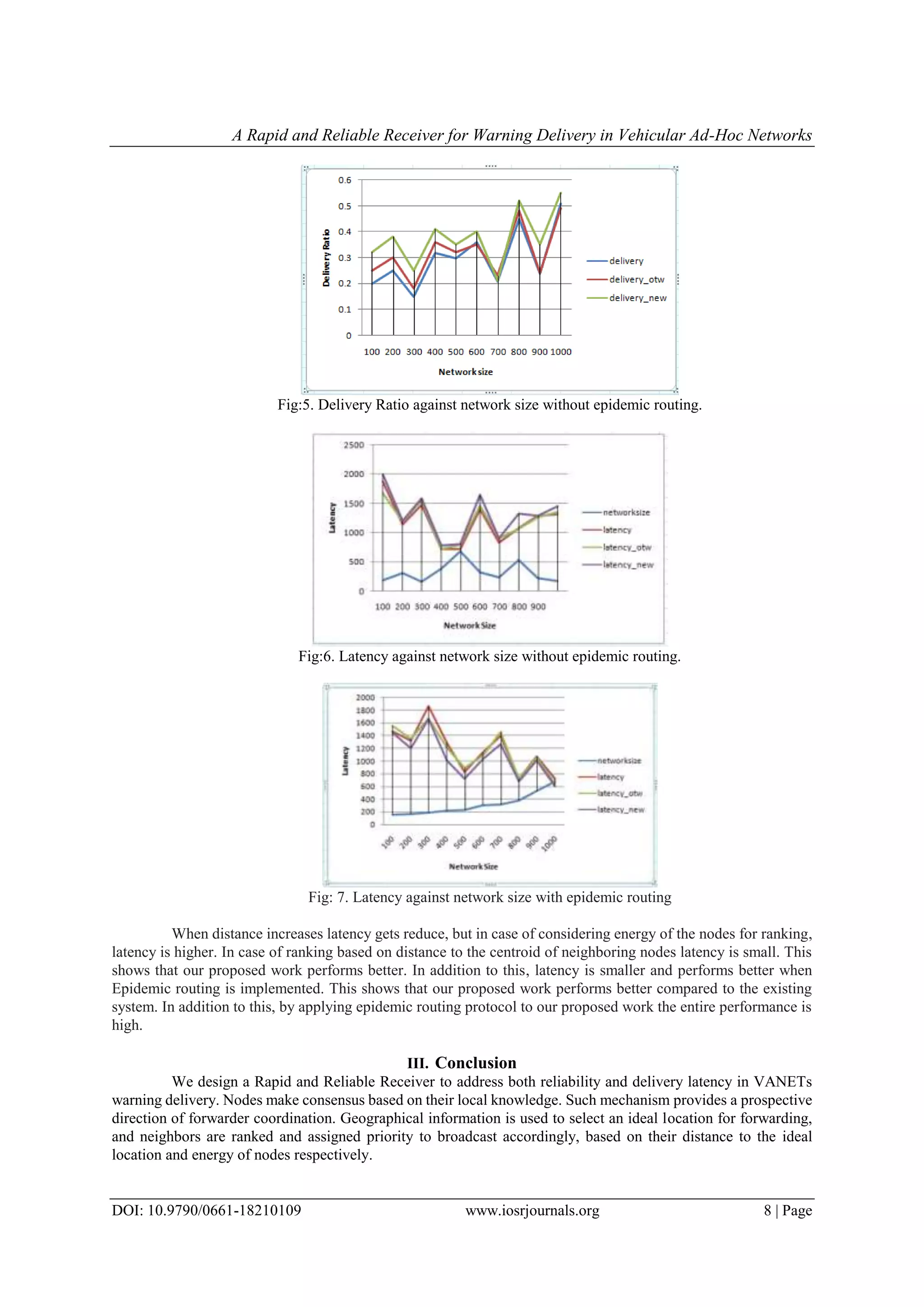
Fig:5. Delivery Ratio against network size without epidemic routing.
Fig:6. Latency against network size without epidemic routing.
Fig: 7. Latency against network size with epidemic routing
When distance increases latency gets reduce, but in case of considering energy of the nodes for ranking,
latency is higher. In case of ranking based on distance to the centroid of neighboring nodes latency is small. This
shows that our proposed work performs better. In addition to this, latency is smaller and performs better when
Epidemic routing is implemented. This shows that our proposed work performs better compared to the existing
system. In addition to this, by applying epidemic routing protocol to our proposed work the entire performance is
high.
III. Conclusion
We design a Rapid and Reliable Receiver to address both reliability and delivery latency in VANETs
warning delivery. Nodes make consensus based on their local knowledge. Such mechanism provides a prospective
direction of forwarder coordination. Geographical information is used to select an ideal location for forwarding,
and neighbors are ranked and assigned priority to broadcast accordingly, based on their distance to the ideal
location and energy of nodes respectively.
A Rapid and Reliable Receiver for Warning Delivery in Vehicular Ad-Hoc Networks
DOI: 10.9790/0661-18210109 www.iosrjournals.org 9 | Page
The goals of Epidemic Routing are to maximize message delivery rate and to minimize message latency
while also minimizing the total resources (e.g., memory and network bandwidth) consumed in message delivery.
We show that Epidemic Routing delivers 100% of messages with reasonable aggregate resource consumption for
scenarios where existing ad hoc routing protocols are unable to deliver any messages because no end-to-end routes
are available. For our work, we introduce a variant of the general theory of epidemic algorithms by taking
advantage of the semantics of our particular application domain. That is, rather than requiring all messages to be
eventually seen by all replicas, we desire to have individual messages eventually seen by individual hosts. In fact,
for Epidemic Routing it may be desirable to limit the distribution of messages to conserve host resources.
Fig: 8. delivery ratio against network size with epidemic routing.
Finally, we observed that reliability of Rapid and Reliable Receiver remains high compared to other
solutions which are designed for non-safety messages (e.g. ABSM [8]) and it can be considered for adaption in
other tasks, such as video geo-casting [23].
References
[1] Junliang Liu 1,2, Zheng Yangi, 2, and Ivan Stojmenovic1, 3 “Receiver Consensus : On-Time Warning Delivery For Vehicular
Ad-Hoc Network” July 2013.
[2] S. Biswas, R. Tatchikou, and F. Dion, `` Vehicle-to-vehicle wireless communication protocols for enhancing highway traffic
safety,'' IEEE Commun. Mag., vol. 44, no. 1, pp. 74_82, Jan. 2006.
[3] N. Wisitpongphan, O. Tonguz, J. S. Parikh, P. Mudalige, F. Bai, and V. Sadekar ``Broadcast storm mitigation techniques in vehicular
ad hoc networks,'' IEEE Wireless Commun., vol. 14, no. 6, pp. 84_94, Dec. 2007.
[4] S. Olariu and M. Weigle, Vehicular Networks: From Theory to Practice. Cleveland, OH, USA: CRC, 2009.
[5] M.-T. Sun, W.-C. Feng, T.-H. Lai, K. Yamada, H. Okada, and K. Fujimura ``GPS-based message broadcast for adaptive inter-vehicle
communications,'' in Proc. IEEE Veh. Technol. Co nf., Sep. 2000, pp. 2685_2692.
[5] M. Li, K. Zeng, and W. Lou, ``Opportunistic broadcast of emergency messages in vehicular ad hoc networks with lossy links,''
Comput. Netw., vol. 55, no. 10, pp. 2443_2464, Jul. 2011.
[6] M. Torrent-Moreno, J. Mittag, P. Santi, and H. Hartenstein, ``Vehicleto- vehicle communication: Fair transmit power control for
safety-critical information,'' IEEE Trans. Veh. Technol., vol. 78, no. 7, pp. 3684_3703, Feb. 2009.
[7] A. Amoroso, G. Mar_a, and M. Roccetti, ``Going realistic and optimal: A distributed multi-hop broadcast algorithm for vehicular
safety,'' Comput. Netw., vol. 55, pp. 2504_2519, Jul. 2011.
[8] F. J. Ros, P. M. Ruiz, and I. Stojmenovic, ``Acknowledgment-based broadcast protocol for reliable and ef_cient data dissemination in
vehicular adhoc networks,'' IEEE Trans. Mobile Comput., vol. 11, no. 1, pp. 33_46, Jan. 2012.
[9] J. Liu, Z. Yang, and I. Stojmenovic, ``Receiver consensus: Rapid and reliable broadcasting for warning delivery,'' in Proc. IEEE
ICDCS, Jun. 2012, pp. 386_395.
[10] Amin Vahdat and David Becker “Epidemic Routing for Partially-Connected Ad Hoc Networks” Department of Computer Science
Duke University Durham, NC 27708
[11] A. A. Khan, I. Stojmenovic, and N. Zaguia, ``Parameterless broadcasting in static to highly mobile wireless ad hoc, sensor and acuator
networks,'' in Proc. IEEE AINA, Mar. 2008, pp. 620_627.
[12] T. Osafune, L. Lin, and M. Lenardi, ``Multi-hop vehicular broadcast MHVB,'' in Proc. 6th Int. Conf. ITS Telecommun., Jun. 2006,
pp. 757_760
[13] H.-Y. Huang, P.-E. Luo, M. Li, D. Li, X. Li, W. Shu, and M.-Y. Wu, Performance evaluation of safety applications over dsrc vehicular
ad hoc networks,” in Proceedings of the 1st ACM international workshop on Vehicular ad hoc networks, Philadelphia, PA, USA,
2004, pp. 1–9.
[14]. S. Basagni, I. Chlamtac, and V. R. Syrotiuk. Dynamic Source Routing for Ad Hoc Networks Using the Global Positioning System. In
Proceedings of the IEEE Wireless Communications and Networking Conference 1999 (WCNC’99), September 1999.

A018210109

  • 1.
    IOSR Journal ofComputer Engineering (IOSR-JCE) e-ISSN: 2278-0661,p-ISSN: 2278-8727, Volume 18, Issue 2, Ver. I (Mar-Apr. 2016), PP 01-09 www.iosrjournals.org DOI: 10.9790/0661-18210109 www.iosrjournals.org 1 | Page A Rapid and Reliable Receiver for Warning Delivery in Vehicular Ad-Hoc Networks Anseena A S, Shameem Ansar A PG student, TKM College of Engineering Kollam, Kerala university, India Assistant Professor TKM College of Engineering Kollam, Kerala university, India Abstract: Vehicular ad-hoc networks (VANETs) are known for highly mobile and frequently disconnected characteristics. To improve safety, a warning message in VANETs should be delivered both reliably and urgently. In the existing solution, we make consensus of receiver by assigning rank, and the best forwarder is selected by distance to the centroid of the neighbors in need of message. The proposed work aims at overcoming the above limitations. Here the best receiver is selected by the ranking based on the energy of the nodes and also the distance to the centroid of the neighbors. An Epidemic routing is used to improve the performance. Each vehicle maintains a neighbor table, which stores the information overheard from the periodic beacon messages. In order to get the packet we should get the summary vector of it. The proposed method has been simulated and tested and the results indicate that the proposed system shows high reliability and enhances timeliness. It also provides higher packet delivery ratio and a lower control overhead. Index Terms: VANETs, location-assisted, epidemic routing, mobility, summary vector. I. Introduction Vehicular Ad-hoc Networks (VANETs) are special Mobile Ad-hoc Networks (MANETs), in which nodes are vehicles equipped with wireless communication. There is no centralized administration to deliver data. Due to the high dynamicity of underlying network topology, and intermittent connectivity VANETs raise new challenges to the design of data communication protocol. To send message from a source node to all other nodes in a network, Broadcasting is the message delivery task. Many important VANET services, ranging from safety applications to location-based advertisement, rely on the reliability and efficiency of underlying broadcast protocols. Applications have different requirements on broadcast protocol design. Location-based advertisement emphasizes reliability in order to achieve higher coverage of vehicles, while warning delivery, which broadcasts emergent information to approaching vehicles, requires both low propagation delay and reliability. We propose a broadcasting scheme based on best Receiver, which is a fully distributed and effective warning delivery algorithm suitable for VANETs with all mobility and density scenarios. Ranking is the key idea behind our proposed work. Receiving node retransmits immediately if it considers itself as the best forwarder. We adopt flexible receiver consensus, which can be applied in1-D, 2-D or even 3-D scenarios, rather than selecting best forwarders by the sender. Once a node receives a broadcast message, based on its local knowledge, it ranks the potential (and known) forwarders according to their geographical locations. Ranking is based on distance to an ideal forwarder, located at the centroid of (remaining) neighboring vehicles and energy of the vehicles believed to need the message. In addition to this ranking, an epidemic routing is used to improve the performance. Each node considers itself as a potential forwarder picks up a time slot according to its ranking .Time delays are calculated, and all the known candidates are ranked by these timers resulting in zero delay. The best forwarder retransmits immediately after it receives the packet, while other nodes would take action if better ones fail to fulfill their duties. Otherwise they will update the reception information and reassess the need for further retransmissions. Rapid and reliable receiver for on-time warning delivery in vehicular ad-hoc networks exhibits its basic advantages and great potentials in assuring reliability and timeliness. To the best of our knowledge, this is the first broadcast protocol in VANETs solving broadcast storm and aiming at perfect timeliness in 1D, 2D and 3D scenarios. Previous works are only for sender-oriented approaches. It is the first and best receiver-oriented approach with instant retransmission without any time delay.
  • 2.
    A Rapid andReliable Receiver for Warning Delivery in Vehicular Ad-Hoc Networks DOI: 10.9790/0661-18210109 www.iosrjournals.org 2 | Page The main aim of Epidemic Routing [10] is to provide message delivery with high probability and minimizing resource consumption. Epidemic routing distributes application messages to hosts, called carriers, within connected portions of ad hoc networks. Messages are quickly transmitted upon the connected portions of the network. Due to the mobility of nodes, Epidemic Routing then relies upon the carriers coming into contact with another connected portion of the network. At this point, the message spreads to an additional island of nodes. Through this transitive transmission of data, warning messages have a high probability to reach their destination without time delay. Figure 1 depicts Epidemic Routing at a high level, with mobile nodes represented as dark circles and their wireless communication range shown as a dotted circle extending from the source. In Figure 1(a), a source, S, needs to transmit a message to a destination, D, but there is no connected path between S and D. S transmits its messages to its two neighbors, C1 and C2, within the same communication range. After sometime, as shown in Figure 1(b), C2 comes into direct communication range with another host, C3, and transmits the message to it. C3 is in direct range of D and finally sends the message to its destination. This paper is structured as follows: Section 2 discuss about the review of related work. Section 3 describes the protocol design and features of our proposed work. Section 4 describes how epidemic routing is implemented in our proposed work. Section 5 Discuss about the implementation details and finally concluded our work. Figure 1: A source, S, wishes to transmit a message to destination but there is no connected path in (a). Carriers, C1- C3 are leveraged to transitively deliver the message to its destination at another point in time as shown in (b). II. Related Work Current approaches includes receiver-oriented and sender –oriented approach. In both approaches immediate retransmissions lead to contention and collision occurs in neighboring nodes [2], which degrades reliability. Existing solutions to this problem is not applicable to our proposed work due to the high reception rate and time delay. 2.1 Receiver-Oriented Approach Existing receiver-oriented approaches are based on local timers. These timers differentiate the broadcast time of each node by setting different timeslot. After receiving broadcast message each node starts its timer, and retransmits the message when the timer expires. Delay at every hop reduces the propagation and thus degrades time. One example of existing receiver oriented approach is Multi-hop Vehicular Broadcast scheme. In this method a threshold value of distance is set such that nodes further than this threshold value do not compete to retransmit.
  • 3.
    A Rapid andReliable Receiver for Warning Delivery in Vehicular Ad-Hoc Networks DOI: 10.9790/0661-18210109 www.iosrjournals.org 3 | Page By short- range sensors MHVB detects congestion and increases the waiting time of the congested vehicles (which is inversely proportional to the number of vehicles in the communication range. This method increases the time delay 2.2 Sender-Oriented Approach Sender oriented -approach [4]-[7] strongly achieve instant retransmissions. Sender dedicates one or more neighbors as forwarders, and they can be able to retransmit immediately. The dedicated forwarder may not receive the request to forward, or may not be a neighbor anymore. Sender-oriented approaches suffer from low message reception rates in VANETs. In sender-oriented approach, for the fast propagation without any delay farthest node is selected as forwarder. In our work, we consider Acknowledgment based forwarder selection algorithm. Nodes attach their acknowledgments in their beacons. Nodes are selected by assigning rank based on this acknowledgment. So our work can be implemented in 2-D and 3-D scenarios with low propagation delay and timeliness. Protocol Design We assume that vehicles are GPS-enabled. Following DSRC/WAVE standard [18], each vehicle periodically (e.g., every 300 ms) broadcasts a beacon containing basic information including geographic position. Nodes also use one bit in their beacons to exchange their CDS status so that a node's CDS status can be locally computed. We use a round to refer to the period between two consecutive beacons. Nodes send beacons (and start their round) at different times to avoid collisions. Each round is divided into T time slots; one slot suffices to fit warning message. This work consists of four components: * Acknowledgement-based neighbor elimination :- It guarantees reliability while reducing the number of retransmissions. * Location Based Ranking :- It enables fast propagation without unnecessary waiting time latency at every hop. * Energy Based Ranking :- It reduces packet loss due to collision * Epidemic Routing :- It improves the performance in all components, receivers utilize local knowledge to achieve consensus on forwarding strategies. A. Neighbor Elimination and Status Updates Neighbors' geographic positions, local topology and CDS are updated by beacons. The topology can also be modified dynamically between beacons by estimating speed and direction of movement based on last two beacons. Beacons also include acknowledgement of warning messages. For each warning message m, each node divides its neighbor nodes into three sets, according to their reception status: R (affirmatively received, nodes that attach ACK in their beacons), P (potentially received), and N (not received, nodes without ACK in their beacons). Potentially received is a transient status before receiving ACK. Receiver node computes each neighbor's distance to the sender. Neighbors whose distance to sender are less than sender's communication radius, are marked as potentially received and moved into set P. Node A updates the three sets in the following cases: 1) A node (can be A itself) broadcasts m: in this case all nodes in N covered by the sender are moved into P. Also the sender is moved into R. 2) A beacon from a node B (can be newly discovered neighbor) is received: if ACK(m) is attached, B is moved into R, otherwise (missing ACK(m) in the beacon) B is moved into N. 3) Beacons from a known neighbor B have not been heard for a period of time: it is possible that B moves away from A. B is removed from local neighbor list and the three sets in this case. B. Location Based Ranking All neighbors that affirmatively or potentially received the message are ranked in the order of the distance to the ``ideal'' location and energy of the nodes .After each transmission energy of the node gets reduced. Thus ranking can be done by selecting nodes with highest energy and the smallest distance to the ideal location. The node then picks up r-th upcoming slot (where r is its ranking) to retransmit the message. Thus if the node ranks itself first, it retransmits m immediately (in the next slot). If all neighbors believed to have lower ranking remain silent in previous slots, node will retransmit in r-th slot. All nodes in N are moved into P after retransmission. While waiting for its time slot, node keeps listening on the channel. Neighbors' reception status and ranking are updated upon the
  • 4.
    A Rapid andReliable Receiver for Warning Delivery in Vehicular Ad-Hoc Networks DOI: 10.9790/0661-18210109 www.iosrjournals.org 4 | Page detection of successive broadcasts. If no more neighbors are in need of the message, the node cancels its retransmission. Fig: 2. (a) Ranking example The ``ideal'' location for the next hop forwarder is the centroid I of all nodes in N (the point having average coordinate values of ``not received'' neighbors). It is computed as follows: x(I)= y(I)= C. Energy Based Ranking In addition to ranking based on the distance to the centroid of neighbors, energy based ranking is performed in our work. After every transmission of data, energy of the vehicles gets reduced and sometimes this leads to packet loss. A node with least energy would have the highest rank based on the distance to the centroid of the neighboring nodes, and this node cannot retransmit the data immediately. This causes time delay for finding another best forwarder node. To overcome this problem for transmitting warning message with reliability and without propagation delay and timeliness, best forwarder is selected based on the energy. The algorithm for energy based ranking is given below. All candidate nodes that are (based on local knowledge) in CDS are ranked before all the nodes that are not in CDS. Within each CDS and non-CDS candidate neighbors, further ranking is performed as follows. The node ranks all nodes in RUP according to their distances to the ideal forwarding location I and the energy of each node. The distance is small and the energy is high, then the ranking is high. In case of ties, we prefer node with larger distance to the source node (whose coordinate is attached in the warning message). The x-coordinate and y-coordinate can be used for final resolution. It can be computed as follows: Rank, R= - Algorithm Step 1. Let X be the node wants to transmit the warning message Step 2. Initialize P, N, R are empty Step 3. When beacon from neighbor is received, update the CDS into three sets, based on the reception status. Step 4. If broadcast of warning message is not scheduled, perform location based ranking. Step 5. When two nodes have same rank, then perform energy based ranking. Select nodes with minimum distance and maximum energy, and forward warning message via IEEE 802.11 Step 6. Beacon not received for a while, that node is removed from these set and cancel the timer. D. Epidemic Routing Protocol Epidemic Routing [10] supports the eventual delivery of messages to arbitrary destinations with minimal assumptions regarding the underlying topology and connectivity of the underlying network. In fact, only periodic pair-wise connectivity is required to ensure eventual message delivery. The Epidemic Routing approach based on the replication process. The source generates number of copies of the same message to a group of nodes. The nodes
  • 5.
    A Rapid andReliable Receiver for Warning Delivery in Vehicular Ad-Hoc Networks DOI: 10.9790/0661-18210109 www.iosrjournals.org 5 | Page save this message in their buffer until the connection is established to the destination. Each host maintains a buffer consisting of messages that it has originated as well as messages that it is buffering on behalf of other hosts. For efficiency, a hash table indexes this list of messages, keyed by a unique identifier associated with each message. Each host stores a bit vector, called the summary vector that indicates which entries in their local hash tables are set. While not explored here, a “Bloom filter” [4, 12] would substantially reduce the space overhead associated with the summary vector. When two hosts come into communication range of one another, the host with the smaller identifier initiates an anti-entropy session with the host with the larger identifier. To avoid redundant connections, each host maintains a cache of hosts that it has spoken with recently. Anti-entropy is not re-initiated with remote hosts that have been contacted within a configurable time period. During anti-entropy, the two hosts exchange their summary vectors to determine which messages stored remotely have not been seen by the local host. In turn, each host then requests copies of messages that it has not yet seen. The receiving host maintains total autonomy in deciding whether it will accept a message. For example, it may determine that it is unwilling to carry messages larger than a given size or destined for certain hosts. While we do not experiment with such general policies, we do model a maximum queue size associated with each host, which determines the maximum number of messages a host is willing to carry on behalf of other hosts. Figure 3: The Epidemic Routing protocol when two hosts, A and B, come into transmission range of one another. Figure 3. shows the message exchange in the Epidemic Routing protocol. Host A comes into contact with Host B and initiates an anti-entropy session. In first step, A transmits it summary vector, SVA to B. SVA is a compact representation of all the messages being buffered at A. Second, B performs a logical AND operation between the negation of its summary vector, SVB, (the negation of B’s summary vector, representing the messages that it needs) and SVA. That is, B determines the set difference between the messages buffered at A and the messages buffered locally at B. It then transmits a vector requesting these messages from A. In last step, A transmits the requested messages to B. This process is repeated transitively when B comes into contact with a new neighbor. Given sufficient buffer space and time, these anti-entropy sessions guarantee eventual message delivery through such pair-wise message exchange. Our design for Epidemic Routing associates a unique message identifier, a hop count, and an optional ack request with each message. The message identifier is a unique 32-bit number. This identifier is a concatenation of the host’s ID and a locally-generated message ID (16 bits each). Assigning ID’s to mobile hosts is beyond the scope of this paper. However, if hosts in an ad hoc network are assigned the same subnet mask, the remaining bits of the IP address can be used as the identifier. In our implementation, the hosts in the ad hoc network are statically assigned ID’s. Algorithm of Epidemic Routing whenever two hosts come into communication range if host has the lower ID start anti-entropy session and exchange all messages, that one of the hosts has not seen yet The hop count field determines the maximum number of epidemic exchanges that a particular message is subject to. While the hop count is similar to the TTL field in IP packets, messages with a hop count of one will only be delivered to their end destination. As discussed below, such packets are dropped subject to the requirements of locally available buffer space. Larger values for hop count will distribute a message through the network more quickly. This will typically reduce average delivery time, but will also increase total resource consumption in message delivery. Thus, high priority messages might be marked with a high hop count, while most messages can be marked with a value close to the expected number of hops for a given network configuration to minimize resource consumption.
  • 6.
    A Rapid andReliable Receiver for Warning Delivery in Vehicular Ad-Hoc Networks DOI: 10.9790/0661-18210109 www.iosrjournals.org 6 | Page Given that messages are delivered probabilistically in epidemic routing, certain applications may require acknowledgments of message delivery. The ack request field signals the destination of a message to provide an acknowledgment of message delivery. These acknowledgments are modeled as simple return messages from receiver back to the sender. Of course, the acknowledgment can also be piggybacked with any other message destined back to the sender after the message is successfully delivered. As future work, we intend to experiment with supplementing anti-entropy with the exchange of a “message delivered” vector. This vector can act as both message acknowledgment and as a capability to free the buffer space associated with messages that have been previously delivered. Each host sets a maximum buffer size that it is willing to allocate for epidemic message distribution. The buffer size limits the amount of memory and network resources consumed through Epidemic Routing. In general, hosts will drop older messages in favor of newer ones upon reaching their buffer’s capacity. Of course, there is an inherent tradeoff between aggregate resource consumption and message delivery rate/latency. To ensure eventual delivery of all messages, the buffer size on at least a subset of nodes must be roughly equal to the expected number of messages in transit at any given time. Otherwise, it is possible for older messages to be flushed from all buffers before delivery. Implementation The simulator we use in our work is ONE: Opportunistic Network Environment (ONE). Unlike other DTN simulators, which usually focus only on simulating routing protocols, the ONE combines mobility modeling, DTN routing and visualization in one package that is easily extensible and provides a rich set of reporting and analyzing modules. Node movement is implemented using movement models. These are either synthetic models or existing movement traces. Connectivity between the nodes is based on their location, communication range and the bit-rate. The routing function is implemented using routing modules that decide which messages to forward over existing contacts. Finally, the messages themselves are generated through event generators. The messages are always unicast, having a single source and destination host inside the simulation world. The simulations can contain any number of different types of agents, i.e., wireless nodes. The nodes are presented in groups and each group shares a set of common parameters such as message buffer size, radio range and mobility model. Because different groups can have different configurations, creating a simulation with pedestrians, cars and public transportation for example is made possible. Fig: 4 Screenshot of ONE Simulator’s GUI Fig: 4. shows the GUI displaying the simulation in real-time. Node locations, current paths, connections between nodes, number of messages carried by a node, etc. are all visualized in the main window. If a map-based movement model is used, also all the map paths are shown. An additional background image (e.g., a raster map or a satellite image of the simulation area) is shown below the map paths if available. The view allows zooming and interactive adjusting of the simulation speed. The focus of the simulator is on modeling the behavior of store carry- forward networking, and hence, we deliberately refrain from detailed modeling of the lower layer mechanisms such as signal attenuation and
  • 7.
    A Rapid andReliable Receiver for Warning Delivery in Vehicular Ad-Hoc Networks DOI: 10.9790/0661-18210109 www.iosrjournals.org 7 | Page congestion of the physical medium. Instead, the radio link is abstracted to a communication range and bit-rate. These are statically configured and typically assumed to remain constant over the simulation. However, the context awareness and dynamic link configuration mechanisms can be used to adjust both range and bit rate depending on the surroundings, the distance between peers and the number of (active) nodes nearby as suggested. The node energy consumption model is based on an energy budget approach. Each node is given an energy budget which is spent by energy consuming activities such as transmission or scanning and can be filled by charging in certain locations (e.g., at home). An inquiry mechanism allows other modules to obtain energy level readings and adjust their actions (e.g., scanning frequency as in , forwarding activity, or transmission power) accordingly. Performance Evaluation We have performed different tests on the ONE simulator to find the performance of this work. It takes the discrete sequential encounter events and the corresponding social graph as the inputs and makes data forwarding decision using ranking based on the distance to the centroid of neighboring nodes and energy of the nodes. For each experiment, we emulate 1000 messages with a particular lifetime sent from a random selected source to destination. The following performance metrics are used to evaluate the performance of proposed work .We design different scenarios, categorized in the following aspects. * Layout (1D/2D): We use line layout for 1D (2 km highway) scenario, and grid layout for 2D scenario. The grid layout has 2 latitudinal and 2 longitudinal 3 km lanes. * Physical layer model (UDG/TRG): In the unit disk graph (UDG) model, if node u is within the communication range of node v, then packets from v can always be delivered to u. For two-ray-ground propagation model, however, signal strength varies with distance, and u may suffer packet loss. * Node mobility (static/slow/fast): For static case, all nodes are stationed in fixed positions. For `slow' and `fast' cases, nodes are moving at the average speed 60 km/h and 120 km/h respectively. *Collision: We have measured the performance for Collision -free cases in our conference version [9]; here we only consider scenarios with collisions. * Traffic density: The traffic density is measured by the number of vehicles injected into each road (from each side of the road) every minute. Vehicles are injected into a road, and they exit when they drive out of the simulation region. We take measurement 5 minutes after the beginning so the network is `stable' (i.e. the number of vehicles exiting per minute approximates the number of vehicles entering). In example 1D scenario, when traffic density is 15, about every 4 seconds there is a car entering the road from each side of the road, thus there are 30 cars entering the network every minute. The number of vehicles in network is about 60 for slow mobility and about 120 for fast mobility. We focus on the following metrics. *Reception Ratio. The ratio between the number Nrecv of vehicles that received the broadcast message before the message expired, and the total number Ntotal that could possibly receive it. It reflects the reliability of a protocol. Some nodes may remain partitioned from the source. We calculate the number of nodes that have received the message by Hyper Flooding (HF) protocol under ideal MAC/PHY layers (no collisions) as the upper bound of Ntotal . *Delivery latency. The delay for a certain node is the time since the source issues the message until this node receives the message. We also consider the average delay per node and also the delay of the last receiver. To better reflect the timeliness, we only consider nodes which are already in the network when the message is issued. *Usability. It is desirable to keep the moving distance of vehicles small, during geo-cast, to avoid subsequent accidents. Therefore, we measure the distance travelled before receiving message.
  • 8.
    A Rapid andReliable Receiver for Warning Delivery in Vehicular Ad-Hoc Networks DOI: 10.9790/0661-18210109 www.iosrjournals.org 8 | Page Fig:5. Delivery Ratio against network size without epidemic routing. Fig:6. Latency against network size without epidemic routing. Fig: 7. Latency against network size with epidemic routing When distance increases latency gets reduce, but in case of considering energy of the nodes for ranking, latency is higher. In case of ranking based on distance to the centroid of neighboring nodes latency is small. This shows that our proposed work performs better. In addition to this, latency is smaller and performs better when Epidemic routing is implemented. This shows that our proposed work performs better compared to the existing system. In addition to this, by applying epidemic routing protocol to our proposed work the entire performance is high. III. Conclusion We design a Rapid and Reliable Receiver to address both reliability and delivery latency in VANETs warning delivery. Nodes make consensus based on their local knowledge. Such mechanism provides a prospective direction of forwarder coordination. Geographical information is used to select an ideal location for forwarding, and neighbors are ranked and assigned priority to broadcast accordingly, based on their distance to the ideal location and energy of nodes respectively.
  • 9.
    A Rapid andReliable Receiver for Warning Delivery in Vehicular Ad-Hoc Networks DOI: 10.9790/0661-18210109 www.iosrjournals.org 9 | Page The goals of Epidemic Routing are to maximize message delivery rate and to minimize message latency while also minimizing the total resources (e.g., memory and network bandwidth) consumed in message delivery. We show that Epidemic Routing delivers 100% of messages with reasonable aggregate resource consumption for scenarios where existing ad hoc routing protocols are unable to deliver any messages because no end-to-end routes are available. For our work, we introduce a variant of the general theory of epidemic algorithms by taking advantage of the semantics of our particular application domain. That is, rather than requiring all messages to be eventually seen by all replicas, we desire to have individual messages eventually seen by individual hosts. In fact, for Epidemic Routing it may be desirable to limit the distribution of messages to conserve host resources. Fig: 8. delivery ratio against network size with epidemic routing. Finally, we observed that reliability of Rapid and Reliable Receiver remains high compared to other solutions which are designed for non-safety messages (e.g. ABSM [8]) and it can be considered for adaption in other tasks, such as video geo-casting [23]. References [1] Junliang Liu 1,2, Zheng Yangi, 2, and Ivan Stojmenovic1, 3 “Receiver Consensus : On-Time Warning Delivery For Vehicular Ad-Hoc Network” July 2013. [2] S. Biswas, R. Tatchikou, and F. Dion, `` Vehicle-to-vehicle wireless communication protocols for enhancing highway traffic safety,'' IEEE Commun. Mag., vol. 44, no. 1, pp. 74_82, Jan. 2006. [3] N. Wisitpongphan, O. Tonguz, J. S. Parikh, P. Mudalige, F. Bai, and V. Sadekar ``Broadcast storm mitigation techniques in vehicular ad hoc networks,'' IEEE Wireless Commun., vol. 14, no. 6, pp. 84_94, Dec. 2007. [4] S. Olariu and M. Weigle, Vehicular Networks: From Theory to Practice. Cleveland, OH, USA: CRC, 2009. [5] M.-T. Sun, W.-C. Feng, T.-H. Lai, K. Yamada, H. Okada, and K. Fujimura ``GPS-based message broadcast for adaptive inter-vehicle communications,'' in Proc. IEEE Veh. Technol. Co nf., Sep. 2000, pp. 2685_2692. [5] M. Li, K. Zeng, and W. Lou, ``Opportunistic broadcast of emergency messages in vehicular ad hoc networks with lossy links,'' Comput. Netw., vol. 55, no. 10, pp. 2443_2464, Jul. 2011. [6] M. Torrent-Moreno, J. Mittag, P. Santi, and H. Hartenstein, ``Vehicleto- vehicle communication: Fair transmit power control for safety-critical information,'' IEEE Trans. Veh. Technol., vol. 78, no. 7, pp. 3684_3703, Feb. 2009. [7] A. Amoroso, G. Mar_a, and M. Roccetti, ``Going realistic and optimal: A distributed multi-hop broadcast algorithm for vehicular safety,'' Comput. Netw., vol. 55, pp. 2504_2519, Jul. 2011. [8] F. J. Ros, P. M. Ruiz, and I. Stojmenovic, ``Acknowledgment-based broadcast protocol for reliable and ef_cient data dissemination in vehicular adhoc networks,'' IEEE Trans. Mobile Comput., vol. 11, no. 1, pp. 33_46, Jan. 2012. [9] J. Liu, Z. Yang, and I. Stojmenovic, ``Receiver consensus: Rapid and reliable broadcasting for warning delivery,'' in Proc. IEEE ICDCS, Jun. 2012, pp. 386_395. [10] Amin Vahdat and David Becker “Epidemic Routing for Partially-Connected Ad Hoc Networks” Department of Computer Science Duke University Durham, NC 27708 [11] A. A. Khan, I. Stojmenovic, and N. Zaguia, ``Parameterless broadcasting in static to highly mobile wireless ad hoc, sensor and acuator networks,'' in Proc. IEEE AINA, Mar. 2008, pp. 620_627. [12] T. Osafune, L. Lin, and M. Lenardi, ``Multi-hop vehicular broadcast MHVB,'' in Proc. 6th Int. Conf. ITS Telecommun., Jun. 2006, pp. 757_760 [13] H.-Y. Huang, P.-E. Luo, M. Li, D. Li, X. Li, W. Shu, and M.-Y. Wu, Performance evaluation of safety applications over dsrc vehicular ad hoc networks,” in Proceedings of the 1st ACM international workshop on Vehicular ad hoc networks, Philadelphia, PA, USA, 2004, pp. 1–9. [14]. S. Basagni, I. Chlamtac, and V. R. Syrotiuk. Dynamic Source Routing for Ad Hoc Networks Using the Global Positioning System. In Proceedings of the IEEE Wireless Communications and Networking Conference 1999 (WCNC’99), September 1999.