INTERFERENCE AWRE MULTI-
PATH ROUTING IN WIRELESS
SENSOR NETWORKS
Guidance By: Presented by:
Mrs. Subhalaxmi Das Rakesh Behera, Regn. No-1221106016
Department of Computer Science Salkhan Majhi ,Regn. No-1101106097
& Engineering 4th Year ,CSE
Introduction
Related Work
Problem Statement
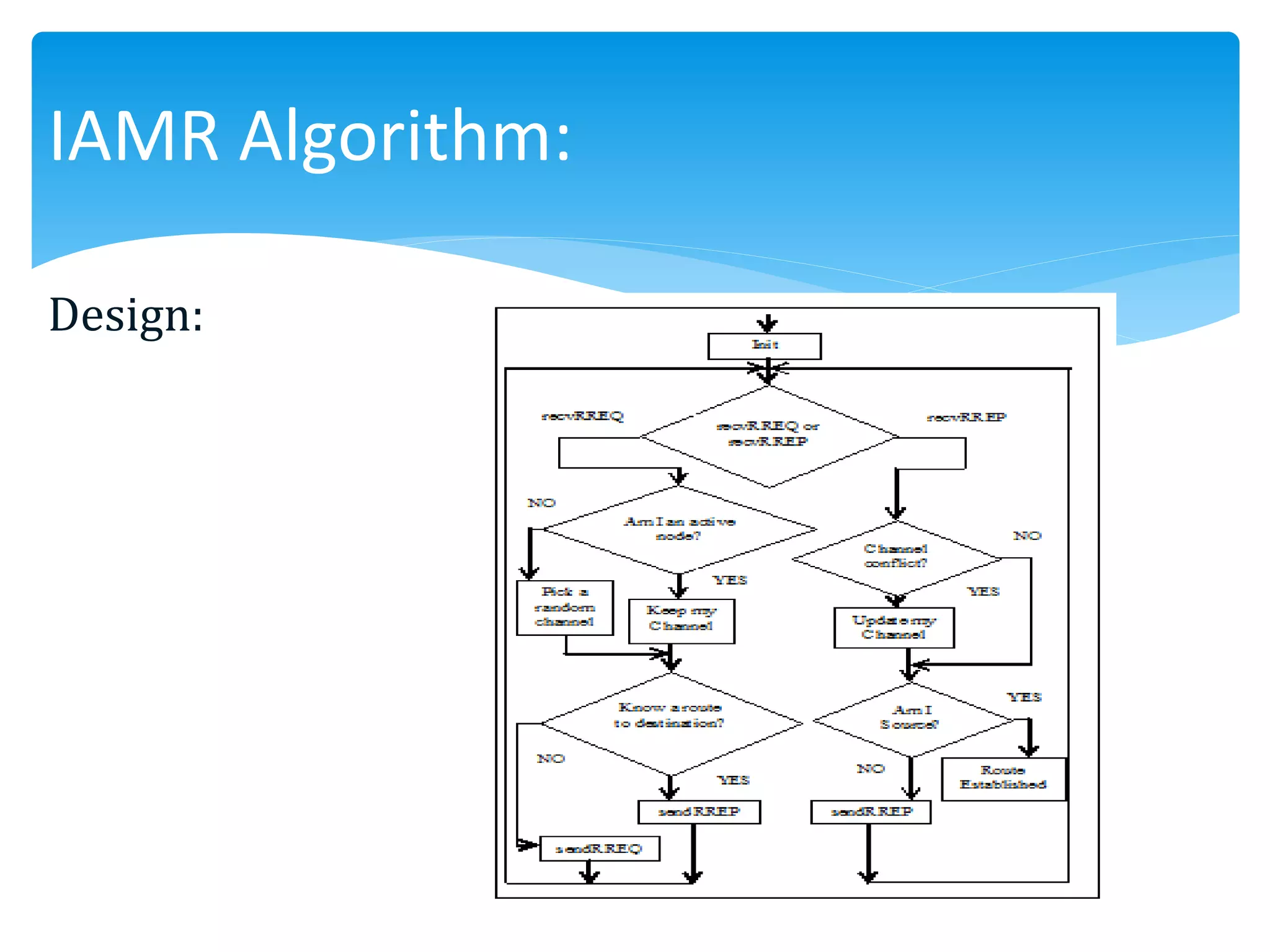
IAMR Algorithm
Performance Evaluation
Conclusion
References
CONTENTS
What is Wireless Sensor Network (WSN)?
Single-path routing in WSNs and its disadvantages.
Multi-path routing in WSNs and its advantages over
single-path routing of packets.
Aim of proposing Interference-Aware Multipath
Routing (IAMR) Protocol.
I. Efficient energy consumption
II. Increasing end-to-end throughput
III. Improving end-to-end Latency
IV. Minimizing Inter-path Interference
Introduction
 The existing routing protocols in wireless sensor networks
are designed based on the single path routing strategy
without considering the effects of various traffic load
intensities.
 In order to cope up with the limitations of single-path
routing techniques, another type of routing strategy, which is
called the multipath routing approach has become a
promising technique in wireless sensor and ad hoc networks.
 The new protocol named Interference Aware Routing
Protocol (IAMR) has been proposed to reduce the energy
consumption and routing overhead during the transmission
of data between the sources and sinks that is common in
Multi-path concepts .
Introduction:
Energy-Efficient and Collision-Aware Multipath
Routing Protocol (EECA) uses the location information
of all the sensor nodes to establish two collision-free
paths between a pair of source-sink nodes .
 EECA aims to reduce the negative effects of wireless
interference through constructing two paths in both
sides of the direct line between the source-destination
pair & the distance between these two paths is more
than the interference range of the sensor nodes.
Ad hoc On Demand Multipath Distance Vector Routing
extends AODV to provide the multipath.
Related Work:
 WSN, designing routing protocols is a big challenge because of the
stringent QoS requirement of throughput and delay.
 Most of the existing routing protocols are based on single path
routing strategy which are failed to support high data rate.
 In contrast, multipath routing protocols enable the source nodes to
discover several paths towards the destination.
 Since in multipath routing technique data packets are propagated
over several paths, it provides higher throughput, more balanced
energy consumption and improved latency
Problem Statement:
Design:
IAMR Algorithm:
IMAR Algorithm has two phases.
1. Initialization phase
2. Route Discovery & Establishment Phase
IMAR Algorithm phases
Simulation of the proposed IAMR was conducted
using NS-2 simulator.
Performance Evaluation:
Simulation Parameter:
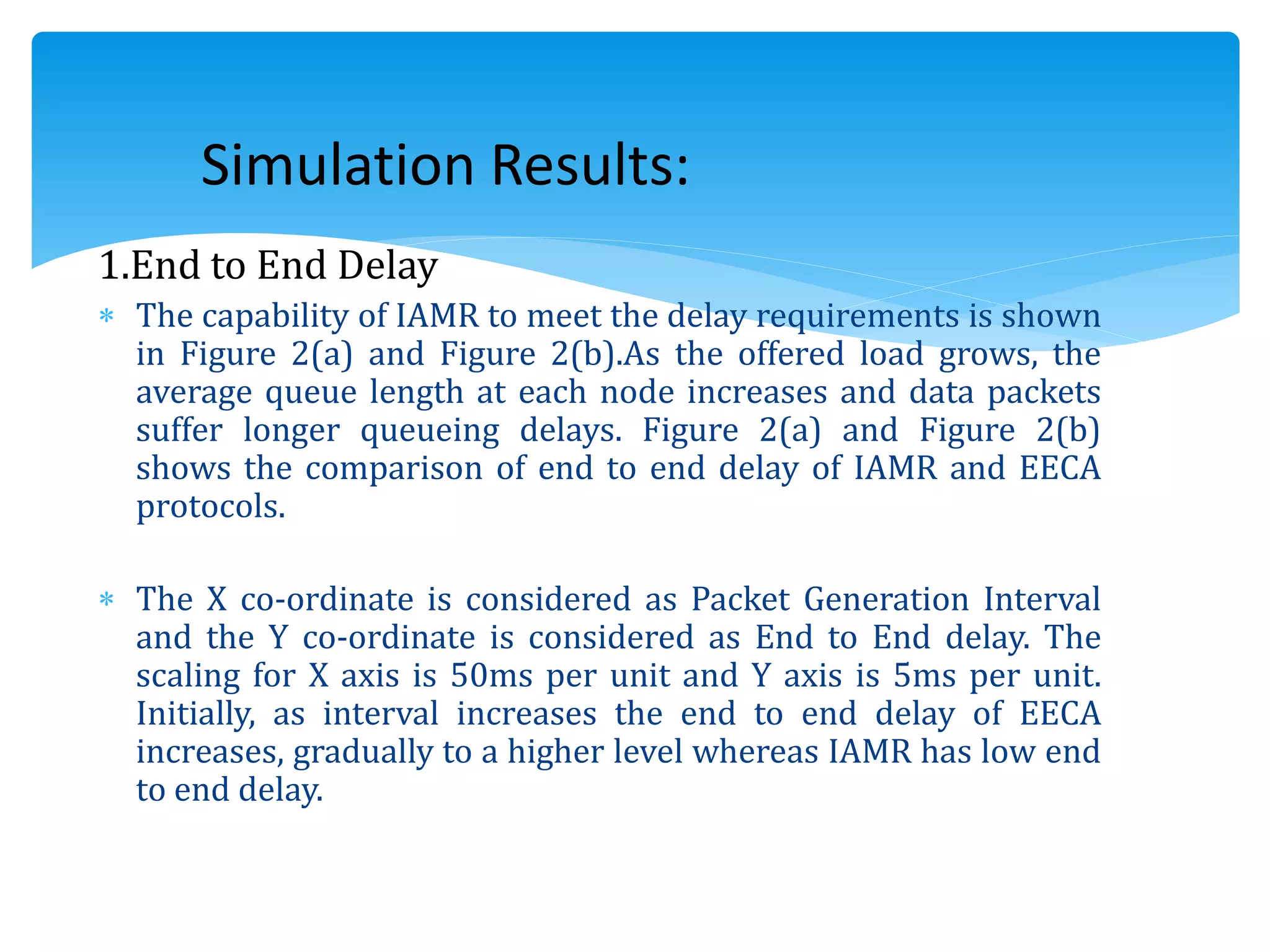
Table.I
ASSUMED PARAMETERS
Parameters Value
Transmission Range 250m
Simulation Time >800s
Topology size 1000m x 1000m
Number of sensors 25 & 50
Number of sinks 1
Traffic type Constant bit rate
Packet size 512 bytes
Bandwidth 2 Mb/s
Interference range 550m
Initial energies in batteries 10 Joules
Energy Threshold 0.001mJ
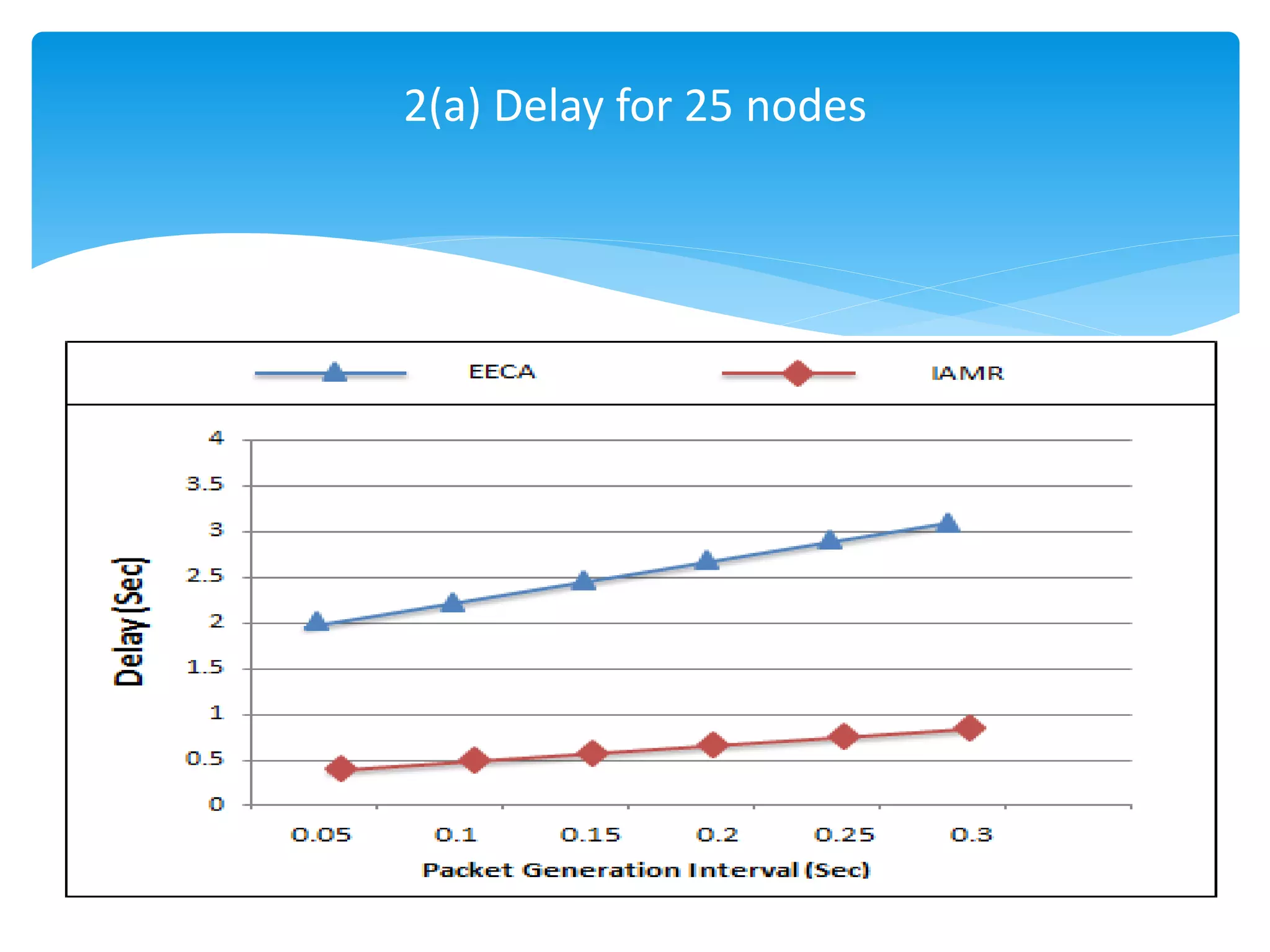
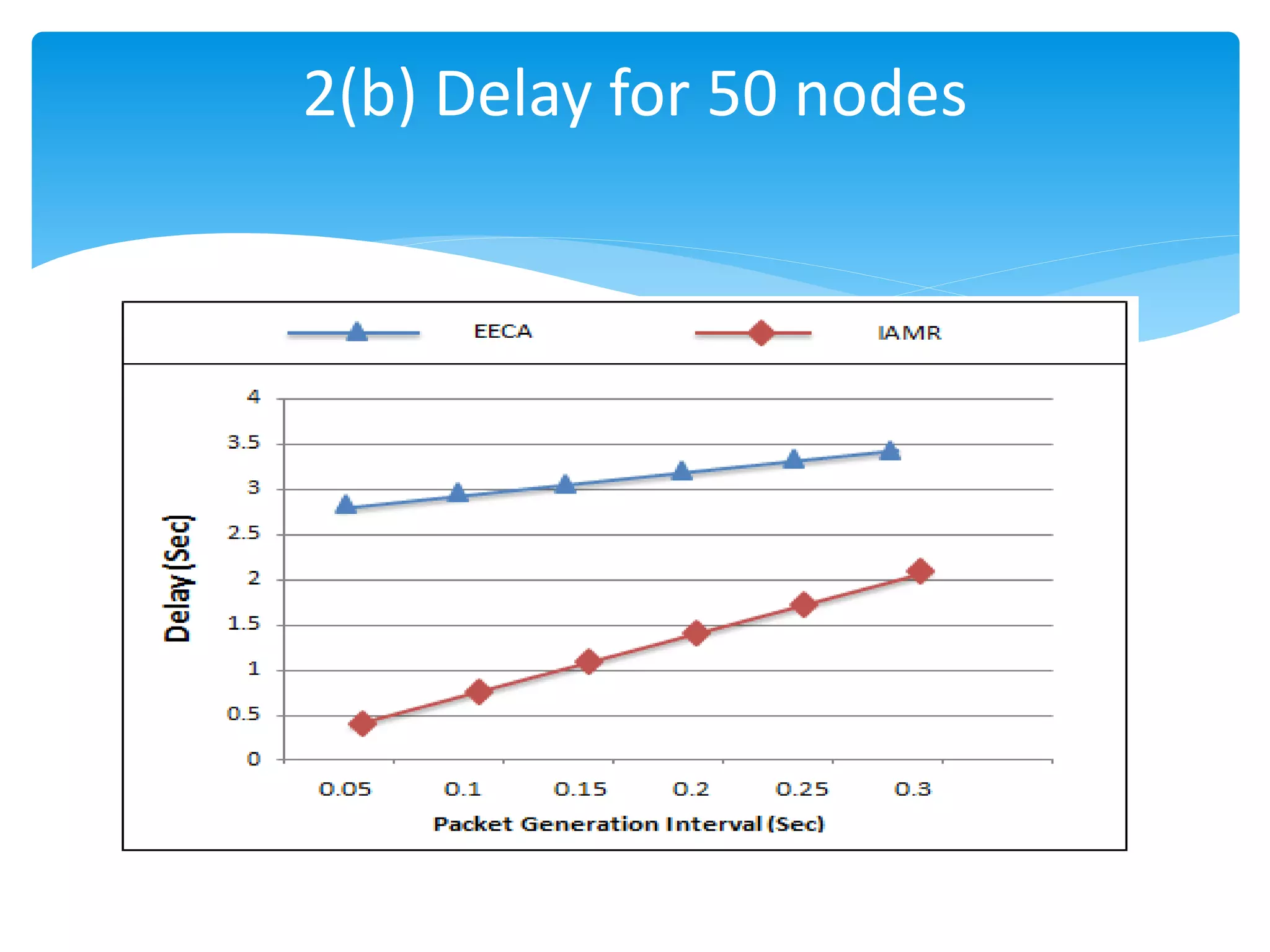
1.End to End Delay
 The capability of IAMR to meet the delay requirements is shown
in Figure 2(a) and Figure 2(b).As the offered load grows, the
average queue length at each node increases and data packets
suffer longer queueing delays. Figure 2(a) and Figure 2(b)
shows the comparison of end to end delay of IAMR and EECA
protocols.
 The X co-ordinate is considered as Packet Generation Interval
and the Y co-ordinate is considered as End to End delay. The
scaling for X axis is 50ms per unit and Y axis is 5ms per unit.
Initially, as interval increases the end to end delay of EECA
increases, gradually to a higher level whereas IAMR has low end
to end delay.
Simulation Results:
2(a) Delay for 25 nodes
2(b) Delay for 50 nodes
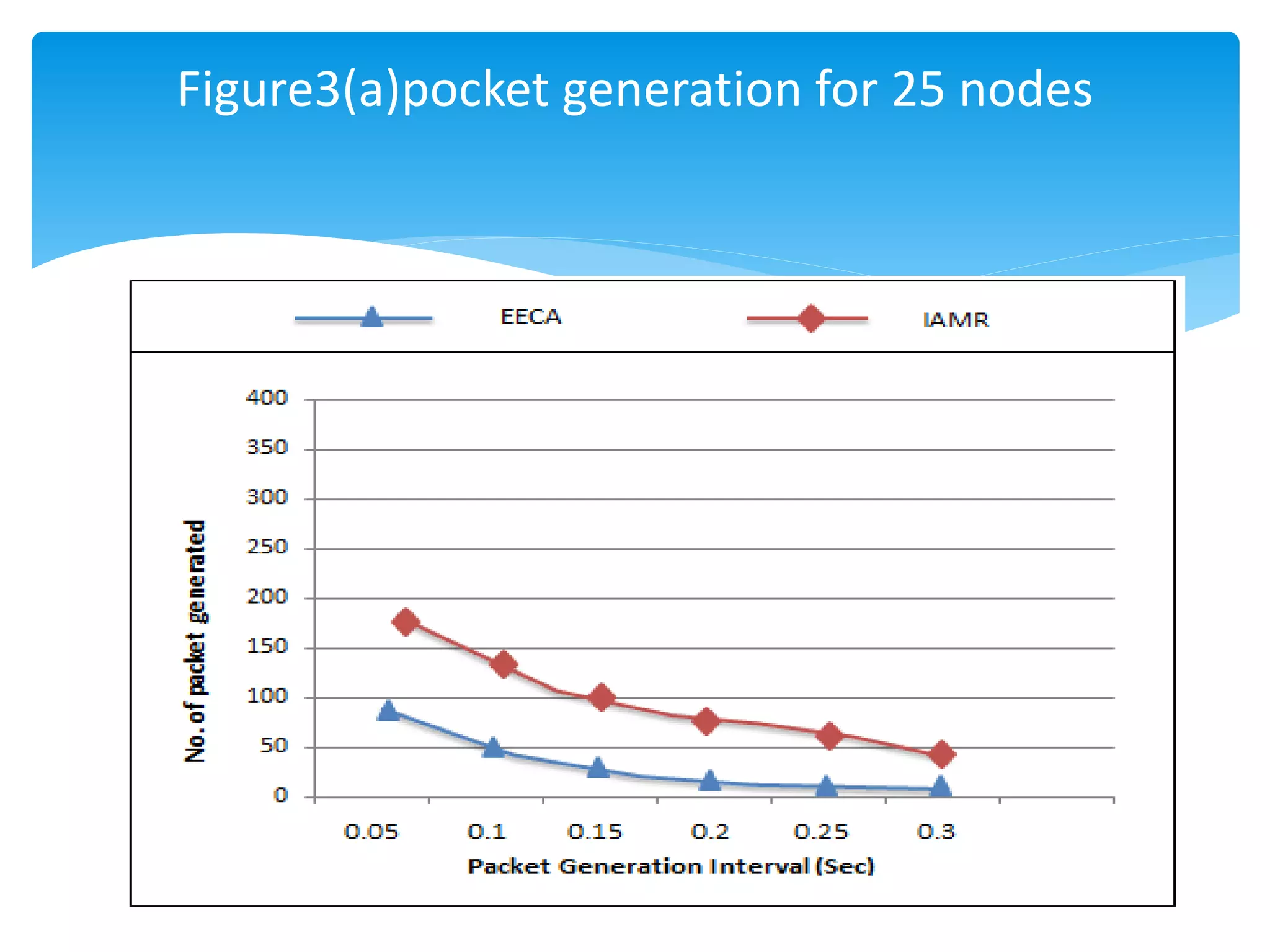
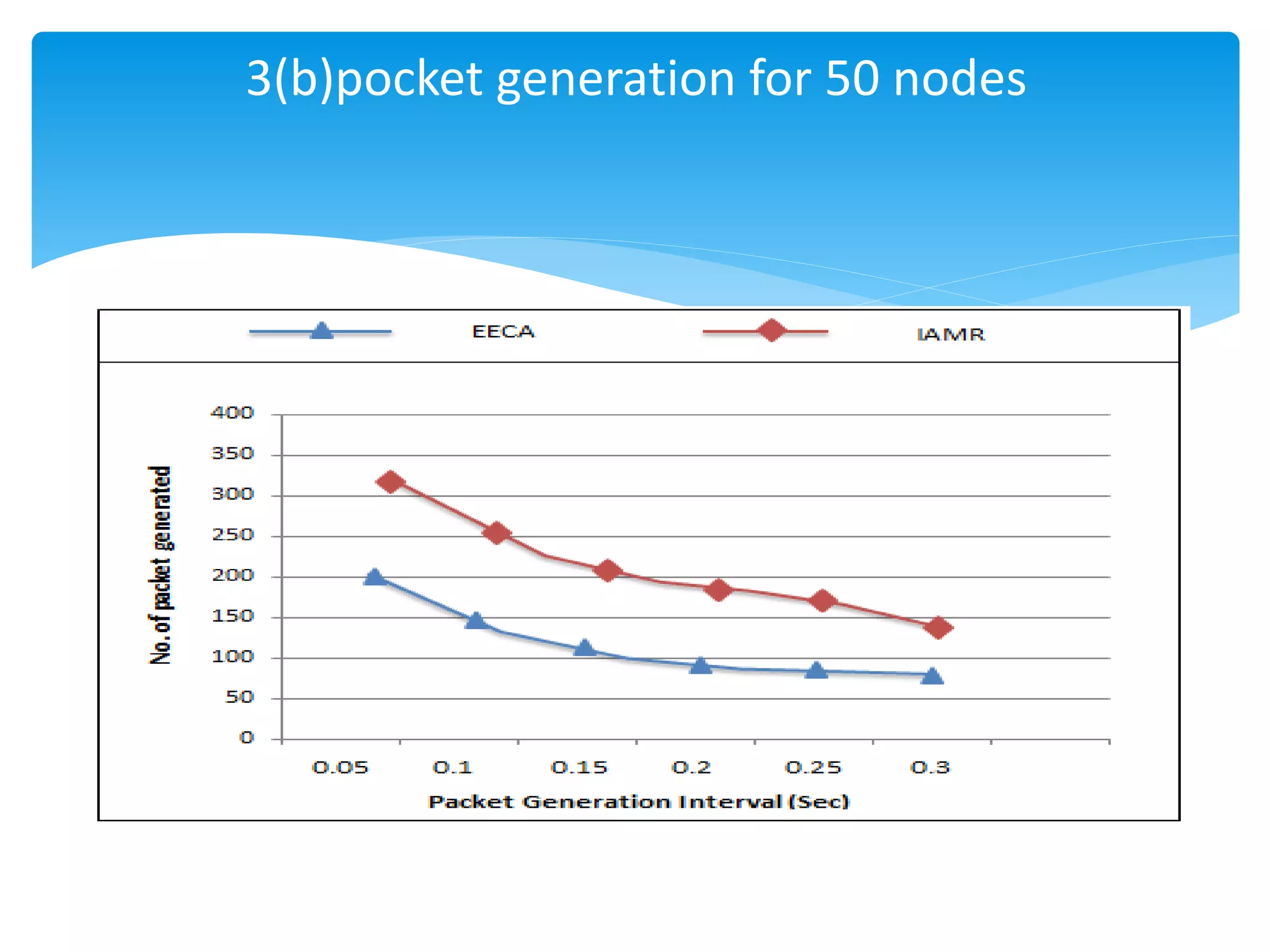
 - The number of packet generated with respect to the
interval taken for generating the packets. Comparison of
packet generation of IAMR and EECA protocols is shown
in Figure 2(a) and Figure 2(b). The X co-ordinate is
considered as Packet Generation Interval and the Y co-
ordinate is considered as number of packets generated .
 Initially, as interval increases, the packet generation of
IAMR increases gradually to a higher level whereas EECA
has low Packet Generation
PACKET GENERATION:
Figure3(a)pocket generation for 25 nodes
3(b)pocket generation for 50 nodes
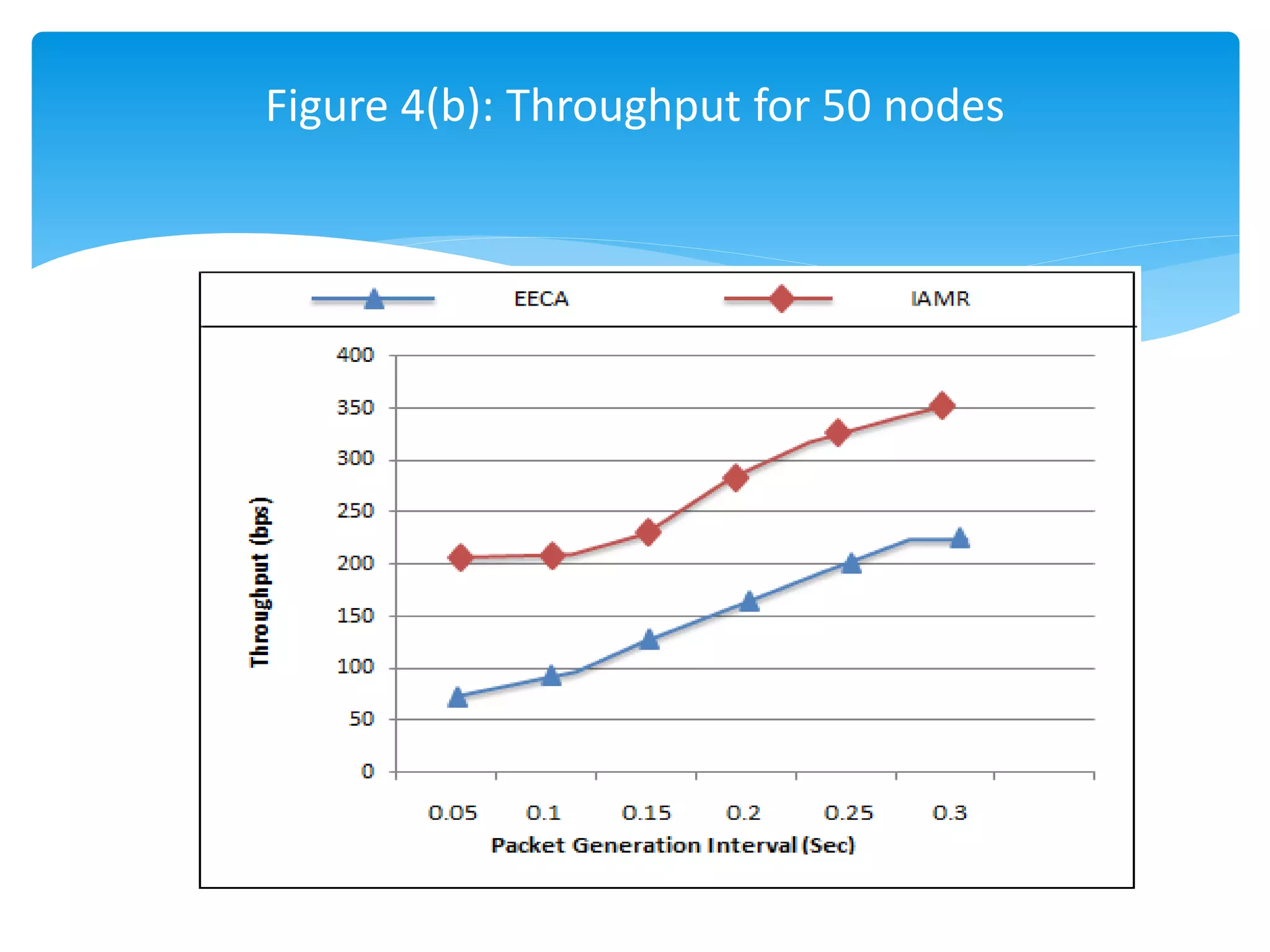
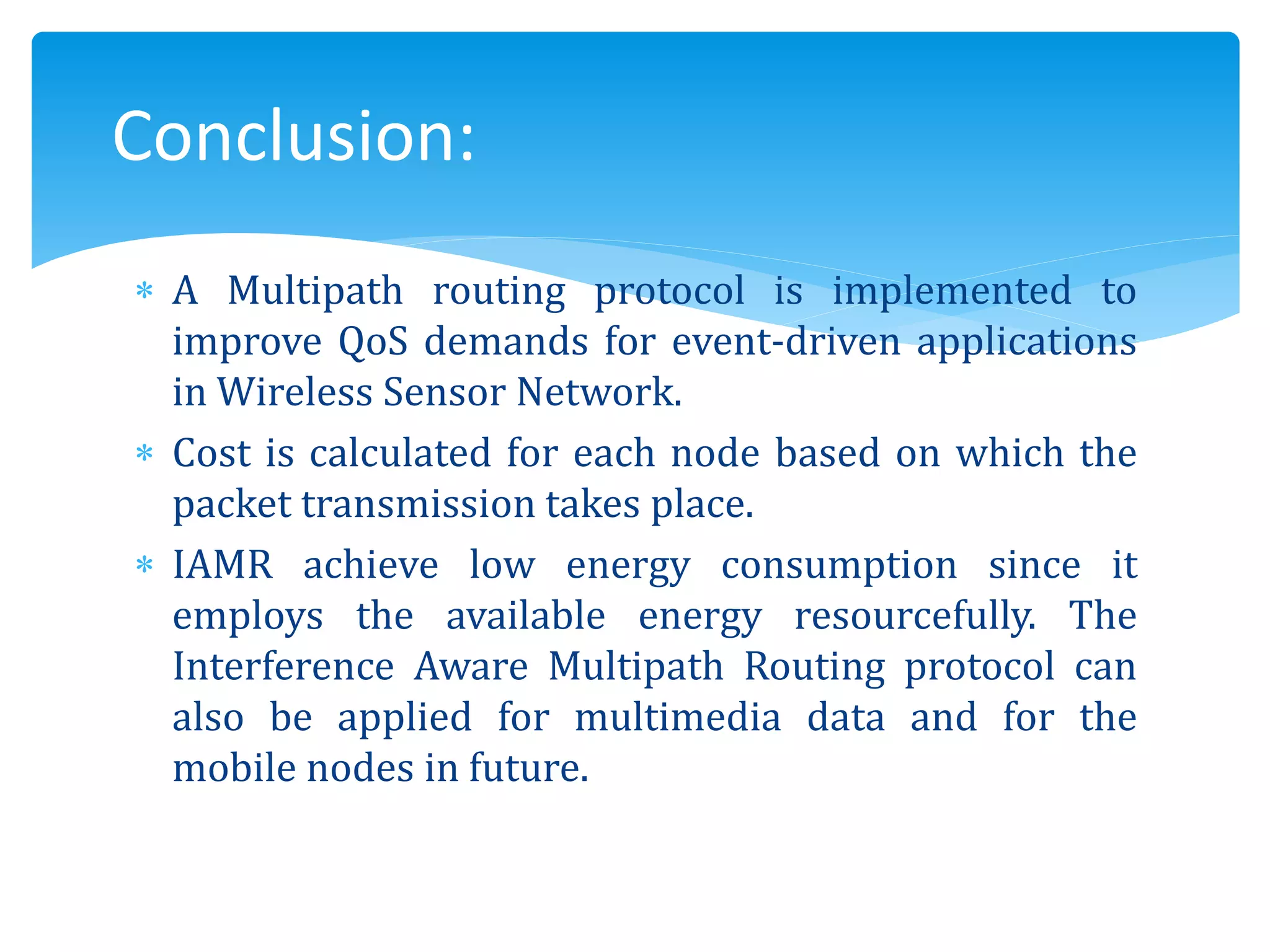
 Throughput:
 Figure 4(a) and Figure 4(b) shows the comparison of
throughput of IAMR and EECA protocols. The X co-
ordinate denotes the packet generation interval
where the Y co-ordinate denotes throughput at each
interval. From the plotted graph the throughput for
IAMR is higher than EECA.
Throughput:
Figure 4(a): Throughput for 25 nodes
Figure 4(b): Throughput for 50 nodes
 A Multipath routing protocol is implemented to
improve QoS demands for event-driven applications
in Wireless Sensor Network.
 Cost is calculated for each node based on which the
packet transmission takes place.
 IAMR achieve low energy consumption since it
employs the available energy resourcefully. The
Interference Aware Multipath Routing protocol can
also be applied for multimedia data and for the
mobile nodes in future.
Conclusion:
[1] Shuang Li, Raghu KisoreNeelisetti, Cong Liu and Alvin Lim,“Efficient Multipath
protocol for Wireless Sensor Networks”, In Proc International Journal of Wireless
and Mobile Networks (IJWMN),Vol.2, No.1, February 2010.
[2] Jonathan L. Bredin, Erik D. Demaine, Mohammad Taghi Hajiaghayi,
and Daniela Rus, “Deploying Sensor Networks With Guaranteed Fault Tolerance”,
In Proc IEEE/ACM Transactions on Networking,Vol.18, NO.1, February 2010.
[3] Lou,W, Liu, W and Zhang,Y. “Optimizations in Mobile AdHoc”, In Proc. Combinator
Optimization,2006.
[4] Zijian Wang, Eyuphan Bulut, and Boleslaw K.Szymanski, “Energy
Efficient Collision Aware Multipath Routing for Wireless Sensor Networks”,
InProc. International Conference on Communication,pp.1-5, June 2009.
[5] Tsai J and Moors T, “A Review of Multipath Routing Protocols: From Wireless
adhoc to mesh networks”, In Proc. of the First ACoRN Early Career Researcher
Workshop on Wireless Multihop Networking,Sydney, Australia,17-18, September
2006.
References:
Thank
You

Interference-Aware Multipath Routing In Wireless Sensor NetworksMinor projrct ppt

  • 1.
    INTERFERENCE AWRE MULTI- PATHROUTING IN WIRELESS SENSOR NETWORKS Guidance By: Presented by: Mrs. Subhalaxmi Das Rakesh Behera, Regn. No-1221106016 Department of Computer Science Salkhan Majhi ,Regn. No-1101106097 & Engineering 4th Year ,CSE
  • 2.
    Introduction Related Work Problem Statement IAMRAlgorithm Performance Evaluation Conclusion References CONTENTS
  • 3.
    What is WirelessSensor Network (WSN)? Single-path routing in WSNs and its disadvantages. Multi-path routing in WSNs and its advantages over single-path routing of packets. Aim of proposing Interference-Aware Multipath Routing (IAMR) Protocol. I. Efficient energy consumption II. Increasing end-to-end throughput III. Improving end-to-end Latency IV. Minimizing Inter-path Interference Introduction
  • 4.
     The existingrouting protocols in wireless sensor networks are designed based on the single path routing strategy without considering the effects of various traffic load intensities.  In order to cope up with the limitations of single-path routing techniques, another type of routing strategy, which is called the multipath routing approach has become a promising technique in wireless sensor and ad hoc networks.  The new protocol named Interference Aware Routing Protocol (IAMR) has been proposed to reduce the energy consumption and routing overhead during the transmission of data between the sources and sinks that is common in Multi-path concepts . Introduction:
  • 5.
    Energy-Efficient and Collision-AwareMultipath Routing Protocol (EECA) uses the location information of all the sensor nodes to establish two collision-free paths between a pair of source-sink nodes .  EECA aims to reduce the negative effects of wireless interference through constructing two paths in both sides of the direct line between the source-destination pair & the distance between these two paths is more than the interference range of the sensor nodes. Ad hoc On Demand Multipath Distance Vector Routing extends AODV to provide the multipath. Related Work:
  • 6.
     WSN, designingrouting protocols is a big challenge because of the stringent QoS requirement of throughput and delay.  Most of the existing routing protocols are based on single path routing strategy which are failed to support high data rate.  In contrast, multipath routing protocols enable the source nodes to discover several paths towards the destination.  Since in multipath routing technique data packets are propagated over several paths, it provides higher throughput, more balanced energy consumption and improved latency Problem Statement:
  • 7.
  • 8.
    IMAR Algorithm hastwo phases. 1. Initialization phase 2. Route Discovery & Establishment Phase IMAR Algorithm phases
  • 9.
    Simulation of theproposed IAMR was conducted using NS-2 simulator. Performance Evaluation:
  • 10.
    Simulation Parameter: Table.I ASSUMED PARAMETERS ParametersValue Transmission Range 250m Simulation Time >800s Topology size 1000m x 1000m Number of sensors 25 & 50 Number of sinks 1 Traffic type Constant bit rate Packet size 512 bytes Bandwidth 2 Mb/s Interference range 550m Initial energies in batteries 10 Joules Energy Threshold 0.001mJ
  • 11.
    1.End to EndDelay  The capability of IAMR to meet the delay requirements is shown in Figure 2(a) and Figure 2(b).As the offered load grows, the average queue length at each node increases and data packets suffer longer queueing delays. Figure 2(a) and Figure 2(b) shows the comparison of end to end delay of IAMR and EECA protocols.  The X co-ordinate is considered as Packet Generation Interval and the Y co-ordinate is considered as End to End delay. The scaling for X axis is 50ms per unit and Y axis is 5ms per unit. Initially, as interval increases the end to end delay of EECA increases, gradually to a higher level whereas IAMR has low end to end delay. Simulation Results:
  • 12.
  • 13.
  • 14.
     - Thenumber of packet generated with respect to the interval taken for generating the packets. Comparison of packet generation of IAMR and EECA protocols is shown in Figure 2(a) and Figure 2(b). The X co-ordinate is considered as Packet Generation Interval and the Y co- ordinate is considered as number of packets generated .  Initially, as interval increases, the packet generation of IAMR increases gradually to a higher level whereas EECA has low Packet Generation PACKET GENERATION:
  • 15.
  • 16.
  • 17.
     Throughput:  Figure4(a) and Figure 4(b) shows the comparison of throughput of IAMR and EECA protocols. The X co- ordinate denotes the packet generation interval where the Y co-ordinate denotes throughput at each interval. From the plotted graph the throughput for IAMR is higher than EECA. Throughput:
  • 18.
  • 19.
  • 20.
     A Multipathrouting protocol is implemented to improve QoS demands for event-driven applications in Wireless Sensor Network.  Cost is calculated for each node based on which the packet transmission takes place.  IAMR achieve low energy consumption since it employs the available energy resourcefully. The Interference Aware Multipath Routing protocol can also be applied for multimedia data and for the mobile nodes in future. Conclusion:
  • 21.
    [1] Shuang Li,Raghu KisoreNeelisetti, Cong Liu and Alvin Lim,“Efficient Multipath protocol for Wireless Sensor Networks”, In Proc International Journal of Wireless and Mobile Networks (IJWMN),Vol.2, No.1, February 2010. [2] Jonathan L. Bredin, Erik D. Demaine, Mohammad Taghi Hajiaghayi, and Daniela Rus, “Deploying Sensor Networks With Guaranteed Fault Tolerance”, In Proc IEEE/ACM Transactions on Networking,Vol.18, NO.1, February 2010. [3] Lou,W, Liu, W and Zhang,Y. “Optimizations in Mobile AdHoc”, In Proc. Combinator Optimization,2006. [4] Zijian Wang, Eyuphan Bulut, and Boleslaw K.Szymanski, “Energy Efficient Collision Aware Multipath Routing for Wireless Sensor Networks”, InProc. International Conference on Communication,pp.1-5, June 2009. [5] Tsai J and Moors T, “A Review of Multipath Routing Protocols: From Wireless adhoc to mesh networks”, In Proc. of the First ACoRN Early Career Researcher Workshop on Wireless Multihop Networking,Sydney, Australia,17-18, September 2006. References:
  • 22.