IMPROVING THRPOUGHPUT AND ENERGY EFFICIENCY BY PCTAR
PROTOCOL IN WIRELESS SENSOR NETWORK
C Ram Kumar#1
, B Vijayalakshmi #2
, Dr C Ramesh#3
, Dr S Chenthur Pandian#4
1
Assistant Professor, ECE, Sri Ramakrishna Engineering College, Coimbatore, India
2
Assistant Professor, ECE, SNS College of Engineering, Coimbatore, India
3
Senior Engineer, EEE, Igate Patni, Bangalore, India
4
Principal, EEE, SNS College of Technology, Coimbatore, India
Abstract: Wireless sensor network is an
emerging technology consists of spatially
distributed autonomous sensors to monitor
physical or environmental conditions. The major
constraints of these networks are limited to
battery life and congestion. Most current routing
protocols try to alleviate indiscriminate dropping
of data. That type routing protocols not
considering congestion and low priority data
dropping, so it will degrade the throughput. Here
proposing a prioritized congestion and traffic
aware routing (PCTAR) protocol to ameliorate
throughput by lessen congestion. PCTAR
protocol dynamically discovers the routing zone
by considering hybrid potential fields and data
priority. The simulation result shows that the
proposed method improves the overall
throughput by 70 percent as compare to TADR.
PCTAR protocol make worthier changes in the
health care monitoring and military applications.
Key words-Wireless sensor networks (WSN),
congestion control, TADR and prioritization
1. INTRODUCTION
A sensor network is an infrastructure
comprised of sensing computing and
communication elements that give an
administrator the ability to instrument, observe,
and react to events and phenomena in a specified
environment. Wireless sensor networking
promises a wide range of potential applications in
both civilian and military areas. One of the great
benefits of using wireless sensor network is that
they can be used to replace the man power in
military and health monitoring.
To meet the requirements of the
application a wireless sensor network design
must have several unique features. The major
constraints of these networks are limited to
battery life and congestion.
Figure 1: Wireless Sensor Network.
.
Undoubtedly the leading issue in sensor network
is battery conservation and careful use of
available energy. In wireless sensor networks the
methods for energy conservation can be divided
into two groups passive and active methods.
Passive methods include using sophisticated
energy sources to supplant the batteries and
placement of sensors into energy efficient
topologies. Active methods to conserve
Energy includes using specified operating
systems.
Congestion control and reliable data
delivery are the other paramount challenges in
wireless sensor network. Network congestion
occurs when a link or node is carrying so much
data that its quality of service deteriorates.
ISBN-13: 978-1537313573
www.iirdem.org
Proceedings of ICTPRE-2016
©IIRDEM 201682
Typical effects include queuing delay, packet loss
or the blocking of new connections.
Packet loss is the discarding of packets in
a network when a router or other network devices
is overloaded and cannot accept additional
packets at a given moment. Packets are the
fundamental unit of information transport in all
modern computer networks, and increasingly in
other communication network as well.
All the protocols that are designed and
implemented in wireless sensor network should
provide some real-time support as they are
applied in areas where data is sensed, processed
and transmitted based on an event that leads to an
immediate action. A- CAR[2], which is a
differentiated routing protocol and uses data
prioritization. Along with high priority (HP)
packet, low priority (LP) packets also contain
information. So the packet delivery of both the
packets is to be achieved. TADR[1] is a
distributed and scalable routing algorithm.
Traffic aware dynamic routing can effectively
alleviate congestion through by passing the
hotspots, and met the fidelity requirements
through improving the overall throughput. An
extra rule is also introduced to prevent dropping
of packets at the hot spots near the sink.
2. TADR
The congestion problem in Wireless
Sensor Networks (WSNs) is quite different
from that in traditional networks. Most current
congestion control algorithms try to alleviate
the congestion by reducing the rate at which the
source nodes inject packets into the network.
However, this traffic control scheme always
decreases the throughput so as to violate
fidelity level required by the applications.
In this paper, they present a solution
that sufficiently exerts the idle or under loaded
nodes to alleviate congestion and improve the
overall throughput in WSNs. To achieve this
goal, a traffic-aware dynamic routing
(TADR)[1] algorithm is proposed to route
packets around the congestion areas and scatter
the excessive packets along multiple paths
consisting of idle and under loaded nodes.
Utilizing the concept of potential in classical
physics, our TADR algorithm is designed
through constructing a hybrid virtual potential
field using depth and normalized queue length
to force the packets to steer clear of obstacles
created by congestion and eventually move
toward the sink. TADR scheme has low
overhead suitable for large-scale, dense sensor
networks.
Figure2: Illustration of TADR procedure
2.1 MODULES
 Depth potential field formation.
 Queue length field formation.
 Superposition of potential field.
2.1.1 DEPTH POTENTIAL FIELD
FORMATION
To provide basic routing function TADR
defines the depth potential field Vd(v) to make
each packet flow towards the sink. Depth(v) is
quite similar to shortest distance since they both
represent distance from the destination.
depth potential field Vd(v) = depth(V), where
depth(V) is the depth of node v.
Depth field force from node v to neighbor w ε
nbr(v)
Fd(v,w) = Vd(v) - Vd(w)
Cvw
ISBN-13: 978-1537313573
www.iirdem.org
Proceedings of ICTPRE-2016
©IIRDEM 201683
The depth difference between node v and
neighbor node can only be one of -1,0,1.
The depth field force should also be one of 0,
1/Cvw, -1/Cvw
2.1.2 QUEUE LENGTH FIELD
FORMATION
Queue length potential field at node v is Vq(v) =
Q(v), Q(v) denotes normalized queue length
potential field at node v.
Q(v) = Number of packets in the queue
Buffer size at node v
The queue length potential field Fq(v,w) from
node v to neighbor w ε nbr(v) as follows
Fq(v,w) = Vq(v)-Vq(w)
Cvw
The range of Q(v) is [0,1]
2.1.3 SUPERPOSITION OF POTENTIAL
FIELD.
The main attribute of TADR algorithm is
Queue length field which make the routing
algorithm traffic aware. The Queue length field
performs the routing decisions as a combination
of both depth and Queue length potential fields.
Using linear combination method for simplicity
and tractability.
Combine the potential fields by Vm(v) =
(1-α)Vd(v) + αVq(v). Here Vm(v) is the potential
field of the combined field at node v.
Combined force from node v to neighbor w ε
nbr(v).
Fm (v,w) = Vm(v)-Vm(w)
Cvw
Depth potential field encourages data
flow directly to the sink and Queue length
potential field endows traffic aware solutions.
3. PROPOSED SYSTEM
The recent progressions in the field of
sensing, computing and communication have
made a lot of research efforts. The major
challenges considering in the research activities
are congestion control, improving throughput,
energy efficiency, security, data rate and link
failure.
This paper proposes a prioritized
congestion and traffic aware routing (PCTAR)
protocol. PCTAR PROTOCOL dynamically
discovers the routing zone by considering hybrid
potential fields and data priority.
This system consist the following module.
* Prioritized congestion and traffic aware
dynamic routing (PCTAR) protocol.
PCTAR
Prioritized congestion aware routing
scheme is designed based on the concept of
prioritized congestion aware routing and hybrid
potential field. The steps involved in this PCTAR
design are
 High priority network formation
 Design of potential fields
 Routing zone discovery
 Differential routing
For calculating shortest path instead of
quadrant or other method we are considering
hybrid potential fields. Hybrid potential field is
the combination of depth potential field and
queue length field. In this the high priority
packets are sending through this routing zone
created according to the potential fields High
priority and low priority packet delivery is
assured because of traffic aware routing.
ISBN-13: 978-1537313573
www.iirdem.org
Proceedings of ICTPRE-2016
©IIRDEM 201684
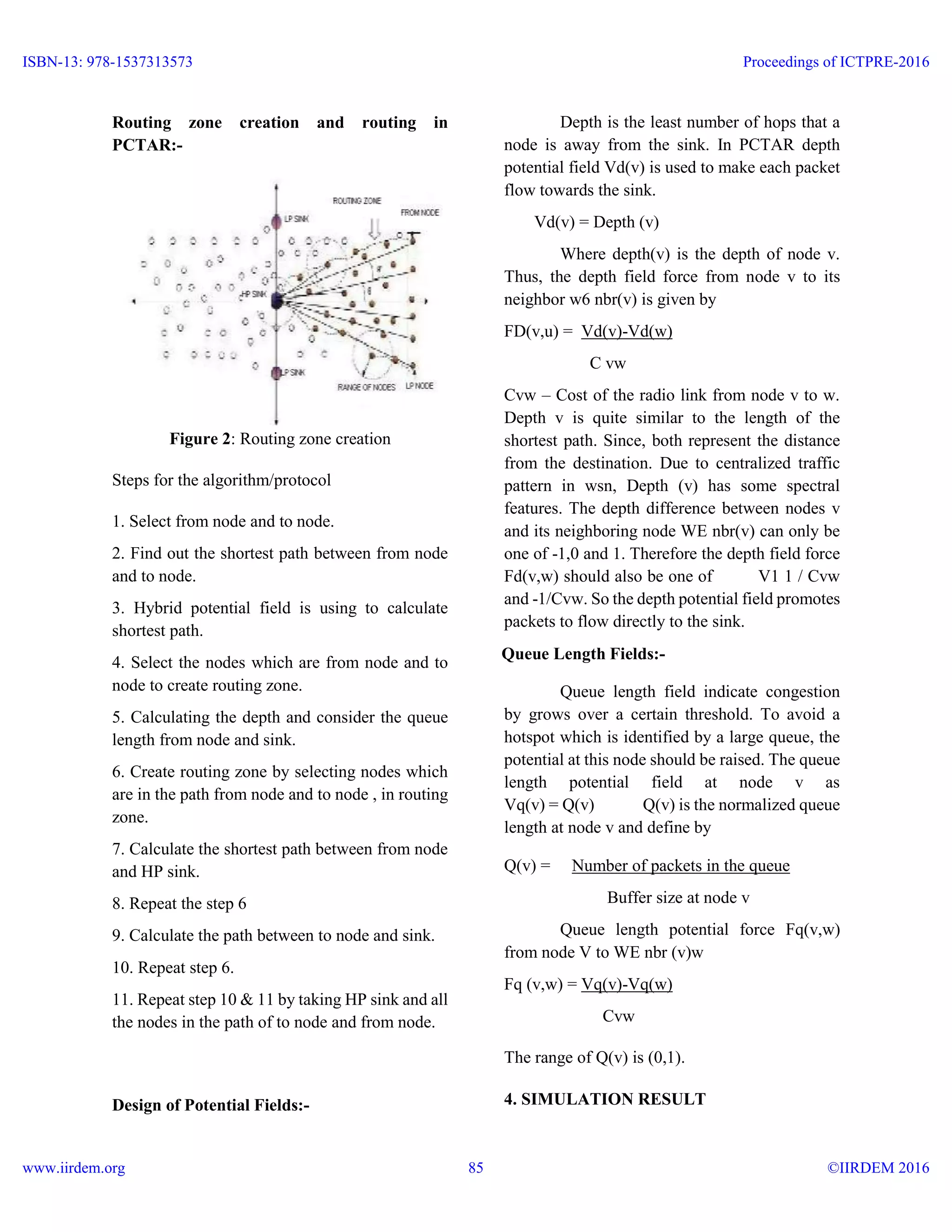
Routing zone creation and routing in
PCTAR:-
Figure 2: Routing zone creation
Steps for the algorithm/protocol
1. Select from node and to node.
2. Find out the shortest path between from node
and to node.
3. Hybrid potential field is using to calculate
shortest path.
4. Select the nodes which are from node and to
node to create routing zone.
5. Calculating the depth and consider the queue
length from node and sink.
6. Create routing zone by selecting nodes which
are in the path from node and to node , in routing
zone.
7. Calculate the shortest path between from node
and HP sink.
8. Repeat the step 6
9. Calculate the path between to node and sink.
10. Repeat step 6.
11. Repeat step 10 & 11 by taking HP sink and all
the nodes in the path of to node and from node.
Design of Potential Fields:-
Depth is the least number of hops that a
node is away from the sink. In PCTAR depth
potential field Vd(v) is used to make each packet
flow towards the sink.
Vd(v) = Depth (v)
Where depth(v) is the depth of node v.
Thus, the depth field force from node v to its
neighbor w6 nbr(v) is given by
FD(v,u) = Vd(v)-Vd(w)
C vw
Cvw – Cost of the radio link from node v to w.
Depth v is quite similar to the length of the
shortest path. Since, both represent the distance
from the destination. Due to centralized traffic
pattern in wsn, Depth (v) has some spectral
features. The depth difference between nodes v
and its neighboring node WE nbr(v) can only be
one of -1,0 and 1. Therefore the depth field force
Fd(v,w) should also be one of V1 1 / Cvw
and -1/Cvw. So the depth potential field promotes
packets to flow directly to the sink.
Queue Length Fields:-
Queue length field indicate congestion
by grows over a certain threshold. To avoid a
hotspot which is identified by a large queue, the
potential at this node should be raised. The queue
length potential field at node v as
Vq(v) = Q(v) Q(v) is the normalized queue
length at node v and define by
Q(v) = Number of packets in the queue
Buffer size at node v
Queue length potential force Fq(v,w)
from node V to WE nbr (v)w
Fq (v,w) = Vq(v)-Vq(w)
Cvw
The range of Q(v) is (0,1).
4. SIMULATION RESULT
ISBN-13: 978-1537313573
www.iirdem.org
Proceedings of ICTPRE-2016
©IIRDEM 201685
Implementation is done using NS-2. Here
there are some important sequence that to be
implemented with the simulator. The
experimental set up contains 100 nodes. These
100 nodes are arranged randomly in positions.
Since this is the wireless environment, the nodes
are given the random motion. In the
implementation, the throughput, packet delivery
ratio (PDR), packet delay and node energy
efficiency are measured.
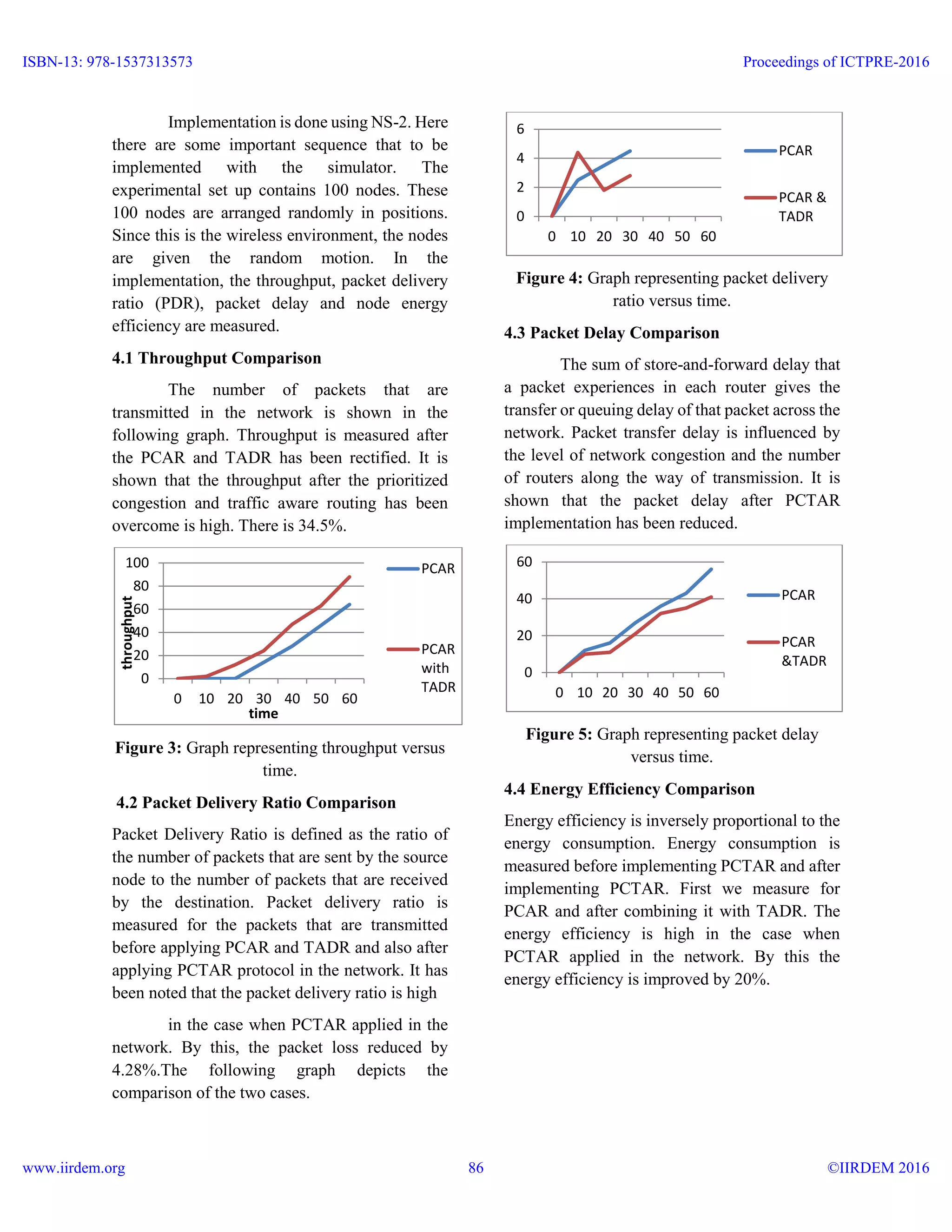
4.1 Throughput Comparison
The number of packets that are
transmitted in the network is shown in the
following graph. Throughput is measured after
the PCAR and TADR has been rectified. It is
shown that the throughput after the prioritized
congestion and traffic aware routing has been
overcome is high. There is 34.5%.
Figure 3: Graph representing throughput versus
time.
4.2 Packet Delivery Ratio Comparison
Packet Delivery Ratio is defined as the ratio of
the number of packets that are sent by the source
node to the number of packets that are received
by the destination. Packet delivery ratio is
measured for the packets that are transmitted
before applying PCAR and TADR and also after
applying PCTAR protocol in the network. It has
been noted that the packet delivery ratio is high
in the case when PCTAR applied in the
network. By this, the packet loss reduced by
4.28%.The following graph depicts the
comparison of the two cases.
Figure 4: Graph representing packet delivery
ratio versus time.
4.3 Packet Delay Comparison
The sum of store-and-forward delay that
a packet experiences in each router gives the
transfer or queuing delay of that packet across the
network. Packet transfer delay is influenced by
the level of network congestion and the number
of routers along the way of transmission. It is
shown that the packet delay after PCTAR
implementation has been reduced.
Figure 5: Graph representing packet delay
versus time.
4.4 Energy Efficiency Comparison
Energy efficiency is inversely proportional to the
energy consumption. Energy consumption is
measured before implementing PCTAR and after
implementing PCTAR. First we measure for
PCAR and after combining it with TADR. The
energy efficiency is high in the case when
PCTAR applied in the network. By this the
energy efficiency is improved by 20%.
0
20
40
60
80
100
0 10 20 30 40 50 60
throughput
time
PCAR
PCAR
with
TADR
0
2
4
6
0 10 20 30 40 50 60
PCAR
PCAR &
TADR
0
20
40
60
0 10 20 30 40 50 60
PCAR
PCAR
&TADR
ISBN-13: 978-1537313573
www.iirdem.org
Proceedings of ICTPRE-2016
©IIRDEM 201686
Figure 6: Graph representing energy efficiency
versus time.
5. CONCLUSION
In wireless sensor network congestion
control is quite different from other networks.
Only the efficient traffic control can alleviate
congestion, but it may affect the fidelity
requirements of the application. The proposed
method prioritized congestion and traffic aware
routing (PCTAR) protocol to ameliorate
throughput by lessen congestion. PCTAR
protocol dynamically discovers the routing zone
by considering hybrid potential fields and data
priority. By this we got high throughput and
energy efficiency.
REFERENCES
[1]. C.Y Wan, S.B Eisenman, and A.T
Campbell, “CODA : Congestion Detection
and Avoidance in Sensor Networks”,
Proc.ACM Int’l Conf. Embedded
networked Sensor Systems, pp. 266-
279,2003
[2]. C. Ram Kumar and R. Raghunath,
“Enhancing Code Aware Routing By
Idling Methods To Improve Energy
Efficiency In Wireless Networks”,
International Journal of Applied
Engineering Research, Volume 10,
Number 4 (2015) pp. 10731-10741.
[3]. Fengyuan Ren, Tao He, “Traffic-Aware
Dynamic Routing to Alleviate Congestion
in Wireless Sensor Networks”, IEEE
Transaction on Parallel and Distributed
Systems, Vol.22 no.9, September 2011.
[4]. Vrushali sonar, Sumedha Sirsikar,
“Prioritized congestion aware routing
protocol in distributed sensor network”
IEEE International Conference on
Electronic Systems, Signal processing and
computing Technologies,2014
[5]. H. R. Pradeep Kumar and S.
Krishnaprasanth, “EAACM: Enhanced
ACK Aware Clustering Mechanism for
Energy Efficient and Secure Routing in
Wireless Sensor Networks”, IMPACT:
International Journal of Research in
Engineering & Technology (IMPACT:
IJRET), Vol. 2, Issue 4, Apr 2014, 53-
62.
[6]. G. Velu and M. B. Suryatejaa,
“Congestion Avoidance based on RC-
MAC Protocol in Wireless Sensor
Networks”, International Journal of
Computational Intelligence and
Informatics, Vol. 4: No. 4, March 2015
[7]. Drieberg. M, Asirvadam V. S, Fu-Chun
Zheng, “Accurate delay analysis in
prioritized wireless sensor network for
generalized packet arrival” wireless
communication letter , IEEE, Vol.3 ,
issue.2,April 2014.
[8]. J. Kang, Y. Zhang, and B. Nath, “TARA:
Topology-Aware Resource Adaptation to
Alleviate Congestion In Sensor Networks”,
IEEE Trans. Parallel and Distributed
Systems, Vol.18, no. 7, pp. 919-931,july
2007.
[9]. C Ram Kumar and M Jennie Bharathi,
“Enhancing Coding Aware Routing and
Handling Link Failure in WSN”,
Journal of Computer Applications
(JCA), Volume IV, Issue 4, 2011
[10]. S. Chen and N. Yang, “Congestion
Avoidance Based on Light-Weight Buffer
Management in Sensor Networks”, IEEE
trans. Parallel and Distributed Systems,
vol. 17, no. 9, pp. 934-946, Sep 2006.
0
50
100
150
0 10 20 30 40 50 60
PCAR
PCAR &
TADR
ISBN-13: 978-1537313573
www.iirdem.org
Proceedings of ICTPRE-2016
©IIRDEM 201687

Improving thrpoughput and energy efficiency by pctar protocol in wireless

  • 1.
    IMPROVING THRPOUGHPUT ANDENERGY EFFICIENCY BY PCTAR PROTOCOL IN WIRELESS SENSOR NETWORK C Ram Kumar#1 , B Vijayalakshmi #2 , Dr C Ramesh#3 , Dr S Chenthur Pandian#4 1 Assistant Professor, ECE, Sri Ramakrishna Engineering College, Coimbatore, India 2 Assistant Professor, ECE, SNS College of Engineering, Coimbatore, India 3 Senior Engineer, EEE, Igate Patni, Bangalore, India 4 Principal, EEE, SNS College of Technology, Coimbatore, India Abstract: Wireless sensor network is an emerging technology consists of spatially distributed autonomous sensors to monitor physical or environmental conditions. The major constraints of these networks are limited to battery life and congestion. Most current routing protocols try to alleviate indiscriminate dropping of data. That type routing protocols not considering congestion and low priority data dropping, so it will degrade the throughput. Here proposing a prioritized congestion and traffic aware routing (PCTAR) protocol to ameliorate throughput by lessen congestion. PCTAR protocol dynamically discovers the routing zone by considering hybrid potential fields and data priority. The simulation result shows that the proposed method improves the overall throughput by 70 percent as compare to TADR. PCTAR protocol make worthier changes in the health care monitoring and military applications. Key words-Wireless sensor networks (WSN), congestion control, TADR and prioritization 1. INTRODUCTION A sensor network is an infrastructure comprised of sensing computing and communication elements that give an administrator the ability to instrument, observe, and react to events and phenomena in a specified environment. Wireless sensor networking promises a wide range of potential applications in both civilian and military areas. One of the great benefits of using wireless sensor network is that they can be used to replace the man power in military and health monitoring. To meet the requirements of the application a wireless sensor network design must have several unique features. The major constraints of these networks are limited to battery life and congestion. Figure 1: Wireless Sensor Network. . Undoubtedly the leading issue in sensor network is battery conservation and careful use of available energy. In wireless sensor networks the methods for energy conservation can be divided into two groups passive and active methods. Passive methods include using sophisticated energy sources to supplant the batteries and placement of sensors into energy efficient topologies. Active methods to conserve Energy includes using specified operating systems. Congestion control and reliable data delivery are the other paramount challenges in wireless sensor network. Network congestion occurs when a link or node is carrying so much data that its quality of service deteriorates. ISBN-13: 978-1537313573 www.iirdem.org Proceedings of ICTPRE-2016 ©IIRDEM 201682
  • 2.
    Typical effects includequeuing delay, packet loss or the blocking of new connections. Packet loss is the discarding of packets in a network when a router or other network devices is overloaded and cannot accept additional packets at a given moment. Packets are the fundamental unit of information transport in all modern computer networks, and increasingly in other communication network as well. All the protocols that are designed and implemented in wireless sensor network should provide some real-time support as they are applied in areas where data is sensed, processed and transmitted based on an event that leads to an immediate action. A- CAR[2], which is a differentiated routing protocol and uses data prioritization. Along with high priority (HP) packet, low priority (LP) packets also contain information. So the packet delivery of both the packets is to be achieved. TADR[1] is a distributed and scalable routing algorithm. Traffic aware dynamic routing can effectively alleviate congestion through by passing the hotspots, and met the fidelity requirements through improving the overall throughput. An extra rule is also introduced to prevent dropping of packets at the hot spots near the sink. 2. TADR The congestion problem in Wireless Sensor Networks (WSNs) is quite different from that in traditional networks. Most current congestion control algorithms try to alleviate the congestion by reducing the rate at which the source nodes inject packets into the network. However, this traffic control scheme always decreases the throughput so as to violate fidelity level required by the applications. In this paper, they present a solution that sufficiently exerts the idle or under loaded nodes to alleviate congestion and improve the overall throughput in WSNs. To achieve this goal, a traffic-aware dynamic routing (TADR)[1] algorithm is proposed to route packets around the congestion areas and scatter the excessive packets along multiple paths consisting of idle and under loaded nodes. Utilizing the concept of potential in classical physics, our TADR algorithm is designed through constructing a hybrid virtual potential field using depth and normalized queue length to force the packets to steer clear of obstacles created by congestion and eventually move toward the sink. TADR scheme has low overhead suitable for large-scale, dense sensor networks. Figure2: Illustration of TADR procedure 2.1 MODULES  Depth potential field formation.  Queue length field formation.  Superposition of potential field. 2.1.1 DEPTH POTENTIAL FIELD FORMATION To provide basic routing function TADR defines the depth potential field Vd(v) to make each packet flow towards the sink. Depth(v) is quite similar to shortest distance since they both represent distance from the destination. depth potential field Vd(v) = depth(V), where depth(V) is the depth of node v. Depth field force from node v to neighbor w ε nbr(v) Fd(v,w) = Vd(v) - Vd(w) Cvw ISBN-13: 978-1537313573 www.iirdem.org Proceedings of ICTPRE-2016 ©IIRDEM 201683
  • 3.
    The depth differencebetween node v and neighbor node can only be one of -1,0,1. The depth field force should also be one of 0, 1/Cvw, -1/Cvw 2.1.2 QUEUE LENGTH FIELD FORMATION Queue length potential field at node v is Vq(v) = Q(v), Q(v) denotes normalized queue length potential field at node v. Q(v) = Number of packets in the queue Buffer size at node v The queue length potential field Fq(v,w) from node v to neighbor w ε nbr(v) as follows Fq(v,w) = Vq(v)-Vq(w) Cvw The range of Q(v) is [0,1] 2.1.3 SUPERPOSITION OF POTENTIAL FIELD. The main attribute of TADR algorithm is Queue length field which make the routing algorithm traffic aware. The Queue length field performs the routing decisions as a combination of both depth and Queue length potential fields. Using linear combination method for simplicity and tractability. Combine the potential fields by Vm(v) = (1-α)Vd(v) + αVq(v). Here Vm(v) is the potential field of the combined field at node v. Combined force from node v to neighbor w ε nbr(v). Fm (v,w) = Vm(v)-Vm(w) Cvw Depth potential field encourages data flow directly to the sink and Queue length potential field endows traffic aware solutions. 3. PROPOSED SYSTEM The recent progressions in the field of sensing, computing and communication have made a lot of research efforts. The major challenges considering in the research activities are congestion control, improving throughput, energy efficiency, security, data rate and link failure. This paper proposes a prioritized congestion and traffic aware routing (PCTAR) protocol. PCTAR PROTOCOL dynamically discovers the routing zone by considering hybrid potential fields and data priority. This system consist the following module. * Prioritized congestion and traffic aware dynamic routing (PCTAR) protocol. PCTAR Prioritized congestion aware routing scheme is designed based on the concept of prioritized congestion aware routing and hybrid potential field. The steps involved in this PCTAR design are  High priority network formation  Design of potential fields  Routing zone discovery  Differential routing For calculating shortest path instead of quadrant or other method we are considering hybrid potential fields. Hybrid potential field is the combination of depth potential field and queue length field. In this the high priority packets are sending through this routing zone created according to the potential fields High priority and low priority packet delivery is assured because of traffic aware routing. ISBN-13: 978-1537313573 www.iirdem.org Proceedings of ICTPRE-2016 ©IIRDEM 201684
  • 4.
    Routing zone creationand routing in PCTAR:- Figure 2: Routing zone creation Steps for the algorithm/protocol 1. Select from node and to node. 2. Find out the shortest path between from node and to node. 3. Hybrid potential field is using to calculate shortest path. 4. Select the nodes which are from node and to node to create routing zone. 5. Calculating the depth and consider the queue length from node and sink. 6. Create routing zone by selecting nodes which are in the path from node and to node , in routing zone. 7. Calculate the shortest path between from node and HP sink. 8. Repeat the step 6 9. Calculate the path between to node and sink. 10. Repeat step 6. 11. Repeat step 10 & 11 by taking HP sink and all the nodes in the path of to node and from node. Design of Potential Fields:- Depth is the least number of hops that a node is away from the sink. In PCTAR depth potential field Vd(v) is used to make each packet flow towards the sink. Vd(v) = Depth (v) Where depth(v) is the depth of node v. Thus, the depth field force from node v to its neighbor w6 nbr(v) is given by FD(v,u) = Vd(v)-Vd(w) C vw Cvw – Cost of the radio link from node v to w. Depth v is quite similar to the length of the shortest path. Since, both represent the distance from the destination. Due to centralized traffic pattern in wsn, Depth (v) has some spectral features. The depth difference between nodes v and its neighboring node WE nbr(v) can only be one of -1,0 and 1. Therefore the depth field force Fd(v,w) should also be one of V1 1 / Cvw and -1/Cvw. So the depth potential field promotes packets to flow directly to the sink. Queue Length Fields:- Queue length field indicate congestion by grows over a certain threshold. To avoid a hotspot which is identified by a large queue, the potential at this node should be raised. The queue length potential field at node v as Vq(v) = Q(v) Q(v) is the normalized queue length at node v and define by Q(v) = Number of packets in the queue Buffer size at node v Queue length potential force Fq(v,w) from node V to WE nbr (v)w Fq (v,w) = Vq(v)-Vq(w) Cvw The range of Q(v) is (0,1). 4. SIMULATION RESULT ISBN-13: 978-1537313573 www.iirdem.org Proceedings of ICTPRE-2016 ©IIRDEM 201685
  • 5.
    Implementation is doneusing NS-2. Here there are some important sequence that to be implemented with the simulator. The experimental set up contains 100 nodes. These 100 nodes are arranged randomly in positions. Since this is the wireless environment, the nodes are given the random motion. In the implementation, the throughput, packet delivery ratio (PDR), packet delay and node energy efficiency are measured. 4.1 Throughput Comparison The number of packets that are transmitted in the network is shown in the following graph. Throughput is measured after the PCAR and TADR has been rectified. It is shown that the throughput after the prioritized congestion and traffic aware routing has been overcome is high. There is 34.5%. Figure 3: Graph representing throughput versus time. 4.2 Packet Delivery Ratio Comparison Packet Delivery Ratio is defined as the ratio of the number of packets that are sent by the source node to the number of packets that are received by the destination. Packet delivery ratio is measured for the packets that are transmitted before applying PCAR and TADR and also after applying PCTAR protocol in the network. It has been noted that the packet delivery ratio is high in the case when PCTAR applied in the network. By this, the packet loss reduced by 4.28%.The following graph depicts the comparison of the two cases. Figure 4: Graph representing packet delivery ratio versus time. 4.3 Packet Delay Comparison The sum of store-and-forward delay that a packet experiences in each router gives the transfer or queuing delay of that packet across the network. Packet transfer delay is influenced by the level of network congestion and the number of routers along the way of transmission. It is shown that the packet delay after PCTAR implementation has been reduced. Figure 5: Graph representing packet delay versus time. 4.4 Energy Efficiency Comparison Energy efficiency is inversely proportional to the energy consumption. Energy consumption is measured before implementing PCTAR and after implementing PCTAR. First we measure for PCAR and after combining it with TADR. The energy efficiency is high in the case when PCTAR applied in the network. By this the energy efficiency is improved by 20%. 0 20 40 60 80 100 0 10 20 30 40 50 60 throughput time PCAR PCAR with TADR 0 2 4 6 0 10 20 30 40 50 60 PCAR PCAR & TADR 0 20 40 60 0 10 20 30 40 50 60 PCAR PCAR &TADR ISBN-13: 978-1537313573 www.iirdem.org Proceedings of ICTPRE-2016 ©IIRDEM 201686
  • 6.
    Figure 6: Graphrepresenting energy efficiency versus time. 5. CONCLUSION In wireless sensor network congestion control is quite different from other networks. Only the efficient traffic control can alleviate congestion, but it may affect the fidelity requirements of the application. The proposed method prioritized congestion and traffic aware routing (PCTAR) protocol to ameliorate throughput by lessen congestion. PCTAR protocol dynamically discovers the routing zone by considering hybrid potential fields and data priority. By this we got high throughput and energy efficiency. REFERENCES [1]. C.Y Wan, S.B Eisenman, and A.T Campbell, “CODA : Congestion Detection and Avoidance in Sensor Networks”, Proc.ACM Int’l Conf. Embedded networked Sensor Systems, pp. 266- 279,2003 [2]. C. Ram Kumar and R. Raghunath, “Enhancing Code Aware Routing By Idling Methods To Improve Energy Efficiency In Wireless Networks”, International Journal of Applied Engineering Research, Volume 10, Number 4 (2015) pp. 10731-10741. [3]. Fengyuan Ren, Tao He, “Traffic-Aware Dynamic Routing to Alleviate Congestion in Wireless Sensor Networks”, IEEE Transaction on Parallel and Distributed Systems, Vol.22 no.9, September 2011. [4]. Vrushali sonar, Sumedha Sirsikar, “Prioritized congestion aware routing protocol in distributed sensor network” IEEE International Conference on Electronic Systems, Signal processing and computing Technologies,2014 [5]. H. R. Pradeep Kumar and S. Krishnaprasanth, “EAACM: Enhanced ACK Aware Clustering Mechanism for Energy Efficient and Secure Routing in Wireless Sensor Networks”, IMPACT: International Journal of Research in Engineering & Technology (IMPACT: IJRET), Vol. 2, Issue 4, Apr 2014, 53- 62. [6]. G. Velu and M. B. Suryatejaa, “Congestion Avoidance based on RC- MAC Protocol in Wireless Sensor Networks”, International Journal of Computational Intelligence and Informatics, Vol. 4: No. 4, March 2015 [7]. Drieberg. M, Asirvadam V. S, Fu-Chun Zheng, “Accurate delay analysis in prioritized wireless sensor network for generalized packet arrival” wireless communication letter , IEEE, Vol.3 , issue.2,April 2014. [8]. J. Kang, Y. Zhang, and B. Nath, “TARA: Topology-Aware Resource Adaptation to Alleviate Congestion In Sensor Networks”, IEEE Trans. Parallel and Distributed Systems, Vol.18, no. 7, pp. 919-931,july 2007. [9]. C Ram Kumar and M Jennie Bharathi, “Enhancing Coding Aware Routing and Handling Link Failure in WSN”, Journal of Computer Applications (JCA), Volume IV, Issue 4, 2011 [10]. S. Chen and N. Yang, “Congestion Avoidance Based on Light-Weight Buffer Management in Sensor Networks”, IEEE trans. Parallel and Distributed Systems, vol. 17, no. 9, pp. 934-946, Sep 2006. 0 50 100 150 0 10 20 30 40 50 60 PCAR PCAR & TADR ISBN-13: 978-1537313573 www.iirdem.org Proceedings of ICTPRE-2016 ©IIRDEM 201687