CMREF SAFI ENGLISH DEPARTMENT
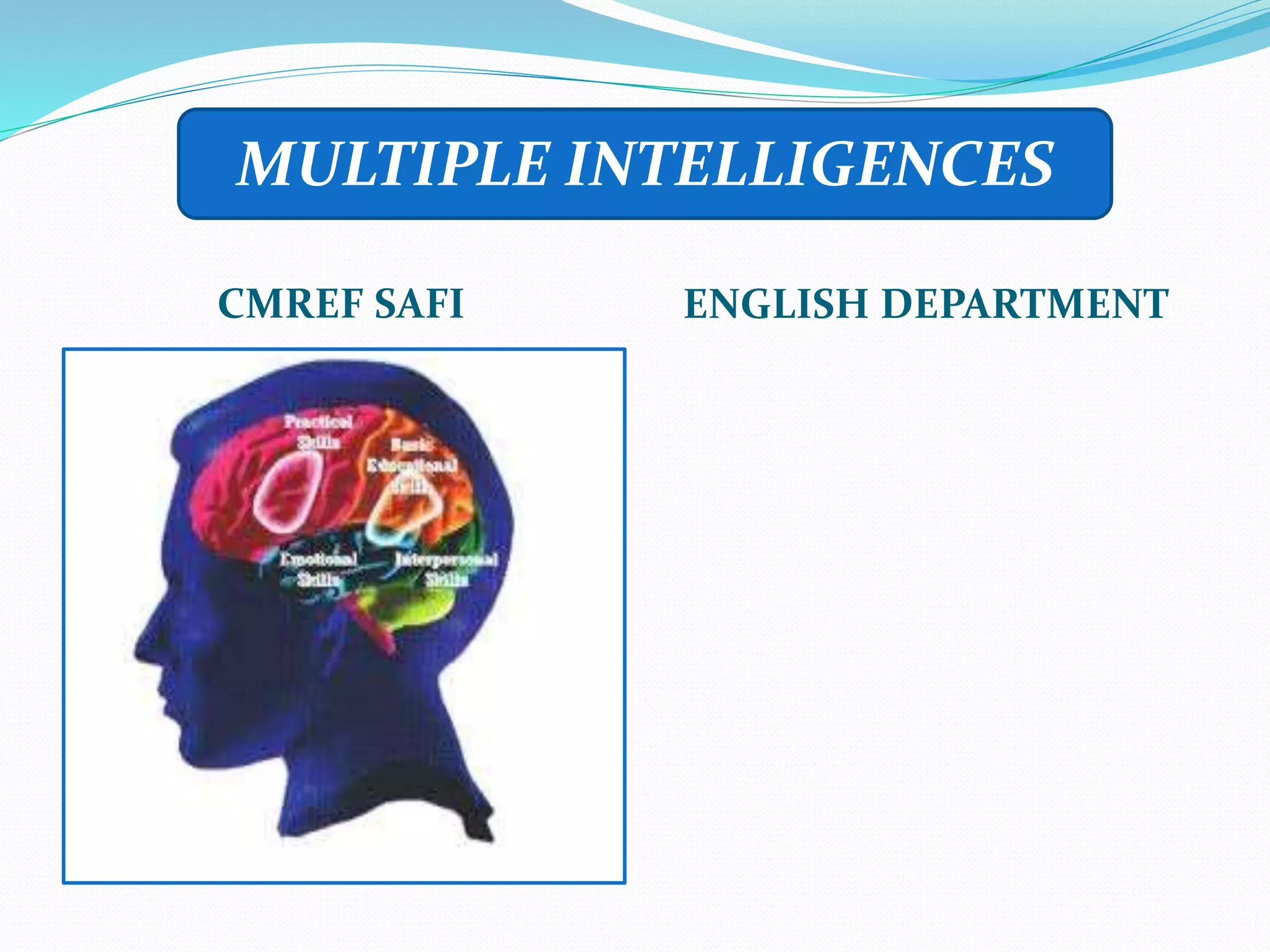
MULTIPLE INTELLIGENCES
STORY
STUPID
?
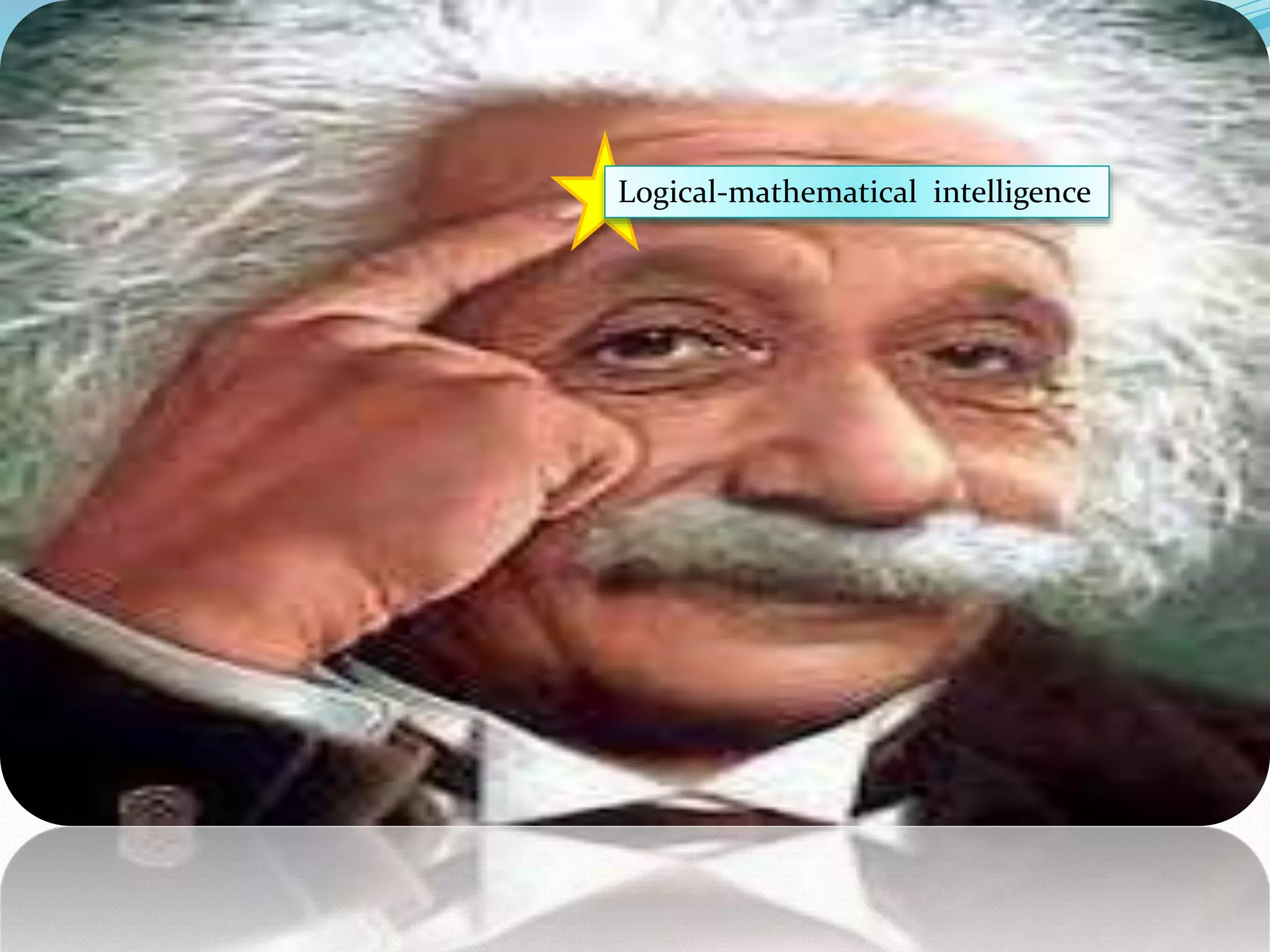
Logical-mathematical intelligence
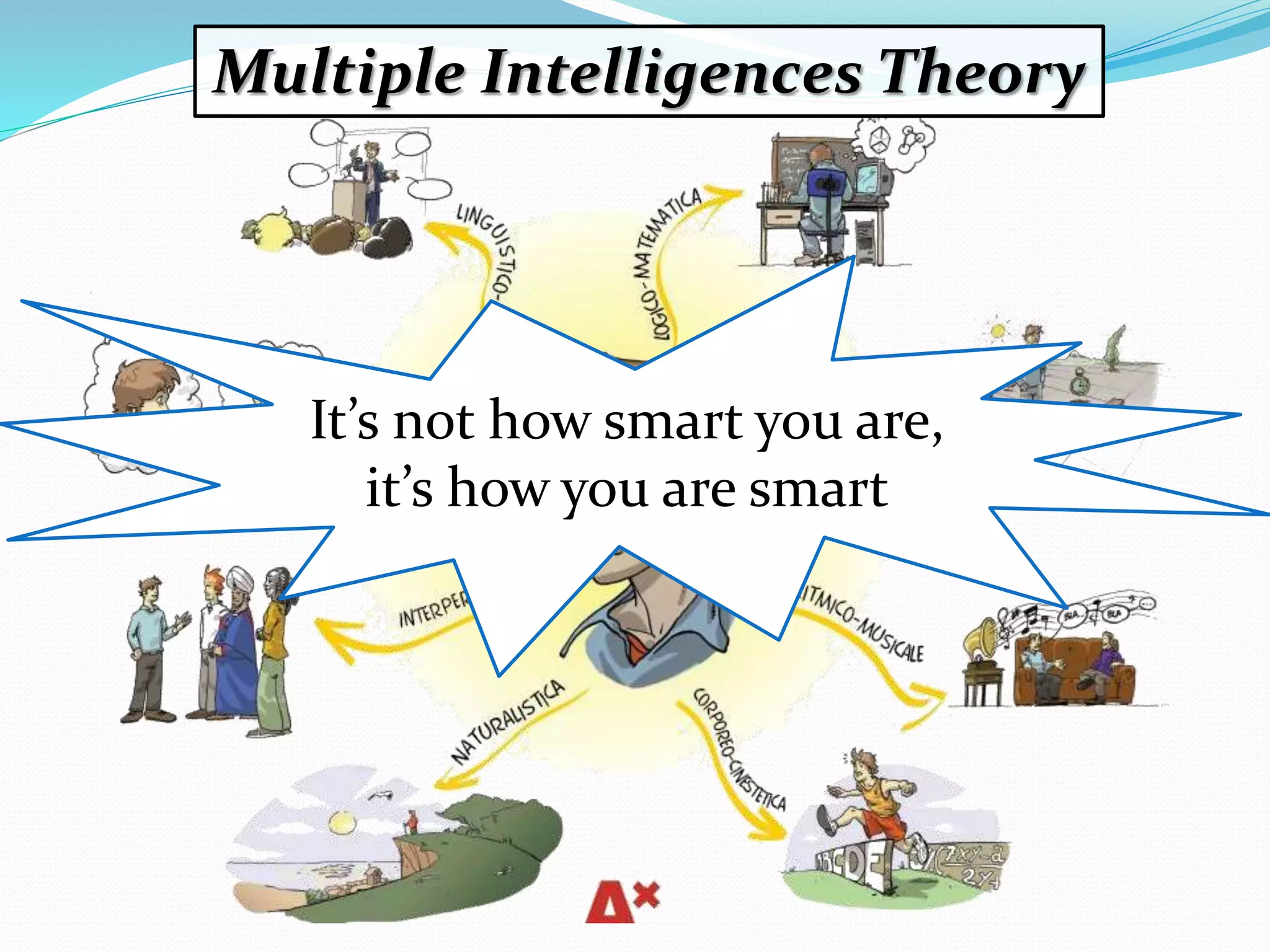
It’s not how smart you are,
it’s how you are smart
Multiple Intelligences Theory
Outline
 Introduction
 Definition of MI Theory
 Types of Multiple Intelligences
 Verbal/Linguistic intelligence
 Logical/Mathematical intelligence
 Visual/Spatial intelligence
 Bodily/Kinesthetic intelligence
 Musical/Rhythmic intelligence
 Interpersonal intelligence
 Intrapersonal intelligence
 Naturalist intelligence
 Existential intelligence
 Implementations for teaching using MI
 Conclusion
 Activity
Introduction
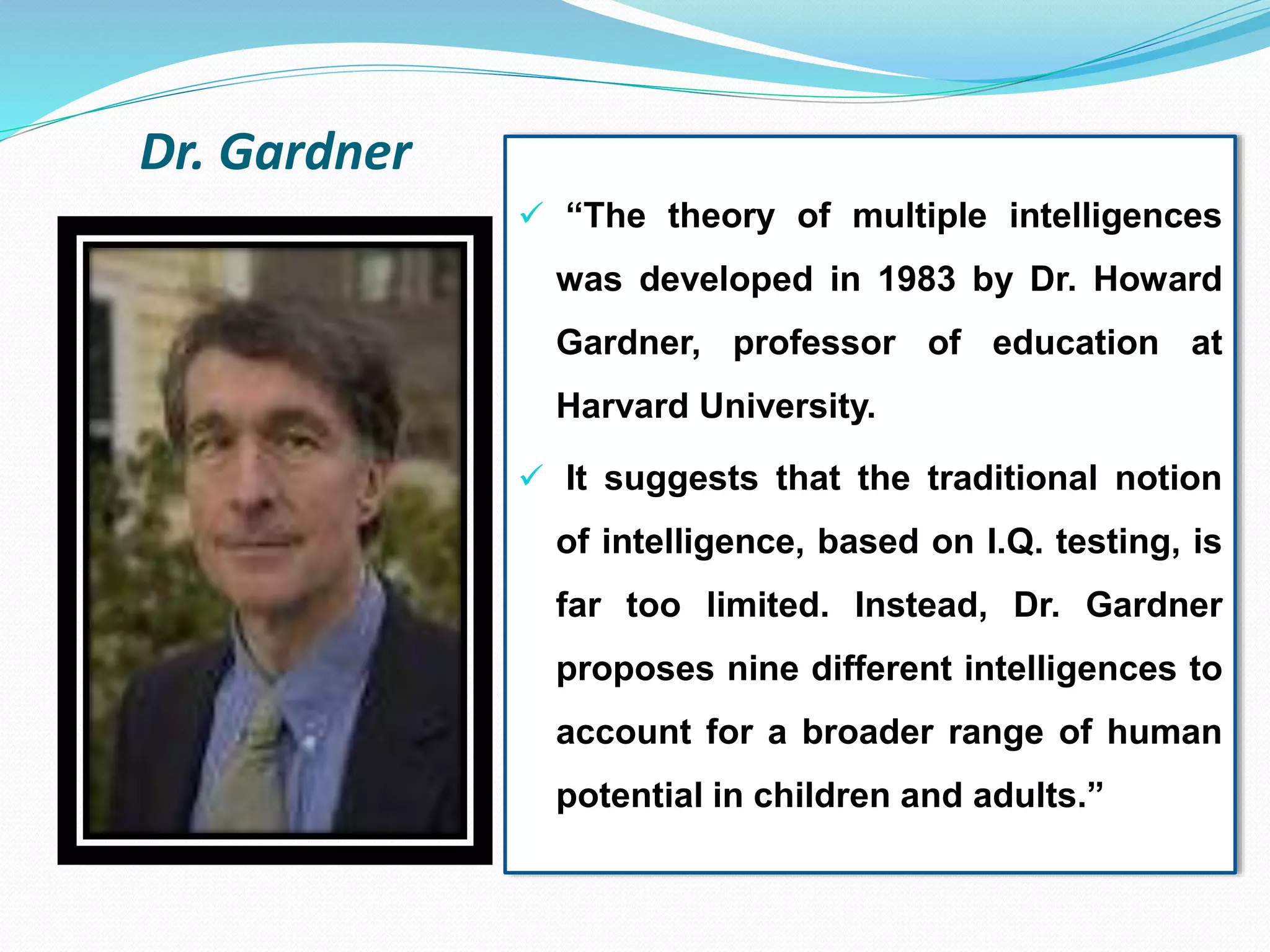
Dr. Gardner
 “The theory of multiple intelligences
was developed in 1983 by Dr. Howard
Gardner, professor of education at
Harvard University.
 It suggests that the traditional notion
of intelligence, based on I.Q. testing, is
far too limited. Instead, Dr. Gardner
proposes nine different intelligences to
account for a broader range of human
potential in children and adults.”
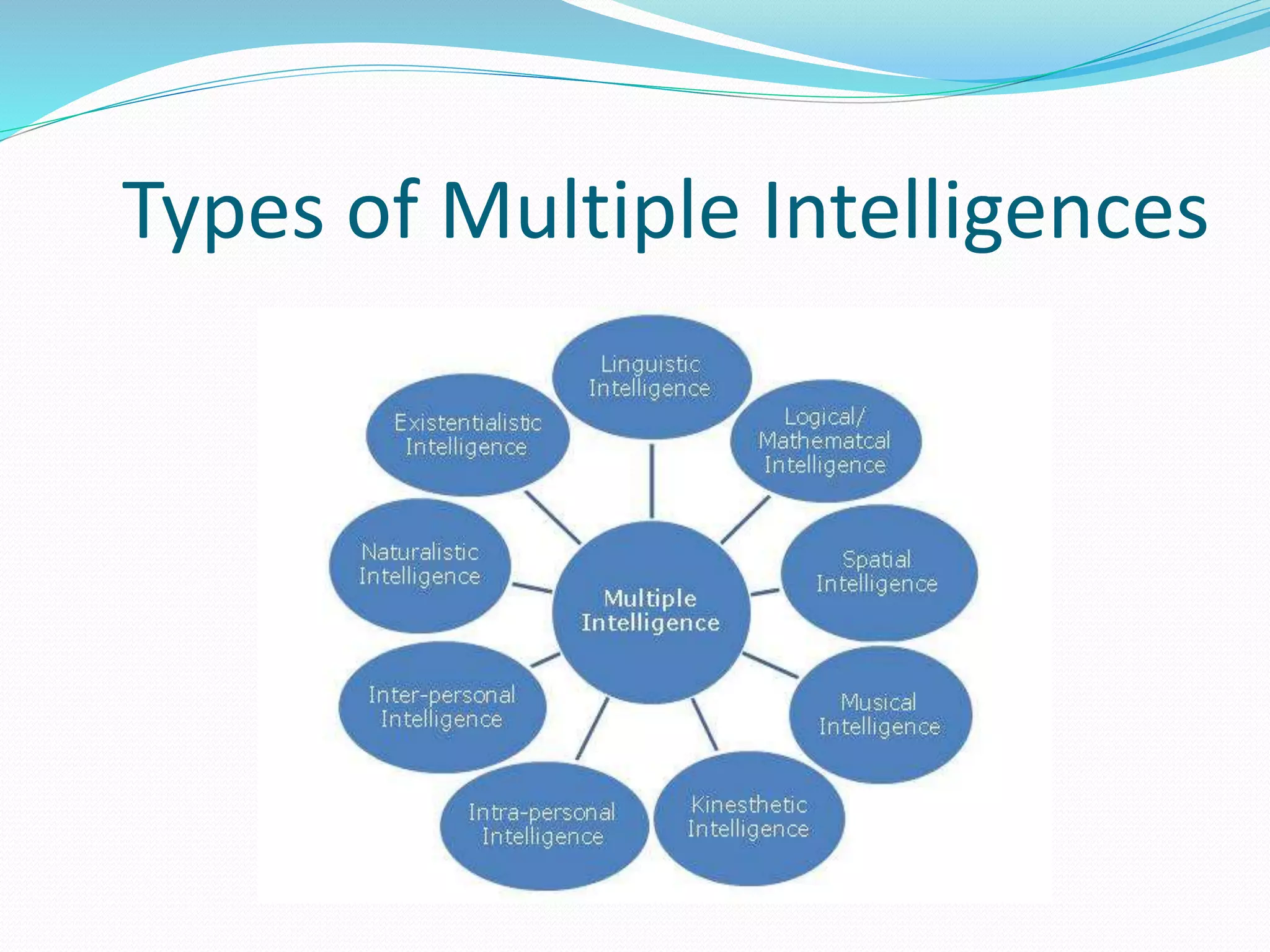
Types of Multiple Intelligences
Verbal/Linguistic Intelligence
 It is the capacity to use language(s) to express
yourself and understand other people.
 Sensitivity to the sounds, rhythms and
meanings of words; sensitivity to the different
functions of language.
 People with this kind of intelligence are called
Word Smart.
 They end as: poets, writers, authors,
journalist, playwright, typist, orator
politician, etc
Students with this kind of intelligence
learn best by saying, hearing and
seeing words, writing, talking and
reading.
Criteria for Verbal/Linguistic Intelligence
Can understand words and manipulate the
structure of language.
Has highly developed communication skills
including writing, speaking, and story-telling
Knows and correctly uses rules of grammar
Enjoys reading, writing, and speaking
Has a large vocabulary
Logical/Mathematical Intelligence
Logical-mathematical intelligence is the
capacity to use numbers effectively and reason well.
Someone who has this kind of intelligence is able to
see cause and effect really well. Also, they are able to
identify a problem and solve it right there on the
spot.
People with this intelligence think by
reasoning, they love experimenting, questioning,
figuring out logical puzzles and calculating.
 People with this kind of intelligence are called
Number/Reasoning Smart
Sensitivity to, and capacity to discern, logical or
numerical patterns; ability to handle long chains of
reasoning.
 They end as: Scientist, Mathematician, Accountant,
Banker, Computer Programmer, Science Teacher,
Statistician …etc
• They learn best by: categorizing, classifying, inferring,
generalizing, calculating and hypothesis testing.
Visual/Spatial Intelligence
 Spatial intelligence is the brain’s ability to perceive,
interpret the visual-spatial world accurately and
perform transformations on one’s initial perceptions.
In other words, it’s how our minds process what we
see. Although not very recognized, spatial intelligence
is very important in the arts and in everyday life.
People with this kind of intelligence are called
Picture Smart.
 They end as: Navigator, Sculptor, Architect, Engineer,
Painter … etc
They learn best by: Sculpting, Visualization, Posters,
Painting, Brochures, Mapping, Drawings … etc
Bodily/Kinesthetic Intelligence
 It is the ability to use one’s hands to produce or
transform things. It is proficiency in controlling
one’s whole body movements to express ideas and
to handle objects skillfully.
 People with this kind of intelligence are called
Body Smart.
 They end as: Actors, dancers, Athletes etc …
 They learn best by: Role play, Drama, Movement,
Things to build, Sports and physical games,
Tactile (touchable) experiences, Hands-on
learning.
Intrapersonal Intelligence
Access to one’s own feelings and the ability to
discriminate among them and draw on them to
guide behavior .
It is self-knowledge and the ability to act
adaptively on the basis of that knowledge.
People with this kind of intelligence are called
Self Smart.
They end as: Philosopher, Psychology Teacher…
They learn best by: Journal writing, self-evaluation,
personal instruction, independent study,
reflecting.
Sigmund
FREUD
Interpersonal Intelligence
 Capacities to understand, discern and respond appropriately to the
moods, temperaments, motivations, and desires of other people.
 Anybody needs this intelligence in order to have good rapport with
other people.
 People with this kind of intelligence are called People Smart.
 They can be: politician, salesmen, counselor, manager,
nurse, teacher, public relations.
 They learn best by: Person-to-person communication,
Cooperative learning strategies, Group projects, Teaching
someone else something new, Creating group rules, Acting
in a play or simulation and Conducting an interview.
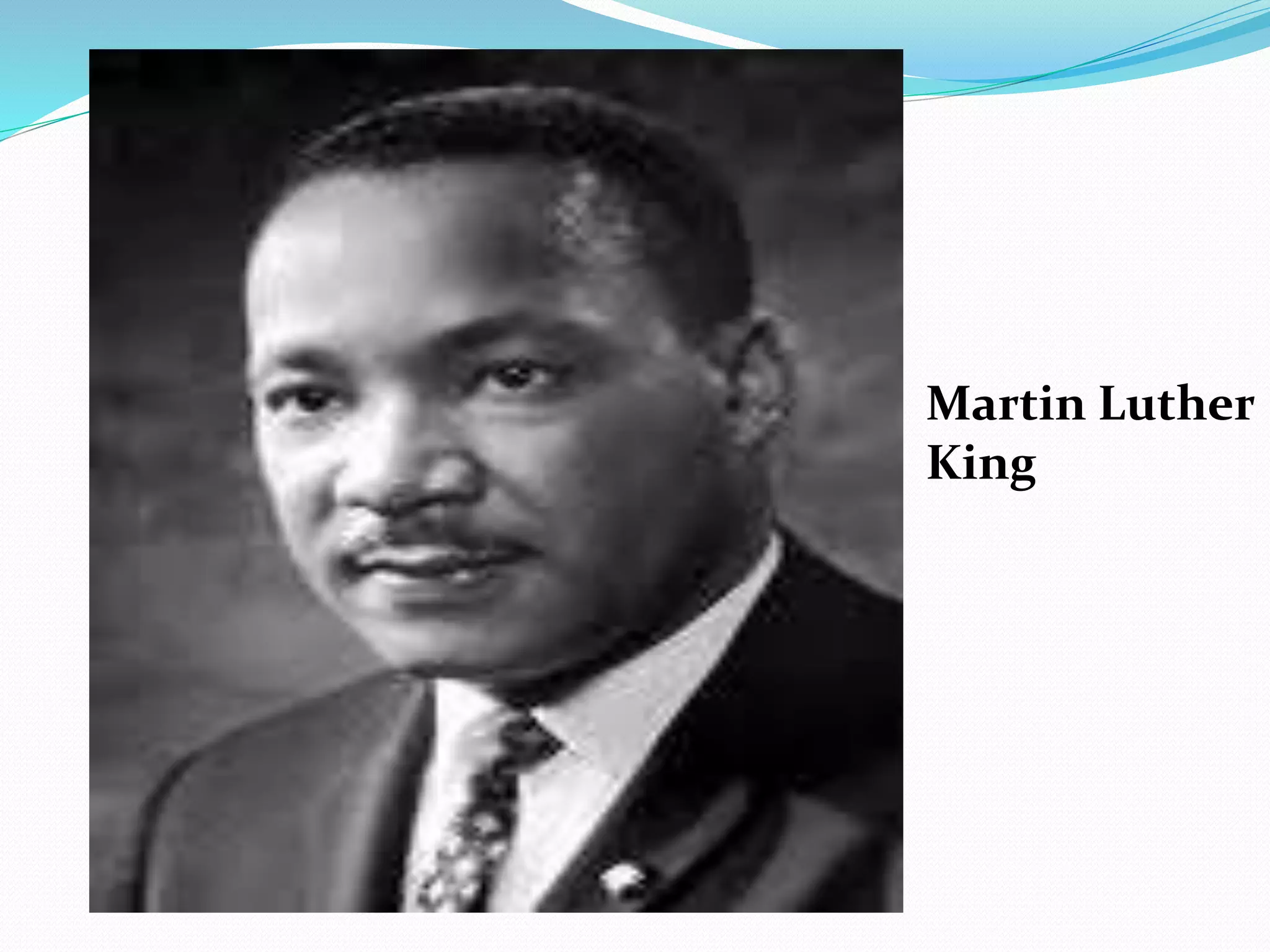
Martin Luther
King
Musical/Rhythmic Intelligence
 Being musically intelligent means that you are able to
distinguish the sounds around you and that you have the
ability to make your own melodies. Even if you are only
singing a song or making music, you are using your musical
intelligence!
 It is the ability to produce and appreciate rhythm, pitch,
and timbre; perception, discrimination, transformation
and appreciation of the forms of musical expressiveness.
 People with this kind of intelligence are called Music
Smart.
 They end as: Composer, Violinist, Singer, Rapper,
Conductor, Music Therapist … etc
Ludwig Van Beethoven
Naturalist Intelligence
 Abilities to recognize plants and animals, to make
distinctions in the natural world, to understand
systems and define categories.
 People with this kind of intelligence are called
Nature Smart.
 They end as: Botanist, farmer, gardeners, hunters and
scientists.
They learn best by connecting them to nature subjects,
taking them to open places like gardens and school
yards.
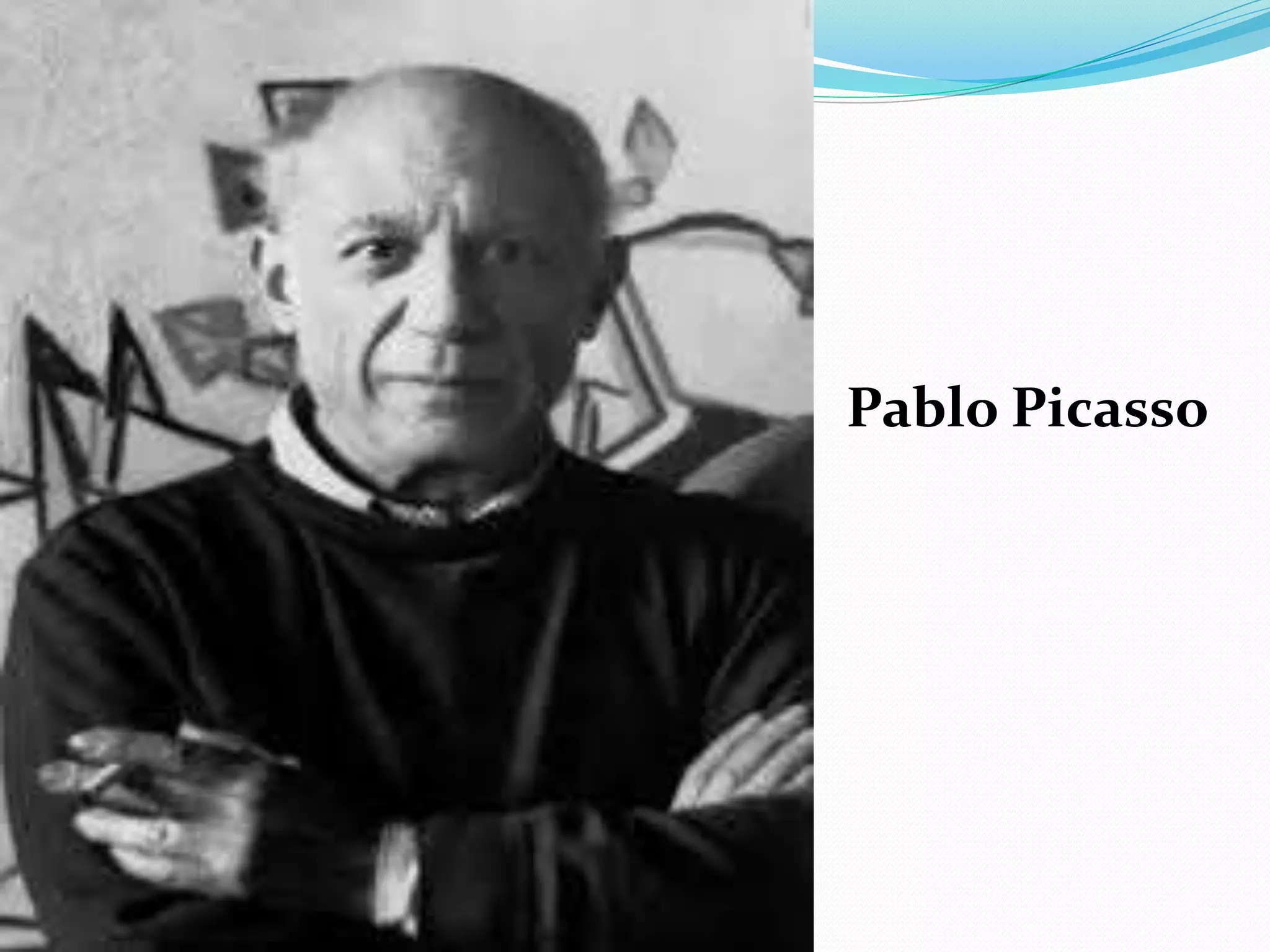
Pablo Picasso
Existential Intelligence
Is a new type of intelligence added by Gardner in 1999.
When learners contemplate in life and question their
own existence. They look for the truth and think in the
reason behind life and death.
They learn best in context where mankind stands in
the big picture of existence. (Teachers are advised to
use stories, plays and topics related to existence).
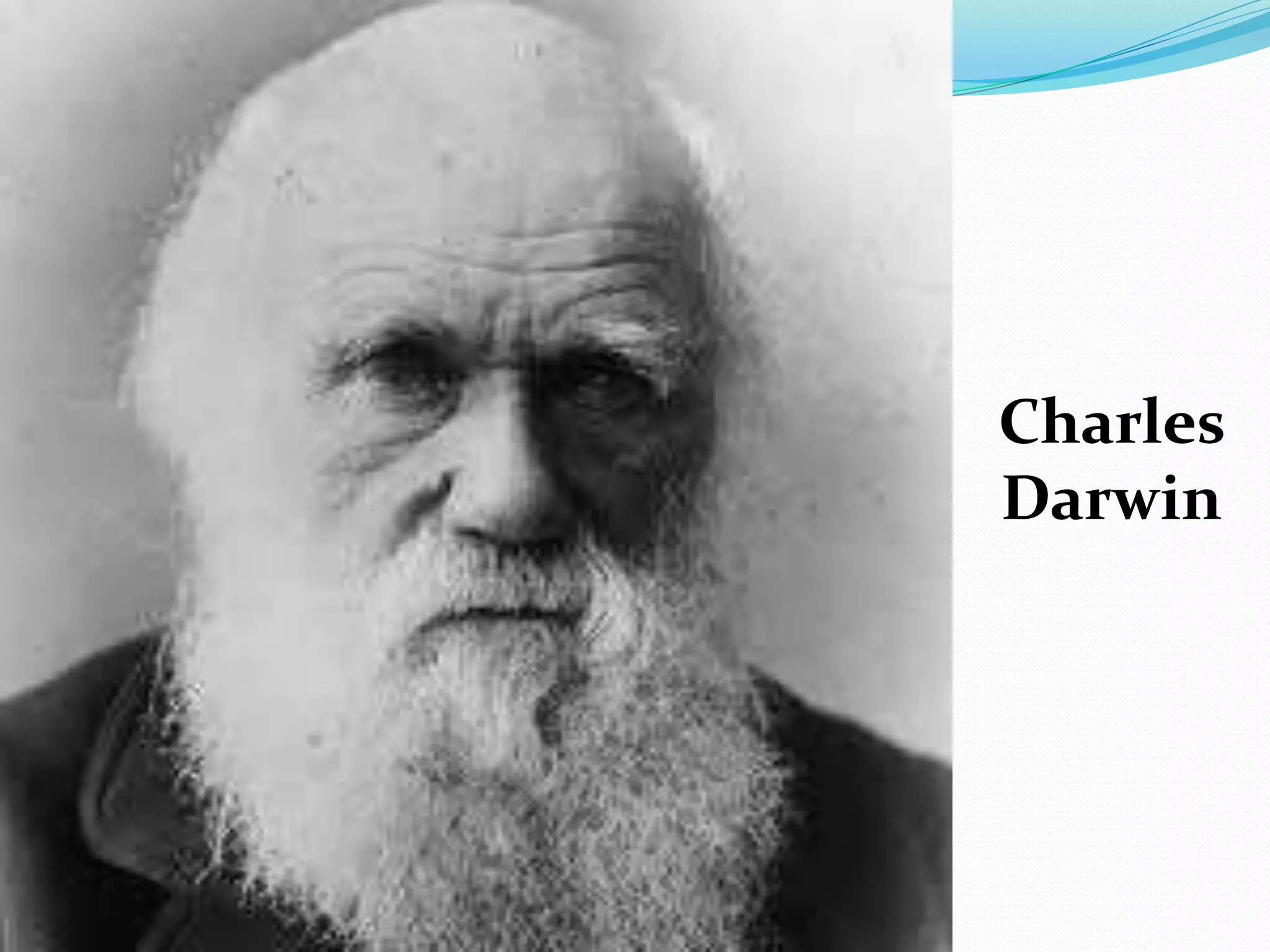
Charles
Darwin
Verbal-Linguistic discussions, debates, journal writing, conferences, essays, stories,
poems, storytelling, listening, reading
Logical-
Mathematical
calculations, experiments, comparisons, number games, using
evidence, formulating hypotheses, deductive/inductive reasoning
Visual Spatial concept maps, graphs, charts, art projects, metaphorical thinking,
visualization, videos, visuals
Bodily-
Kinesthetic
role-playing, dance, athletics, manipulatives, concept miming,
hands-on demonstrations
Musical playing music, singing, rapping, whistling, clapping, analyzing
sounds and music
Interpersonal community-involvement, discussions, cooperative learning, games,
peer tutoring, social activities
Intrapersonal student choice, journal writing, self-evaluation, personal instruction,
independent study, reflecting
Naturalist ecological field trips, environmental study, caring for
plants/animals, outdoor work, pattern recognition
 The theory of multiple intelligences proposes an important change
in the way our schools are run.
It suggests that teachers should be trained to introduce their lessons
in a wide variety of ways. They have to use:
 Music or multimedia
 Cooperative learning
 Art activities
 Role play
 Field trips
 Inner reflection, etc.
Video
Every now and then, the teacher, stands back and takes a look at what’s
going on in his classroom. Today, in pairs or small groups, his students are
working on projects. Sarah and James are poring over a stack of books from the
library, writing notes on index cards. Jones draws detailed illustrations, while
Tony designs charts and graphs on the computer. Pedro is bouncing his pencil
eraser on his desk and tapping his foot against the chair leg. Mr. Oakes knows
this helps Pedro to stay focused on his reading. Clara is so excited about
explaining her ideas to her partner that she’s twirling around her braid of hair as
if it were a propeller. Megan is staring out the window, watching the traffic move
along the busy street that borders the school. Mr. Oakes doesn’t call her back to
work quite yet. He knows Megan needs this dream time to relax and allow her
ideas to percolate. At the back of the classroom, good friends Percy and David
are laughing and fooling around. He remembers their huge disagreement from
yesterday and knows that neither can accomplish any work until the friendship
is reestablished. Slowly, he heads to the back of the room, knowing that his
presence alone will remind them to get back to work. “These kids are really
working hard,” Mr. Oakes thinks. Only a high school teacher would recognize
that among all these varied activities, real learning is taking place.
Every now and then, the teacher, stands back and takes a look at what’s
going on in his classroom. Today, in pairs or small groups, his students are
working on projects. Sarah and James are poring over a stack of books from the
library, writing notes on index cards. Jones draws detailed illustrations, while
Tony designs charts and graphs on the computer. Pedro is bouncing his pencil
eraser on his desk and tapping his foot against the chair leg. Mr. Oakes knows
this helps Pedro to stay focused on his reading. Clara is so excited about
explaining her ideas to her partner that she’s twirling around her braid of hair as
if it were a propeller. Megan is staring out the window, watching the traffic move
along the busy street that borders the school. Mr. Oakes doesn’t call her back to
work quite yet. He knows Megan needs this dream time to relax and allow her
ideas to percolate. At the back of the classroom, good friends Percy and David
are laughing and fooling around. He remembers their huge disagreement from
yesterday and knows that neither can accomplish any work until the friendship
is reestablished. Slowly, he heads to the back of the room, knowing that his
presence alone will remind them to get back to work. “These kids are really
working hard,” Mr. Oakes thinks. Only a high school teacher would recognize
that among all these varied activities, real learning is taking place.
Sarah and James are poring over a stack
of books from the library, writing notes
on index cards.
Jones draws detailed illustrations, while
Tony designs charts and graphs on the
computer
Pedro is bouncing his pencil eraser on
his desk and tapping his foot against the
chair leg
Clara is so excited about explaining her
ideas to her partner that she’s twirling
around her braid of hair as if it were a
propeller.
Megan is staring out the window,
watching the traffic move along the busy
street that borders the school. Mr. Oakes
doesn’t call her back to work quite yet. He
knows Megan needs this dream time to
relax and allow her ideas to percolate.
Percy and David are laughing and
fooling around. He remembers their huge
disagreement from yesterday and knows
that neither can accomplish any work
until the friendship is reestablished.
Multiple intelligences

Multiple intelligences

  • 1.
    CMREF SAFI ENGLISHDEPARTMENT MULTIPLE INTELLIGENCES
  • 2.
  • 3.
  • 4.
    It’s not howsmart you are, it’s how you are smart Multiple Intelligences Theory
  • 5.
    Outline  Introduction  Definitionof MI Theory  Types of Multiple Intelligences  Verbal/Linguistic intelligence  Logical/Mathematical intelligence  Visual/Spatial intelligence  Bodily/Kinesthetic intelligence  Musical/Rhythmic intelligence  Interpersonal intelligence  Intrapersonal intelligence  Naturalist intelligence  Existential intelligence  Implementations for teaching using MI  Conclusion  Activity
  • 6.
  • 7.
    Dr. Gardner  “Thetheory of multiple intelligences was developed in 1983 by Dr. Howard Gardner, professor of education at Harvard University.  It suggests that the traditional notion of intelligence, based on I.Q. testing, is far too limited. Instead, Dr. Gardner proposes nine different intelligences to account for a broader range of human potential in children and adults.”
  • 8.
    Types of MultipleIntelligences
  • 9.
  • 10.
     It isthe capacity to use language(s) to express yourself and understand other people.  Sensitivity to the sounds, rhythms and meanings of words; sensitivity to the different functions of language.  People with this kind of intelligence are called Word Smart.
  • 11.
     They endas: poets, writers, authors, journalist, playwright, typist, orator politician, etc Students with this kind of intelligence learn best by saying, hearing and seeing words, writing, talking and reading.
  • 12.
    Criteria for Verbal/LinguisticIntelligence Can understand words and manipulate the structure of language. Has highly developed communication skills including writing, speaking, and story-telling Knows and correctly uses rules of grammar Enjoys reading, writing, and speaking Has a large vocabulary
  • 14.
  • 15.
    Logical-mathematical intelligence isthe capacity to use numbers effectively and reason well. Someone who has this kind of intelligence is able to see cause and effect really well. Also, they are able to identify a problem and solve it right there on the spot. People with this intelligence think by reasoning, they love experimenting, questioning, figuring out logical puzzles and calculating.
  • 16.
     People withthis kind of intelligence are called Number/Reasoning Smart Sensitivity to, and capacity to discern, logical or numerical patterns; ability to handle long chains of reasoning.  They end as: Scientist, Mathematician, Accountant, Banker, Computer Programmer, Science Teacher, Statistician …etc • They learn best by: categorizing, classifying, inferring, generalizing, calculating and hypothesis testing.
  • 17.
  • 18.
     Spatial intelligenceis the brain’s ability to perceive, interpret the visual-spatial world accurately and perform transformations on one’s initial perceptions. In other words, it’s how our minds process what we see. Although not very recognized, spatial intelligence is very important in the arts and in everyday life. People with this kind of intelligence are called Picture Smart.  They end as: Navigator, Sculptor, Architect, Engineer, Painter … etc They learn best by: Sculpting, Visualization, Posters, Painting, Brochures, Mapping, Drawings … etc
  • 19.
  • 20.
     It isthe ability to use one’s hands to produce or transform things. It is proficiency in controlling one’s whole body movements to express ideas and to handle objects skillfully.  People with this kind of intelligence are called Body Smart.  They end as: Actors, dancers, Athletes etc …  They learn best by: Role play, Drama, Movement, Things to build, Sports and physical games, Tactile (touchable) experiences, Hands-on learning.
  • 22.
  • 23.
    Access to one’sown feelings and the ability to discriminate among them and draw on them to guide behavior . It is self-knowledge and the ability to act adaptively on the basis of that knowledge. People with this kind of intelligence are called Self Smart. They end as: Philosopher, Psychology Teacher… They learn best by: Journal writing, self-evaluation, personal instruction, independent study, reflecting.
  • 24.
  • 25.
  • 26.
     Capacities tounderstand, discern and respond appropriately to the moods, temperaments, motivations, and desires of other people.  Anybody needs this intelligence in order to have good rapport with other people.  People with this kind of intelligence are called People Smart.  They can be: politician, salesmen, counselor, manager, nurse, teacher, public relations.  They learn best by: Person-to-person communication, Cooperative learning strategies, Group projects, Teaching someone else something new, Creating group rules, Acting in a play or simulation and Conducting an interview.
  • 27.
  • 28.
  • 29.
     Being musicallyintelligent means that you are able to distinguish the sounds around you and that you have the ability to make your own melodies. Even if you are only singing a song or making music, you are using your musical intelligence!  It is the ability to produce and appreciate rhythm, pitch, and timbre; perception, discrimination, transformation and appreciation of the forms of musical expressiveness.  People with this kind of intelligence are called Music Smart.  They end as: Composer, Violinist, Singer, Rapper, Conductor, Music Therapist … etc
  • 30.
  • 31.
  • 32.
     Abilities torecognize plants and animals, to make distinctions in the natural world, to understand systems and define categories.  People with this kind of intelligence are called Nature Smart.  They end as: Botanist, farmer, gardeners, hunters and scientists. They learn best by connecting them to nature subjects, taking them to open places like gardens and school yards.
  • 33.
  • 34.
  • 35.
    Is a newtype of intelligence added by Gardner in 1999. When learners contemplate in life and question their own existence. They look for the truth and think in the reason behind life and death. They learn best in context where mankind stands in the big picture of existence. (Teachers are advised to use stories, plays and topics related to existence).
  • 36.
  • 37.
    Verbal-Linguistic discussions, debates,journal writing, conferences, essays, stories, poems, storytelling, listening, reading Logical- Mathematical calculations, experiments, comparisons, number games, using evidence, formulating hypotheses, deductive/inductive reasoning Visual Spatial concept maps, graphs, charts, art projects, metaphorical thinking, visualization, videos, visuals Bodily- Kinesthetic role-playing, dance, athletics, manipulatives, concept miming, hands-on demonstrations Musical playing music, singing, rapping, whistling, clapping, analyzing sounds and music Interpersonal community-involvement, discussions, cooperative learning, games, peer tutoring, social activities Intrapersonal student choice, journal writing, self-evaluation, personal instruction, independent study, reflecting Naturalist ecological field trips, environmental study, caring for plants/animals, outdoor work, pattern recognition
  • 38.
     The theoryof multiple intelligences proposes an important change in the way our schools are run. It suggests that teachers should be trained to introduce their lessons in a wide variety of ways. They have to use:  Music or multimedia  Cooperative learning  Art activities  Role play  Field trips  Inner reflection, etc.
  • 41.
  • 42.
    Every now andthen, the teacher, stands back and takes a look at what’s going on in his classroom. Today, in pairs or small groups, his students are working on projects. Sarah and James are poring over a stack of books from the library, writing notes on index cards. Jones draws detailed illustrations, while Tony designs charts and graphs on the computer. Pedro is bouncing his pencil eraser on his desk and tapping his foot against the chair leg. Mr. Oakes knows this helps Pedro to stay focused on his reading. Clara is so excited about explaining her ideas to her partner that she’s twirling around her braid of hair as if it were a propeller. Megan is staring out the window, watching the traffic move along the busy street that borders the school. Mr. Oakes doesn’t call her back to work quite yet. He knows Megan needs this dream time to relax and allow her ideas to percolate. At the back of the classroom, good friends Percy and David are laughing and fooling around. He remembers their huge disagreement from yesterday and knows that neither can accomplish any work until the friendship is reestablished. Slowly, he heads to the back of the room, knowing that his presence alone will remind them to get back to work. “These kids are really working hard,” Mr. Oakes thinks. Only a high school teacher would recognize that among all these varied activities, real learning is taking place.
  • 43.
    Every now andthen, the teacher, stands back and takes a look at what’s going on in his classroom. Today, in pairs or small groups, his students are working on projects. Sarah and James are poring over a stack of books from the library, writing notes on index cards. Jones draws detailed illustrations, while Tony designs charts and graphs on the computer. Pedro is bouncing his pencil eraser on his desk and tapping his foot against the chair leg. Mr. Oakes knows this helps Pedro to stay focused on his reading. Clara is so excited about explaining her ideas to her partner that she’s twirling around her braid of hair as if it were a propeller. Megan is staring out the window, watching the traffic move along the busy street that borders the school. Mr. Oakes doesn’t call her back to work quite yet. He knows Megan needs this dream time to relax and allow her ideas to percolate. At the back of the classroom, good friends Percy and David are laughing and fooling around. He remembers their huge disagreement from yesterday and knows that neither can accomplish any work until the friendship is reestablished. Slowly, he heads to the back of the room, knowing that his presence alone will remind them to get back to work. “These kids are really working hard,” Mr. Oakes thinks. Only a high school teacher would recognize that among all these varied activities, real learning is taking place. Sarah and James are poring over a stack of books from the library, writing notes on index cards. Jones draws detailed illustrations, while Tony designs charts and graphs on the computer Pedro is bouncing his pencil eraser on his desk and tapping his foot against the chair leg Clara is so excited about explaining her ideas to her partner that she’s twirling around her braid of hair as if it were a propeller. Megan is staring out the window, watching the traffic move along the busy street that borders the school. Mr. Oakes doesn’t call her back to work quite yet. He knows Megan needs this dream time to relax and allow her ideas to percolate. Percy and David are laughing and fooling around. He remembers their huge disagreement from yesterday and knows that neither can accomplish any work until the friendship is reestablished.