WELCOME
National Level Workshop on
Design and Development on Moocs
02-08 December 2019
Organised by
Department of Education
University of Kerala, Thiruvananthapuram
Topic: Multiple Intelligence
Prepared by
P. Vel Murugan
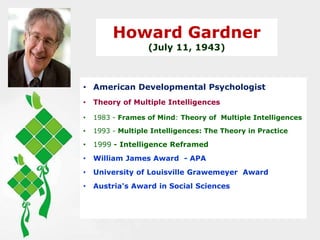
Howard Gardner
(July 11, 1943)
• American Developmental Psychologist
• Theory of Multiple Intelligences
• 1983 - Frames of Mind: Theory of Multiple Intelligences
• 1993 - Multiple Intelligences: The Theory in Practice
• 1999 - Intelligence Reframed
• William James Award - APA
• University of Louisville Grawemeyer Award
• Austria's Award in Social Sciences
Multiple Intelligence - Meaning
Ability to solve problems, or to create products,
that are valued within one or more cultural
settings.
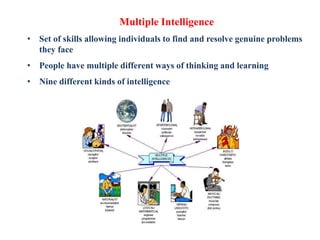
Multiple Intelligence
• Set of skills allowing individuals to find and resolve genuine problems
they face
• People have multiple different ways of thinking and learning
• Nine different kinds of intelligence
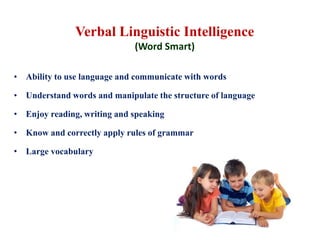
Verbal Linguistic Intelligence
(Word Smart)
• Ability to use language and communicate with words
• Understand words and manipulate the structure of language
• Enjoy reading, writing and speaking
• Know and correctly apply rules of grammar
• Large vocabulary
Examples
• Author
• Journalist
• Poet
• Playwright
• Radio Announcer
• Typist
• Novelist
• Comedian
• Politician
• Lawyer
• Orator
• Actor
• Curator
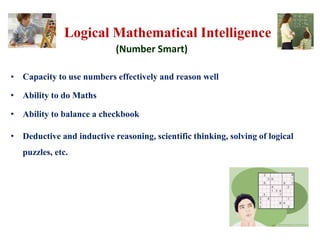
Logical Mathematical Intelligence
(Number Smart)
• Capacity to use numbers effectively and reason well
• Ability to do Maths
• Ability to balance a checkbook
• Deductive and inductive reasoning, scientific thinking, solving of logical
puzzles, etc.
Examples
• Accountant
• Auditor
• Banker
• Bookkeeper
• Businessperson
• Computer Analyst
• Computer Programmer
• Philosopher
• Economist
• Mathematician
• Purchasing Agent
• Science Researcher
• Science Teacher
• Statistician
• Technician
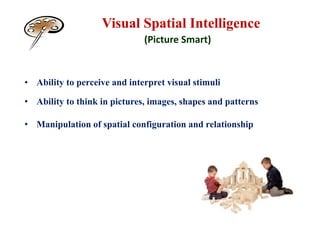
Visual Spatial Intelligence
(Picture Smart)
• Ability to perceive and interpret visual stimuli
• Ability to think in pictures, images, shapes and patterns
• Manipulation of spatial configuration and relationship
Examples
• Advertising Agent
• Architect
• Drafter
• Engineer
• Fine Artist
• Graphic Designer
• Fashion Designer
• Interior Designer
• Chess player
• Inventor
• Painter
• Photographer
• Pilot
• Navigator
• Sculptor
• Surveyor
• Urban Planner
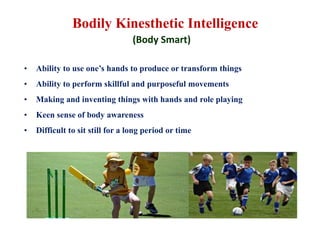
Bodily Kinesthetic Intelligence
(Body Smart)
• Ability to use one’s hands to produce or transform things
• Ability to perform skillful and purposeful movements
• Making and inventing things with hands and role playing
• Keen sense of body awareness
• Difficult to sit still for a long period or time
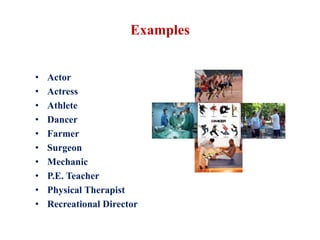
Examples
• Actor
• Actress
• Athlete
• Dancer
• Farmer
• Surgeon
• Mechanic
• P.E. Teacher
• Physical Therapist
• Recreational Director
Musical Rhythmic Intelligence
(Music Smart)
• Ability to think in musical terms, hear and recognize patterns,
discriminate between sounds and create music
• Well demonstrated through one’s capacity for pitch
discrimination, sensitivity to rhythm, texture and timbre
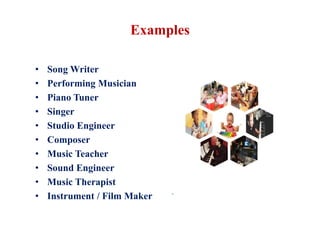
Examples
• Song Writer
• Performing Musician
• Piano Tuner
• Singer
• Studio Engineer
• Composer
• Music Teacher
• Sound Engineer
• Music Therapist
• Instrument / Film Maker
1
1
1
Interpersonal Intelligence
(People Smart)
• Capacity to understand, communicate and relate to other
people and groups
• Lot of friends
• Empathy for others
• Team activities
• Sensitive to other people’s feelings and idea
Examples
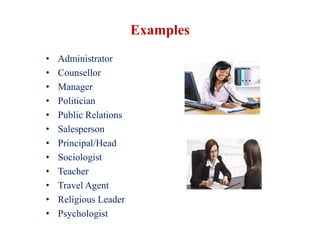
• Administrator
• Counsellor
• Manager
• Politician
• Public Relations
• Salesperson
• Principal/Head
• Sociologist
• Teacher
• Travel Agent
• Religious Leader
• Psychologist
Intrapersonal Intelligence
(Self Smart)
• Ability to know himself, his cognitive strengths, styles and
mental functioning
• Ability to act adaptively on the basis of knowledge
• Self-analysis and self-reflection
• It refers what he can do, what he wants to do, how he reacts to
things, what they can’t do
• Provides insight to his total behaviour
• Positive Thinking
• Control Emotions
Examples
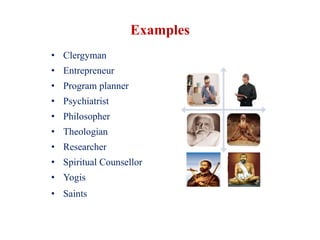
• Clergyman
• Entrepreneur
• Program planner
• Psychiatrist
• Philosopher
• Theologian
• Researcher
• Spiritual Counsellor
• Yogis
• Saints
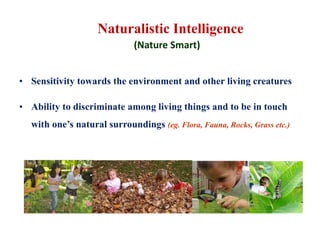
Naturalistic Intelligence
(Nature Smart)
• Sensitivity towards the environment and other living creatures
• Ability to discriminate among living things and to be in touch
with one’s natural surroundings (eg. Flora, Fauna, Rocks, Grass etc.)
Examples
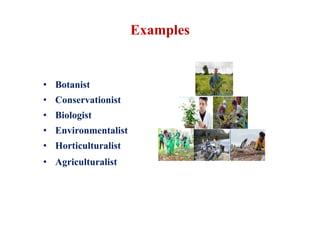
• Botanist
• Conservationist
• Biologist
• Environmentalist
• Horticulturalist
• Agriculturalist
Existential Intelligence
(Deep Thought Smart)
• Ability to think about religion and ultimate issues
• Clear-cut thoughts
• Exhibit the proclivity to pose questions about life, death and
ultimate realities
• Highly introspective
• Opposed to memorizing facts and information
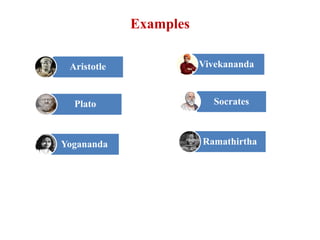
Examples
Aristotle Einstein
Plato Socrates
Vivekananda
Yogananda Ramathirtha
The theory of multiple intelligence is so popular
within the field of education because it “validates
educators’ everyday experience: students thinking
varies. It also provides educators with a conceptual
framework for organizing and reflecting on
curriculum assessment and pedagogical practices. In
turn, this reflection has led many educators to
develop new approaches”.
References
Armstrong, T. (2000). Multiple Intelligences in the Classroom (2 ed.).
Alexandria, Virginia, USA: Association for Supervision and Curriculum
Development.
Howard Gardner. (2010). Multiple intelligences. http://www.Howard
gardner.com/MI/mi.html
Mangal, S.K. (2008). Advanced Studies in Education, New Delhi: Prentice
Hall India Learning Private Limited

Multiple intelligence

  • 1.
  • 2.
    National Level Workshopon Design and Development on Moocs 02-08 December 2019 Organised by Department of Education University of Kerala, Thiruvananthapuram Topic: Multiple Intelligence Prepared by P. Vel Murugan
  • 3.
    Howard Gardner (July 11,1943) • American Developmental Psychologist • Theory of Multiple Intelligences • 1983 - Frames of Mind: Theory of Multiple Intelligences • 1993 - Multiple Intelligences: The Theory in Practice • 1999 - Intelligence Reframed • William James Award - APA • University of Louisville Grawemeyer Award • Austria's Award in Social Sciences
  • 4.
    Multiple Intelligence -Meaning Ability to solve problems, or to create products, that are valued within one or more cultural settings.
  • 5.
    Multiple Intelligence • Setof skills allowing individuals to find and resolve genuine problems they face • People have multiple different ways of thinking and learning • Nine different kinds of intelligence
  • 6.
    Verbal Linguistic Intelligence (WordSmart) • Ability to use language and communicate with words • Understand words and manipulate the structure of language • Enjoy reading, writing and speaking • Know and correctly apply rules of grammar • Large vocabulary
  • 7.
    Examples • Author • Journalist •Poet • Playwright • Radio Announcer • Typist • Novelist • Comedian • Politician • Lawyer • Orator • Actor • Curator
  • 8.
    Logical Mathematical Intelligence (NumberSmart) • Capacity to use numbers effectively and reason well • Ability to do Maths • Ability to balance a checkbook • Deductive and inductive reasoning, scientific thinking, solving of logical puzzles, etc.
  • 9.
    Examples • Accountant • Auditor •Banker • Bookkeeper • Businessperson • Computer Analyst • Computer Programmer • Philosopher • Economist • Mathematician • Purchasing Agent • Science Researcher • Science Teacher • Statistician • Technician
  • 10.
    Visual Spatial Intelligence (PictureSmart) • Ability to perceive and interpret visual stimuli • Ability to think in pictures, images, shapes and patterns • Manipulation of spatial configuration and relationship
  • 11.
    Examples • Advertising Agent •Architect • Drafter • Engineer • Fine Artist • Graphic Designer • Fashion Designer • Interior Designer • Chess player • Inventor • Painter • Photographer • Pilot • Navigator • Sculptor • Surveyor • Urban Planner
  • 12.
    Bodily Kinesthetic Intelligence (BodySmart) • Ability to use one’s hands to produce or transform things • Ability to perform skillful and purposeful movements • Making and inventing things with hands and role playing • Keen sense of body awareness • Difficult to sit still for a long period or time
  • 13.
    Examples • Actor • Actress •Athlete • Dancer • Farmer • Surgeon • Mechanic • P.E. Teacher • Physical Therapist • Recreational Director
  • 14.
    Musical Rhythmic Intelligence (MusicSmart) • Ability to think in musical terms, hear and recognize patterns, discriminate between sounds and create music • Well demonstrated through one’s capacity for pitch discrimination, sensitivity to rhythm, texture and timbre
  • 15.
    Examples • Song Writer •Performing Musician • Piano Tuner • Singer • Studio Engineer • Composer • Music Teacher • Sound Engineer • Music Therapist • Instrument / Film Maker 1 1 1
  • 16.
    Interpersonal Intelligence (People Smart) •Capacity to understand, communicate and relate to other people and groups • Lot of friends • Empathy for others • Team activities • Sensitive to other people’s feelings and idea
  • 17.
    Examples • Administrator • Counsellor •Manager • Politician • Public Relations • Salesperson • Principal/Head • Sociologist • Teacher • Travel Agent • Religious Leader • Psychologist
  • 18.
    Intrapersonal Intelligence (Self Smart) •Ability to know himself, his cognitive strengths, styles and mental functioning • Ability to act adaptively on the basis of knowledge • Self-analysis and self-reflection • It refers what he can do, what he wants to do, how he reacts to things, what they can’t do • Provides insight to his total behaviour • Positive Thinking • Control Emotions
  • 19.
    Examples • Clergyman • Entrepreneur •Program planner • Psychiatrist • Philosopher • Theologian • Researcher • Spiritual Counsellor • Yogis • Saints
  • 20.
    Naturalistic Intelligence (Nature Smart) •Sensitivity towards the environment and other living creatures • Ability to discriminate among living things and to be in touch with one’s natural surroundings (eg. Flora, Fauna, Rocks, Grass etc.)
  • 21.
    Examples • Botanist • Conservationist •Biologist • Environmentalist • Horticulturalist • Agriculturalist
  • 22.
    Existential Intelligence (Deep ThoughtSmart) • Ability to think about religion and ultimate issues • Clear-cut thoughts • Exhibit the proclivity to pose questions about life, death and ultimate realities • Highly introspective • Opposed to memorizing facts and information
  • 23.
  • 24.
    The theory ofmultiple intelligence is so popular within the field of education because it “validates educators’ everyday experience: students thinking varies. It also provides educators with a conceptual framework for organizing and reflecting on curriculum assessment and pedagogical practices. In turn, this reflection has led many educators to develop new approaches”.
  • 25.
    References Armstrong, T. (2000).Multiple Intelligences in the Classroom (2 ed.). Alexandria, Virginia, USA: Association for Supervision and Curriculum Development. Howard Gardner. (2010). Multiple intelligences. http://www.Howard gardner.com/MI/mi.html Mangal, S.K. (2008). Advanced Studies in Education, New Delhi: Prentice Hall India Learning Private Limited