I’m Not Stupid, I Just Don’t Get It When You Explain It Like That! Differentiated Instruction and Multiple Intelligences. Is It the Way to Break Through?
Differentiated Instruction Differentiating instruction involves providing students with different avenues to learn and to developing lesson plans so that all students within a classroom can learn effectively, regardless of differences in ability
DI- Preassessment The first and most important step in differentiated instruction is determining what students already know so as not to cover material students have mastered, or use methods that would be ineffective for students. A preassessment can be a quiz, game, discussion, or other activity.
DI- Preassessment The goals of DI are to develop challenging and engaging tasks for each learner (from low-end to high-end learner). Instructional activities are flexible and based and evaluated on content, process and product. The approach and choice of lesson plan tasks are come from students’ assessment results. Assessments (pre and post) are essential in determining the students’ needs.
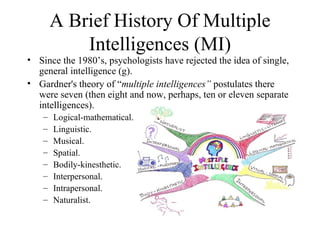
A Brief History Of Multiple Intelligences (MI) Since the 1980’s, psychologists have rejected the idea of single, general intelligence (g). Gardner's theory of “ multiple intelligences”  postulates there were seven (then eight and now, perhaps, ten or eleven separate intelligences). Logical-mathematical. Linguistic. Musical. Spatial. Bodily-kinesthetic. Interpersonal. Intrapersonal. Naturalist.
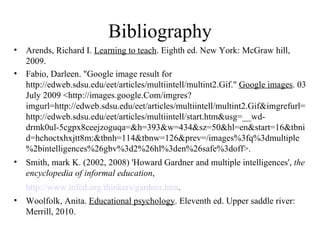
The Intelligences Linguistic intelligence  involves sensitivity to spoken and written language. Includes; Writers, poets, lawyers. Logical-mathematical intelligence  consists of the capacity to analyze problems logically, carry out mathematical operations, and investigate issues scientifically. Includes; Scientists and mathematicians. Musical intelligence  involves skill in the performance, composition, and appreciation of musical patterns. Bodily-kinesthetic intelligence  entails the potential of using one's whole body or parts of the body to solve problems. It is the ability to use mental abilities to coordinate bodily movements. Spatial intelligence  involves the potential to recognize and use the patterns of wide space and more confined areas. Interpersonal intelligence  is concerned with the capacity to understand the intentions, motivations and desires of other people. It allows people to work effectively with others.  Intrapersonal intelligence  entails the capacity to understand oneself, to appreciate one's feelings, fears and motivations.  Naturalist intelligence  enables human beings to recognize, categorize and draw upon certain features of the environment.
MI Theory By reaching the student on his preferred plane, learning occurs more easily. Schools need to expand the range of abilities and values they teach to accommodate different intelligences.
Detractors All intelligences are connected. It is a single general intelligence(g). Many of those listed are closely correlated. It is unlikely to help students. Talents or intelligence. Musical and bodily-kinesthetic intelligence are better approached as talents.
Proponents MI does not negate (g), rather helps us to reach students Newer theories support MI Dynamic Cultural Increase student participation Development of entry points Narrative Logical-quantitative Aesthetic Experiential Interpersonal Existential/foundational
It Ties In Differentiated instruction – MI easily lends itself, by it’s very 7(or 11) part structure, to differentiated instruction. See the lesson planning tool on the next slide. Vygotsky’s zone of proximal development (ZPD)- imagine, as children enter the ZPD for a subject, reaching out and homing in on the style with which they learn best and driving them closer to a mastery level.
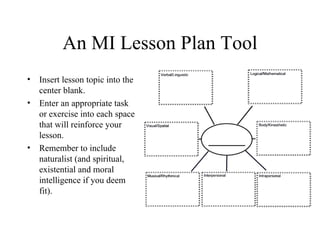
An MI Lesson Plan Tool Insert lesson topic into the center blank. Enter an appropriate task or exercise into each space that will reinforce your lesson. Remember to include naturalist (and spiritual, existential and moral intelligence if you deem fit).
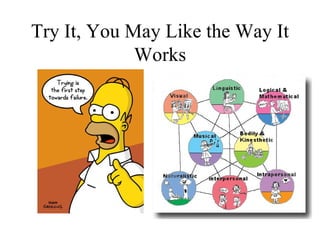
Try It, You May Like the Way It Works
Bibliography Arends, Richard I.  Learning to teach . Eighth ed. New York: McGraw hill, 2009. Fabio, Darleen. &quot;Google image result for http://edweb.sdsu.edu/eet/articles/multiintell/multint2.Gif.&quot;  Google images . 03 July 2009 <http://images.google.Com/imgres?imgurl=http://edweb.sdsu.edu/eet/articles/multiintell/multint2.Gif&imgrefurl=http://edweb.sdsu.edu/eet/articles/multiintell/start.htm&usg=__wd-drmk0ul-5cgpx8ceejzoguqa=&h=393&w=434&sz=50&hl=en&start=16&tbnid=hchoctxhxjtt8m:&tbnh=114&tbnw=126&prev=/images%3fq%3dmultiple%2bintelligences%26gbv%3d2%26hl%3den%26safe%3doff>. Smith, mark K. (2002, 2008) 'Howard Gardner and multiple intelligences',  the encyclopedia of informal education ,  http://www.infed.org/thinkers/gardner.htm .   Woolfolk, Anita.  Educational psychology . Eleventh ed. Upper saddle river: Merrill, 2010.

Di using mi ppt[1]

  • 1.
    I’m Not Stupid,I Just Don’t Get It When You Explain It Like That! Differentiated Instruction and Multiple Intelligences. Is It the Way to Break Through?
  • 2.
    Differentiated Instruction Differentiatinginstruction involves providing students with different avenues to learn and to developing lesson plans so that all students within a classroom can learn effectively, regardless of differences in ability
  • 3.
    DI- Preassessment Thefirst and most important step in differentiated instruction is determining what students already know so as not to cover material students have mastered, or use methods that would be ineffective for students. A preassessment can be a quiz, game, discussion, or other activity.
  • 4.
    DI- Preassessment Thegoals of DI are to develop challenging and engaging tasks for each learner (from low-end to high-end learner). Instructional activities are flexible and based and evaluated on content, process and product. The approach and choice of lesson plan tasks are come from students’ assessment results. Assessments (pre and post) are essential in determining the students’ needs.
  • 5.
    A Brief HistoryOf Multiple Intelligences (MI) Since the 1980’s, psychologists have rejected the idea of single, general intelligence (g). Gardner's theory of “ multiple intelligences” postulates there were seven (then eight and now, perhaps, ten or eleven separate intelligences). Logical-mathematical. Linguistic. Musical. Spatial. Bodily-kinesthetic. Interpersonal. Intrapersonal. Naturalist.
  • 6.
    The Intelligences Linguisticintelligence involves sensitivity to spoken and written language. Includes; Writers, poets, lawyers. Logical-mathematical intelligence consists of the capacity to analyze problems logically, carry out mathematical operations, and investigate issues scientifically. Includes; Scientists and mathematicians. Musical intelligence involves skill in the performance, composition, and appreciation of musical patterns. Bodily-kinesthetic intelligence entails the potential of using one's whole body or parts of the body to solve problems. It is the ability to use mental abilities to coordinate bodily movements. Spatial intelligence involves the potential to recognize and use the patterns of wide space and more confined areas. Interpersonal intelligence is concerned with the capacity to understand the intentions, motivations and desires of other people. It allows people to work effectively with others. Intrapersonal intelligence entails the capacity to understand oneself, to appreciate one's feelings, fears and motivations. Naturalist intelligence enables human beings to recognize, categorize and draw upon certain features of the environment.
  • 7.
    MI Theory Byreaching the student on his preferred plane, learning occurs more easily. Schools need to expand the range of abilities and values they teach to accommodate different intelligences.
  • 8.
    Detractors All intelligencesare connected. It is a single general intelligence(g). Many of those listed are closely correlated. It is unlikely to help students. Talents or intelligence. Musical and bodily-kinesthetic intelligence are better approached as talents.
  • 9.
    Proponents MI doesnot negate (g), rather helps us to reach students Newer theories support MI Dynamic Cultural Increase student participation Development of entry points Narrative Logical-quantitative Aesthetic Experiential Interpersonal Existential/foundational
  • 10.
    It Ties InDifferentiated instruction – MI easily lends itself, by it’s very 7(or 11) part structure, to differentiated instruction. See the lesson planning tool on the next slide. Vygotsky’s zone of proximal development (ZPD)- imagine, as children enter the ZPD for a subject, reaching out and homing in on the style with which they learn best and driving them closer to a mastery level.
  • 11.
    An MI LessonPlan Tool Insert lesson topic into the center blank. Enter an appropriate task or exercise into each space that will reinforce your lesson. Remember to include naturalist (and spiritual, existential and moral intelligence if you deem fit).
  • 12.
    Try It, YouMay Like the Way It Works
  • 13.
    Bibliography Arends, RichardI. Learning to teach . Eighth ed. New York: McGraw hill, 2009. Fabio, Darleen. &quot;Google image result for http://edweb.sdsu.edu/eet/articles/multiintell/multint2.Gif.&quot; Google images . 03 July 2009 <http://images.google.Com/imgres?imgurl=http://edweb.sdsu.edu/eet/articles/multiintell/multint2.Gif&imgrefurl=http://edweb.sdsu.edu/eet/articles/multiintell/start.htm&usg=__wd-drmk0ul-5cgpx8ceejzoguqa=&h=393&w=434&sz=50&hl=en&start=16&tbnid=hchoctxhxjtt8m:&tbnh=114&tbnw=126&prev=/images%3fq%3dmultiple%2bintelligences%26gbv%3d2%26hl%3den%26safe%3doff>. Smith, mark K. (2002, 2008) 'Howard Gardner and multiple intelligences', the encyclopedia of informal education , http://www.infed.org/thinkers/gardner.htm . Woolfolk, Anita. Educational psychology . Eleventh ed. Upper saddle river: Merrill, 2010.