A Seminar on

AN INTRODUCTION TO MULTIRESOLUTION AND WAVELET
TRANSFORM
By
Randhir Singh
(3132509)
Electronics department
NIT KKR
Contents
• What is MRA?
• The need for MRA
• Fourier transform
• Short Term Fourier Transform (STFT)
• Wavelet
• Features of Wavelet Transform
• Wavelet applications
• Wavelet transform in image compression
• Conclusion
What is MRA
• Multi resolution analysis is a relatively new
concept that tries to get time as well as
frequency information simultaneously.
• MRA(Multi-Resolution Analysis) is analysis of
signals simultaneously at varying levels of
detail (known as resolutions).
• Multi resolution analysis, as implied by its
name, analysis the signal at different
frequencies with different resolutions.
Need for MRA
• There are some signals which are nonstationary in nature for those need of MRA
occurs.
• Signals at lower resolution are suitable for
compression, but are not suitable for analysis.
On contrary, high resolution signals are
suitable for analysis but have poor
compression/communication capabilities
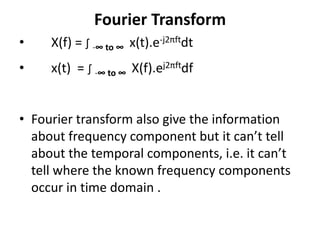
Fourier Transform
•

X(f) = ∫ -∞ to ∞ x(t).e-j2πftdt

•

x(t) = ∫ -∞ to ∞ X(f).ej2πftdf

• Fourier transform also give the information
about frequency component but it can’t tell
about the temporal components, i.e. it can’t
tell where the known frequency components
occur in time domain .
Limitations of Fourier transform
• Fourier transform gives only spectral details of
the
signal without considering temporal
properties.
• Hence not suitable for analyzing signals with
time varying spectra (non-stationary signals).
• It has fixed time and frequency resolution. i.e.
100% frequency information. 0% time
information.
Solution:
1. Short Term Fourier Transform
2. Wavelet transform
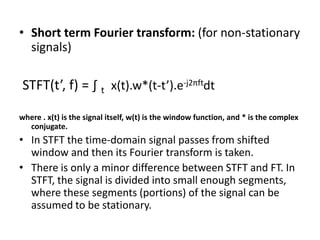
• Short term Fourier transform: (for non-stationary
signals)

STFT(t’, f) = ∫ t x(t).w*(t-t’).e-j2πftdt
where . x(t) is the signal itself, w(t) is the window function, and * is the complex
conjugate.

• In STFT the time-domain signal passes from shifted
window and then its Fourier transform is taken.
• There is only a minor difference between STFT and FT. In
STFT, the signal is divided into small enough segments,
where these segments (portions) of the signal can be
assumed to be stationary.
NON- STATIONARY SIGNAL AND ITS STFT:

Ref. [1]
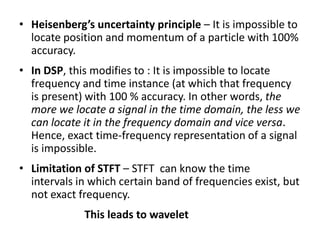
• Heisenberg’s uncertainty principle – It is impossible to
locate position and momentum of a particle with 100%
accuracy.
• In DSP, this modifies to : It is impossible to locate
frequency and time instance (at which that frequency
is present) with 100 % accuracy. In other words, the
more we locate a signal in the time domain, the less we
can locate it in the frequency domain and vice versa.
Hence, exact time-frequency representation of a signal
is impossible.
• Limitation of STFT – STFT can know the time
intervals in which certain band of frequencies exist, but
not exact frequency.
This leads to wavelet
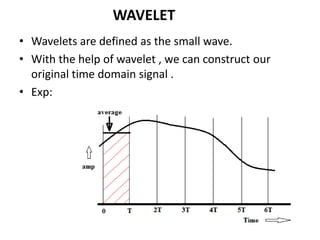
WAVELET
• Wavelets are defined as the small wave.
• With the help of wavelet , we can construct our
original time domain signal .
• Exp:
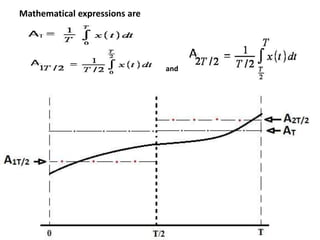
Mathematical expressions are

and
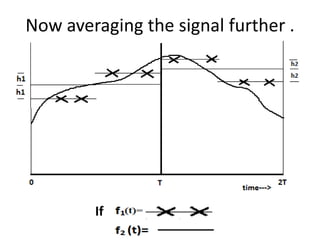
Now averaging the signal further .

If
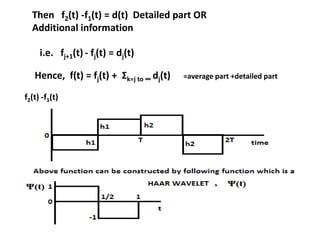
Then f2(t) -f1(t) = d(t) Detailed part OR
Additional information

i.e. fj+1(t) - fj(t) = dj(t)
Hence, f(t) = fj(t) + Σk=j to ∞ dj(t)
f2(t) -f1(t)

=average part +detailed part
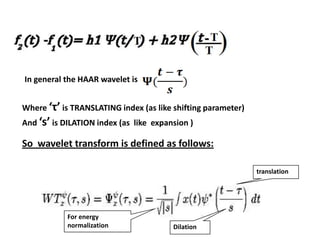
In general the HAAR wavelet is
Where ‘τ’ is TRANSLATING index (as like shifting parameter)
And ‘s’ is DILATION index (as like expansion )

So wavelet transform is defined as follows:
translation

For energy
normalization

Dilation
Features of wavelet transform
• Varying time and frequency resolutions

• Good time but poor frequency resolution at
higher frequencies
• Poor time but good frequency resolution at
lower frequencies
• Suitable for analyses of non-stationary signals
Example of WT (Haar Basis)
consider a 1D 4-pixel Image [ 9 7 3 5]
9

3

5

8
Averaging
(9+7)/2

7
4

1

-1

6

2

1

-1

Detailed part
(9-7)/2

Reconstruction of image:
6

2

1

-1

8

4

1

-1

9

7

3

5
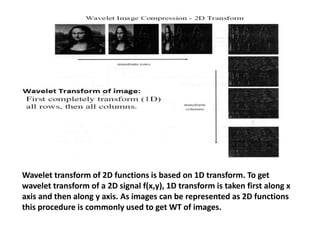
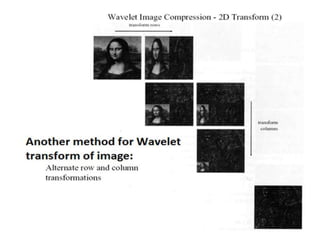
Wavelet transform of 2D functions is based on 1D transform. To get
wavelet transform of a 2D signal f(x,y), 1D transform is taken first along x
axis and then along y axis. As images can be represented as 2D functions
this procedure is commonly used to get WT of images.
Wavelet transform applications
• This lead to a huge number of applications in
various fields, such as, for example,
geophysics, astrophysics, telecommunications,
image and video coding. They are the
foundation for new techniques of signal
analysis and synthesis and find beautiful
applications to general problems such as
compression and denoising.
Conclusion
• Multi-Resolution analysis is a different approach
of signal processing that gives coarse as well as
detailed information at the same time.
• Wavelet transform is extension of MRA which
resolves signals in domain best suitable for
analysis.
• As wavelet transform not only gives more
information that fourier transform but it is also
computationally more efficient, it is expected to
get more attention in future.
References:
[1].http://users.rowan.edu/~polikar/WAVELETS/WTtutorial.html
[2].P.M. Bentley and J.T.E. McDonnell "Wavelet transforms: an introduction," IEEE
Electronics & Communication Engineering Journal (Volume:6 , Issue: 4 ) 1994
[3].A Graps "An introduction to wavelets,“ IEEE Computational Science &
Engineering, (Volume:2 , Issue: 2 ) 1995
[4].NPTEL (http://nptel.iitm.ac.in/courses/117101001/1)
THANKYOU
ANY QUERIES.........?

A seminar on INTRODUCTION TO MULTI-RESOLUTION AND WAVELET TRANSFORM

  • 1.
    A Seminar on ANINTRODUCTION TO MULTIRESOLUTION AND WAVELET TRANSFORM By Randhir Singh (3132509) Electronics department NIT KKR
  • 2.
    Contents • What isMRA? • The need for MRA • Fourier transform • Short Term Fourier Transform (STFT) • Wavelet • Features of Wavelet Transform • Wavelet applications • Wavelet transform in image compression • Conclusion
  • 3.
    What is MRA •Multi resolution analysis is a relatively new concept that tries to get time as well as frequency information simultaneously. • MRA(Multi-Resolution Analysis) is analysis of signals simultaneously at varying levels of detail (known as resolutions). • Multi resolution analysis, as implied by its name, analysis the signal at different frequencies with different resolutions.
  • 4.
    Need for MRA •There are some signals which are nonstationary in nature for those need of MRA occurs. • Signals at lower resolution are suitable for compression, but are not suitable for analysis. On contrary, high resolution signals are suitable for analysis but have poor compression/communication capabilities
  • 5.
    Fourier Transform • X(f) =∫ -∞ to ∞ x(t).e-j2πftdt • x(t) = ∫ -∞ to ∞ X(f).ej2πftdf • Fourier transform also give the information about frequency component but it can’t tell about the temporal components, i.e. it can’t tell where the known frequency components occur in time domain .
  • 6.
    Limitations of Fouriertransform • Fourier transform gives only spectral details of the signal without considering temporal properties. • Hence not suitable for analyzing signals with time varying spectra (non-stationary signals). • It has fixed time and frequency resolution. i.e. 100% frequency information. 0% time information.
  • 7.
    Solution: 1. Short TermFourier Transform 2. Wavelet transform
  • 8.
    • Short termFourier transform: (for non-stationary signals) STFT(t’, f) = ∫ t x(t).w*(t-t’).e-j2πftdt where . x(t) is the signal itself, w(t) is the window function, and * is the complex conjugate. • In STFT the time-domain signal passes from shifted window and then its Fourier transform is taken. • There is only a minor difference between STFT and FT. In STFT, the signal is divided into small enough segments, where these segments (portions) of the signal can be assumed to be stationary.
  • 9.
    NON- STATIONARY SIGNALAND ITS STFT: Ref. [1]
  • 10.
    • Heisenberg’s uncertaintyprinciple – It is impossible to locate position and momentum of a particle with 100% accuracy. • In DSP, this modifies to : It is impossible to locate frequency and time instance (at which that frequency is present) with 100 % accuracy. In other words, the more we locate a signal in the time domain, the less we can locate it in the frequency domain and vice versa. Hence, exact time-frequency representation of a signal is impossible. • Limitation of STFT – STFT can know the time intervals in which certain band of frequencies exist, but not exact frequency. This leads to wavelet
  • 11.
    WAVELET • Wavelets aredefined as the small wave. • With the help of wavelet , we can construct our original time domain signal . • Exp:
  • 12.
  • 13.
    Now averaging thesignal further . If
  • 14.
    Then f2(t) -f1(t)= d(t) Detailed part OR Additional information i.e. fj+1(t) - fj(t) = dj(t) Hence, f(t) = fj(t) + Σk=j to ∞ dj(t) f2(t) -f1(t) =average part +detailed part
  • 15.
    In general theHAAR wavelet is Where ‘τ’ is TRANSLATING index (as like shifting parameter) And ‘s’ is DILATION index (as like expansion ) So wavelet transform is defined as follows: translation For energy normalization Dilation
  • 16.
    Features of wavelettransform • Varying time and frequency resolutions • Good time but poor frequency resolution at higher frequencies • Poor time but good frequency resolution at lower frequencies • Suitable for analyses of non-stationary signals
  • 17.
    Example of WT(Haar Basis) consider a 1D 4-pixel Image [ 9 7 3 5] 9 3 5 8 Averaging (9+7)/2 7 4 1 -1 6 2 1 -1 Detailed part (9-7)/2 Reconstruction of image: 6 2 1 -1 8 4 1 -1 9 7 3 5
  • 18.
    Wavelet transform of2D functions is based on 1D transform. To get wavelet transform of a 2D signal f(x,y), 1D transform is taken first along x axis and then along y axis. As images can be represented as 2D functions this procedure is commonly used to get WT of images.
  • 20.
    Wavelet transform applications •This lead to a huge number of applications in various fields, such as, for example, geophysics, astrophysics, telecommunications, image and video coding. They are the foundation for new techniques of signal analysis and synthesis and find beautiful applications to general problems such as compression and denoising.
  • 21.
    Conclusion • Multi-Resolution analysisis a different approach of signal processing that gives coarse as well as detailed information at the same time. • Wavelet transform is extension of MRA which resolves signals in domain best suitable for analysis. • As wavelet transform not only gives more information that fourier transform but it is also computationally more efficient, it is expected to get more attention in future.
  • 22.
    References: [1].http://users.rowan.edu/~polikar/WAVELETS/WTtutorial.html [2].P.M. Bentley andJ.T.E. McDonnell "Wavelet transforms: an introduction," IEEE Electronics & Communication Engineering Journal (Volume:6 , Issue: 4 ) 1994 [3].A Graps "An introduction to wavelets,“ IEEE Computational Science & Engineering, (Volume:2 , Issue: 2 ) 1995 [4].NPTEL (http://nptel.iitm.ac.in/courses/117101001/1)
  • 23.