Fourier Series
Presented by
Dr. Amany AbdElSamea
1
Outline
• Frequency Domain
• Time Domain vs. Frequency Domain
• Fourier Series
2
Frequency Domain
• Time domain signal tells us how the real-world signal varies with time,
whereas a frequency domain signal indicates the rate of change in signal
values and its spectral composition
• The frequency domain refers to the analysis of mathematical functions or
signals with respect to frequency rather than time.
• The “Spectrum” of frequency components is the frequency-domain
representation of the signal.
• A Spectrum analyzer is a tool commonly used to visualize electronic
signals in the frequency domain but time domain signals are visualized
using oscilloscope.
• The frequency domain is better for determining the harmonic content of a
signal.
• A given function or signal can be converted between the time and
frequency domains with a pair of mathematical operators called
transform.
Time Domain vs. Frequency Domain
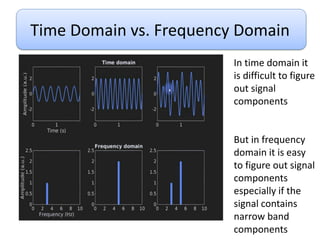
In time domain it
is difficult to figure
out signal
components
But in frequency
domain it is easy
to figure out signal
components
especially if the
signal contains
narrow band
components
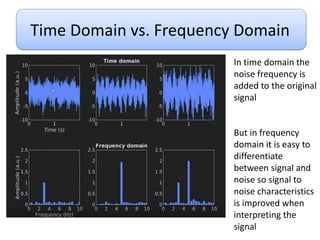
Time Domain vs. Frequency Domain
In time domain the
noise frequency is
added to the original
signal
But in frequency
domain it is easy to
differentiate
between signal and
noise so signal to
noise characteristics
is improved when
interpreting the
signal
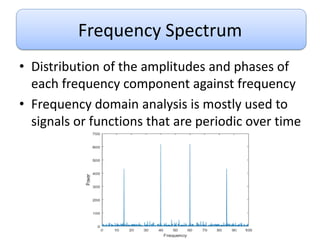
Frequency Spectrum
• Distribution of the amplitudes and phases of
each frequency component against frequency
• Frequency domain analysis is mostly used to
signals or functions that are periodic over time
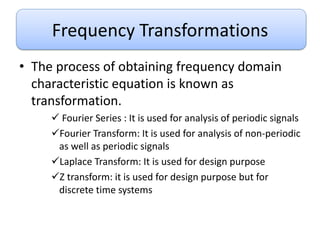
Frequency Transformations
• The process of obtaining frequency domain
characteristic equation is known as
transformation.
 Fourier Series : It is used for analysis of periodic signals
Fourier Transform: It is used for analysis of non-periodic
as well as periodic signals
Laplace Transform: It is used for design purpose
Z transform: it is used for design purpose but for
discrete time systems
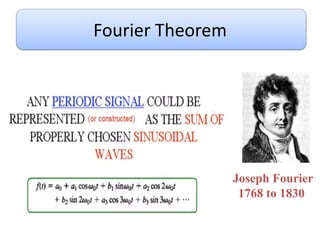
Fourier Theorem
Joseph Fourier
1768 to 1830
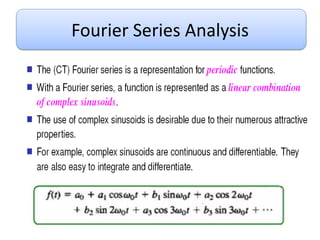
Fourier Series Analysis
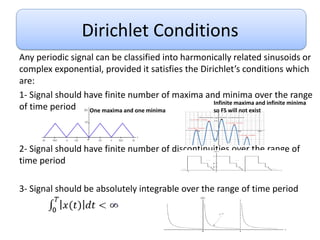
Dirichlet Conditions
Any periodic signal can be classified into harmonically related sinusoids or
complex exponential, provided it satisfies the Dirichlet’s conditions which
are:
1- Signal should have finite number of maxima and minima over the range
of time period
2- Signal should have finite number of discontinuities over the range of
time period
3- Signal should be absolutely integrable over the range of time period
One maxima and one minima
Infinite maxima and infinite minima
so FS will not exist
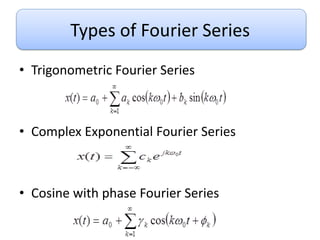
Types of Fourier Series
• Trigonometric Fourier Series
• Complex Exponential Fourier Series
• Cosine with phase Fourier Series
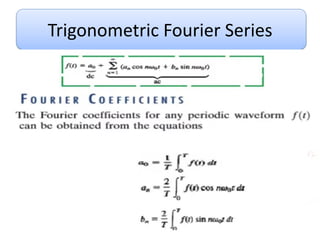
Trigonometric Fourier Series
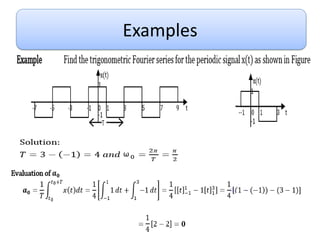
Examples
ω
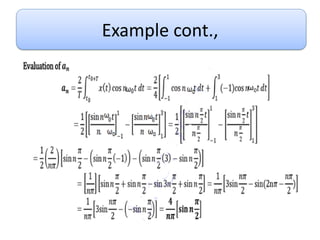
Example cont.,
ω0
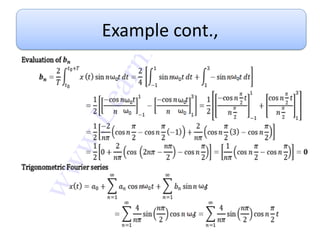
Example cont.,
Example cont.,
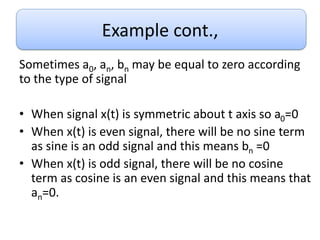
Sometimes a0, an, bn may be equal to zero according
to the type of signal
• When signal x(t) is symmetric about t axis so a0=0
• When x(t) is even signal, there will be no sine term
as sine is an odd signal and this means bn =0
• When x(t) is odd signal, there will be no cosine
term as cosine is an even signal and this means that
an=0.
Questions

Lect5-FourierSeries.pdf

  • 1.
  • 2.
    Outline • Frequency Domain •Time Domain vs. Frequency Domain • Fourier Series 2
  • 3.
    Frequency Domain • Timedomain signal tells us how the real-world signal varies with time, whereas a frequency domain signal indicates the rate of change in signal values and its spectral composition • The frequency domain refers to the analysis of mathematical functions or signals with respect to frequency rather than time. • The “Spectrum” of frequency components is the frequency-domain representation of the signal. • A Spectrum analyzer is a tool commonly used to visualize electronic signals in the frequency domain but time domain signals are visualized using oscilloscope. • The frequency domain is better for determining the harmonic content of a signal. • A given function or signal can be converted between the time and frequency domains with a pair of mathematical operators called transform.
  • 4.
    Time Domain vs.Frequency Domain In time domain it is difficult to figure out signal components But in frequency domain it is easy to figure out signal components especially if the signal contains narrow band components
  • 5.
    Time Domain vs.Frequency Domain In time domain the noise frequency is added to the original signal But in frequency domain it is easy to differentiate between signal and noise so signal to noise characteristics is improved when interpreting the signal
  • 6.
    Frequency Spectrum • Distributionof the amplitudes and phases of each frequency component against frequency • Frequency domain analysis is mostly used to signals or functions that are periodic over time
  • 7.
    Frequency Transformations • Theprocess of obtaining frequency domain characteristic equation is known as transformation.  Fourier Series : It is used for analysis of periodic signals Fourier Transform: It is used for analysis of non-periodic as well as periodic signals Laplace Transform: It is used for design purpose Z transform: it is used for design purpose but for discrete time systems
  • 8.
  • 9.
  • 10.
    Dirichlet Conditions Any periodicsignal can be classified into harmonically related sinusoids or complex exponential, provided it satisfies the Dirichlet’s conditions which are: 1- Signal should have finite number of maxima and minima over the range of time period 2- Signal should have finite number of discontinuities over the range of time period 3- Signal should be absolutely integrable over the range of time period One maxima and one minima Infinite maxima and infinite minima so FS will not exist
  • 11.
    Types of FourierSeries • Trigonometric Fourier Series • Complex Exponential Fourier Series • Cosine with phase Fourier Series
  • 12.
  • 13.
  • 14.
  • 15.
  • 16.
    Example cont., Sometimes a0,an, bn may be equal to zero according to the type of signal • When signal x(t) is symmetric about t axis so a0=0 • When x(t) is even signal, there will be no sine term as sine is an odd signal and this means bn =0 • When x(t) is odd signal, there will be no cosine term as cosine is an even signal and this means that an=0.
  • 17.