Image processing in frequency Domain
Department of Computer Science And Engineering
Shahjalal University of Science and Technology
Nashid Alam
Registration No: 2012321028
annanya_cse@yahoo.co.uk
Masters -2 Presentation
(Backup Slides# 6)
Introduction to Frequency domain
Deal with images in:
-Spatial domain
-Frequency domain
Difference between spatial domain and frequency domain
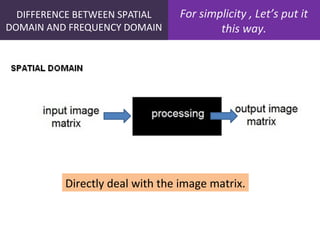
Spatial domain :
- Deal with images as it is.
- The value of the pixels of the image
change with respect to scene.
Frequency domain :
-Deal with the rate at which
the pixel values are changing in spatial
domain.
For simplicity , Let’s put it
this way.
DIFFERENCE BETWEEN SPATIAL
DOMAIN AND FREQUENCY DOMAIN
Directly deal with the image matrix.
For simplicity , Let’s put it
this way.
Image Processing in Frequency
Domain
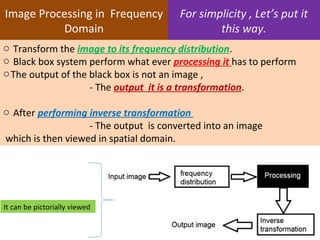
o Transform the image to its frequency distribution.
o Black box system perform what ever processing it has to perform
oThe output of the black box is not an image ,
- The output it is a transformation.
o After performing inverse transformation
- The output is converted into an image
which is then viewed in spatial domain.
It can be pictorially viewed
Frequency Components
Any image in spatial domain can be represented
in a frequency domain.
But what do this frequencies actually mean?
Frequency components are divided into two major components.
1. HIGH FREQUENCY COMPONENTS
High frequency components correspond to edges in an image.
2. LOW FREQUENCY COMPONENTS
Low frequency components in an image correspond to smooth regions.
TRANSFORMATION
Transformation:
A signal can be converted from spatial domain
into frequency domain using mathematical operators called
transformation.
kind of transformation:
Fourier Series
Fourier transformation
Laplace transform
Z transform
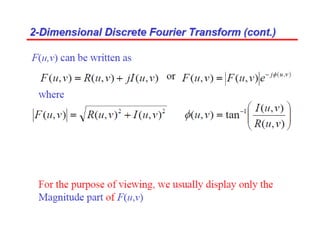
Fourier Transform
Fourier Transform
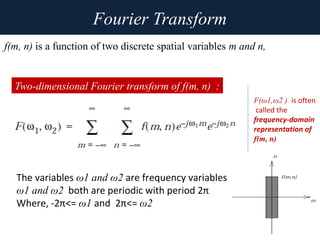
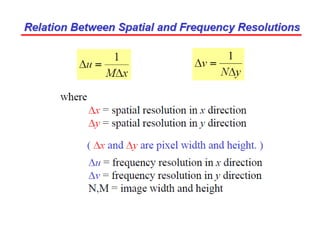
f(m, n) is a function of two discrete spatial variables m and n,
Two-dimensional Fourier transform of f(m, n) :
The variables ω1 and ω2 are frequency variables
ω1 and ω2 both are periodic with period 2π
Where, -2π<= ω1 and 2π<= ω2
F(ω1,ω2 ) is often
called the
frequency-domain
representation of
f(m, n)
Fourier Transform
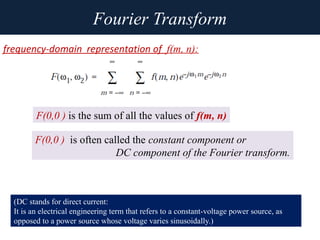
F(0,0 ) is the sum of all the values of f(m, n)
F(0,0 ) is often called the constant component or
DC component of the Fourier transform.
(DC stands for direct current:
It is an electrical engineering term that refers to a constant-voltage power source, as
opposed to a power source whose voltage varies sinusoidally.)
frequency-domain representation of f(m, n):
Fourier Transform
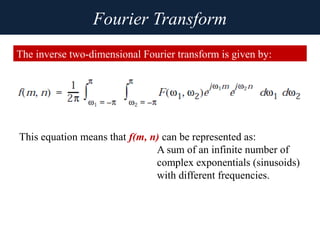
The inverse two-dimensional Fourier transform is given by:
This equation means that f(m, n) can be represented as:
A sum of an infinite number of
complex exponentials (sinusoids)
with different frequencies.
Example2D Fourier Transform
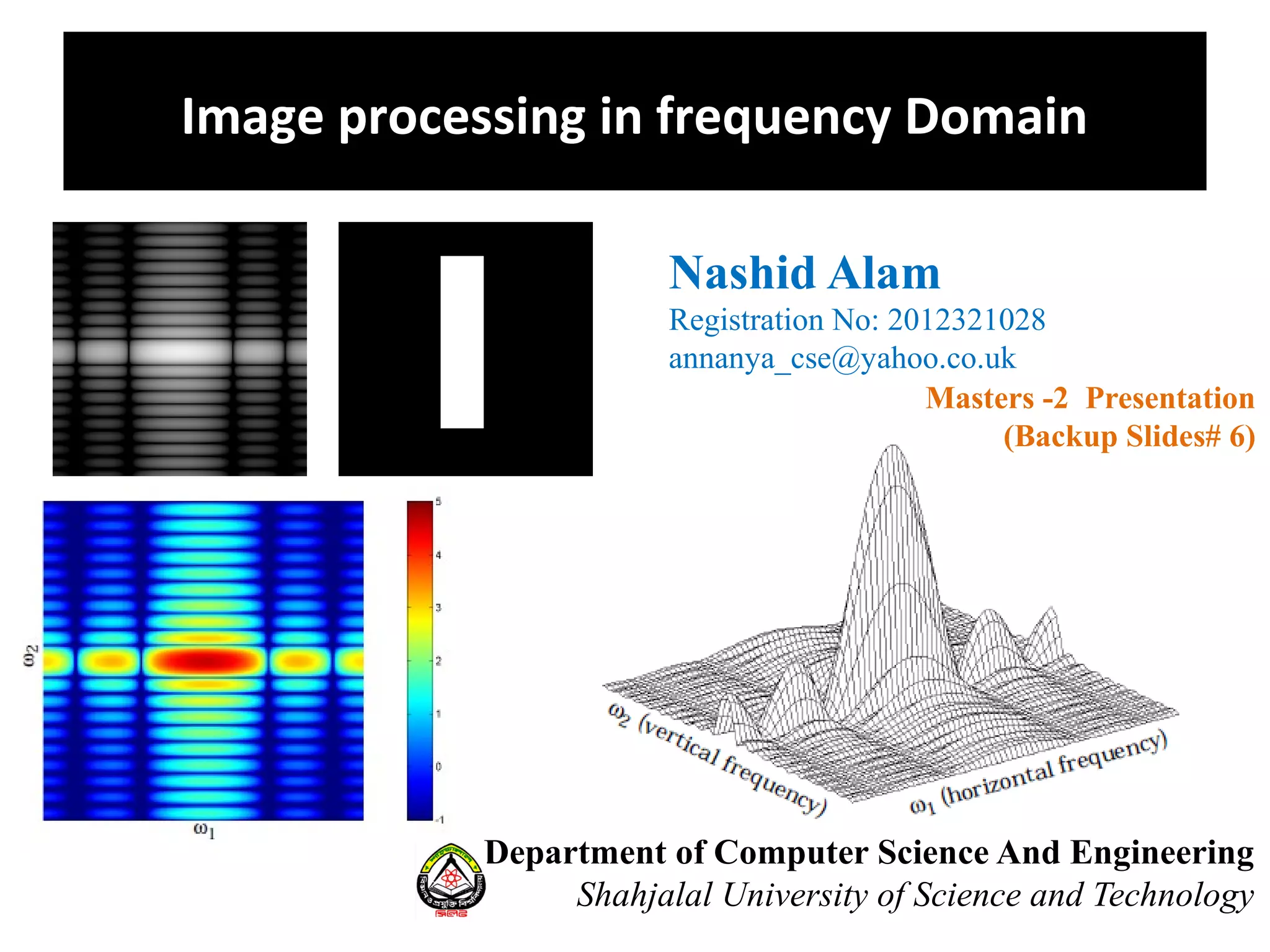
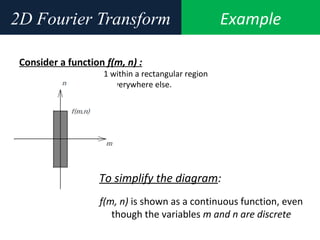
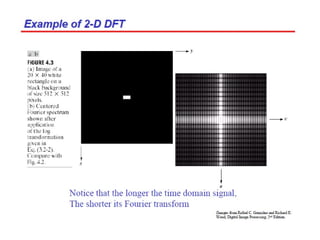
Consider a function f(m, n) :
1 within a rectangular region
0 everywhere else.
To simplify the diagram:
f(m, n) is shown as a continuous function, even
though the variables m and n are discrete
Example2D Fourier Transform
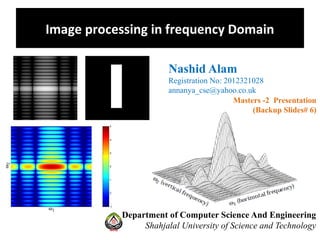
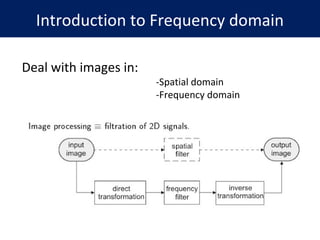
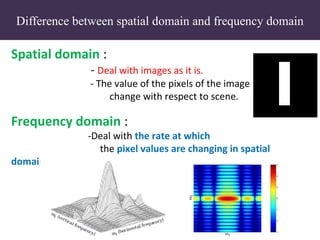
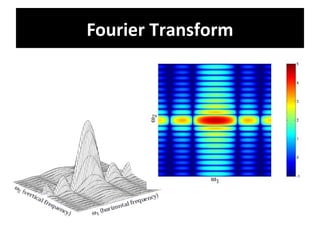
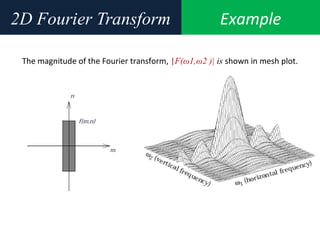
The magnitude of the Fourier transform, |F(ω1,ω2 )| is shown in mesh plot.
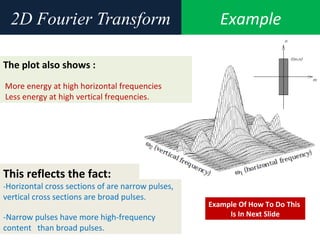
This reflects the fact:
-Horizontal cross sections of are narrow pulses,
vertical cross sections are broad pulses.
-Narrow pulses have more high-frequency
content than broad pulses.
Example2D Fourier Transform
The plot also shows :
More energy at high horizontal frequencies
Less energy at high vertical frequencies.
Example Of How To Do This
Is In Next Slide
Implemented example
Example
Relationship to 2D Fourier
transform with spatial image
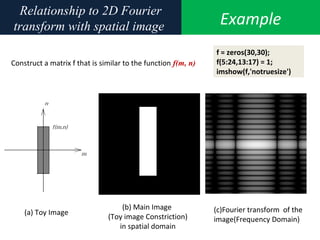
Construct a matrix f that is similar to the function f(m, n)
f = zeros(30,30);
f(5:24,13:17) = 1;
imshow(f,'notruesize')
(b) Main Image
(Toy image Constriction)
in spatial domain
(c)Fourier transform of the
image(Frequency Domain)
(a) Toy Image
Example2D Fourier Transform
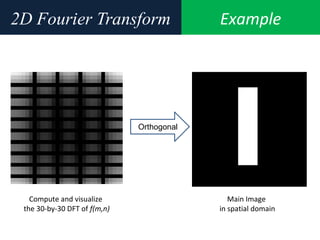
Main Image
in spatial domain
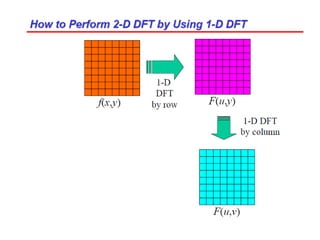
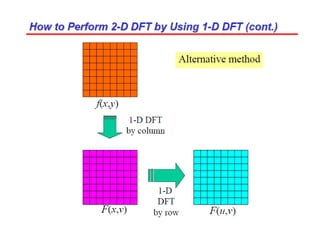
Orthogonal
Compute and visualize
the 30-by-30 DFT of f(m,n)
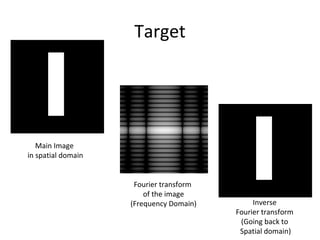
Target
Main Image
in spatial domain
Fourier transform
of the image
(Frequency Domain) Inverse
Fourier transform
(Going back to
Spatial domain)
Example2D Fourier Transform
Compute and visualize the 30-by-30 DFT of f(m,n)
F = fft2(f);
F2 = log(abs(F));
imshow(F2,[-1 5],'notruesize');
%% colormap(jet); colorbar
Example2D Fourier Transform
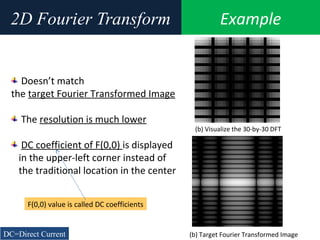
Doesn’t match
the target Fourier Transformed Image
The resolution is much lower
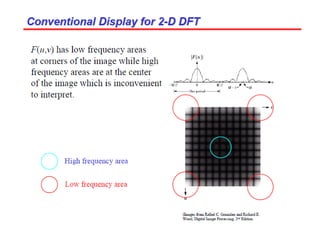
DC coefficient of F(0,0) is displayed
in the upper-left corner instead of
the traditional location in the center
(b) Target Fourier Transformed Image
(b) Visualize the 30-by-30 DFT
F(0,0) value is called DC coefficients
DC=Direct Current
Example2D Fourier Transform
The resolution is increased
by zero-padding f when computing its DFT.
Need more computation
%resolution is increased by zero-padding f
%zero-pads f to be 256-by-256 before
%computing the DFT
F = fft2(f,256,256);
Dealing with Resolution
Example2D Fourier Transform
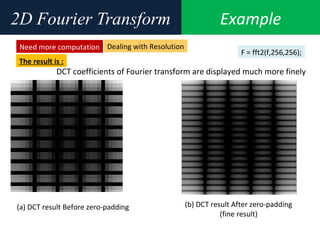
DCT coefficients of Fourier transform are displayed much more finely
The result is :
(a) DCT result Before zero-padding (b) DCT result After zero-padding
(fine result)
Need more computation Dealing with Resolution
F = fft2(f,256,256);
Example2D Fourier Transform
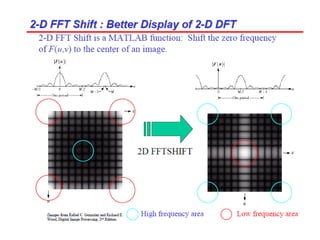
Need more computation Dealing with displaying DC coefficient of F(0,0)
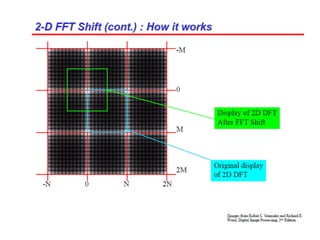
fix this problem by using the function fftshift,
which swaps the quadrants of F so that the DC
coefficient is in the center.
imshow(log(abs(F)),[-1 5]);
(b) Target Fourier Transformed Image
Example2D Fourier Transform
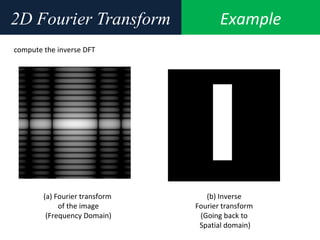
compute the inverse DFT
(a) Fourier transform
of the image
(Frequency Domain)
(b) Inverse
Fourier transform
(Going back to
Spatial domain)

6.frequency domain image_processing

  • 1.
    Image processing infrequency Domain Department of Computer Science And Engineering Shahjalal University of Science and Technology Nashid Alam Registration No: 2012321028 annanya_cse@yahoo.co.uk Masters -2 Presentation (Backup Slides# 6)
  • 2.
    Introduction to Frequencydomain Deal with images in: -Spatial domain -Frequency domain
  • 3.
    Difference between spatialdomain and frequency domain Spatial domain : - Deal with images as it is. - The value of the pixels of the image change with respect to scene. Frequency domain : -Deal with the rate at which the pixel values are changing in spatial domain.
  • 4.
    For simplicity ,Let’s put it this way. DIFFERENCE BETWEEN SPATIAL DOMAIN AND FREQUENCY DOMAIN Directly deal with the image matrix.
  • 5.
    For simplicity ,Let’s put it this way. Image Processing in Frequency Domain o Transform the image to its frequency distribution. o Black box system perform what ever processing it has to perform oThe output of the black box is not an image , - The output it is a transformation. o After performing inverse transformation - The output is converted into an image which is then viewed in spatial domain. It can be pictorially viewed
  • 6.
    Frequency Components Any imagein spatial domain can be represented in a frequency domain. But what do this frequencies actually mean? Frequency components are divided into two major components. 1. HIGH FREQUENCY COMPONENTS High frequency components correspond to edges in an image. 2. LOW FREQUENCY COMPONENTS Low frequency components in an image correspond to smooth regions.
  • 7.
    TRANSFORMATION Transformation: A signal canbe converted from spatial domain into frequency domain using mathematical operators called transformation. kind of transformation: Fourier Series Fourier transformation Laplace transform Z transform
  • 8.
  • 9.
    Fourier Transform f(m, n)is a function of two discrete spatial variables m and n, Two-dimensional Fourier transform of f(m, n) : The variables ω1 and ω2 are frequency variables ω1 and ω2 both are periodic with period 2π Where, -2π<= ω1 and 2π<= ω2 F(ω1,ω2 ) is often called the frequency-domain representation of f(m, n)
  • 10.
    Fourier Transform F(0,0 )is the sum of all the values of f(m, n) F(0,0 ) is often called the constant component or DC component of the Fourier transform. (DC stands for direct current: It is an electrical engineering term that refers to a constant-voltage power source, as opposed to a power source whose voltage varies sinusoidally.) frequency-domain representation of f(m, n):
  • 11.
    Fourier Transform The inversetwo-dimensional Fourier transform is given by: This equation means that f(m, n) can be represented as: A sum of an infinite number of complex exponentials (sinusoids) with different frequencies.
  • 12.
    Example2D Fourier Transform Considera function f(m, n) : 1 within a rectangular region 0 everywhere else. To simplify the diagram: f(m, n) is shown as a continuous function, even though the variables m and n are discrete
  • 13.
    Example2D Fourier Transform Themagnitude of the Fourier transform, |F(ω1,ω2 )| is shown in mesh plot.
  • 14.
    This reflects thefact: -Horizontal cross sections of are narrow pulses, vertical cross sections are broad pulses. -Narrow pulses have more high-frequency content than broad pulses. Example2D Fourier Transform The plot also shows : More energy at high horizontal frequencies Less energy at high vertical frequencies. Example Of How To Do This Is In Next Slide
  • 31.
  • 32.
    Example Relationship to 2DFourier transform with spatial image Construct a matrix f that is similar to the function f(m, n) f = zeros(30,30); f(5:24,13:17) = 1; imshow(f,'notruesize') (b) Main Image (Toy image Constriction) in spatial domain (c)Fourier transform of the image(Frequency Domain) (a) Toy Image
  • 33.
    Example2D Fourier Transform MainImage in spatial domain Orthogonal Compute and visualize the 30-by-30 DFT of f(m,n)
  • 34.
    Target Main Image in spatialdomain Fourier transform of the image (Frequency Domain) Inverse Fourier transform (Going back to Spatial domain)
  • 35.
    Example2D Fourier Transform Computeand visualize the 30-by-30 DFT of f(m,n) F = fft2(f); F2 = log(abs(F)); imshow(F2,[-1 5],'notruesize'); %% colormap(jet); colorbar
  • 36.
    Example2D Fourier Transform Doesn’tmatch the target Fourier Transformed Image The resolution is much lower DC coefficient of F(0,0) is displayed in the upper-left corner instead of the traditional location in the center (b) Target Fourier Transformed Image (b) Visualize the 30-by-30 DFT F(0,0) value is called DC coefficients DC=Direct Current
  • 37.
    Example2D Fourier Transform Theresolution is increased by zero-padding f when computing its DFT. Need more computation %resolution is increased by zero-padding f %zero-pads f to be 256-by-256 before %computing the DFT F = fft2(f,256,256); Dealing with Resolution
  • 38.
    Example2D Fourier Transform DCTcoefficients of Fourier transform are displayed much more finely The result is : (a) DCT result Before zero-padding (b) DCT result After zero-padding (fine result) Need more computation Dealing with Resolution F = fft2(f,256,256);
  • 39.
    Example2D Fourier Transform Needmore computation Dealing with displaying DC coefficient of F(0,0) fix this problem by using the function fftshift, which swaps the quadrants of F so that the DC coefficient is in the center. imshow(log(abs(F)),[-1 5]); (b) Target Fourier Transformed Image
  • 40.
    Example2D Fourier Transform computethe inverse DFT (a) Fourier transform of the image (Frequency Domain) (b) Inverse Fourier transform (Going back to Spatial domain)