Approach to Peripheral
Neuropathy
Xuan Wu, M.D., Ph.D
Assistant Professor
Neurology Department
Baylor College of Medicine
Three Goals
1. Determine Where is the lesion and
underlying pathology.
2. Determine What is the Cause of the
Lesion.
3. Determine If There is a Specific Rx
Therapy; or If Not, What is the Best
Management.
Peripheral Neuropathies (sensory, motor,
sensorimotor, autonomic)
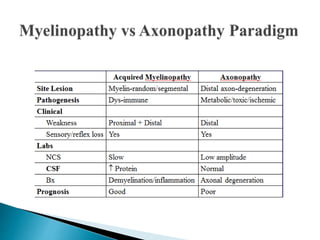
Myelinopathies
Axonopathies
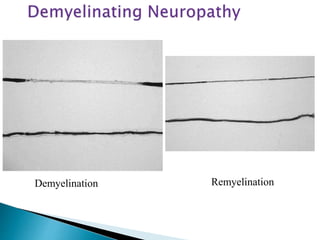
Demyelination Remyelination
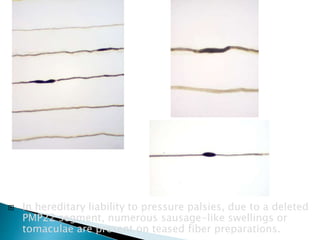
 In hereditary liability to pressure palsies, due to a deleted
PMP22 segment, numerous sausage-like swellings or
tomaculae are present on teased fiber preparations.
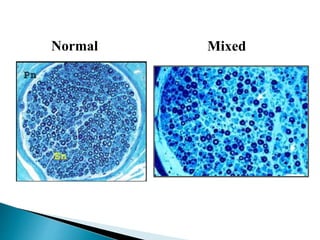
Normal Axonopathy
Normal Mixed
KEY QUESTIONS
1. What systems are involved?

- Sensory, motor, autonomic, or combinations
 KEY QUESTIONS
 2.What is the distribution of weakness and sensory
loss
 3. What is the temporal evolution
 4. Is there evidence on the physical exam suggesting
a hereditary neuropathy?/or Is there a family
history of neuropathy?
 5. Is There Evidence on the Physical Exam of Upper
Motor Neuron Involvement?
 Cryptogenic Sensory Polyneuropathy (CSPN)
 Metabolic, Drugs/Toxic Neuropathy
 Sensory Neuronopathy
 Hereditary Sensory Neuropathy
Asymmetric Proprioceptive Loss Without
Weakness
 Cancer (Paraneoplastic)
 Sjögren’s Syndrome
 Cisplatinum and Analogues
 Vitamin B6 Toxicity (Vitamin E deficiency)
 HIV-Related Sensory Neuronopathy
(HTLV, EBV, VZV, measles)
 Idiopathic Sensory Neuronopathy
 ?MGUS
 Cryptogenic Sensory / Sensorimotor
Polyneuropathy
 Diabetes Mellitus
 Amyloidosis
 Alcoholic
 HIV Related Distal Sensorimotor Neuropathy
 Vasculitis
 Guillain-Barré Syndrome
 Syphilis
 Toxic (arsenic, thallium)
 Fabry’s Disease
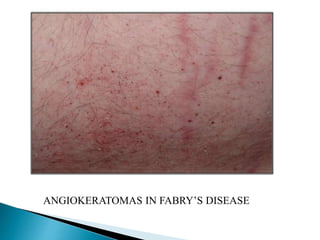
ANGIOKERATOMAS IN FABRY’S DISEASE
 Multifocal Motor Neuropathy
 Guillain-Barré Syndrome*
 CIDP*
 Acute Porphyric Neuropathy*
 Lead Intoxication*
 Hereditary Motor-Sensory Neuropathy* (CMT)
 Hereditary Motor Neuropathy
*Usually has sensory signs
Diabetes mellitus
Amyloidosis (familial & acquired)
HIV-related autonomic neuropathy
Acute/subacute autonomic neuropathies:
 Guillain-Barré syndrome
 paraneoplastic
 Autoimmune autonomic ganglionopathy
 Connective tissue diseases (SS, RA, ALE, MCTD)
Hereditary: HSANs, porphyria, Fabry disease
Idiopathic pandysautonomia
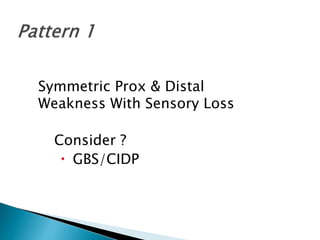
Symmetric Prox & Distal
Weakness With Sensory Loss
Consider ?
 GBS/CIDP
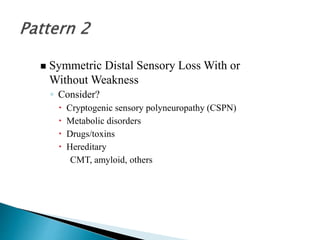
 Symmetric Distal Sensory Loss With or
Without Weakness
◦ Consider?
 Cryptogenic sensory polyneuropathy (CSPN)
 Metabolic disorders
 Drugs/toxins
 Hereditary
CMT, amyloid, others
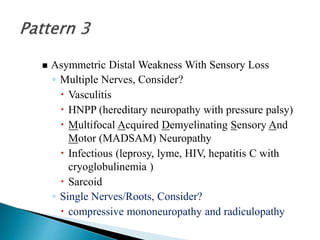
 Asymmetric Distal Weakness With Sensory Loss
◦ Multiple Nerves, Consider?
 Vasculitis
 HNPP (hereditary neuropathy with pressure palsy)
 Multifocal Acquired Demyelinating Sensory And
Motor (MADSAM) Neuropathy
 Infectious (leprosy, lyme, HIV, hepatitis C with
cryoglobulinemia )
 Sarcoid
◦ Single Nerves/Roots, Consider?
 compressive mononeuropathy and radiculopathy
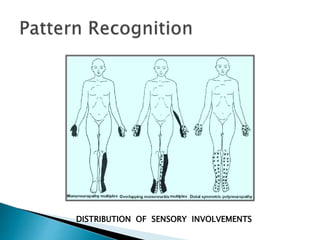
DISTRIBUTION OF SENSORY INVOLVEMENTS
 Asymmetric Prox & Distal Weakness
With Sensory Loss
◦ Consider?
 Polyradiculopathy
 Plexopathy
 Hereditary (HNPP, familial)
 Symmetric Sensory Loss (with or without
distal weakness), and Upper Motor Neuron
Signs
◦ Consider?
B12 deficiency; other causes of combined
system degeneration – esp copper defic
Inherited disorders
 ALD, MLD
 Friedreich’s
 Spinocerebellar ataxia
 2nd lesion, ex. Cerv. spondylosis
History:
•45 year old male with 6 month hx tingling toes, 3 month
fingers, and weakness
Exam:
•Orb Oculi 4
•deltoid 4
•biceps 4
•Finger abduction 4
•Hip flexion 4
•Ankle dorsal flexion 4
•Distal light touch/pin prick loss
•No DTR
What pattern of neuropathy does this patient have?
a. Symmetric proximal and distal weakness with
sensory loss.
b. Symmetric distal sensory loss with or without
weakness.
c. Asymmetric distal weakness with sensory loss
d. Asymmetric proximal and distal weakness with
sensory loss
e. Asymmetric distal weakness without sensory loss
What pattern of neuropathy does this patient have?
a. Symmetric proximal and distal weakness with
sensory loss.
b. Symmetric distal sensory loss with or without
weakness.
c. Asymmetric distal weakness with sensory loss
d. Asymmetric proximal and distal weakness with
sensory loss
e. Asymmetric distal weakness without sensory loss
Answer: a
The most useful test would be:
a. 24 year urine for lead and other heavy metals
b. Nerve conduction studies
c. Needle electromyography
d. Cerebrospinal fluid exam
e. Nerve biopsy
The most useful test would be:
a. 24 year urine for lead and other heavy metals
b. Nerve conduction studies
c. Needle electromyography
d. Cerebrospinal fluid exam
e. Nerve biopsy
Answer: b
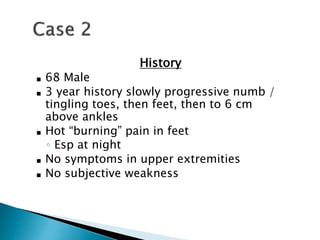
History
■ 68 Male
■ 3 year history slowly progressive numb /
tingling toes, then feet, then to 6 cm
above ankles
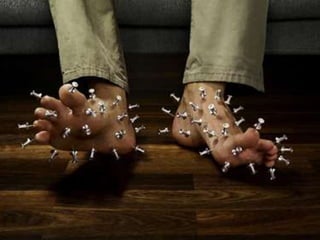
■ Hot “burning” pain in feet
◦ Esp at night
■ No symptoms in upper extremities
■ No subjective weakness
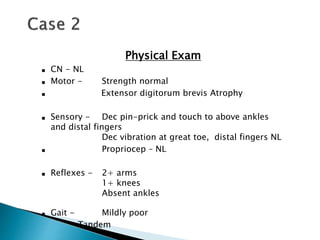
Physical Exam
■ CN - NL
■ Motor - Strength normal
■ Extensor digitorum brevis Atrophy
■ Sensory - Dec pin-prick and touch to above ankles
and distal fingers
Dec vibration at great toe, distal fingers NL
■ Propriocep – NL
■ Reflexes - 2+ arms
1+ knees
Absent ankles
■ Gait - Mildly poor
Tandem
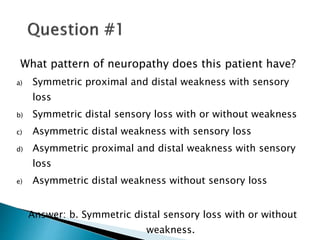
What pattern of neuropathy does this patient have?
a) Symmetric proximal and distal weakness with sensory
loss
b) Symmetric distal sensory loss with or without weakness
c) Asymmetric distal weakness with sensory loss
d) Asymmetric proximal and distal weakness with sensory
loss
e) Asymmetric distal weakness without sensory loss
What pattern of neuropathy does this patient have?
a) Symmetric proximal and distal weakness with sensory
loss
b) Symmetric distal sensory loss with or without weakness
c) Asymmetric distal weakness with sensory loss
d) Asymmetric proximal and distal weakness with sensory
loss
e) Asymmetric distal weakness without sensory loss
Answer: b. Symmetric distal sensory loss with or without
weakness.
What laboratory tests should be ordered?
a) Heavy metals screen in urine and blood
b) Anti-Hu antibody
c) 2-hour glucose tolerance test
d) ESR
e) Anti-sulfatide antibody
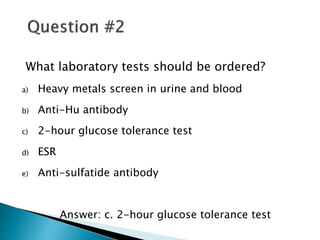
What laboratory tests should be ordered?
a) Heavy metals screen in urine and blood
b) Anti-Hu antibody
c) 2-hour glucose tolerance test
d) ESR
e) Anti-sulfatide antibody
Answer: c. 2-hour glucose tolerance test
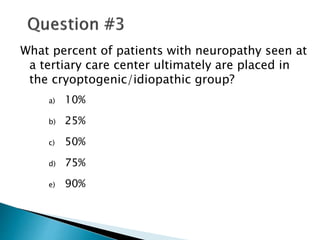
What percent of patients with neuropathy seen at
a tertiary care center ultimately are placed in
the cryoptogenic/idiopathic group?
a) 10%
b) 25%
c) 50%
d) 75%
e) 90%
What percent of patients with neuropathy seen at
a tertiary care center ultimately are placed in
the cryoptogenic/idiopathic group?
a) 10%
b) 25%
c) 50%
d) 75%
e) 90%
Answer: b. 25%
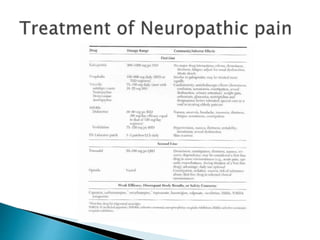
What is a reasonable medication management
approach for this patient?
a) Amitriptyline
b) Gabapentin
c) Duloxetine
d) Pregabalin
e) All of the above
What is a reasonable medication management
approach for this patient?
a) Amitriptyline
b) Gabapentin
c) Duloxetine
d) Pregabalin
e) All of the above
Answer: e. All of the above
■ 46 F
■ Numb/tingling fingers/toes
■ Unsteady gait
■ PE
◦ Motor normal except HF-4
◦ Dec LT/PP/distally
◦ Vib/prop absent toes/ankles
◦ DTR – Bic/knees 3 – ankles - 0
 + Hoffman’s; toes – ext RT
◦ Gait – ataxic, poor tandem
What neuropathy pattern is this?
a) Symmetric proximal and distal weakness with sensory
loss
b) Symmetric distal sensory loss with or without weakness
c) Symmetric sensory loss with or without distal weakness
and upper motor neuron signs
d) Asymmetric proprioceptive loss without weakness
e) Symmetric weakness without sensory loss
Answer: c. Symmetric sensory loss with or without distal
weakness and upper motor neurons signs.
■ B12 – 115
■ WBC – 1,200
■ Hg – 7.71/ Hct 25/ MCV 108
■ Rx – B12 injections monthly
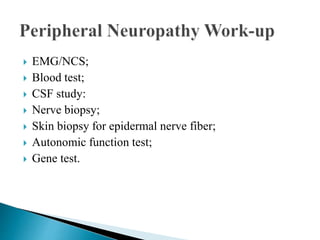
 EMG/NCS;
 Blood test;
 CSF study:
 Nerve biopsy;
 Skin biopsy for epidermal nerve fiber;
 Autonomic function test;
 Gene test.
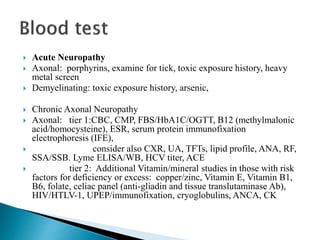
 Acute Neuropathy
 Axonal: porphyrins, examine for tick, toxic exposure history, heavy
metal screen
 Demyelinating: toxic exposure history, arsenic,
 Chronic Axonal Neuropathy
 Axonal: tier 1:CBC, CMP, FBS/HbA1C/OGTT, B12 (methylmalonic
acid/homocysteine), ESR, serum protein immunofixation
electrophoresis (IFE),
 consider also CXR, UA, TFTs, lipid profile, ANA, RF,
SSA/SSB. Lyme ELISA/WB, HCV titer, ACE
 tier 2: Additional Vitamin/mineral studies in those with risk
factors for deficiency or excess: copper/zinc, Vitamin E, Vitamin B1,
B6, folate, celiac panel (anti-gliadin and tissue translutaminase Ab),
HIV/HTLV-1, UPEP/immunofixation, cryoglobulins, ANCA, CK
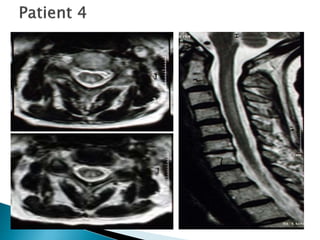
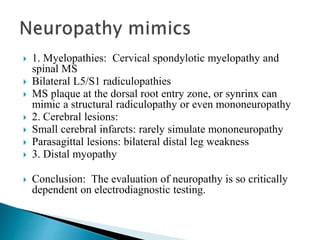
 1. Myelopathies: Cervical spondylotic myelopathy and
spinal MS
 Bilateral L5/S1 radiculopathies
 MS plaque at the dorsal root entry zone, or synrinx can
mimic a structural radiculopathy or even mononeuropathy
 2. Cerebral lesions:
 Small cerebral infarcts: rarely simulate mononeuropathy
 Parasagittal lesions: bilateral distal leg weakness
 3. Distal myopathy
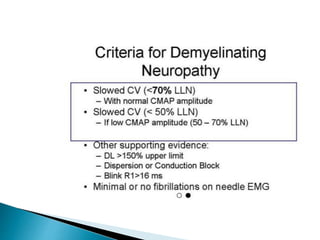
 Conclusion: The evaluation of neuropathy is so critically
dependent on electrodiagnostic testing.

Neuropathy - Dr. Xuan

  • 1.
    Approach to Peripheral Neuropathy XuanWu, M.D., Ph.D Assistant Professor Neurology Department Baylor College of Medicine
  • 10.
    Three Goals 1. DetermineWhere is the lesion and underlying pathology. 2. Determine What is the Cause of the Lesion. 3. Determine If There is a Specific Rx Therapy; or If Not, What is the Best Management.
  • 11.
    Peripheral Neuropathies (sensory,motor, sensorimotor, autonomic) Myelinopathies Axonopathies
  • 13.
  • 14.
     In hereditaryliability to pressure palsies, due to a deleted PMP22 segment, numerous sausage-like swellings or tomaculae are present on teased fiber preparations.
  • 15.
  • 16.
  • 19.
    KEY QUESTIONS 1. Whatsystems are involved? - Sensory, motor, autonomic, or combinations
  • 20.
     KEY QUESTIONS 2.What is the distribution of weakness and sensory loss  3. What is the temporal evolution  4. Is there evidence on the physical exam suggesting a hereditary neuropathy?/or Is there a family history of neuropathy?  5. Is There Evidence on the Physical Exam of Upper Motor Neuron Involvement?
  • 21.
     Cryptogenic SensoryPolyneuropathy (CSPN)  Metabolic, Drugs/Toxic Neuropathy  Sensory Neuronopathy  Hereditary Sensory Neuropathy
  • 22.
    Asymmetric Proprioceptive LossWithout Weakness  Cancer (Paraneoplastic)  Sjögren’s Syndrome  Cisplatinum and Analogues  Vitamin B6 Toxicity (Vitamin E deficiency)  HIV-Related Sensory Neuronopathy (HTLV, EBV, VZV, measles)  Idiopathic Sensory Neuronopathy  ?MGUS
  • 23.
     Cryptogenic Sensory/ Sensorimotor Polyneuropathy  Diabetes Mellitus  Amyloidosis  Alcoholic  HIV Related Distal Sensorimotor Neuropathy  Vasculitis  Guillain-Barré Syndrome  Syphilis  Toxic (arsenic, thallium)  Fabry’s Disease
  • 24.
  • 25.
     Multifocal MotorNeuropathy  Guillain-Barré Syndrome*  CIDP*  Acute Porphyric Neuropathy*  Lead Intoxication*  Hereditary Motor-Sensory Neuropathy* (CMT)  Hereditary Motor Neuropathy *Usually has sensory signs
  • 26.
    Diabetes mellitus Amyloidosis (familial& acquired) HIV-related autonomic neuropathy Acute/subacute autonomic neuropathies:  Guillain-Barré syndrome  paraneoplastic  Autoimmune autonomic ganglionopathy  Connective tissue diseases (SS, RA, ALE, MCTD) Hereditary: HSANs, porphyria, Fabry disease Idiopathic pandysautonomia
  • 28.
    Symmetric Prox &Distal Weakness With Sensory Loss Consider ?  GBS/CIDP
  • 29.
     Symmetric DistalSensory Loss With or Without Weakness ◦ Consider?  Cryptogenic sensory polyneuropathy (CSPN)  Metabolic disorders  Drugs/toxins  Hereditary CMT, amyloid, others
  • 30.
     Asymmetric DistalWeakness With Sensory Loss ◦ Multiple Nerves, Consider?  Vasculitis  HNPP (hereditary neuropathy with pressure palsy)  Multifocal Acquired Demyelinating Sensory And Motor (MADSAM) Neuropathy  Infectious (leprosy, lyme, HIV, hepatitis C with cryoglobulinemia )  Sarcoid ◦ Single Nerves/Roots, Consider?  compressive mononeuropathy and radiculopathy
  • 31.
  • 32.
     Asymmetric Prox& Distal Weakness With Sensory Loss ◦ Consider?  Polyradiculopathy  Plexopathy  Hereditary (HNPP, familial)
  • 33.
     Symmetric SensoryLoss (with or without distal weakness), and Upper Motor Neuron Signs ◦ Consider? B12 deficiency; other causes of combined system degeneration – esp copper defic Inherited disorders  ALD, MLD  Friedreich’s  Spinocerebellar ataxia  2nd lesion, ex. Cerv. spondylosis
  • 35.
    History: •45 year oldmale with 6 month hx tingling toes, 3 month fingers, and weakness Exam: •Orb Oculi 4 •deltoid 4 •biceps 4 •Finger abduction 4 •Hip flexion 4 •Ankle dorsal flexion 4 •Distal light touch/pin prick loss •No DTR
  • 36.
    What pattern ofneuropathy does this patient have? a. Symmetric proximal and distal weakness with sensory loss. b. Symmetric distal sensory loss with or without weakness. c. Asymmetric distal weakness with sensory loss d. Asymmetric proximal and distal weakness with sensory loss e. Asymmetric distal weakness without sensory loss
  • 37.
    What pattern ofneuropathy does this patient have? a. Symmetric proximal and distal weakness with sensory loss. b. Symmetric distal sensory loss with or without weakness. c. Asymmetric distal weakness with sensory loss d. Asymmetric proximal and distal weakness with sensory loss e. Asymmetric distal weakness without sensory loss Answer: a
  • 38.
    The most usefultest would be: a. 24 year urine for lead and other heavy metals b. Nerve conduction studies c. Needle electromyography d. Cerebrospinal fluid exam e. Nerve biopsy
  • 39.
    The most usefultest would be: a. 24 year urine for lead and other heavy metals b. Nerve conduction studies c. Needle electromyography d. Cerebrospinal fluid exam e. Nerve biopsy Answer: b
  • 40.
    History ■ 68 Male ■3 year history slowly progressive numb / tingling toes, then feet, then to 6 cm above ankles ■ Hot “burning” pain in feet ◦ Esp at night ■ No symptoms in upper extremities ■ No subjective weakness
  • 41.
    Physical Exam ■ CN- NL ■ Motor - Strength normal ■ Extensor digitorum brevis Atrophy ■ Sensory - Dec pin-prick and touch to above ankles and distal fingers Dec vibration at great toe, distal fingers NL ■ Propriocep – NL ■ Reflexes - 2+ arms 1+ knees Absent ankles ■ Gait - Mildly poor Tandem
  • 42.
    What pattern ofneuropathy does this patient have? a) Symmetric proximal and distal weakness with sensory loss b) Symmetric distal sensory loss with or without weakness c) Asymmetric distal weakness with sensory loss d) Asymmetric proximal and distal weakness with sensory loss e) Asymmetric distal weakness without sensory loss
  • 43.
    What pattern ofneuropathy does this patient have? a) Symmetric proximal and distal weakness with sensory loss b) Symmetric distal sensory loss with or without weakness c) Asymmetric distal weakness with sensory loss d) Asymmetric proximal and distal weakness with sensory loss e) Asymmetric distal weakness without sensory loss Answer: b. Symmetric distal sensory loss with or without weakness.
  • 44.
    What laboratory testsshould be ordered? a) Heavy metals screen in urine and blood b) Anti-Hu antibody c) 2-hour glucose tolerance test d) ESR e) Anti-sulfatide antibody
  • 45.
    What laboratory testsshould be ordered? a) Heavy metals screen in urine and blood b) Anti-Hu antibody c) 2-hour glucose tolerance test d) ESR e) Anti-sulfatide antibody Answer: c. 2-hour glucose tolerance test
  • 46.
    What percent ofpatients with neuropathy seen at a tertiary care center ultimately are placed in the cryoptogenic/idiopathic group? a) 10% b) 25% c) 50% d) 75% e) 90%
  • 47.
    What percent ofpatients with neuropathy seen at a tertiary care center ultimately are placed in the cryoptogenic/idiopathic group? a) 10% b) 25% c) 50% d) 75% e) 90% Answer: b. 25%
  • 48.
    What is areasonable medication management approach for this patient? a) Amitriptyline b) Gabapentin c) Duloxetine d) Pregabalin e) All of the above
  • 49.
    What is areasonable medication management approach for this patient? a) Amitriptyline b) Gabapentin c) Duloxetine d) Pregabalin e) All of the above Answer: e. All of the above
  • 51.
    ■ 46 F ■Numb/tingling fingers/toes ■ Unsteady gait ■ PE ◦ Motor normal except HF-4 ◦ Dec LT/PP/distally ◦ Vib/prop absent toes/ankles ◦ DTR – Bic/knees 3 – ankles - 0  + Hoffman’s; toes – ext RT ◦ Gait – ataxic, poor tandem
  • 52.
    What neuropathy patternis this? a) Symmetric proximal and distal weakness with sensory loss b) Symmetric distal sensory loss with or without weakness c) Symmetric sensory loss with or without distal weakness and upper motor neuron signs d) Asymmetric proprioceptive loss without weakness e) Symmetric weakness without sensory loss Answer: c. Symmetric sensory loss with or without distal weakness and upper motor neurons signs.
  • 53.
    ■ B12 –115 ■ WBC – 1,200 ■ Hg – 7.71/ Hct 25/ MCV 108 ■ Rx – B12 injections monthly
  • 55.
     EMG/NCS;  Bloodtest;  CSF study:  Nerve biopsy;  Skin biopsy for epidermal nerve fiber;  Autonomic function test;  Gene test.
  • 56.
     Acute Neuropathy Axonal: porphyrins, examine for tick, toxic exposure history, heavy metal screen  Demyelinating: toxic exposure history, arsenic,  Chronic Axonal Neuropathy  Axonal: tier 1:CBC, CMP, FBS/HbA1C/OGTT, B12 (methylmalonic acid/homocysteine), ESR, serum protein immunofixation electrophoresis (IFE),  consider also CXR, UA, TFTs, lipid profile, ANA, RF, SSA/SSB. Lyme ELISA/WB, HCV titer, ACE  tier 2: Additional Vitamin/mineral studies in those with risk factors for deficiency or excess: copper/zinc, Vitamin E, Vitamin B1, B6, folate, celiac panel (anti-gliadin and tissue translutaminase Ab), HIV/HTLV-1, UPEP/immunofixation, cryoglobulins, ANCA, CK
  • 58.
     1. Myelopathies:Cervical spondylotic myelopathy and spinal MS  Bilateral L5/S1 radiculopathies  MS plaque at the dorsal root entry zone, or synrinx can mimic a structural radiculopathy or even mononeuropathy  2. Cerebral lesions:  Small cerebral infarcts: rarely simulate mononeuropathy  Parasagittal lesions: bilateral distal leg weakness  3. Distal myopathy  Conclusion: The evaluation of neuropathy is so critically dependent on electrodiagnostic testing.