RECORDS MANAGEMENT
Judith Read and Mary Lea Ginn
Chapter 6
Alphabetic Records Management
Equipment and Procedures
1
© 2016 Cengage Learning®
. May not be scanned, copied or duplicated, or
posted to a publicly accessible website, in whole or in part.
Physical Documents Records Storage
• Records management—the systematic
control of all records
• Storage—placing records onto a shelf or into
a file drawer according to a storage method
• Storage methods
– Alphabetic, subject, geographic
– Numeric or chronologic
• Alphabetic records management—storing
records according to letters of the alphabet
2
© 2016 Cengage Learning®
. May not be scanned, copied or duplicated, or
posted to a publicly accessible website, in whole or in part.
Storage Equipment
• File cabinets
– Vertical file cabinets
– Lateral file cabinets
• Shelf files
• Mobile shelving
3
© 2016 Cengage Learning®
. May not be scanned, copied or duplicated, or
posted to a publicly accessible website, in whole or in part.
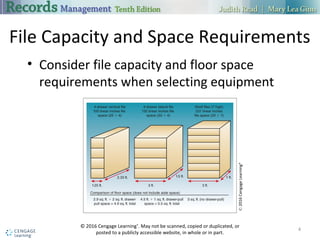
File Capacity and Space Requirements
• Consider file capacity and floor space
requirements when selecting equipment
4
© 2016 Cengage Learning®
. May not be scanned, copied or duplicated, or
posted to a publicly accessible website, in whole or in part.
©2016CengageLearning®
Storage Supplies
• Use of proper supplies aids in efficient
storage and retrieval
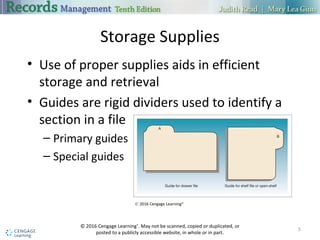
• Guides are rigid dividers used to identify a
section in a file
– Primary guides
– Special guides
5
© 2016 Cengage Learning®
. May not be scanned, copied or duplicated, or
posted to a publicly accessible website, in whole or in part.
© 2016 Cengage Learning®
Folders
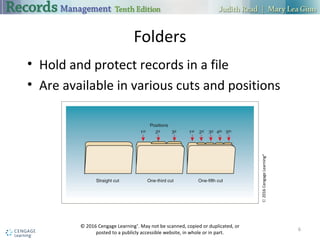
• Hold and protect records in a file
• Are available in various cuts and positions
6
© 2016 Cengage Learning®
. May not be scanned, copied or duplicated, or
posted to a publicly accessible website, in whole or in part.
©2016CengageLearning®
Folders
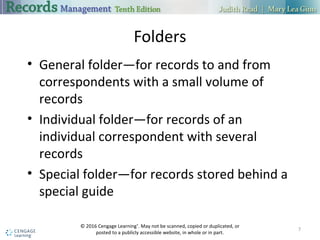
• General folder—for records to and from
correspondents with a small volume of
records
• Individual folder—for records of an
individual correspondent with several
records
• Special folder—for records stored behind a
special guide
7
© 2016 Cengage Learning®
. May not be scanned, copied or duplicated, or
posted to a publicly accessible website, in whole or in part.
Care of Folders
• Proper care of folders will help make stored
records readily accessible
– Limit the number of records in a folder
– Use score marks to expand folders
– Prepare a second folder for a correspondent
when a folder becomes too full
– Replace folders that are worn from heavy use
8
© 2016 Cengage Learning®
. May not be scanned, copied or duplicated, or
posted to a publicly accessible website, in whole or in part.
Other Folders and Compressors
• Suspension folder—has hooks on each side
that hang from metal rails on a file drawer
• Bellows folder—has a top flap and sides to
enclose records in a case
• Pocket folder—has partially enclosed sides
and more expansion at the bottom
• Follower block (compressor)—can be moved
to allow contraction or expansion of the
drawer contents
9
© 2016 Cengage Learning®
. May not be scanned, copied or duplicated, or
posted to a publicly accessible website, in whole or in part.
OUT Indicators
• Control devices that show the location of
borrowed records
– OUT guides are used to replace any record that
has been removed from storage
– OUT folders are used to replace a complete
folder that has been removed from storage
– OUT sheets are forms inserted in place of
records removed from folders
10
© 2016 Cengage Learning®
. May not be scanned, copied or duplicated, or
posted to a publicly accessible website, in whole or in part.
Labels
• Labels contain the names, subjects, or
numbers assigned to file items
– Container labels
– Guide labels
– Folder labels
• Bar codes may be placed onto labels along
with names
11
© 2016 Cengage Learning®
. May not be scanned, copied or duplicated, or
posted to a publicly accessible website, in whole or in part.
Sorters
• Sorters are used to arrange records into
alphabetic or numeric categories
– Hold records temporarily prior to storage
– Make locating unfiled records easier
• Records to be filed are organized in the
order in which they will be filed
• Sorters improve the speed and accuracy of
filing in the records system
12
© 2016 Cengage Learning®
. May not be scanned, copied or duplicated, or
posted to a publicly accessible website, in whole or in part.
Folder Selection Considerations
• Type and volume of records
• Degree of protection required for records
• Efficiency and ease of use of equipment and
systems
• Space available
• Cost
13
© 2016 Cengage Learning®
. May not be scanned, copied or duplicated, or
posted to a publicly accessible website, in whole or in part.
Advantages of Alphabetic Storage
• Alphabetic storage does not require an index
• Alphabetic order is easy to understand
• Storage is easy when following standard
methods
• Misfiles are easily checked
• The direct access feature can save time
• Related records for one name are grouped
together
14
© 2016 Cengage Learning®
. May not be scanned, copied or duplicated, or
posted to a publicly accessible website, in whole or in part.
Disadvantages of Alphabetic Storage
• Rules must be followed to prevent misfiling
• Similar names may cause confusion
• Misfiles can result in lost records
• File names are not confidential
• Related records for different names are not
grouped together
15
© 2016 Cengage Learning®
. May not be scanned, copied or duplicated, or
posted to a publicly accessible website, in whole or in part.
Considerations for System Selection
• The total volume of records
• The number of records in each section
• The expected activity in the files
• The length of time records are to be kept
• The efficiency of the filing personnel
• The time and resources available for training
16
© 2016 Cengage Learning®
. May not be scanned, copied or duplicated, or
posted to a publicly accessible website, in whole or in part.
Examples of Records Storage Systems
• A variety of manufacturers provide records
and information storage systems.
• Both storage equipment and supplies are
included in a storage system.
• Color may be used for coding or accenting.
– Blocks of colored folders act as a visual guide.
– Color bars can correspond to the first letters of
the name to create blocks of colors.
17
© 2016 Cengage Learning®
. May not be scanned, copied or duplicated, or
posted to a publicly accessible website, in whole or in part.
Procedures for Storing Physical
Records
• Inspecting
• Indexing
• Coding
• Cross-referencing
• Sorting
• Storing
18
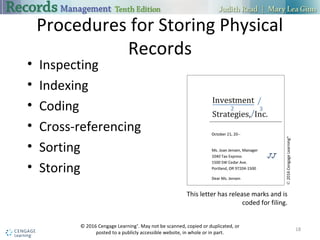
This letter has release marks and is
coded for filing.
© 2016 Cengage Learning®
. May not be scanned, copied or duplicated, or
posted to a publicly accessible website, in whole or in part.
©2016CengageLearning®
Tickler File
• A date-sequenced file by which matters
pending are flagged for attention.
– Also called a pending file
– May be a physical or electronic file
• The tickler file should be checked each day.
• The notes in the file serve as reminders to
act on specific items.
19
© 2016 Cengage Learning®
. May not be scanned, copied or duplicated, or
posted to a publicly accessible website, in whole or in part.
Misfiled or Lost Records
• To find missing physical records
– Look in the folders near the correct folder
– Check for transposition of numbers or names
– Look in preceding years or related subjects
– Look in the related general folder
– Look in the sorter for unfiled records
• To locate electronic records, use the search
feature of the computer’s operating system
20
© 2016 Cengage Learning®
. May not be scanned, copied or duplicated, or
posted to a publicly accessible website, in whole or in part.

Chapter 06

  • 1.
    RECORDS MANAGEMENT Judith Readand Mary Lea Ginn Chapter 6 Alphabetic Records Management Equipment and Procedures 1 © 2016 Cengage Learning® . May not be scanned, copied or duplicated, or posted to a publicly accessible website, in whole or in part.
  • 2.
    Physical Documents RecordsStorage • Records management—the systematic control of all records • Storage—placing records onto a shelf or into a file drawer according to a storage method • Storage methods – Alphabetic, subject, geographic – Numeric or chronologic • Alphabetic records management—storing records according to letters of the alphabet 2 © 2016 Cengage Learning® . May not be scanned, copied or duplicated, or posted to a publicly accessible website, in whole or in part.
  • 3.
    Storage Equipment • Filecabinets – Vertical file cabinets – Lateral file cabinets • Shelf files • Mobile shelving 3 © 2016 Cengage Learning® . May not be scanned, copied or duplicated, or posted to a publicly accessible website, in whole or in part.
  • 4.
    File Capacity andSpace Requirements • Consider file capacity and floor space requirements when selecting equipment 4 © 2016 Cengage Learning® . May not be scanned, copied or duplicated, or posted to a publicly accessible website, in whole or in part. ©2016CengageLearning®
  • 5.
    Storage Supplies • Useof proper supplies aids in efficient storage and retrieval • Guides are rigid dividers used to identify a section in a file – Primary guides – Special guides 5 © 2016 Cengage Learning® . May not be scanned, copied or duplicated, or posted to a publicly accessible website, in whole or in part. © 2016 Cengage Learning®
  • 6.
    Folders • Hold andprotect records in a file • Are available in various cuts and positions 6 © 2016 Cengage Learning® . May not be scanned, copied or duplicated, or posted to a publicly accessible website, in whole or in part. ©2016CengageLearning®
  • 7.
    Folders • General folder—forrecords to and from correspondents with a small volume of records • Individual folder—for records of an individual correspondent with several records • Special folder—for records stored behind a special guide 7 © 2016 Cengage Learning® . May not be scanned, copied or duplicated, or posted to a publicly accessible website, in whole or in part.
  • 8.
    Care of Folders •Proper care of folders will help make stored records readily accessible – Limit the number of records in a folder – Use score marks to expand folders – Prepare a second folder for a correspondent when a folder becomes too full – Replace folders that are worn from heavy use 8 © 2016 Cengage Learning® . May not be scanned, copied or duplicated, or posted to a publicly accessible website, in whole or in part.
  • 9.
    Other Folders andCompressors • Suspension folder—has hooks on each side that hang from metal rails on a file drawer • Bellows folder—has a top flap and sides to enclose records in a case • Pocket folder—has partially enclosed sides and more expansion at the bottom • Follower block (compressor)—can be moved to allow contraction or expansion of the drawer contents 9 © 2016 Cengage Learning® . May not be scanned, copied or duplicated, or posted to a publicly accessible website, in whole or in part.
  • 10.
    OUT Indicators • Controldevices that show the location of borrowed records – OUT guides are used to replace any record that has been removed from storage – OUT folders are used to replace a complete folder that has been removed from storage – OUT sheets are forms inserted in place of records removed from folders 10 © 2016 Cengage Learning® . May not be scanned, copied or duplicated, or posted to a publicly accessible website, in whole or in part.
  • 11.
    Labels • Labels containthe names, subjects, or numbers assigned to file items – Container labels – Guide labels – Folder labels • Bar codes may be placed onto labels along with names 11 © 2016 Cengage Learning® . May not be scanned, copied or duplicated, or posted to a publicly accessible website, in whole or in part.
  • 12.
    Sorters • Sorters areused to arrange records into alphabetic or numeric categories – Hold records temporarily prior to storage – Make locating unfiled records easier • Records to be filed are organized in the order in which they will be filed • Sorters improve the speed and accuracy of filing in the records system 12 © 2016 Cengage Learning® . May not be scanned, copied or duplicated, or posted to a publicly accessible website, in whole or in part.
  • 13.
    Folder Selection Considerations •Type and volume of records • Degree of protection required for records • Efficiency and ease of use of equipment and systems • Space available • Cost 13 © 2016 Cengage Learning® . May not be scanned, copied or duplicated, or posted to a publicly accessible website, in whole or in part.
  • 14.
    Advantages of AlphabeticStorage • Alphabetic storage does not require an index • Alphabetic order is easy to understand • Storage is easy when following standard methods • Misfiles are easily checked • The direct access feature can save time • Related records for one name are grouped together 14 © 2016 Cengage Learning® . May not be scanned, copied or duplicated, or posted to a publicly accessible website, in whole or in part.
  • 15.
    Disadvantages of AlphabeticStorage • Rules must be followed to prevent misfiling • Similar names may cause confusion • Misfiles can result in lost records • File names are not confidential • Related records for different names are not grouped together 15 © 2016 Cengage Learning® . May not be scanned, copied or duplicated, or posted to a publicly accessible website, in whole or in part.
  • 16.
    Considerations for SystemSelection • The total volume of records • The number of records in each section • The expected activity in the files • The length of time records are to be kept • The efficiency of the filing personnel • The time and resources available for training 16 © 2016 Cengage Learning® . May not be scanned, copied or duplicated, or posted to a publicly accessible website, in whole or in part.
  • 17.
    Examples of RecordsStorage Systems • A variety of manufacturers provide records and information storage systems. • Both storage equipment and supplies are included in a storage system. • Color may be used for coding or accenting. – Blocks of colored folders act as a visual guide. – Color bars can correspond to the first letters of the name to create blocks of colors. 17 © 2016 Cengage Learning® . May not be scanned, copied or duplicated, or posted to a publicly accessible website, in whole or in part.
  • 18.
    Procedures for StoringPhysical Records • Inspecting • Indexing • Coding • Cross-referencing • Sorting • Storing 18 This letter has release marks and is coded for filing. © 2016 Cengage Learning® . May not be scanned, copied or duplicated, or posted to a publicly accessible website, in whole or in part. ©2016CengageLearning®
  • 19.
    Tickler File • Adate-sequenced file by which matters pending are flagged for attention. – Also called a pending file – May be a physical or electronic file • The tickler file should be checked each day. • The notes in the file serve as reminders to act on specific items. 19 © 2016 Cengage Learning® . May not be scanned, copied or duplicated, or posted to a publicly accessible website, in whole or in part.
  • 20.
    Misfiled or LostRecords • To find missing physical records – Look in the folders near the correct folder – Check for transposition of numbers or names – Look in preceding years or related subjects – Look in the related general folder – Look in the sorter for unfiled records • To locate electronic records, use the search feature of the computer’s operating system 20 © 2016 Cengage Learning® . May not be scanned, copied or duplicated, or posted to a publicly accessible website, in whole or in part.