Geographic Records Storage Method Geographic records management  Geographic filing system  Closely related to subject records management  Uses alphabetic and numeric filing and indexing rules
Examples of Activities that Require Decisions Based on Location Scientific research  Oil and gas exploration  Facility management  Real estate transactions Emergency response Utility and telecommunication services  Product distribution Continued on next slide
Geographical Information  System—GIS A computer system designed to allow users to collect, manage, and analyze large volumes of data Referenced to a geographical location by some type of geographical coordinates  Query or analysis of the database results in the form of a map  Continued on next slide
Geographical Information  System—GIS Increasingly considered essential components of effective engineering, planning, and emergency management operations Continued from previous slide
Advantages of  Geographic Records Storage Operations relating to a specific location are filed together  Each geographic area in storage is a unit or a group, and the shift of groups of records is easily accomplished by moving an entire group from one file location to another
Disadvantages of  Geographic Records Storage  User must know the geographic location, or an index must be created and maintained  Guide and folder arrangements for some large systems are complex Cross-references are necessary for both alphabetic filing methods and numeric filing methods
Geographic Records  Storage Arrangements  The geographic arrangement of records depends on the following:  The type of business The way reference is made to records  The geographic areas related to records
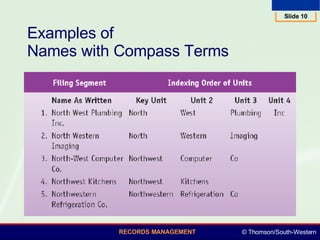
Compass Terms  A  compass term  uses compass points as part of the company or subject name.  Each word or unit in a filing segment is considered a separate filing unit.  If the term includes more than one compass point, the term should be treated as it is written.  When used in scientific document filing the compass term is treated as an adjective and is placed after the name.
Examples of  Names with Compass Terms
Storage Arrangements Dictionary storage arrangements Lettered guide plan Location name guide plan Encyclopedic storage arrangements Lettered guide plan Location name guide plan
Dictionary Storage Arrangements A  dictionary arrangement  for geographic records is an arrangement of records in alphabetic order.
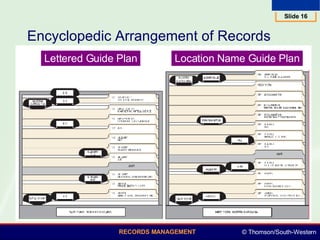
Encyclopedic Storage Arrangements An  encyclopedic arrangement  is the alphabetic arrangement of major geographic divisions plus one or more geographic subdivisions also arranged in alphabetic order.
Guide Plans Lettered guide plan —an arrangement of geographic records with primary guides labeled with alphabetic letters  Location name guide plan —an arrangement of geographic records with primary guides labeled with location names
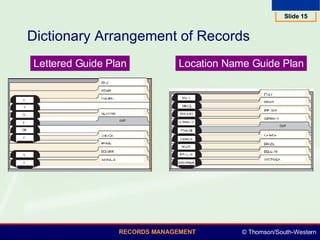
Dictionary Arrangement of Records Lettered Guide Plan Location Name Guide Plan
Encyclopedic Arrangement of Records Lettered Guide Plan Location Name Guide Plan
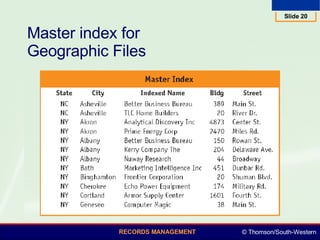
Geographic Records Storage Indexes  Numeric file list  (accession log)—a serial list of the numbers assigned to records in a numeric storage system Alphabetic index —lists all correspondents or subjects in geographic storage  Master index —a complete listing of all filing segments in the filing system
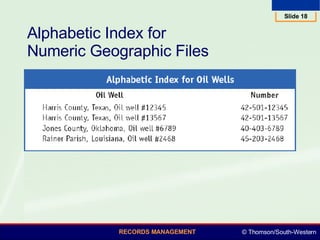
Alphabetic Index for  Numeric Geographic Files
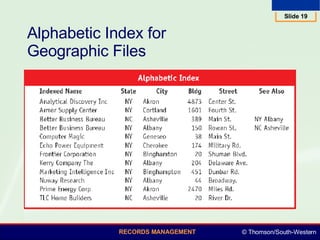
Alphabetic Index for  Geographic Files
Master index for  Geographic Files
Geographic Records Storage and Retrieval Procedures  Supplies include guides, folders, and OUT indicators.  Retrieval procedures such as requisitioning, charging out, and following up are basically the same as alphabetic, subject, and numeric methods.
Inspecting and Indexing Record is inspected to determine if it is released for storage and indexed by scanning the content to determine its proper place in storage
Coding Code the document for geographic storage Mark the correspondents’ location first Write numbers above or below the filing segment to show the order of indexing and alphabetizing units Code the name of the correspondent by underlining the name,  Place diagonals between the indexing units, and number the succeeding units
Cross-Referencing  As necessary in the geographic storage method as it is in the alphabetic or numeric storage methods  Use established rules for cross-referencing personal and business names  Continued on next slide
Cross-Referencing Additional Cross-References  Names of organizations having more than one address Organizations located at one address and doing business under other names at other locations A foreign country name translated into its English equivalent Continued from previous slide Continued on next slide
Cross-Referencing Insert cross-references in both the alphabetic or numeric index and the storage file  In the numeric index prepare an entry for each of the identification numbers assigned to each file  In the alphabetic index, prepare an entry for every name  Continued from previous slide
Types of Cross-References  Cross-reference sheet  Cross-reference guide SEE ALSO cross-reference notation
Cross-Reference Sheet Cross-reference sheet —a sheet placed in an alternate location in the file directing the filer to a specific record stored in a different location other than where the filer is searching
Cross-Reference Guide Cross-reference guide —a special guide serving as a permanent marker in storage indicating that all records pertaining to a correspondent are stored elsewhere
SEE ALSO Cross-Reference SEE ALSO cross-reference —a notation on a folder tab or cross-reference sheet directing the filer to multiple locations for related information
Sorting and Storing Sort records numerically by file code or alphabetically by location  Complexity of a geographic arrangement requires extreme care when storing Lettered Guide Plan—use the guides to locate the alphabetic section within which the name falls  Location Name Guide Plan—find the primary guide and look for the correct name on a secondary guide. If a secondary guide is present, also look for an individual correspondent’s folder
Retrieving  Ask for the record (requisition) Check the alphabetic or numeric index to determine the location of the record Remove the record from the files Complete charge-out documentation for the record Follow up to see that the record is returned to storage within a specified time

baim_ch10

  • 1.
  • 2.
    Geographic Records StorageMethod Geographic records management Geographic filing system Closely related to subject records management Uses alphabetic and numeric filing and indexing rules
  • 3.
    Examples of Activitiesthat Require Decisions Based on Location Scientific research Oil and gas exploration Facility management Real estate transactions Emergency response Utility and telecommunication services Product distribution Continued on next slide
  • 4.
    Geographical Information System—GIS A computer system designed to allow users to collect, manage, and analyze large volumes of data Referenced to a geographical location by some type of geographical coordinates Query or analysis of the database results in the form of a map Continued on next slide
  • 5.
    Geographical Information System—GIS Increasingly considered essential components of effective engineering, planning, and emergency management operations Continued from previous slide
  • 6.
    Advantages of Geographic Records Storage Operations relating to a specific location are filed together Each geographic area in storage is a unit or a group, and the shift of groups of records is easily accomplished by moving an entire group from one file location to another
  • 7.
    Disadvantages of Geographic Records Storage User must know the geographic location, or an index must be created and maintained Guide and folder arrangements for some large systems are complex Cross-references are necessary for both alphabetic filing methods and numeric filing methods
  • 8.
    Geographic Records Storage Arrangements The geographic arrangement of records depends on the following: The type of business The way reference is made to records The geographic areas related to records
  • 9.
    Compass Terms A compass term uses compass points as part of the company or subject name. Each word or unit in a filing segment is considered a separate filing unit. If the term includes more than one compass point, the term should be treated as it is written. When used in scientific document filing the compass term is treated as an adjective and is placed after the name.
  • 10.
    Examples of Names with Compass Terms
  • 11.
    Storage Arrangements Dictionarystorage arrangements Lettered guide plan Location name guide plan Encyclopedic storage arrangements Lettered guide plan Location name guide plan
  • 12.
    Dictionary Storage ArrangementsA dictionary arrangement for geographic records is an arrangement of records in alphabetic order.
  • 13.
    Encyclopedic Storage ArrangementsAn encyclopedic arrangement is the alphabetic arrangement of major geographic divisions plus one or more geographic subdivisions also arranged in alphabetic order.
  • 14.
    Guide Plans Letteredguide plan —an arrangement of geographic records with primary guides labeled with alphabetic letters Location name guide plan —an arrangement of geographic records with primary guides labeled with location names
  • 15.
    Dictionary Arrangement ofRecords Lettered Guide Plan Location Name Guide Plan
  • 16.
    Encyclopedic Arrangement ofRecords Lettered Guide Plan Location Name Guide Plan
  • 17.
    Geographic Records StorageIndexes Numeric file list (accession log)—a serial list of the numbers assigned to records in a numeric storage system Alphabetic index —lists all correspondents or subjects in geographic storage Master index —a complete listing of all filing segments in the filing system
  • 18.
    Alphabetic Index for Numeric Geographic Files
  • 19.
    Alphabetic Index for Geographic Files
  • 20.
    Master index for Geographic Files
  • 21.
    Geographic Records Storageand Retrieval Procedures Supplies include guides, folders, and OUT indicators. Retrieval procedures such as requisitioning, charging out, and following up are basically the same as alphabetic, subject, and numeric methods.
  • 22.
    Inspecting and IndexingRecord is inspected to determine if it is released for storage and indexed by scanning the content to determine its proper place in storage
  • 23.
    Coding Code thedocument for geographic storage Mark the correspondents’ location first Write numbers above or below the filing segment to show the order of indexing and alphabetizing units Code the name of the correspondent by underlining the name, Place diagonals between the indexing units, and number the succeeding units
  • 24.
    Cross-Referencing Asnecessary in the geographic storage method as it is in the alphabetic or numeric storage methods Use established rules for cross-referencing personal and business names Continued on next slide
  • 25.
    Cross-Referencing Additional Cross-References Names of organizations having more than one address Organizations located at one address and doing business under other names at other locations A foreign country name translated into its English equivalent Continued from previous slide Continued on next slide
  • 26.
    Cross-Referencing Insert cross-referencesin both the alphabetic or numeric index and the storage file In the numeric index prepare an entry for each of the identification numbers assigned to each file In the alphabetic index, prepare an entry for every name Continued from previous slide
  • 27.
    Types of Cross-References Cross-reference sheet Cross-reference guide SEE ALSO cross-reference notation
  • 28.
    Cross-Reference Sheet Cross-referencesheet —a sheet placed in an alternate location in the file directing the filer to a specific record stored in a different location other than where the filer is searching
  • 29.
    Cross-Reference Guide Cross-referenceguide —a special guide serving as a permanent marker in storage indicating that all records pertaining to a correspondent are stored elsewhere
  • 30.
    SEE ALSO Cross-ReferenceSEE ALSO cross-reference —a notation on a folder tab or cross-reference sheet directing the filer to multiple locations for related information
  • 31.
    Sorting and StoringSort records numerically by file code or alphabetically by location Complexity of a geographic arrangement requires extreme care when storing Lettered Guide Plan—use the guides to locate the alphabetic section within which the name falls Location Name Guide Plan—find the primary guide and look for the correct name on a secondary guide. If a secondary guide is present, also look for an individual correspondent’s folder
  • 32.
    Retrieving Askfor the record (requisition) Check the alphabetic or numeric index to determine the location of the record Remove the record from the files Complete charge-out documentation for the record Follow up to see that the record is returned to storage within a specified time