Chapter 9
Numeric Records Management
Records Management
Judith Read and Mary Lea Ginn
1
Numeric Records Storage and
Retrieval
O Numeric records management
• Is a system for arranging records based on numbers
(Read & Ginn, 2015, p. 218).
• May be used by organizations
• manage a large number of records
• that need to keep records confidential
• Makes expanding files easy
• It is important to remember that numbers are
impersonal…
2
Consecutive Numbering
Defined Components
3
O Serial, sequential, and
straight numeric
O Numbered records are
arranged in ascending
number order
O Numbers follow one after
another without
interruption
O An index must be
referenced to locate a
numbered record (Read &
Ginn, 2015, p. 219).
O Numbered guides and
folders for the numeric
file
O Alphabetic guides and
folders for the general
alphabetic file
O A lined book or
software for an
accession log
O Software for an alphabetic
index (Read & Ginn, 2015,
p. 219).
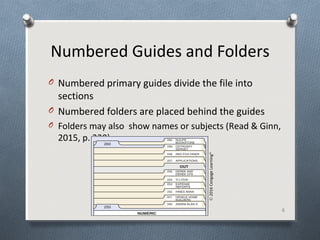
Numbered Guides and Folders
O Numbered primary guides divide the file into
sections
O Numbered folders are placed behind the guides
O Folders may also show names or subjects (Read & Ginn,
2015, p. 220).
4
©2016CengageLearning®
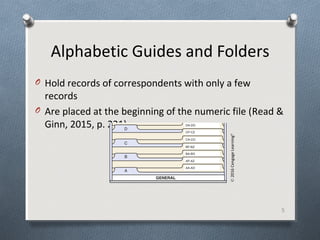
Alphabetic Guides and Folders
O Hold records of correspondents with only a few
records
O Are placed at the beginning of the numeric file (Read &
Ginn, 2015, p. 221).
5
©2016CengageLearning®
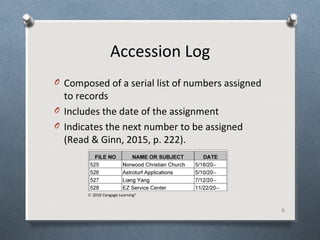
Accession Log
O Composed of a serial list of numbers assigned
to records
O Includes the date of the assignment
O Indicates the next number to be assigned
(Read & Ginn, 2015, p. 222).
6
© 2016 Cengage Learning®
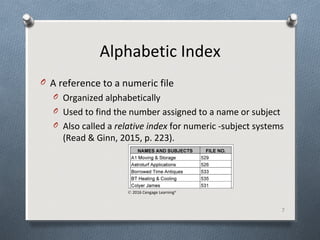
Alphabetic Index
O A reference to a numeric file
O Organized alphabetically
O Used to find the number assigned to a name or subject
O Also called a relative index for numeric -subject systems
(Read & Ginn, 2015, p. 223).
7
© 2016 Cengage Learning®
Storage and Retrieval Procedures
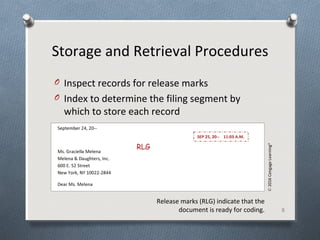
O Inspect records for release marks
O Index to determine the filing segment by
which to store each record
8
Release marks (RLG) indicate that the
document is ready for coding.
©2016CengageLearning®
Storage and Retrieval Procedures
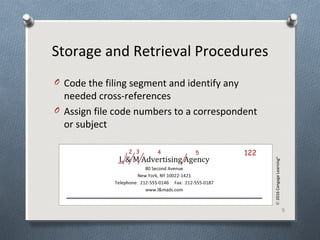
O Code the filing segment and identify any
needed cross-references
O Assign file code numbers to a correspondent
or subject
9
©2016CengageLearning®
Storage and Retrieval Procedures
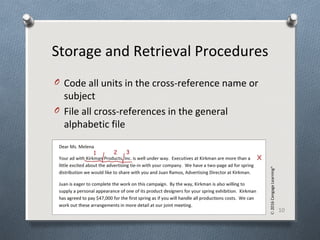
O Code all units in the cross-reference name or
subject
O File all cross-references in the general
alphabetic file
10
©2016CengageLearning®
Storage and Retrieval Procedures
O Perform an initial alphabetic sorting before
assigning file code numbers or the letter G
O Assign all necessary codes and place the
records into numeric or alphabetic sorters
O Store all records coded with numbers in
folders with the most recent date on top
O Store records coded G in the general
alphabetic folders
11
Storage and Retrieval Procedures
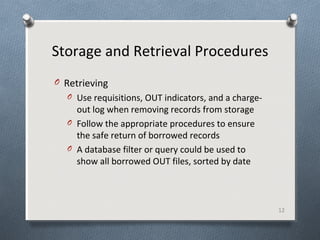
O Retrieving
O Use requisitions, OUT indicators, and a charge-
out log when removing records from storage
O Follow the appropriate procedures to ensure
the safe return of borrowed records
O A database filter or query could be used to
show all borrowed OUT files, sorted by date
12
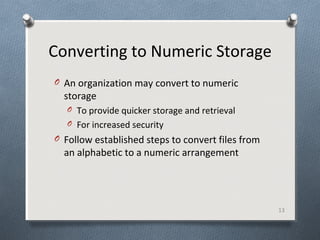
Converting to Numeric Storage
O An organization may convert to numeric
storage
O To provide quicker storage and retrieval
O For increased security
O Follow established steps to convert files from
an alphabetic to a numeric arrangement
13
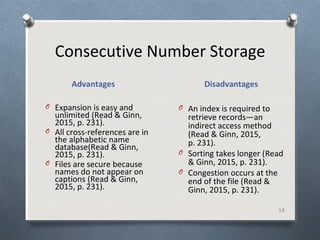
Consecutive Number Storage
Advantages Disadvantages
14
O Expansion is easy and
unlimited (Read & Ginn,
2015, p. 231).
O All cross-references are in
the alphabetic name
database(Read & Ginn,
2015, p. 231).
O Files are secure because
names do not appear on
captions (Read & Ginn,
2015, p. 231).
O An index is required to
retrieve records—an
indirect access method
(Read & Ginn, 2015,
p. 231).
O Sorting takes longer (Read
& Ginn, 2015, p. 231).
O Congestion occurs at the
end of the file (Read &
Ginn, 2015, p. 231).
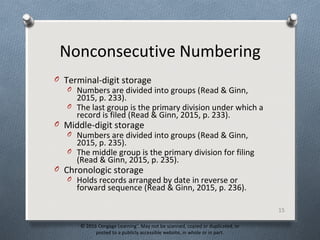
Nonconsecutive Numbering
O Terminal-digit storage
O Numbers are divided into groups (Read & Ginn,
2015, p. 233).
O The last group is the primary division under which a
record is filed (Read & Ginn, 2015, p. 233).
O Middle-digit storage
O Numbers are divided into groups (Read & Ginn,
2015, p. 235).
O The middle group is the primary division for filing
(Read & Ginn, 2015, p. 235).
O Chronologic storage
O Holds records arranged by date in reverse or
forward sequence (Read & Ginn, 2015, p. 236).
15
© 2016 Cengage Learning®
. May not be scanned, copied or duplicated, or
posted to a publicly accessible website, in whole or in part.
Other Numeric Coding Systems
O Block-numeric coding: “a coding system based on the
assignment of number ranges to subjects” (Read & Ginn,
2015, p. 237).
O Duplex-numeric coding: “a coding system using numbers
(or sometimes letters) with two or more parts separated
by a dash, space, or comma” (Read & Ginn, 2015, p. 237).
O Decimal-numeric coding: “a numeric method of classifying
records by subject, in units of 10and coded for
arrangement in numeric order” (Read & Ginn, 2015,
p. 238).
O Alphanumeric coding: “a coding system that combines
letters and numbers, in combination with punctuation
marks, to develop codes for classifying and retrieving
information” (Read & Ginn, 2015, p. 238).
16
Databases for Numeric Storage
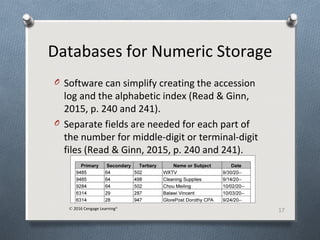
O Software can simplify creating the accession
log and the alphabetic index (Read & Ginn,
2015, p. 240 and 241).
O Separate fields are needed for each part of
the number for middle-digit or terminal-digit
files (Read & Ginn, 2015, p. 240 and 241).
17© 2016 Cengage Learning®
Resource
O Read, J., & Ginn, M. L. (2015). Numeric Records
Management. In Records management (10th ed.).
Boston, MA: Cengage Learning.
18

Chapter 09

  • 1.
    Chapter 9 Numeric RecordsManagement Records Management Judith Read and Mary Lea Ginn 1
  • 2.
    Numeric Records Storageand Retrieval O Numeric records management • Is a system for arranging records based on numbers (Read & Ginn, 2015, p. 218). • May be used by organizations • manage a large number of records • that need to keep records confidential • Makes expanding files easy • It is important to remember that numbers are impersonal… 2
  • 3.
    Consecutive Numbering Defined Components 3 OSerial, sequential, and straight numeric O Numbered records are arranged in ascending number order O Numbers follow one after another without interruption O An index must be referenced to locate a numbered record (Read & Ginn, 2015, p. 219). O Numbered guides and folders for the numeric file O Alphabetic guides and folders for the general alphabetic file O A lined book or software for an accession log O Software for an alphabetic index (Read & Ginn, 2015, p. 219).
  • 4.
    Numbered Guides andFolders O Numbered primary guides divide the file into sections O Numbered folders are placed behind the guides O Folders may also show names or subjects (Read & Ginn, 2015, p. 220). 4 ©2016CengageLearning®
  • 5.
    Alphabetic Guides andFolders O Hold records of correspondents with only a few records O Are placed at the beginning of the numeric file (Read & Ginn, 2015, p. 221). 5 ©2016CengageLearning®
  • 6.
    Accession Log O Composedof a serial list of numbers assigned to records O Includes the date of the assignment O Indicates the next number to be assigned (Read & Ginn, 2015, p. 222). 6 © 2016 Cengage Learning®
  • 7.
    Alphabetic Index O Areference to a numeric file O Organized alphabetically O Used to find the number assigned to a name or subject O Also called a relative index for numeric -subject systems (Read & Ginn, 2015, p. 223). 7 © 2016 Cengage Learning®
  • 8.
    Storage and RetrievalProcedures O Inspect records for release marks O Index to determine the filing segment by which to store each record 8 Release marks (RLG) indicate that the document is ready for coding. ©2016CengageLearning®
  • 9.
    Storage and RetrievalProcedures O Code the filing segment and identify any needed cross-references O Assign file code numbers to a correspondent or subject 9 ©2016CengageLearning®
  • 10.
    Storage and RetrievalProcedures O Code all units in the cross-reference name or subject O File all cross-references in the general alphabetic file 10 ©2016CengageLearning®
  • 11.
    Storage and RetrievalProcedures O Perform an initial alphabetic sorting before assigning file code numbers or the letter G O Assign all necessary codes and place the records into numeric or alphabetic sorters O Store all records coded with numbers in folders with the most recent date on top O Store records coded G in the general alphabetic folders 11
  • 12.
    Storage and RetrievalProcedures O Retrieving O Use requisitions, OUT indicators, and a charge- out log when removing records from storage O Follow the appropriate procedures to ensure the safe return of borrowed records O A database filter or query could be used to show all borrowed OUT files, sorted by date 12
  • 13.
    Converting to NumericStorage O An organization may convert to numeric storage O To provide quicker storage and retrieval O For increased security O Follow established steps to convert files from an alphabetic to a numeric arrangement 13
  • 14.
    Consecutive Number Storage AdvantagesDisadvantages 14 O Expansion is easy and unlimited (Read & Ginn, 2015, p. 231). O All cross-references are in the alphabetic name database(Read & Ginn, 2015, p. 231). O Files are secure because names do not appear on captions (Read & Ginn, 2015, p. 231). O An index is required to retrieve records—an indirect access method (Read & Ginn, 2015, p. 231). O Sorting takes longer (Read & Ginn, 2015, p. 231). O Congestion occurs at the end of the file (Read & Ginn, 2015, p. 231).
  • 15.
    Nonconsecutive Numbering O Terminal-digitstorage O Numbers are divided into groups (Read & Ginn, 2015, p. 233). O The last group is the primary division under which a record is filed (Read & Ginn, 2015, p. 233). O Middle-digit storage O Numbers are divided into groups (Read & Ginn, 2015, p. 235). O The middle group is the primary division for filing (Read & Ginn, 2015, p. 235). O Chronologic storage O Holds records arranged by date in reverse or forward sequence (Read & Ginn, 2015, p. 236). 15 © 2016 Cengage Learning® . May not be scanned, copied or duplicated, or posted to a publicly accessible website, in whole or in part.
  • 16.
    Other Numeric CodingSystems O Block-numeric coding: “a coding system based on the assignment of number ranges to subjects” (Read & Ginn, 2015, p. 237). O Duplex-numeric coding: “a coding system using numbers (or sometimes letters) with two or more parts separated by a dash, space, or comma” (Read & Ginn, 2015, p. 237). O Decimal-numeric coding: “a numeric method of classifying records by subject, in units of 10and coded for arrangement in numeric order” (Read & Ginn, 2015, p. 238). O Alphanumeric coding: “a coding system that combines letters and numbers, in combination with punctuation marks, to develop codes for classifying and retrieving information” (Read & Ginn, 2015, p. 238). 16
  • 17.
    Databases for NumericStorage O Software can simplify creating the accession log and the alphabetic index (Read & Ginn, 2015, p. 240 and 241). O Separate fields are needed for each part of the number for middle-digit or terminal-digit files (Read & Ginn, 2015, p. 240 and 241). 17© 2016 Cengage Learning®
  • 18.
    Resource O Read, J.,& Ginn, M. L. (2015). Numeric Records Management. In Records management (10th ed.). Boston, MA: Cengage Learning. 18