RECORDS MANAGEMENT
Judith Read and Mary Lea Ginn
Chapter 4
Alphabetic Indexing
Rules 9-10
Copyright 2011 South-Western, Cengage Learning
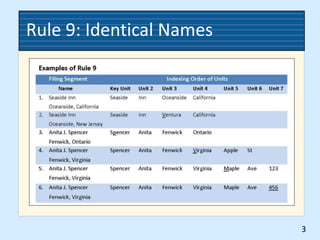
Rule 9: Identical Names
• For identical names, sort records by
– City names first
– State or province names second
– Street names third
– House or building numbers fourth
2
Rule 9: Identical Names
3
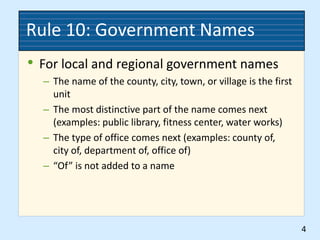
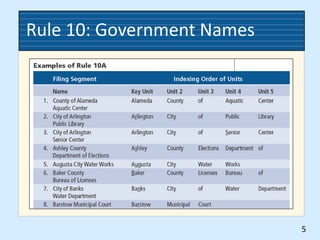
Rule 10: Government Names
• For local and regional government names
– The name of the county, city, town, or village is the first
unit
– The most distinctive part of the name comes next
(examples: public library, fitness center, water works)
– The type of office comes next (examples: county of,
city of, department of, office of)
– “Of” is not added to a name
4
Rule 10: Government Names
5
Rule 10: Government Names
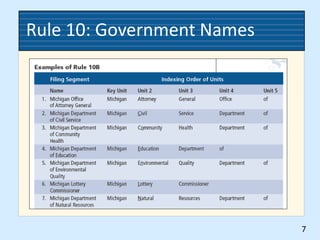
• For state government names
– The name of the state or province is the first unit
– The most distinctive part of the name comes next
(examples: attorney general, environmental quality)
– The type of office comes next (examples: office of,
department of)
– “Of” is not added to a name
6
Rule 10: Government Names
7
Rule 10: Government Names
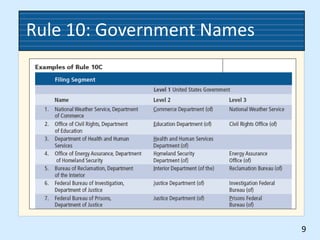
• For federal government names
– Use three indexing levels rather than units
– United States Government is the first level
– The name of a department or top-level agency is the
second level
– A distinctive name is the third level (examples: national
weather service, civil rights office)
– “Of” and “the” are not considered but may be included
for clarity
8
Rule 10: Government Names
9
Rule 10: Government Names
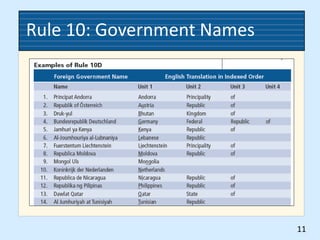
• For foreign government names
– Index the name as translated to English
– Use the most distinctive part of country name as the
first unit
– Index the balance of country name
– Index distinctive names for branches, departments, or
offices next
10
Rule 10: Government Names
11
Cross-Reference Examples
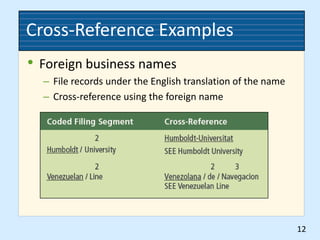
• Foreign business names
– File records under the English translation of the name
– Cross-reference using the foreign name
12
Cross-Reference Examples
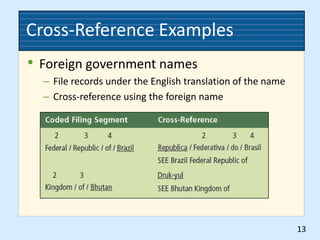
• Foreign government names
– File records under the English translation of the name
– Cross-reference using the foreign name
13
Subject Titles
• Subject titles may be used in an alphabetic
name file
– Applications
– Bids or project names
– Special promotions or celebrations
• The subject title is the key unit
• Subject subdivisions are indexed next
• The correspondent’s name is indexed next
14
Subject Titles
15

Ch04 records management

  • 1.
    RECORDS MANAGEMENT Judith Readand Mary Lea Ginn Chapter 4 Alphabetic Indexing Rules 9-10 Copyright 2011 South-Western, Cengage Learning
  • 2.
    Rule 9: IdenticalNames • For identical names, sort records by – City names first – State or province names second – Street names third – House or building numbers fourth 2
  • 3.
  • 4.
    Rule 10: GovernmentNames • For local and regional government names – The name of the county, city, town, or village is the first unit – The most distinctive part of the name comes next (examples: public library, fitness center, water works) – The type of office comes next (examples: county of, city of, department of, office of) – “Of” is not added to a name 4
  • 5.
  • 6.
    Rule 10: GovernmentNames • For state government names – The name of the state or province is the first unit – The most distinctive part of the name comes next (examples: attorney general, environmental quality) – The type of office comes next (examples: office of, department of) – “Of” is not added to a name 6
  • 7.
  • 8.
    Rule 10: GovernmentNames • For federal government names – Use three indexing levels rather than units – United States Government is the first level – The name of a department or top-level agency is the second level – A distinctive name is the third level (examples: national weather service, civil rights office) – “Of” and “the” are not considered but may be included for clarity 8
  • 9.
  • 10.
    Rule 10: GovernmentNames • For foreign government names – Index the name as translated to English – Use the most distinctive part of country name as the first unit – Index the balance of country name – Index distinctive names for branches, departments, or offices next 10
  • 11.
  • 12.
    Cross-Reference Examples • Foreignbusiness names – File records under the English translation of the name – Cross-reference using the foreign name 12
  • 13.
    Cross-Reference Examples • Foreigngovernment names – File records under the English translation of the name – Cross-reference using the foreign name 13
  • 14.
    Subject Titles • Subjecttitles may be used in an alphabetic name file – Applications – Bids or project names – Special promotions or celebrations • The subject title is the key unit • Subject subdivisions are indexed next • The correspondent’s name is indexed next 14
  • 15.