Numeric Records Management Any classification system for arranging records that is based on numbers: Consecutive numbering Nonconsecutive numbering Numeric coding used in combination with geographic or subject filing
Consecutive Numbering Method Consecutively numbered records are arranged in ascending   number order—from the lowest number to the highest number.
Consecutive Numbering Components Numbered file Alphabetic file Accession log Alphabetic index
Consecutive Numbering Supplies Numbered guides and folders for the numeric file Alphabetic guides and folders for the general alphabetic file Database software (or a lined book) for an accession log Database or word processing software for an alphabetic index
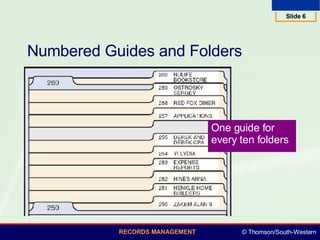
Numbered Guides and Folders One guide for every ten folders
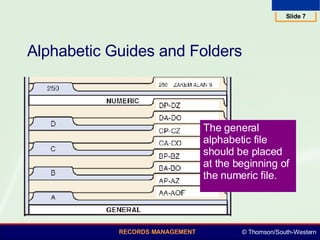
Alphabetic Guides and Folders The general alphabetic file should be placed at the beginning of the numeric file.
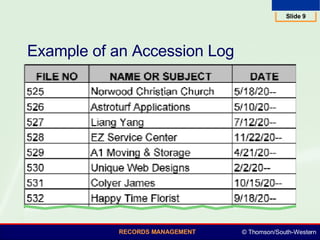
Accession Log An  accession log  is a serial list of numbers assigned to records in a numeric storage system.
Example of an Accession Log
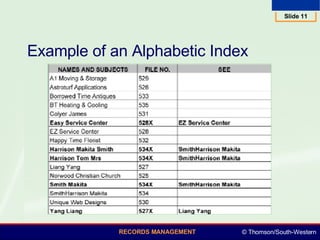
Alphabetic Index An  alphabetic index  is a reference to a numeric file that is used when the name or subject is known but not the assigned number.
Example of an Alphabetic Index
Steps for Coding Records Coding Sorting Number coding
Coding Code the filing segment Write an X in the margin beside cross-reference names or subjects Underline the cross-reference with a wavy line
Sorting Sort records that do not have preprinted numbers alphabetically before referencing the alphabetic index
Number Coding Consult the alphabetic index Write the assigned file code or a G in upper right corner of record Assign next available number, if one has not been assigned, or a G Enter new file code number into accession log Write code number or a G in upper right corner of record
Advantages of  Consecutive Numbering Rapid re-filing Easy and unlimited expansion  Easy transfer of inactive records Cross-references are in general file Built-in security Same numeric code for all records for one customer Labeling takes less time Easy detection of misfiled records
Disadvantages of  Consecutive Numbering Requires reference to alphabetic index Requires more guides More time-consuming Congestion Numbers can be easily transposed
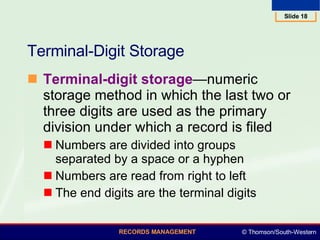
Terminal-Digit Storage Terminal-digit storage —numeric storage method in which the last two or three digits are used as the primary division under which a record is filed Numbers are divided into groups separated by a space or a hyphen Numbers are read from right to left The end digits are the terminal digits
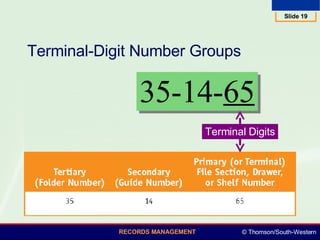
Terminal-Digit Number Groups 35-14- 65 Terminal Digits
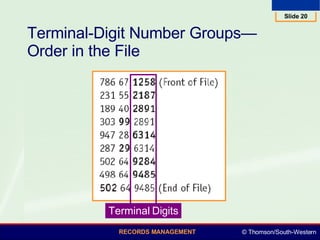
Terminal-Digit Number Groups—Order in the File Terminal Digits
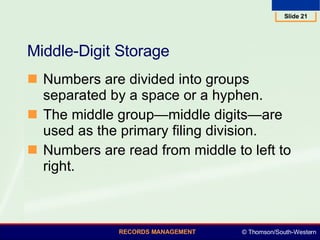
Middle-Digit Storage Numbers are divided into groups separated by a space or a hyphen. The middle group—middle digits—are used as the primary filing division. Numbers are read from middle to left to right.
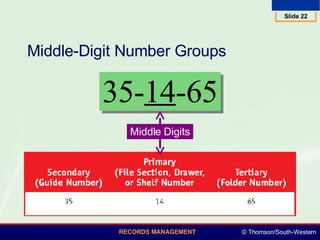
Middle-Digit Number Groups 35- 14 -65 Middle Digits
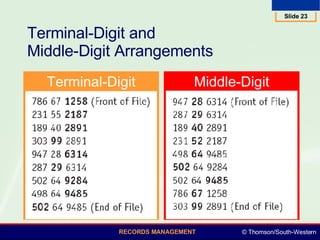
Terminal-Digit and  Middle-Digit Arrangements Terminal-Digit Middle-Digit
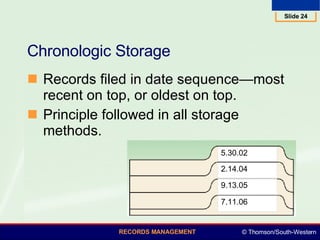
Chronologic Storage Records filed in date sequence—most recent on top, or oldest on top. Principle followed in all storage methods. 5.30.02 2.14.04 9.13.05 7.11.06
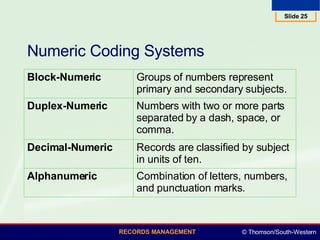
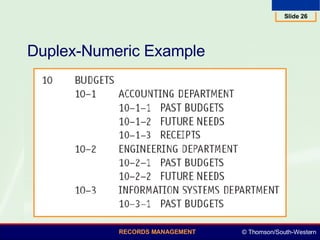
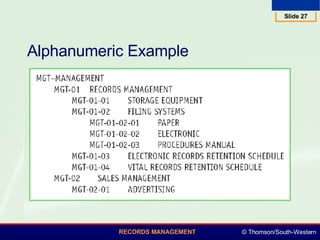
Numeric Coding Systems Combination of letters, numbers, and punctuation marks. Alphanumeric Records are classified by subject in units of ten. Decimal-Numeric Numbers with two or more parts separated by a dash, space, or comma. Duplex-Numeric Groups of numbers represent primary and secondary subjects. Block-Numeric
Duplex-Numeric Example
Alphanumeric Example
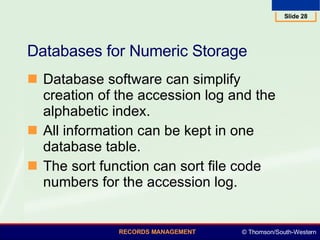
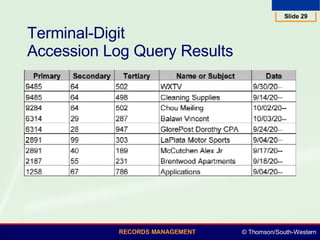
Databases for Numeric Storage Database software can simplify creation of the accession log and the alphabetic index. All information can be kept in one database table. The sort function can sort file code numbers for the accession log.
Terminal-Digit  Accession Log Query Results

baim_ch09

  • 1.
  • 2.
    Numeric Records ManagementAny classification system for arranging records that is based on numbers: Consecutive numbering Nonconsecutive numbering Numeric coding used in combination with geographic or subject filing
  • 3.
    Consecutive Numbering MethodConsecutively numbered records are arranged in ascending number order—from the lowest number to the highest number.
  • 4.
    Consecutive Numbering ComponentsNumbered file Alphabetic file Accession log Alphabetic index
  • 5.
    Consecutive Numbering SuppliesNumbered guides and folders for the numeric file Alphabetic guides and folders for the general alphabetic file Database software (or a lined book) for an accession log Database or word processing software for an alphabetic index
  • 6.
    Numbered Guides andFolders One guide for every ten folders
  • 7.
    Alphabetic Guides andFolders The general alphabetic file should be placed at the beginning of the numeric file.
  • 8.
    Accession Log An accession log is a serial list of numbers assigned to records in a numeric storage system.
  • 9.
    Example of anAccession Log
  • 10.
    Alphabetic Index An alphabetic index is a reference to a numeric file that is used when the name or subject is known but not the assigned number.
  • 11.
    Example of anAlphabetic Index
  • 12.
    Steps for CodingRecords Coding Sorting Number coding
  • 13.
    Coding Code thefiling segment Write an X in the margin beside cross-reference names or subjects Underline the cross-reference with a wavy line
  • 14.
    Sorting Sort recordsthat do not have preprinted numbers alphabetically before referencing the alphabetic index
  • 15.
    Number Coding Consultthe alphabetic index Write the assigned file code or a G in upper right corner of record Assign next available number, if one has not been assigned, or a G Enter new file code number into accession log Write code number or a G in upper right corner of record
  • 16.
    Advantages of Consecutive Numbering Rapid re-filing Easy and unlimited expansion Easy transfer of inactive records Cross-references are in general file Built-in security Same numeric code for all records for one customer Labeling takes less time Easy detection of misfiled records
  • 17.
    Disadvantages of Consecutive Numbering Requires reference to alphabetic index Requires more guides More time-consuming Congestion Numbers can be easily transposed
  • 18.
    Terminal-Digit Storage Terminal-digitstorage —numeric storage method in which the last two or three digits are used as the primary division under which a record is filed Numbers are divided into groups separated by a space or a hyphen Numbers are read from right to left The end digits are the terminal digits
  • 19.
    Terminal-Digit Number Groups35-14- 65 Terminal Digits
  • 20.
    Terminal-Digit Number Groups—Orderin the File Terminal Digits
  • 21.
    Middle-Digit Storage Numbersare divided into groups separated by a space or a hyphen. The middle group—middle digits—are used as the primary filing division. Numbers are read from middle to left to right.
  • 22.
    Middle-Digit Number Groups35- 14 -65 Middle Digits
  • 23.
    Terminal-Digit and Middle-Digit Arrangements Terminal-Digit Middle-Digit
  • 24.
    Chronologic Storage Recordsfiled in date sequence—most recent on top, or oldest on top. Principle followed in all storage methods. 5.30.02 2.14.04 9.13.05 7.11.06
  • 25.
    Numeric Coding SystemsCombination of letters, numbers, and punctuation marks. Alphanumeric Records are classified by subject in units of ten. Decimal-Numeric Numbers with two or more parts separated by a dash, space, or comma. Duplex-Numeric Groups of numbers represent primary and secondary subjects. Block-Numeric
  • 26.
  • 27.
  • 28.
    Databases for NumericStorage Database software can simplify creation of the accession log and the alphabetic index. All information can be kept in one database table. The sort function can sort file code numbers for the accession log.
  • 29.
    Terminal-Digit AccessionLog Query Results

Editor's Notes