1
RECORDS MANAGEMENT
Judith Read and Mary Lea Ginn
Chapter 2
The RIM Environment
2
Electronic Business Activities
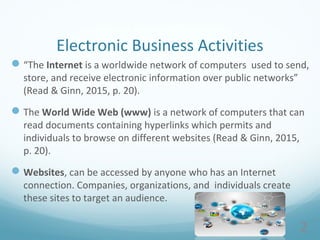
“The Internet is a worldwide network of computers used to send,
store, and receive electronic information over public networks”
(Read & Ginn, 2015, p. 20).
The World Wide Web (www) is a network of computers that can
read documents containing hyperlinks which permits and
individuals to browse on different websites (Read & Ginn, 2015,
p. 20).
Websites, can be accessed by anyone who has an Internet
connection. Companies, organizations, and individuals create
these sites to target an audience.
E-Commerce
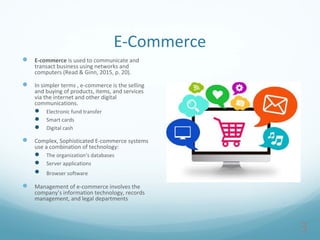
 E-commerce is used to communicate and
transact business using networks and
computers (Read & Ginn, 2015, p. 20).
 In simpler terms , e-commerce is the selling
and buying of products, items, and services
via the internet and other digital
communications.
 Electronic fund transfer
 Smart cards
 Digital cash
 Complex, Sophisticated E-commerce systems
use a combination of technology:
 The organization’s databases
 Server applications
 Browser software
 Management of e-commerce involves the
company’s information technology, records
management, and legal departments
3
Electronic Fund Transfer and
Data Interchange
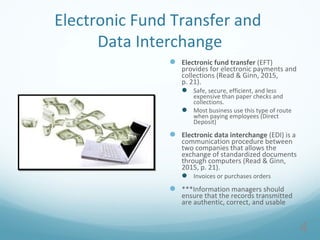
 Electronic fund transfer (EFT)
provides for electronic payments and
collections (Read & Ginn, 2015,
p. 21).
 Safe, secure, efficient, and less
expensive than paper checks and
collections.
 Most business use this type of route
when paying employees (Direct
Deposit)
 Electronic data interchange (EDI) is a
communication procedure between
two companies that allows the
exchange of standardized documents
through computers (Read & Ginn,
2015, p. 21).
 Invoices or purchases orders
 ***Information managers should
ensure that the records transmitted
are authentic, correct, and usable
4
5
Programs for Managing Records
Records management is not new, it has been taking place in
organizations over 50 years.
Tragedies and corporate scandals in recent years have
affected the profession of records and information
management.
Events have forced managers to reconsider how information
and records management processes should be updated and
improved
Information Governance
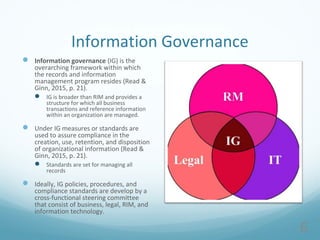
 Information governance (IG) is the
overarching framework within which
the records and information
management program resides (Read &
Ginn, 2015, p. 21).
 IG is broader than RIM and provides a
structure for which all business
transactions and reference information
within an organization are managed.
 Under IG measures or standards are
used to assure compliance in the
creation, use, retention, and disposition
of organizational information (Read &
Ginn, 2015, p. 21).
 Standards are set for managing all
records
 Ideally, IG policies, procedures, and
compliance standards are develop by a
cross-functional steering committee
that consist of business, legal, RIM, and
information technology.
6
Generally Accepted
Recordkeeping Principles
 ARMA’s Generally Accepted
RecordKeeping Principles® (“The
Principles”) were developed and
published through ARMA
International (not-for-profit
professional association and the
authority on information
governance programs).
 The Principles foster general
awareness of information
governance standards and
principles
 They are comprehensive in scope
but general in nature
 They are intended to set forth
the characteristics of an effective
information governance program
7
8
Records Program Management
Guidelines
 Records and information management (RIM) programs should have
common features
 Adherence to the ARMA Principles
 A legally defensible retention schedule to reduce risk and legal liability
 Efficient procedures for managing each stage in the records life cycle
 A well-trained staff
 The RIM system may be centralized where the records are physically
located and controlled in an area.
 Or the RIM system may be decentralized where the records are
physically located in the departments where they care made and
utilized.
 Each plan has it advantages and disadvantages that supervisors should
take into consideration before adopting a method of choice.
Electronic Records Management
Tools
Several terms relate to processes, policies, and procedures
for managing electronic records
“Enterprise content management (ECM) is the strategies,
methods, and tools, used to capture, manage, store preserve,
and deliver content and documents related to organizational
processes” (Read & Ginn, 2015, p. 24).
Electronic document records management (EDRMS)
“Association for Information and Image Management (AIIM)
is a global, non-profit organization that provides independent
research, education, certification programs, to information
professionals” (Read & Ginn, 2015, p. 23).
The value of ECM includes technology and the activities that
involve people and processes.
9
Common Records System
Problems and Challenges
 A records system is a bundled of
interrelated resources, such as
people, equipment, supplies,
space, procedures, and information
that act together though a plan to
achieve goals of the RIM program
(Read & Ginn, 2015, p. 25).
 It is important to know that
anything that hinders the
processes of these resources
creates a complication in the
records system.
10
11
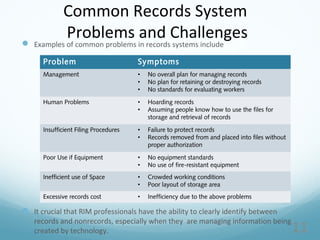
 Examples of common problems in records systems include
 It crucial that RIM professionals have the ability to clearly identify between
records and nonrecords, especially when they are managing information being
created by technology.
Common Records System
Problems and Challenges
Problem Symptoms
Management • No overall plan for managing records
• No plan for retaining or destroying records
• No standards for evaluating workers
Human Problems • Hoarding records
• Assuming people know how to use the files for
storage and retrieval of records
Insufficient Filing Procedures • Failure to protect records
• Records removed from and placed into files without
proper authorization
Poor Use if Equipment • No equipment standards
• No use of fire-resistant equipment
Inefficient use of Space • Crowded working conditions
• Poor layout of storage area
Excessive records cost • Inefficiency due to the above problems
Legal Considerations
for Records Management
 As records continue to
increase so does legislation to
help keep privacy and security
of citizens.
 There are laws and
regulations that are in place
 Health Insurance
Portability and
Accountability Act (HIPAA)
Privacy Rule, 2001
 Patriot Act, 2001
 Records managers must be
continually willing to adapt
and meet these challenges.
12
Legal Considerations
for Records Management Continued
 Managers must be certain that
their companies’ recordkeeping
systems are legally acceptable
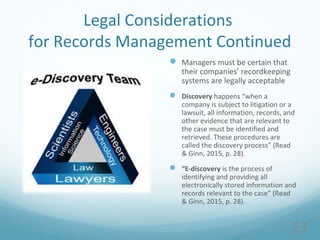
 Discovery happens “when a
company is subject to litigation or a
lawsuit, all information, records, and
other evidence that are relevant to
the case must be identified and
retrieved. These procedures are
called the discovery process” (Read
& Ginn, 2015, p. 28).
 “E-discovery is the process of
identifying and providing all
electronically stored information and
records relevant to the case” (Read
& Ginn, 2015, p. 28).
13
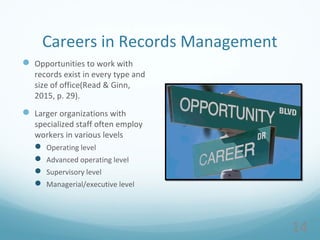
Careers in Records Management
 Opportunities to work with
records exist in every type and
size of office(Read & Ginn,
2015, p. 29).
 Larger organizations with
specialized staff often employ
workers in various levels
 Operating level
 Advanced operating level
 Supervisory level
 Managerial/executive level
14
Career Resources and Professional
Organizations
Institute of Certified Records Managers (ICRM)
ARMA International
Occupational Outlook Handbook
O*NET, the Occupational Information Network
Association for Information and Image Management (AIIM)
American Health Information Management Association
(AHIMA)
15
References
Read, J., & Ginn, M. L. (2015). THE RIM
Environment. In Records management (10th ed.).
Boston, MA: Cengage Learning.
16

rm, 10e ch02 copy

  • 1.
    1 RECORDS MANAGEMENT Judith Readand Mary Lea Ginn Chapter 2 The RIM Environment
  • 2.
    2 Electronic Business Activities “TheInternet is a worldwide network of computers used to send, store, and receive electronic information over public networks” (Read & Ginn, 2015, p. 20). The World Wide Web (www) is a network of computers that can read documents containing hyperlinks which permits and individuals to browse on different websites (Read & Ginn, 2015, p. 20). Websites, can be accessed by anyone who has an Internet connection. Companies, organizations, and individuals create these sites to target an audience.
  • 3.
    E-Commerce  E-commerce isused to communicate and transact business using networks and computers (Read & Ginn, 2015, p. 20).  In simpler terms , e-commerce is the selling and buying of products, items, and services via the internet and other digital communications.  Electronic fund transfer  Smart cards  Digital cash  Complex, Sophisticated E-commerce systems use a combination of technology:  The organization’s databases  Server applications  Browser software  Management of e-commerce involves the company’s information technology, records management, and legal departments 3
  • 4.
    Electronic Fund Transferand Data Interchange  Electronic fund transfer (EFT) provides for electronic payments and collections (Read & Ginn, 2015, p. 21).  Safe, secure, efficient, and less expensive than paper checks and collections.  Most business use this type of route when paying employees (Direct Deposit)  Electronic data interchange (EDI) is a communication procedure between two companies that allows the exchange of standardized documents through computers (Read & Ginn, 2015, p. 21).  Invoices or purchases orders  ***Information managers should ensure that the records transmitted are authentic, correct, and usable 4
  • 5.
    5 Programs for ManagingRecords Records management is not new, it has been taking place in organizations over 50 years. Tragedies and corporate scandals in recent years have affected the profession of records and information management. Events have forced managers to reconsider how information and records management processes should be updated and improved
  • 6.
    Information Governance  Informationgovernance (IG) is the overarching framework within which the records and information management program resides (Read & Ginn, 2015, p. 21).  IG is broader than RIM and provides a structure for which all business transactions and reference information within an organization are managed.  Under IG measures or standards are used to assure compliance in the creation, use, retention, and disposition of organizational information (Read & Ginn, 2015, p. 21).  Standards are set for managing all records  Ideally, IG policies, procedures, and compliance standards are develop by a cross-functional steering committee that consist of business, legal, RIM, and information technology. 6
  • 7.
    Generally Accepted Recordkeeping Principles ARMA’s Generally Accepted RecordKeeping Principles® (“The Principles”) were developed and published through ARMA International (not-for-profit professional association and the authority on information governance programs).  The Principles foster general awareness of information governance standards and principles  They are comprehensive in scope but general in nature  They are intended to set forth the characteristics of an effective information governance program 7
  • 8.
    8 Records Program Management Guidelines Records and information management (RIM) programs should have common features  Adherence to the ARMA Principles  A legally defensible retention schedule to reduce risk and legal liability  Efficient procedures for managing each stage in the records life cycle  A well-trained staff  The RIM system may be centralized where the records are physically located and controlled in an area.  Or the RIM system may be decentralized where the records are physically located in the departments where they care made and utilized.  Each plan has it advantages and disadvantages that supervisors should take into consideration before adopting a method of choice.
  • 9.
    Electronic Records Management Tools Severalterms relate to processes, policies, and procedures for managing electronic records “Enterprise content management (ECM) is the strategies, methods, and tools, used to capture, manage, store preserve, and deliver content and documents related to organizational processes” (Read & Ginn, 2015, p. 24). Electronic document records management (EDRMS) “Association for Information and Image Management (AIIM) is a global, non-profit organization that provides independent research, education, certification programs, to information professionals” (Read & Ginn, 2015, p. 23). The value of ECM includes technology and the activities that involve people and processes. 9
  • 10.
    Common Records System Problemsand Challenges  A records system is a bundled of interrelated resources, such as people, equipment, supplies, space, procedures, and information that act together though a plan to achieve goals of the RIM program (Read & Ginn, 2015, p. 25).  It is important to know that anything that hinders the processes of these resources creates a complication in the records system. 10
  • 11.
    11  Examples ofcommon problems in records systems include  It crucial that RIM professionals have the ability to clearly identify between records and nonrecords, especially when they are managing information being created by technology. Common Records System Problems and Challenges Problem Symptoms Management • No overall plan for managing records • No plan for retaining or destroying records • No standards for evaluating workers Human Problems • Hoarding records • Assuming people know how to use the files for storage and retrieval of records Insufficient Filing Procedures • Failure to protect records • Records removed from and placed into files without proper authorization Poor Use if Equipment • No equipment standards • No use of fire-resistant equipment Inefficient use of Space • Crowded working conditions • Poor layout of storage area Excessive records cost • Inefficiency due to the above problems
  • 12.
    Legal Considerations for RecordsManagement  As records continue to increase so does legislation to help keep privacy and security of citizens.  There are laws and regulations that are in place  Health Insurance Portability and Accountability Act (HIPAA) Privacy Rule, 2001  Patriot Act, 2001  Records managers must be continually willing to adapt and meet these challenges. 12
  • 13.
    Legal Considerations for RecordsManagement Continued  Managers must be certain that their companies’ recordkeeping systems are legally acceptable  Discovery happens “when a company is subject to litigation or a lawsuit, all information, records, and other evidence that are relevant to the case must be identified and retrieved. These procedures are called the discovery process” (Read & Ginn, 2015, p. 28).  “E-discovery is the process of identifying and providing all electronically stored information and records relevant to the case” (Read & Ginn, 2015, p. 28). 13
  • 14.
    Careers in RecordsManagement  Opportunities to work with records exist in every type and size of office(Read & Ginn, 2015, p. 29).  Larger organizations with specialized staff often employ workers in various levels  Operating level  Advanced operating level  Supervisory level  Managerial/executive level 14
  • 15.
    Career Resources andProfessional Organizations Institute of Certified Records Managers (ICRM) ARMA International Occupational Outlook Handbook O*NET, the Occupational Information Network Association for Information and Image Management (AIIM) American Health Information Management Association (AHIMA) 15
  • 16.
    References Read, J., & Ginn, M. L.(2015). THE RIM Environment. In Records management (10th ed.). Boston, MA: Cengage Learning. 16