MLIS 108
Archives and
Records
Management
Lesson 3
• Records Life Cycle
2
Learning Objectives
At the end of the lesson, we will be able to:
➜ understand and articulate the phases and
processed of the records life cycle.
3
Takeaways from Lesson 2
What are Documents
➜ written policies, process
descriptions, procedures,
blank forms
➜ a work in progress and
can still be added to,
edited and updated
➜ change is possible so
documents don’t
necessarily adhere to
specific regulations
4
What are records
➜ information captured on
worksheets, forms, charts,
and other forms of media
➜ final and official
➜ cannot be edited and
recreated
➜ requires backup system
and stored for security
5
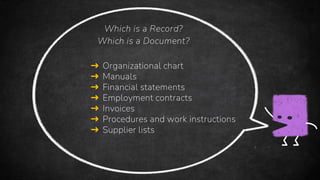
➜ Organizational chart
➜ Manuals
➜ Financial statements
➜ Employment contracts
➜ Invoices
➜ Procedures and work instructions
➜ Supplier lists
Which is a Record?
Which is a Document?
6
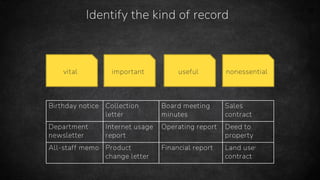
Identify the kind of record
Birthday notice Collection
letter
Board meeting
minutes
Sales
contract
Department
newsletter
Internet usage
report
Operating report Deed to
property
All-staff memo Product
change letter
Financial report Land use
contract
nonessential
useful
important
vital
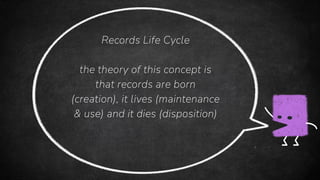
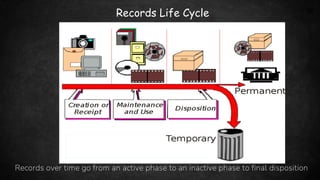
Records Life Cycle
the theory of this concept is
that records are born
(creation), it lives (maintenance
& use) and it dies (disposition)
8
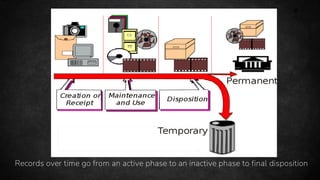
Records over time go from an active phase to an inactive phase to final disposition
9
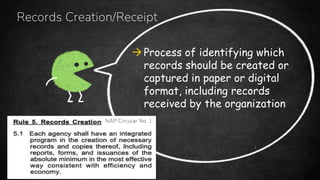
Records Creation/Receipt
Process of identifying which
records should be created or
captured in paper or digital
format, including records
received by the organization
NAP Circular No. 1
What makes a record
 it is the CONTENT and FUNCTION
that determines a record –
regardless of format or technology
used to create or capture it or where
it is located
• paper, carved on a rock, written on a
cocktail napkin, in an electronic device,
or whatever media contains the
information.
who captures record
EVERYONE
 Heads
 Administrators
 Staff/Personnel
 Other stakeholders
why capture/create a record
➜ “Information created,
received, and
maintained as evidence
and information by an
organization or person,
in pursuance of legal
obligations or in
transaction of
business.”
ISO 15489
➜ Provide enduring
value
➜ Evidence
➜ Basis for decision-
making
➜ Business continuity
➜ Transparency &
accountability
➜ Management of data
& information
which records to capture
➜ record captured must
contain complete
content, structural &
contextual information
➜ authentic
➜ be meaningful &
understood
➜ secure
➜ accessible
➜ any record that
documents a decision,
action taken, or any
recommendations
advice or instruction
given
➜ Any records that meet
are created, received or
kept to meet
- legal requirements
- organization
expectations
- business requirements
the cost & risk to the
organization if it does not
have those records
14
when to capture records
 when they are created – to reduce
risk of them being missed or lost
 new process or procedure
 any change to an existing process
or procedure
 but may have to wait to capture
others
 if original not available, capture a
copy on a backup or in an archive
15
after capture – registration
 provides evidence that a record is
created or captured in a records
system
 involves recording brief descriptive
information about the record in a
register or logbook or registration
system, and assigning the record a
unique identifier
R.A. 9470, Art. 3, Sec. 14
tracking system
 involves recording
brief descriptive
process of
documenting the
movements and use
of records so that
their whereabouts are
known at all times
 monitors physical
movement of records,
control the issue of
records and
document their
transfer between
offices or persons and
their return to storage
 periodic review to
identify any missing
records
17
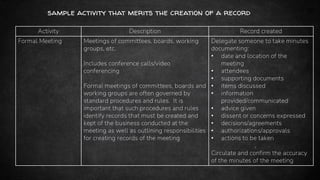
Activity Description Record created
Formal Meeting Meetings of committees, boards, working
groups, etc.
Includes conference calls/video
conferencing
Formal meetings of committees, boards and
working groups are often governed by
standard procedures and rules. It is
important that such procedures and rules
identify records that must be created and
kept of the business conducted at the
meeting as well as outlining responsibilities
for creating records of the meeting
Delegate someone to take minutes
documenting:
• date and location of the
meeting
• attendees
• supporting documents
• items discussed
• information
provided/communicated
• advice given
• dissent or concerns expressed
• decisions/agreements
• authorizations/approvals
• actions to be taken
Circulate and confirm the accuracy
of the minutes of the meeting
sample activity that merits the creation of a record
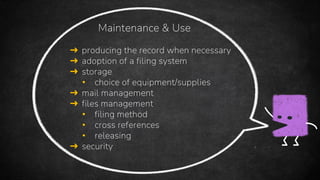
➜ producing the record when necessary
➜ adoption of a filing system
➜ storage
• choice of equipment/supplies
➜ mail management
➜ files management
• filing method
• cross references
• releasing
➜ security
Maintenance & Use
19
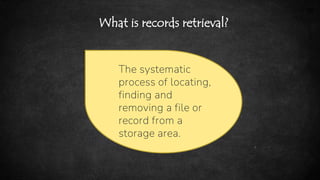
The systematic
process of locating,
finding and
removing a file or
record from a
storage area.
What is records retrieval?
20
21
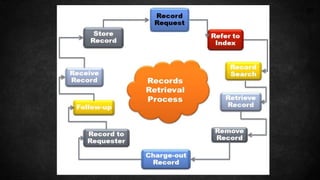
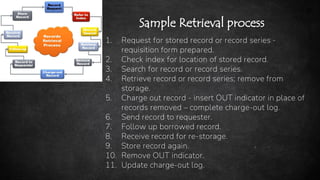
1. Request for stored record or record series -
requisition form prepared.
2. Check index for location of stored record.
3. Search for record or record series.
4. Retrieve record or record series; remove from
storage.
5. Charge out record - insert OUT indicator in place of
records removed – complete charge-out log.
6. Send record to requester.
7. Follow up borrowed record.
8. Receive record for re-storage.
9. Store record again.
10. Remove OUT indicator.
11. Update charge-out log.
Sample Retrieval process
22
Filing System
 Filing should be interesting and attractive
 Offer quick and easy filing and retrieval information
 Ensure integrity and continuity of record keeping despite
changes in office personnel
 Have uniform practices
 Allow for easy identification and disposition of inactive
records
 Clear and simple filing categories
 Expandable and flexible enough to meet everyone’s
needs
23
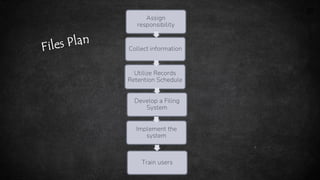
Collect information
Utilize Records
Retention Schedule
Assign
responsibility
Develop a Filing
System
Implement the
system
Train users
➜ Centralization or Decentralization
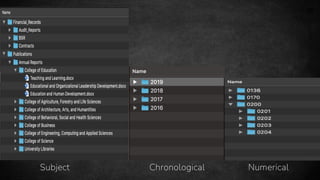
➜ Subject
➜ Chronological
➜ numerical
Arrangement
25
Subject Chronological Numerical
26
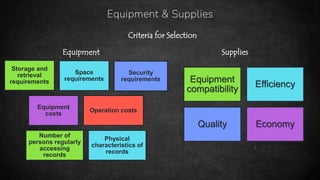
Equipment & Supplies
Storage and
retrieval
requirements
Space
requirements
Security
requirements
Equipment
costs
Operation costs
Number of
persons regularly
accessing
records
Physical
characteristics of
records
Equipment
compatibility
Efficiency
Quality Economy
Criteria for Selection
Equipment Supplies
27
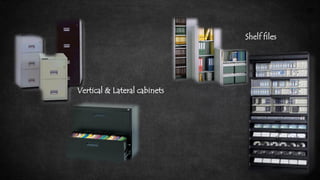
Vertical & Lateral cabinets
Shelf files
28
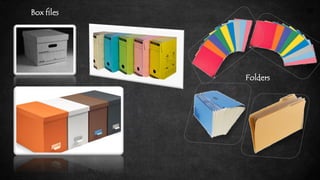
Box files
Folders
29
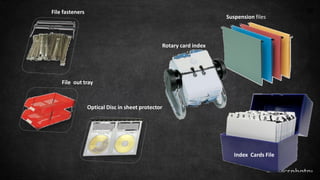
Suspension files
Optical Disc in sheet protector
File out tray
File fasteners
Index Cards File
Rotary card index
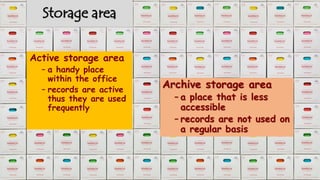
Storage area
Active storage area
– a handy place
within the office
– records are active
thus they are used
frequently
Archive storage area
– a place that is less
accessible
– records are not used on
a regular basis
31
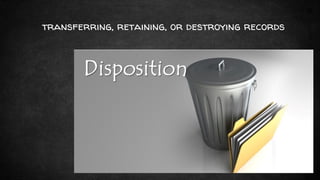
transferring, retaining, or destroying records
Disposition
 final phase of
record life cycle
 final destination of
records after the
end of their
retention period in
active and/or
inactive storage
 disposal refers to the
act of selling, burying
or any way of
discarding valueless
records in accordance
with the provision of
RA 9470
 based on Retention
Policy
 certificate of
completion required
for any disposal
33
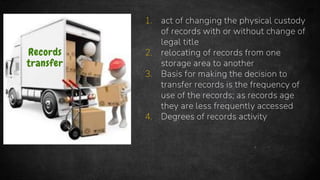
Records
transfer
1. act of changing the physical custody
of records with or without change of
legal title
2. relocating of records from one
storage area to another
3. Basis for making the decision to
transfer records is the frequency of
use of the records; as records age
they are less frequently accessed
4. Degrees of records activity
34
Disposition
 No more active records storage
space available
 Costs of more storage
equipment and extra office
space is increasing Degrees of
records activity
 Stored records no longer
requested
 Workloads have been
lightened and time is
available for the records
transfer activity
 Established organizational
policy required every
department to transfer
records at stated time
4 important questions to answer in Transfer of Records
1. WHAT records are to be moved?
2. HOW are the records to be
prepared for transfer?
3. WHEN are the records to be
transferred?
4. WHERE at the transferred records
to be stored?
Transfer methods
Perpetual Transfer method
 Records continually
transferred from active
storage to inactive
storage whenever
records are no longer
needed for reference
Examples: student records
after graduation; legal cases
that are settled; research
projects when results are
finalized
Periodic Transfer method
 Active records are
transferred at the end of
a stated period of time,
usually one year, to
inactive storage
 Completed on a
scheduled bases from
active storage to inactive
storage whenever
records are no longer
needed for reference
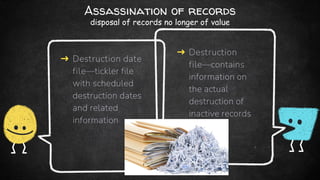
Assassination of records
disposal of records no longer of value
➜ Destruction date
file—tickler file
with scheduled
destruction dates
and related
information
➜ Destruction
file—contains
information on
the actual
destruction of
inactive records
38
Records over time go from an active phase to an inactive phase to final disposition
Records Life Cycle

MLIS 108_Lesson 3_Records life cycle.pdf

  • 1.
  • 2.
  • 3.
    Learning Objectives At theend of the lesson, we will be able to: ➜ understand and articulate the phases and processed of the records life cycle. 3
  • 4.
    Takeaways from Lesson2 What are Documents ➜ written policies, process descriptions, procedures, blank forms ➜ a work in progress and can still be added to, edited and updated ➜ change is possible so documents don’t necessarily adhere to specific regulations 4 What are records ➜ information captured on worksheets, forms, charts, and other forms of media ➜ final and official ➜ cannot be edited and recreated ➜ requires backup system and stored for security
  • 5.
    5 ➜ Organizational chart ➜Manuals ➜ Financial statements ➜ Employment contracts ➜ Invoices ➜ Procedures and work instructions ➜ Supplier lists Which is a Record? Which is a Document?
  • 6.
    6 Identify the kindof record Birthday notice Collection letter Board meeting minutes Sales contract Department newsletter Internet usage report Operating report Deed to property All-staff memo Product change letter Financial report Land use contract nonessential useful important vital
  • 7.
    Records Life Cycle thetheory of this concept is that records are born (creation), it lives (maintenance & use) and it dies (disposition)
  • 8.
    8 Records over timego from an active phase to an inactive phase to final disposition
  • 9.
    9 Records Creation/Receipt Process ofidentifying which records should be created or captured in paper or digital format, including records received by the organization NAP Circular No. 1
  • 10.
    What makes arecord  it is the CONTENT and FUNCTION that determines a record – regardless of format or technology used to create or capture it or where it is located • paper, carved on a rock, written on a cocktail napkin, in an electronic device, or whatever media contains the information.
  • 11.
    who captures record EVERYONE Heads  Administrators  Staff/Personnel  Other stakeholders
  • 12.
    why capture/create arecord ➜ “Information created, received, and maintained as evidence and information by an organization or person, in pursuance of legal obligations or in transaction of business.” ISO 15489 ➜ Provide enduring value ➜ Evidence ➜ Basis for decision- making ➜ Business continuity ➜ Transparency & accountability ➜ Management of data & information
  • 13.
    which records tocapture ➜ record captured must contain complete content, structural & contextual information ➜ authentic ➜ be meaningful & understood ➜ secure ➜ accessible ➜ any record that documents a decision, action taken, or any recommendations advice or instruction given ➜ Any records that meet are created, received or kept to meet - legal requirements - organization expectations - business requirements the cost & risk to the organization if it does not have those records
  • 14.
    14 when to capturerecords  when they are created – to reduce risk of them being missed or lost  new process or procedure  any change to an existing process or procedure  but may have to wait to capture others  if original not available, capture a copy on a backup or in an archive
  • 15.
    15 after capture –registration  provides evidence that a record is created or captured in a records system  involves recording brief descriptive information about the record in a register or logbook or registration system, and assigning the record a unique identifier R.A. 9470, Art. 3, Sec. 14
  • 16.
    tracking system  involvesrecording brief descriptive process of documenting the movements and use of records so that their whereabouts are known at all times  monitors physical movement of records, control the issue of records and document their transfer between offices or persons and their return to storage  periodic review to identify any missing records
  • 17.
    17 Activity Description Recordcreated Formal Meeting Meetings of committees, boards, working groups, etc. Includes conference calls/video conferencing Formal meetings of committees, boards and working groups are often governed by standard procedures and rules. It is important that such procedures and rules identify records that must be created and kept of the business conducted at the meeting as well as outlining responsibilities for creating records of the meeting Delegate someone to take minutes documenting: • date and location of the meeting • attendees • supporting documents • items discussed • information provided/communicated • advice given • dissent or concerns expressed • decisions/agreements • authorizations/approvals • actions to be taken Circulate and confirm the accuracy of the minutes of the meeting sample activity that merits the creation of a record
  • 18.
    ➜ producing therecord when necessary ➜ adoption of a filing system ➜ storage • choice of equipment/supplies ➜ mail management ➜ files management • filing method • cross references • releasing ➜ security Maintenance & Use
  • 19.
    19 The systematic process oflocating, finding and removing a file or record from a storage area. What is records retrieval?
  • 20.
  • 21.
    21 1. Request forstored record or record series - requisition form prepared. 2. Check index for location of stored record. 3. Search for record or record series. 4. Retrieve record or record series; remove from storage. 5. Charge out record - insert OUT indicator in place of records removed – complete charge-out log. 6. Send record to requester. 7. Follow up borrowed record. 8. Receive record for re-storage. 9. Store record again. 10. Remove OUT indicator. 11. Update charge-out log. Sample Retrieval process
  • 22.
    22 Filing System  Filingshould be interesting and attractive  Offer quick and easy filing and retrieval information  Ensure integrity and continuity of record keeping despite changes in office personnel  Have uniform practices  Allow for easy identification and disposition of inactive records  Clear and simple filing categories  Expandable and flexible enough to meet everyone’s needs
  • 23.
    23 Collect information Utilize Records RetentionSchedule Assign responsibility Develop a Filing System Implement the system Train users
  • 24.
    ➜ Centralization orDecentralization ➜ Subject ➜ Chronological ➜ numerical Arrangement
  • 25.
  • 26.
    26 Equipment & Supplies Storageand retrieval requirements Space requirements Security requirements Equipment costs Operation costs Number of persons regularly accessing records Physical characteristics of records Equipment compatibility Efficiency Quality Economy Criteria for Selection Equipment Supplies
  • 27.
    27 Vertical & Lateralcabinets Shelf files
  • 28.
  • 29.
    29 Suspension files Optical Discin sheet protector File out tray File fasteners Index Cards File Rotary card index
  • 30.
    Storage area Active storagearea – a handy place within the office – records are active thus they are used frequently Archive storage area – a place that is less accessible – records are not used on a regular basis
  • 31.
  • 32.
    Disposition  final phaseof record life cycle  final destination of records after the end of their retention period in active and/or inactive storage  disposal refers to the act of selling, burying or any way of discarding valueless records in accordance with the provision of RA 9470  based on Retention Policy  certificate of completion required for any disposal
  • 33.
    33 Records transfer 1. act ofchanging the physical custody of records with or without change of legal title 2. relocating of records from one storage area to another 3. Basis for making the decision to transfer records is the frequency of use of the records; as records age they are less frequently accessed 4. Degrees of records activity
  • 34.
    34 Disposition  No moreactive records storage space available  Costs of more storage equipment and extra office space is increasing Degrees of records activity  Stored records no longer requested  Workloads have been lightened and time is available for the records transfer activity  Established organizational policy required every department to transfer records at stated time
  • 35.
    4 important questionsto answer in Transfer of Records 1. WHAT records are to be moved? 2. HOW are the records to be prepared for transfer? 3. WHEN are the records to be transferred? 4. WHERE at the transferred records to be stored?
  • 36.
    Transfer methods Perpetual Transfermethod  Records continually transferred from active storage to inactive storage whenever records are no longer needed for reference Examples: student records after graduation; legal cases that are settled; research projects when results are finalized Periodic Transfer method  Active records are transferred at the end of a stated period of time, usually one year, to inactive storage  Completed on a scheduled bases from active storage to inactive storage whenever records are no longer needed for reference
  • 37.
    Assassination of records disposalof records no longer of value ➜ Destruction date file—tickler file with scheduled destruction dates and related information ➜ Destruction file—contains information on the actual destruction of inactive records
  • 38.
    38 Records over timego from an active phase to an inactive phase to final disposition Records Life Cycle