Lecture Presentations by
Nicole Tunbridge and
Kathleen Fitzpatrick
Chapter 43
Animal
Transport
Systems
© 2018 Pearson Education Ltd.
Trading Places
 Every organism must exchange substances with its
environment
 Exchanges ultimately occur at the cellular level by
crossing the plasma membrane
 In unicellular organisms, these exchanges occur
directly with the environment
© 2018 Pearson Education Ltd.
 For most cells of multicellular organisms, direct
exchange with the environment is not possible
 Gills are an example of a specialized exchange
system in animals
 O2 diffuses from the water into blood vessels
 CO2 diffuses from blood into the water
 Internal transport and gas exchange are functionally
related in most animals
© 2018 Pearson Education Ltd.
Concept 43.1: Circulatory systems link
exchange surfaces with cells throughout
the body
 Small molecules can move between cells and
their surroundings by diffusion
 Diffusion is only efficient over small distances
because the time it takes to diffuse is proportional to
the square of the distance
© 2018 Pearson Education Ltd.
 In some animals, many or all cells are in direct
contact with the environment
 In most animals, cells exchange materials with the
environment via a fluid-filled circulatory system
© 2018 Pearson Education Ltd.
Gastrovascular Cavities
 Some animals lack a circulatory system
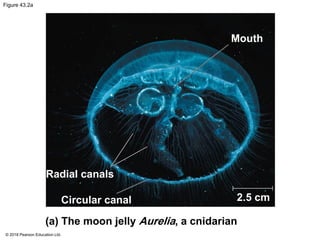
 Some cnidarians have elaborate gastrovascular
cavities that function in both digestion and
distribution of substances throughout the body
 The body wall that encloses the gastrovascular
cavity is only two cells thick
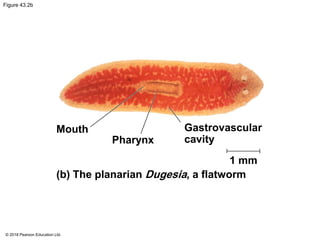
 Flatworms have a gastrovascular cavity and a flat
body that minimizes diffusion distances
© 2018 Pearson Education Ltd.
Figure 43.2a
Mouth
Radial canals
Circular canal 2.5 cm
(a) The moon jelly Aurelia, a cnidarian
© 2018 Pearson Education Ltd.
Figure 43.2b
Mouth
Pharynx
Gastrovascular
cavity
1 mm
(b) The planarian Dugesia, a flatworm
© 2018 Pearson Education Ltd.
Open and Closed Circulatory Systems
 A circulatory system has
 A circulatory fluid
 A set of interconnecting vessels
 A muscular pump, the heart
 The circulatory system connects the fluid that
surrounds cells with the organs that exchange
gases, absorb nutrients, and dispose of wastes
 Circulatory systems can be open or closed
© 2018 Pearson Education Ltd.
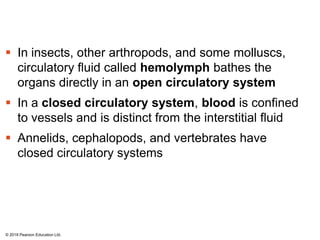
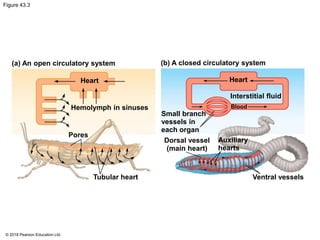
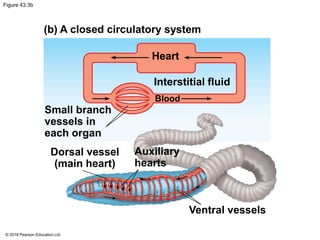
 In insects, other arthropods, and some molluscs,
circulatory fluid called hemolymph bathes the
organs directly in an open circulatory system
 In a closed circulatory system, blood is confined
to vessels and is distinct from the interstitial fluid
 Annelids, cephalopods, and vertebrates have
closed circulatory systems
© 2018 Pearson Education Ltd.
Figure 43.3
(a) An open circulatory system
Heart
(b) A closed circulatory system
Heart
Interstitial fluid
Hemolymph in sinuses
Pores
Small branch
vessels in
each organ
Dorsal vessel
(main heart)
Blood
Auxiliary
hearts
Tubular heart Ventral vessels
© 2018 Pearson Education Ltd.
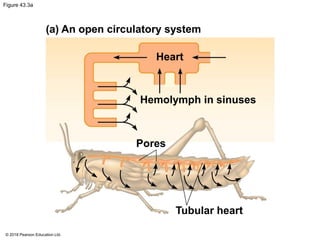
Figure 43.3a
(a) An open circulatory system
Heart
Hemolymph in sinuses
Pores
Tubular heart
© 2018 Pearson Education Ltd.
Figure 43.3b
(b) A closed circulatory system
Heart
Interstitial fluid
Small branch
vessels in
each organ
Dorsal vessel
(main heart)
Blood
Auxiliary
hearts
Ventral vessels
© 2018 Pearson Education Ltd.
Organization of Vertebrate Circulatory Systems
 Humans and other vertebrates have a closed
circulatory system called the cardiovascular
system
 The three main types of blood vessels are arteries,
veins, and capillaries
 Blood flow is one way in these vessels
© 2018 Pearson Education Ltd.
 Arteries branch into arterioles and carry blood
away from the heart to capillaries
 Networks of capillaries called capillary beds are the
sites of chemical exchange between the blood and
interstitial fluid
 Venules converge into veins and return blood from
capillaries to the heart
© 2018 Pearson Education Ltd.
 Arteries and veins are distinguished by the direction
of blood flow, not by O2 content
 Vertebrate hearts contain two or more chambers
 Blood enters through an atria and is pumped out
through ventricles
© 2018 Pearson Education Ltd.
Single Circulation
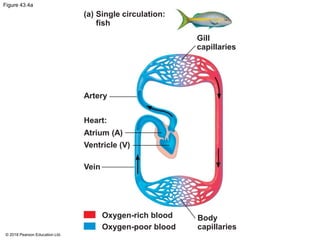
 Bony fishes, rays, and sharks have single circulation
with a two-chambered heart
 In single circulation, blood leaving the heart passes
through two capillary beds before returning
© 2018 Pearson Education Ltd.
Figure 43.4a
(a) Single circulation:
fish
Gill
capillaries
Artery
Heart:
Atrium (A)
Ventricle (V)
Vein
Oxygen-rich blood
Oxygen-poor blood
Body
capillaries
© 2018 Pearson Education Ltd.
Double Circulation
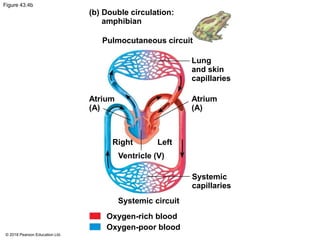
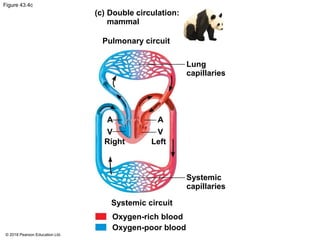
 Amphibians, reptiles, and mammals have double
circulation
 Oxygen-poor and oxygen-rich blood are pumped
separately from the right and left sides of the heart
© 2018 Pearson Education Ltd.
 In reptiles and mammals, oxygen-poor blood flows
through the pulmonary circuit to pick up oxygen
through the lungs
 In amphibians, oxygen-poor blood flows through a
pulmocutaneous circuit to pick up oxygen through
the lungs and skin
 Oxygen-rich blood delivers oxygen through the
systemic circuit
 Double circulation maintains higher blood pressure
in the organs than does single circulation
© 2018 Pearson Education Ltd.
Figure 43.4b
(b) Double circulation:
amphibian
Pulmocutaneous circuit
Lung
and skin
capillaries
Atrium
(A)
Atrium
(A)
Right Left
Ventricle (V)
Systemic
capillaries
Systemic circuit
Oxygen-rich blood
Oxygen-poor blood
© 2018 Pearson Education Ltd.
Figure 43.4c
(c) Double circulation:
mammal
Pulmonary circuit
Lung
capillaries
A
V
Right
A
V
Left
Systemic
capillaries
Systemic circuit
Oxygen-rich blood
Oxygen-poor blood
© 2018 Pearson Education Ltd.
Concept 43.2: Coordinated cycles of heart
contraction drive double circulation in
mammals
 The mammalian cardiovascular system meets the
body’s continuous demand for O2
© 2018 Pearson Education Ltd.
Mammalian Circulation
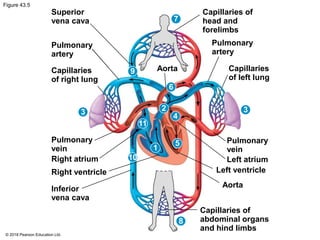
 Contraction of the right ventricle pumps blood to the
lungs via the pulmonary arteries
 The blood flows through capillary beds in the left and
right lungs and loads O2 and unloads CO2
 Oxygen-rich blood returns from the lungs via the
pulmonary veins to the left atrium of the heart
© 2018 Pearson Education Ltd.
 Oxygen-rich blood flows into the left ventricle and is
pumped out to body tissues via the systemic circuit
 Blood leaves the left ventricle via the aorta, which
conveys blood to arteries leading throughout the
body
 The first branches are the coronary arteries,
supplying the heart muscle
© 2018 Pearson Education Ltd.
 Further branches lead to capillary beds in the
abdominal organs and hind limbs
 O2 diffuses from blood to tissues, and CO2 diffuses
from tissues to blood
 Capillaries rejoin, forming venules, conveying blood
to veins
 Oxygen-poor blood from the head, neck, and
forelimbs is channeled into the superior vena cava
© 2018 Pearson Education Ltd.
 The inferior vena cava drains blood from the trunk
and hind limbs
 The two venae cavae empty their blood into the right
atrium from which the oxygen-poor blood flows into
the right ventricle
© 2018 Pearson Education Ltd.
Figure 43.5
Superior
vena cava
Pulmonary
artery
Capillaries
of right lung
Capillaries of
head and
forelimbs
Pulmonary
artery
Aorta Capillaries
of left lung
Pulmonary
vein
Right atrium
Right ventricle
Inferior
vena cava
Pulmonary
vein
Left atrium
Left ventricle
Aorta
Capillaries of
abdominal organs
and hind limbs
2
9
7
6
11
3
4
5
3
1
10
8
© 2018 Pearson Education Ltd.
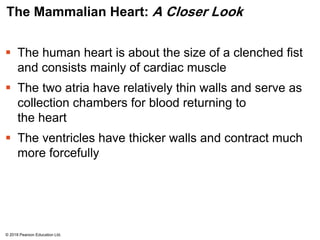
The Mammalian Heart: A Closer Look
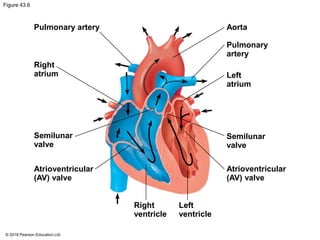
 The human heart is about the size of a clenched fist
and consists mainly of cardiac muscle
 The two atria have relatively thin walls and serve as
collection chambers for blood returning to
the heart
 The ventricles have thicker walls and contract much
more forcefully
© 2018 Pearson Education Ltd.
Figure 43.6
Pulmonary artery Aorta
Pulmonary
artery
Right
atrium Left
atrium
Semilunar
valve
Atrioventricular
(AV) valve
Right
ventricle
Left
ventricle
Semilunar
valve
Atrioventricular
(AV) valve
© 2018 Pearson Education Ltd.
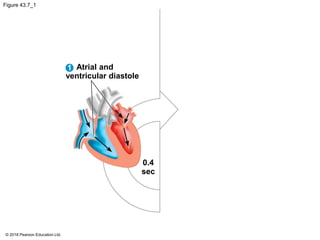
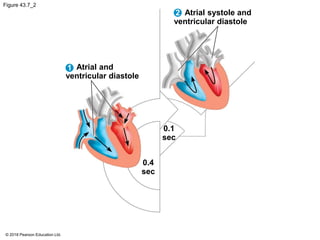
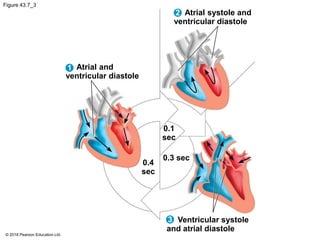
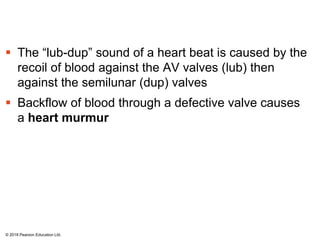
 The heart contracts and relaxes in a rhythmic cycle
called the cardiac cycle
 The contraction, or pumping, phase is called systole
 The relaxation, or filling, phase is called diastole
© 2018 Pearson Education Ltd.
Figure 43.7_1
Atrial and
ventricular diastole
0.4
sec
1
© 2018 Pearson Education Ltd.
Figure 43.7_2
Atrial systole and
ventricular diastole
Atrial and
ventricular diastole
0.1
sec
0.4
sec
1
2
© 2018 Pearson Education Ltd.
Figure 43.7_3
Atrial systole and
ventricular diastole
Atrial and
ventricular diastole
0.1
sec
0.4
sec
0.3 sec
Ventricular systole
and atrial diastole
3
1
2
© 2018 Pearson Education Ltd.
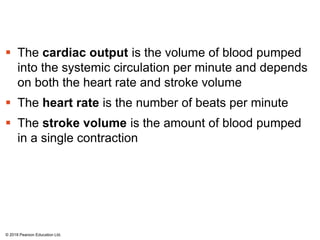
 The cardiac output is the volume of blood pumped
into the systemic circulation per minute and depends
on both the heart rate and stroke volume
 The heart rate is the number of beats per minute
 The stroke volume is the amount of blood pumped
in a single contraction
© 2018 Pearson Education Ltd.
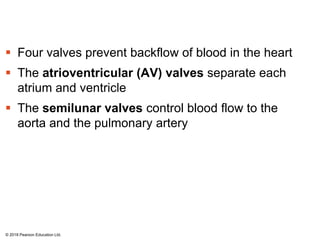
 Four valves prevent backflow of blood in the heart
 The atrioventricular (AV) valves separate each
atrium and ventricle
 The semilunar valves control blood flow to the
aorta and the pulmonary artery
© 2018 Pearson Education Ltd.
 The “lub-dup” sound of a heart beat is caused by the
recoil of blood against the AV valves (lub) then
against the semilunar (dup) valves
 Backflow of blood through a defective valve causes
a heart murmur
© 2018 Pearson Education Ltd.
Maintaining the Heart’s Rhythmic Beat
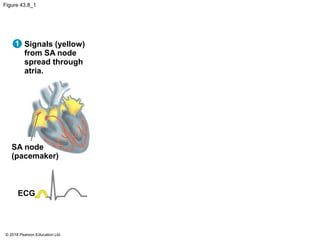
 Some cardiac muscle cells are autorhythmic,
meaning they contract without any signal from the
nervous system
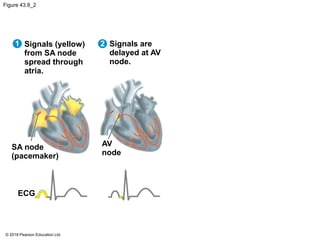
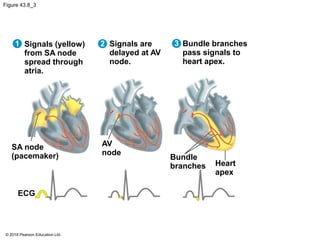
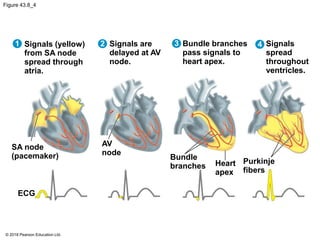
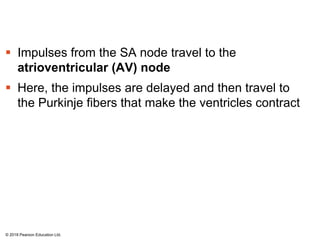
 The sinoatrial (SA) node, or pacemaker, sets the
rate and timing at which cardiac muscle cells
contract
 Impulses that travel during the cardiac cycle can be
recorded as an electrocardiogram (ECG or EKG)
© 2018 Pearson Education Ltd.
Figure 43.8_1
Signals (yellow)
from SA node
spread through
atria.
SA node
(pacemaker)
ECG
1
© 2018 Pearson Education Ltd.
Figure 43.8_2
Signals (yellow)
from SA node
spread through
atria.
Signals are
delayed at AV
node.
SA node
(pacemaker)
AV
node
ECG
1 2
© 2018 Pearson Education Ltd.
Figure 43.8_3
Signals (yellow)
from SA node
spread through
atria.
Signals are
delayed at AV
node.
Bundle branches
pass signals to
heart apex.
SA node
(pacemaker)
AV
node
Bundle
branches Heart
apex
ECG
1 2 3
© 2018 Pearson Education Ltd.
Figure 43.8_4
Signals (yellow)
from SA node
spread through
atria.
Signals are
delayed at AV
node.
Bundle branches
pass signals to
heart apex.
Signals
spread
throughout
ventricles.
SA node
(pacemaker)
AV
node
Bundle
branches Heart
apex
Purkinje
fibers
ECG
1 2 3 4
© 2018 Pearson Education Ltd.
 Impulses from the SA node travel to the
atrioventricular (AV) node
 Here, the impulses are delayed and then travel to
the Purkinje fibers that make the ventricles contract
© 2018 Pearson Education Ltd.
 The pacemaker is regulated by two portions of
the nervous system: the sympathetic and
parasympathetic divisions
 The sympathetic division speeds up the pacemaker
 The parasympathetic division slows down the
pacemaker
 The pacemaker is also regulated by hormones
and temperature
© 2018 Pearson Education Ltd.
Concept 43.3: Patterns of blood pressure and
flow reflect the structure and arrangement of
blood vessels
 The vertebrate circulatory system relies on blood
vessels that exhibit a close match of structure and
function
© 2018 Pearson Education Ltd.
Blood Vessel Structure and Function
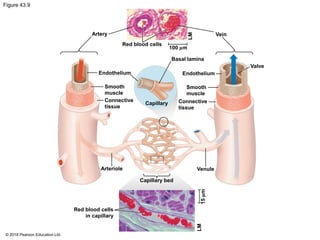
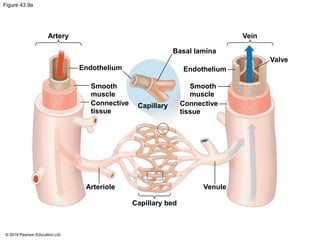
 All blood vessels contain a central lumen lined with
an epithelial layer that lines blood vessels
 This endothelium is smooth and minimizes
resistance
 Capillaries are only slightly wider than a red
blood cell
 Capillaries have thin walls, the endothelium plus its
basal lamina, to facilitate the exchange of materials
© 2018 Pearson Education Ltd.
 Arteries and veins have an endothelium, smooth
muscle, and connective tissue
 Arteries have thick, elastic walls to accommodate the
high pressure of blood pumped from the heart
 In the thinner-walled veins, blood flows back to the
heart mainly as a result of muscle action
 Unlike arteries, veins contain valves to maintain
unidirectional blood flow
© 2018 Pearson Education Ltd.
Figure 43.9
Red blood cells
100 µm
Basal lamina
Valve
Endothelium
Smooth
muscle
Connective
tissue
Endothelium
Smooth
muscle
Connective
tissue
Capillary
Arteriole
Capillary bed
LM
Artery Vein
Venule
Red blood cells
in capillary
LM
15
µm
© 2018 Pearson Education Ltd.
Figure 43.9a
Artery
Basal lamina
Endothelium
Smooth
muscle
Connective
tissue
Vein
Valve
Endothelium
Smooth
muscle
Connective
tissue
Capillary
Arteriole
Capillary bed
Venule
© 2018 Pearson Education Ltd.
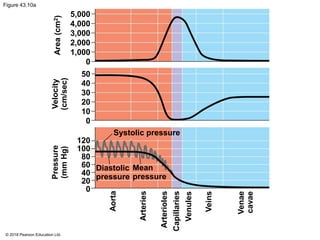
Blood Flow Velocity
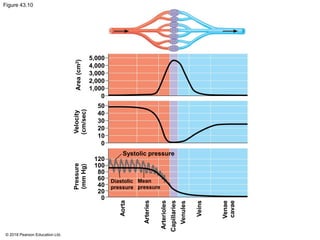
 Physical laws governing movement of fluids through
pipes affect blood flow and blood pressure
 Velocity of blood flow is slowest in the capillary beds
as a result of the high resistance and large total
cross-sectional area
 Blood flow in capillaries is necessarily slow for
exchange of materials
© 2018 Pearson Education Ltd.
Figure 43.10
5,000
4,000
3,000
2,000
1,000
0
50
40
30
20
10
0
Systolic pressure
120
100
80
60
40
20
0
Aorta
Arteries
Arterioles
Pressure
(mm
Hg)
Velocity
(cm/sec)
Area
(cm
2
)
Capillaries
Venules
Veins
Venae
cavae
Diastolic
pressure
Mean
pressure
© 2018 Pearson Education Ltd.
Figure 43.10a
5,000
4,000
3,000
2,000
1,000
0
50
40
30
20
10
0
120
100
80
60
40
20
0
Aorta
Arteries
Systolic pressure
Pressure
(mm
Hg)
Velocity
(cm/sec)
Area
(cm
2
)
Arterioles
Venules
Veins
Capillaries
Venae
cavae
Diastolic
pressure
Mean
pressure
© 2018 Pearson Education Ltd.
Blood Pressure
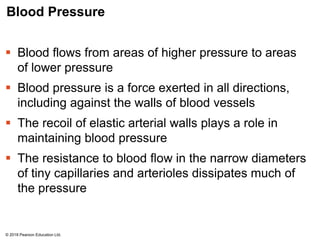
 Blood flows from areas of higher pressure to areas
of lower pressure
 Blood pressure is a force exerted in all directions,
including against the walls of blood vessels
 The recoil of elastic arterial walls plays a role in
maintaining blood pressure
 The resistance to blood flow in the narrow diameters
of tiny capillaries and arterioles dissipates much of
the pressure
© 2018 Pearson Education Ltd.
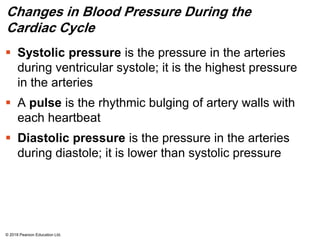
Changes in Blood Pressure During the
Cardiac Cycle
 Systolic pressure is the pressure in the arteries
during ventricular systole; it is the highest pressure
in the arteries
 A pulse is the rhythmic bulging of artery walls with
each heartbeat
 Diastolic pressure is the pressure in the arteries
during diastole; it is lower than systolic pressure
© 2018 Pearson Education Ltd.
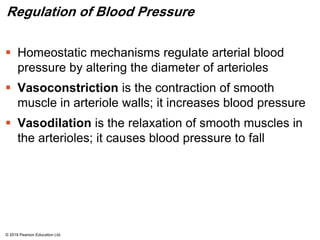
Regulation of Blood Pressure
 Homeostatic mechanisms regulate arterial blood
pressure by altering the diameter of arterioles
 Vasoconstriction is the contraction of smooth
muscle in arteriole walls; it increases blood pressure
 Vasodilation is the relaxation of smooth muscles in
the arterioles; it causes blood pressure to fall
© 2018 Pearson Education Ltd.
 Nitric oxide (NO) is a major inducer of vasodilation
 The peptide endothelin is a potent inducer of
vasoconstriction
 Vasoconstriction and vasodilation are often coupled
to changes in cardiac output that affect blood
pressure
© 2018 Pearson Education Ltd.
Blood Pressure and Gravity
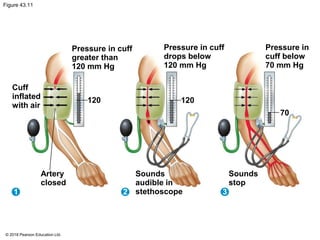
 Blood pressure is generally measured for an artery
in the arm at the same height as the heart
 Blood pressure for a healthy 20-year-old human at
rest is about 120 mm Hg at systole and 70 mm Hg at
diastole
 Gravity has a significant effect on blood pressure
© 2018 Pearson Education Ltd.
Figure 43.11
Pressure in cuff
greater than
120 mm Hg
Cuff
inflated
with air
Pressure in cuff
drops below
120 mm Hg
Pressure in
cuff below
70 mm Hg
120 120
70
Artery
closed
Sounds
audible in
stethoscope
Sounds
stop
2 3
1
© 2018 Pearson Education Ltd.
 Fainting is caused by inadequate blood flow to
the head
 Animals with long necks require a very high systolic
pressure to pump blood a great distance against
gravity
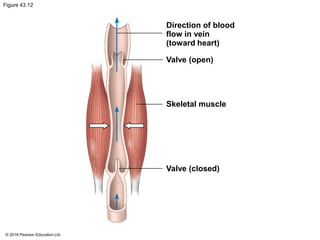
 Because blood pressure is low in veins, one-way
valves in veins prevent backflow of blood
 Return of blood is also enhanced by contraction of
smooth muscle in venule walls and skeletal muscle
contraction
© 2018 Pearson Education Ltd.
Figure 43.12
Direction of blood
flow in vein
(toward heart)
Valve (open)
Skeletal muscle
Valve (closed)
© 2018 Pearson Education Ltd.
Capillary Function
 Blood flows through only 5–10% of the body’s
capillaries at any given time
 Capillaries in major organs are usually filled to
capacity
 Blood supply varies in many other sites
© 2018 Pearson Education Ltd.
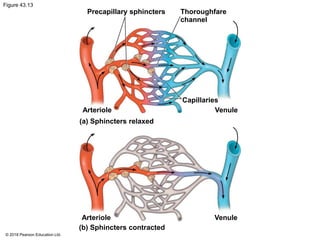
 Two mechanisms regulate distribution of blood in
capillary beds
 Constriction or dilation of arterioles that supply
capillary beds
 Precapillary sphincters that control flow of blood
between arterioles and venules
 Blood flow is regulated by nerve impulses,
hormones, and other chemicals
© 2018 Pearson Education Ltd.
Figure 43.13
Precapillary sphincters Thoroughfare
channel
Arteriole
(a) Sphincters relaxed
Capillaries
Venule
Arteriole
(b) Sphincters contracted
Venule
© 2018 Pearson Education Ltd.
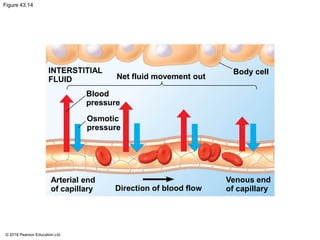
 The exchange of substances between the blood and
interstitial fluid takes place across the thin
endothelial walls of the capillaries
 Blood pressure tends to drive fluid out of capillaries,
and blood proteins tend to pull fluid back
 These proteins are responsible for much of the
blood’s osmotic pressure
 On average, there is a net loss of fluid from
capillaries
© 2018 Pearson Education Ltd.
Figure 43.14
INTERSTITIAL
FLUID Net fluid movement out
Body cell
Blood
pressure
Osmotic
pressure
Arterial end
of capillary Direction of blood flow
Venous end
of capillary
© 2018 Pearson Education Ltd.
Fluid Return by the Lymphatic System
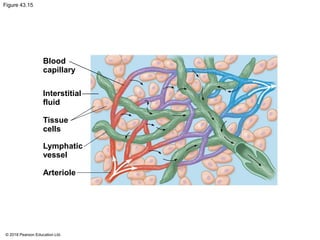
 The lymphatic system returns fluid that leaks
out from the capillary beds
 Fluid lost by capillaries is called lymph
 The lymphatic system drains into veins in the neck
 Valves in lymph vessels prevent the backflow
of fluid
© 2018 Pearson Education Ltd.
 Edema is swelling caused by disruptions in the flow
of lymph
 Lymph nodes are organs that filter lymph and
play an important role in the body’s defense
 When the body is fighting an infection, lymph nodes
become swollen and tender
© 2018 Pearson Education Ltd.
Figure 43.15
Blood
capillary
Interstitial
fluid
Tissue
cells
Lymphatic
vessel
Arteriole
© 2018 Pearson Education Ltd.
Concept 43.4: Blood components function in
exchange, transport, and defense
 With open circulation, the fluid is continuous with the
fluid surrounding all body cells
 The closed circulatory systems of vertebrates
contain a more highly specialized fluid called blood
© 2018 Pearson Education Ltd.
Blood Composition and Function
 Blood in vertebrates is a connective tissue consisting
of several kinds of cells suspended in a liquid matrix
called plasma
 Cells and cell fragments occupy about 45% of the
volume of blood
© 2018 Pearson Education Ltd.
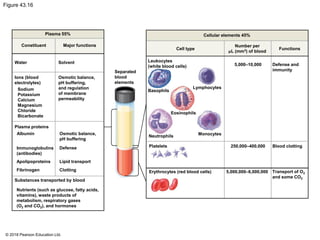
Figure 43.16
Plasma 55%
Constituent Major functions
Cell type
Leukocytes
(white blood cells)
Cellular elements 45%
Number per
µL (mm3) of blood
5,000–10,000
Functions
Defense and
immunity
Water
Ions (blood
electrolytes)
Sodium
Potassium
Calcium
Magnesium
Chloride
Bicarbonate
Plasma proteins
Albumin
Immunoglobulins
(antibodies)
Apolipoproteins
Fibrinogen
Solvent
Osmotic balance,
pH buffering,
and regulation
of membrane
permeability
Separated
blood
elements
Basophils
Lymphocytes
Eosinophils
Osmotic balance,
pH buffering
Defense
Lipid transport
Clotting
Neutrophils
Platelets
Monocytes
250,000–400,000 Blood clotting
Erythrocytes (red blood cells)
Substances transported by blood
Nutrients (such as glucose, fatty acids,
vitamins), waste products of
metabolism, respiratory gases
(O2 and CO2), and hormones
5,000,000–6,000,000 Transport of O2
and some CO2
© 2018 Pearson Education Ltd.
Figure 43.16a
Plasma 55%
Constituent
Water
Ions (blood
electrolytes)
Sodium, Potassium,
Calcium, Magnesium,
Chloride, Bicarbonate
Plasma proteins
Albumin
Immunoglobulins
(antibodies)
Apolipoproteins
Fibrinogen
Major functions
Solvent
Osmotic balance,
pH buffering,
and regulation
of membrane
permeability
Osmotic balance, pH buffering
Defense
Lipid transport
Clotting
Substances transported by blood
Nutrients (such as glucose, fatty acids, vitamins),
waste products of metabolism, respiratory gases
(O2 and CO2), and hormones
© 2018 Pearson Education Ltd.
Figure 43.16b
Cellular elements 45%
Cell type
Leukocytes
(white blood cells)
Number per
µL (mm3) of blood
5,000–10,000
Functions
Defense and
immunity
Basophils
Lymphocytes
Eosinophils
Neutrophils
Platelets
Monocytes
250,000–400,000 Blood clotting
Erythrocytes
(red blood cells)
5,000,000–6,000,000 Transport of O2
and some CO2
© 2018 Pearson Education Ltd.
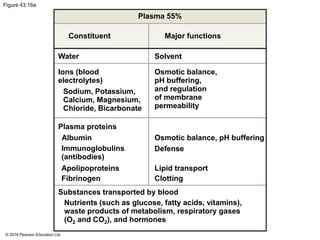
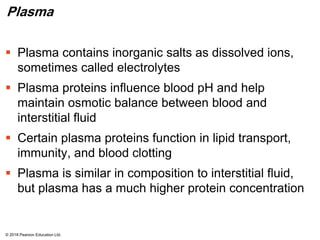
Plasma
 Plasma contains inorganic salts as dissolved ions,
sometimes called electrolytes
 Plasma proteins influence blood pH and help
maintain osmotic balance between blood and
interstitial fluid
 Certain plasma proteins function in lipid transport,
immunity, and blood clotting
 Plasma is similar in composition to interstitial fluid,
but plasma has a much higher protein concentration
© 2018 Pearson Education Ltd.
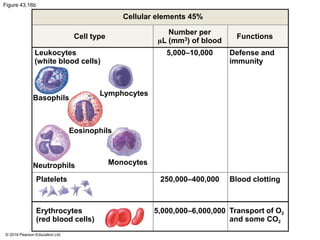
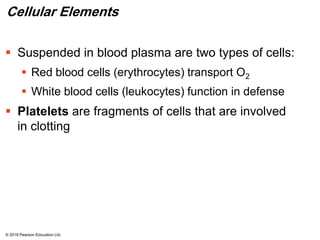
Cellular Elements
 Suspended in blood plasma are two types of cells:
 Red blood cells (erythrocytes) transport O2
 White blood cells (leukocytes) function in defense
 Platelets are fragments of cells that are involved
in clotting
© 2018 Pearson Education Ltd.
Erythrocytes
 Red blood cells, or erythrocytes, are the most
numerous blood cells
 They contain hemoglobin, the iron-containing
protein that transports O2
 Each molecule of hemoglobin binds up to four
molecules of O2
 In mammals, mature erythrocytes lack nuclei
and mitochondria
© 2018 Pearson Education Ltd.
 Sickle-cell disease is caused by abnormal
hemoglobin proteins that form aggregates
 The aggregates can deform an erythrocyte into
a sickle shape
 Sickled cells can rupture or can block blood vessels
© 2018 Pearson Education Ltd.
Leukocytes
 There are five major types of white blood cells, or
leukocytes
 They function in defense either by phagocytizing
bacteria and debris or by mounting immune
responses against foreign substances
 They are found both in and outside of the circulatory
system
© 2018 Pearson Education Ltd.
Platelets
 Platelets are fragments of cells and function in blood
clotting
© 2018 Pearson Education Ltd.
Stem Cells and the Replacement of Cellular
Elements
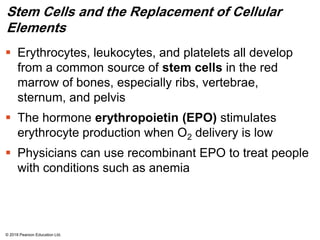
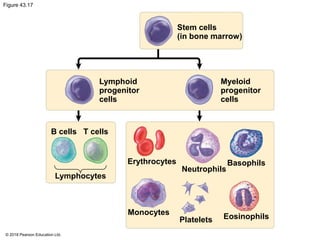
 Erythrocytes, leukocytes, and platelets all develop
from a common source of stem cells in the red
marrow of bones, especially ribs, vertebrae,
sternum, and pelvis
 The hormone erythropoietin (EPO) stimulates
erythrocyte production when O2 delivery is low
 Physicians can use recombinant EPO to treat people
with conditions such as anemia
© 2018 Pearson Education Ltd.
Figure 43.17
Stem cells
(in bone marrow)
Lymphoid
progenitor
cells
Myeloid
progenitor
cells
B cells T cells
Erythrocytes
Lymphocytes
Neutrophils
Basophils
Monocytes
Platelets Eosinophils
© 2018 Pearson Education Ltd.
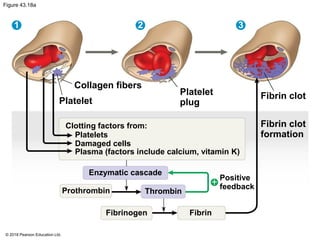
Blood Clotting
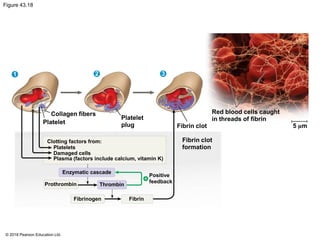
 Coagulation is the formation of a solid clot from
liquid blood
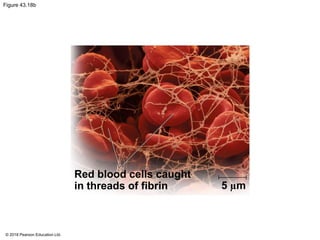
 A cascade of complex reactions converts inactive
fibrinogen to fibrin, forming a clot
 A blood clot formed within a blood vessel is called a
thrombus and can block blood flow
© 2018 Pearson Education Ltd.
Figure 43.18
3
Collagen fibers
Platelet
Platelet
plug Fibrin clot
Red blood cells caught
in threads of fibrin
5 µm
Clotting factors from:
Platelets
Damaged cells
Plasma (factors include calcium, vitamin K)
Enzymatic cascade
Prothrombin Thrombin
Fibrin
Positive
feedback
Fibrin clot
formation
Fibrinogen
1 2 3
© 2018 Pearson Education Ltd.
Figure 43.18a
1
Collagen fibers
Platelet
Platelet
plug
Fibrin clot
Fibrin clot
formation
Clotting factors from:
Platelets
Damaged cells
Plasma (factors include calcium, vitamin K)
Enzymatic cascade
Prothrombin Thrombin
Fibrin
Positive
feedback
Fibrinogen
2 3
1
© 2018 Pearson Education Ltd.
Figure 43.18b
Red blood cells caught
in threads of fibrin 5 µm
© 2018 Pearson Education Ltd.
Cardiovascular Disease
 Cardiovascular diseases are disorders of the heart
and the blood vessels
 These diseases range in seriousness from minor
disturbances of vein or heart function to life-
threatening disruptions of blood flow to the heart
or brain
© 2018 Pearson Education Ltd.
Atherosclerosis, Heart Attacks, and Stroke
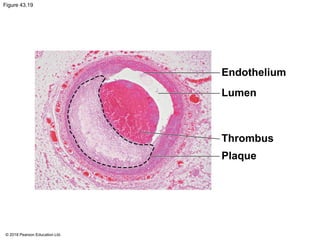
 One type of cardiovascular disease,
atherosclerosis, is caused by the buildup of
fatty deposits (plaque) within arteries
 Cholesterol is a key player in the development
of atherosclerosis
© 2018 Pearson Education Ltd.
 Low-density lipoprotein (LDL) delivers cholesterol
to cells for membrane production
 High-density lipoprotein (HDL) scavenges excess
cholesterol for return to the liver
 Risk for heart disease increases with a high LDL to
HDL ratio
 Inflammation is also a factor in cardiovascular
disease
© 2018 Pearson Education Ltd.
Figure 43.19
Endothelium
Lumen
Thrombus
Plaque
© 2018 Pearson Education Ltd.
 A heart attack, or myocardial infarction, is the
damage or death of cardiac muscle tissue resulting
from blockage of one or more coronary arteries
 A stroke is the death of nervous tissue in the brain,
usually resulting from rupture or blockage of arteries
in the head
 Angina pectoris is chest pain caused by partial
blockage of the coronary arteries
© 2018 Pearson Education Ltd.
Figure 43.20
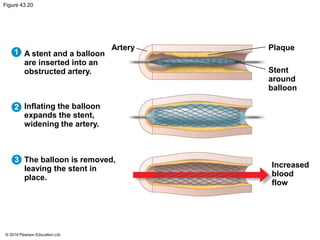
A stent and a balloon
are inserted into an
obstructed artery.
Artery Plaque
Stent
around
balloon
Inflating the balloon
expands the stent,
widening the artery.
The balloon is removed,
leaving the stent in
place.
Increased
blood
flow
1
2
3
© 2018 Pearson Education Ltd.
Risk Factors and Treatment of Cardiovascular
Disease
 A high LDL/HDL ratio increases the risk of
cardiovascular disease
 The proportion of LDL relative to HDL can be
decreased by exercise and by avoiding smoking and
foods with trans fats
 Drugs called statins reduce LDL levels and risk
of heart attacks
© 2018 Pearson Education Ltd.
 Inflammation plays a role in atherosclerosis and
thrombus formation
 Aspirin inhibits inflammation and reduces the risk of
heart attacks and stroke
 Hypertension, or high blood pressure, also
contributes to heart attack and stroke, as well as
other health problems
 Hypertension can be controlled by dietary changes,
exercise, and/or medication
© 2018 Pearson Education Ltd.
Concept 43.5: Gas exchange occurs across
specialized respiratory surfaces
 Gas exchange is the uptake of O2 from the
environment and the discharge of CO2 to the
environment
© 2018 Pearson Education Ltd.
Partial Pressure Gradients in Gas Exchange
 Partial pressure is the pressure exerted by a
particular gas in a mixture of gases
 Partial pressures also apply to gases dissolved
in liquids such as water
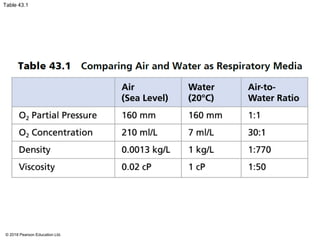
 O2 is much less soluble in water than in air
© 2018 Pearson Education Ltd.
Table 43.1
© 2018 Pearson Education Ltd.
Respiratory Media
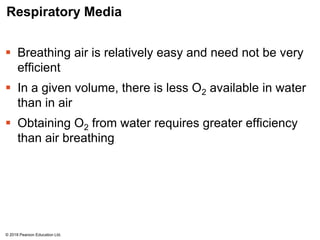
 Breathing air is relatively easy and need not be very
efficient
 In a given volume, there is less O2 available in water
than in air
 Obtaining O2 from water requires greater efficiency
than air breathing
© 2018 Pearson Education Ltd.
Respiratory Surfaces
 Gas exchange across respiratory surfaces takes
place by diffusion
 Respiratory surfaces vary by animal and can include
the skin, gills, tracheae, and lungs
© 2018 Pearson Education Ltd.
Lungs
 Lungs are an infolding of the body surface
 The circulatory system (open or closed) transports
gases between the lungs and the rest of the body
 The size and complexity of lungs correlate with an
animal’s metabolic rate
© 2018 Pearson Education Ltd.
Mammalian Respiratory Systems: A Closer
Look
 A system of branching ducts conveys air to
the lungs
 Air inhaled through the nostrils is filtered, warmed,
humidified, and sampled for odors
 The pharynx directs air to the lungs and food to
the stomach
 Swallowing moves the larynx upward and tips the
epiglottis over the glottis in the pharynx to prevent
food from entering the trachea, or windpipe
© 2018 Pearson Education Ltd.
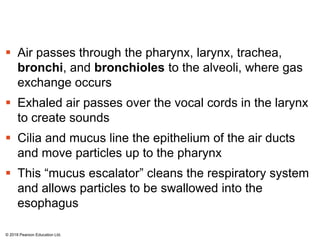
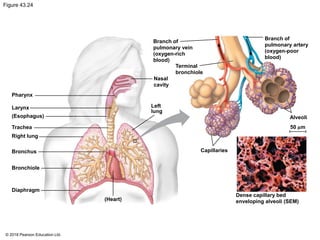
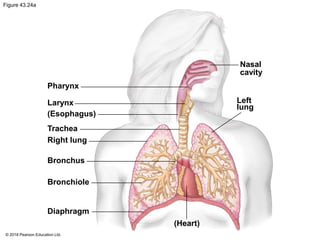
 Air passes through the pharynx, larynx, trachea,
bronchi, and bronchioles to the alveoli, where gas
exchange occurs
 Exhaled air passes over the vocal cords in the larynx
to create sounds
 Cilia and mucus line the epithelium of the air ducts
and move particles up to the pharynx
 This “mucus escalator” cleans the respiratory system
and allows particles to be swallowed into the
esophagus
© 2018 Pearson Education Ltd.
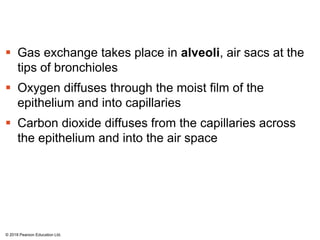
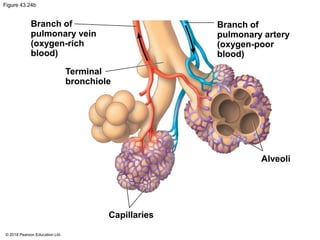
 Gas exchange takes place in alveoli, air sacs at the
tips of bronchioles
 Oxygen diffuses through the moist film of the
epithelium and into capillaries
 Carbon dioxide diffuses from the capillaries across
the epithelium and into the air space
© 2018 Pearson Education Ltd.
Figure 43.24
Branch of
pulmonary vein
(oxygen-rich
blood)
Terminal
bronchiole
Nasal
cavity
Pharynx
Larynx
(Esophagus)
Trachea
Right lung
Bronchus
Bronchiole
Capillaries
Left
lung
Branch of
pulmonary artery
(oxygen-poor
blood)
Alveoli
50 µm
Diaphragm
(Heart)
Dense capillary bed
enveloping alveoli (SEM)
© 2018 Pearson Education Ltd.
Figure 43.24a
Nasal
cavity
Pharynx
Larynx
(Esophagus)
Trachea
Right lung
Bronchus
Bronchiole
Diaphragm
(Heart)
Left
lung
© 2018 Pearson Education Ltd.
Figure 43.24b
Branch of
pulmonary vein
(oxygen-rich
blood)
Terminal
bronchiole
Branch of
pulmonary artery
(oxygen-poor
blood)
Alveoli
Capillaries
© 2018 Pearson Education Ltd.
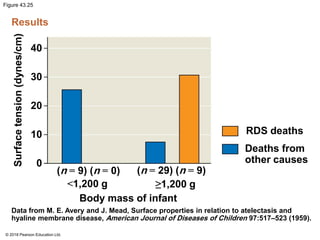
 Alveoli lack cilia and are susceptible to
contamination
 Secretions called surfactants coat the surface of
the alveoli
 Preterm babies lack surfactant and are vulnerable to
respiratory distress syndrome; treatment is provided
by artificial surfactants
© 2018 Pearson Education Ltd.
Figure 43.25
Results
Surface
tension
(dynes/cm)
40
30
20
10
0
(n = 9) (n = 0) (n = 29) (n = 9)
<1,200 g ≥1,200 g
Body mass of infant
RDS deaths
Deaths from
other causes
Data from M. E. Avery and J. Mead, Surface properties in relation to atelectasis and
hyaline membrane disease, American Journal of Diseases of Children 97:517–523 (1959).
© 2018 Pearson Education Ltd.
Concept 43.6: Breathing ventilates the lungs
 The process that ventilates the lungs is breathing,
the alternate inhalation and exhalation of air
© 2018 Pearson Education Ltd.
How a Mammal Breathes
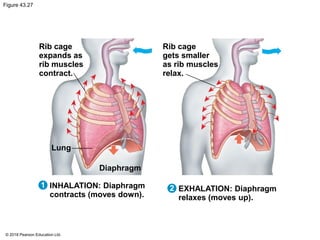
 Mammals ventilate their lungs by negative pressure
breathing, which pulls air into the lungs
 Lung volume increases as the rib muscles and
diaphragm contract
© 2018 Pearson Education Ltd.
 The tidal volume is the volume of air inhaled with
each breath
 The maximum tidal volume is the vital capacity
 After exhalation, a residual volume of air remains in
the lungs
© 2018 Pearson Education Ltd.
Figure 43.27
Rib cage
expands as
rib muscles
contract.
Rib cage
gets smaller
as rib muscles
relax.
Lung
Diaphragm
INHALATION: Diaphragm
contracts (moves down).
EXHALATION: Diaphragm
relaxes (moves up).
1 2
© 2018 Pearson Education Ltd.
Control of Breathing in Humans
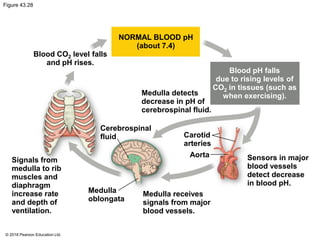
 Breathing is regulated by involuntary mechanisms
 The breathing control centers are found in the
medulla oblongata of the brain
 The medulla regulates the rate and depth of
breathing in response to pH changes in the
cerebrospinal fluid
© 2018 Pearson Education Ltd.
Figure 43.28
Blood CO2 level falls
and pH rises.
Medulla detects
decrease in pH of
cerebrospinal fluid.
Cerebrospinal
fluid
Signals from
medulla to rib
muscles and
diaphragm
increase rate
and depth of
ventilation.
Carotid
arteries
Aorta
Medulla
oblongata
Sensors in major
blood vessels
detect decrease
in blood pH.
Medulla receives
signals from major
blood vessels.
Blood pH falls
due to rising levels of
CO2 in tissues (such as
when exercising).
NORMAL BLOOD pH
(about 7.4)
© 2018 Pearson Education Ltd.
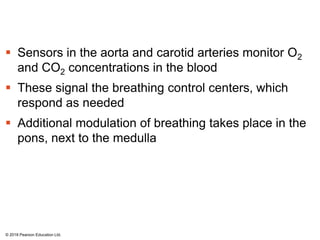
 Sensors in the aorta and carotid arteries monitor O2
and CO2 concentrations in the blood
 These signal the breathing control centers, which
respond as needed
 Additional modulation of breathing takes place in the
pons, next to the medulla
© 2018 Pearson Education Ltd.

Chapter 42 Animal Transport System7s.pdf

  • 1.
    Lecture Presentations by NicoleTunbridge and Kathleen Fitzpatrick Chapter 43 Animal Transport Systems © 2018 Pearson Education Ltd.
  • 2.
    Trading Places  Everyorganism must exchange substances with its environment  Exchanges ultimately occur at the cellular level by crossing the plasma membrane  In unicellular organisms, these exchanges occur directly with the environment © 2018 Pearson Education Ltd.
  • 3.
     For mostcells of multicellular organisms, direct exchange with the environment is not possible  Gills are an example of a specialized exchange system in animals  O2 diffuses from the water into blood vessels  CO2 diffuses from blood into the water  Internal transport and gas exchange are functionally related in most animals © 2018 Pearson Education Ltd.
  • 4.
    Concept 43.1: Circulatorysystems link exchange surfaces with cells throughout the body  Small molecules can move between cells and their surroundings by diffusion  Diffusion is only efficient over small distances because the time it takes to diffuse is proportional to the square of the distance © 2018 Pearson Education Ltd.
  • 5.
     In someanimals, many or all cells are in direct contact with the environment  In most animals, cells exchange materials with the environment via a fluid-filled circulatory system © 2018 Pearson Education Ltd.
  • 6.
    Gastrovascular Cavities  Someanimals lack a circulatory system  Some cnidarians have elaborate gastrovascular cavities that function in both digestion and distribution of substances throughout the body  The body wall that encloses the gastrovascular cavity is only two cells thick  Flatworms have a gastrovascular cavity and a flat body that minimizes diffusion distances © 2018 Pearson Education Ltd.
  • 7.
    Figure 43.2a Mouth Radial canals Circularcanal 2.5 cm (a) The moon jelly Aurelia, a cnidarian © 2018 Pearson Education Ltd.
  • 8.
    Figure 43.2b Mouth Pharynx Gastrovascular cavity 1 mm (b)The planarian Dugesia, a flatworm © 2018 Pearson Education Ltd.
  • 9.
    Open and ClosedCirculatory Systems  A circulatory system has  A circulatory fluid  A set of interconnecting vessels  A muscular pump, the heart  The circulatory system connects the fluid that surrounds cells with the organs that exchange gases, absorb nutrients, and dispose of wastes  Circulatory systems can be open or closed © 2018 Pearson Education Ltd.
  • 10.
     In insects,other arthropods, and some molluscs, circulatory fluid called hemolymph bathes the organs directly in an open circulatory system  In a closed circulatory system, blood is confined to vessels and is distinct from the interstitial fluid  Annelids, cephalopods, and vertebrates have closed circulatory systems © 2018 Pearson Education Ltd.
  • 11.
    Figure 43.3 (a) Anopen circulatory system Heart (b) A closed circulatory system Heart Interstitial fluid Hemolymph in sinuses Pores Small branch vessels in each organ Dorsal vessel (main heart) Blood Auxiliary hearts Tubular heart Ventral vessels © 2018 Pearson Education Ltd.
  • 12.
    Figure 43.3a (a) Anopen circulatory system Heart Hemolymph in sinuses Pores Tubular heart © 2018 Pearson Education Ltd.
  • 13.
    Figure 43.3b (b) Aclosed circulatory system Heart Interstitial fluid Small branch vessels in each organ Dorsal vessel (main heart) Blood Auxiliary hearts Ventral vessels © 2018 Pearson Education Ltd.
  • 14.
    Organization of VertebrateCirculatory Systems  Humans and other vertebrates have a closed circulatory system called the cardiovascular system  The three main types of blood vessels are arteries, veins, and capillaries  Blood flow is one way in these vessels © 2018 Pearson Education Ltd.
  • 15.
     Arteries branchinto arterioles and carry blood away from the heart to capillaries  Networks of capillaries called capillary beds are the sites of chemical exchange between the blood and interstitial fluid  Venules converge into veins and return blood from capillaries to the heart © 2018 Pearson Education Ltd.
  • 16.
     Arteries andveins are distinguished by the direction of blood flow, not by O2 content  Vertebrate hearts contain two or more chambers  Blood enters through an atria and is pumped out through ventricles © 2018 Pearson Education Ltd.
  • 17.
    Single Circulation  Bonyfishes, rays, and sharks have single circulation with a two-chambered heart  In single circulation, blood leaving the heart passes through two capillary beds before returning © 2018 Pearson Education Ltd.
  • 18.
    Figure 43.4a (a) Singlecirculation: fish Gill capillaries Artery Heart: Atrium (A) Ventricle (V) Vein Oxygen-rich blood Oxygen-poor blood Body capillaries © 2018 Pearson Education Ltd.
  • 19.
    Double Circulation  Amphibians,reptiles, and mammals have double circulation  Oxygen-poor and oxygen-rich blood are pumped separately from the right and left sides of the heart © 2018 Pearson Education Ltd.
  • 20.
     In reptilesand mammals, oxygen-poor blood flows through the pulmonary circuit to pick up oxygen through the lungs  In amphibians, oxygen-poor blood flows through a pulmocutaneous circuit to pick up oxygen through the lungs and skin  Oxygen-rich blood delivers oxygen through the systemic circuit  Double circulation maintains higher blood pressure in the organs than does single circulation © 2018 Pearson Education Ltd.
  • 21.
    Figure 43.4b (b) Doublecirculation: amphibian Pulmocutaneous circuit Lung and skin capillaries Atrium (A) Atrium (A) Right Left Ventricle (V) Systemic capillaries Systemic circuit Oxygen-rich blood Oxygen-poor blood © 2018 Pearson Education Ltd.
  • 22.
    Figure 43.4c (c) Doublecirculation: mammal Pulmonary circuit Lung capillaries A V Right A V Left Systemic capillaries Systemic circuit Oxygen-rich blood Oxygen-poor blood © 2018 Pearson Education Ltd.
  • 23.
    Concept 43.2: Coordinatedcycles of heart contraction drive double circulation in mammals  The mammalian cardiovascular system meets the body’s continuous demand for O2 © 2018 Pearson Education Ltd.
  • 24.
    Mammalian Circulation  Contractionof the right ventricle pumps blood to the lungs via the pulmonary arteries  The blood flows through capillary beds in the left and right lungs and loads O2 and unloads CO2  Oxygen-rich blood returns from the lungs via the pulmonary veins to the left atrium of the heart © 2018 Pearson Education Ltd.
  • 25.
     Oxygen-rich bloodflows into the left ventricle and is pumped out to body tissues via the systemic circuit  Blood leaves the left ventricle via the aorta, which conveys blood to arteries leading throughout the body  The first branches are the coronary arteries, supplying the heart muscle © 2018 Pearson Education Ltd.
  • 26.
     Further brancheslead to capillary beds in the abdominal organs and hind limbs  O2 diffuses from blood to tissues, and CO2 diffuses from tissues to blood  Capillaries rejoin, forming venules, conveying blood to veins  Oxygen-poor blood from the head, neck, and forelimbs is channeled into the superior vena cava © 2018 Pearson Education Ltd.
  • 27.
     The inferiorvena cava drains blood from the trunk and hind limbs  The two venae cavae empty their blood into the right atrium from which the oxygen-poor blood flows into the right ventricle © 2018 Pearson Education Ltd.
  • 28.
    Figure 43.5 Superior vena cava Pulmonary artery Capillaries ofright lung Capillaries of head and forelimbs Pulmonary artery Aorta Capillaries of left lung Pulmonary vein Right atrium Right ventricle Inferior vena cava Pulmonary vein Left atrium Left ventricle Aorta Capillaries of abdominal organs and hind limbs 2 9 7 6 11 3 4 5 3 1 10 8 © 2018 Pearson Education Ltd.
  • 29.
    The Mammalian Heart:A Closer Look  The human heart is about the size of a clenched fist and consists mainly of cardiac muscle  The two atria have relatively thin walls and serve as collection chambers for blood returning to the heart  The ventricles have thicker walls and contract much more forcefully © 2018 Pearson Education Ltd.
  • 30.
    Figure 43.6 Pulmonary arteryAorta Pulmonary artery Right atrium Left atrium Semilunar valve Atrioventricular (AV) valve Right ventricle Left ventricle Semilunar valve Atrioventricular (AV) valve © 2018 Pearson Education Ltd.
  • 31.
     The heartcontracts and relaxes in a rhythmic cycle called the cardiac cycle  The contraction, or pumping, phase is called systole  The relaxation, or filling, phase is called diastole © 2018 Pearson Education Ltd.
  • 32.
    Figure 43.7_1 Atrial and ventriculardiastole 0.4 sec 1 © 2018 Pearson Education Ltd.
  • 33.
    Figure 43.7_2 Atrial systoleand ventricular diastole Atrial and ventricular diastole 0.1 sec 0.4 sec 1 2 © 2018 Pearson Education Ltd.
  • 34.
    Figure 43.7_3 Atrial systoleand ventricular diastole Atrial and ventricular diastole 0.1 sec 0.4 sec 0.3 sec Ventricular systole and atrial diastole 3 1 2 © 2018 Pearson Education Ltd.
  • 35.
     The cardiacoutput is the volume of blood pumped into the systemic circulation per minute and depends on both the heart rate and stroke volume  The heart rate is the number of beats per minute  The stroke volume is the amount of blood pumped in a single contraction © 2018 Pearson Education Ltd.
  • 36.
     Four valvesprevent backflow of blood in the heart  The atrioventricular (AV) valves separate each atrium and ventricle  The semilunar valves control blood flow to the aorta and the pulmonary artery © 2018 Pearson Education Ltd.
  • 37.
     The “lub-dup”sound of a heart beat is caused by the recoil of blood against the AV valves (lub) then against the semilunar (dup) valves  Backflow of blood through a defective valve causes a heart murmur © 2018 Pearson Education Ltd.
  • 38.
    Maintaining the Heart’sRhythmic Beat  Some cardiac muscle cells are autorhythmic, meaning they contract without any signal from the nervous system  The sinoatrial (SA) node, or pacemaker, sets the rate and timing at which cardiac muscle cells contract  Impulses that travel during the cardiac cycle can be recorded as an electrocardiogram (ECG or EKG) © 2018 Pearson Education Ltd.
  • 39.
    Figure 43.8_1 Signals (yellow) fromSA node spread through atria. SA node (pacemaker) ECG 1 © 2018 Pearson Education Ltd.
  • 40.
    Figure 43.8_2 Signals (yellow) fromSA node spread through atria. Signals are delayed at AV node. SA node (pacemaker) AV node ECG 1 2 © 2018 Pearson Education Ltd.
  • 41.
    Figure 43.8_3 Signals (yellow) fromSA node spread through atria. Signals are delayed at AV node. Bundle branches pass signals to heart apex. SA node (pacemaker) AV node Bundle branches Heart apex ECG 1 2 3 © 2018 Pearson Education Ltd.
  • 42.
    Figure 43.8_4 Signals (yellow) fromSA node spread through atria. Signals are delayed at AV node. Bundle branches pass signals to heart apex. Signals spread throughout ventricles. SA node (pacemaker) AV node Bundle branches Heart apex Purkinje fibers ECG 1 2 3 4 © 2018 Pearson Education Ltd.
  • 43.
     Impulses fromthe SA node travel to the atrioventricular (AV) node  Here, the impulses are delayed and then travel to the Purkinje fibers that make the ventricles contract © 2018 Pearson Education Ltd.
  • 44.
     The pacemakeris regulated by two portions of the nervous system: the sympathetic and parasympathetic divisions  The sympathetic division speeds up the pacemaker  The parasympathetic division slows down the pacemaker  The pacemaker is also regulated by hormones and temperature © 2018 Pearson Education Ltd.
  • 45.
    Concept 43.3: Patternsof blood pressure and flow reflect the structure and arrangement of blood vessels  The vertebrate circulatory system relies on blood vessels that exhibit a close match of structure and function © 2018 Pearson Education Ltd.
  • 46.
    Blood Vessel Structureand Function  All blood vessels contain a central lumen lined with an epithelial layer that lines blood vessels  This endothelium is smooth and minimizes resistance  Capillaries are only slightly wider than a red blood cell  Capillaries have thin walls, the endothelium plus its basal lamina, to facilitate the exchange of materials © 2018 Pearson Education Ltd.
  • 47.
     Arteries andveins have an endothelium, smooth muscle, and connective tissue  Arteries have thick, elastic walls to accommodate the high pressure of blood pumped from the heart  In the thinner-walled veins, blood flows back to the heart mainly as a result of muscle action  Unlike arteries, veins contain valves to maintain unidirectional blood flow © 2018 Pearson Education Ltd.
  • 48.
    Figure 43.9 Red bloodcells 100 µm Basal lamina Valve Endothelium Smooth muscle Connective tissue Endothelium Smooth muscle Connective tissue Capillary Arteriole Capillary bed LM Artery Vein Venule Red blood cells in capillary LM 15 µm © 2018 Pearson Education Ltd.
  • 49.
  • 50.
    Blood Flow Velocity Physical laws governing movement of fluids through pipes affect blood flow and blood pressure  Velocity of blood flow is slowest in the capillary beds as a result of the high resistance and large total cross-sectional area  Blood flow in capillaries is necessarily slow for exchange of materials © 2018 Pearson Education Ltd.
  • 51.
  • 52.
  • 53.
    Blood Pressure  Bloodflows from areas of higher pressure to areas of lower pressure  Blood pressure is a force exerted in all directions, including against the walls of blood vessels  The recoil of elastic arterial walls plays a role in maintaining blood pressure  The resistance to blood flow in the narrow diameters of tiny capillaries and arterioles dissipates much of the pressure © 2018 Pearson Education Ltd.
  • 54.
    Changes in BloodPressure During the Cardiac Cycle  Systolic pressure is the pressure in the arteries during ventricular systole; it is the highest pressure in the arteries  A pulse is the rhythmic bulging of artery walls with each heartbeat  Diastolic pressure is the pressure in the arteries during diastole; it is lower than systolic pressure © 2018 Pearson Education Ltd.
  • 55.
    Regulation of BloodPressure  Homeostatic mechanisms regulate arterial blood pressure by altering the diameter of arterioles  Vasoconstriction is the contraction of smooth muscle in arteriole walls; it increases blood pressure  Vasodilation is the relaxation of smooth muscles in the arterioles; it causes blood pressure to fall © 2018 Pearson Education Ltd.
  • 56.
     Nitric oxide(NO) is a major inducer of vasodilation  The peptide endothelin is a potent inducer of vasoconstriction  Vasoconstriction and vasodilation are often coupled to changes in cardiac output that affect blood pressure © 2018 Pearson Education Ltd.
  • 57.
    Blood Pressure andGravity  Blood pressure is generally measured for an artery in the arm at the same height as the heart  Blood pressure for a healthy 20-year-old human at rest is about 120 mm Hg at systole and 70 mm Hg at diastole  Gravity has a significant effect on blood pressure © 2018 Pearson Education Ltd.
  • 58.
    Figure 43.11 Pressure incuff greater than 120 mm Hg Cuff inflated with air Pressure in cuff drops below 120 mm Hg Pressure in cuff below 70 mm Hg 120 120 70 Artery closed Sounds audible in stethoscope Sounds stop 2 3 1 © 2018 Pearson Education Ltd.
  • 59.
     Fainting iscaused by inadequate blood flow to the head  Animals with long necks require a very high systolic pressure to pump blood a great distance against gravity  Because blood pressure is low in veins, one-way valves in veins prevent backflow of blood  Return of blood is also enhanced by contraction of smooth muscle in venule walls and skeletal muscle contraction © 2018 Pearson Education Ltd.
  • 60.
    Figure 43.12 Direction ofblood flow in vein (toward heart) Valve (open) Skeletal muscle Valve (closed) © 2018 Pearson Education Ltd.
  • 61.
    Capillary Function  Bloodflows through only 5–10% of the body’s capillaries at any given time  Capillaries in major organs are usually filled to capacity  Blood supply varies in many other sites © 2018 Pearson Education Ltd.
  • 62.
     Two mechanismsregulate distribution of blood in capillary beds  Constriction or dilation of arterioles that supply capillary beds  Precapillary sphincters that control flow of blood between arterioles and venules  Blood flow is regulated by nerve impulses, hormones, and other chemicals © 2018 Pearson Education Ltd.
  • 63.
    Figure 43.13 Precapillary sphinctersThoroughfare channel Arteriole (a) Sphincters relaxed Capillaries Venule Arteriole (b) Sphincters contracted Venule © 2018 Pearson Education Ltd.
  • 64.
     The exchangeof substances between the blood and interstitial fluid takes place across the thin endothelial walls of the capillaries  Blood pressure tends to drive fluid out of capillaries, and blood proteins tend to pull fluid back  These proteins are responsible for much of the blood’s osmotic pressure  On average, there is a net loss of fluid from capillaries © 2018 Pearson Education Ltd.
  • 65.
    Figure 43.14 INTERSTITIAL FLUID Netfluid movement out Body cell Blood pressure Osmotic pressure Arterial end of capillary Direction of blood flow Venous end of capillary © 2018 Pearson Education Ltd.
  • 66.
    Fluid Return bythe Lymphatic System  The lymphatic system returns fluid that leaks out from the capillary beds  Fluid lost by capillaries is called lymph  The lymphatic system drains into veins in the neck  Valves in lymph vessels prevent the backflow of fluid © 2018 Pearson Education Ltd.
  • 67.
     Edema isswelling caused by disruptions in the flow of lymph  Lymph nodes are organs that filter lymph and play an important role in the body’s defense  When the body is fighting an infection, lymph nodes become swollen and tender © 2018 Pearson Education Ltd.
  • 68.
  • 69.
    Concept 43.4: Bloodcomponents function in exchange, transport, and defense  With open circulation, the fluid is continuous with the fluid surrounding all body cells  The closed circulatory systems of vertebrates contain a more highly specialized fluid called blood © 2018 Pearson Education Ltd.
  • 70.
    Blood Composition andFunction  Blood in vertebrates is a connective tissue consisting of several kinds of cells suspended in a liquid matrix called plasma  Cells and cell fragments occupy about 45% of the volume of blood © 2018 Pearson Education Ltd.
  • 71.
    Figure 43.16 Plasma 55% ConstituentMajor functions Cell type Leukocytes (white blood cells) Cellular elements 45% Number per µL (mm3) of blood 5,000–10,000 Functions Defense and immunity Water Ions (blood electrolytes) Sodium Potassium Calcium Magnesium Chloride Bicarbonate Plasma proteins Albumin Immunoglobulins (antibodies) Apolipoproteins Fibrinogen Solvent Osmotic balance, pH buffering, and regulation of membrane permeability Separated blood elements Basophils Lymphocytes Eosinophils Osmotic balance, pH buffering Defense Lipid transport Clotting Neutrophils Platelets Monocytes 250,000–400,000 Blood clotting Erythrocytes (red blood cells) Substances transported by blood Nutrients (such as glucose, fatty acids, vitamins), waste products of metabolism, respiratory gases (O2 and CO2), and hormones 5,000,000–6,000,000 Transport of O2 and some CO2 © 2018 Pearson Education Ltd.
  • 72.
    Figure 43.16a Plasma 55% Constituent Water Ions(blood electrolytes) Sodium, Potassium, Calcium, Magnesium, Chloride, Bicarbonate Plasma proteins Albumin Immunoglobulins (antibodies) Apolipoproteins Fibrinogen Major functions Solvent Osmotic balance, pH buffering, and regulation of membrane permeability Osmotic balance, pH buffering Defense Lipid transport Clotting Substances transported by blood Nutrients (such as glucose, fatty acids, vitamins), waste products of metabolism, respiratory gases (O2 and CO2), and hormones © 2018 Pearson Education Ltd.
  • 73.
    Figure 43.16b Cellular elements45% Cell type Leukocytes (white blood cells) Number per µL (mm3) of blood 5,000–10,000 Functions Defense and immunity Basophils Lymphocytes Eosinophils Neutrophils Platelets Monocytes 250,000–400,000 Blood clotting Erythrocytes (red blood cells) 5,000,000–6,000,000 Transport of O2 and some CO2 © 2018 Pearson Education Ltd.
  • 74.
    Plasma  Plasma containsinorganic salts as dissolved ions, sometimes called electrolytes  Plasma proteins influence blood pH and help maintain osmotic balance between blood and interstitial fluid  Certain plasma proteins function in lipid transport, immunity, and blood clotting  Plasma is similar in composition to interstitial fluid, but plasma has a much higher protein concentration © 2018 Pearson Education Ltd.
  • 75.
    Cellular Elements  Suspendedin blood plasma are two types of cells:  Red blood cells (erythrocytes) transport O2  White blood cells (leukocytes) function in defense  Platelets are fragments of cells that are involved in clotting © 2018 Pearson Education Ltd.
  • 76.
    Erythrocytes  Red bloodcells, or erythrocytes, are the most numerous blood cells  They contain hemoglobin, the iron-containing protein that transports O2  Each molecule of hemoglobin binds up to four molecules of O2  In mammals, mature erythrocytes lack nuclei and mitochondria © 2018 Pearson Education Ltd.
  • 77.
     Sickle-cell diseaseis caused by abnormal hemoglobin proteins that form aggregates  The aggregates can deform an erythrocyte into a sickle shape  Sickled cells can rupture or can block blood vessels © 2018 Pearson Education Ltd.
  • 78.
    Leukocytes  There arefive major types of white blood cells, or leukocytes  They function in defense either by phagocytizing bacteria and debris or by mounting immune responses against foreign substances  They are found both in and outside of the circulatory system © 2018 Pearson Education Ltd.
  • 79.
    Platelets  Platelets arefragments of cells and function in blood clotting © 2018 Pearson Education Ltd.
  • 80.
    Stem Cells andthe Replacement of Cellular Elements  Erythrocytes, leukocytes, and platelets all develop from a common source of stem cells in the red marrow of bones, especially ribs, vertebrae, sternum, and pelvis  The hormone erythropoietin (EPO) stimulates erythrocyte production when O2 delivery is low  Physicians can use recombinant EPO to treat people with conditions such as anemia © 2018 Pearson Education Ltd.
  • 81.
    Figure 43.17 Stem cells (inbone marrow) Lymphoid progenitor cells Myeloid progenitor cells B cells T cells Erythrocytes Lymphocytes Neutrophils Basophils Monocytes Platelets Eosinophils © 2018 Pearson Education Ltd.
  • 82.
    Blood Clotting  Coagulationis the formation of a solid clot from liquid blood  A cascade of complex reactions converts inactive fibrinogen to fibrin, forming a clot  A blood clot formed within a blood vessel is called a thrombus and can block blood flow © 2018 Pearson Education Ltd.
  • 83.
    Figure 43.18 3 Collagen fibers Platelet Platelet plugFibrin clot Red blood cells caught in threads of fibrin 5 µm Clotting factors from: Platelets Damaged cells Plasma (factors include calcium, vitamin K) Enzymatic cascade Prothrombin Thrombin Fibrin Positive feedback Fibrin clot formation Fibrinogen 1 2 3 © 2018 Pearson Education Ltd.
  • 84.
    Figure 43.18a 1 Collagen fibers Platelet Platelet plug Fibrinclot Fibrin clot formation Clotting factors from: Platelets Damaged cells Plasma (factors include calcium, vitamin K) Enzymatic cascade Prothrombin Thrombin Fibrin Positive feedback Fibrinogen 2 3 1 © 2018 Pearson Education Ltd.
  • 85.
    Figure 43.18b Red bloodcells caught in threads of fibrin 5 µm © 2018 Pearson Education Ltd.
  • 86.
    Cardiovascular Disease  Cardiovasculardiseases are disorders of the heart and the blood vessels  These diseases range in seriousness from minor disturbances of vein or heart function to life- threatening disruptions of blood flow to the heart or brain © 2018 Pearson Education Ltd.
  • 87.
    Atherosclerosis, Heart Attacks,and Stroke  One type of cardiovascular disease, atherosclerosis, is caused by the buildup of fatty deposits (plaque) within arteries  Cholesterol is a key player in the development of atherosclerosis © 2018 Pearson Education Ltd.
  • 88.
     Low-density lipoprotein(LDL) delivers cholesterol to cells for membrane production  High-density lipoprotein (HDL) scavenges excess cholesterol for return to the liver  Risk for heart disease increases with a high LDL to HDL ratio  Inflammation is also a factor in cardiovascular disease © 2018 Pearson Education Ltd.
  • 89.
  • 90.
     A heartattack, or myocardial infarction, is the damage or death of cardiac muscle tissue resulting from blockage of one or more coronary arteries  A stroke is the death of nervous tissue in the brain, usually resulting from rupture or blockage of arteries in the head  Angina pectoris is chest pain caused by partial blockage of the coronary arteries © 2018 Pearson Education Ltd.
  • 91.
    Figure 43.20 A stentand a balloon are inserted into an obstructed artery. Artery Plaque Stent around balloon Inflating the balloon expands the stent, widening the artery. The balloon is removed, leaving the stent in place. Increased blood flow 1 2 3 © 2018 Pearson Education Ltd.
  • 92.
    Risk Factors andTreatment of Cardiovascular Disease  A high LDL/HDL ratio increases the risk of cardiovascular disease  The proportion of LDL relative to HDL can be decreased by exercise and by avoiding smoking and foods with trans fats  Drugs called statins reduce LDL levels and risk of heart attacks © 2018 Pearson Education Ltd.
  • 93.
     Inflammation playsa role in atherosclerosis and thrombus formation  Aspirin inhibits inflammation and reduces the risk of heart attacks and stroke  Hypertension, or high blood pressure, also contributes to heart attack and stroke, as well as other health problems  Hypertension can be controlled by dietary changes, exercise, and/or medication © 2018 Pearson Education Ltd.
  • 94.
    Concept 43.5: Gasexchange occurs across specialized respiratory surfaces  Gas exchange is the uptake of O2 from the environment and the discharge of CO2 to the environment © 2018 Pearson Education Ltd.
  • 95.
    Partial Pressure Gradientsin Gas Exchange  Partial pressure is the pressure exerted by a particular gas in a mixture of gases  Partial pressures also apply to gases dissolved in liquids such as water  O2 is much less soluble in water than in air © 2018 Pearson Education Ltd.
  • 96.
    Table 43.1 © 2018Pearson Education Ltd.
  • 97.
    Respiratory Media  Breathingair is relatively easy and need not be very efficient  In a given volume, there is less O2 available in water than in air  Obtaining O2 from water requires greater efficiency than air breathing © 2018 Pearson Education Ltd.
  • 98.
    Respiratory Surfaces  Gasexchange across respiratory surfaces takes place by diffusion  Respiratory surfaces vary by animal and can include the skin, gills, tracheae, and lungs © 2018 Pearson Education Ltd.
  • 99.
    Lungs  Lungs arean infolding of the body surface  The circulatory system (open or closed) transports gases between the lungs and the rest of the body  The size and complexity of lungs correlate with an animal’s metabolic rate © 2018 Pearson Education Ltd.
  • 100.
    Mammalian Respiratory Systems:A Closer Look  A system of branching ducts conveys air to the lungs  Air inhaled through the nostrils is filtered, warmed, humidified, and sampled for odors  The pharynx directs air to the lungs and food to the stomach  Swallowing moves the larynx upward and tips the epiglottis over the glottis in the pharynx to prevent food from entering the trachea, or windpipe © 2018 Pearson Education Ltd.
  • 101.
     Air passesthrough the pharynx, larynx, trachea, bronchi, and bronchioles to the alveoli, where gas exchange occurs  Exhaled air passes over the vocal cords in the larynx to create sounds  Cilia and mucus line the epithelium of the air ducts and move particles up to the pharynx  This “mucus escalator” cleans the respiratory system and allows particles to be swallowed into the esophagus © 2018 Pearson Education Ltd.
  • 102.
     Gas exchangetakes place in alveoli, air sacs at the tips of bronchioles  Oxygen diffuses through the moist film of the epithelium and into capillaries  Carbon dioxide diffuses from the capillaries across the epithelium and into the air space © 2018 Pearson Education Ltd.
  • 103.
    Figure 43.24 Branch of pulmonaryvein (oxygen-rich blood) Terminal bronchiole Nasal cavity Pharynx Larynx (Esophagus) Trachea Right lung Bronchus Bronchiole Capillaries Left lung Branch of pulmonary artery (oxygen-poor blood) Alveoli 50 µm Diaphragm (Heart) Dense capillary bed enveloping alveoli (SEM) © 2018 Pearson Education Ltd.
  • 104.
  • 105.
    Figure 43.24b Branch of pulmonaryvein (oxygen-rich blood) Terminal bronchiole Branch of pulmonary artery (oxygen-poor blood) Alveoli Capillaries © 2018 Pearson Education Ltd.
  • 106.
     Alveoli lackcilia and are susceptible to contamination  Secretions called surfactants coat the surface of the alveoli  Preterm babies lack surfactant and are vulnerable to respiratory distress syndrome; treatment is provided by artificial surfactants © 2018 Pearson Education Ltd.
  • 107.
    Figure 43.25 Results Surface tension (dynes/cm) 40 30 20 10 0 (n =9) (n = 0) (n = 29) (n = 9) <1,200 g ≥1,200 g Body mass of infant RDS deaths Deaths from other causes Data from M. E. Avery and J. Mead, Surface properties in relation to atelectasis and hyaline membrane disease, American Journal of Diseases of Children 97:517–523 (1959). © 2018 Pearson Education Ltd.
  • 108.
    Concept 43.6: Breathingventilates the lungs  The process that ventilates the lungs is breathing, the alternate inhalation and exhalation of air © 2018 Pearson Education Ltd.
  • 109.
    How a MammalBreathes  Mammals ventilate their lungs by negative pressure breathing, which pulls air into the lungs  Lung volume increases as the rib muscles and diaphragm contract © 2018 Pearson Education Ltd.
  • 110.
     The tidalvolume is the volume of air inhaled with each breath  The maximum tidal volume is the vital capacity  After exhalation, a residual volume of air remains in the lungs © 2018 Pearson Education Ltd.
  • 111.
    Figure 43.27 Rib cage expandsas rib muscles contract. Rib cage gets smaller as rib muscles relax. Lung Diaphragm INHALATION: Diaphragm contracts (moves down). EXHALATION: Diaphragm relaxes (moves up). 1 2 © 2018 Pearson Education Ltd.
  • 112.
    Control of Breathingin Humans  Breathing is regulated by involuntary mechanisms  The breathing control centers are found in the medulla oblongata of the brain  The medulla regulates the rate and depth of breathing in response to pH changes in the cerebrospinal fluid © 2018 Pearson Education Ltd.
  • 113.
    Figure 43.28 Blood CO2level falls and pH rises. Medulla detects decrease in pH of cerebrospinal fluid. Cerebrospinal fluid Signals from medulla to rib muscles and diaphragm increase rate and depth of ventilation. Carotid arteries Aorta Medulla oblongata Sensors in major blood vessels detect decrease in blood pH. Medulla receives signals from major blood vessels. Blood pH falls due to rising levels of CO2 in tissues (such as when exercising). NORMAL BLOOD pH (about 7.4) © 2018 Pearson Education Ltd.
  • 114.
     Sensors inthe aorta and carotid arteries monitor O2 and CO2 concentrations in the blood  These signal the breathing control centers, which respond as needed  Additional modulation of breathing takes place in the pons, next to the medulla © 2018 Pearson Education Ltd.