11
22
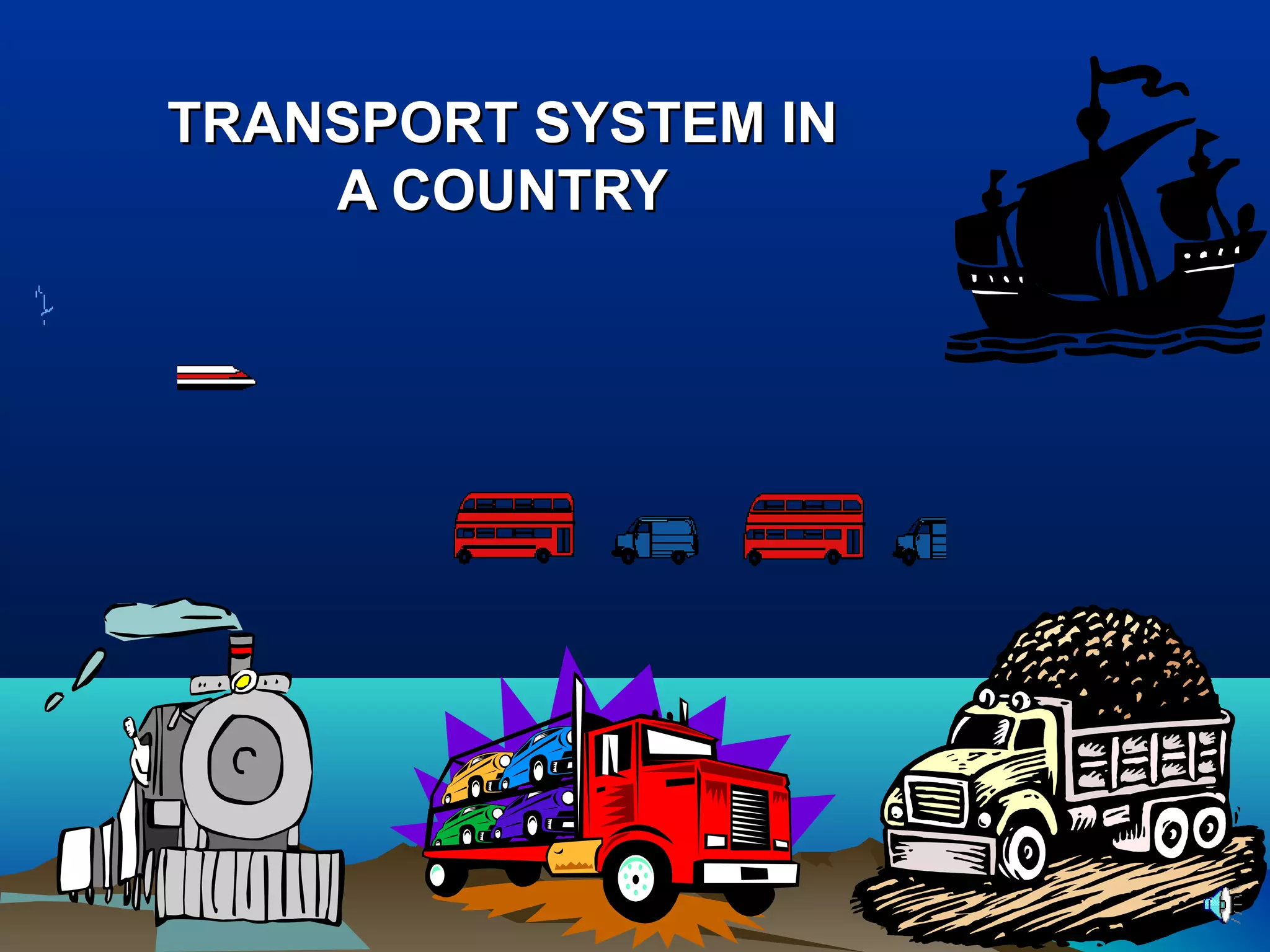
TRANSPORT SYSTEM INTRANSPORT SYSTEM IN
A COUNTRYA COUNTRY
33
Living things both plants and
animals including man need a
transport system
44
TRANSPORT SYSTEM INTRANSPORT SYSTEM IN
ANIMALSANIMALS
We need TRANSPORT when
• 2 cells are far away from each other
• materials needed to be moved from
one place to another place.
55
TRANSPORTATION INTRANSPORTATION IN
ANIMALSANIMALS
All organisms need food, water and oxygen forAll organisms need food, water and oxygen for
survivalsurvival
So they need to transport all these.So they need to transport all these.
Wastes also to be transported.Wastes also to be transported.
The system carrying on this function is calledThe system carrying on this function is called
circulatory systemcirculatory system..
It consists of blood, blood vessels and Heart.It consists of blood, blood vessels and Heart.
66
77
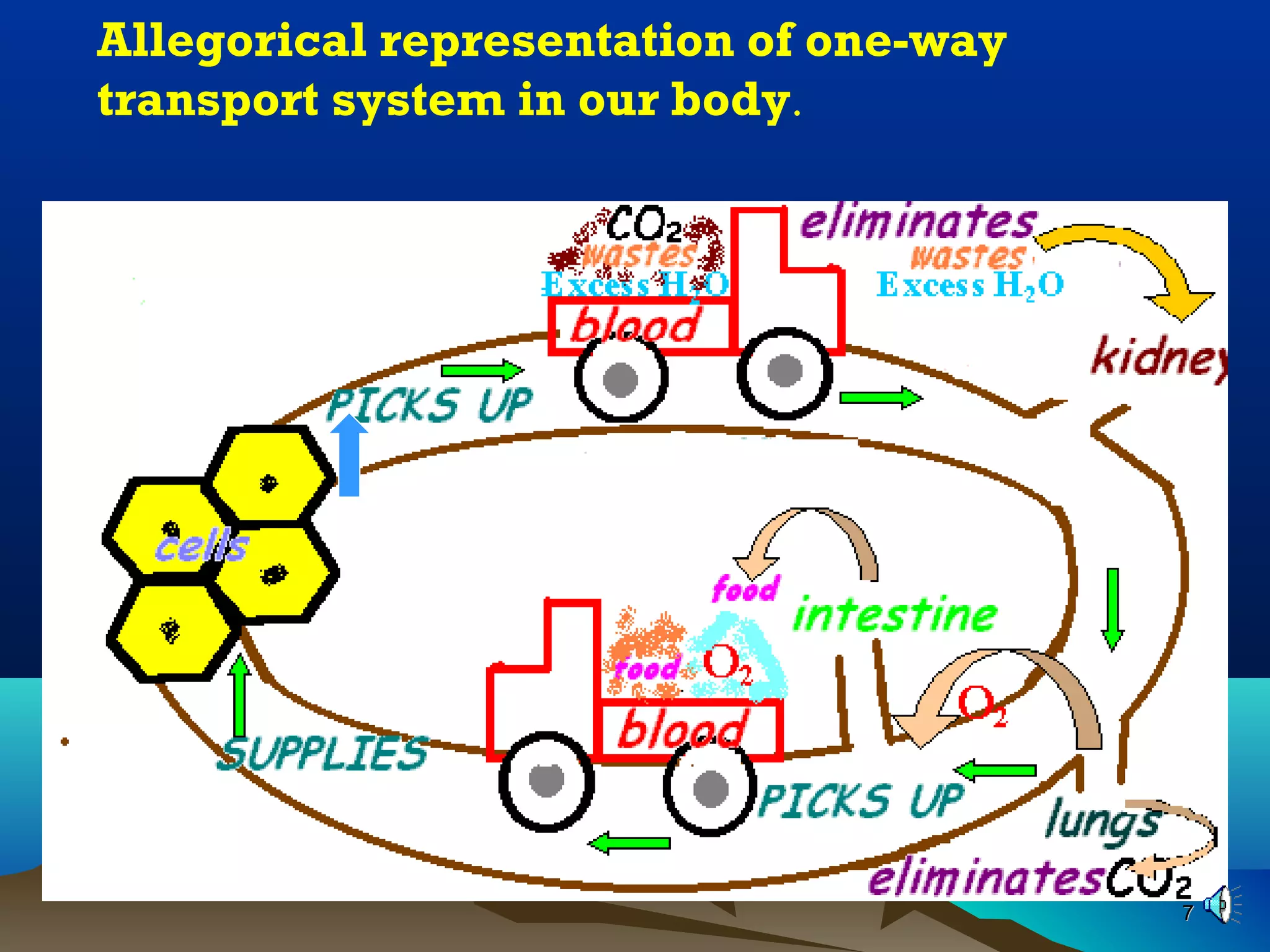
Allegorical representation of one-way
transport system in our body.
88
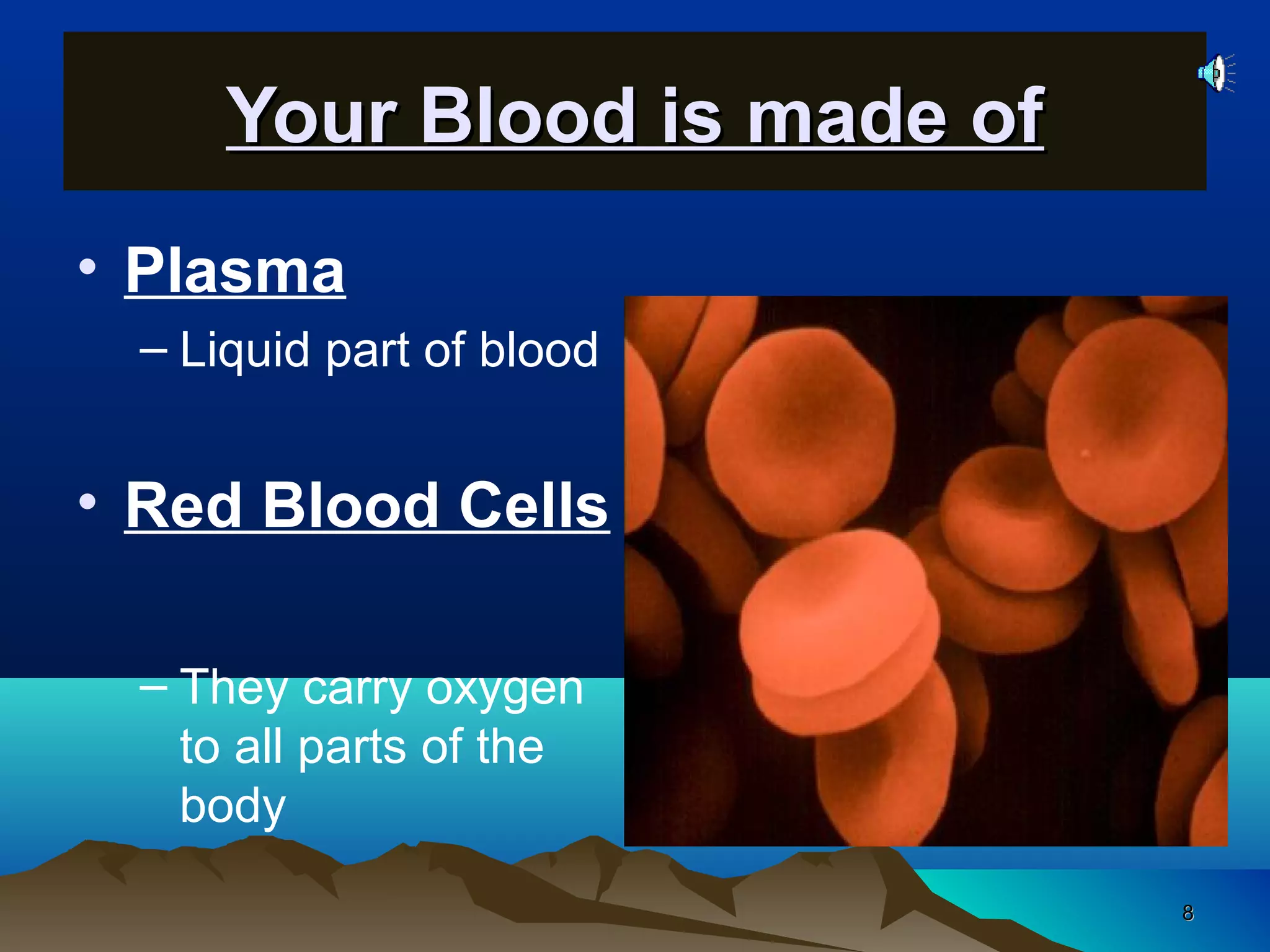
Your Blood is made ofYour Blood is made of
• Plasma
– Liquid part of blood
• Red Blood Cells
– They carry oxygen
to all parts of the
body
99
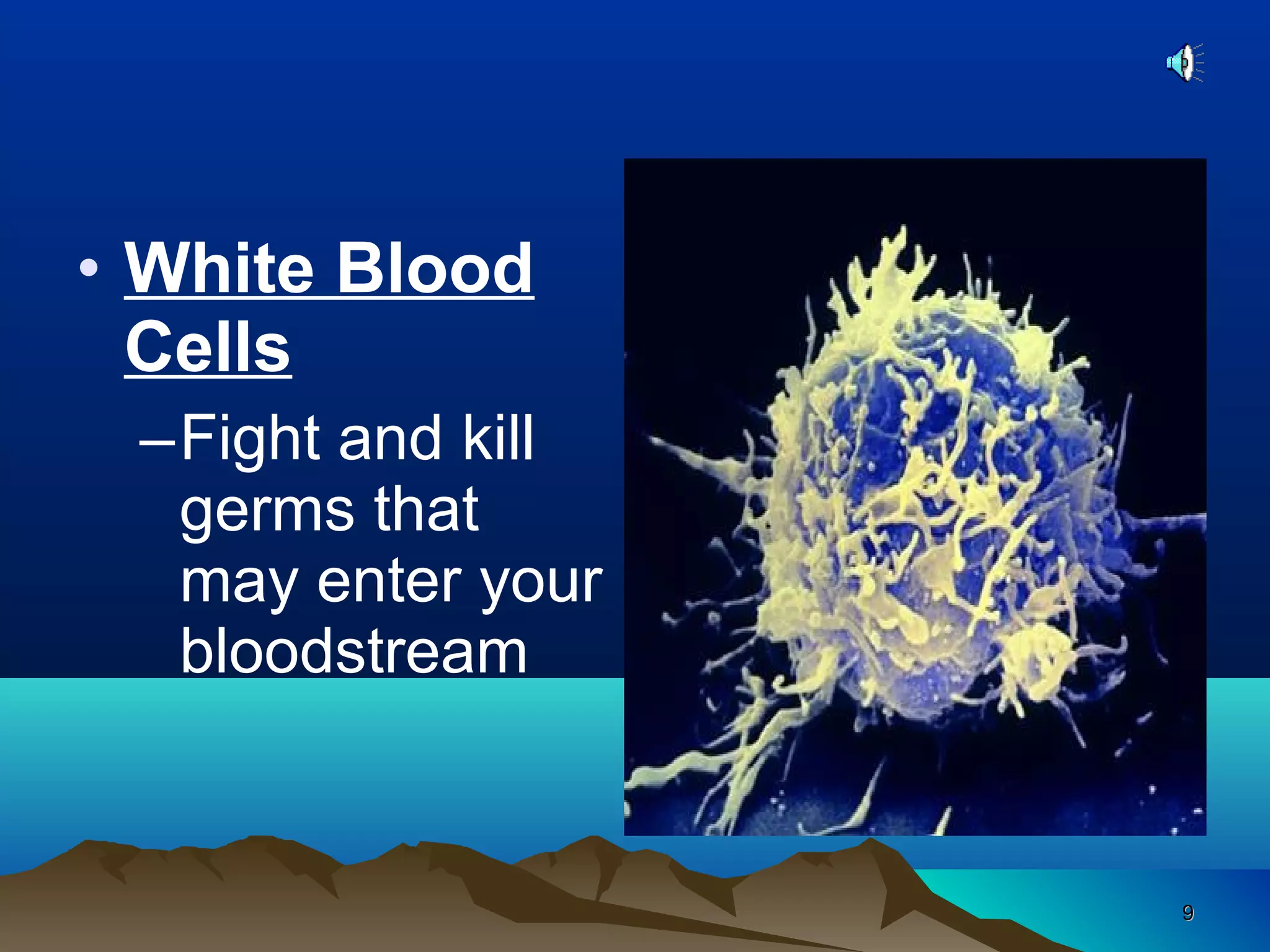
• White Blood
Cells
–Fight and kill
germs that
may enter your
bloodstream
1010
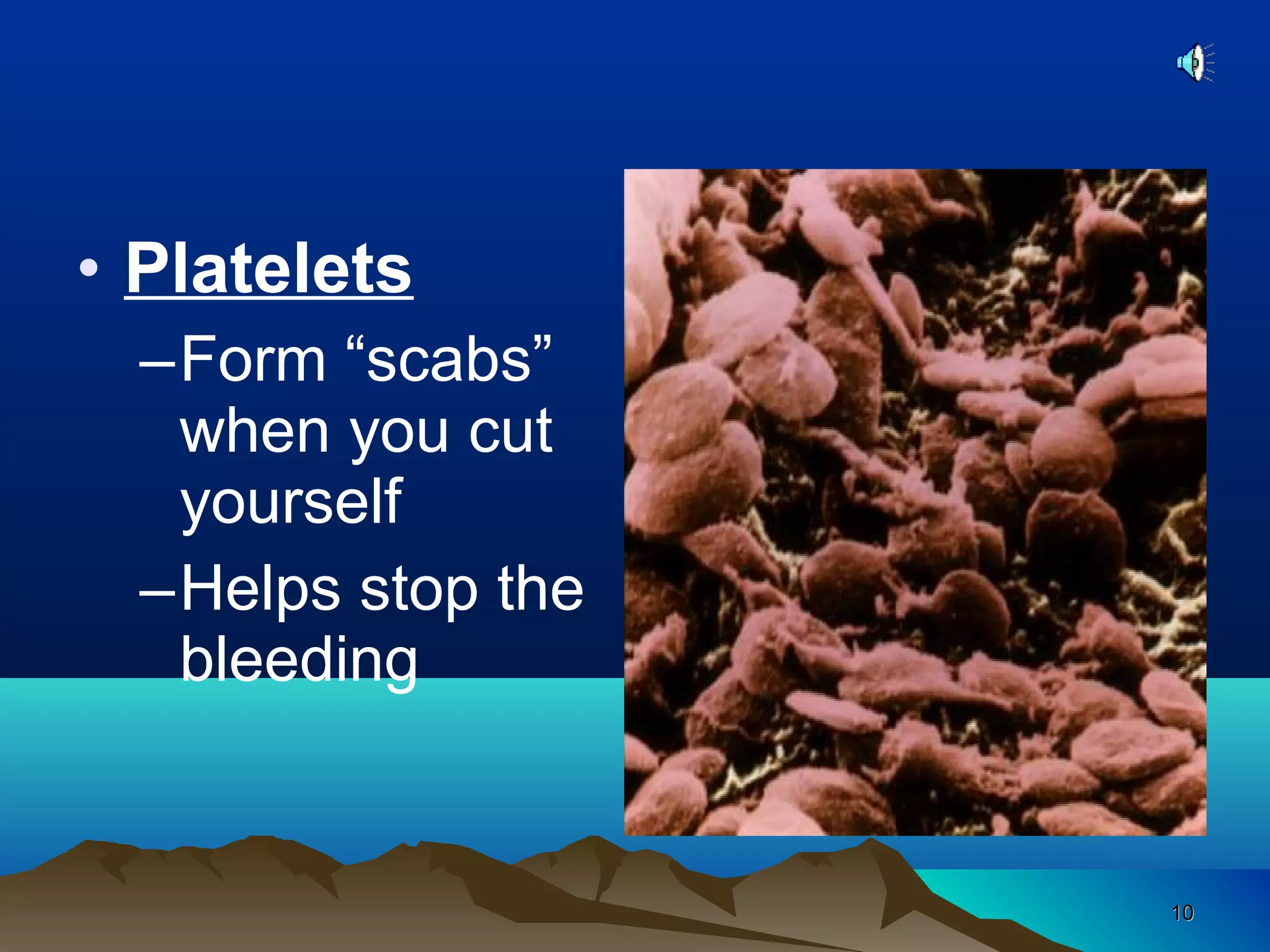
• Platelets
–Form “scabs”
when you cut
yourself
–Helps stop the
bleeding
1111
BLOODBLOOD
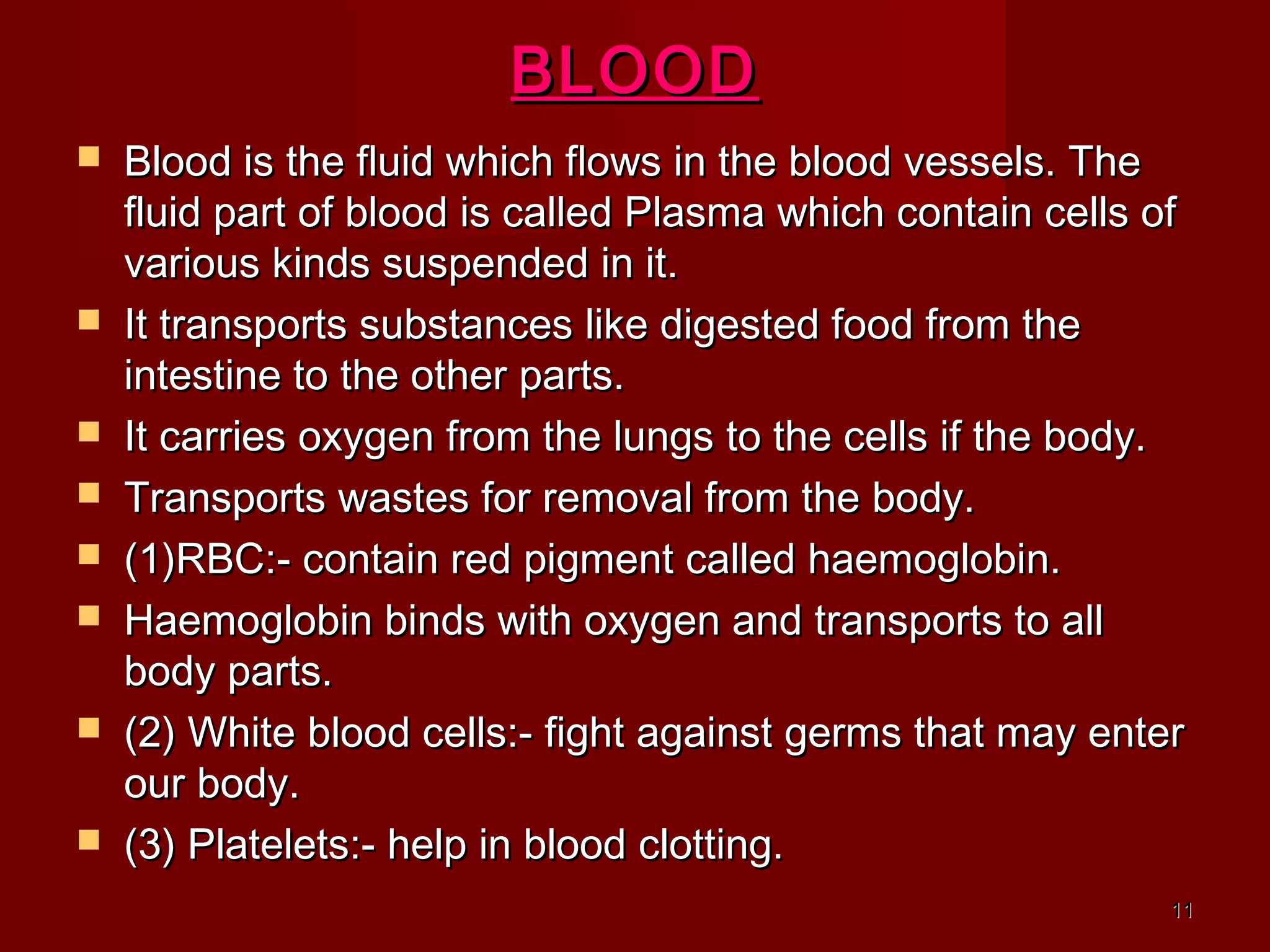
 Blood is the fluid which flows in the blood vessels. TheBlood is the fluid which flows in the blood vessels. The
fluid part of blood is called Plasma which contain cells offluid part of blood is called Plasma which contain cells of
various kinds suspended in it.various kinds suspended in it.
 It transports substances like digested food from theIt transports substances like digested food from the
intestine to the other parts.intestine to the other parts.
 It carries oxygen from the lungs to the cells if the body.It carries oxygen from the lungs to the cells if the body.
 Transports wastes for removal from the body.Transports wastes for removal from the body.
 (1)RBC:- contain red pigment called haemoglobin.(1)RBC:- contain red pigment called haemoglobin.
 Haemoglobin binds with oxygen and transports to allHaemoglobin binds with oxygen and transports to all
body parts.body parts.
 (2) White blood cells:- fight against germs that may enter(2) White blood cells:- fight against germs that may enter
our body.our body.
 (3) Platelets:- help in blood clotting.(3) Platelets:- help in blood clotting.
12
BLOOD CELLS
13
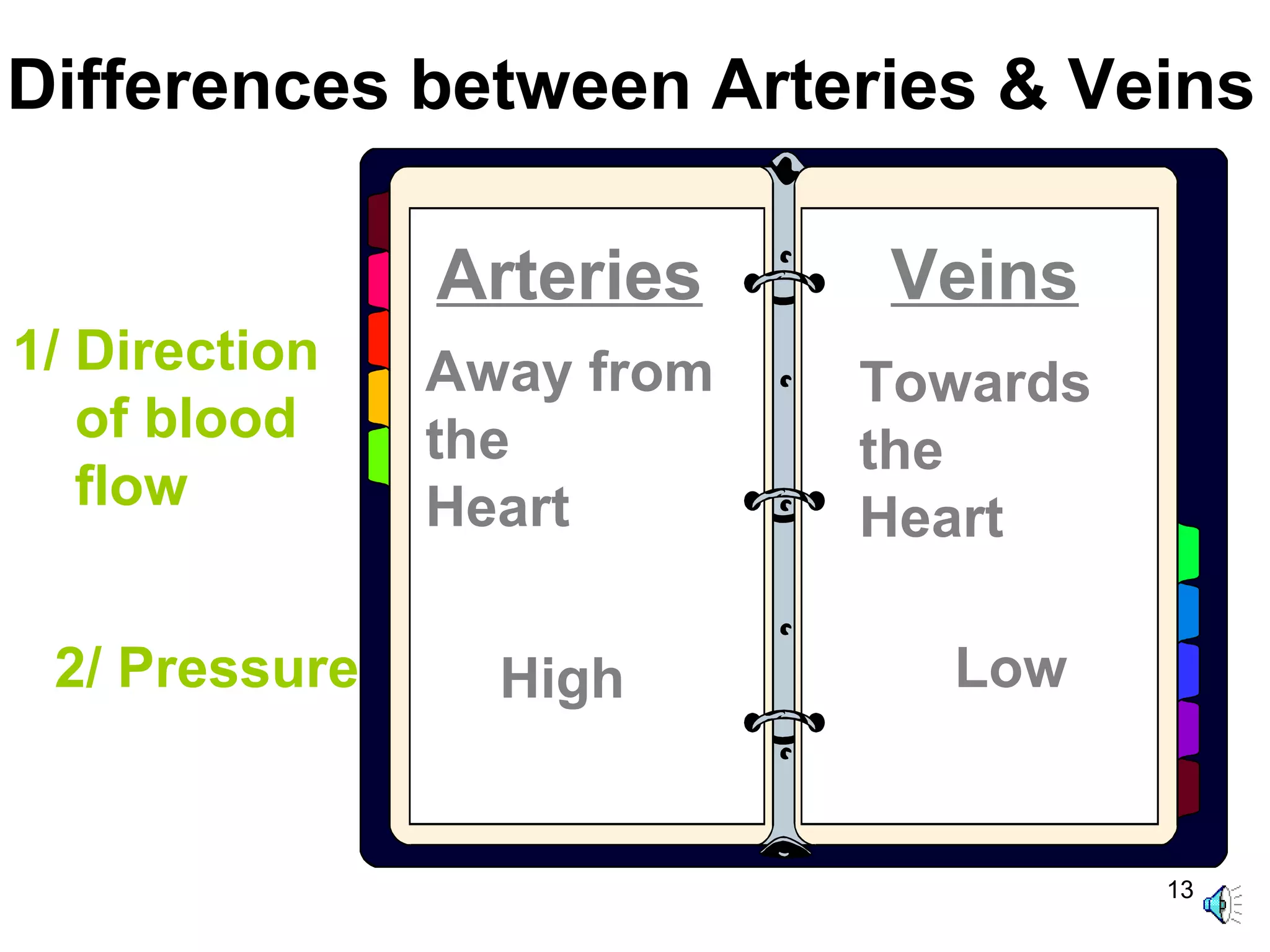
Differences between Arteries & Veins
Arteries Veins
1/ Direction
of blood
flow
2/ Pressure
Away from
the
Heart
Towards
the
Heart
High Low
14
Differences between Arteries & Veins
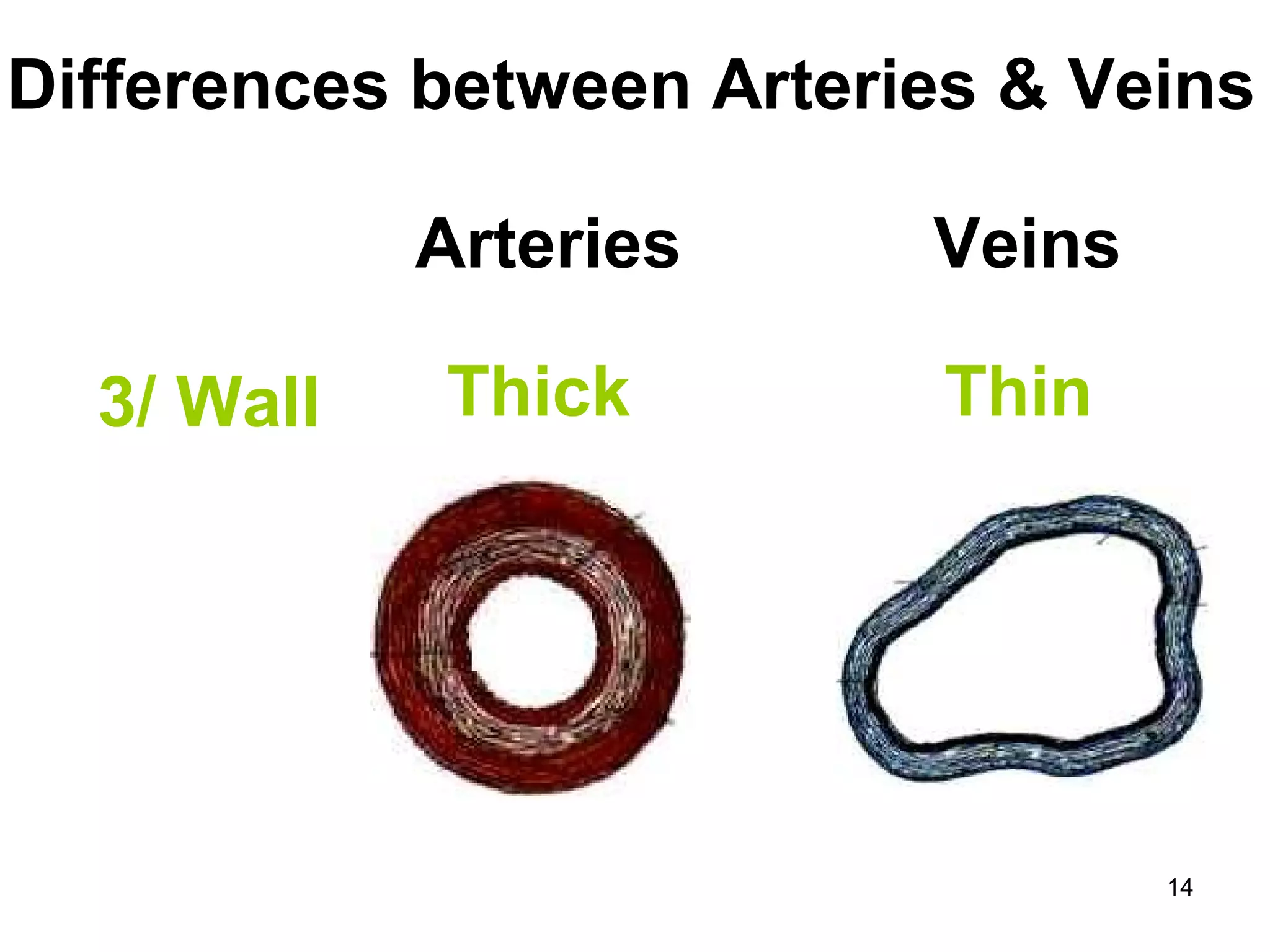
3/ Wall
Arteries Veins
Thick Thin
15
Differences between Arteries & Veins
4/ Valves
Arteries Veins
ABSENT PRESENT
Q. What’s the use of valve?
16
Valves promote One-way flow of
blood.
When Valve is opened
blood can flow
When Valve is closed
blood can’t
flow back
17
Arteries
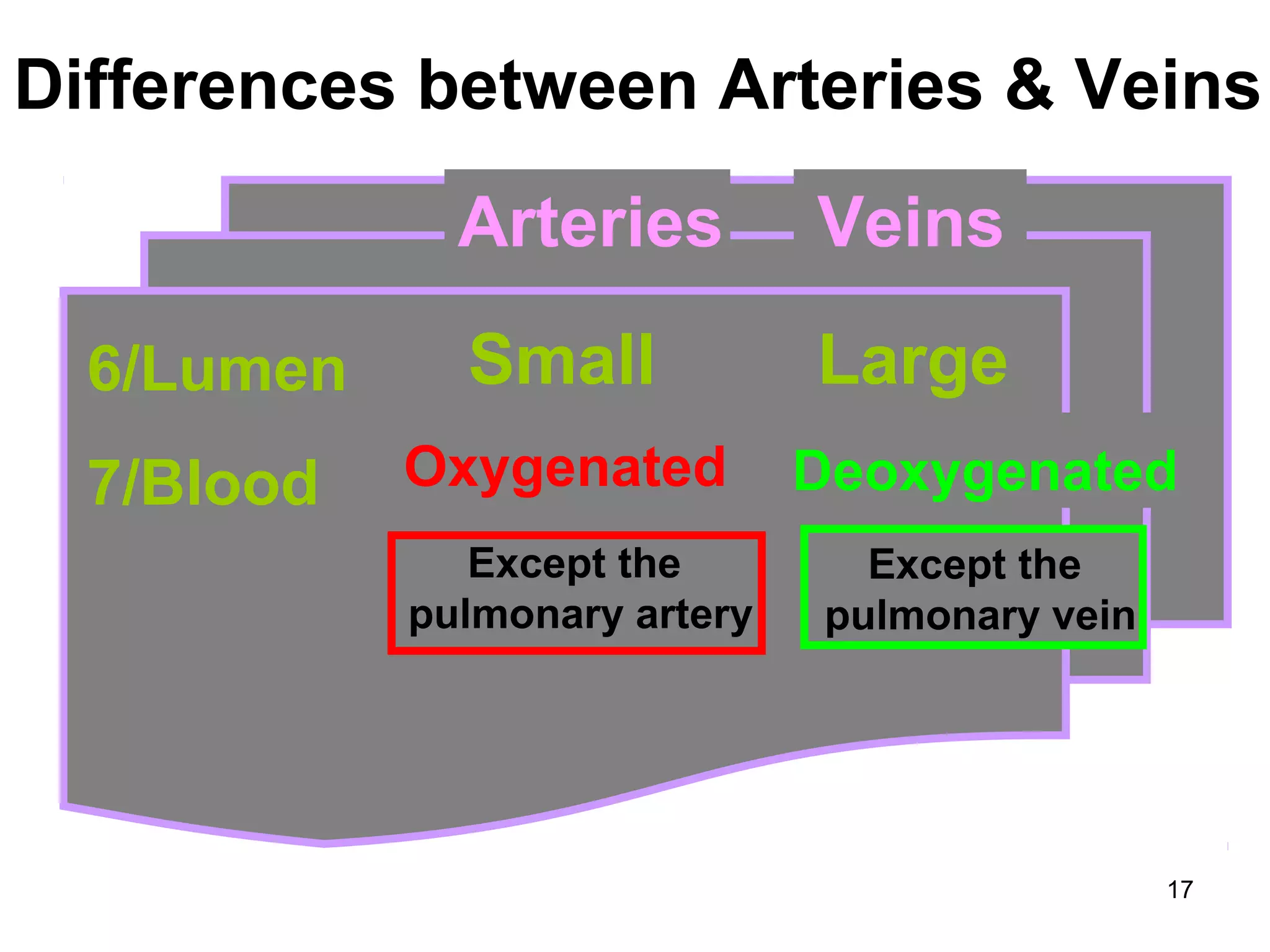
6/Lumen
7/Blood
Differences between Arteries & Veins
Veins
Small Large
Oxygenated Deoxygenated
Except the
pulmonary artery
Except the
pulmonary vein
1818
BLOODVESSESLSBLOODVESSESLS
 Two types ofTwo types of blood vesselsblood vessels. Arteries and veins.. Arteries and veins.
 Arteries carry oxygen rich blood from heart to all parts ofArteries carry oxygen rich blood from heart to all parts of
body.body.
 Veins carry co2 rich blood from all parts of the body backVeins carry co2 rich blood from all parts of the body back
to heart.to heart.
 Capillaries:- extremely thin tubes join up to form veins.Capillaries:- extremely thin tubes join up to form veins.
Differences between arteries and veins
1. Carry oxygen rich blood
from heart to body parts
2. Have thick elastic walls.
3. Blood pressure is high
and flow is rapid
4. No valves
1.Carry co2 rich blood from
All parts of body back to heart.
2. Have thin walls
3. Blood pressure is low.
4. Valves present.
1919
HeartHeart
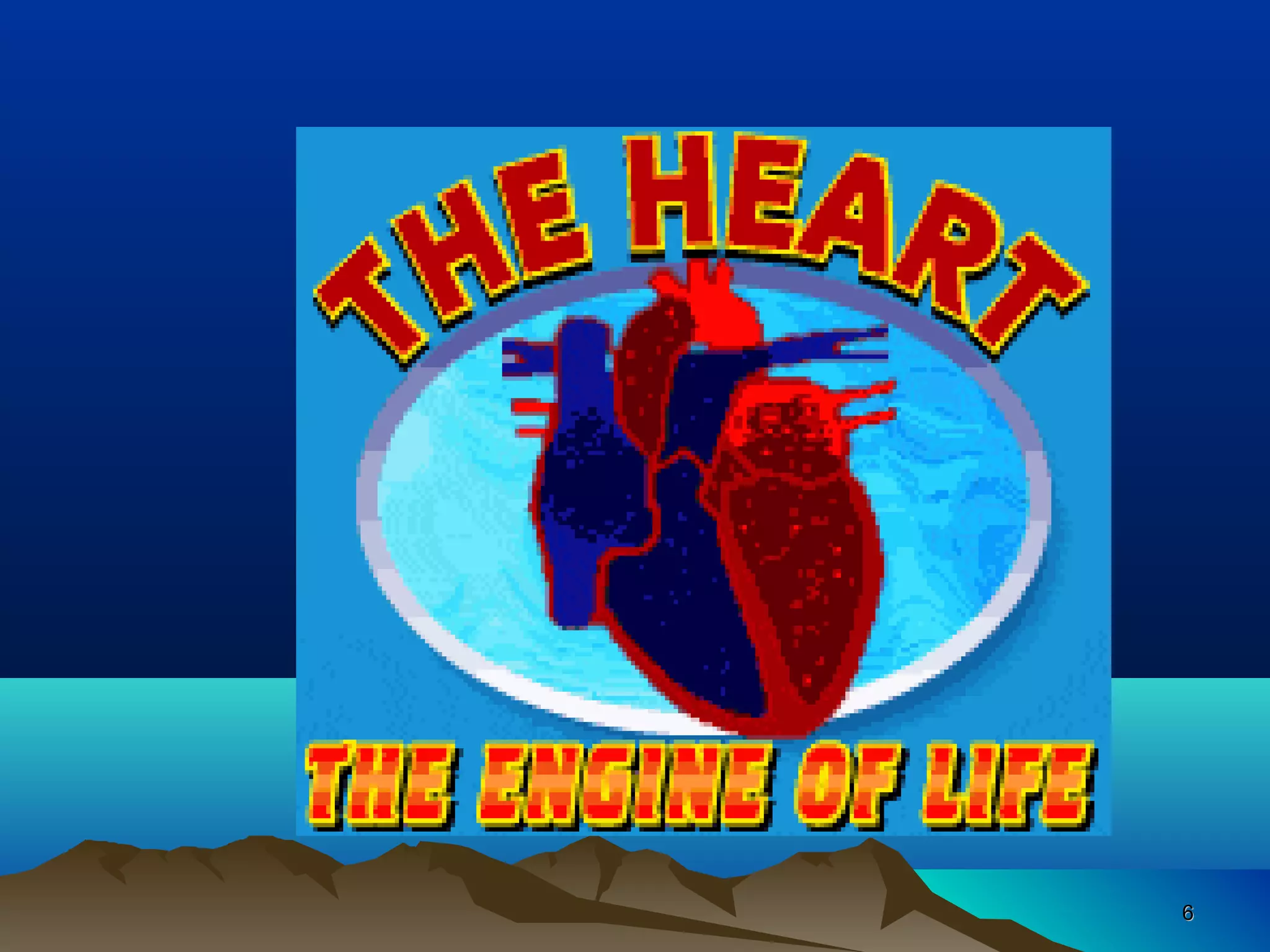
 it acts as a pump for transport of blood.it acts as a pump for transport of blood.
 It is located in the chest cavity with its lower tip slightlyIt is located in the chest cavity with its lower tip slightly
tilted towards the left.tilted towards the left.
 Heart has 4 chambers-Heart has 4 chambers- the two uppper chambersthe two uppper chambers
called ventricles and two lower chambers calledcalled ventricles and two lower chambers called
ventricles.ventricles.
 Heartbeat:- the rhythmical contraction abd relaxationHeartbeat:- the rhythmical contraction abd relaxation
constitute heart beat.constitute heart beat. StethoscopeStethoscope is used to feel theis used to feel the
heart beat.heart beat.
 Each heart beat generates one pulse in the arteries.Each heart beat generates one pulse in the arteries.
 Pulse rate per minute indicates the rate of heart.Pulse rate per minute indicates the rate of heart.
 Animals such as sponges and Hydra do not possess anyAnimals such as sponges and Hydra do not possess any
circulatory system. Exchange of materials takes placecirculatory system. Exchange of materials takes place
through water in which they live.through water in which they live.
2020
Excretory systemExcretory system
The process of removal of wastesThe process of removal of wastes
produced in the living cells is calledproduced in the living cells is called
excretion.excretion.
Excretory system in humans containExcretory system in humans contain
1.pair of kidneys1.pair of kidneys
2.ureters2.ureters
3.Urinary bladder3.Urinary bladder
4.urethra.4.urethra.
2121
Excretory system in HumansExcretory system in Humans
2222
2323
Excretory mechanismExcretory mechanism
When blood reaches to the kidneys theWhen blood reaches to the kidneys the
nephrons present in the kidneys filter thenephrons present in the kidneys filter the
blood . The useful substances areblood . The useful substances are
absorbed back into the blood and theabsorbed back into the blood and the
wastes dissolved in water are removed aswastes dissolved in water are removed as
urine. From the kidneys the urine goesurine. From the kidneys the urine goes
into the urinary bladder through ureters.itinto the urinary bladder through ureters.it
is stored in the bladder and is passed outis stored in the bladder and is passed out
through urethra.through urethra.
2424
2525
26
EXCRETION IN ANIMKALSEXCRETION IN ANIMKALS
 An adult human being normally pases about 1-1.8L of urine inAn adult human being normally pases about 1-1.8L of urine in
24 hrs.24 hrs.
 Urine consists 95% water, 2.5% urea and 2.5 % other wasteUrine consists 95% water, 2.5% urea and 2.5 % other waste
products.products.
2727
TRANSPORT OF SUBSTANCES IN PLANTSTRANSPORT OF SUBSTANCES IN PLANTS
 Transport of water and mineralsTransport of water and minerals:-:-
Plants absorb water and minerals by roots through rootPlants absorb water and minerals by roots through root
hairshairs
Plants have pipe like vessels to transport water andPlants have pipe like vessels to transport water and
nutrients.nutrients.
 A tissue is group of cells that perform specializedA tissue is group of cells that perform specialized
function in an organism.function in an organism.
 XylemXylem for transport of water and nutrients whilefor transport of water and nutrients while
phloem for transport of food.phloem for transport of food.
 Xylem and phloem together form vascular tissue.Xylem and phloem together form vascular tissue.
2828
TRANSPORT OF SUBSTANCES INTRANSPORT OF SUBSTANCES IN
PLANTSPLANTS
2929
TRANSPORT OF SUBSTANCES INTRANSPORT OF SUBSTANCES IN
PLANTSPLANTS
30
TRANSPIRATIONTRANSPIRATION
 the evaporation of water through the stomata present onthe evaporation of water through the stomata present on
the surface of leaves is calledthe surface of leaves is called transpiration.transpiration.
 Transpiration generates a suction pull which can pullTranspiration generates a suction pull which can pull
water to great heights in the tall trees.water to great heights in the tall trees.
 It causes cooling effect in plant.It causes cooling effect in plant.
31
AVOID PLASTICS AS FOR AS POSSIBLEAVOID PLASTICS AS FOR AS POSSIBLE
 As a responsible citizen remember the 4RAs a responsible citizen remember the 4R
principleprinciple
 ReduceReduce
 ReuseReuse
 RecycleRecycle
 RecoverRecover

11. Transportation in Animals and Plants by Dilip Kumar Chandra

  • 1.
  • 2.
    22 TRANSPORT SYSTEM INTRANSPORTSYSTEM IN A COUNTRYA COUNTRY
  • 3.
    33 Living things bothplants and animals including man need a transport system
  • 4.
    44 TRANSPORT SYSTEM INTRANSPORTSYSTEM IN ANIMALSANIMALS We need TRANSPORT when • 2 cells are far away from each other • materials needed to be moved from one place to another place.
  • 5.
    55 TRANSPORTATION INTRANSPORTATION IN ANIMALSANIMALS Allorganisms need food, water and oxygen forAll organisms need food, water and oxygen for survivalsurvival So they need to transport all these.So they need to transport all these. Wastes also to be transported.Wastes also to be transported. The system carrying on this function is calledThe system carrying on this function is called circulatory systemcirculatory system.. It consists of blood, blood vessels and Heart.It consists of blood, blood vessels and Heart.
  • 6.
  • 7.
    77 Allegorical representation ofone-way transport system in our body.
  • 8.
    88 Your Blood ismade ofYour Blood is made of • Plasma – Liquid part of blood • Red Blood Cells – They carry oxygen to all parts of the body
  • 9.
    99 • White Blood Cells –Fightand kill germs that may enter your bloodstream
  • 10.
    1010 • Platelets –Form “scabs” whenyou cut yourself –Helps stop the bleeding
  • 11.
    1111 BLOODBLOOD  Blood isthe fluid which flows in the blood vessels. TheBlood is the fluid which flows in the blood vessels. The fluid part of blood is called Plasma which contain cells offluid part of blood is called Plasma which contain cells of various kinds suspended in it.various kinds suspended in it.  It transports substances like digested food from theIt transports substances like digested food from the intestine to the other parts.intestine to the other parts.  It carries oxygen from the lungs to the cells if the body.It carries oxygen from the lungs to the cells if the body.  Transports wastes for removal from the body.Transports wastes for removal from the body.  (1)RBC:- contain red pigment called haemoglobin.(1)RBC:- contain red pigment called haemoglobin.  Haemoglobin binds with oxygen and transports to allHaemoglobin binds with oxygen and transports to all body parts.body parts.  (2) White blood cells:- fight against germs that may enter(2) White blood cells:- fight against germs that may enter our body.our body.  (3) Platelets:- help in blood clotting.(3) Platelets:- help in blood clotting.
  • 12.
  • 13.
    13 Differences between Arteries& Veins Arteries Veins 1/ Direction of blood flow 2/ Pressure Away from the Heart Towards the Heart High Low
  • 14.
    14 Differences between Arteries& Veins 3/ Wall Arteries Veins Thick Thin
  • 15.
    15 Differences between Arteries& Veins 4/ Valves Arteries Veins ABSENT PRESENT Q. What’s the use of valve?
  • 16.
    16 Valves promote One-wayflow of blood. When Valve is opened blood can flow When Valve is closed blood can’t flow back
  • 17.
    17 Arteries 6/Lumen 7/Blood Differences between Arteries& Veins Veins Small Large Oxygenated Deoxygenated Except the pulmonary artery Except the pulmonary vein
  • 18.
    1818 BLOODVESSESLSBLOODVESSESLS  Two typesofTwo types of blood vesselsblood vessels. Arteries and veins.. Arteries and veins.  Arteries carry oxygen rich blood from heart to all parts ofArteries carry oxygen rich blood from heart to all parts of body.body.  Veins carry co2 rich blood from all parts of the body backVeins carry co2 rich blood from all parts of the body back to heart.to heart.  Capillaries:- extremely thin tubes join up to form veins.Capillaries:- extremely thin tubes join up to form veins. Differences between arteries and veins 1. Carry oxygen rich blood from heart to body parts 2. Have thick elastic walls. 3. Blood pressure is high and flow is rapid 4. No valves 1.Carry co2 rich blood from All parts of body back to heart. 2. Have thin walls 3. Blood pressure is low. 4. Valves present.
  • 19.
    1919 HeartHeart  it actsas a pump for transport of blood.it acts as a pump for transport of blood.  It is located in the chest cavity with its lower tip slightlyIt is located in the chest cavity with its lower tip slightly tilted towards the left.tilted towards the left.  Heart has 4 chambers-Heart has 4 chambers- the two uppper chambersthe two uppper chambers called ventricles and two lower chambers calledcalled ventricles and two lower chambers called ventricles.ventricles.  Heartbeat:- the rhythmical contraction abd relaxationHeartbeat:- the rhythmical contraction abd relaxation constitute heart beat.constitute heart beat. StethoscopeStethoscope is used to feel theis used to feel the heart beat.heart beat.  Each heart beat generates one pulse in the arteries.Each heart beat generates one pulse in the arteries.  Pulse rate per minute indicates the rate of heart.Pulse rate per minute indicates the rate of heart.  Animals such as sponges and Hydra do not possess anyAnimals such as sponges and Hydra do not possess any circulatory system. Exchange of materials takes placecirculatory system. Exchange of materials takes place through water in which they live.through water in which they live.
  • 20.
    2020 Excretory systemExcretory system Theprocess of removal of wastesThe process of removal of wastes produced in the living cells is calledproduced in the living cells is called excretion.excretion. Excretory system in humans containExcretory system in humans contain 1.pair of kidneys1.pair of kidneys 2.ureters2.ureters 3.Urinary bladder3.Urinary bladder 4.urethra.4.urethra.
  • 21.
    2121 Excretory system inHumansExcretory system in Humans
  • 22.
  • 23.
    2323 Excretory mechanismExcretory mechanism Whenblood reaches to the kidneys theWhen blood reaches to the kidneys the nephrons present in the kidneys filter thenephrons present in the kidneys filter the blood . The useful substances areblood . The useful substances are absorbed back into the blood and theabsorbed back into the blood and the wastes dissolved in water are removed aswastes dissolved in water are removed as urine. From the kidneys the urine goesurine. From the kidneys the urine goes into the urinary bladder through ureters.itinto the urinary bladder through ureters.it is stored in the bladder and is passed outis stored in the bladder and is passed out through urethra.through urethra.
  • 24.
  • 25.
  • 26.
    26 EXCRETION IN ANIMKALSEXCRETIONIN ANIMKALS  An adult human being normally pases about 1-1.8L of urine inAn adult human being normally pases about 1-1.8L of urine in 24 hrs.24 hrs.  Urine consists 95% water, 2.5% urea and 2.5 % other wasteUrine consists 95% water, 2.5% urea and 2.5 % other waste products.products.
  • 27.
    2727 TRANSPORT OF SUBSTANCESIN PLANTSTRANSPORT OF SUBSTANCES IN PLANTS  Transport of water and mineralsTransport of water and minerals:-:- Plants absorb water and minerals by roots through rootPlants absorb water and minerals by roots through root hairshairs Plants have pipe like vessels to transport water andPlants have pipe like vessels to transport water and nutrients.nutrients.  A tissue is group of cells that perform specializedA tissue is group of cells that perform specialized function in an organism.function in an organism.  XylemXylem for transport of water and nutrients whilefor transport of water and nutrients while phloem for transport of food.phloem for transport of food.  Xylem and phloem together form vascular tissue.Xylem and phloem together form vascular tissue.
  • 28.
    2828 TRANSPORT OF SUBSTANCESINTRANSPORT OF SUBSTANCES IN PLANTSPLANTS
  • 29.
    2929 TRANSPORT OF SUBSTANCESINTRANSPORT OF SUBSTANCES IN PLANTSPLANTS
  • 30.
    30 TRANSPIRATIONTRANSPIRATION  the evaporationof water through the stomata present onthe evaporation of water through the stomata present on the surface of leaves is calledthe surface of leaves is called transpiration.transpiration.  Transpiration generates a suction pull which can pullTranspiration generates a suction pull which can pull water to great heights in the tall trees.water to great heights in the tall trees.  It causes cooling effect in plant.It causes cooling effect in plant.
  • 31.
    31 AVOID PLASTICS ASFOR AS POSSIBLEAVOID PLASTICS AS FOR AS POSSIBLE  As a responsible citizen remember the 4RAs a responsible citizen remember the 4R principleprinciple  ReduceReduce  ReuseReuse  RecycleRecycle  RecoverRecover