BIOLOGY MODULE 2012

LEARNING AREA : TRANSPORT

Activity 1 :The circulatory system in humans and animals

         The circulatory system is divided into a closed circulatory system and an open
 circulatory system. Humans, fish, amphibians and birds have a closed circulatory system,
 while insects have an open circulatory system. Unlike fish which have a single circulatory
 system, amphibians, birds and humans have a double circulatory system.
         The human circulatory system consists of blood, blood vessels and the heart. Blood
 is made up of blood cells and plasma. Blood cells consist of red blood cells, white blood cells
 and platelets. Plasma consists of water, plasma proteins, nutrients, metabolic waste,
 hormones and antibodies.
         Blood vessels are divided into three types; arteries, veins and capillaries.
         The heart is the organ that pumps blood, which carries all the vital materials that help
 the body function and waste products that the body does not need.


                                                                                                    1
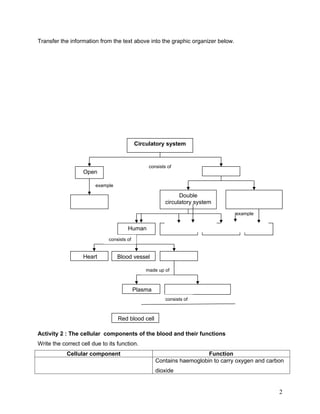
Transfer the information from the text above into the graphic organizer below.


                                            Circulatory system


                                                 consists of
                   Open

                        example

                                                               Double
                                                         circulatory system
                                                                                  example


                                       Human                   Birds                    Fish
                              consists of


                   Heart          Blood vessel

                                                made up of


                                            Plasma
                                                         consists of


                                  Red blood cell

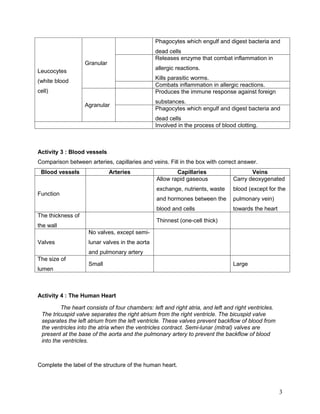
Activity 2 : The cellular components of the blood and their functions
Write the correct cell due to its function.
            Cellular component                                          Function
                                                     Contains haemoglobin to carry oxygen and carbon
                                                     dioxide


                                                                                                  2
Phagocytes which engulf and digest bacteria and
                                                dead cells
                                                Releases enzyme that combat inflammation in
                   Granular
                                                allergic reactions.
Leucocytes
                                                Kills parasitic worms.
(white blood
                                                Combats inflammation in allergic reactions.
cell)                                           Produces the immune response against foreign
                                                substances.
                   Agranular
                                                Phagocytes which engulf and digest bacteria and
                                                dead cells
                                                Involved in the process of blood clotting.


Activity 3 : Blood vessels
Comparison between arteries, capillaries and veins. Fill in the box with correct answer.
 Blood vessels                Arteries                  Capillaries                    Veins
                                                Allow rapid gaseous             Carry deoxygenated
                                                exchange, nutrients, waste      blood (except for the
Function
                                                and hormones between the        pulmonary vein)
                                                blood and cells                 towards the heart
The thickness of
                                                Thinnest (one-cell thick)
the wall
                    No valves, except semi-
Valves              lunar valves in the aorta
                    and pulmonary artery
The size of
                    Small                                                       Large
lumen


Activity 4 : The Human Heart

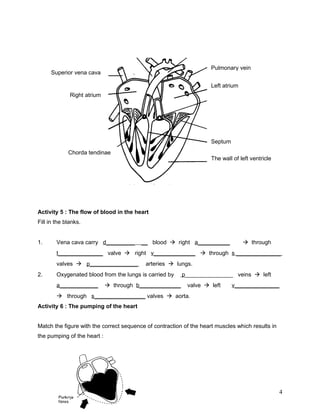
         The heart consists of four chambers: left and right atria, and left and right ventricles.
 The tricuspid valve separates the right atrium from the right ventricle. The bicuspid valve
 separates the left atrium from the left ventricle. These valves prevent backflow of blood from
 the ventricles into the atria when the ventricles contract. Semi-lunar (mitral) valves are
 present at the base of the aorta and the pulmonary artery to prevent the backflow of blood
 into the ventricles.


Complete the label of the structure of the human heart.


                                                                                                     3
Pulmonary vein
     Superior vena cava

                                                                    Left atrium
              Right atrium


                                                                    Septum
             Chorda tendinae
                                                                    The wall of left ventricle


Activity 5 : The flow of blood in the heart
Fill in the blanks.


1.      Vena cava carry d_________       __ blood  right a__________              through
        t______________ valve  right v_____________  through s ______________
        valves  p_______________         arteries  lungs.
2.      Oxygenated blood from the lungs is carried by    p_______________ veins  left
        a____________         through b_____________      valve  left      v______________
         through s________________ valves  aorta.
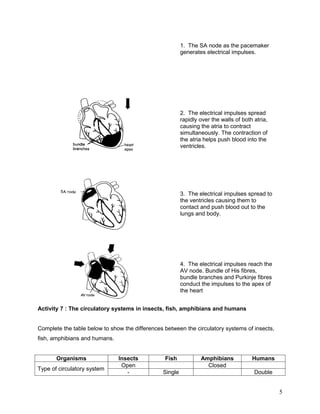
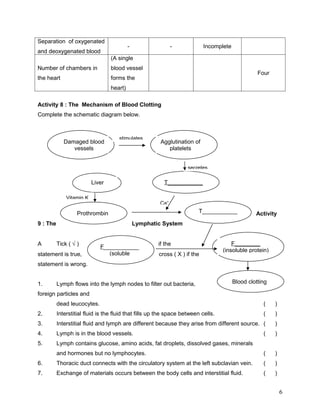
Activity 6 : The pumping of the heart


Match the figure with the correct sequence of contraction of the heart muscles which results in
the pumping of the heart :


                                                                                                  4
1. The SA node as the pacemaker
                                                         generates electrical impulses.


                                                         2. The electrical impulses spread
                                                         rapidly over the walls of both atria,
                                                         causing the atria to contract
                                                         simultaneously. The contraction of
                                                         the atria helps push blood into the
                                                         ventricles.


                                                         3. The electrical impulses spread to
                                                         the ventricles causing them to
                                                         contact and push blood out to the
                                                         lungs and body.


                                                         4. The electrical impulses reach the
                                                         AV node. Bundle of His fibres,
                                                         bundle branches and Purkinje fibres
                                                         conduct the impulses to the apex of
                                                         the heart


Activity 7 : The circulatory systems in insects, fish, amphibians and humans


Complete the table below to show the differences between the circulatory systems of insects,
fish, amphibians and humans.


       Organisms               Insects           Fish            Amphibians            Humans
                                Open                               Closed
Type of circulatory system
                                  -             Single                                  Double


                                                                                                 5
Separation of oxygenated
                                           -                 -              Incomplete
and deoxygenated blood
                                  (A single
Number of chambers in             blood vessel
                                                                                                   Four
the heart                         forms the
                                  heart)

Activity 8 : The Mechanism of Blood Clotting
Complete the schematic diagram below.


                                     stimulates
             Damaged blood                              Agglutination of
                vessels                                    platelets


                                                                    secretes

                          Liver                          T___________

              Vitamin K
                                                       Ca+
                   Prothrombin                                           T___________             Activity
                                                                              _
9 : The                                        Lymphatic System


A         Tick ( √ )                                   if the                          F________
                             F___________
                                                                                   (insoluble protein)
statement is true,              (soluble               cross ( X ) if the
statement is wrong.


1.        Lymph flows into the lymph nodes to filter out bacteria,                       Blood clotting

foreign particles and
          dead leucocytes.                                                                           (    )
2.        Interstitial fluid is the fluid that fills up the space between cells.                     (    )
3.        Interstitial fluid and lymph are different because they arise from different source. (          )
4.        Lymph is in the blood vessels.                                                             (    )
5.        Lymph contains glucose, amino acids, fat droplets, dissolved gases, minerals
          and hormones but no lymphocytes.                                                           (    )
6.        Thoracic duct connects with the circulatory system at the left subclavian vein.            (    )
7.        Exchange of materials occurs between the body cells and interstitial fluid.                (    )


                                                                                                              6
8.      Interstitial fluid is formed due to high pressure in the body cells.                           (    )
9.      Fatty acids and glycerol are transported by lacteal into the right lymphatic duct
        to be returned to the circulatory system.                                                      (    )
10.     Interstitial fluid that fails to return to the circulatory system can cause oedema.            (    )


B       Fill in the blanks the correct word to explain the concepts and facts regarding the
        lymphatic system.


1.      The flow of lymph in the lymphatic vessels is aided by the contraction of s___________
        m_____________             around it.


2.      Interstitial fluid is returned to the circulatory system in two ways :
        (a)      by diffusing back into the        t           d            and the       r        ________
                 l                         d___________
        (b)      through the       c_______________        into the circulatory system.


Activity 10 : The Body’s Defence Mechanism


Complete the schematic diagram below.


                                                Lymphatic system

                                                           is involved
                                                                in
                                            Defence mechanism

                                                          is divided into


               First                          S__________                     T_________
         line of defence                    _______________                 _______________

                                                          consists of                         consists of

                     consists of
                                                Phagocytic white                 Lymphocyte
                                                                                                                7
                            M________              blood cell
      S_______             m__________
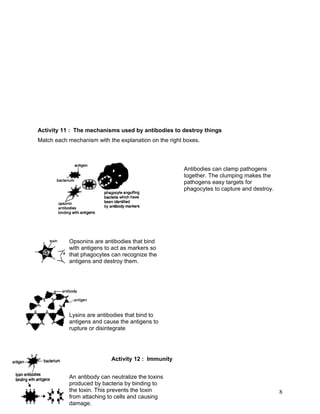
Activity 11 : The mechanisms used by antibodies to destroy things
Match each mechanism with the explanation on the right boxes.


                                                       Antibodies can clamp pathogens
                                                       together. The clumping makes the
                                                       pathogens easy targets for
                                                       phagocytes to capture and destroy.


           Opsonins are antibodies that bind
           with antigens to act as markers so
           that phagocytes can recognize the
           antigens and destroy them.


           Lysins are antibodies that bind to
           antigens and cause the antigens to
           rupture or disintegrate


                           Activity 12 : Immunity


           An antibody can neutralize the toxins
           produced by bacteria by binding to
           the toxin. This prevents the toxin                                               8
           from attaching to cells and causing
           damage.
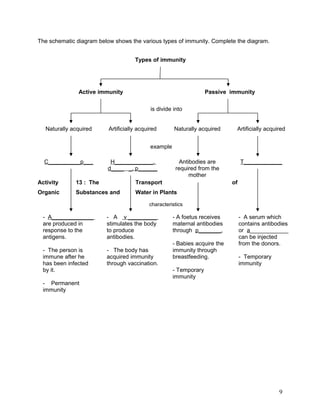
The schematic diagram below shows the various types of immunity. Complete the diagram.


                                     Types of immunity


               Active immunity                                      Passive immunity

                                            is divide into


   Naturally acquired     Artificially acquired       Naturally acquired      Artificially acquired


                                            example

  C__________p___          H____________,               Antibodies are            T____________
                          d____ _, p______             required from the
                                                            mother
Activity      13 : The               Transport                               of
Organic       Substances and         Water in Plants

                                           characteristics

 - A_____________        - A v _________              - A foetus receives         - A serum which
 are produced in         stimulates the body          maternal antibodies         contains antibodies
 response to the         to produce                   through p_______.           or a____________
 antigens.               antibodies.                                              can be injected
                                                      - Babies acquire the        from the donors.
 - The person is         - The body has               immunity through
 immune after he         acquired immunity            breastfeeding.              - Temporary
 has been infected       through vaccination.                                     immunity
 by it.                                               - Temporary
                                                      immunity
 - Permanent
 immunity


                                                                                                 9
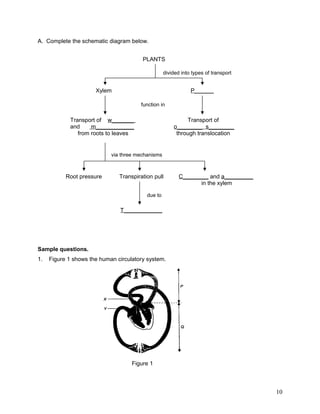
A. Complete the schematic diagram below.


                                        PLANTS

                                                   divided into types of transport


                      Xylem                                    P______

                                       function in

             Transport of w_______                          Transport of
             and     m____________                     o________ s________
                from roots to leaves                    through translocation


                            via three mechanisms


           Root pressure       Transpiration pull         C________ and a_________
                                                                 in the xylem

                                          due to

                               T____________


Sample questions.
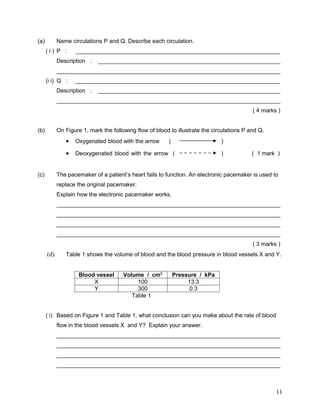
1.   Figure 1 shows the human circulatory system.


                                    Figure 1


                                                                                     10
(a)         Name circulations P and Q. Describe each circulation.
      (i) P :      ________________________________________________________________
            Description :    _________________________________________________________
            ______________________________________________________________________
      (i i) Q :    ________________________________________________________________
            Description :    _________________________________________________________
            ______________________________________________________________________
                                                                                            ( 4 marks )


(b)         On Figure 1, mark the following flow of blood to illustrate the circulations P and Q.
               •   Oxygenated blood with the arrow        (                    )

               •   Deoxygenated blood with the arrow (                         )            ( 1 mark )


(c)         The pacemaker of a patient’s heart fails to function. An electronic pacemaker is used to
            replace the original pacemaker.
            Explain how the electronic pacemaker works.
            ______________________________________________________________________
            ______________________________________________________________________
            ______________________________________________________________________
            ______________________________________________________________________
                                                                                            ( 3 marks )
      (d)      Table 1 shows the volume of blood and the blood pressure in blood vessels X and Y.


                     Blood vessel      Volume / cm3           Pressure / kPa
                          X                 100                    13.3
                          Y                 300                     0.3
                                          Table 1


      ( i) Based on Figure 1 and Table 1, what conclusion can you make about the rate of blood
            flow in the blood vessels X and Y? Explain your answer.
            ______________________________________________________________________
            ______________________________________________________________________
            ______________________________________________________________________
            ______________________________________________________________________


                                                                                                     11
( 2 marks )
      (ii) Explain how vigorous exercise increase the blood flow in the blood vessel X.
          ______________________________________________________________________
          ______________________________________________________________________
          ______________________________________________________________________
                                                                                          ( 2 marks )


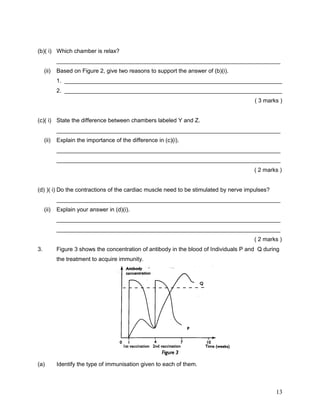
2.     Figure 2 shows left half of the human heart.


                                        Figure 2
(a)       On Figure 2,
          ( i) complete the right half of the heart and label the drawn parts.
          (ii) draw an arrow to show the flow of blood.                                   ( 3 marks )


                                                                                                   12
(b)( i) Which chamber is relax?
            ______________________________________________________________________
     (ii)   Based on Figure 2, give two reasons to support the answer of (b)(i).
            1. ____________________________________________________________________
            2. ____________________________________________________________________
                                                                                         ( 3 marks )


(c)( i) State the difference between chambers labeled Y and Z.
            ______________________________________________________________________
     (ii)   Explain the importance of the difference in (c)(i).
            ______________________________________________________________________
            ______________________________________________________________________
                                                                                         ( 2 marks )


(d) )( i) Do the contractions of the cardiac muscle need to be stimulated by nerve impulses?
            ______________________________________________________________________
     (ii)   Explain your answer in (d)(i).
            ______________________________________________________________________
            ______________________________________________________________________
                                                                                         ( 2 marks )
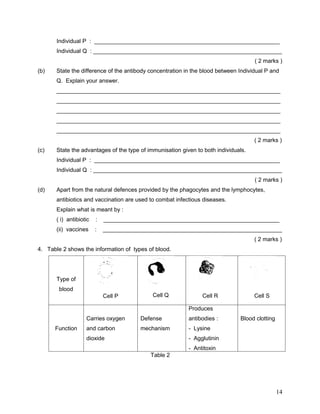
3.          Figure 3 shows the concentration of antibody in the blood of Individuals P and Q during
            the treatment to acquire immunity.


(a)         Identify the type of immunisation given to each of them.


                                                                                                 13
Individual P : __________________________________________________________
       Individual Q : ___________________________________________________________
                                                                                     ( 2 marks )
(b)    State the difference of the antibody concentration in the blood between Individual P and
       Q. Explain your answer.
       ______________________________________________________________________
       ______________________________________________________________________
       ______________________________________________________________________
       ______________________________________________________________________
       ______________________________________________________________________
                                                                                     ( 2 marks )
(c)    State the advantages of the type of immunisation given to both individuals.
       Individual P : __________________________________________________________
       Individual Q : ___________________________________________________________
                                                                                     ( 2 marks )
(d)    Apart from the natural defences provided by the phagocytes and the lymphocytes,
       antibiotics and vaccination are used to combat infectious diseases.
       Explain what is meant by :
       ( i) antibiotic   :   _______________________________________________________
       (ii) vaccines     :   ________________________________________________________
                                                                                     ( 2 marks )
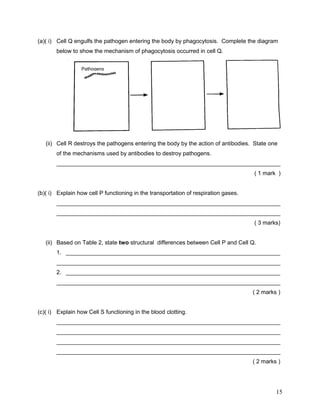
4. Table 2 shows the information of types of blood.


       Type of
        blood
                             Cell P          Cell Q             Cell R               Cell S

                                                           Produces
                    Carries oxygen      Defense            antibodies :        Blood clotting
      Function      and carbon          mechanism          - Lysine
                    dioxide                                - Agglutinin
                                                           - Antitoxin
                                            Table 2


                                                                                                14
(a)( i) Cell Q engulfs the pathogen entering the body by phagocytosis. Complete the diagram
       below to show the mechanism of phagocytosis occurred in cell Q.


                 Pathogens


   (ii) Cell R destroys the pathogens entering the body by the action of antibodies. State one
       of the mechanisms used by antibodies to destroy pathogens.
       ______________________________________________________________________
                                                                                     ( 1 mark )


(b)( i) Explain how cell P functioning in the transportation of respiration gases.
       ______________________________________________________________________
       ______________________________________________________________________
                                                                                     ( 3 marks)


   (ii) Based on Table 2, state two structural differences between Cell P and Cell Q.
       1. ___________________________________________________________________
       ______________________________________________________________________
       2. ___________________________________________________________________
       ______________________________________________________________________
                                                                                     ( 2 marks )


(c)( i) Explain how Cell S functioning in the blood clotting.
       ______________________________________________________________________
       ______________________________________________________________________
       ______________________________________________________________________
       ______________________________________________________________________
                                                                                     ( 2 marks )


                                                                                              15
(ii) Write down two enzymic reactions in the mechanism of blood clotting.


    1.


    2.


                                                                            ( 2 marks )


Nama:……………………………………………………
                            Ole-ole Biologi
Tingkatan :………………………………………………
             FORM 5 : CHAPTER 1
Nama Guru:……………………………………………...  16

                TRANSPORT

Module question-chapter-transport

  • 1.
    BIOLOGY MODULE 2012 LEARNINGAREA : TRANSPORT Activity 1 :The circulatory system in humans and animals The circulatory system is divided into a closed circulatory system and an open circulatory system. Humans, fish, amphibians and birds have a closed circulatory system, while insects have an open circulatory system. Unlike fish which have a single circulatory system, amphibians, birds and humans have a double circulatory system. The human circulatory system consists of blood, blood vessels and the heart. Blood is made up of blood cells and plasma. Blood cells consist of red blood cells, white blood cells and platelets. Plasma consists of water, plasma proteins, nutrients, metabolic waste, hormones and antibodies. Blood vessels are divided into three types; arteries, veins and capillaries. The heart is the organ that pumps blood, which carries all the vital materials that help the body function and waste products that the body does not need. 1
  • 2.
    Transfer the informationfrom the text above into the graphic organizer below. Circulatory system consists of Open example Double circulatory system example Human Birds Fish consists of Heart Blood vessel made up of Plasma consists of Red blood cell Activity 2 : The cellular components of the blood and their functions Write the correct cell due to its function. Cellular component Function Contains haemoglobin to carry oxygen and carbon dioxide 2
  • 3.
    Phagocytes which engulfand digest bacteria and dead cells Releases enzyme that combat inflammation in Granular allergic reactions. Leucocytes Kills parasitic worms. (white blood Combats inflammation in allergic reactions. cell) Produces the immune response against foreign substances. Agranular Phagocytes which engulf and digest bacteria and dead cells Involved in the process of blood clotting. Activity 3 : Blood vessels Comparison between arteries, capillaries and veins. Fill in the box with correct answer. Blood vessels Arteries Capillaries Veins Allow rapid gaseous Carry deoxygenated exchange, nutrients, waste blood (except for the Function and hormones between the pulmonary vein) blood and cells towards the heart The thickness of Thinnest (one-cell thick) the wall No valves, except semi- Valves lunar valves in the aorta and pulmonary artery The size of Small Large lumen Activity 4 : The Human Heart The heart consists of four chambers: left and right atria, and left and right ventricles. The tricuspid valve separates the right atrium from the right ventricle. The bicuspid valve separates the left atrium from the left ventricle. These valves prevent backflow of blood from the ventricles into the atria when the ventricles contract. Semi-lunar (mitral) valves are present at the base of the aorta and the pulmonary artery to prevent the backflow of blood into the ventricles. Complete the label of the structure of the human heart. 3
  • 4.
    Pulmonary vein Superior vena cava Left atrium Right atrium Septum Chorda tendinae The wall of left ventricle Activity 5 : The flow of blood in the heart Fill in the blanks. 1. Vena cava carry d_________ __ blood  right a__________  through t______________ valve  right v_____________  through s ______________ valves  p_______________ arteries  lungs. 2. Oxygenated blood from the lungs is carried by p_______________ veins  left a____________  through b_____________ valve  left v______________  through s________________ valves  aorta. Activity 6 : The pumping of the heart Match the figure with the correct sequence of contraction of the heart muscles which results in the pumping of the heart : 4
  • 5.
    1. The SAnode as the pacemaker generates electrical impulses. 2. The electrical impulses spread rapidly over the walls of both atria, causing the atria to contract simultaneously. The contraction of the atria helps push blood into the ventricles. 3. The electrical impulses spread to the ventricles causing them to contact and push blood out to the lungs and body. 4. The electrical impulses reach the AV node. Bundle of His fibres, bundle branches and Purkinje fibres conduct the impulses to the apex of the heart Activity 7 : The circulatory systems in insects, fish, amphibians and humans Complete the table below to show the differences between the circulatory systems of insects, fish, amphibians and humans. Organisms Insects Fish Amphibians Humans Open Closed Type of circulatory system - Single Double 5
  • 6.
    Separation of oxygenated - - Incomplete and deoxygenated blood (A single Number of chambers in blood vessel Four the heart forms the heart) Activity 8 : The Mechanism of Blood Clotting Complete the schematic diagram below. stimulates Damaged blood Agglutination of vessels platelets secretes Liver T___________ Vitamin K Ca+ Prothrombin T___________ Activity _ 9 : The Lymphatic System A Tick ( √ ) if the F________ F___________ (insoluble protein) statement is true, (soluble cross ( X ) if the statement is wrong. 1. Lymph flows into the lymph nodes to filter out bacteria, Blood clotting foreign particles and dead leucocytes. ( ) 2. Interstitial fluid is the fluid that fills up the space between cells. ( ) 3. Interstitial fluid and lymph are different because they arise from different source. ( ) 4. Lymph is in the blood vessels. ( ) 5. Lymph contains glucose, amino acids, fat droplets, dissolved gases, minerals and hormones but no lymphocytes. ( ) 6. Thoracic duct connects with the circulatory system at the left subclavian vein. ( ) 7. Exchange of materials occurs between the body cells and interstitial fluid. ( ) 6
  • 7.
    8. Interstitial fluid is formed due to high pressure in the body cells. ( ) 9. Fatty acids and glycerol are transported by lacteal into the right lymphatic duct to be returned to the circulatory system. ( ) 10. Interstitial fluid that fails to return to the circulatory system can cause oedema. ( ) B Fill in the blanks the correct word to explain the concepts and facts regarding the lymphatic system. 1. The flow of lymph in the lymphatic vessels is aided by the contraction of s___________ m_____________ around it. 2. Interstitial fluid is returned to the circulatory system in two ways : (a) by diffusing back into the t d and the r ________ l d___________ (b) through the c_______________ into the circulatory system. Activity 10 : The Body’s Defence Mechanism Complete the schematic diagram below. Lymphatic system is involved in Defence mechanism is divided into First S__________ T_________ line of defence _______________ _______________ consists of consists of consists of Phagocytic white Lymphocyte 7 M________ blood cell S_______ m__________
  • 8.
    Activity 11 :The mechanisms used by antibodies to destroy things Match each mechanism with the explanation on the right boxes. Antibodies can clamp pathogens together. The clumping makes the pathogens easy targets for phagocytes to capture and destroy. Opsonins are antibodies that bind with antigens to act as markers so that phagocytes can recognize the antigens and destroy them. Lysins are antibodies that bind to antigens and cause the antigens to rupture or disintegrate Activity 12 : Immunity An antibody can neutralize the toxins produced by bacteria by binding to the toxin. This prevents the toxin 8 from attaching to cells and causing damage.
  • 9.
    The schematic diagrambelow shows the various types of immunity. Complete the diagram. Types of immunity Active immunity Passive immunity is divide into Naturally acquired Artificially acquired Naturally acquired Artificially acquired example C__________p___ H____________, Antibodies are T____________ d____ _, p______ required from the mother Activity 13 : The Transport of Organic Substances and Water in Plants characteristics - A_____________ - A v _________ - A foetus receives - A serum which are produced in stimulates the body maternal antibodies contains antibodies response to the to produce through p_______. or a____________ antigens. antibodies. can be injected - Babies acquire the from the donors. - The person is - The body has immunity through immune after he acquired immunity breastfeeding. - Temporary has been infected through vaccination. immunity by it. - Temporary immunity - Permanent immunity 9
  • 10.
    A. Complete theschematic diagram below. PLANTS divided into types of transport Xylem P______ function in Transport of w_______ Transport of and m____________ o________ s________ from roots to leaves through translocation via three mechanisms Root pressure Transpiration pull C________ and a_________ in the xylem due to T____________ Sample questions. 1. Figure 1 shows the human circulatory system. Figure 1 10
  • 11.
    (a) Name circulations P and Q. Describe each circulation. (i) P : ________________________________________________________________ Description : _________________________________________________________ ______________________________________________________________________ (i i) Q : ________________________________________________________________ Description : _________________________________________________________ ______________________________________________________________________ ( 4 marks ) (b) On Figure 1, mark the following flow of blood to illustrate the circulations P and Q. • Oxygenated blood with the arrow ( ) • Deoxygenated blood with the arrow ( ) ( 1 mark ) (c) The pacemaker of a patient’s heart fails to function. An electronic pacemaker is used to replace the original pacemaker. Explain how the electronic pacemaker works. ______________________________________________________________________ ______________________________________________________________________ ______________________________________________________________________ ______________________________________________________________________ ( 3 marks ) (d) Table 1 shows the volume of blood and the blood pressure in blood vessels X and Y. Blood vessel Volume / cm3 Pressure / kPa X 100 13.3 Y 300 0.3 Table 1 ( i) Based on Figure 1 and Table 1, what conclusion can you make about the rate of blood flow in the blood vessels X and Y? Explain your answer. ______________________________________________________________________ ______________________________________________________________________ ______________________________________________________________________ ______________________________________________________________________ 11
  • 12.
    ( 2 marks) (ii) Explain how vigorous exercise increase the blood flow in the blood vessel X. ______________________________________________________________________ ______________________________________________________________________ ______________________________________________________________________ ( 2 marks ) 2. Figure 2 shows left half of the human heart. Figure 2 (a) On Figure 2, ( i) complete the right half of the heart and label the drawn parts. (ii) draw an arrow to show the flow of blood. ( 3 marks ) 12
  • 13.
    (b)( i) Whichchamber is relax? ______________________________________________________________________ (ii) Based on Figure 2, give two reasons to support the answer of (b)(i). 1. ____________________________________________________________________ 2. ____________________________________________________________________ ( 3 marks ) (c)( i) State the difference between chambers labeled Y and Z. ______________________________________________________________________ (ii) Explain the importance of the difference in (c)(i). ______________________________________________________________________ ______________________________________________________________________ ( 2 marks ) (d) )( i) Do the contractions of the cardiac muscle need to be stimulated by nerve impulses? ______________________________________________________________________ (ii) Explain your answer in (d)(i). ______________________________________________________________________ ______________________________________________________________________ ( 2 marks ) 3. Figure 3 shows the concentration of antibody in the blood of Individuals P and Q during the treatment to acquire immunity. (a) Identify the type of immunisation given to each of them. 13
  • 14.
    Individual P :__________________________________________________________ Individual Q : ___________________________________________________________ ( 2 marks ) (b) State the difference of the antibody concentration in the blood between Individual P and Q. Explain your answer. ______________________________________________________________________ ______________________________________________________________________ ______________________________________________________________________ ______________________________________________________________________ ______________________________________________________________________ ( 2 marks ) (c) State the advantages of the type of immunisation given to both individuals. Individual P : __________________________________________________________ Individual Q : ___________________________________________________________ ( 2 marks ) (d) Apart from the natural defences provided by the phagocytes and the lymphocytes, antibiotics and vaccination are used to combat infectious diseases. Explain what is meant by : ( i) antibiotic : _______________________________________________________ (ii) vaccines : ________________________________________________________ ( 2 marks ) 4. Table 2 shows the information of types of blood. Type of blood Cell P Cell Q Cell R Cell S Produces Carries oxygen Defense antibodies : Blood clotting Function and carbon mechanism - Lysine dioxide - Agglutinin - Antitoxin Table 2 14
  • 15.
    (a)( i) CellQ engulfs the pathogen entering the body by phagocytosis. Complete the diagram below to show the mechanism of phagocytosis occurred in cell Q. Pathogens (ii) Cell R destroys the pathogens entering the body by the action of antibodies. State one of the mechanisms used by antibodies to destroy pathogens. ______________________________________________________________________ ( 1 mark ) (b)( i) Explain how cell P functioning in the transportation of respiration gases. ______________________________________________________________________ ______________________________________________________________________ ( 3 marks) (ii) Based on Table 2, state two structural differences between Cell P and Cell Q. 1. ___________________________________________________________________ ______________________________________________________________________ 2. ___________________________________________________________________ ______________________________________________________________________ ( 2 marks ) (c)( i) Explain how Cell S functioning in the blood clotting. ______________________________________________________________________ ______________________________________________________________________ ______________________________________________________________________ ______________________________________________________________________ ( 2 marks ) 15
  • 16.
    (ii) Write downtwo enzymic reactions in the mechanism of blood clotting. 1. 2. ( 2 marks ) Nama:…………………………………………………… Ole-ole Biologi Tingkatan :……………………………………………… FORM 5 : CHAPTER 1 Nama Guru:……………………………………………... 16 TRANSPORT