Dr Roshan Valentine
PG Resident
Dept of Radiodiagnosis
St Johns Medical College
CT ANATOMY OF NECK
SPACES
NORMAL ANATOMY
• Neck has a complex anatomy
• Compartmentalisation of anatomic structures
Superiorly :
Mandible & mylohyoid anteriorly
Skull base posteriorly
Inferiorly:
Thoracic inlet centrally
Scapula posteriorly
INTRODUCTION
• Clinicians : anterior and posterior triangles
• Anatomists : pioneered the work on fascial spaces and anatomy
• Cross sectional imaging helped clinicians , anatomists and
surgeons in dividing it into fascial compartments
• Basis for dividing neck into spaces and compartments :
arrangement of superficial and deep layers of cervical fascia
• The importance of this spaces is that they may limit to some degree
the spread of most infections and some tumors
• A proper understanding of their anatomy will also aid in the
diagnosis of various conditions
INTR0DUCTION
NECK SPACES
Described in relation to the hyoid bone.
• Suprahyoid Spaces.
• Infrahyoid Spaces.
• Spaces extending up to the entire length of
the neck.
SUPRAHYOID SPACES
• Sublingual Space.
• Submandibular Space.
• Buccal Space.
• Masticator Space.
• Parotid Space.
• Pharyngeal mucosal Space.
• Parapharyngeal Space
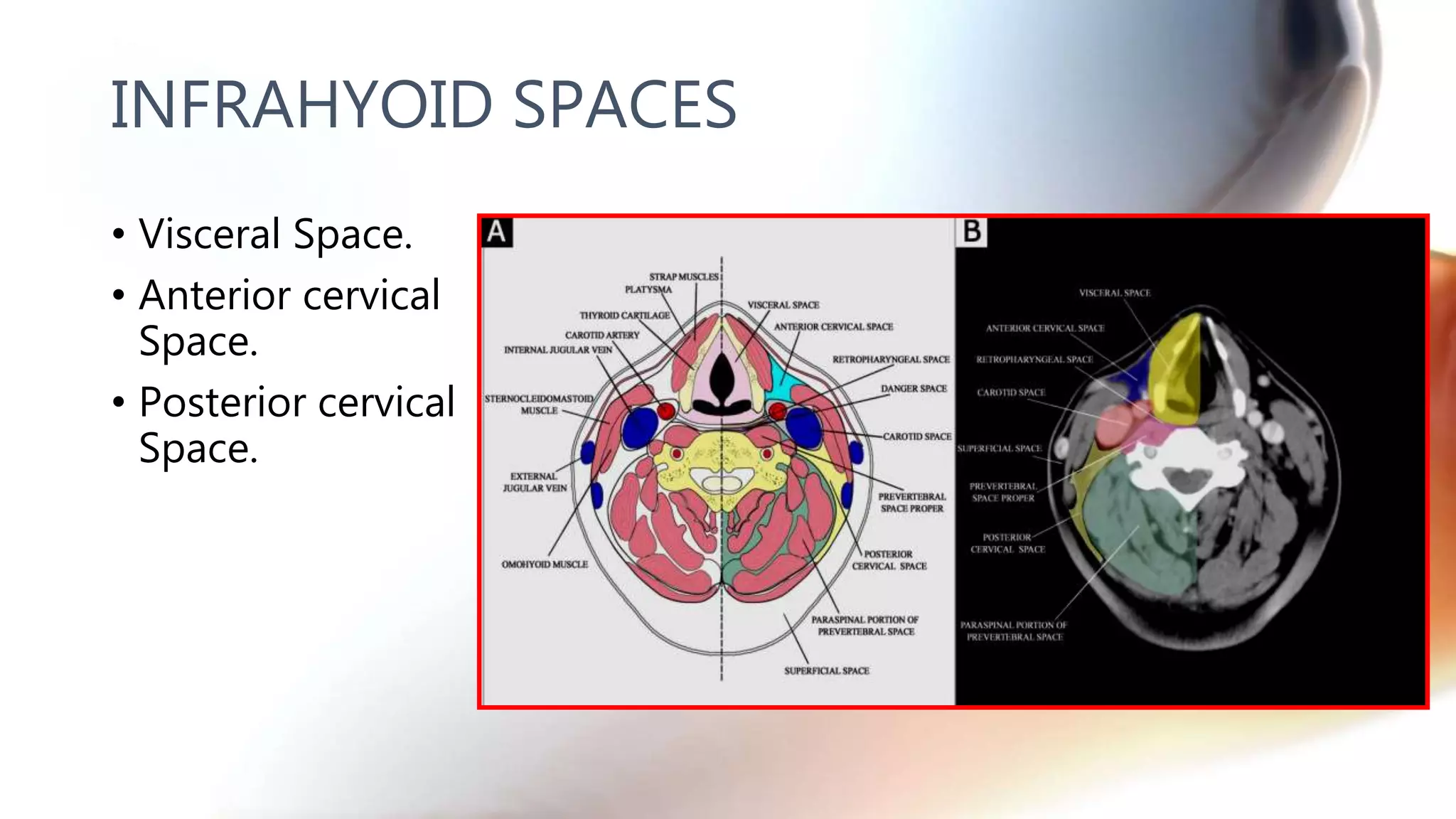
INFRAHYOID SPACES
• Visceral Space.
• Anterior cervical
Space.
• Posterior cervical
Space.
SPACES COMMON TO BOTH
• Carotid Space.
• Retropharyngeal Space.
• Prevertebral Space.
• Danger Space.
Fascia
Superficial
Deep
Superficial
Middle
Deep
CERVICAL FASCIAE
SUPERFICIAL FASCIA
• Composed of subcutaneous tissues that
encircle the neck like a collar.
• Encircles the deep fascia
• Components:
• Platysma and muscles of facial expression.
• Subcutaneous veins , nerves and fat
• Superficial lymph nodes.
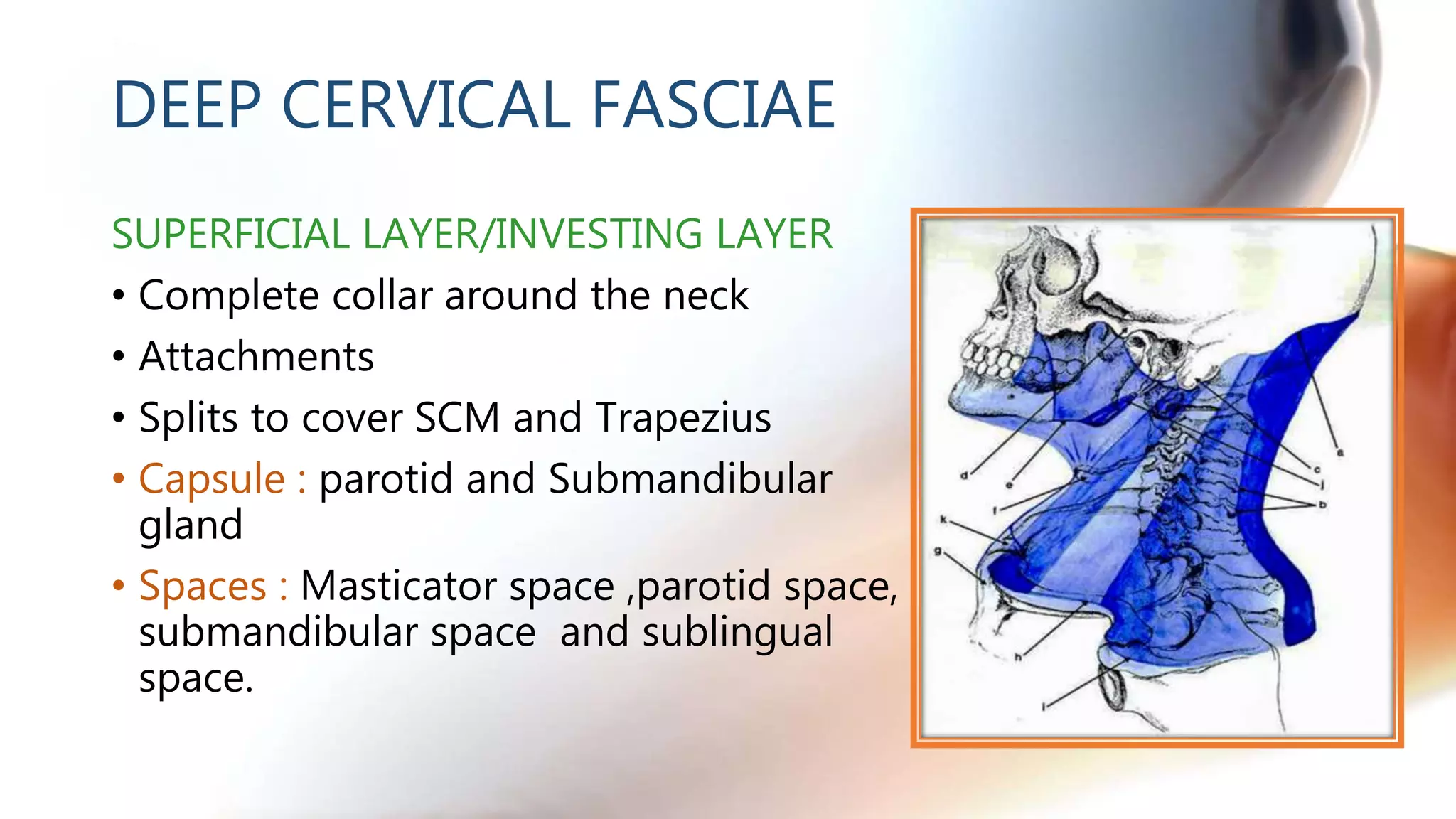
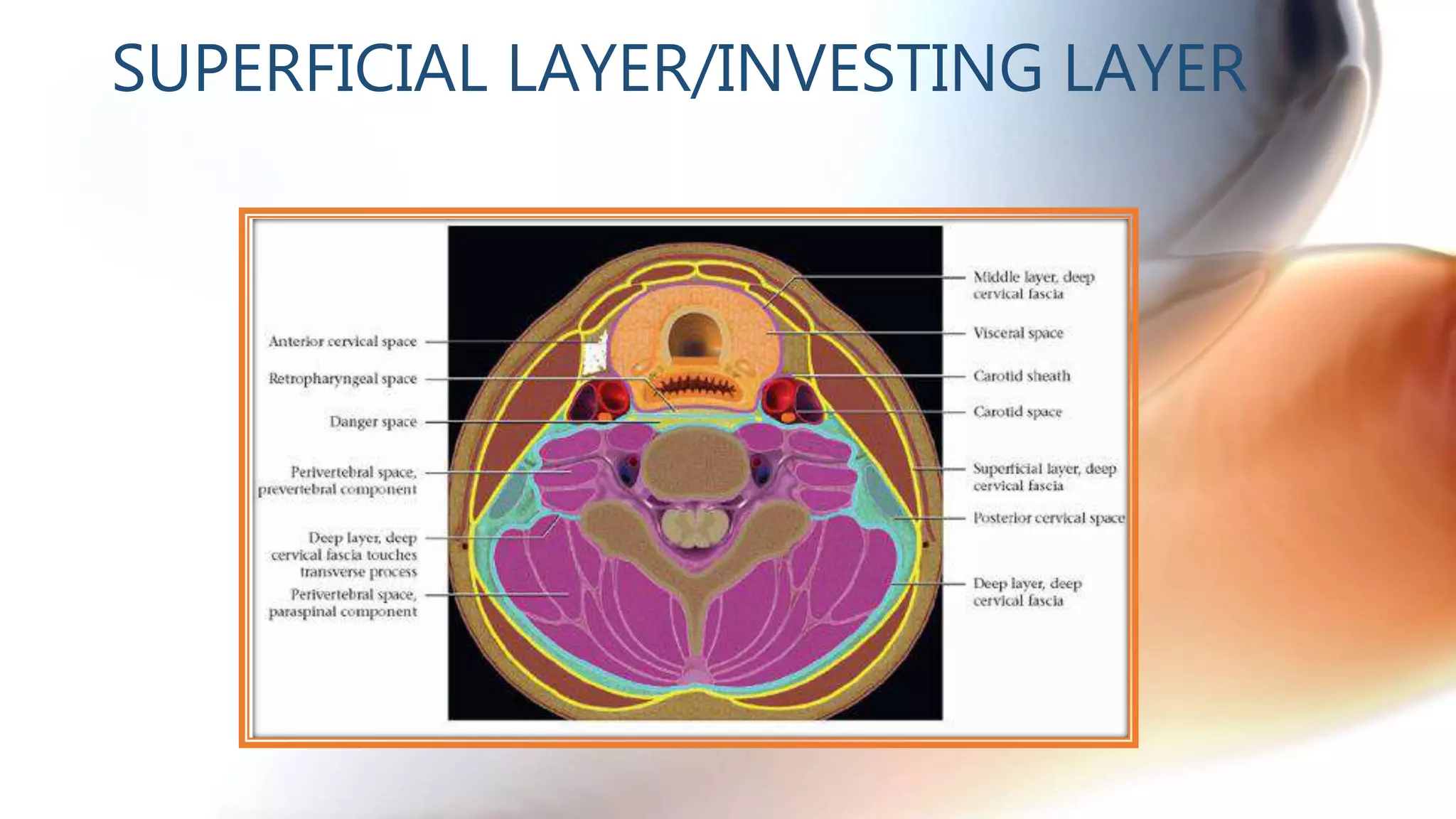
SUPERFICIAL LAYER/INVESTING LAYER
• Complete collar around the neck
• Attachments
• Splits to cover SCM and Trapezius
• Capsule : parotid and Submandibular
gland
• Spaces : Masticator space ,parotid space,
submandibular space and sublingual
space.
DEEP CERVICAL FASCIAE
SUPERFICIAL LAYER/INVESTING LAYER
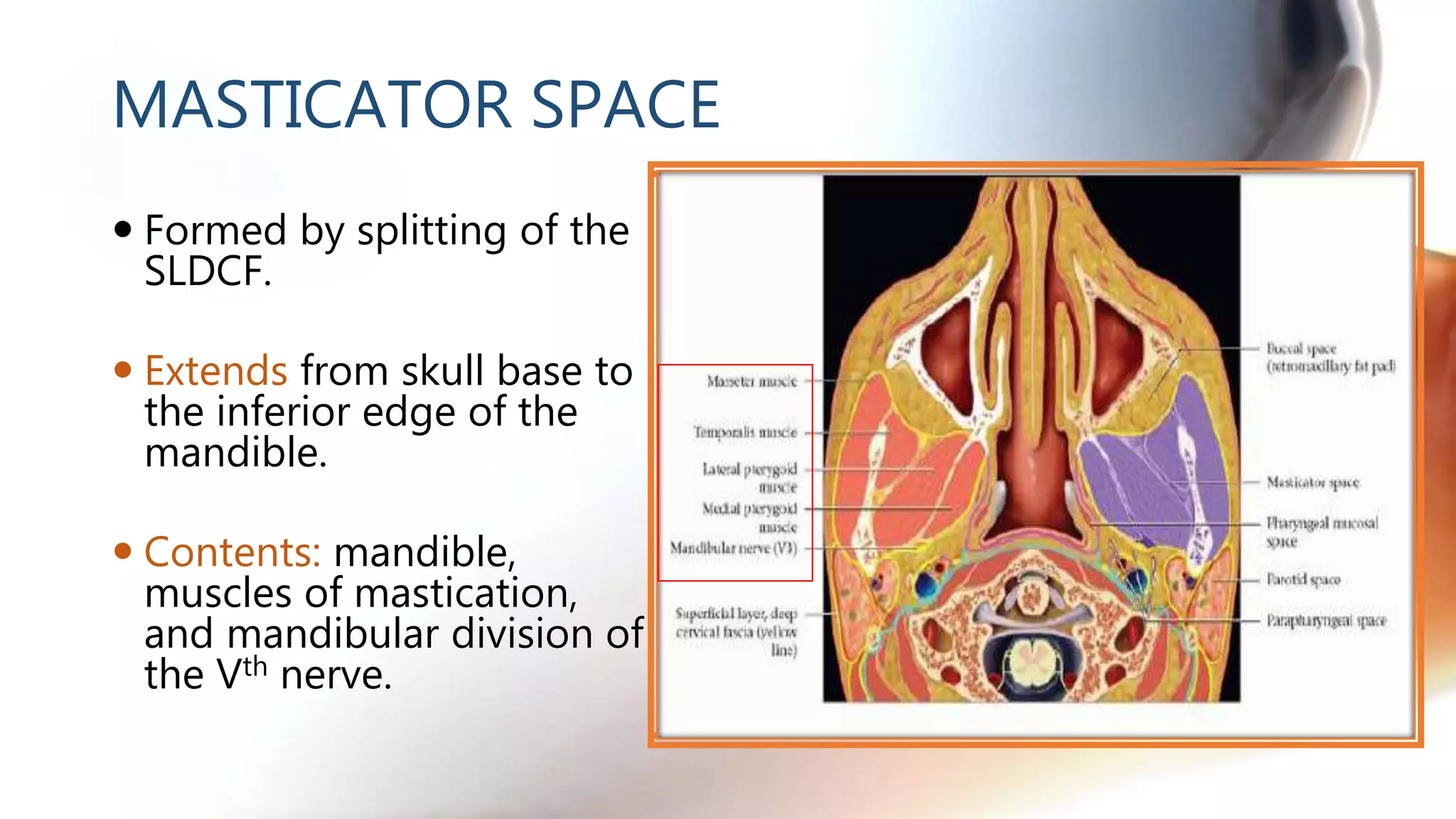
MASTICATOR SPACE
 Formed by splitting of the
SLDCF.
 Extends from skull base to
the inferior edge of the
mandible.
 Contents: mandible,
muscles of mastication,
and mandibular division of
the Vth nerve.
MASTICATOR SPACE
M
T
L
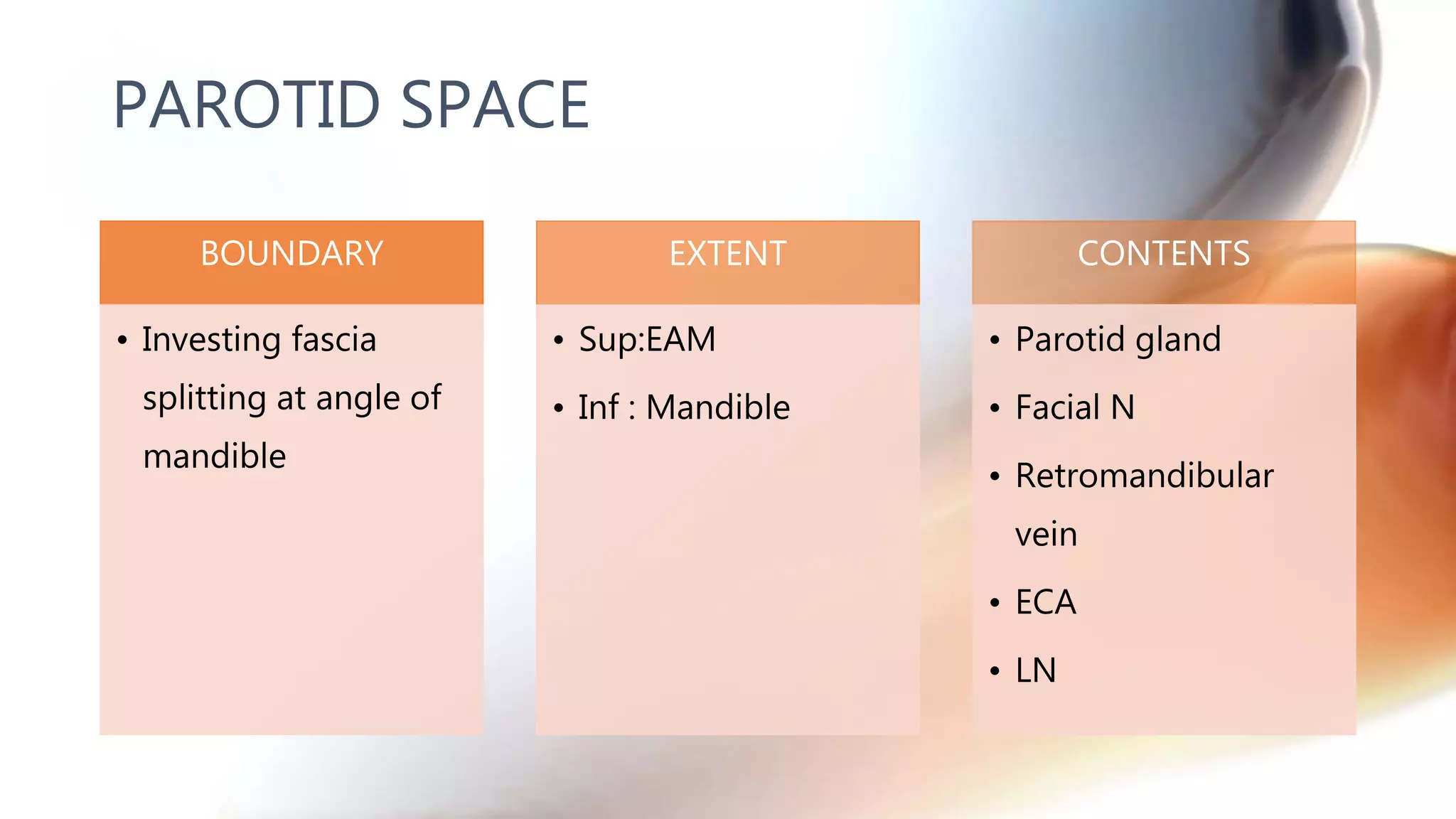
PAROTID SPACE
• Boundary : Investing fascia(SLDCF) splitting at the angle of mandible.
• Extends : Superiorly external acoustic meatus
Inferiorly up to the mandible.
• Contents: Parotid Gland, proximal part of the parotid duct, intraparotid lymph nodes
and vessels.
• Parotid gland is divided by facial nerve into superficial and deep.
• Division identified on imaging by retromandibular vein.
PAROTID SPACE
PAROTID SPACE
BOUNDARY
• Investing fascia
splitting at angle of
mandible
EXTENT
• Sup:EAM
• Inf : Mandible
CONTENTS
• Parotid gland
• Facial N
• Retromandibular
vein
• ECA
• LN
PAROTID SPACE
SUBMANDIBULAR SPACE
• Extend : Mylohoid superiorly & hyoid
bone inferiorly.
• Communicates freely with sublingual
space.
• Contents : superficial portions of the
Submandibular gland,submental and
submandibular LNs, facial artery and
vein, fat and ant belly of digastric.
SUBMANDIBULAR SPACE
SUBMANDIBULAR SPACE
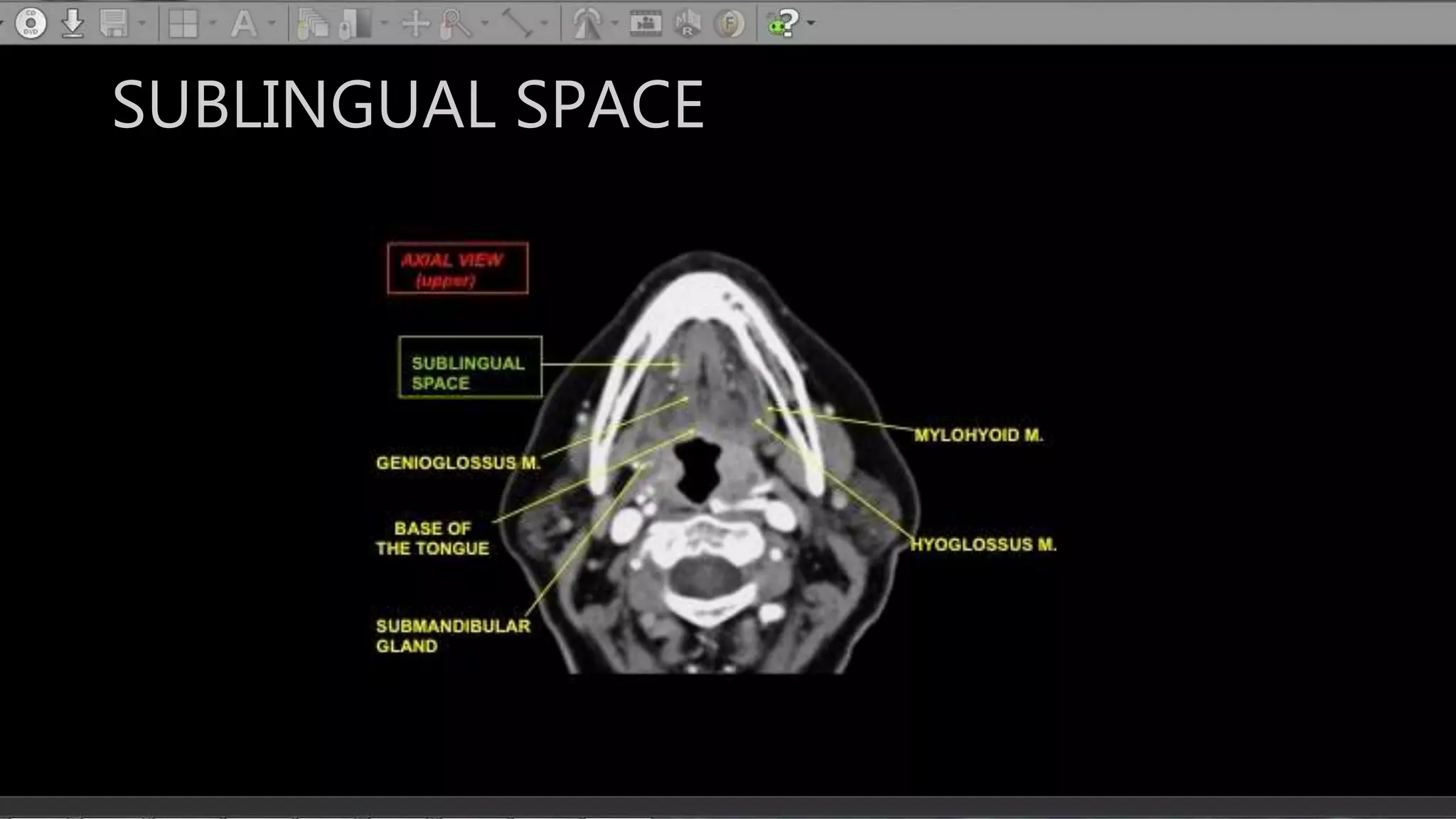
Extent : Above the mylohyoid
muscle
Contents : Sublingual gland
and their ducts , LNs,
hypoglossal muscle , lingual
artery and vein , hypoglossal
N and deeper portion of
submandibular gland.
SUBLINGUAL SPACE
SUBLINGUAL SPACE
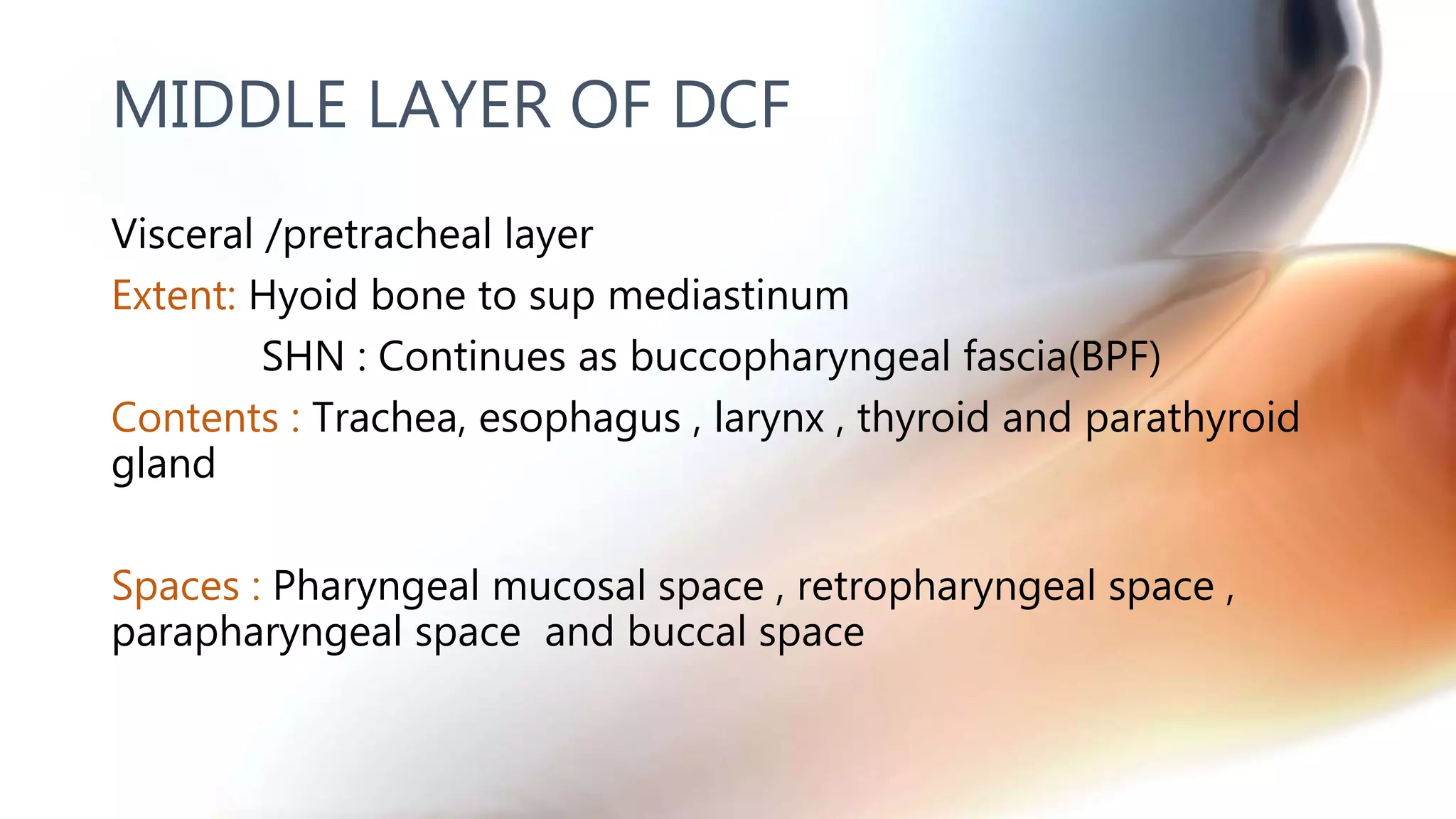
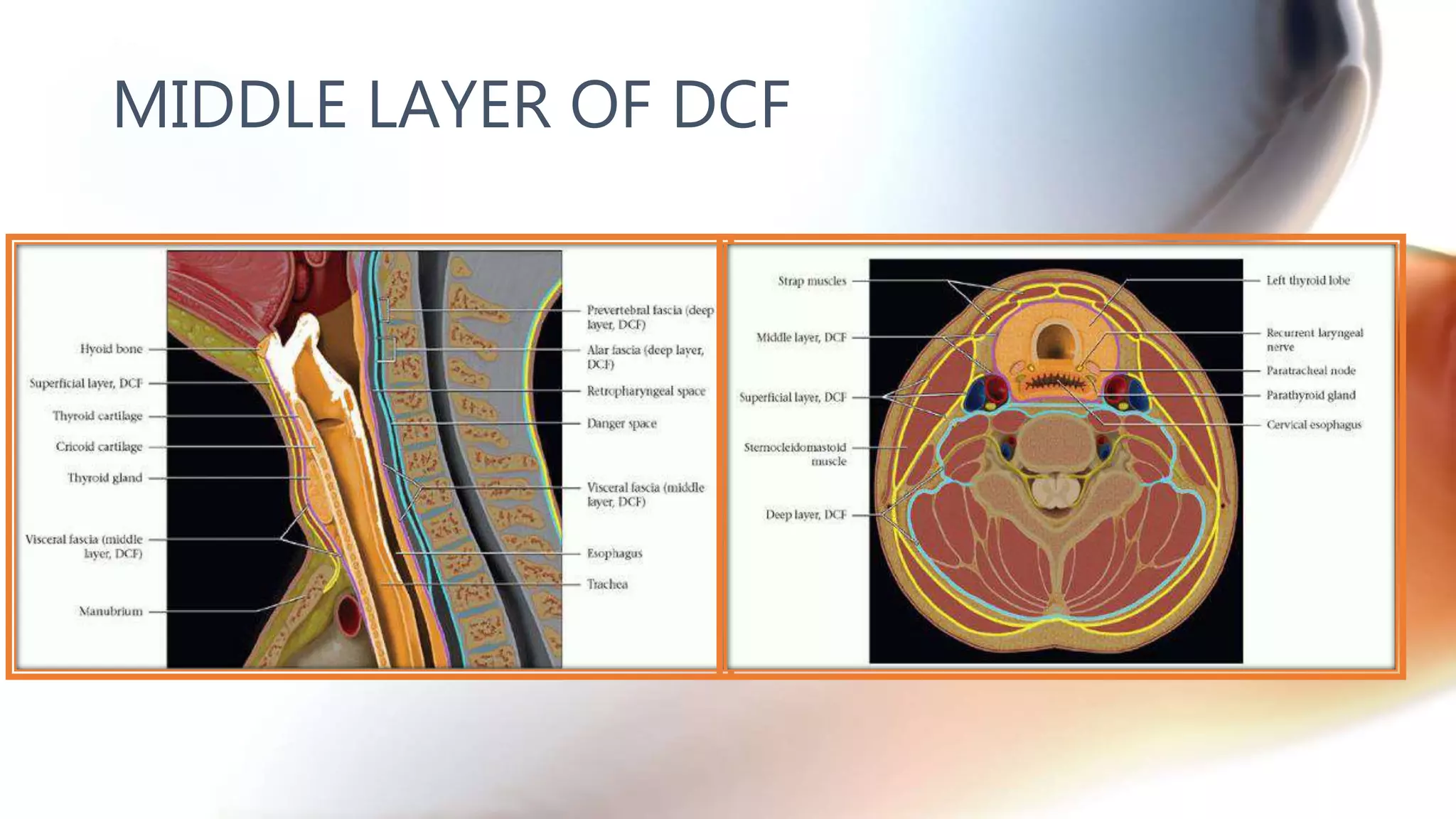
Visceral /pretracheal layer
Extent: Hyoid bone to sup mediastinum
SHN : Continues as buccopharyngeal fascia(BPF)
Contents : Trachea, esophagus , larynx , thyroid and parathyroid
gland
Spaces : Pharyngeal mucosal space , retropharyngeal space ,
parapharyngeal space and buccal space
MIDDLE LAYER OF DCF
MIDDLE LAYER OF DCF
MIDDLE LAYER OF DCF- SPACES
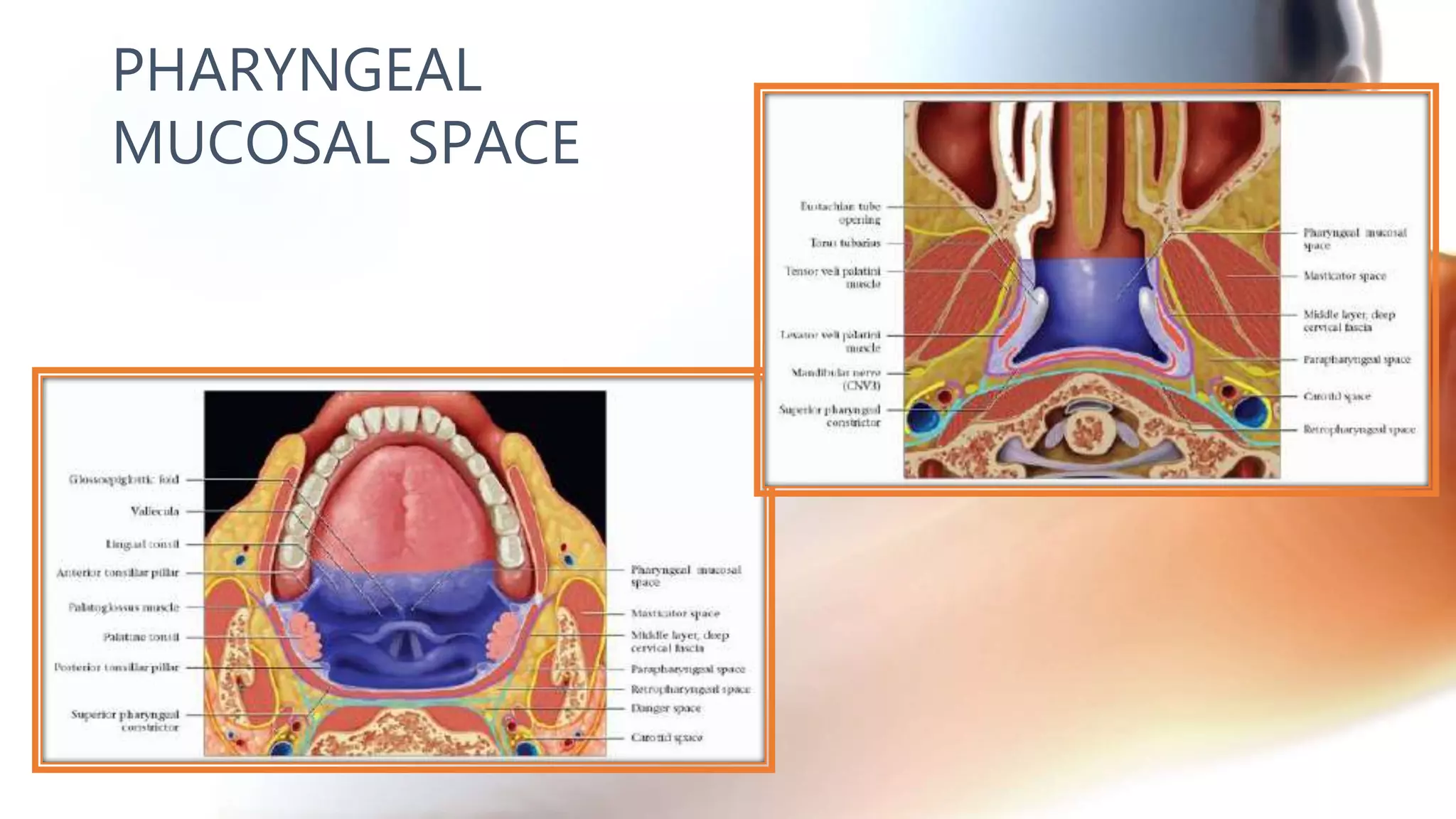
PHARYNGEAL MUCOSAL SPACE
• Located on the airway side of the Buccopharyngeal fascia in the nasopharynx
and oropharynx.
• No fascial boundaries on the airway side.
• Extend from skull base to the Cricoid cartilage.
• Contents: Mucosa, lymphoid tissue of Waldeyer’s ring, minor salivary glands,
and pharyngeal constrictor muscles.
PHARYNGEAL
MUCOSAL SPACE
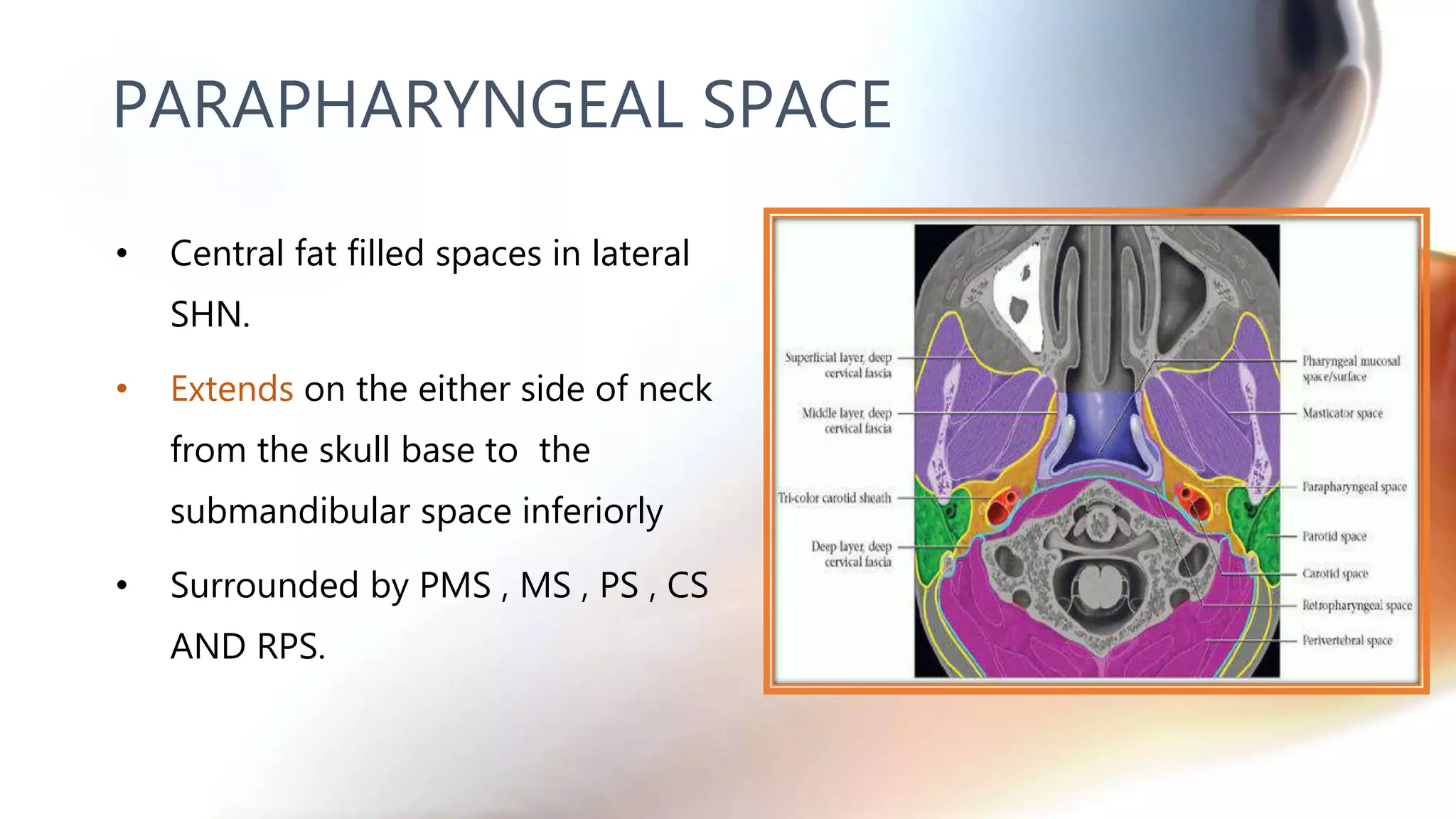
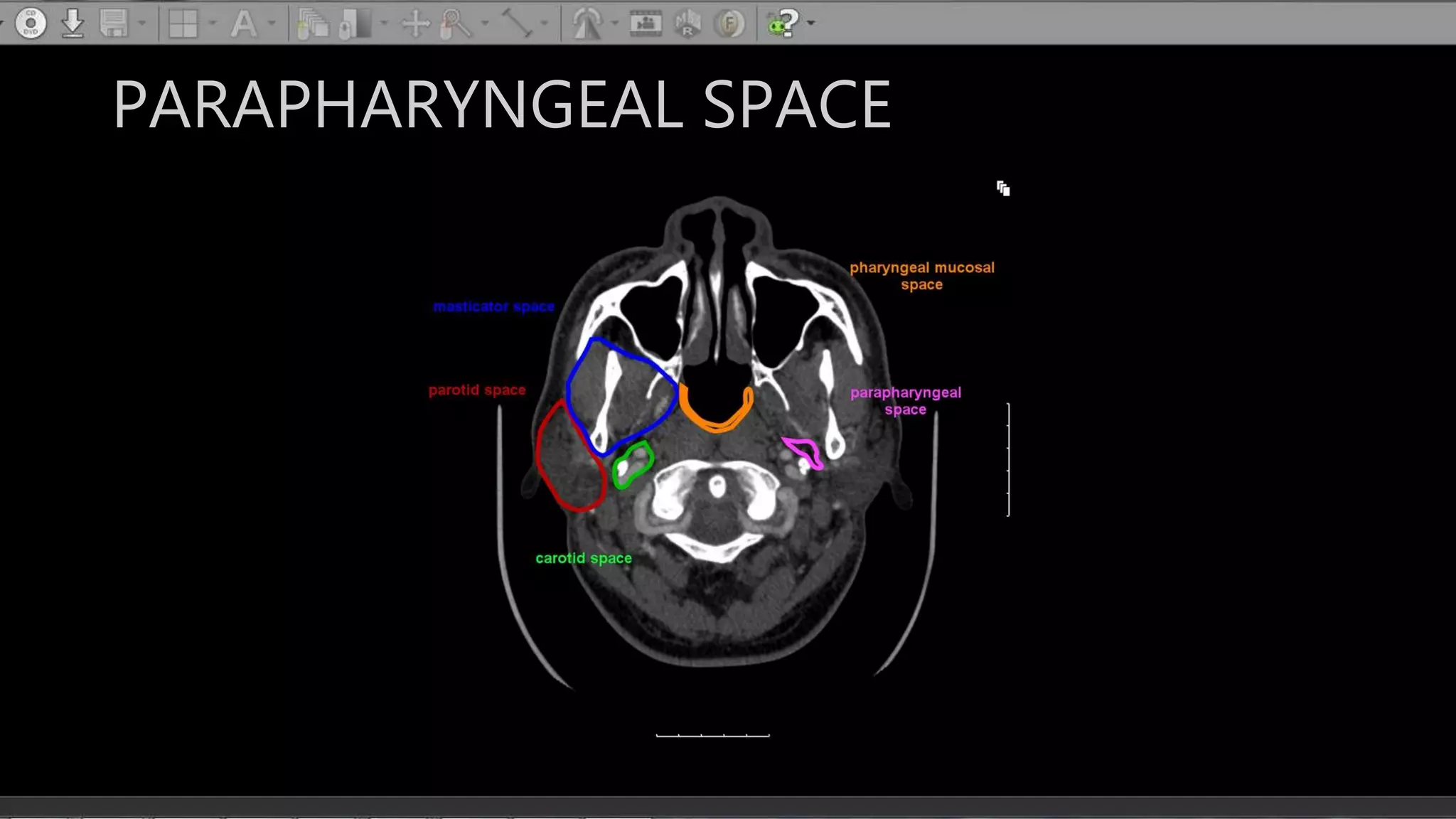
PARAPHARYNGEAL SPACE
• Central fat filled spaces in lateral
SHN.
• Extends on the either side of neck
from the skull base to the
submandibular space inferiorly
• Surrounded by PMS , MS , PS , CS
AND RPS.
• Contents : Mainly fat ,
pharyngeal venous plexus
, Mandibular N , Int
mammary A , ascending
pharyngeal artery.
• Direction of displacement
of PPS – space of origin
of the lesion
PARAPHARYNGEAL SPACE
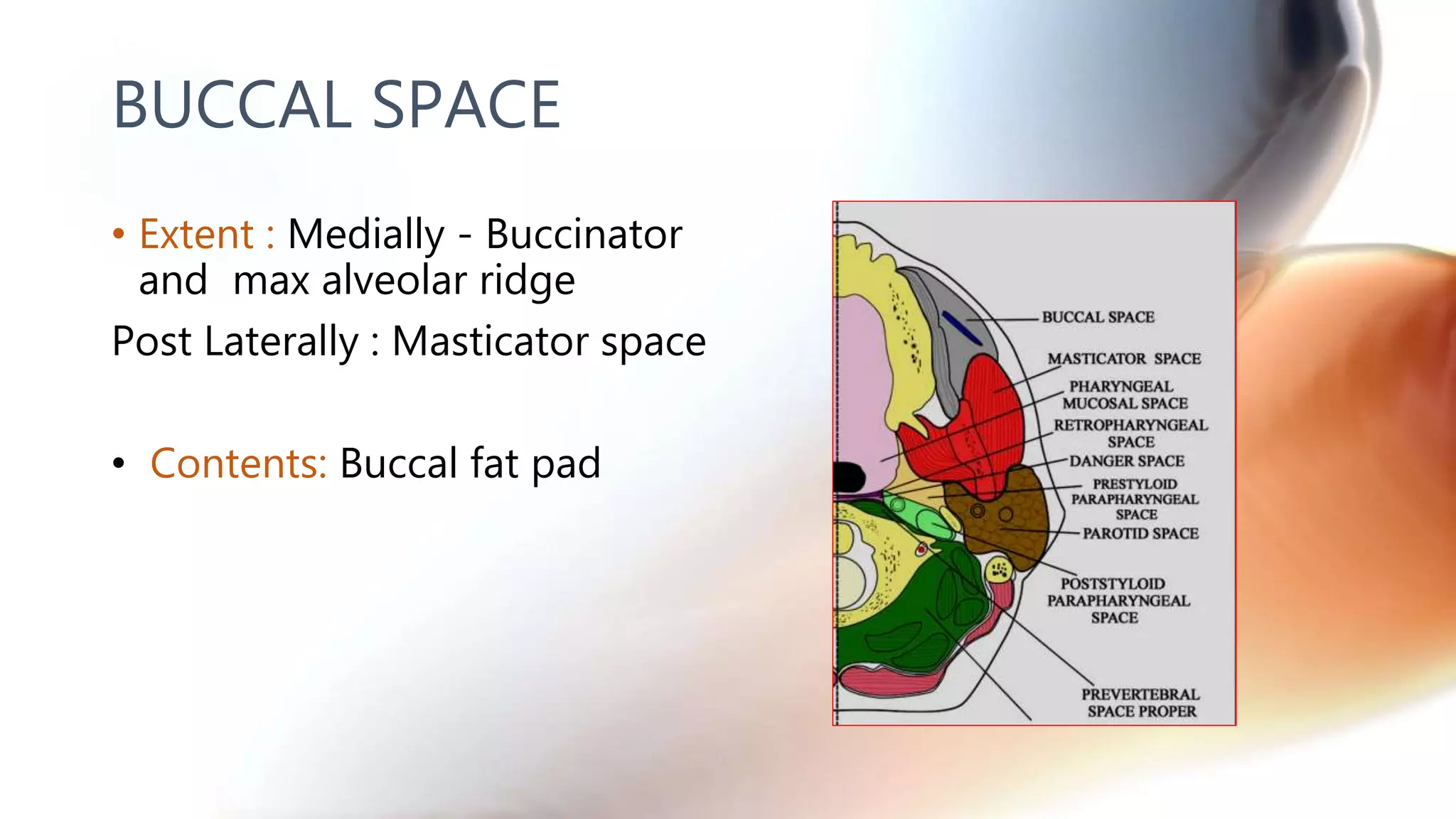
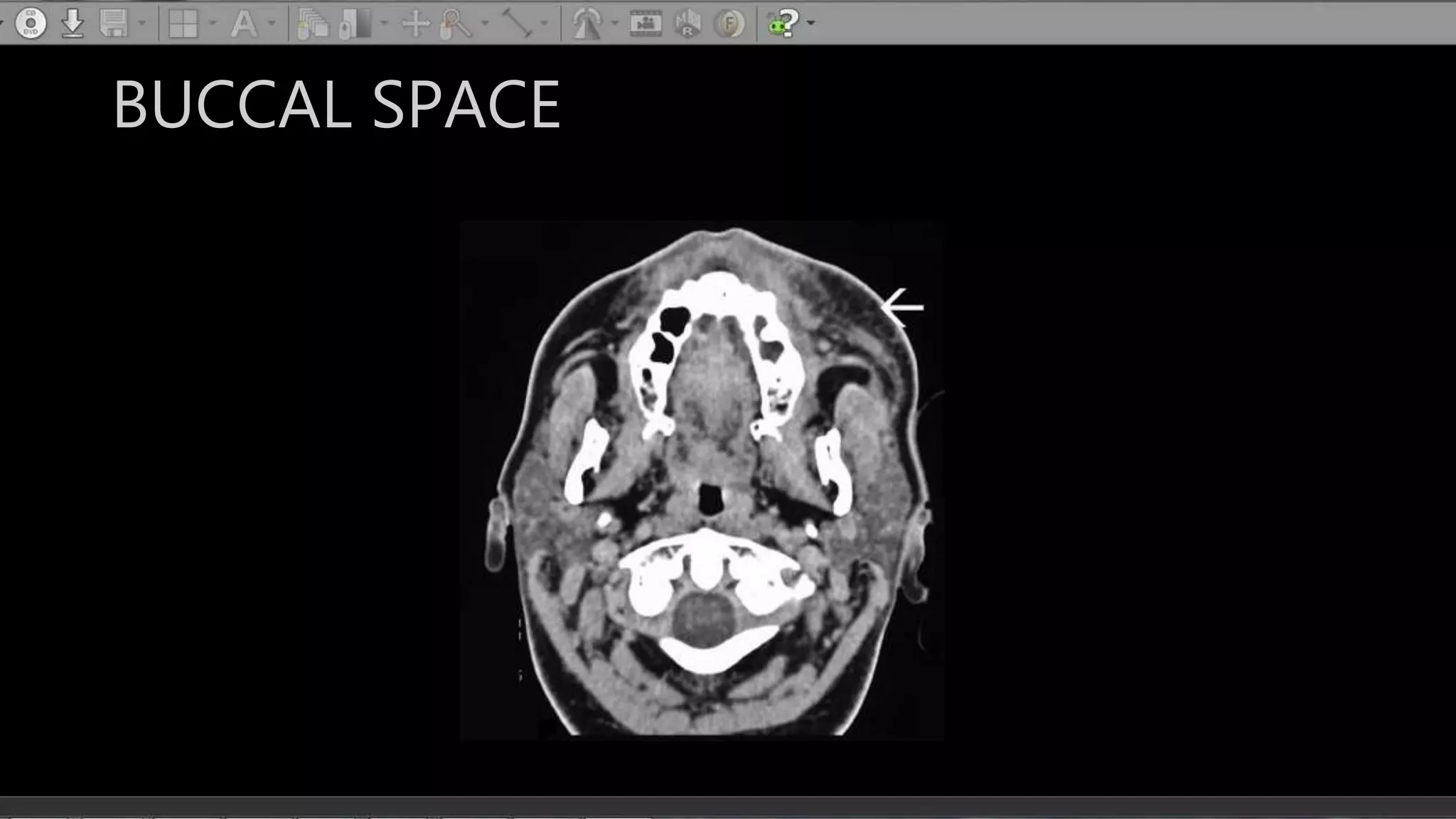
BUCCAL SPACE
• Extent : Medially - Buccinator
and max alveolar ridge
Post Laterally : Masticator space
• Contents: Buccal fat pad
BUCCAL SPACE
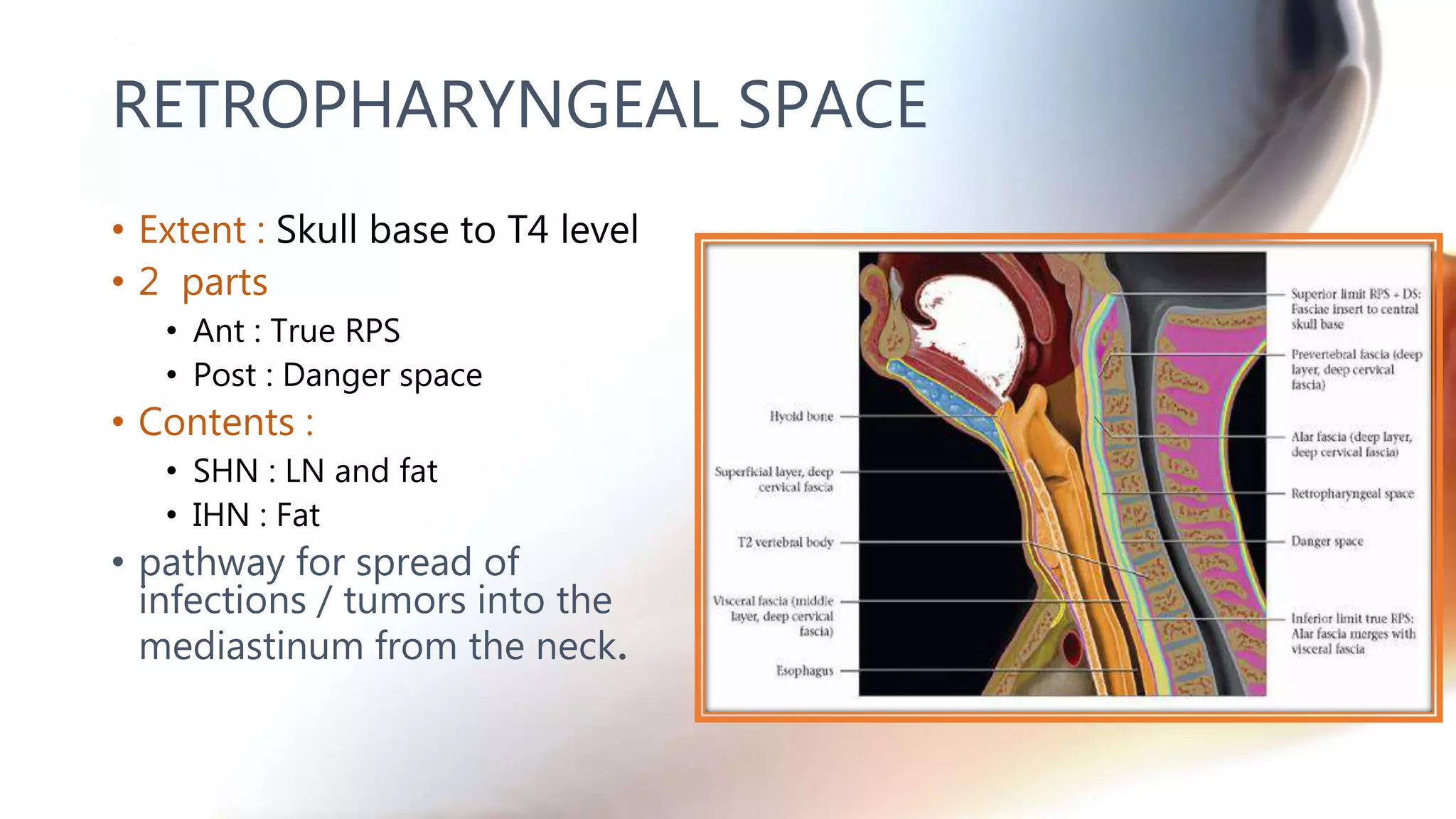
• Extent : Skull base to T4 level
• 2 parts
• Ant : True RPS
• Post : Danger space
• Contents :
• SHN : LN and fat
• IHN : Fat
• pathway for spread of
infections / tumors into the
mediastinum from the neck.
RETROPHARYNGEAL SPACE
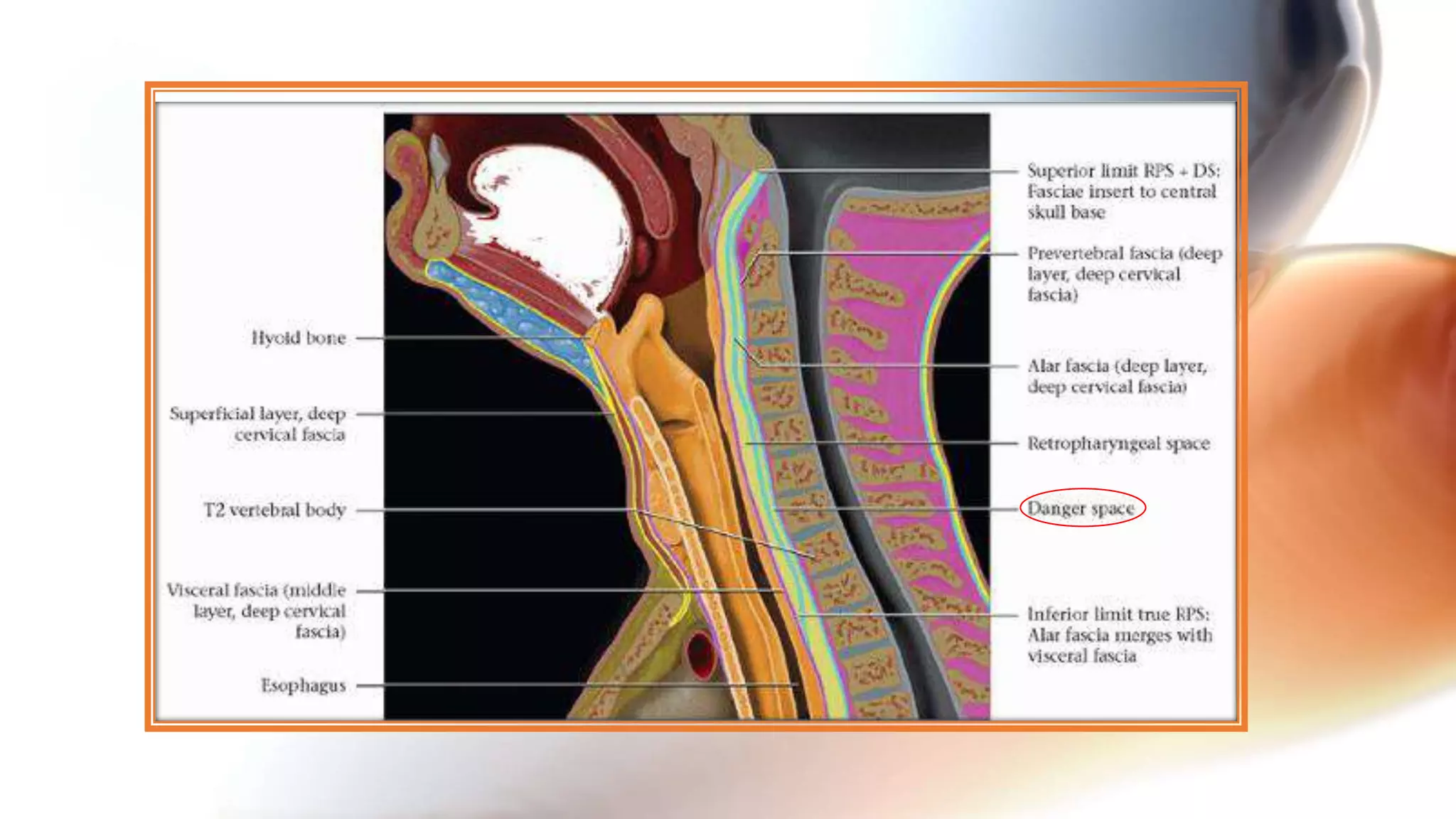
DANGER SPACE
• Posterior to the RPS.
• Bounded by the Alar fascia anteriorly and Prevertebral portion proper posteriorly.
• Extends from the skull base up to the diaphragm.
• Content : loose areolar tissue which provides easy pathway for the spread of
infections.
• Extent : skull base to superior
mediastinum T4 level.
• Encircles : Paravertebral and
paraspinal muscles, vertebral
body , vertebral A and Vn ,
phrenic nerve and brachial plexus
trunk
• Spaces : involve both SHN and
IHN – CS , RPS, DS , PVS and
posterior cervical space.
: Involving only IHN -
Visceral spaces and anterior
cervical space
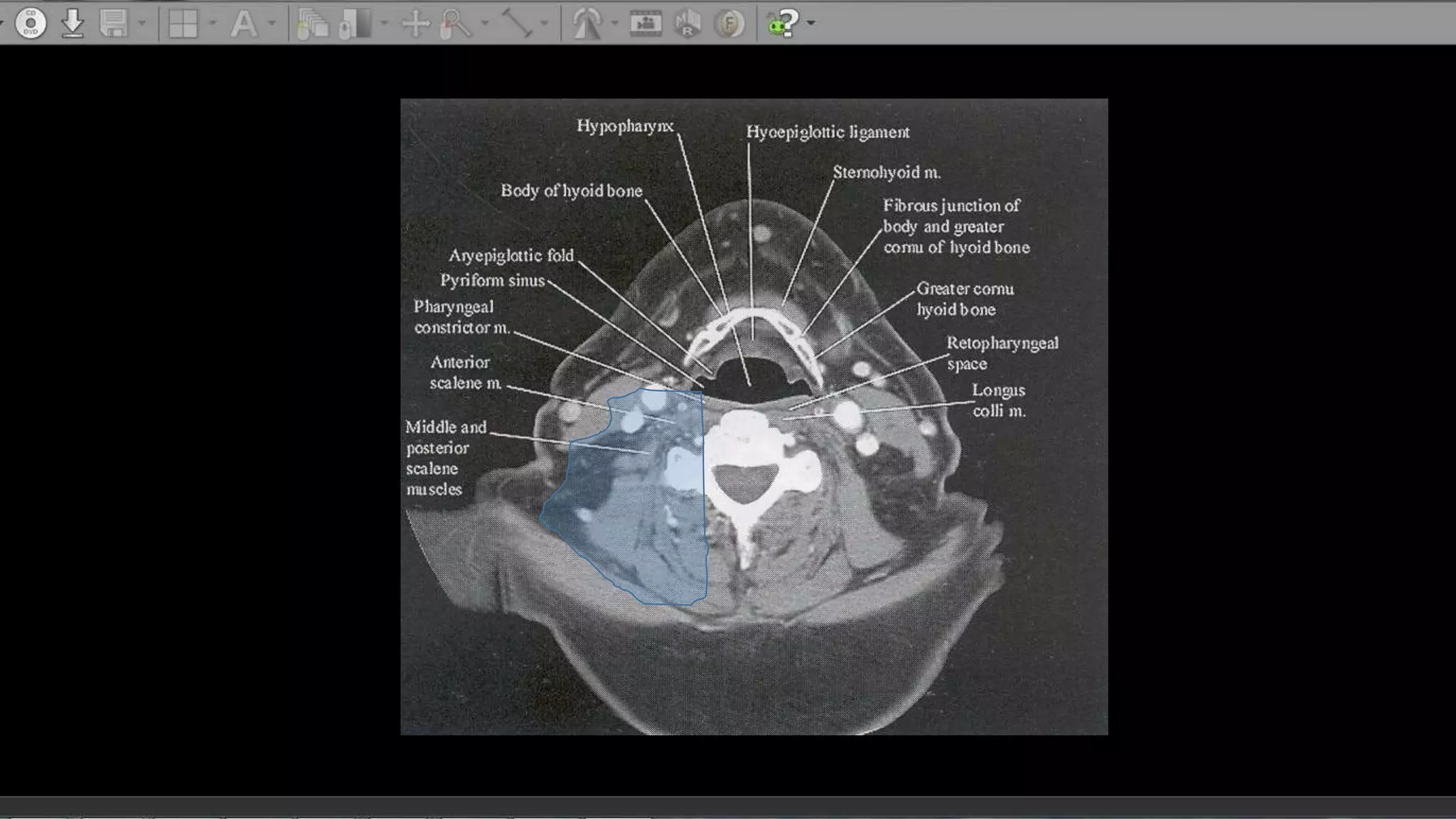
DEEP LAYER OF DCF(Prevertebral fascia)
• Paired tubular structure
traversing SHN and IHN
• Skull base to superior
mediastinum
• Lateral to RPS
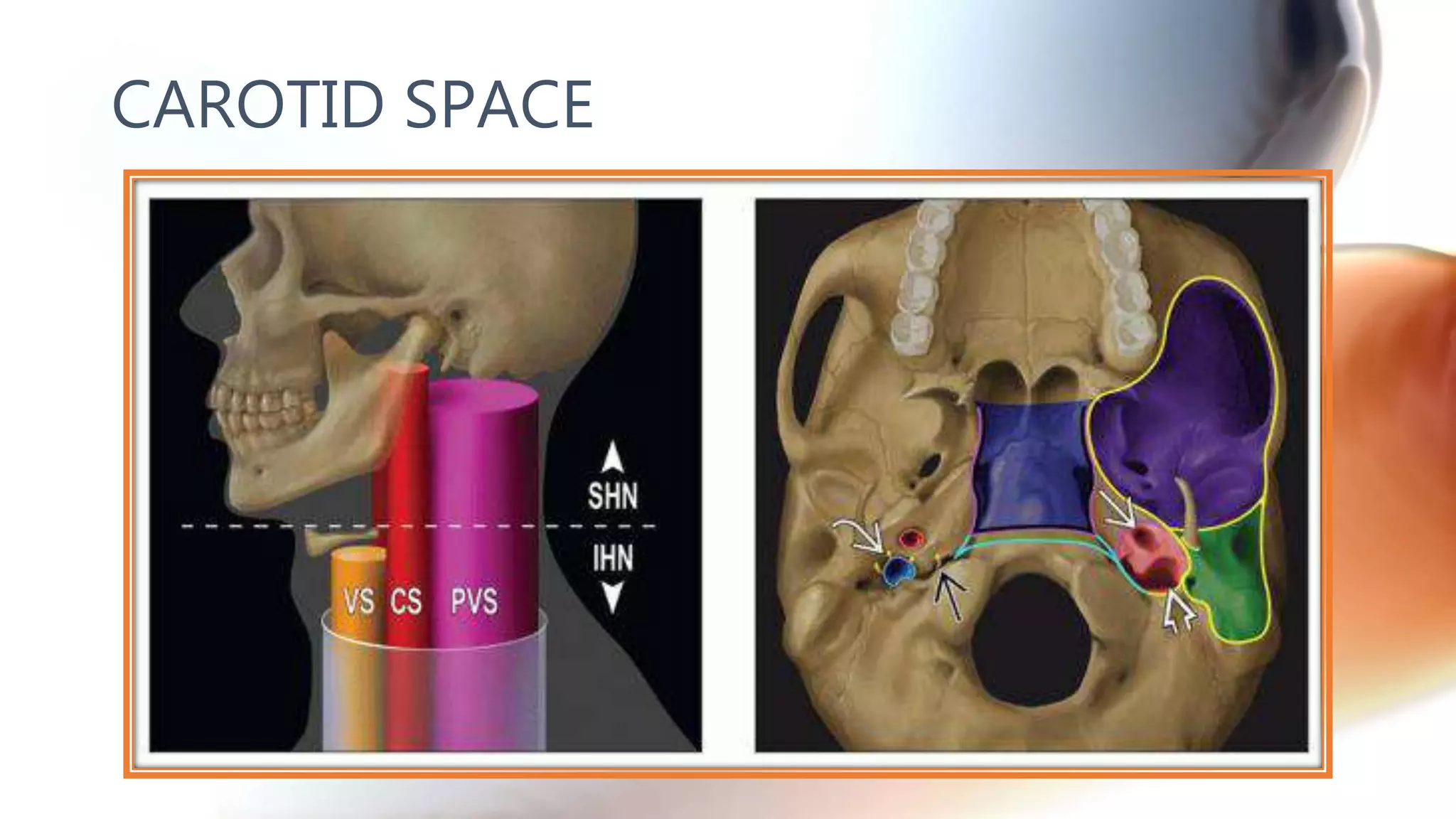
• Enveloped by carotid sheath :
all 3 layers of DCf
• Contents : SHN – ICA IJV ,
CN9-12,
:IHN - CCA, IJV ,
CN10 trunk ( vagus)
CAROTID SPACE
CAROTID SPACE
CAROTID SPACE
IHN
SHN
CAROTID SPACE
• Posterior midline space
of SHN and IHN
• Enclosed by deep layer
of DCF
• Extent : base of skull to
level of coccyx
• 2 compartments :
Prevertebral and
Paraspinal
PERIVERTEBRAL SPACE
PERIVERTEBRAL SPACE- CONTENTS
CERVICAL SPACES
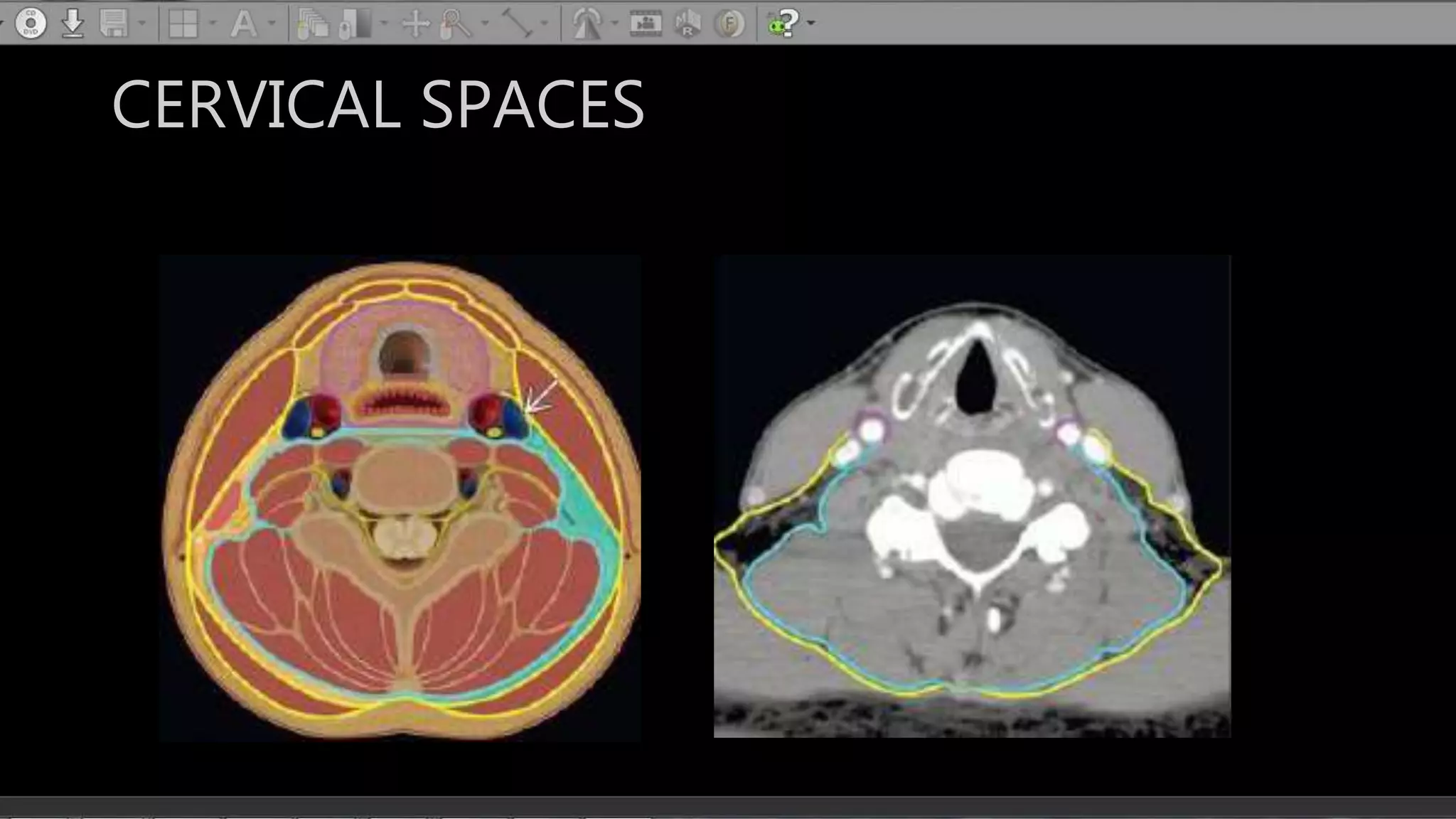
• ANTERIOR CERVICAL SPACE : Hyoid to clavicle
• Content : Only fat
• POSTERIOR CERVICAL SPACE : Extend from the skull base to the clavicles.
• Deep and posterior to sternocledomastoid
• Content : fat, spinal accessory nerves and spinal accessory chain of deep cervical lymph nodes.
CERVICAL SPACES
CERVICAL SPACES
CT anatomy of Neck Spaces RV

CT anatomy of Neck Spaces RV

  • 1.
    Dr Roshan Valentine PGResident Dept of Radiodiagnosis St Johns Medical College CT ANATOMY OF NECK SPACES
  • 2.
    NORMAL ANATOMY • Neckhas a complex anatomy • Compartmentalisation of anatomic structures Superiorly : Mandible & mylohyoid anteriorly Skull base posteriorly Inferiorly: Thoracic inlet centrally Scapula posteriorly
  • 3.
    INTRODUCTION • Clinicians :anterior and posterior triangles • Anatomists : pioneered the work on fascial spaces and anatomy • Cross sectional imaging helped clinicians , anatomists and surgeons in dividing it into fascial compartments
  • 4.
    • Basis fordividing neck into spaces and compartments : arrangement of superficial and deep layers of cervical fascia • The importance of this spaces is that they may limit to some degree the spread of most infections and some tumors • A proper understanding of their anatomy will also aid in the diagnosis of various conditions INTR0DUCTION
  • 5.
    NECK SPACES Described inrelation to the hyoid bone. • Suprahyoid Spaces. • Infrahyoid Spaces. • Spaces extending up to the entire length of the neck.
  • 6.
    SUPRAHYOID SPACES • SublingualSpace. • Submandibular Space. • Buccal Space. • Masticator Space. • Parotid Space. • Pharyngeal mucosal Space. • Parapharyngeal Space
  • 7.
    INFRAHYOID SPACES • VisceralSpace. • Anterior cervical Space. • Posterior cervical Space.
  • 8.
    SPACES COMMON TOBOTH • Carotid Space. • Retropharyngeal Space. • Prevertebral Space. • Danger Space.
  • 9.
  • 10.
    SUPERFICIAL FASCIA • Composedof subcutaneous tissues that encircle the neck like a collar. • Encircles the deep fascia • Components: • Platysma and muscles of facial expression. • Subcutaneous veins , nerves and fat • Superficial lymph nodes.
  • 11.
    SUPERFICIAL LAYER/INVESTING LAYER •Complete collar around the neck • Attachments • Splits to cover SCM and Trapezius • Capsule : parotid and Submandibular gland • Spaces : Masticator space ,parotid space, submandibular space and sublingual space. DEEP CERVICAL FASCIAE
  • 12.
  • 13.
    MASTICATOR SPACE  Formedby splitting of the SLDCF.  Extends from skull base to the inferior edge of the mandible.  Contents: mandible, muscles of mastication, and mandibular division of the Vth nerve.
  • 14.
  • 15.
    PAROTID SPACE • Boundary: Investing fascia(SLDCF) splitting at the angle of mandible. • Extends : Superiorly external acoustic meatus Inferiorly up to the mandible. • Contents: Parotid Gland, proximal part of the parotid duct, intraparotid lymph nodes and vessels. • Parotid gland is divided by facial nerve into superficial and deep. • Division identified on imaging by retromandibular vein.
  • 16.
  • 17.
  • 18.
    BOUNDARY • Investing fascia splittingat angle of mandible EXTENT • Sup:EAM • Inf : Mandible CONTENTS • Parotid gland • Facial N • Retromandibular vein • ECA • LN PAROTID SPACE
  • 19.
    SUBMANDIBULAR SPACE • Extend: Mylohoid superiorly & hyoid bone inferiorly. • Communicates freely with sublingual space. • Contents : superficial portions of the Submandibular gland,submental and submandibular LNs, facial artery and vein, fat and ant belly of digastric.
  • 20.
  • 21.
  • 23.
    Extent : Abovethe mylohyoid muscle Contents : Sublingual gland and their ducts , LNs, hypoglossal muscle , lingual artery and vein , hypoglossal N and deeper portion of submandibular gland. SUBLINGUAL SPACE
  • 24.
  • 25.
    Visceral /pretracheal layer Extent:Hyoid bone to sup mediastinum SHN : Continues as buccopharyngeal fascia(BPF) Contents : Trachea, esophagus , larynx , thyroid and parathyroid gland Spaces : Pharyngeal mucosal space , retropharyngeal space , parapharyngeal space and buccal space MIDDLE LAYER OF DCF
  • 26.
  • 27.
    MIDDLE LAYER OFDCF- SPACES
  • 28.
    PHARYNGEAL MUCOSAL SPACE •Located on the airway side of the Buccopharyngeal fascia in the nasopharynx and oropharynx. • No fascial boundaries on the airway side. • Extend from skull base to the Cricoid cartilage. • Contents: Mucosa, lymphoid tissue of Waldeyer’s ring, minor salivary glands, and pharyngeal constrictor muscles.
  • 29.
  • 30.
    PARAPHARYNGEAL SPACE • Centralfat filled spaces in lateral SHN. • Extends on the either side of neck from the skull base to the submandibular space inferiorly • Surrounded by PMS , MS , PS , CS AND RPS.
  • 31.
    • Contents :Mainly fat , pharyngeal venous plexus , Mandibular N , Int mammary A , ascending pharyngeal artery. • Direction of displacement of PPS – space of origin of the lesion PARAPHARYNGEAL SPACE
  • 32.
  • 33.
    BUCCAL SPACE • Extent: Medially - Buccinator and max alveolar ridge Post Laterally : Masticator space • Contents: Buccal fat pad
  • 34.
  • 35.
    • Extent :Skull base to T4 level • 2 parts • Ant : True RPS • Post : Danger space • Contents : • SHN : LN and fat • IHN : Fat • pathway for spread of infections / tumors into the mediastinum from the neck. RETROPHARYNGEAL SPACE
  • 36.
  • 37.
  • 38.
    DANGER SPACE • Posteriorto the RPS. • Bounded by the Alar fascia anteriorly and Prevertebral portion proper posteriorly. • Extends from the skull base up to the diaphragm. • Content : loose areolar tissue which provides easy pathway for the spread of infections.
  • 40.
    • Extent :skull base to superior mediastinum T4 level. • Encircles : Paravertebral and paraspinal muscles, vertebral body , vertebral A and Vn , phrenic nerve and brachial plexus trunk • Spaces : involve both SHN and IHN – CS , RPS, DS , PVS and posterior cervical space. : Involving only IHN - Visceral spaces and anterior cervical space DEEP LAYER OF DCF(Prevertebral fascia)
  • 41.
    • Paired tubularstructure traversing SHN and IHN • Skull base to superior mediastinum • Lateral to RPS • Enveloped by carotid sheath : all 3 layers of DCf • Contents : SHN – ICA IJV , CN9-12, :IHN - CCA, IJV , CN10 trunk ( vagus) CAROTID SPACE
  • 42.
  • 43.
  • 44.
  • 45.
    • Posterior midlinespace of SHN and IHN • Enclosed by deep layer of DCF • Extent : base of skull to level of coccyx • 2 compartments : Prevertebral and Paraspinal PERIVERTEBRAL SPACE
  • 46.
  • 48.
    CERVICAL SPACES • ANTERIORCERVICAL SPACE : Hyoid to clavicle • Content : Only fat • POSTERIOR CERVICAL SPACE : Extend from the skull base to the clavicles. • Deep and posterior to sternocledomastoid • Content : fat, spinal accessory nerves and spinal accessory chain of deep cervical lymph nodes.
  • 49.
  • 50.

Editor's Notes

  • #3 Extend from mandible to thoracic inlet and from base of skull to scapulae
  • #12 Skullbase , mandible, hyoid , clavicle , sternum , scapula Posteriorly : Ligamentum nuchae and cervical spinous process
  • #15 Contrast enhanced CT 1 Parapharyngeal space. 2 Masticator space. 3 Carotid space 4 Parotid space. 5 Mucosal space. 6 Perivertebral space (anterior portion). 7 Retropharyngeal space (virtual at this level).
  • #17 Boundary : Investing fascia(SLDCF) splitting at the angle of mandible. Extends : Superiorly external acoustic meatus Inferiorly up to the mandible. Contents: Parotid gland Facial N Retromandibular vein ECA LN Parotid gland is divided by facial nerve into superficial and deep. Division identified on imaging by retromandibular vein.
  • #18 Contrast enhanced CT 1 Parapharyngeal space. 2 Masticator space. 3 Mucosal space. 4 Carotid space 4 Parotid space. 5 Mucosal space. 6 Perivertebral space (anterior portion). 7 Retropharyngeal space (virtual at this level).
  • #28 Pharyngeal mucosal , parapaharyngeal , retropharyngeal and buccal
  • #30 Ant : nasal cavity by post choanae, laterally : Eustachian tube opening and torus tubaris Contents : pharyngeal mucosa , lingular and palatine tonsils , adenoids , minor salivary glands
  • #31 Boundaries : PPS-PMS : Bucopharyngeal fascia, PPS-MS : SLDCF , PPS- PVS: Prevertebral fascia
  • #32  PMS mass lesion pushes PPS laterally MS mass lesion pushes PPS posteriorly PS mass lesion pushes PPS medially CS mass lesion pushes PPS anteriorly Lateral retropharyngeal space mass (nodal) pushes PPS anterolaterally The PPS is a crescent-shaped fat-filled space in craniocaudal dimension extending
  • #36 Ant : Pharynx and esophagus , posteriorly : cervical and upper thoracic spine
  • #38 AT THE LEVEL OF THYROID , iHN , danger s[pace between true and prevertrbral space
  • #41 DS; danger space
  • #43 (Left) Lateral graphic of the cervical neck shows the tubular carotid space (CS) extending from the skull base (carotid canal and jugular foramen) to the aortic arch. RIGHT: Axial graphic of the skull base viewed from below shows the carotid space abutting the skull base. The ICA enters the carotid canal , while the jugular foramen gives rise to the internal jugular vein. Notice CN 9-11 exiting the jugular foramen. CN12 is more medial as it leaves the hypoglossal canal.
  • #44 Contents : SHN – ICA IJV , CN9-12, :IHN - CCA, IJV , CN10 trunk ( vagus)
  • #45 LEFT : outside ijv , ica , styloid process Right : IJV ( big) cca (small)
  • #47 Pre : prevertebral and scalene muscles , br plexus roots , vert A and V , Phrenic N Paraspinal : paraspinal muscle , vertebral lamina and spinous process
  • #50 2) superficial (yellow) and deep (light blue) layers of the DCF that surround the PCS are depicted.