PHYSIOLOGY
OF
TASTE SENSATION
PRESENTED BY
N.NARMATHA
INTRODUCTION:
• Taste belongs to our chemical sensing system, or the chemosenses.
• The complex process of tasting begins when tiny molecules
released by substances stimulate special cells in the nose, mouth,
throat.
• Tongue is a muscular organ situated in the floor of the mouth.
• Associated with functions of taste, speech, mastication and
deglutition.
• Taste buds – sense organs for taste or gustatory sensation.
• One’s sense of smell also contributes strongly to taste sensation
Women have better sense of taste – typically have more taste areas –
fungiform papillae and taste buds than men.
ANATOMY:
Tongue has
• Root
• Tip
• Body
PAPILLAE OF TONGUE:
• Gives characteristic roughness to
anterior two-thirds of tongue.
• Projections of mucous membrane or
corium.
• Taste buds are present
TASTE BUDS:
Ovoid bodies - 50 – 70 µ
TYPES OF PAPILLAE:
• Vallate or circumvallate papillae
• Fungiform papillae
• Filliform papillae or conical papillae
• Foliate papillae
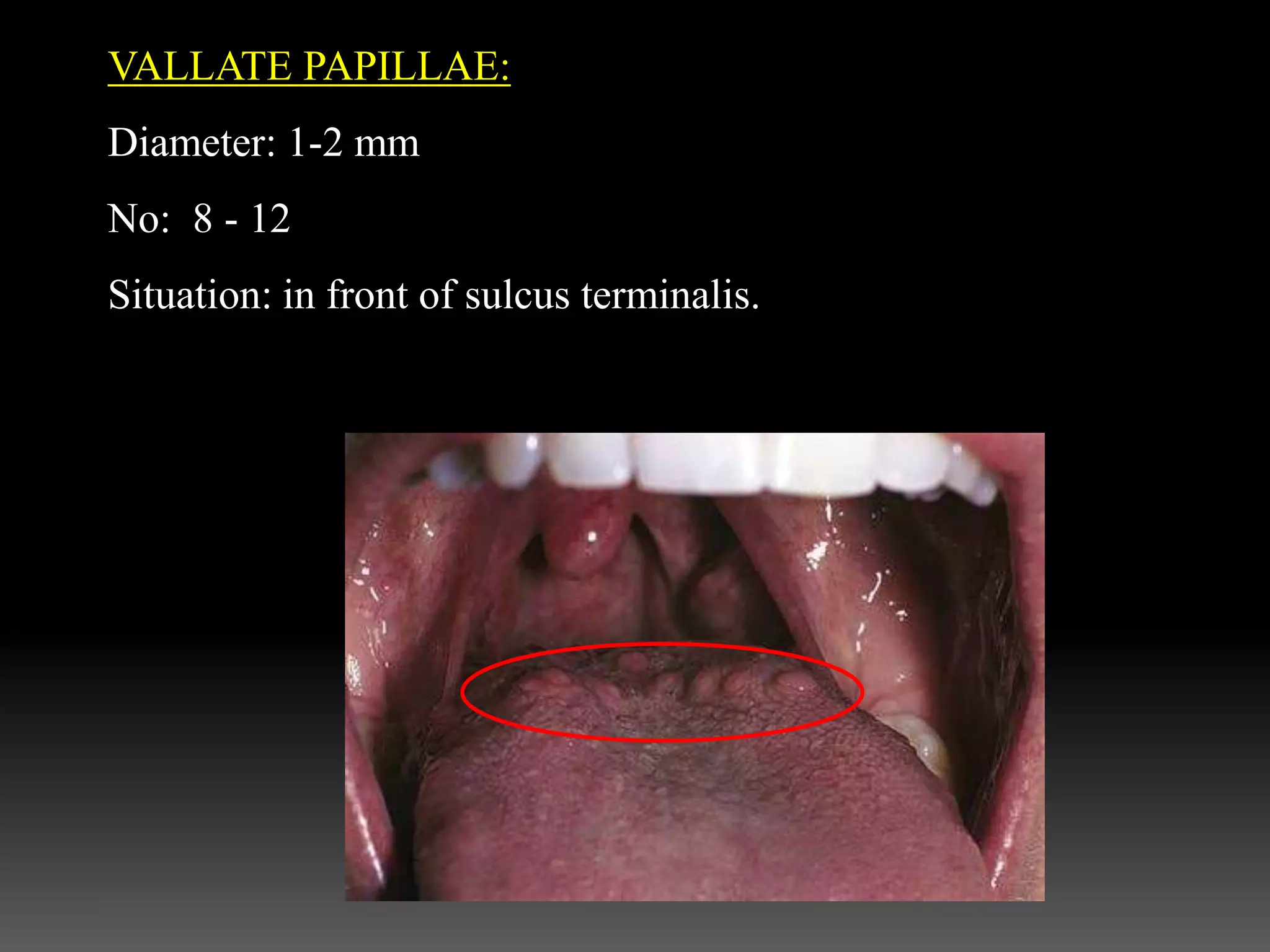
VALLATE PAPILLAE:
Diameter: 1-2 mm
No: 8 - 12
Situation: in front of sulcus terminalis.
FUNGIFORM PAPILLAE:
• Colour: Bright red
• Numerous near tip and margins of tongue.
• Scattered over the dorsum.
• Size: < vallate papillae > filliform papillae
FILLIFORM PAPILLAE:
Colour:Velvet
Situation: presulcal area of dorsum of tongue
Smallest and most numerous.
FOLIATE PAPILLAE:
Situation :In front of the palatoglossal arch.
STRUCTURE OF TASTE BUD
MUSCLES OF TONGUE
ARTERIAL SUPPLY OF TONGUE:
Lingual artery , tonsillar , ascending pharyngeal branch of external
carotid artery.
VENOUS DRAINAGE
LYMPHATIC DRAINAGE
NERVE SUPPLY
PRIMARY SENSATIONS:
• Sour taste
• Salt taste
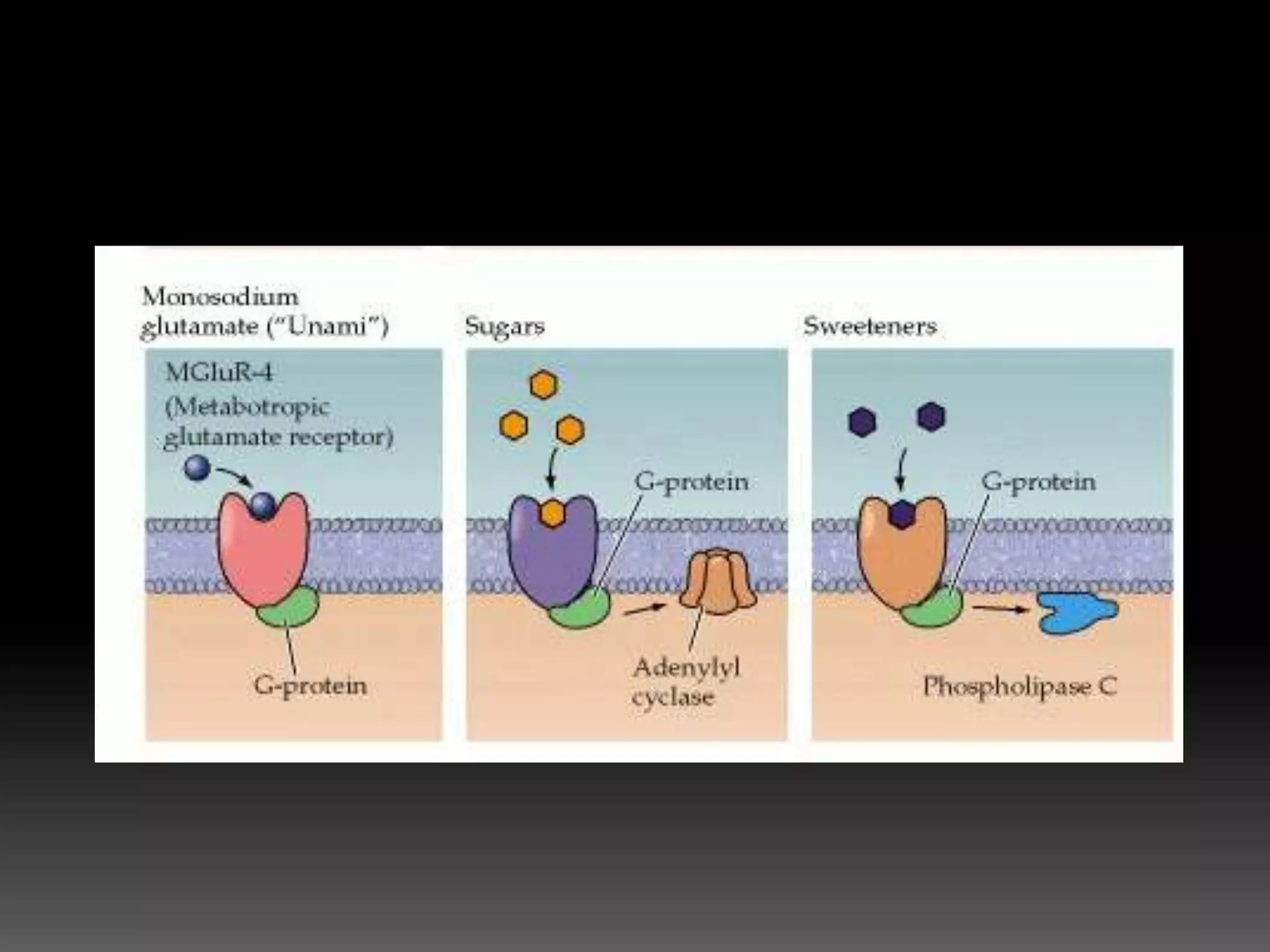
• Sweet taste
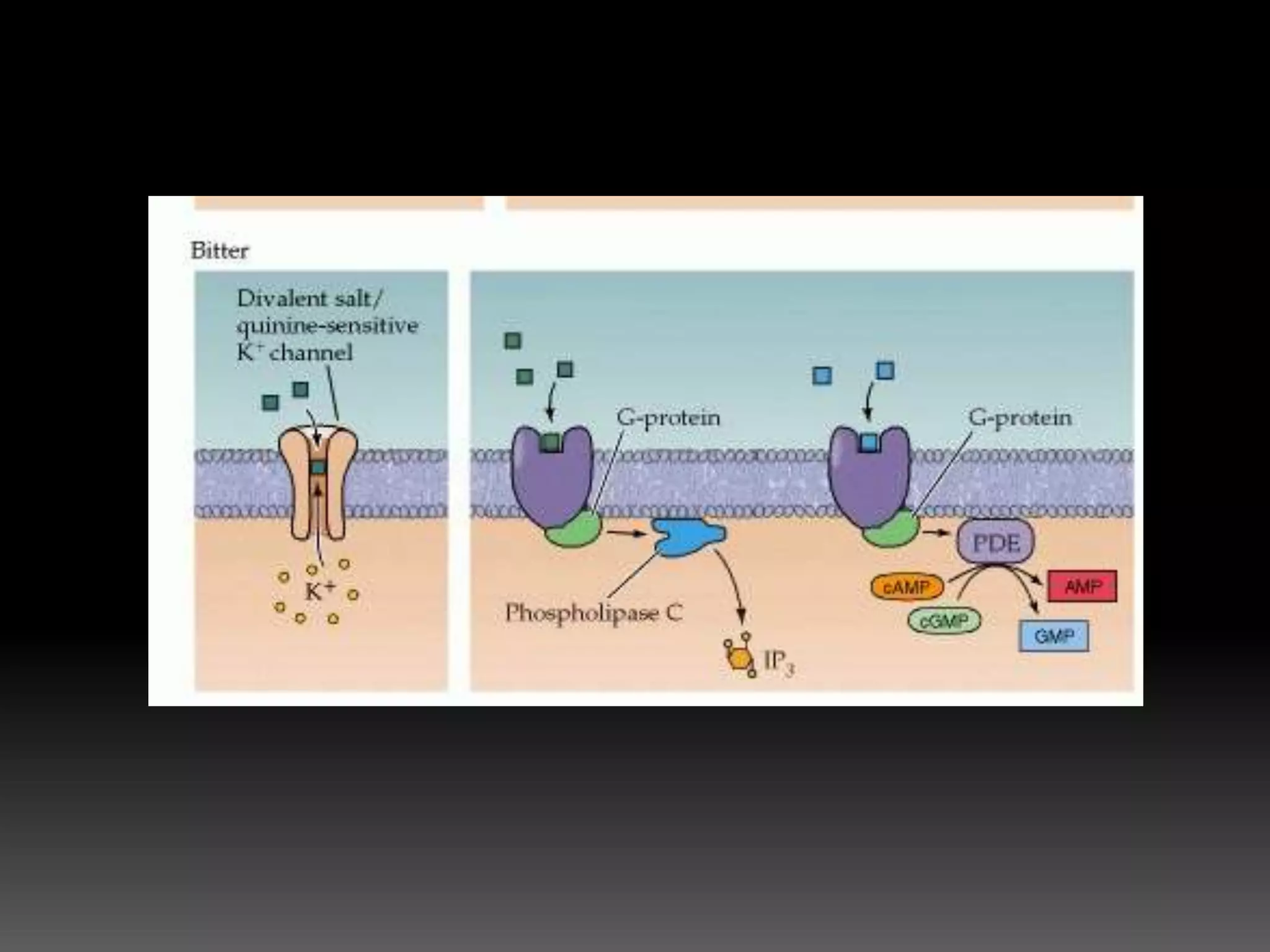
• Bitter taste
• Umami taste
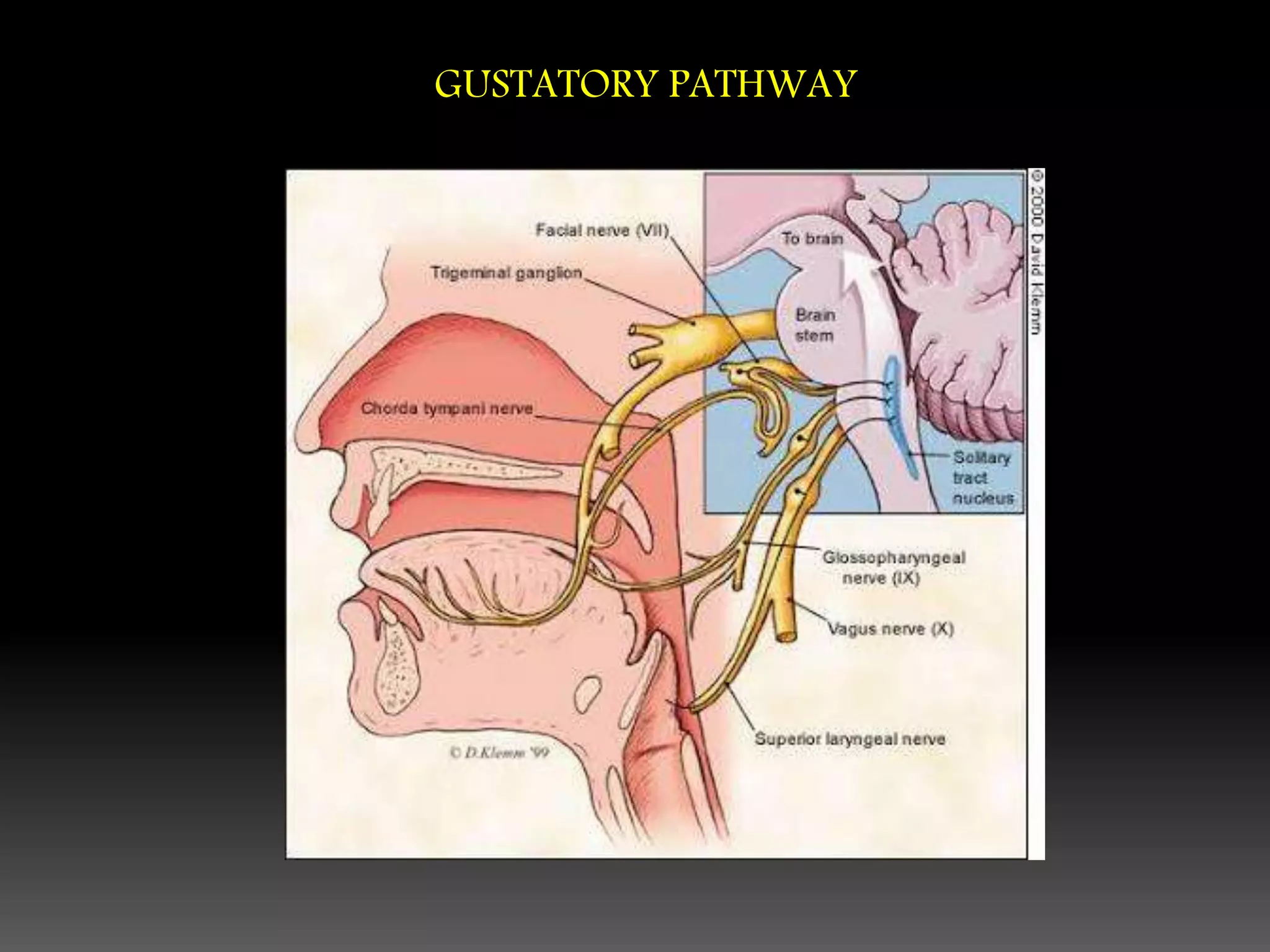
GUSTATORY PATHWAY
Sour taste: Caused by acids - hydrogen ion concentration
Salty taste: Elicited by ionized salts – sodium ion concentration.
Sweet taste: Organic chemicals, sugars, glycols, amino acids etc..
Bitter taste: Organic substances containing nitrogen, alkaloids.
Umami: pleasant taste sensation that is quantitavely different from
sour, salt , sweet or bitter.
MECHANISM OF STIMULATION:
Binding of taste
chemical to protein
receptor molecule
Opens ions channels
Allows positively
charged sodium ions
or hydrogen ions
depolarize
Taste chemical
washed away
Stimulus removed.
GENERATION OF NERVE IMPULSES:
• First application of stimulus: rate of discharge – rises to peak in a
small fraction of second
• Next few seconds : back to lower ,steady level
GENERATION OF NERVE IMPULSES
PATHWAY FOR TASTE:
• RECEPTORS:
• Type III cells of taste buds.
• Each taste bud is innervated by about 50 sensory nerves .
• Each nerve fiber supplies atleast 5 taste buds.
FIRST ORDER NEURONS:
• Present in the nuclei of different cranial nerves.
• Dendrites of the neurons are distributed to the taste buds.
Fibres run along the following nerves.
1. Chorda tympani – anterior two thirds of tongue.
2. Glossopharyngeal nerve fibres – posterior one- third .
3. Vagal fibres – taste buds in other regions.
• Axons of first order neurons run together in medulla oblongata and
terminate in the nucleus of tractus solitarius.
Second order neurons:
• Present in the nucleus of tractus
solitarius.
• Axons run through medial
lemniscus and terminate in
posteroventral nucleus of
thalamus.
Third order neurons:
• Center – opercular insular cortex
in parietal lobe of cerebral
cortex.
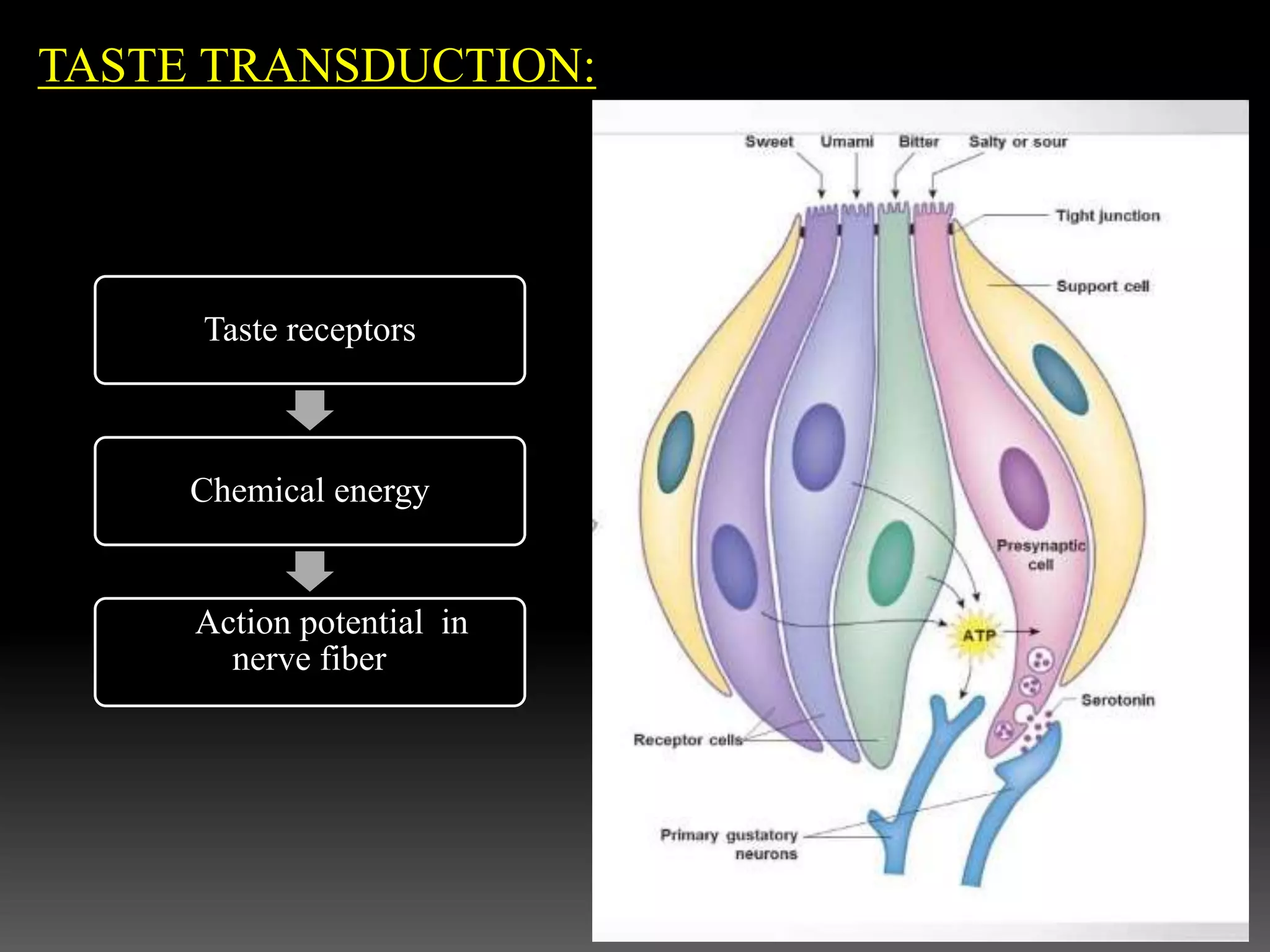
Taste receptors
Chemical energy
Action potential in
nerve fiber
TASTE TRANSDUCTION:
receptors
Stimulated by substances
dissolved in mouth by saliva
microvilli
Receptor potential
Action potential
APPLIED PHYSIOLOGY:
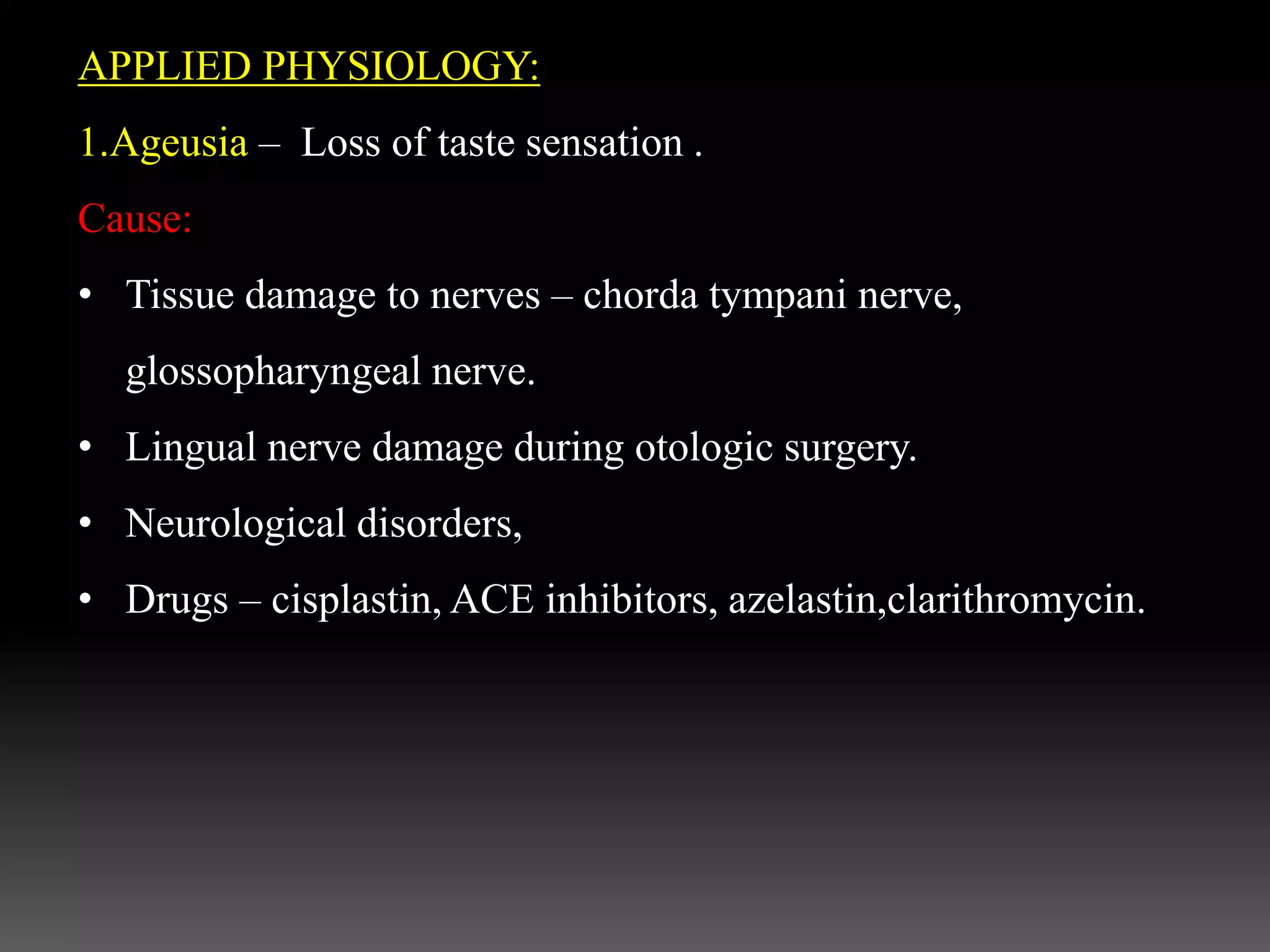
1.Ageusia – Loss of taste sensation .
Cause:
• Tissue damage to nerves – chorda tympani nerve,
glossopharyngeal nerve.
• Lingual nerve damage during otologic surgery.
• Neurological disorders,
• Drugs – cisplastin, ACE inhibitors, azelastin,clarithromycin.
2.Hypogeusia – diminished taste sensation.
Cause:
• Drug – bleomycin
• Zinc defeciency.
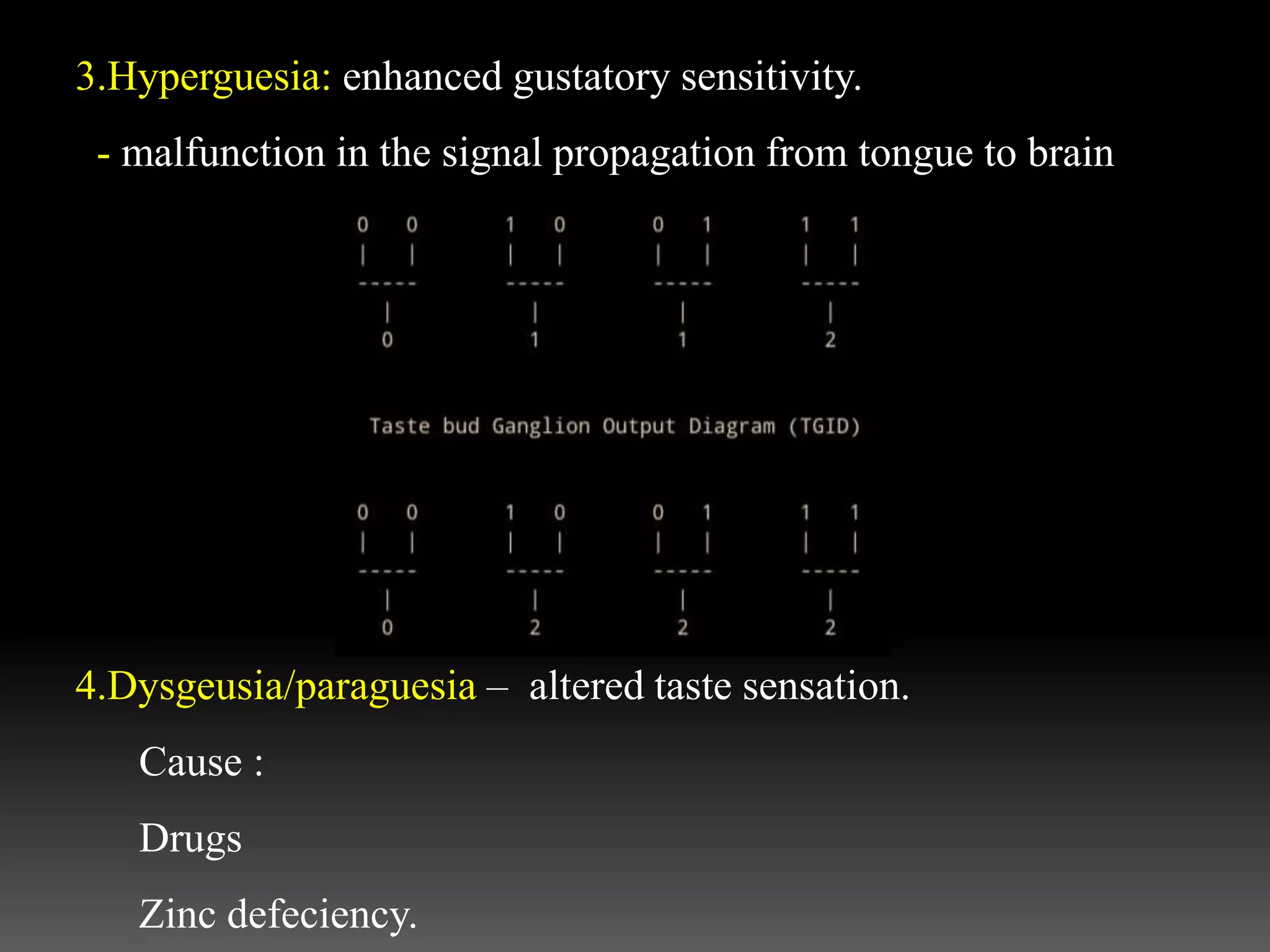
3.Hyperguesia: enhanced gustatory sensitivity.
- malfunction in the signal propagation from tongue to brain
4.Dysgeusia/paraguesia – altered taste sensation.
Cause :
Drugs
Zinc defeciency.
5.Cacoguesia – bad taste in the mouth.
- occurs independent of any drug, food, liquid
- described as all five taste signals, permanently on and mixing.
6.Heteroguesia –inability to distinguish between tastes.
- lingual or glossopharyngeal nerve sheaths damaged – signal
contamination between strands.
-Damage to olfactory centre in brain.
7.Phantoguesia – gustatory hallucination
- due to misfiring nerves – sends signals where there is
no source
- linked to memory in the brain
8.Norguesia –the sought after ideal.
• Familial dysautonomia – loss of taste sensation.
• Taste blindness – Very high threshold to bitter taste
CAUSES:
Defeciency
• Vitamin B 12 defeciency
• Zinc responsible for
• repair and produce taste buds
• Cofactor for alkaline phosphatase
(enzyme in taste bud membranes)
ENDOCRINE DISORDERS:
• Cushing’s syndrome
• Hypothyroidism - has effects at multiple points of the gustatory and
olfactory perceptual pathways.
• Diabetes mellitus
- Oral & perioral disorders(hypogeusia)
- Xerostomia
- Glossitis – ageusia.
- Diabetic autonomic neuropathy(rare-0.05%)
- Peripheral neuropathy.
- Sweet taste receptors(T1R2) increased.
- Metformin,glibenclamide
LOCAL INJURY OR INFLAMMATION:
• Radiation therapy saliva interacts & protects taste receptors
decrease in saliva
mediates sour & sweet taste
(bicarbonate ions,glutamate)
dysguesia
• Glossitis
• Tobacco usage
• Denture use
MEDICATIONS:
• Mechanism:
Oral mucositis, oral infection, salivary gland dysfunction.
• Antiproliferative drugs - cisplastin
inhibition of sodium channels
• ACE inhibitors – losartan
• The ACE enzyme is a zinc-dependent enzyme.
• ACE inhibitors, need zinc for reaction,
• the inhibition of ACE by the drug - affect the zinc of the ACE
protein in the salivary gland cells - alter taste
• Antihistamines – azelastine,emedastine
• Drugs containing sulfhydryl groups – penicilamine, captopril
React with zinc - defeciency - dysguesia
• Anti rheumatic drugs
• Metronidazole ,chlorhexidine
interact with metal ions in cell membrane.
• Calcium channel blocker -Amlodipine
block calcium sensitive taste buds.
NEUROLOGIC CONDITIONS:
• Bells palsy
- facial nerve damage - aguesia
• Familial dysautonomia
• Multiple sclerosis
Others :
• Ageing – diminished taste buds.
• Xerostomia
• Injury to glossopharyngeal nerve
• Damage to pons,thalamus,midbrain
• Anxiety disorder
• Cancer
• Renal failure
• Hepatic failure
• Bladder obstruction – dysguesia
areas responsible for urinary system and taste are in close
proximity(pons &cerebral cortex).
• Upper respiratory and middle ear infections
• Cold – odors – cant reach sensory cells in the nose -food
tends to taste bland .
• Sinus infections
• Surgery to ear ,nose,throat
• Poor oral hygiene
• Third molar extraction.
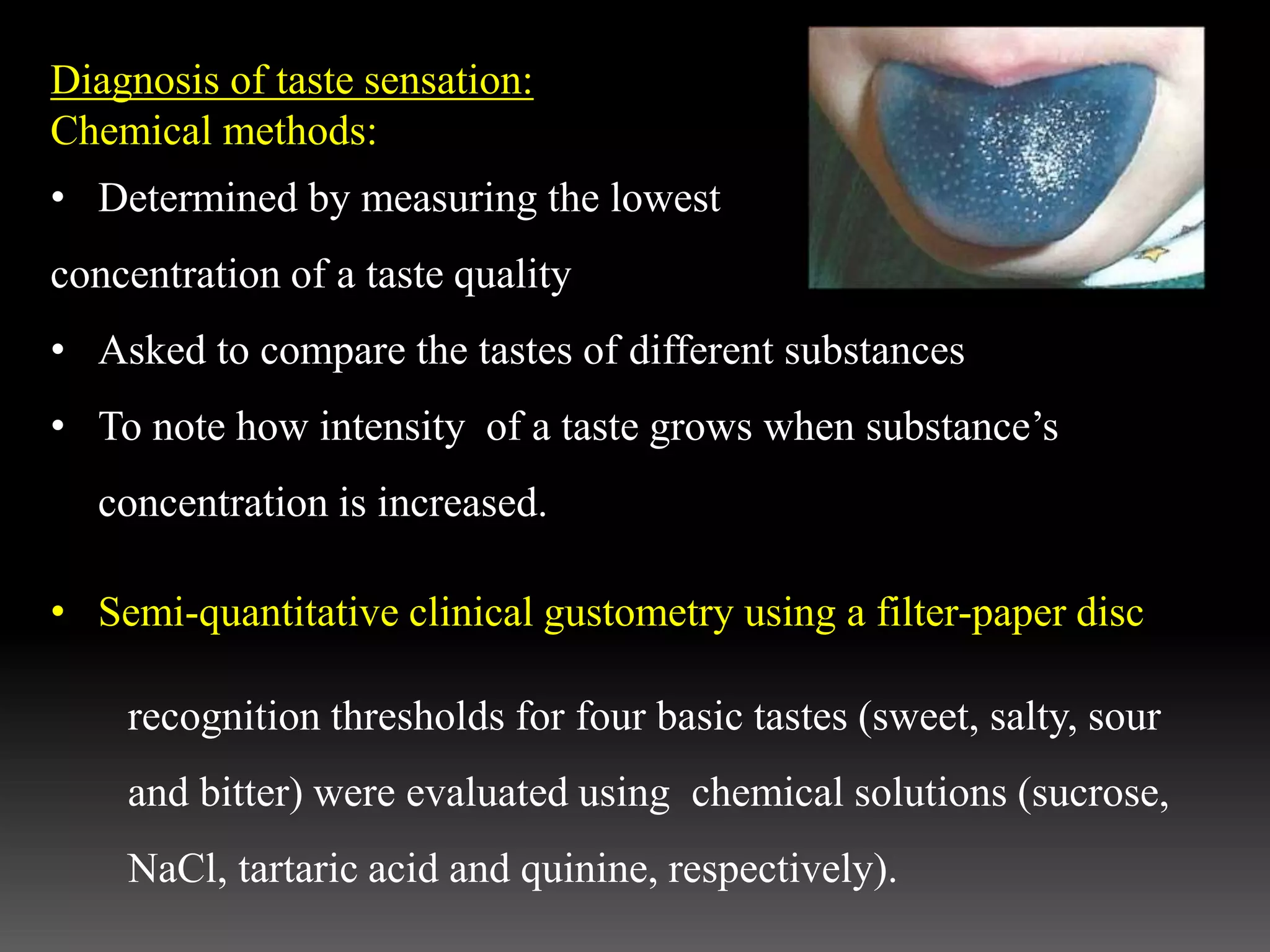
Diagnosis of taste sensation:
Chemical methods:
• Determined by measuring the lowest
concentration of a taste quality
• Asked to compare the tastes of different substances
• To note how intensity of a taste grows when substance’s
concentration is increased.
• Semi-quantitative clinical gustometry using a filter-paper disc
recognition thresholds for four basic tastes (sweet, salty, sour
and bitter) were evaluated using chemical solutions (sucrose,
NaCl, tartaric acid and quinine, respectively).
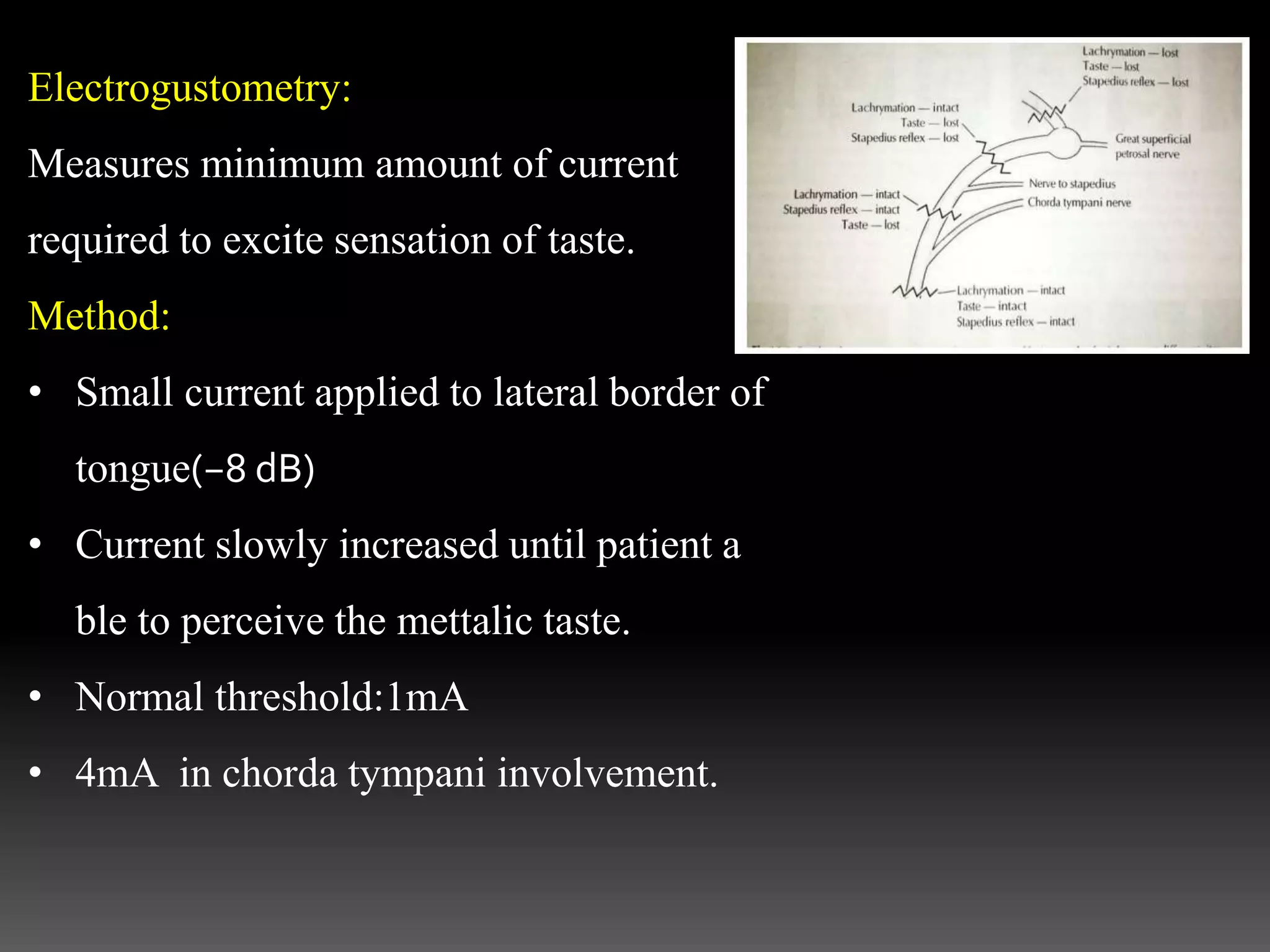
Electrogustometry:
Measures minimum amount of current
required to excite sensation of taste.
Method:
• Small current applied to lateral border of
tongue(−8 dB)
• Current slowly increased until patient a
ble to perceive the mettalic taste.
• Normal threshold:1mA
• 4mA in chorda tympani involvement.
References:
• Grey,s anatomy,
• B.D .chaurashia
• Orban,s
• Textbook of physiology – guyton
• Sensory malfunction : taste
• Appleyard D.A cold left me unable to smell or taste for two
years, 29 january 2012.
• mandibular nerve involvement in diabetic polyneuropathy
mucle nerve 1998:21(12):1673-9
Thank you

Physiology of taste

  • 1.
  • 2.
    INTRODUCTION: • Taste belongsto our chemical sensing system, or the chemosenses. • The complex process of tasting begins when tiny molecules released by substances stimulate special cells in the nose, mouth, throat. • Tongue is a muscular organ situated in the floor of the mouth. • Associated with functions of taste, speech, mastication and deglutition.
  • 3.
    • Taste buds– sense organs for taste or gustatory sensation. • One’s sense of smell also contributes strongly to taste sensation Women have better sense of taste – typically have more taste areas – fungiform papillae and taste buds than men.
  • 4.
  • 6.
    PAPILLAE OF TONGUE: •Gives characteristic roughness to anterior two-thirds of tongue. • Projections of mucous membrane or corium. • Taste buds are present TASTE BUDS: Ovoid bodies - 50 – 70 µ
  • 7.
    TYPES OF PAPILLAE: •Vallate or circumvallate papillae • Fungiform papillae • Filliform papillae or conical papillae • Foliate papillae
  • 8.
    VALLATE PAPILLAE: Diameter: 1-2mm No: 8 - 12 Situation: in front of sulcus terminalis.
  • 9.
    FUNGIFORM PAPILLAE: • Colour:Bright red • Numerous near tip and margins of tongue. • Scattered over the dorsum. • Size: < vallate papillae > filliform papillae
  • 10.
    FILLIFORM PAPILLAE: Colour:Velvet Situation: presulcalarea of dorsum of tongue Smallest and most numerous.
  • 11.
    FOLIATE PAPILLAE: Situation :Infront of the palatoglossal arch.
  • 12.
  • 13.
  • 15.
    ARTERIAL SUPPLY OFTONGUE: Lingual artery , tonsillar , ascending pharyngeal branch of external carotid artery.
  • 16.
  • 17.
  • 18.
  • 19.
    PRIMARY SENSATIONS: • Sourtaste • Salt taste • Sweet taste • Bitter taste • Umami taste
  • 20.
  • 22.
    Sour taste: Causedby acids - hydrogen ion concentration Salty taste: Elicited by ionized salts – sodium ion concentration. Sweet taste: Organic chemicals, sugars, glycols, amino acids etc.. Bitter taste: Organic substances containing nitrogen, alkaloids. Umami: pleasant taste sensation that is quantitavely different from sour, salt , sweet or bitter.
  • 26.
    MECHANISM OF STIMULATION: Bindingof taste chemical to protein receptor molecule Opens ions channels Allows positively charged sodium ions or hydrogen ions depolarize Taste chemical washed away Stimulus removed.
  • 28.
    GENERATION OF NERVEIMPULSES: • First application of stimulus: rate of discharge – rises to peak in a small fraction of second • Next few seconds : back to lower ,steady level
  • 29.
  • 30.
    PATHWAY FOR TASTE: •RECEPTORS: • Type III cells of taste buds. • Each taste bud is innervated by about 50 sensory nerves . • Each nerve fiber supplies atleast 5 taste buds.
  • 31.
    FIRST ORDER NEURONS: •Present in the nuclei of different cranial nerves. • Dendrites of the neurons are distributed to the taste buds. Fibres run along the following nerves. 1. Chorda tympani – anterior two thirds of tongue. 2. Glossopharyngeal nerve fibres – posterior one- third . 3. Vagal fibres – taste buds in other regions. • Axons of first order neurons run together in medulla oblongata and terminate in the nucleus of tractus solitarius.
  • 32.
    Second order neurons: •Present in the nucleus of tractus solitarius. • Axons run through medial lemniscus and terminate in posteroventral nucleus of thalamus. Third order neurons: • Center – opercular insular cortex in parietal lobe of cerebral cortex.
  • 33.
    Taste receptors Chemical energy Actionpotential in nerve fiber TASTE TRANSDUCTION:
  • 34.
    receptors Stimulated by substances dissolvedin mouth by saliva microvilli Receptor potential Action potential
  • 35.
    APPLIED PHYSIOLOGY: 1.Ageusia –Loss of taste sensation . Cause: • Tissue damage to nerves – chorda tympani nerve, glossopharyngeal nerve. • Lingual nerve damage during otologic surgery. • Neurological disorders, • Drugs – cisplastin, ACE inhibitors, azelastin,clarithromycin.
  • 36.
    2.Hypogeusia – diminishedtaste sensation. Cause: • Drug – bleomycin • Zinc defeciency.
  • 37.
    3.Hyperguesia: enhanced gustatorysensitivity. - malfunction in the signal propagation from tongue to brain 4.Dysgeusia/paraguesia – altered taste sensation. Cause : Drugs Zinc defeciency.
  • 38.
    5.Cacoguesia – badtaste in the mouth. - occurs independent of any drug, food, liquid - described as all five taste signals, permanently on and mixing. 6.Heteroguesia –inability to distinguish between tastes. - lingual or glossopharyngeal nerve sheaths damaged – signal contamination between strands. -Damage to olfactory centre in brain.
  • 39.
    7.Phantoguesia – gustatoryhallucination - due to misfiring nerves – sends signals where there is no source - linked to memory in the brain 8.Norguesia –the sought after ideal.
  • 40.
    • Familial dysautonomia– loss of taste sensation. • Taste blindness – Very high threshold to bitter taste
  • 41.
    CAUSES: Defeciency • Vitamin B12 defeciency • Zinc responsible for • repair and produce taste buds • Cofactor for alkaline phosphatase (enzyme in taste bud membranes)
  • 42.
    ENDOCRINE DISORDERS: • Cushing’ssyndrome • Hypothyroidism - has effects at multiple points of the gustatory and olfactory perceptual pathways. • Diabetes mellitus - Oral & perioral disorders(hypogeusia) - Xerostomia - Glossitis – ageusia. - Diabetic autonomic neuropathy(rare-0.05%) - Peripheral neuropathy. - Sweet taste receptors(T1R2) increased. - Metformin,glibenclamide
  • 43.
    LOCAL INJURY ORINFLAMMATION: • Radiation therapy saliva interacts & protects taste receptors decrease in saliva mediates sour & sweet taste (bicarbonate ions,glutamate) dysguesia • Glossitis • Tobacco usage • Denture use
  • 44.
    MEDICATIONS: • Mechanism: Oral mucositis,oral infection, salivary gland dysfunction. • Antiproliferative drugs - cisplastin inhibition of sodium channels • ACE inhibitors – losartan • The ACE enzyme is a zinc-dependent enzyme. • ACE inhibitors, need zinc for reaction, • the inhibition of ACE by the drug - affect the zinc of the ACE protein in the salivary gland cells - alter taste
  • 45.
    • Antihistamines –azelastine,emedastine • Drugs containing sulfhydryl groups – penicilamine, captopril React with zinc - defeciency - dysguesia
  • 46.
    • Anti rheumaticdrugs • Metronidazole ,chlorhexidine interact with metal ions in cell membrane. • Calcium channel blocker -Amlodipine block calcium sensitive taste buds.
  • 47.
    NEUROLOGIC CONDITIONS: • Bellspalsy - facial nerve damage - aguesia • Familial dysautonomia • Multiple sclerosis
  • 48.
    Others : • Ageing– diminished taste buds. • Xerostomia • Injury to glossopharyngeal nerve • Damage to pons,thalamus,midbrain • Anxiety disorder • Cancer • Renal failure • Hepatic failure • Bladder obstruction – dysguesia areas responsible for urinary system and taste are in close proximity(pons &cerebral cortex).
  • 49.
    • Upper respiratoryand middle ear infections • Cold – odors – cant reach sensory cells in the nose -food tends to taste bland . • Sinus infections • Surgery to ear ,nose,throat • Poor oral hygiene • Third molar extraction.
  • 50.
    Diagnosis of tastesensation: Chemical methods: • Determined by measuring the lowest concentration of a taste quality • Asked to compare the tastes of different substances • To note how intensity of a taste grows when substance’s concentration is increased. • Semi-quantitative clinical gustometry using a filter-paper disc recognition thresholds for four basic tastes (sweet, salty, sour and bitter) were evaluated using chemical solutions (sucrose, NaCl, tartaric acid and quinine, respectively).
  • 51.
    Electrogustometry: Measures minimum amountof current required to excite sensation of taste. Method: • Small current applied to lateral border of tongue(−8 dB) • Current slowly increased until patient a ble to perceive the mettalic taste. • Normal threshold:1mA • 4mA in chorda tympani involvement.
  • 52.
    References: • Grey,s anatomy, •B.D .chaurashia • Orban,s • Textbook of physiology – guyton • Sensory malfunction : taste • Appleyard D.A cold left me unable to smell or taste for two years, 29 january 2012. • mandibular nerve involvement in diabetic polyneuropathy mucle nerve 1998:21(12):1673-9
  • 53.

Editor's Notes