8251 usart programmable communication interface by aniket bhute
This document provides an overview of the 8251A USART chip, including:
- It is a programmable peripheral designed for serial communication that converts parallel data from the CPU to serial and vice versa.
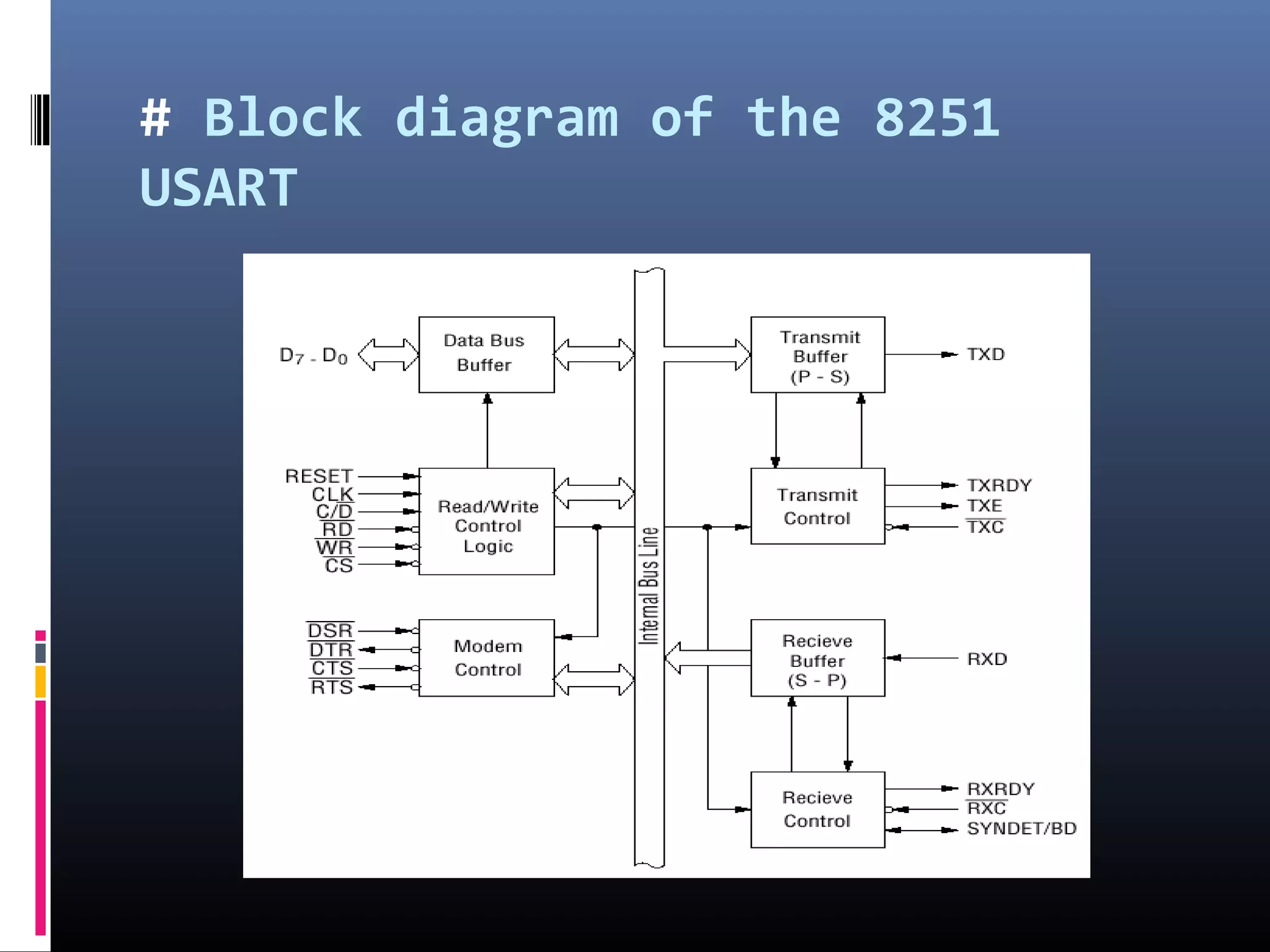
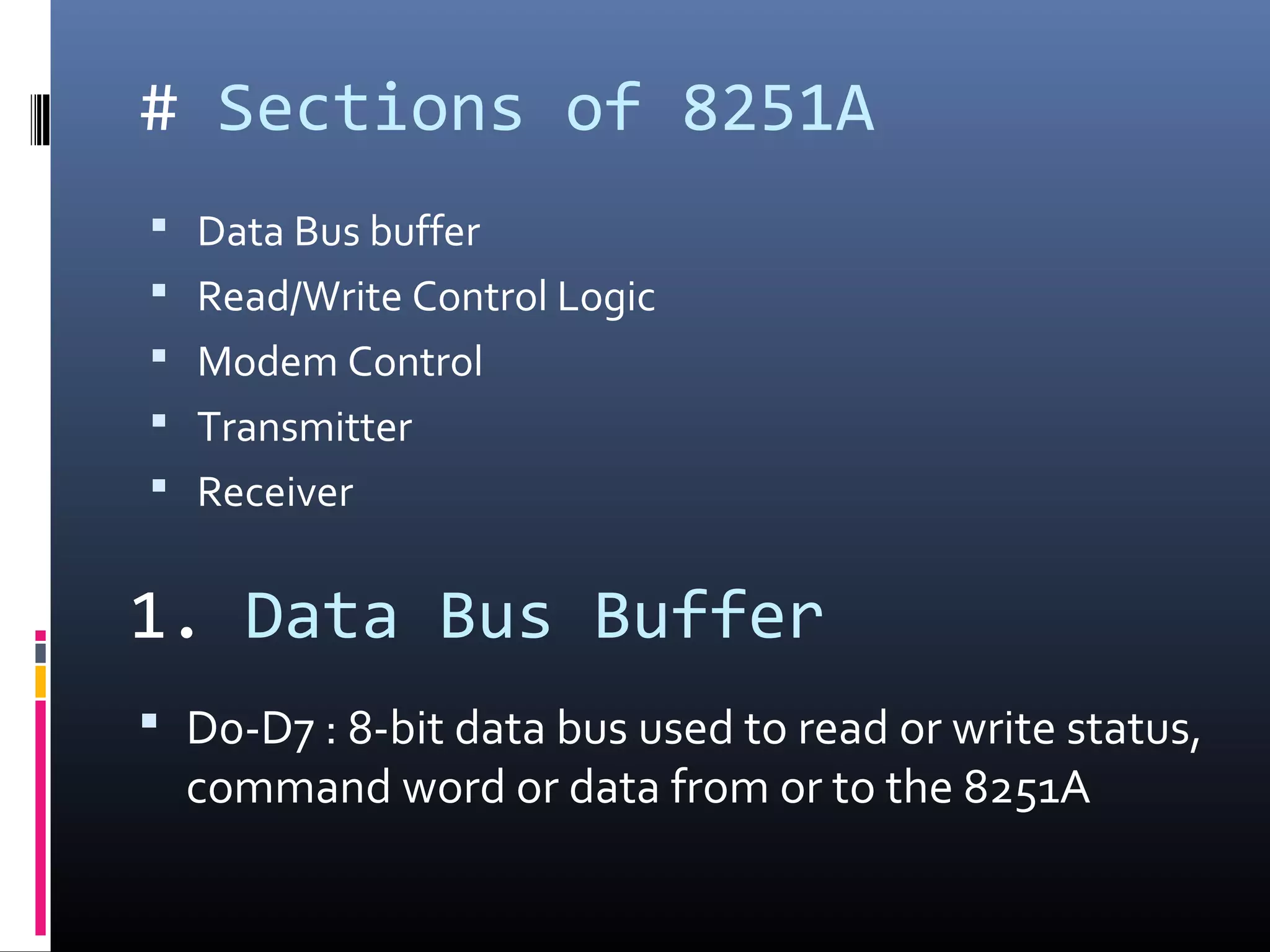
- It has sections for the data bus buffer, read/write control logic, modem control, transmitter and receiver.
- The transmitter accepts parallel data and converts it to serial, while the receiver accepts serial data and converts it to parallel for the CPU.
- It has control, status and data registers that are accessed via various control signals to read/write data and control the chip's operation.
8251A isa USART (Universal Synchronous
Asynchronous Receiver Transmitter) for serial
data communication.
Programmable peripheral designed for
synchronous /asynchronous serial data
communication, packaged in a 28-pin DIP.
Receives parallel data from the CPU & transmits
serial data after conversion.
Also receives serial data from the outside &
transmits parallel data to the CPU after
conversion.
# Introduction
# Sections of8251A
Data Bus buffer
Read/Write Control Logic
Modem Control
Transmitter
Receiver
1. Data Bus Buffer
D0-D7 : 8-bit data bus used to read or write status,
command word or data from or to the 8251A
6.
2. Read/Write Controllogic
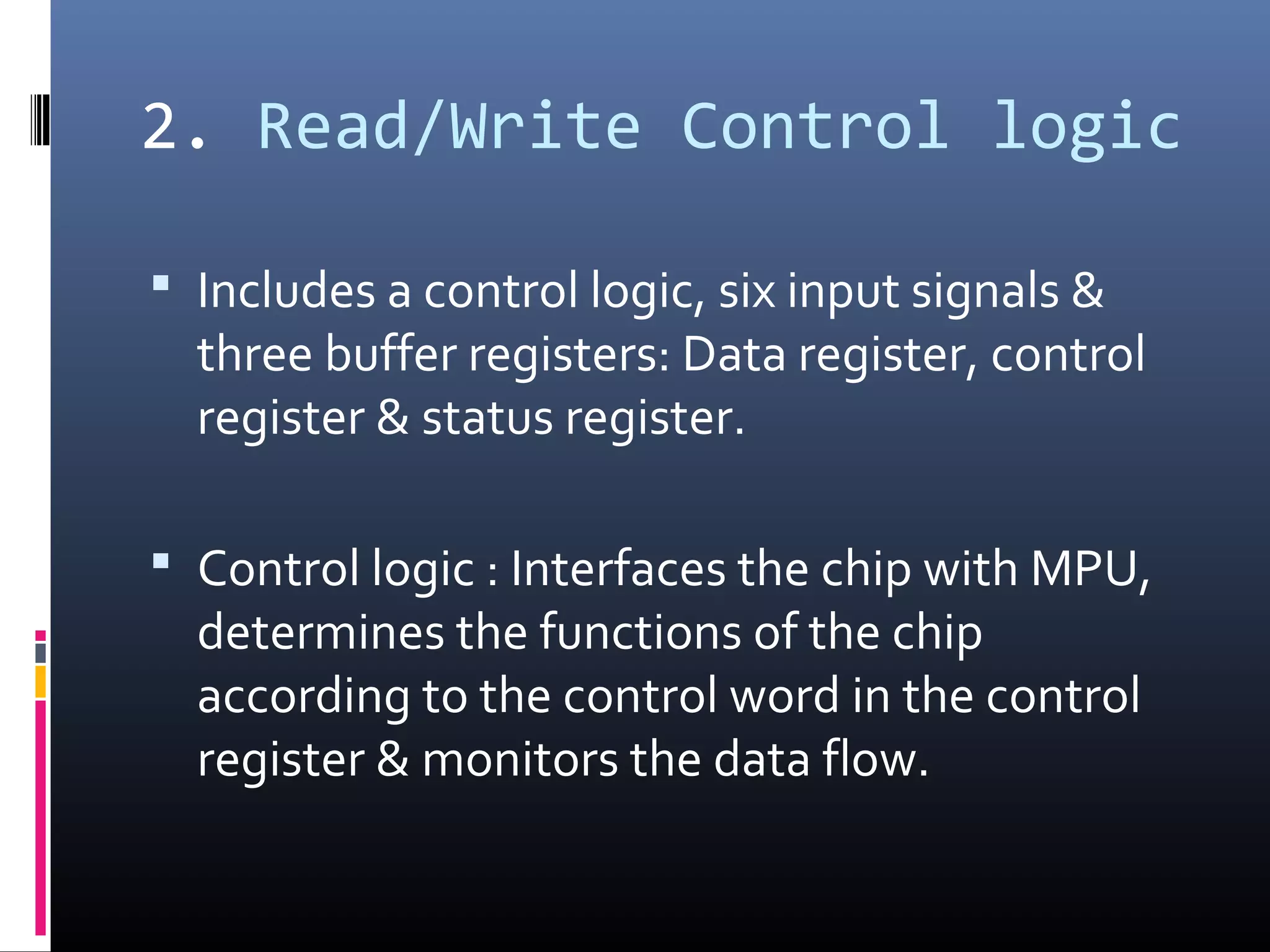
Includes a control logic, six input signals &
three buffer registers: Data register, control
register & status register.
Control logic : Interfaces the chip with MPU,
determines the functions of the chip
according to the control word in the control
register & monitors the data flow.
7.
Input signals
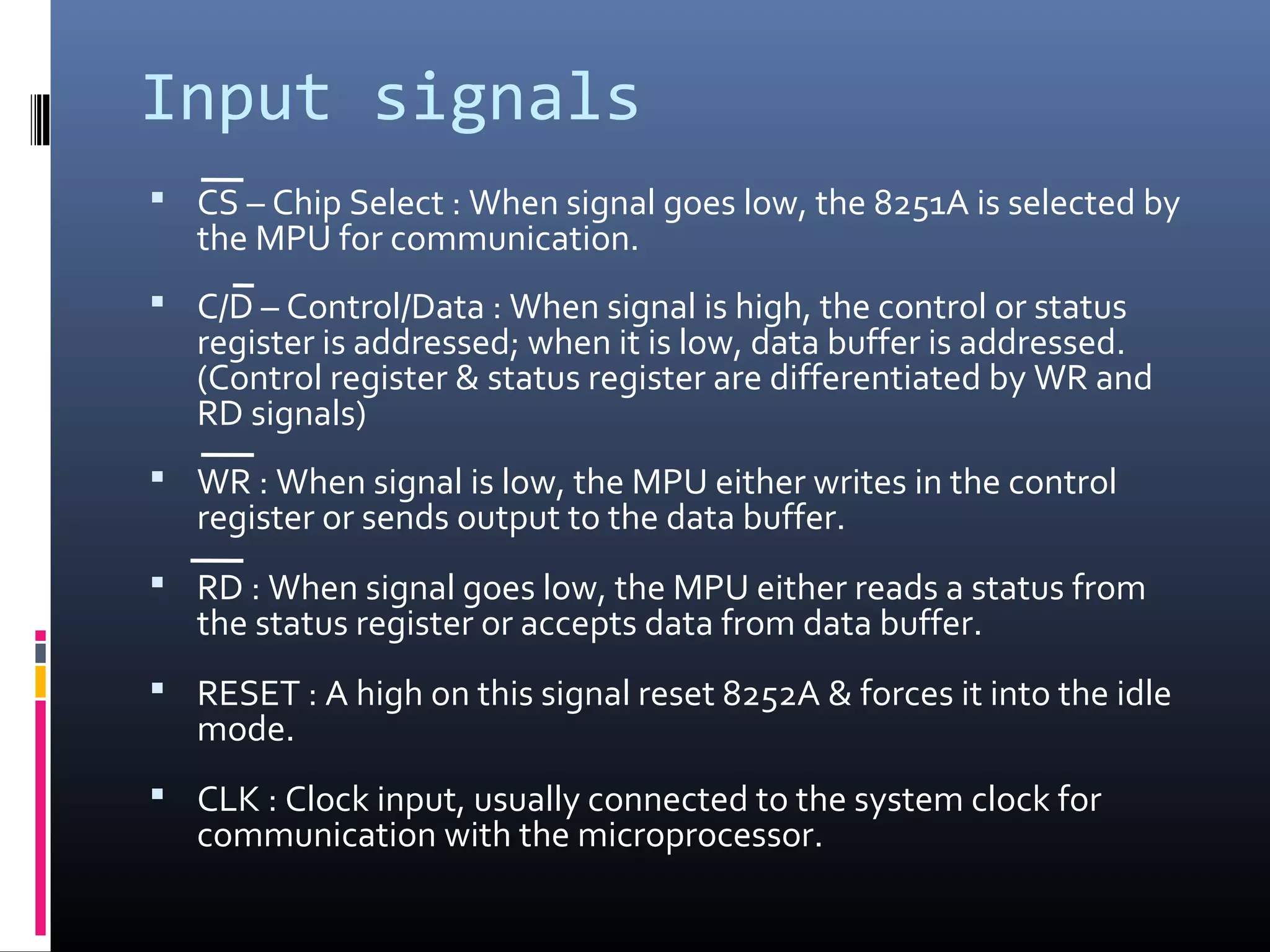
CS– Chip Select : When signal goes low, the 8251A is selected by
the MPU for communication.
C/D – Control/Data : When signal is high, the control or status
register is addressed; when it is low, data buffer is addressed.
(Control register & status register are differentiated by WR and
RD signals)
WR : When signal is low, the MPU either writes in the control
register or sends output to the data buffer.
RD : When signal goes low, the MPU either reads a status from
the status register or accepts data from data buffer.
RESET : A high on this signal reset 8252A & forces it into the idle
mode.
CLK : Clock input, usually connected to the system clock for
communication with the microprocessor.
8.
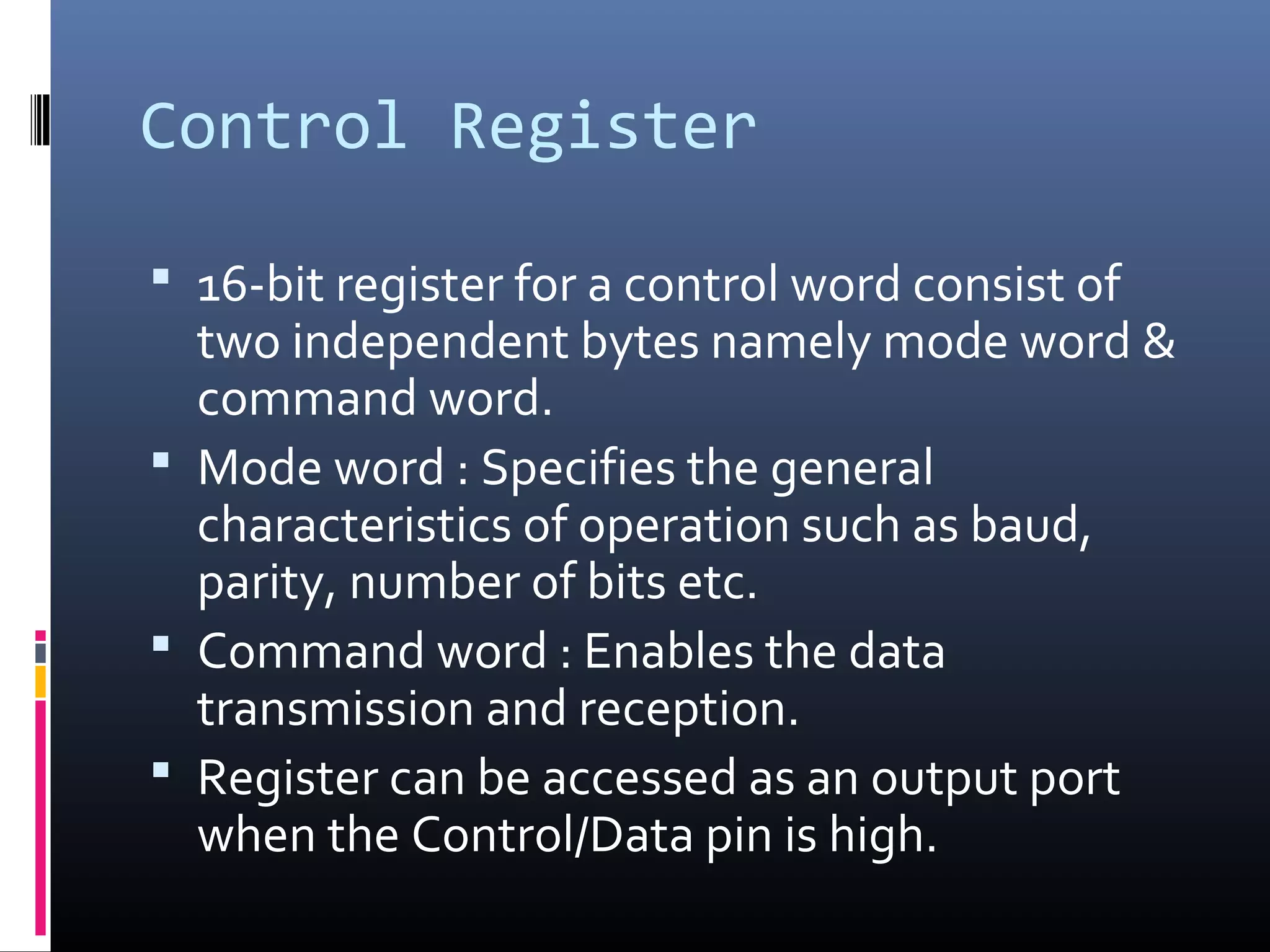
Control Register
16-bitregister for a control word consist of
two independent bytes namely mode word &
command word.
Mode word : Specifies the general
characteristics of operation such as baud,
parity, number of bits etc.
Command word : Enables the data
transmission and reception.
Register can be accessed as an output port
when the Control/Data pin is high.
9.
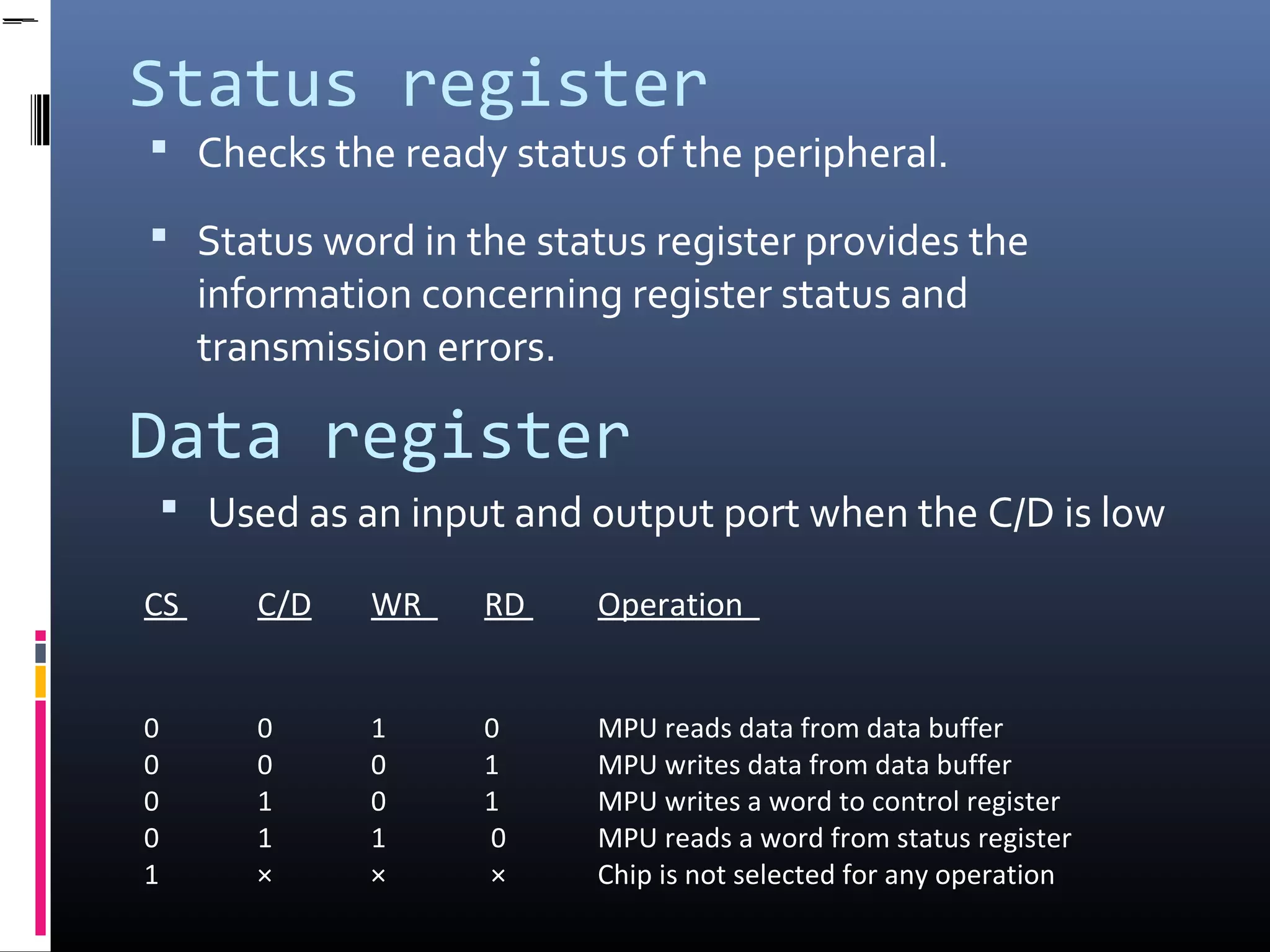
Status register
Checksthe ready status of the peripheral.
Status word in the status register provides the
information concerning register status and
transmission errors.
Data register
Used as an input and output port when the C/D is low
CS C/D WR RD Operation
0
0
0
0
1
0
0
1
1
×
1
0
0
1
×
0
1
1
0
×
MPU reads data from data buffer
MPU writes data from data buffer
MPU writes a word to control register
MPU reads a word from status register
Chip is not selected for any operation
10.
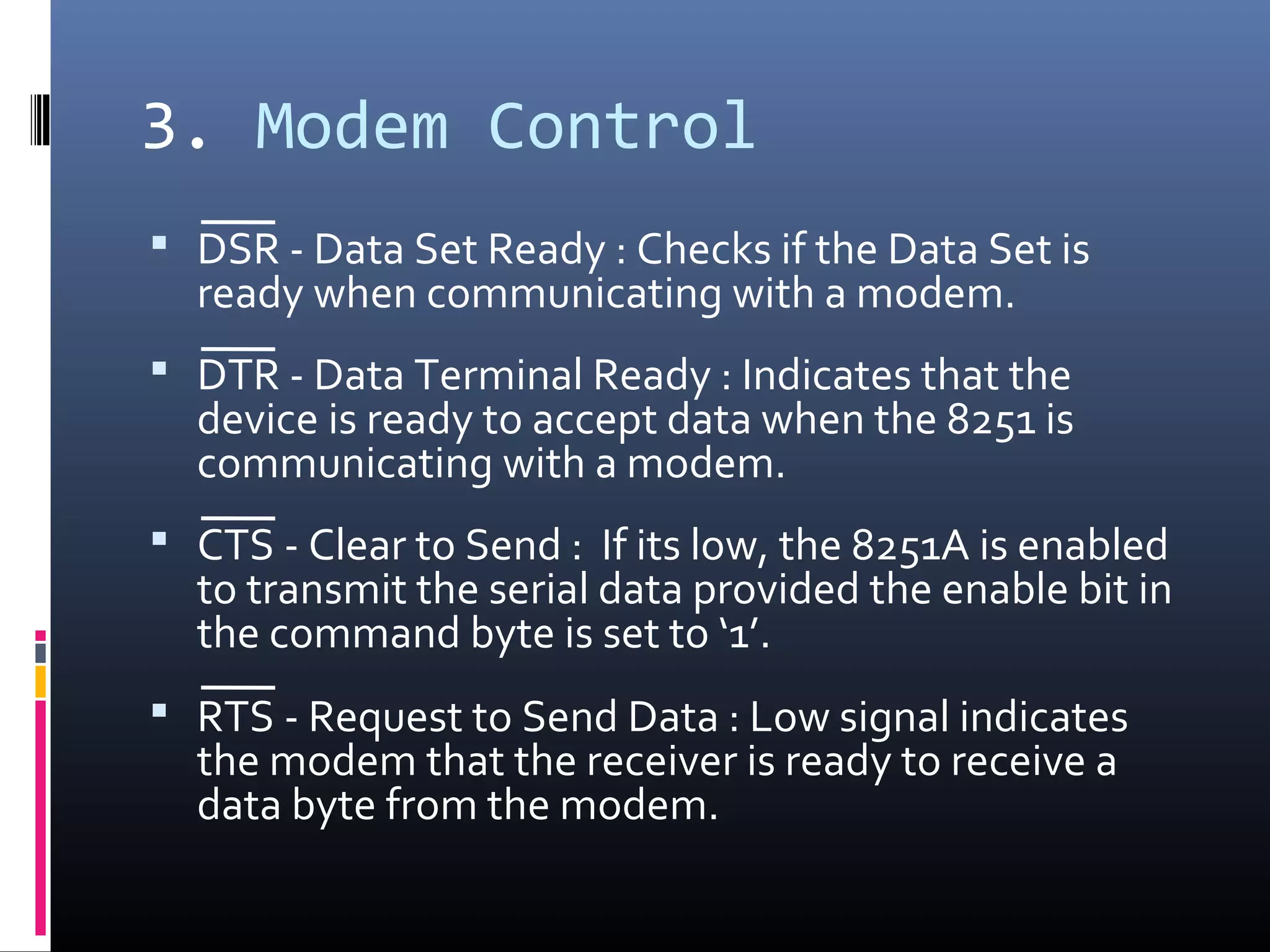
3. Modem Control
DSR - Data Set Ready : Checks if the Data Set is
ready when communicating with a modem.
DTR - Data Terminal Ready : Indicates that the
device is ready to accept data when the 8251 is
communicating with a modem.
CTS - Clear to Send : If its low, the 8251A is enabled
to transmit the serial data provided the enable bit in
the command byte is set to ‘1’.
RTS - Request to Send Data : Low signal indicates
the modem that the receiver is ready to receive a
data byte from the modem.
11.
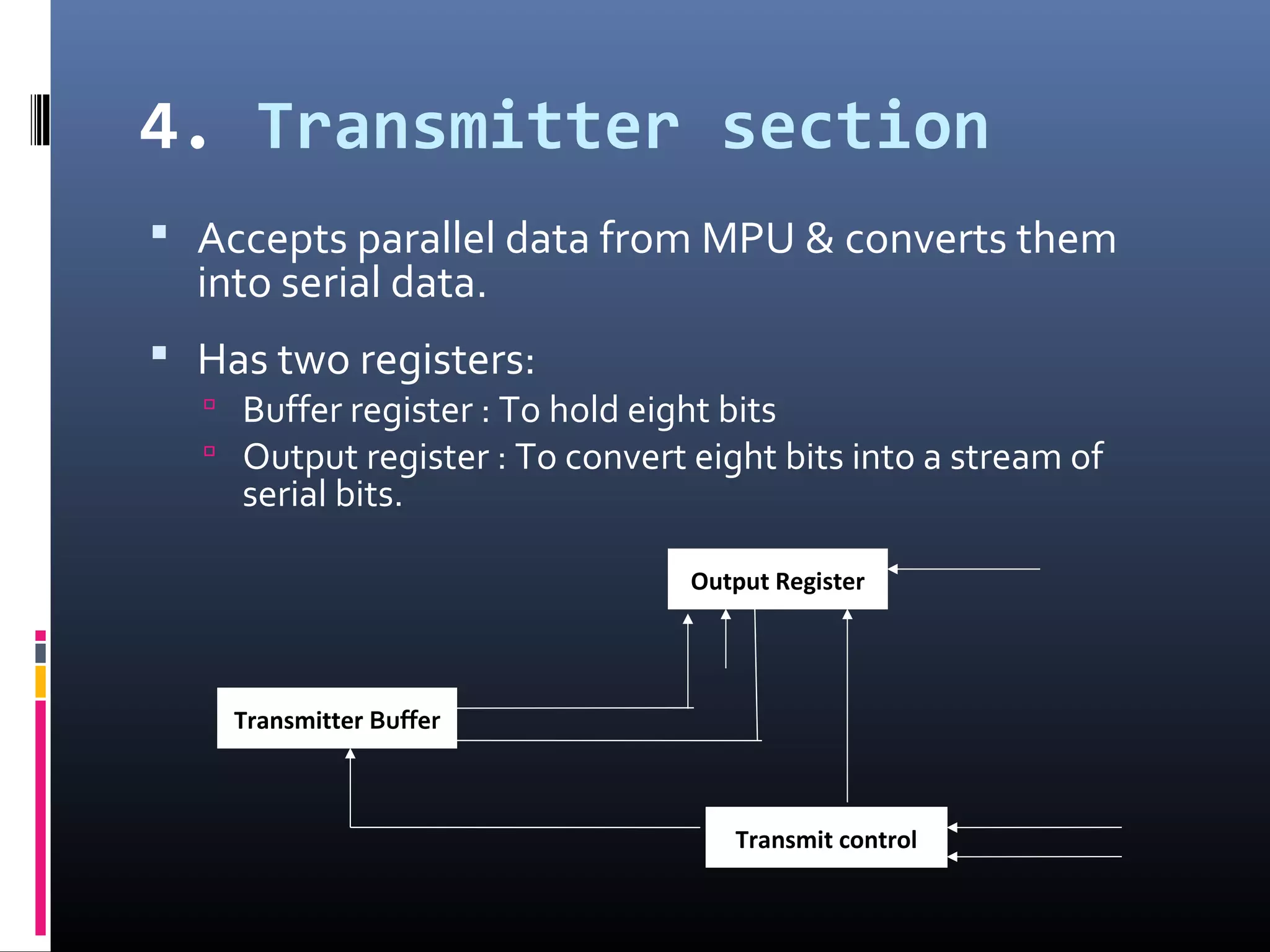
4. Transmitter section
Accepts parallel data from MPU & converts them
into serial data.
Has two registers:
Buffer register : To hold eight bits
Output register : To convert eight bits into a stream of
serial bits.
Transmit control
Output Register
Transmitter Buffer
12.
The MPUwrites a byte in the buffer register.
Whenever the output register is empty; the contents
of buffer register are transferred to output register.
Transmitter section consists of three output & one
input signals
TxD - Transmitted Data Output : Output signal to transmit
the data to peripherals
TxC - Transmitter Clock Input : Input signal, controls the
rate of transmission.
TxRDY - Transmitter Ready : Output signal, indicates the
buffer register is empty and the USART is ready to accept
the next data byte.
TxE - Transmitter Empty : Output signal to indicate the
output register is empty and the USART is ready to accept
the next data byte.
13.
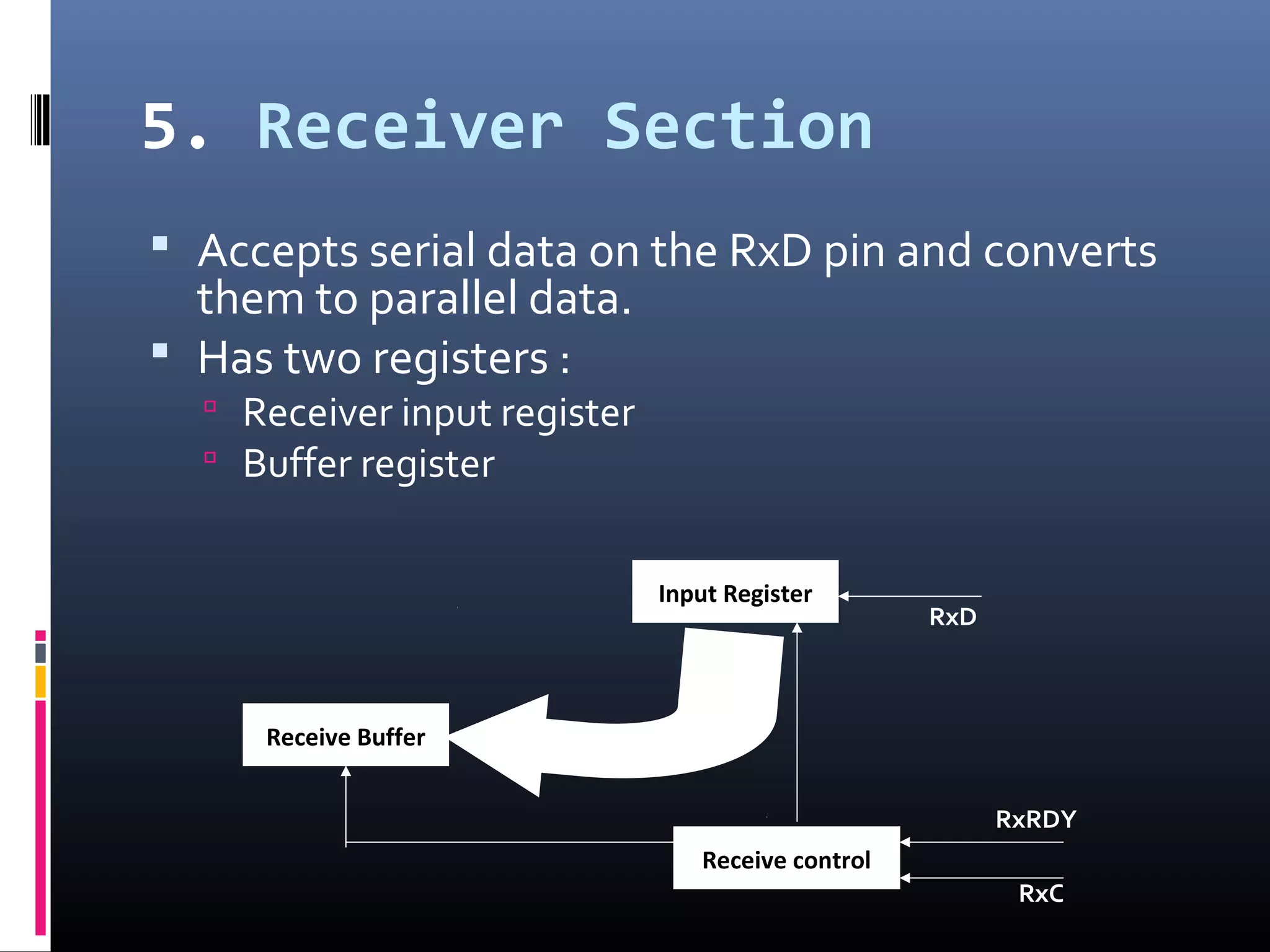
5. Receiver Section
Accepts serial data on the RxD pin and converts
them to parallel data.
Has two registers :
Receiver input register
Buffer register
Receive Buffer
Receive control
Input Register
RxRDY
RxC
RxD
14.
When RxDgoes low, the control logic assumes it is a
start bit, waits for half bit time, and samples the line
again. If the line is still low, the input register accepts
the following data, and loads it into buffer register at
the rate determined by the receiver clock.
RxRDY - Receiver Ready Output: Output signal, goes
high when the USART has a character in the buffer
register & is ready to transfer it to the MPU.
RxD - Receive Data Input : Bits are received serially
on this line & converted into a parallel byte in the
receiver input register.
RxC - Receiver Clock Input : Clock signal that
controls the rate at which bits are received by the
USART.