ADDRESSING MODES OF
8085
www.eazynotes.co
m
Addressing Modes of 8085
 To perform any operation, we have to give the
corresponding instructions to the microprocessor.
 In each instruction, programmer has to specify 3
things:
 Operation to be performed.
 Address of source of data.
 Address of destination of result.
www.eazynotes.co
m
Addressing Modes of 8085
 The method by which the address of
source of data or the address of
destination of result is given in the
instruction is called Addressing Modes.
 The term addressing mode refers to the
way in which the operand of the instruction
is specified.
www.eazynotes.co
m
Why use addressing modes
in 8085 microprocessor ?
 Flexibility: Addressing modes provide a flexible
way to access data and instructions in memory.
depending on the type of data being accessed, the
size of the data, and other factors.
 Memory optimization: Addressing modes can help
to optimize the use of memory resources by
allowing data and instructions to be accessed in the
most efficient way possible.
www.eazynotes.co
m
 Performance optimization: Addressing modes
can also help to optimize the performance of the
microprocessor by reducing the number of memory
accesses needed to fetch data or instructions.
 Reduced code size: Addressing modes can help
to reduce the size of code needed to perform a
particular task. By using addressing modes
programmers can write more compact and efficient
code.
www.eazynotes.co
m
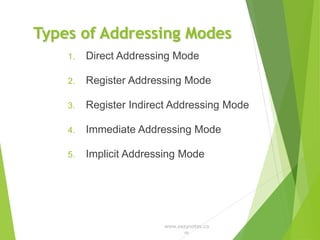
Types of Addressing Modes
1. Direct Addressing Mode
2. Register Addressing Mode
3. Register Indirect Addressing Mode
4. Immediate Addressing Mode
5. Implicit Addressing Mode
www.eazynotes.co
m
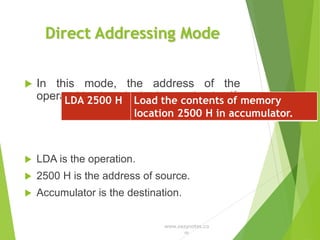
Direct Addressing Mode
 In this mode, the address of the
operand is given in the instruction itself.
 LDA is the operation.
 2500 H is the address of source.
 Accumulator is the destination.
LDA 2500 H Load the contents of memory
location 2500 H in accumulator.
www.eazynotes.co
m
 Direct addressing: Direct addressing is used
when the address of the operand is directly
specified in the instruction. This addressing
mode is used for simple operations where the
operand is stored in a specific memory
location, and the address does not need to be
calculated or manipulated in any way.
www.eazynotes.co
m
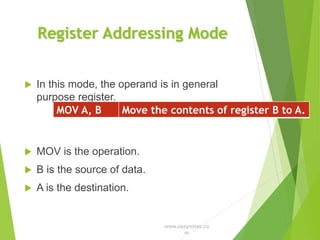
Register Addressing Mode
 In this mode, the operand is in general
purpose register.
 MOV is the operation.
 B is the source of data.
 A is the destination.
MOV A, B Move the contents of register B to A.
www.eazynotes.co
m
 Register addressing: Register addressing
is used when the operand is stored in a
register, rather than in memory. This
addressing mode is useful for performing
fast arithmetic or logic operations on small
amounts of data.
www.eazynotes.co
m
Register Indirect Addressing
Mode
 In this mode, the address of operand is
specified by a register pair.
 MOV is the operation.
 M is the memory location specified by H-L
register pair.
 A is the destination.
MOV A, M Move data from memory location
specified by H-L pair to accumulator.
www.eazynotes.co
m
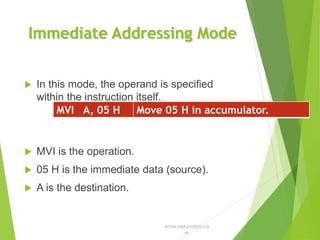
Immediate Addressing Mode
 In this mode, the operand is specified
within the instruction itself.
 MVI is the operation.
 05 H is the immediate data (source).
 A is the destination.
MVI A, 05 H Move 05 H in accumulator.
www.eazynotes.co
m
 Immediate addressing: Immediate
addressing is used when the operand is
specified directly in the instruction, rather
than being stored in memory. This
addressing mode is useful for performing
simple arithmetic or logic operations on
constants or literals.
www.eazynotes.co
m
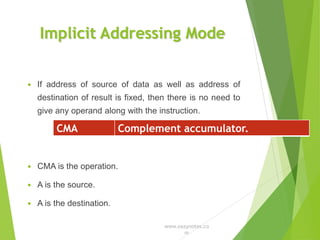
Implicit Addressing Mode
 If address of source of data as well as address of
destination of result is fixed, then there is no need to
give any operand along with the instruction.
 CMA is the operation.
 A is the source.
 A is the destination.
CMA Complement accumulator.
www.eazynotes.co
m
Challenges associated with
addressing modes in the 8085
microprocessor
 Limited addressing range
 Complex instruction set
 Limited addressing modes
 Stack management
 Performance considerations
 Memory management
www.eazynotes.co
m
Advantages of Addressing Modes
in 8085 Microprocessor
 Versatility
 Efficient memory usage
 Easy to use
 Improved performance
www.eazynotes.co
m
Disadvantages of Addressing
Modes in 8085 Microprocessor
 Complexity
 Debugging difficulties
 Limitations

Microprocessor - unit 2-Addressing Modes of 8085

  • 1.
  • 2.
    www.eazynotes.co m Addressing Modes of8085  To perform any operation, we have to give the corresponding instructions to the microprocessor.  In each instruction, programmer has to specify 3 things:  Operation to be performed.  Address of source of data.  Address of destination of result.
  • 3.
    www.eazynotes.co m Addressing Modes of8085  The method by which the address of source of data or the address of destination of result is given in the instruction is called Addressing Modes.  The term addressing mode refers to the way in which the operand of the instruction is specified.
  • 4.
    www.eazynotes.co m Why use addressingmodes in 8085 microprocessor ?  Flexibility: Addressing modes provide a flexible way to access data and instructions in memory. depending on the type of data being accessed, the size of the data, and other factors.  Memory optimization: Addressing modes can help to optimize the use of memory resources by allowing data and instructions to be accessed in the most efficient way possible.
  • 5.
    www.eazynotes.co m  Performance optimization:Addressing modes can also help to optimize the performance of the microprocessor by reducing the number of memory accesses needed to fetch data or instructions.  Reduced code size: Addressing modes can help to reduce the size of code needed to perform a particular task. By using addressing modes programmers can write more compact and efficient code.
  • 6.
    www.eazynotes.co m Types of AddressingModes 1. Direct Addressing Mode 2. Register Addressing Mode 3. Register Indirect Addressing Mode 4. Immediate Addressing Mode 5. Implicit Addressing Mode
  • 7.
    www.eazynotes.co m Direct Addressing Mode In this mode, the address of the operand is given in the instruction itself.  LDA is the operation.  2500 H is the address of source.  Accumulator is the destination. LDA 2500 H Load the contents of memory location 2500 H in accumulator.
  • 8.
    www.eazynotes.co m  Direct addressing:Direct addressing is used when the address of the operand is directly specified in the instruction. This addressing mode is used for simple operations where the operand is stored in a specific memory location, and the address does not need to be calculated or manipulated in any way.
  • 9.
    www.eazynotes.co m Register Addressing Mode In this mode, the operand is in general purpose register.  MOV is the operation.  B is the source of data.  A is the destination. MOV A, B Move the contents of register B to A.
  • 10.
    www.eazynotes.co m  Register addressing:Register addressing is used when the operand is stored in a register, rather than in memory. This addressing mode is useful for performing fast arithmetic or logic operations on small amounts of data.
  • 11.
    www.eazynotes.co m Register Indirect Addressing Mode In this mode, the address of operand is specified by a register pair.  MOV is the operation.  M is the memory location specified by H-L register pair.  A is the destination. MOV A, M Move data from memory location specified by H-L pair to accumulator.
  • 12.
    www.eazynotes.co m Immediate Addressing Mode In this mode, the operand is specified within the instruction itself.  MVI is the operation.  05 H is the immediate data (source).  A is the destination. MVI A, 05 H Move 05 H in accumulator.
  • 13.
    www.eazynotes.co m  Immediate addressing:Immediate addressing is used when the operand is specified directly in the instruction, rather than being stored in memory. This addressing mode is useful for performing simple arithmetic or logic operations on constants or literals.
  • 14.
    www.eazynotes.co m Implicit Addressing Mode If address of source of data as well as address of destination of result is fixed, then there is no need to give any operand along with the instruction.  CMA is the operation.  A is the source.  A is the destination. CMA Complement accumulator.
  • 15.
    www.eazynotes.co m Challenges associated with addressingmodes in the 8085 microprocessor  Limited addressing range  Complex instruction set  Limited addressing modes  Stack management  Performance considerations  Memory management
  • 16.
    www.eazynotes.co m Advantages of AddressingModes in 8085 Microprocessor  Versatility  Efficient memory usage  Easy to use  Improved performance
  • 17.
    www.eazynotes.co m Disadvantages of Addressing Modesin 8085 Microprocessor  Complexity  Debugging difficulties  Limitations