Enzymes Pt 3:  Regulation of enzyme activity Relicardo M. Coloso, Ph. D. College of Medicine Central Philippine University
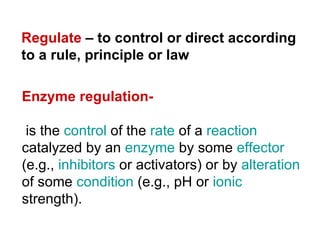
Regulate  – to control or direct according  to a rule, principle or law Enzyme regulation- is the  control  of the  rate  of a  reaction  catalyzed by an  enzyme  by some  effector  (e.g.,  inhibitors  or activators) or by  alteration  of some  condition  (e.g., pH or  ionic  strength).
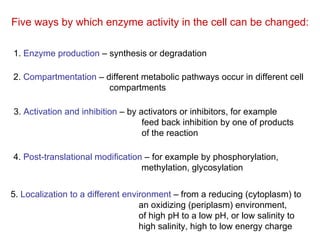
Five ways by which enzyme activity in the cell can be changed: 1.  Enzyme production  – synthesis or degradation 2.  Compartmentation  – different metabolic pathways occur in different cell compartments 3.  Activation and inhibition  – by activators or inhibitors, for example feed back inhibition by one of products  of the reaction 4.  Post-translational modification  – for example by phosphorylation, methylation, glycosylation 5.  Localization to a different environment  – from a reducing (cytoplasm) to an oxidizing (periplasm) environment, of high pH to a low pH, or low salinity to  high salinity, high to low energy charge
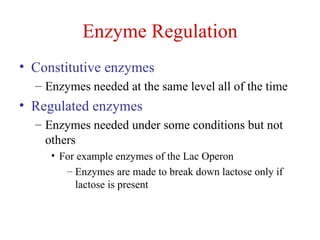
Enzyme Regulation Constitutive enzymes Enzymes needed at the same level all of the time  Regulated enzymes Enzymes needed under some conditions but not others For example enzymes of the Lac Operon Enzymes are made to break down lactose only if lactose is present
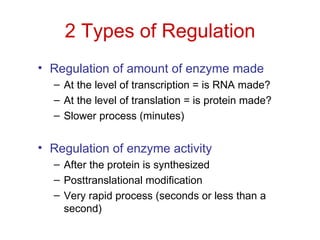
2 Types of Regulation Regulation of amount of enzyme made At the level of transcription = is RNA made? At the level of translation = is protein made? Slower process (minutes) Regulation of enzyme activity After the protein is synthesized Posttranslational modification Very rapid process (seconds or less than a second)
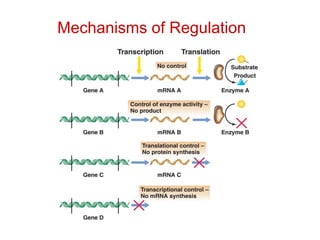
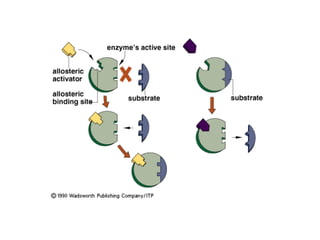
Mechanisms of Regulation


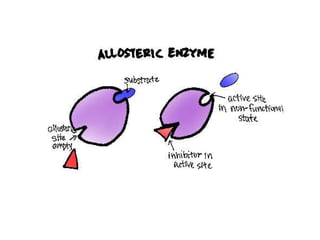
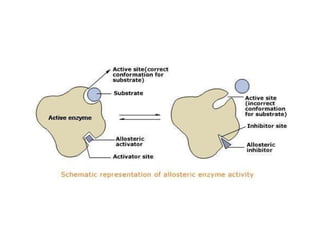
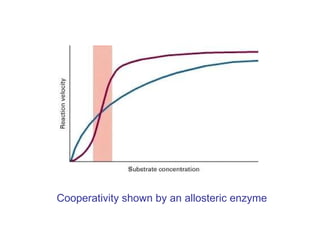
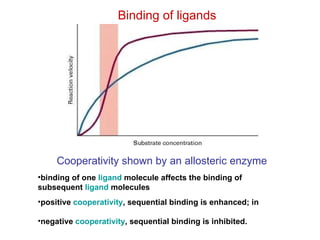
Cooperativity shown by an allosteric enzyme
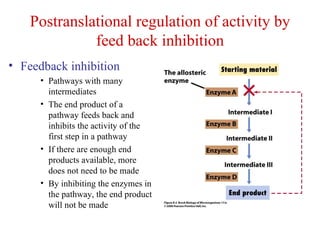
Postranslational regulation of activity by feed back inhibition Feedback inhibition Pathways with many intermediates The end product of a pathway feeds back and inhibits the activity of the first step in a pathway If there are enough end products available, more does not need to be made By inhibiting the enzymes in the pathway, the end product will not be made
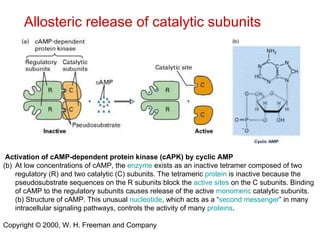
Activation of cAMP-dependent protein kinase (cAPK) by cyclic AMP   At low concentrations of cAMP, the  enzyme  exists as an inactive tetramer composed of two regulatory (R) and two catalytic (C) subunits. The tetrameric  protein  is inactive because the pseudosubstrate sequences on the R subunits block the  active sites  on the C subunits. Binding of cAMP to the regulatory subunits causes release of the active  monomeric  catalytic subunits. (b) Structure of cAMP. This unusual  nucleotide , which acts as a “ second messenger ” in many intracellular signaling pathways, controls the activity of many  proteins . Copyright © 2000, W. H. Freeman and Company Allosteric release of catalytic subunits
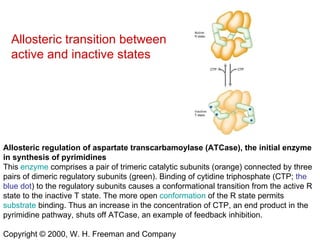
Allosteric regulation of aspartate transcarbamoylase (ATCase), the initial enzyme in synthesis of pyrimidines   This  enzyme  comprises a pair of trimeric catalytic subunits (orange) connected by three pairs of dimeric regulatory subunits (green). Binding of cytidine triphosphate (CTP;  the blue dot ) to the regulatory subunits causes a conformational transition from the active R state to the inactive T state. The more open  conformation  of the R state permits  substrate  binding. Thus an increase in the concentration of CTP, an end product in the pyrimidine pathway, shuts off ATCase, an example of feedback inhibition.  Copyright © 2000, W. H. Freeman and Company Allosteric transition between active and inactive states
Cooperativity shown by an allosteric enzyme binding of one  ligand  molecule affects the binding of subsequent  ligand  molecules  positive  cooperativity , sequential binding is enhanced; in  negative  cooperativity , sequential binding is inhibited.  Binding of ligands
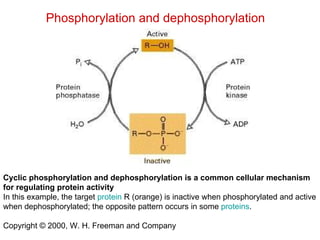
Cyclic phosphorylation and dephosphorylation is a common cellular mechanism for regulating protein activity   In this example, the target  protein  R (orange) is inactive when phosphorylated and active when dephosphorylated; the opposite pattern occurs in some  proteins . Copyright © 2000, W. H. Freeman and Company Phosphorylation and dephosphorylation
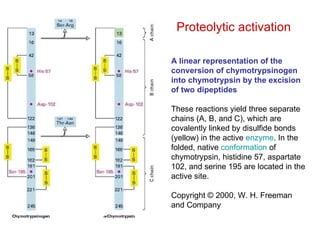
A linear representation of the conversion of chymotrypsinogen into chymotrypsin by the excision of two dipeptides   These reactions yield three separate chains (A, B, and C), which are covalently linked by disulfide bonds (yellow) in the active  enzyme . In the folded, native  conformation  of chymotrypsin, histidine 57, aspartate 102, and serine 195 are located in the active site. Copyright © 2000, W. H. Freeman and Company Proteolytic activation
Thank you!

enzyme regulation

  • 1.
    Enzymes Pt 3: Regulation of enzyme activity Relicardo M. Coloso, Ph. D. College of Medicine Central Philippine University
  • 2.
    Regulate –to control or direct according to a rule, principle or law Enzyme regulation- is the control of the rate of a reaction catalyzed by an enzyme by some effector (e.g., inhibitors or activators) or by alteration of some condition (e.g., pH or ionic strength).
  • 3.
    Five ways bywhich enzyme activity in the cell can be changed: 1. Enzyme production – synthesis or degradation 2. Compartmentation – different metabolic pathways occur in different cell compartments 3. Activation and inhibition – by activators or inhibitors, for example feed back inhibition by one of products of the reaction 4. Post-translational modification – for example by phosphorylation, methylation, glycosylation 5. Localization to a different environment – from a reducing (cytoplasm) to an oxidizing (periplasm) environment, of high pH to a low pH, or low salinity to high salinity, high to low energy charge
  • 4.
    Enzyme Regulation Constitutiveenzymes Enzymes needed at the same level all of the time Regulated enzymes Enzymes needed under some conditions but not others For example enzymes of the Lac Operon Enzymes are made to break down lactose only if lactose is present
  • 5.
    2 Types ofRegulation Regulation of amount of enzyme made At the level of transcription = is RNA made? At the level of translation = is protein made? Slower process (minutes) Regulation of enzyme activity After the protein is synthesized Posttranslational modification Very rapid process (seconds or less than a second)
  • 6.
  • 7.
  • 8.
  • 9.
  • 10.
    Cooperativity shown byan allosteric enzyme
  • 11.
    Postranslational regulation ofactivity by feed back inhibition Feedback inhibition Pathways with many intermediates The end product of a pathway feeds back and inhibits the activity of the first step in a pathway If there are enough end products available, more does not need to be made By inhibiting the enzymes in the pathway, the end product will not be made
  • 12.
    Activation of cAMP-dependentprotein kinase (cAPK) by cyclic AMP At low concentrations of cAMP, the enzyme exists as an inactive tetramer composed of two regulatory (R) and two catalytic (C) subunits. The tetrameric protein is inactive because the pseudosubstrate sequences on the R subunits block the active sites on the C subunits. Binding of cAMP to the regulatory subunits causes release of the active monomeric catalytic subunits. (b) Structure of cAMP. This unusual nucleotide , which acts as a “ second messenger ” in many intracellular signaling pathways, controls the activity of many proteins . Copyright © 2000, W. H. Freeman and Company Allosteric release of catalytic subunits
  • 13.
    Allosteric regulation ofaspartate transcarbamoylase (ATCase), the initial enzyme in synthesis of pyrimidines This enzyme comprises a pair of trimeric catalytic subunits (orange) connected by three pairs of dimeric regulatory subunits (green). Binding of cytidine triphosphate (CTP; the blue dot ) to the regulatory subunits causes a conformational transition from the active R state to the inactive T state. The more open conformation of the R state permits substrate binding. Thus an increase in the concentration of CTP, an end product in the pyrimidine pathway, shuts off ATCase, an example of feedback inhibition. Copyright © 2000, W. H. Freeman and Company Allosteric transition between active and inactive states
  • 14.
    Cooperativity shown byan allosteric enzyme binding of one ligand molecule affects the binding of subsequent ligand molecules positive cooperativity , sequential binding is enhanced; in negative cooperativity , sequential binding is inhibited. Binding of ligands
  • 15.
    Cyclic phosphorylation anddephosphorylation is a common cellular mechanism for regulating protein activity In this example, the target protein R (orange) is inactive when phosphorylated and active when dephosphorylated; the opposite pattern occurs in some proteins . Copyright © 2000, W. H. Freeman and Company Phosphorylation and dephosphorylation
  • 16.
    A linear representationof the conversion of chymotrypsinogen into chymotrypsin by the excision of two dipeptides These reactions yield three separate chains (A, B, and C), which are covalently linked by disulfide bonds (yellow) in the active enzyme . In the folded, native conformation of chymotrypsin, histidine 57, aspartate 102, and serine 195 are located in the active site. Copyright © 2000, W. H. Freeman and Company Proteolytic activation
  • 17.