Entner Doudoroff pathway
(ED pathway)
Dr. Aswartha Harinath Reddy
Department of Life Sciences
Srikrishnadevaraya University
Anantapur –A.P. India
 The ED pathway was first reported by Michael Doudoroff in
Prokaryotic organisms.
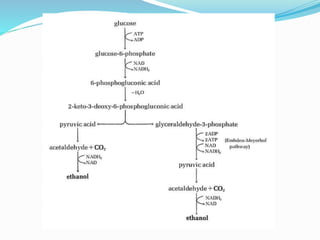
 The Entner–Doudoroff pathway (ED pathway) catabolizes
glucose to pyruvic acid using enzymes distinct either from
those used in glycolysis.
 This pathway Uses 6-phosphogluconate dehydratase and
2-keto-3-deoxy phosphogluconate aldolase to create pyruvate
from glucose.
 The Entner–Doudoroff pathway also has a net yield of 1 ATP for
every glucose molecule processed, as well as 1 NADH and 1
NADPH.
 By comparison, glycolysis has a net yield of 2 ATP and 2 NADH
for every one glucose molecule processed.
 This pathway is generally found in Pseudomonas,
Rhizobium, Azotobacter and Agrobacterium, and a few
other Gram-negative genera.
 Very few Gram-positive bacteria have this pathway, with
Enterococcus faecalis being a rare exception.
 All these bacteria lack enzyme essential for glycolysis,
such as phosphofructokinase.
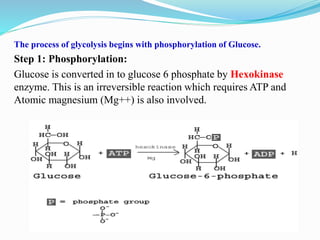
The process of glycolysis begins with phosphorylation of Glucose.
Step 1: Phosphorylation:
Glucose is converted in to glucose 6 phosphate by Hexokinase
enzyme. This is an irreversible reaction which requires ATP and
Atomic magnesium (Mg++) is also involved.
Oxidative phase:
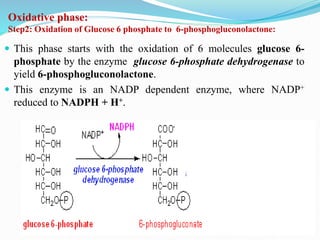
Step2: Oxidation of Glucose 6 phosphate to 6-phosphogluconolactone:
 This phase starts with the oxidation of 6 molecules glucose 6-
phosphate by the enzyme glucose 6-phosphate dehydrogenase to
yield 6-phosphogluconolactone.
 This enzyme is an NADP dependent enzyme, where NADP+
reduced to NADPH + H+.
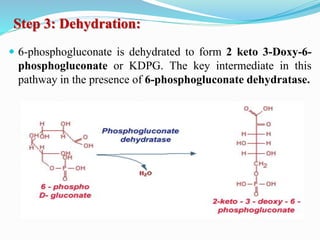
Step 3: Dehydration:
 6-phosphogluconate is dehydrated to form 2 keto 3-Doxy-6-
phosphogluconate or KDPG. The key intermediate in this
pathway in the presence of 6-phosphogluconate dehydratase.
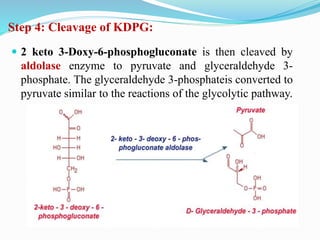
Step 4: Cleavage of KDPG:
 2 keto 3-Doxy-6-phosphogluconate is then cleaved by
aldolase enzyme to pyruvate and glyceraldehyde 3-
phosphate. The glyceraldehyde 3-phosphateis converted to
pyruvate similar to the reactions of the glycolytic pathway.
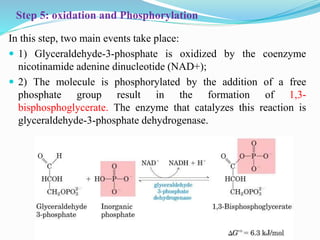
Step 5: oxidation and Phosphorylation
In this step, two main events take place:
 1) Glyceraldehyde-3-phosphate is oxidized by the coenzyme
nicotinamide adenine dinucleotide (NAD+);
 2) The molecule is phosphorylated by the addition of a free
phosphate group result in the formation of 1,3-
bisphosphoglycerate. The enzyme that catalyzes this reaction is
glyceraldehyde-3-phosphate dehydrogenase.
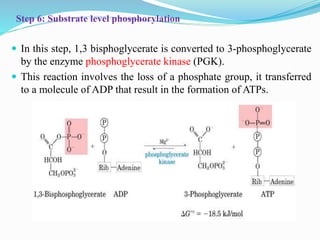
Step 6: Substrate level phosphorylation
 In this step, 1,3 bisphoglycerate is converted to 3-phosphoglycerate
by the enzyme phosphoglycerate kinase (PGK).
 This reaction involves the loss of a phosphate group, it transferred
to a molecule of ADP that result in the formation of ATPs.
Step 7: Isomerization
 The 3-phosphoglyceric acid undergoes internal rearrangement to
form 2-phosphoglyceric acid.
 The enzyme phosphoglycero mutase relocates the phosphate group
from the 3rd carbon to the 2nd carbon to form phosphoglycerate.
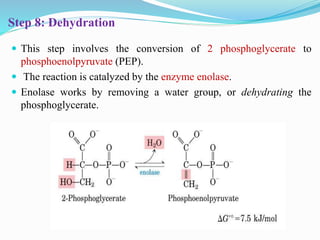
Step 8: Dehydration
 This step involves the conversion of 2 phosphoglycerate to
phosphoenolpyruvate (PEP).
 The reaction is catalyzed by the enzyme enolase.
 Enolase works by removing a water group, or dehydrating the
phosphoglycerate.
Step 9: Substrate level phosphorylation
 The final step of glycolysis converts phosphoenolpyruvate into
pyruvate with the help of the enzyme pyruvate kinase.
 The phosphate group attached to the 2′ carbon of the PEP is
transferred to a molecule of ADP, yielding ATP. Again, since there
are one molecules of PEP, here we actually generate ATP
molecules.
 Has a net yield of 1 ATP for every one glucose molecule
processed, as well as 1 NADH and 1 NADPH.
 In comparison, glycolysis has a net yield of 2 ATP
molecules and 2 NADH molecules for every one glucose
molecule metabolised
THANK YOU….

Entner Doudoroff pathway

  • 1.
    Entner Doudoroff pathway (EDpathway) Dr. Aswartha Harinath Reddy Department of Life Sciences Srikrishnadevaraya University Anantapur –A.P. India
  • 2.
     The EDpathway was first reported by Michael Doudoroff in Prokaryotic organisms.  The Entner–Doudoroff pathway (ED pathway) catabolizes glucose to pyruvic acid using enzymes distinct either from those used in glycolysis.
  • 3.
     This pathwayUses 6-phosphogluconate dehydratase and 2-keto-3-deoxy phosphogluconate aldolase to create pyruvate from glucose.  The Entner–Doudoroff pathway also has a net yield of 1 ATP for every glucose molecule processed, as well as 1 NADH and 1 NADPH.  By comparison, glycolysis has a net yield of 2 ATP and 2 NADH for every one glucose molecule processed.
  • 4.
     This pathwayis generally found in Pseudomonas, Rhizobium, Azotobacter and Agrobacterium, and a few other Gram-negative genera.  Very few Gram-positive bacteria have this pathway, with Enterococcus faecalis being a rare exception.  All these bacteria lack enzyme essential for glycolysis, such as phosphofructokinase.
  • 5.
    The process ofglycolysis begins with phosphorylation of Glucose. Step 1: Phosphorylation: Glucose is converted in to glucose 6 phosphate by Hexokinase enzyme. This is an irreversible reaction which requires ATP and Atomic magnesium (Mg++) is also involved.
  • 6.
    Oxidative phase: Step2: Oxidationof Glucose 6 phosphate to 6-phosphogluconolactone:  This phase starts with the oxidation of 6 molecules glucose 6- phosphate by the enzyme glucose 6-phosphate dehydrogenase to yield 6-phosphogluconolactone.  This enzyme is an NADP dependent enzyme, where NADP+ reduced to NADPH + H+.
  • 7.
    Step 3: Dehydration: 6-phosphogluconate is dehydrated to form 2 keto 3-Doxy-6- phosphogluconate or KDPG. The key intermediate in this pathway in the presence of 6-phosphogluconate dehydratase.
  • 8.
    Step 4: Cleavageof KDPG:  2 keto 3-Doxy-6-phosphogluconate is then cleaved by aldolase enzyme to pyruvate and glyceraldehyde 3- phosphate. The glyceraldehyde 3-phosphateis converted to pyruvate similar to the reactions of the glycolytic pathway.
  • 9.
    Step 5: oxidationand Phosphorylation In this step, two main events take place:  1) Glyceraldehyde-3-phosphate is oxidized by the coenzyme nicotinamide adenine dinucleotide (NAD+);  2) The molecule is phosphorylated by the addition of a free phosphate group result in the formation of 1,3- bisphosphoglycerate. The enzyme that catalyzes this reaction is glyceraldehyde-3-phosphate dehydrogenase.
  • 10.
    Step 6: Substratelevel phosphorylation  In this step, 1,3 bisphoglycerate is converted to 3-phosphoglycerate by the enzyme phosphoglycerate kinase (PGK).  This reaction involves the loss of a phosphate group, it transferred to a molecule of ADP that result in the formation of ATPs.
  • 11.
    Step 7: Isomerization The 3-phosphoglyceric acid undergoes internal rearrangement to form 2-phosphoglyceric acid.  The enzyme phosphoglycero mutase relocates the phosphate group from the 3rd carbon to the 2nd carbon to form phosphoglycerate.
  • 12.
    Step 8: Dehydration This step involves the conversion of 2 phosphoglycerate to phosphoenolpyruvate (PEP).  The reaction is catalyzed by the enzyme enolase.  Enolase works by removing a water group, or dehydrating the phosphoglycerate.
  • 13.
    Step 9: Substratelevel phosphorylation  The final step of glycolysis converts phosphoenolpyruvate into pyruvate with the help of the enzyme pyruvate kinase.  The phosphate group attached to the 2′ carbon of the PEP is transferred to a molecule of ADP, yielding ATP. Again, since there are one molecules of PEP, here we actually generate ATP molecules.
  • 15.
     Has anet yield of 1 ATP for every one glucose molecule processed, as well as 1 NADH and 1 NADPH.  In comparison, glycolysis has a net yield of 2 ATP molecules and 2 NADH molecules for every one glucose molecule metabolised
  • 16.