Impedance
 Matching
 Microwave Engineering
       CHO, Yong Heui
Microwave Engineering
1. Impedance matching

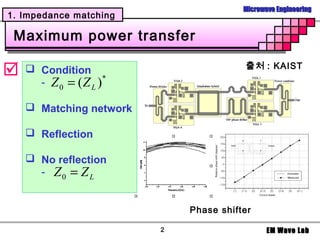
 Maximum power transfer

                                        출처 : KAIST
    Condition
      - Z 0 = ( Z L )*

     Matching network

     Reflection

     No reflection
      - Z0 = Z L


                             Phase shifter

                         2                     EM Wave Lab
Microwave Engineering
1. Impedance matching

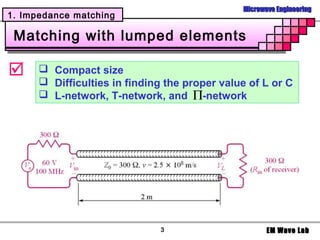
 Matching with lumped elements

      Compact size
       Difficulties in finding the proper value of L or C
       L-network, T-network, and Π-network


                              3                       EM Wave Lab
Microwave Engineering
1. Impedance matching

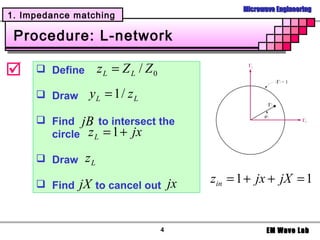
 Procedure: L-network

     Define        zL = Z L / Z0
      Draw     yL = 1 / zL
      Find jB to intersect the
       circle z L = 1 + jx

      Draw     zL
      Find   jX to cancel out jx        zin = 1 + jx + jX = 1


                                     4                EM Wave Lab
Microwave Engineering
1. Impedance matching

 Example

      Design the L section matching network to
        match the transmission line,
        where
       Z L = 200 − j100[ Ω], Z 0 = 100[ Ω], f = 500 MHz


                                       Smith chart


                             5                       EM Wave Lab
Microwave Engineering
1. Impedance matching

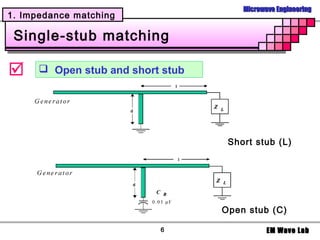
 Single-stub matching

      Open stub and short stub


                                    Short stub (L)


                                   Open stub (C)

                           6                  EM Wave Lab
Microwave Engineering
1. Impedance matching

 Single-stub matching

      Simple matching network


                                  Smith chart


                          7                   EM Wave Lab
Microwave Engineering
1. Impedance matching

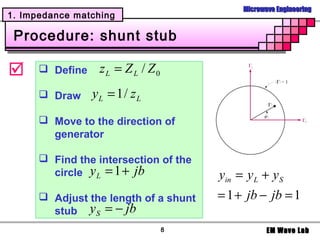
 Procedure: shunt stub

      Define    zL = Z L / Z0
       Draw     yL = 1 / zL
       Move to the direction of
        generator

       Find the intersection of the
        circle y L = 1 + jb            yin = y L + y S
       Adjust the length of a shunt   = 1 + jb − jb = 1
        stub y S = − jb
                                  8                EM Wave Lab
Microwave Engineering
1. Impedance matching

 Example

      Design the single-stub shunt tuning network to
        match the transmission line,
        where
          Z L = 15 + j10[ Ω], Z 0 = 50[ Ω], f = 2GHz


                                        Smith chart


                              9                       EM Wave Lab
Microwave Engineering
1. Impedance matching

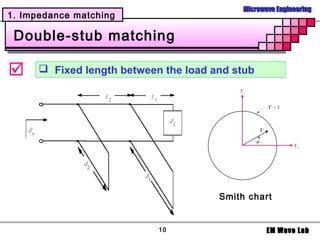
 Double-stub matching

      Fixed length between the load and stub


                                       Smith chart


                            10                     EM Wave Lab
Microwave Engineering
1. Impedance matching

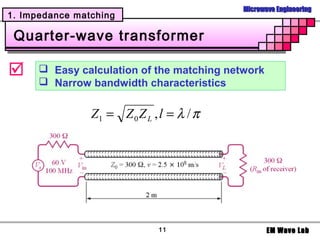
 Quarter-wave transformer

      Easy calculation of the matching network
       Narrow bandwidth characteristics


                Z1 = Z 0 Z L , l = λ / π


                              11                   EM Wave Lab
Microwave Engineering
1. Impedance matching

 Transitions

      Complicated design procedure
       Broad bandwidth characteristics
       The theory of small reflections


      Binomial multisection line
       Chebyshev multisection line
       Tapered line


                           12                    EM Wave Lab

Impedance Matching

  • 1.
    Impedance Matching MicrowaveEngineering CHO, Yong Heui
  • 2.
    Microwave Engineering 1. Impedancematching Maximum power transfer 출처 : KAIST   Condition - Z 0 = ( Z L )*  Matching network  Reflection  No reflection - Z0 = Z L Phase shifter 2 EM Wave Lab
  • 3.
    Microwave Engineering 1. Impedancematching Matching with lumped elements   Compact size  Difficulties in finding the proper value of L or C  L-network, T-network, and Π-network 3 EM Wave Lab
  • 4.
    Microwave Engineering 1. Impedancematching Procedure: L-network   Define zL = Z L / Z0  Draw yL = 1 / zL  Find jB to intersect the circle z L = 1 + jx  Draw zL  Find jX to cancel out jx zin = 1 + jx + jX = 1 4 EM Wave Lab
  • 5.
    Microwave Engineering 1. Impedancematching Example   Design the L section matching network to match the transmission line, where Z L = 200 − j100[ Ω], Z 0 = 100[ Ω], f = 500 MHz Smith chart 5 EM Wave Lab
  • 6.
    Microwave Engineering 1. Impedancematching Single-stub matching   Open stub and short stub Short stub (L) Open stub (C) 6 EM Wave Lab
  • 7.
    Microwave Engineering 1. Impedancematching Single-stub matching   Simple matching network Smith chart 7 EM Wave Lab
  • 8.
    Microwave Engineering 1. Impedancematching Procedure: shunt stub   Define zL = Z L / Z0  Draw yL = 1 / zL  Move to the direction of generator  Find the intersection of the circle y L = 1 + jb yin = y L + y S  Adjust the length of a shunt = 1 + jb − jb = 1 stub y S = − jb 8 EM Wave Lab
  • 9.
    Microwave Engineering 1. Impedancematching Example   Design the single-stub shunt tuning network to match the transmission line, where Z L = 15 + j10[ Ω], Z 0 = 50[ Ω], f = 2GHz Smith chart 9 EM Wave Lab
  • 10.
    Microwave Engineering 1. Impedancematching Double-stub matching   Fixed length between the load and stub Smith chart 10 EM Wave Lab
  • 11.
    Microwave Engineering 1. Impedancematching Quarter-wave transformer   Easy calculation of the matching network  Narrow bandwidth characteristics Z1 = Z 0 Z L , l = λ / π 11 EM Wave Lab
  • 12.
    Microwave Engineering 1. Impedancematching Transitions   Complicated design procedure  Broad bandwidth characteristics  The theory of small reflections   Binomial multisection line  Chebyshev multisection line  Tapered line 12 EM Wave Lab