Bit Error Rate
Pawan Kumar Tiwari
MCA 5th sem
Roll No-15
Introduction
 Bit Error Rate (BER) is an important concept to understand in
any digital transmission system since it is a major indicator of
the health of the system.
 As data is transmitted some of the bits may not be received
correctly. The more bits that are incorrect, the more the signal
will be affected.
 Its important to know what portion of the bits are in error so
you can determine how much margin the system has before
failure.
What is BER?
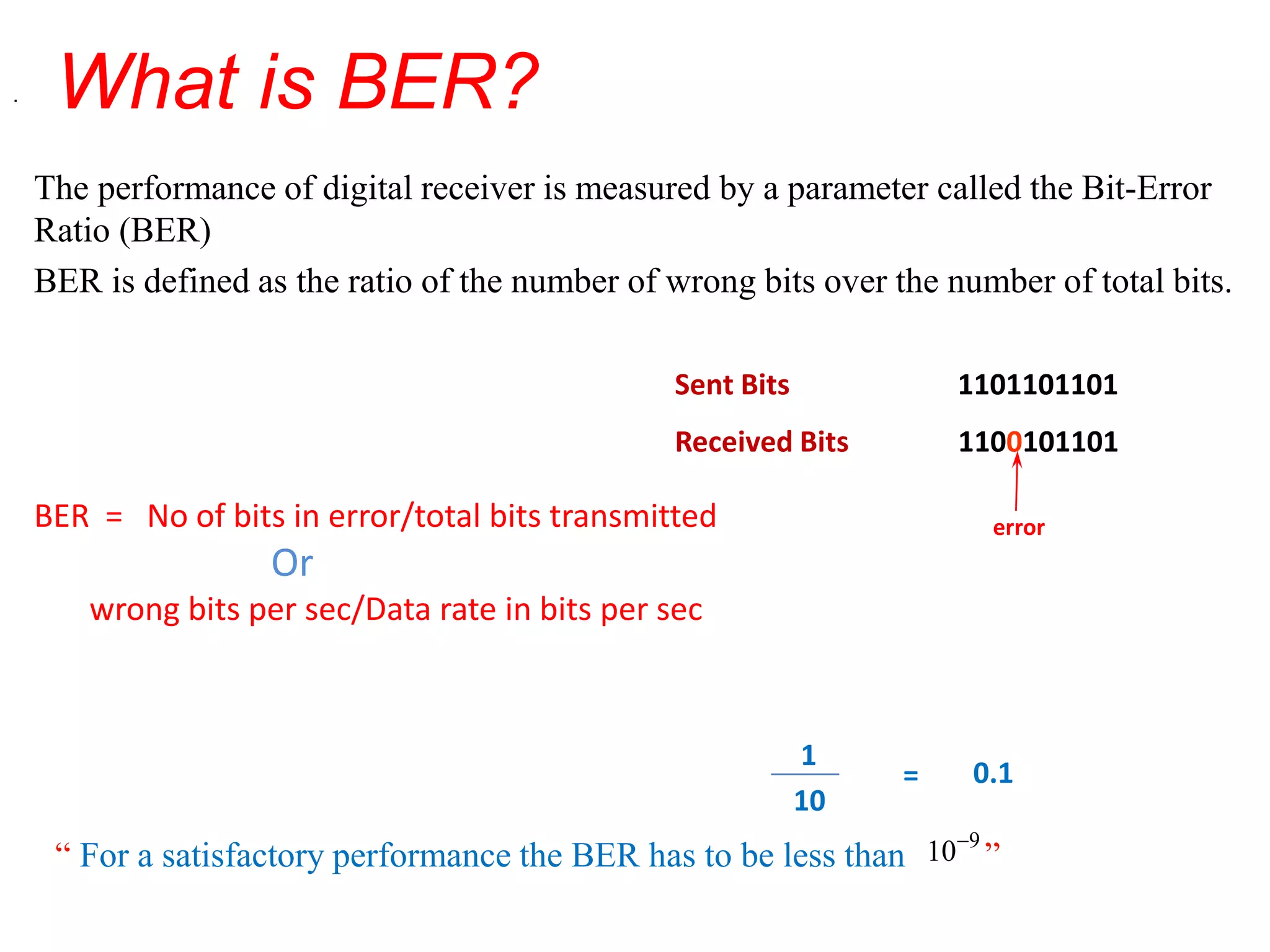
The performance of digital receiver is measured by a parameter called the Bit-Error
Ratio (BER)
BER is defined as the ratio of the number of wrong bits over the number of total bits.
Sent Bits 1101101101
Received Bits 1100101101
errorBER = No of bits in error/total bits transmitted
Or
wrong bits per sec/Data rate in bits per sec
10
0.1
1
=
“ For a satisfactory performance the BER has to be less than ”
.
9
10
Example
Average rate of bit error
For instance of 10000 bits are transmitted, 100 bits
are received in error then average BER is
= 100/10000
= 1% or 0.01
“ Bit error rate is frequently expressed as Probability Pe ”
[ 0<= Pe <=0.5 ]
Here 0.5 is maximum BER
Bit Error Probability
The bit error probability pe is the expectation value of the bit error ratio. The bit
error ratio can be considered as an approximate estimate of the bit error probability.
This estimate is accurate for a long time interval and a high number of bit errors.
Example
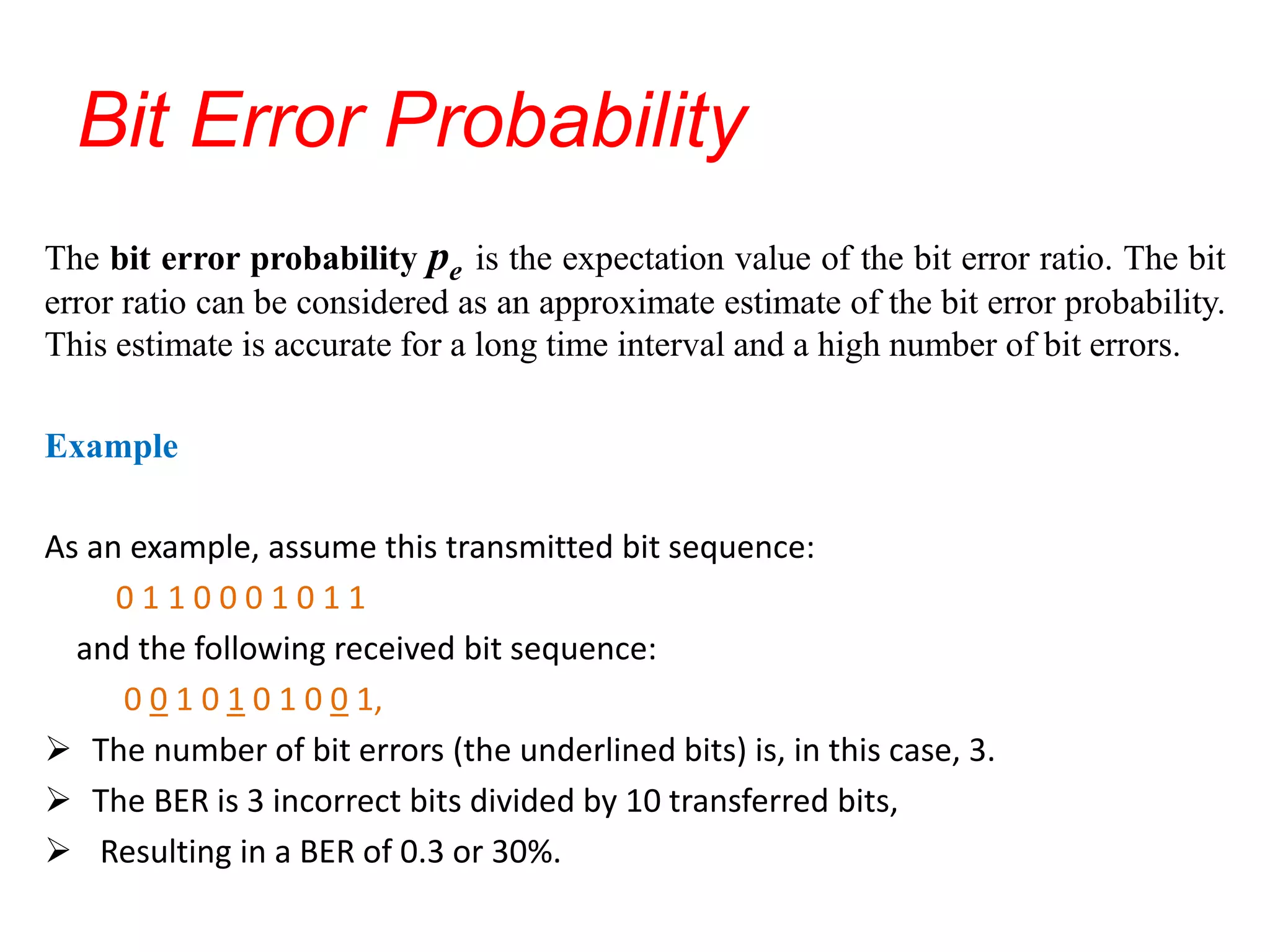
As an example, assume this transmitted bit sequence:
0 1 1 0 0 0 1 0 1 1
and the following received bit sequence:
0 0 1 0 1 0 1 0 0 1,
 The number of bit errors (the underlined bits) is, in this case, 3.
 The BER is 3 incorrect bits divided by 10 transferred bits,
 Resulting in a BER of 0.3 or 30%.
Packet Error Ratio
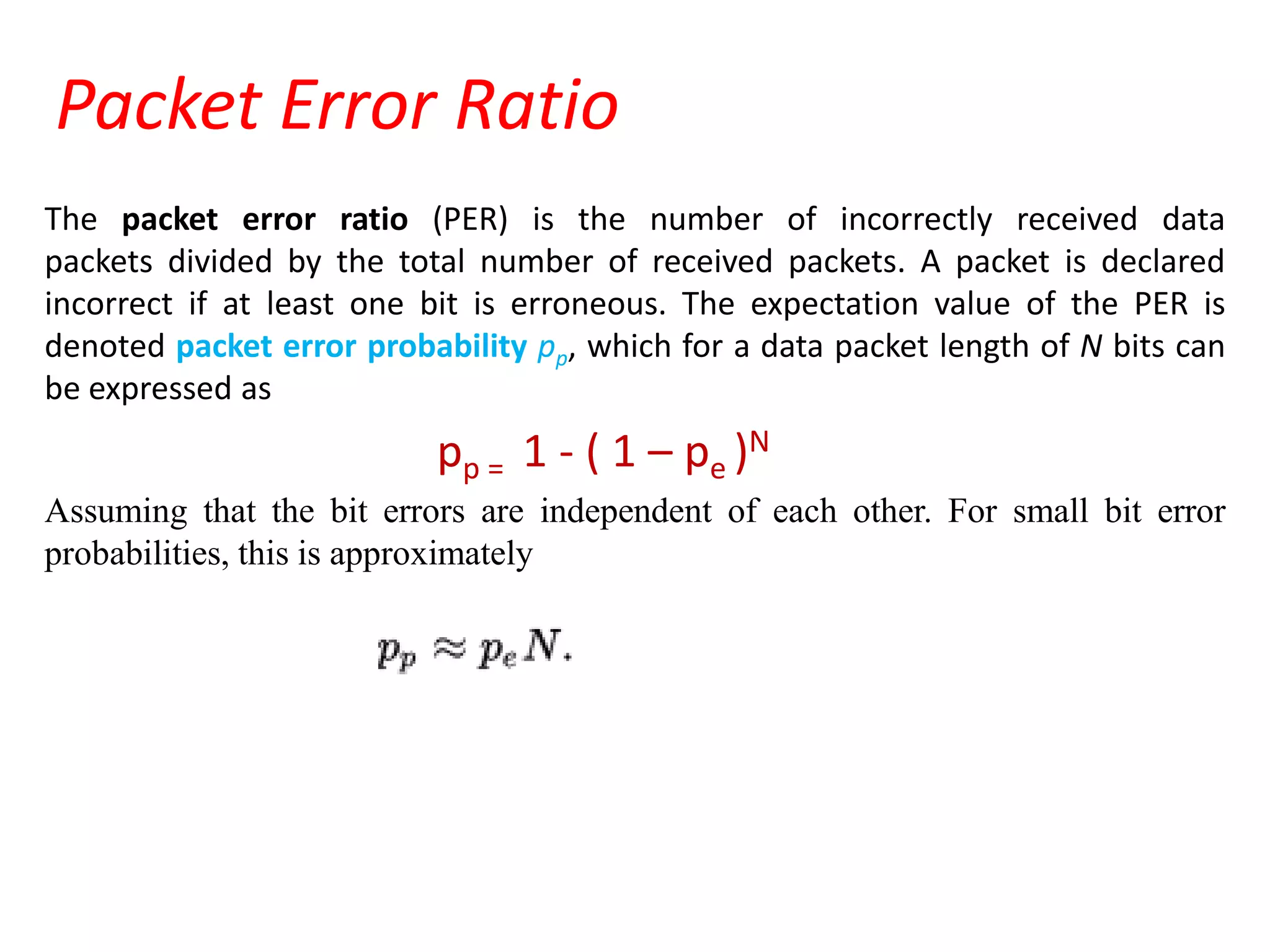
The packet error ratio (PER) is the number of incorrectly received data
packets divided by the total number of received packets. A packet is declared
incorrect if at least one bit is erroneous. The expectation value of the PER is
denoted packet error probability pp, which for a data packet length of N bits can
be expressed as
pp = 1 - ( 1 – pe )N
Assuming that the bit errors are independent of each other. For small bit error
probabilities, this is approximately
Noise and Intermittents
 Errors caused by noise or intermittent causes can have the same BER, but
very different effects.
 Errors that are spread out are due to noise problems
 Errors that are grouped are due to intermittent problems such as ingress
or loose connectors.
Spaced Errors 1101101011010011100
Burst Errors 1111101011101101101
This Example Shows the Same Error
Rate But the Burst Errors are More
Difficult to Correct
Error Seconds
 To get an idea of whether the errors are caused by noise or
intermittent problems, errors can be measured over a one second
period.
 If no errors are seen in a one second period, this is known as a
Error Free Second.
 If some errors are received in a one second period that can't be
handle by the FEC and seen by the end-user, this is known as a
Error Second.
 If errors in a one second period that the FEC can't handle exceed a
set threshold, this is known as a Severely Errored Second.
 A Severely Errored Second has a BER within that second of 1E-6
or worse at the output of the FEC.
Bit Error Rate test
 A BERT (bit error rate test or tester) is a procedure or device that measures the
BER for a given transmission.
 A bit error rate tester (BERT), also known as a bit error ratio tester.
The main building blocks of a BERT are:
 Pattern generator, which transmits a defined test pattern to the test system
 Error detector connected to the test system, to count the errors generated by
or test system
 Clock signal generator to synchronize the pattern generator and the error
detector
 Digital communication analyzer is optional to display the transmitted or
received signal.
 Electrical-optical converter and optical-electrical converter for testing optical
communication signals.
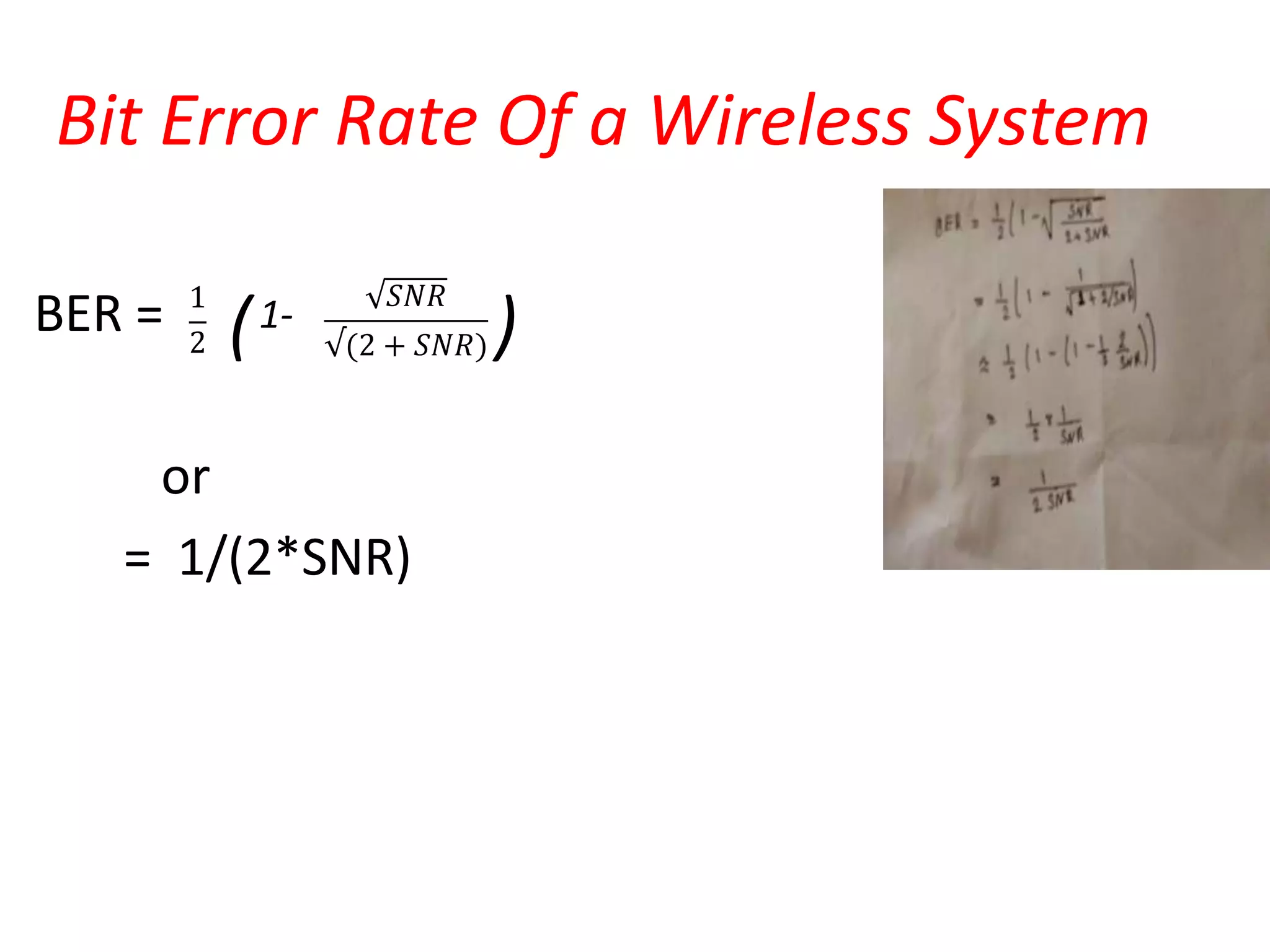
Bit Error Rate Of a Wireless System
BER =
or
= 1/(2*SNR)
1
2
𝑆𝑁𝑅
√(2 + 𝑆𝑁𝑅)(1- )
Example-1
Compute a bit error rate of a wireless communication system at
SNR=20 db
20 db = 10 log10 SNR
log10 SNR = 2
SNR = 102
BER = 1/(2*SNR)
= 1/(2 *100)
= 0.5 * 10-3
= 5 * 10-4
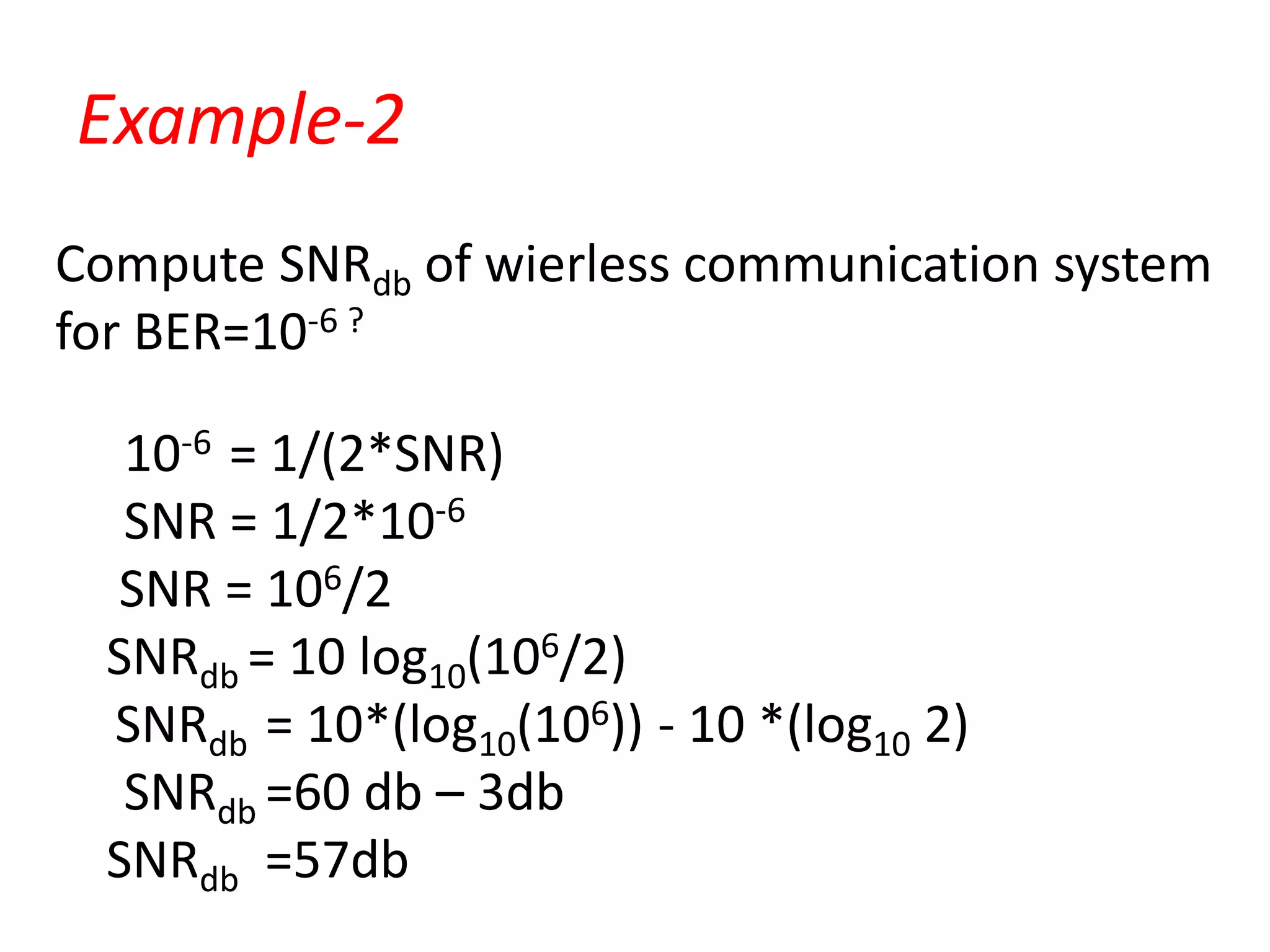
Example-2
Compute SNRdb of wierless communication system
for BER=10-6 ?
10-6 = 1/(2*SNR)
SNR = 1/2*10-6
SNR = 106/2
SNRdb = 10 log10(106/2)
SNRdb = 10*(log10(106)) - 10 *(log10 2)
SNRdb =60 db – 3db
SNRdb =57db
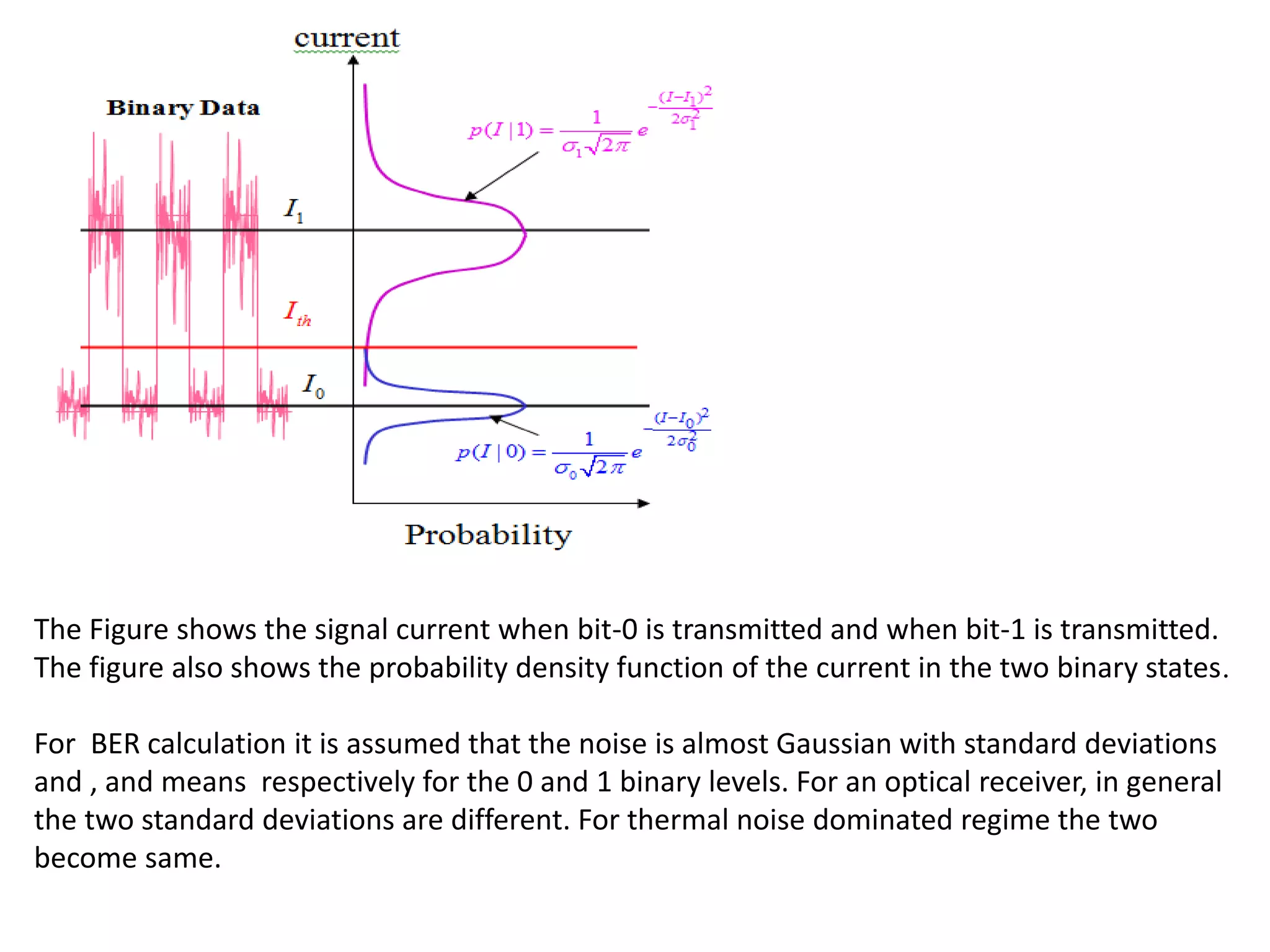
The Figure shows the signal current when bit-0 is transmitted and when bit-1 is transmitted.
The figure also shows the probability density function of the current in the two binary states.
For BER calculation it is assumed that the noise is almost Gaussian with standard deviations
and , and means respectively for the 0 and 1 binary levels. For an optical receiver, in general
the two standard deviations are different. For thermal noise dominated regime the two
become same.
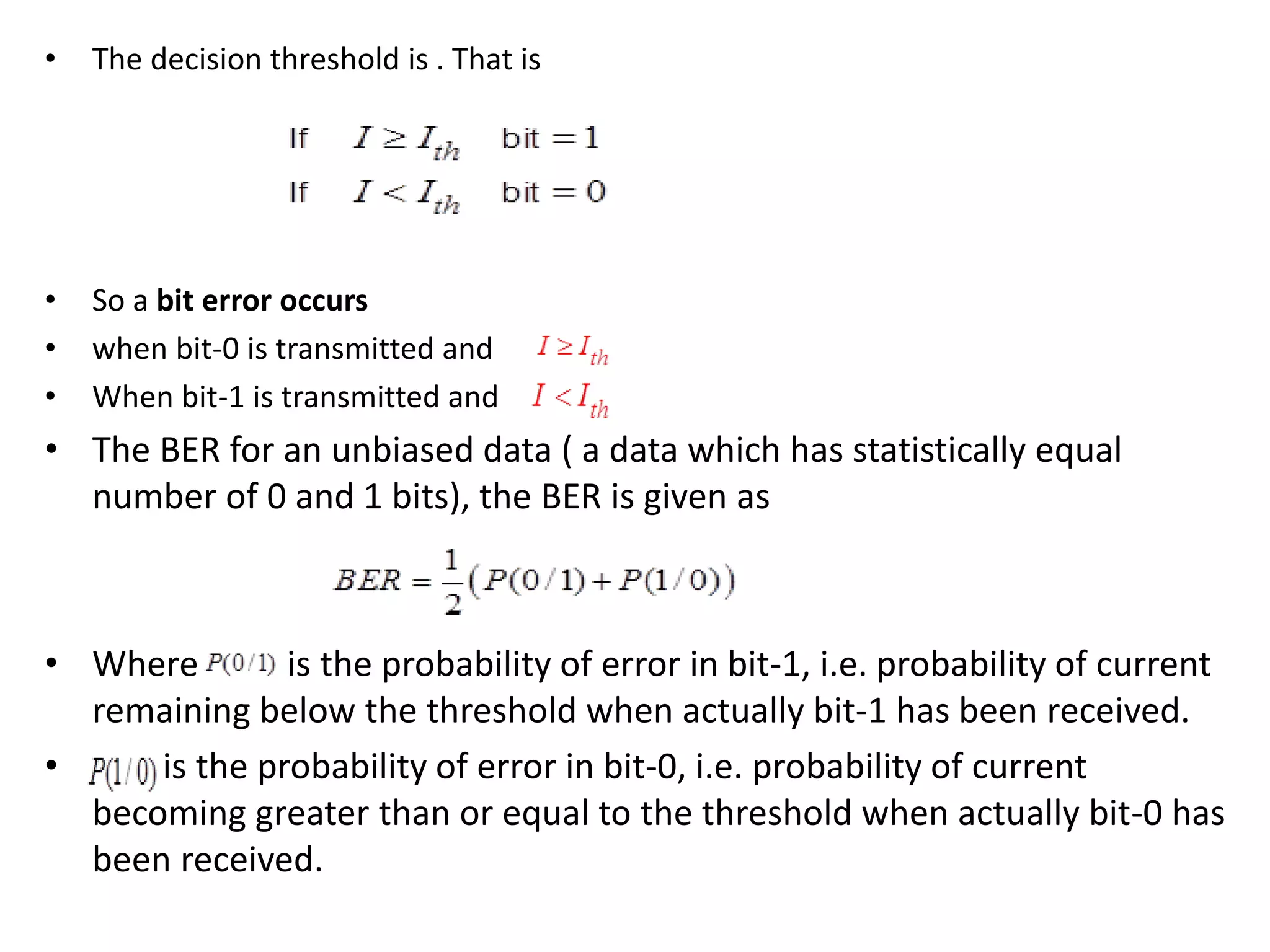
• The decision threshold is . That is
• So a bit error occurs
• when bit-0 is transmitted and
• When bit-1 is transmitted and
• The BER for an unbiased data ( a data which has statistically equal
number of 0 and 1 bits), the BER is given as
• Where is the probability of error in bit-1, i.e. probability of current
remaining below the threshold when actually bit-1 has been received.
• is the probability of error in bit-0, i.e. probability of current
becoming greater than or equal to the threshold when actually bit-0 has
been received.
References
 nptel.ac.in/courses/Webcourse-contents/IIT%20Bombay/.../FOC-Noise-BER.doc
 http://nptel.ac.in/courses/117104099/
 http://www.ijser.org/researchpaper%5COptimization-Method-for-Analysis-of-
Bit-Error-Rate-with-BPSK-Modulation-Technique.pdf
 http://www.ijarcsse.com/docs/papers/Volume_4/6_June2014/V4I6-0265.pdf
 https://en.wikipedia.org/wiki/Bit_error_rate
BIT Error Rate

BIT Error Rate

  • 1.
    Bit Error Rate PawanKumar Tiwari MCA 5th sem Roll No-15
  • 2.
    Introduction  Bit ErrorRate (BER) is an important concept to understand in any digital transmission system since it is a major indicator of the health of the system.  As data is transmitted some of the bits may not be received correctly. The more bits that are incorrect, the more the signal will be affected.  Its important to know what portion of the bits are in error so you can determine how much margin the system has before failure.
  • 3.
    What is BER? Theperformance of digital receiver is measured by a parameter called the Bit-Error Ratio (BER) BER is defined as the ratio of the number of wrong bits over the number of total bits. Sent Bits 1101101101 Received Bits 1100101101 errorBER = No of bits in error/total bits transmitted Or wrong bits per sec/Data rate in bits per sec 10 0.1 1 = “ For a satisfactory performance the BER has to be less than ” . 9 10
  • 4.
    Example Average rate ofbit error For instance of 10000 bits are transmitted, 100 bits are received in error then average BER is = 100/10000 = 1% or 0.01 “ Bit error rate is frequently expressed as Probability Pe ” [ 0<= Pe <=0.5 ] Here 0.5 is maximum BER
  • 5.
    Bit Error Probability Thebit error probability pe is the expectation value of the bit error ratio. The bit error ratio can be considered as an approximate estimate of the bit error probability. This estimate is accurate for a long time interval and a high number of bit errors. Example As an example, assume this transmitted bit sequence: 0 1 1 0 0 0 1 0 1 1 and the following received bit sequence: 0 0 1 0 1 0 1 0 0 1,  The number of bit errors (the underlined bits) is, in this case, 3.  The BER is 3 incorrect bits divided by 10 transferred bits,  Resulting in a BER of 0.3 or 30%.
  • 6.
    Packet Error Ratio Thepacket error ratio (PER) is the number of incorrectly received data packets divided by the total number of received packets. A packet is declared incorrect if at least one bit is erroneous. The expectation value of the PER is denoted packet error probability pp, which for a data packet length of N bits can be expressed as pp = 1 - ( 1 – pe )N Assuming that the bit errors are independent of each other. For small bit error probabilities, this is approximately
  • 7.
    Noise and Intermittents Errors caused by noise or intermittent causes can have the same BER, but very different effects.  Errors that are spread out are due to noise problems  Errors that are grouped are due to intermittent problems such as ingress or loose connectors. Spaced Errors 1101101011010011100 Burst Errors 1111101011101101101 This Example Shows the Same Error Rate But the Burst Errors are More Difficult to Correct
  • 8.
    Error Seconds  Toget an idea of whether the errors are caused by noise or intermittent problems, errors can be measured over a one second period.  If no errors are seen in a one second period, this is known as a Error Free Second.  If some errors are received in a one second period that can't be handle by the FEC and seen by the end-user, this is known as a Error Second.  If errors in a one second period that the FEC can't handle exceed a set threshold, this is known as a Severely Errored Second.  A Severely Errored Second has a BER within that second of 1E-6 or worse at the output of the FEC.
  • 9.
    Bit Error Ratetest  A BERT (bit error rate test or tester) is a procedure or device that measures the BER for a given transmission.  A bit error rate tester (BERT), also known as a bit error ratio tester. The main building blocks of a BERT are:  Pattern generator, which transmits a defined test pattern to the test system  Error detector connected to the test system, to count the errors generated by or test system  Clock signal generator to synchronize the pattern generator and the error detector  Digital communication analyzer is optional to display the transmitted or received signal.  Electrical-optical converter and optical-electrical converter for testing optical communication signals.
  • 10.
    Bit Error RateOf a Wireless System BER = or = 1/(2*SNR) 1 2 𝑆𝑁𝑅 √(2 + 𝑆𝑁𝑅)(1- )
  • 11.
    Example-1 Compute a biterror rate of a wireless communication system at SNR=20 db 20 db = 10 log10 SNR log10 SNR = 2 SNR = 102 BER = 1/(2*SNR) = 1/(2 *100) = 0.5 * 10-3 = 5 * 10-4
  • 12.
    Example-2 Compute SNRdb ofwierless communication system for BER=10-6 ? 10-6 = 1/(2*SNR) SNR = 1/2*10-6 SNR = 106/2 SNRdb = 10 log10(106/2) SNRdb = 10*(log10(106)) - 10 *(log10 2) SNRdb =60 db – 3db SNRdb =57db
  • 13.
    The Figure showsthe signal current when bit-0 is transmitted and when bit-1 is transmitted. The figure also shows the probability density function of the current in the two binary states. For BER calculation it is assumed that the noise is almost Gaussian with standard deviations and , and means respectively for the 0 and 1 binary levels. For an optical receiver, in general the two standard deviations are different. For thermal noise dominated regime the two become same.
  • 14.
    • The decisionthreshold is . That is • So a bit error occurs • when bit-0 is transmitted and • When bit-1 is transmitted and • The BER for an unbiased data ( a data which has statistically equal number of 0 and 1 bits), the BER is given as • Where is the probability of error in bit-1, i.e. probability of current remaining below the threshold when actually bit-1 has been received. • is the probability of error in bit-0, i.e. probability of current becoming greater than or equal to the threshold when actually bit-0 has been received.
  • 15.
    References  nptel.ac.in/courses/Webcourse-contents/IIT%20Bombay/.../FOC-Noise-BER.doc  http://nptel.ac.in/courses/117104099/ http://www.ijser.org/researchpaper%5COptimization-Method-for-Analysis-of- Bit-Error-Rate-with-BPSK-Modulation-Technique.pdf  http://www.ijarcsse.com/docs/papers/Volume_4/6_June2014/V4I6-0265.pdf  https://en.wikipedia.org/wiki/Bit_error_rate