BY:SUBHAM PANDA
ECE-E
REGISTRATION NUMBER-1011016233
 What

is UWB?
 Principles of UWB
 Advantages of UWB
 Applications of UWB
 UWB Characteristics
 Comparison With Other Technologies
 Future Scopes
 Challenges
 Conclusion
 References




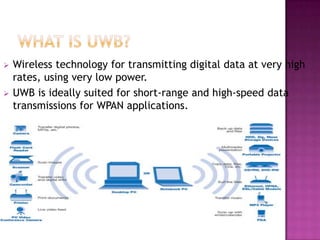
Wireless technology for transmitting digital data at very high
rates, using very low power.
UWB is ideally suited for short-range and high-speed data
transmissions for WPAN applications.
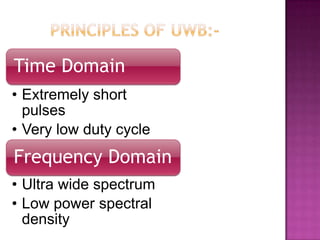
Time Domain
• Extremely short
pulses
• Very low duty cycle

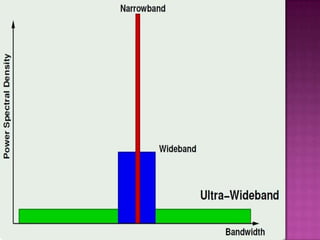
Frequency Domain
• Ultra wide spectrum
• Low power spectral
density
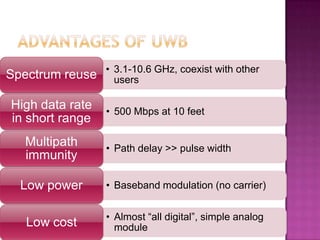
Spectrum reuse
High data rate
in short range
Multipath
immunity

• 3.1-10.6 GHz, coexist with other
users
• 500 Mbps at 10 feet
• Path delay >> pulse width

Low power

• Baseband modulation (no carrier)

Low cost

• Almost “all digital”, simple analog
module
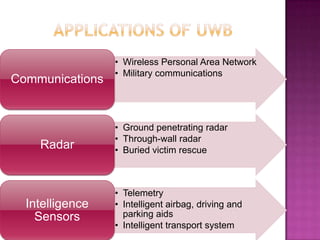
Communications

Radar

Intelligence
Sensors

• Wireless Personal Area Network
• Military communications

• Ground penetrating radar
• Through-wall radar
• Buried victim rescue

• Telemetry
• Intelligent airbag, driving and
parking aids
• Intelligent transport system




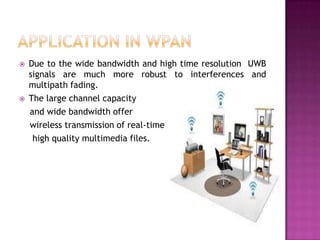
Due to the wide bandwidth and high time resolution UWB
signals are much more robust to interferences and
multipath fading.
The large channel capacity
and wide bandwidth offer
wireless transmission of real-time
high quality multimedia files.


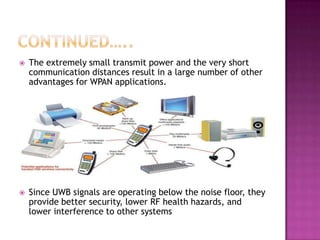
The extremely small transmit power and the very short
communication distances result in a large number of other
advantages for WPAN applications.



Since UWB signals are operating below the noise floor, they
provide better security, lower RF health hazards, and
lower interference to other systems
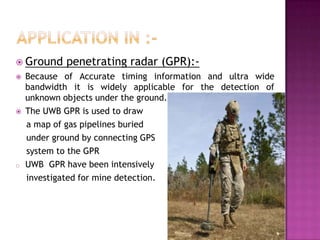
 Ground




o

penetrating radar (GPR):-

Because of Accurate timing information and ultra wide
bandwidth it is widely applicable for the detection of
unknown objects under the ground.
The UWB GPR is used to draw
a map of gas pipelines buried
under ground by connecting GPS
system to the GPR
UWB GPR have been intensively
investigated for mine detection.
 Military


o

Communication :-

Attractive for manned and unmanned military vehicles
􀂉 Issues associated with cable weight, space, and costs.
􀂉 Substantial cost associated with installing and
modifying cabling embedded within the platform .

Trade-off: extra ammunition or fuel.


Extremely low transmission energy



Extremely difficult to intercept



Multipath immunity to fading



Follows Shannon’s channel capacity theorem



C:- Maximum channel capacity
B:- Bandwidth(Hz)
S/N:- Signal to Noise power Ratio(Watts)



COMPARISION WITH OTHER
TECHNOLOGIES
• Extremely low transmission energy
• Extremely difficult to intercept
• Multipath immunity to fading
• Follows Shannon’s channel capacity
theorem
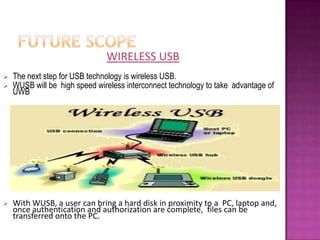
WIRELESS USB



The next step for USB technology is wireless USB.
WUSB will be high speed wireless interconnect technology to take advantage of
UWB



With WUSB, a user can bring a hard disk in proximity to a PC, laptop and,
once authentication and authorization are complete, files can be
transferred onto the PC.
 Interference
 Tradeoffs

 Low

with other licensed bands

with noise

power operation
 Well

suited for high speed, short range
WPAN.

 Supports

multimedia data rates, and offers
inherent data security.

 There's

a possibility that UWB will become
the "next best" technology for all types of
wireless networks, including wireless LANs.










Rahman,T.A ,Ngah,R,Hall,P.S. Wireless and Optical Communications
Networks, 2009. WOCN '09. 5th IFIP International Conference : 5-7
May 2009
Liuqing Yang; Giannakis, G.B..”Ultra Wideband communications, An
idea whose Time has come.”Signal Processing
Magazine, IEEE.Volume 21, Issue 6, Date: Nov. 2007.
Dr. Jeffrey Reed, Dr. R. Michael Buehrer, Dr. Dong S. Ha,
“Introduction to UWB:Impulse Radio for Radar and Wireless
Communications”.
M.Ghavami,L.B. Michael,R.Kohno, “Ultra wideband signals and
systems in communication engineering”,2nd Edition.
Maria-Gabriella Di Benedetto, Thomas Kaiser, Andreas F. Molisch,
Ian Oppermann, Christian Politano, and Domenico Porcino,”UWB
communication systems”.
Ultra wide band technology

Ultra wide band technology

  • 1.
  • 2.
     What is UWB? Principles of UWB  Advantages of UWB  Applications of UWB  UWB Characteristics  Comparison With Other Technologies  Future Scopes  Challenges  Conclusion  References
  • 3.
      Wireless technology fortransmitting digital data at very high rates, using very low power. UWB is ideally suited for short-range and high-speed data transmissions for WPAN applications.
  • 5.
    Time Domain • Extremelyshort pulses • Very low duty cycle Frequency Domain • Ultra wide spectrum • Low power spectral density
  • 6.
    Spectrum reuse High datarate in short range Multipath immunity • 3.1-10.6 GHz, coexist with other users • 500 Mbps at 10 feet • Path delay >> pulse width Low power • Baseband modulation (no carrier) Low cost • Almost “all digital”, simple analog module
  • 7.
    Communications Radar Intelligence Sensors • Wireless PersonalArea Network • Military communications • Ground penetrating radar • Through-wall radar • Buried victim rescue • Telemetry • Intelligent airbag, driving and parking aids • Intelligent transport system
  • 8.
      Due to thewide bandwidth and high time resolution UWB signals are much more robust to interferences and multipath fading. The large channel capacity and wide bandwidth offer wireless transmission of real-time high quality multimedia files.
  • 9.
     The extremely smalltransmit power and the very short communication distances result in a large number of other advantages for WPAN applications.  Since UWB signals are operating below the noise floor, they provide better security, lower RF health hazards, and lower interference to other systems
  • 10.
     Ground   o penetrating radar(GPR):- Because of Accurate timing information and ultra wide bandwidth it is widely applicable for the detection of unknown objects under the ground. The UWB GPR is used to draw a map of gas pipelines buried under ground by connecting GPS system to the GPR UWB GPR have been intensively investigated for mine detection.
  • 11.
     Military  o Communication :- Attractivefor manned and unmanned military vehicles 􀂉 Issues associated with cable weight, space, and costs. 􀂉 Substantial cost associated with installing and modifying cabling embedded within the platform . Trade-off: extra ammunition or fuel.
  • 12.
     Extremely low transmissionenergy  Extremely difficult to intercept  Multipath immunity to fading  Follows Shannon’s channel capacity theorem  C:- Maximum channel capacity B:- Bandwidth(Hz) S/N:- Signal to Noise power Ratio(Watts)  
  • 13.
    COMPARISION WITH OTHER TECHNOLOGIES •Extremely low transmission energy • Extremely difficult to intercept • Multipath immunity to fading • Follows Shannon’s channel capacity theorem
  • 15.
    WIRELESS USB   The nextstep for USB technology is wireless USB. WUSB will be high speed wireless interconnect technology to take advantage of UWB  With WUSB, a user can bring a hard disk in proximity to a PC, laptop and, once authentication and authorization are complete, files can be transferred onto the PC.
  • 16.
     Interference  Tradeoffs Low with other licensed bands with noise power operation
  • 17.
     Well suited forhigh speed, short range WPAN.  Supports multimedia data rates, and offers inherent data security.  There's a possibility that UWB will become the "next best" technology for all types of wireless networks, including wireless LANs.
  • 18.
         Rahman,T.A ,Ngah,R,Hall,P.S. Wirelessand Optical Communications Networks, 2009. WOCN '09. 5th IFIP International Conference : 5-7 May 2009 Liuqing Yang; Giannakis, G.B..”Ultra Wideband communications, An idea whose Time has come.”Signal Processing Magazine, IEEE.Volume 21, Issue 6, Date: Nov. 2007. Dr. Jeffrey Reed, Dr. R. Michael Buehrer, Dr. Dong S. Ha, “Introduction to UWB:Impulse Radio for Radar and Wireless Communications”. M.Ghavami,L.B. Michael,R.Kohno, “Ultra wideband signals and systems in communication engineering”,2nd Edition. Maria-Gabriella Di Benedetto, Thomas Kaiser, Andreas F. Molisch, Ian Oppermann, Christian Politano, and Domenico Porcino,”UWB communication systems”.

Editor's Notes

  • #4 (1) A mobile computer user could wirelessly connect to a digital projector in a conference room. (2)Digital pictures could be transferred to a computer from digital camera without the need of a cable.