Fission and
Fusion Reaction
Presented by:(Group 1)
Asad Bukhari
Zeeshan Ayyub
CONTENT LIST
Introduction
Fusion Reaction
• Nuclear Binding
energy
• Example
• Challenges
• Advancement
• Advantages
Fission Reaction
• Nuclear Chain reaction
• Controlled and
uncontrolled reaction
Conclusion
2
Introduction
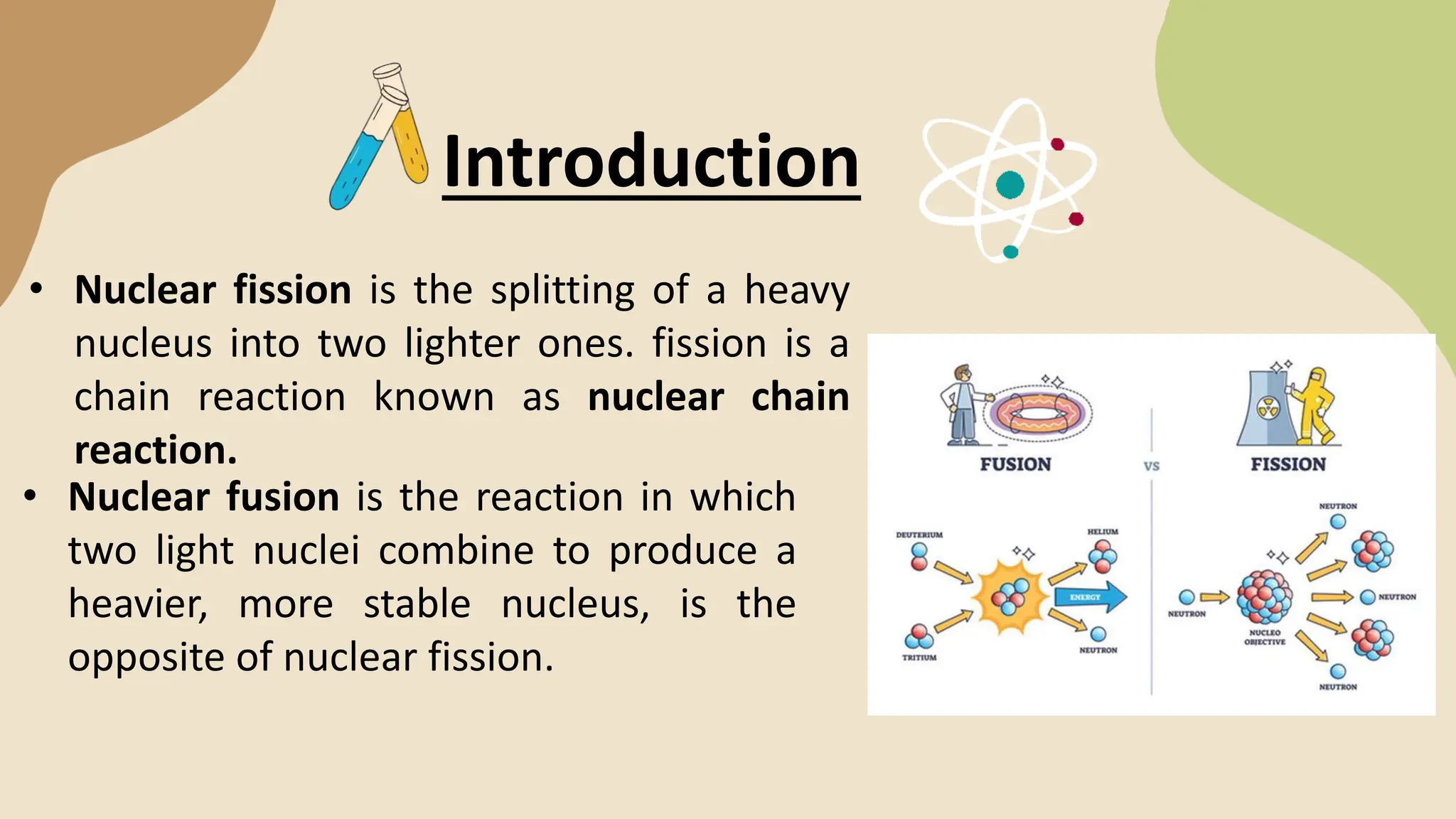
• Nuclear fission is the splitting of a heavy
nucleus into two lighter ones. fission is a
chain reaction known as nuclear chain
reaction.
• Nuclear fusion is the reaction in which
two light nuclei combine to produce a
heavier, more stable nucleus, is the
opposite of nuclear fission.
Nuclear Fusion
Reaction
4
Nuclear Fusion Reaction
Nuclear fusion is the joining of two nuclei to form a heavier
nuclei. The reaction is followed either by a release or
absorption of energy.
• Fusion of nuclei with lower mass than iron releases
energy while fusion of nuclei heavier than iron
generally absorbs energy. This phenomenon is known
as iron peak​
•Nuclear fusion is applied in nuclear weapons, specifically,
a hydrogen bomb.
5
5
Fusion Reaction Nuclear Binding Energy
Δm = [ZmH + (A-Z) mn]-M
•Greater the binding energy greater will
be the stability
6
Example of Nuclear Fusion
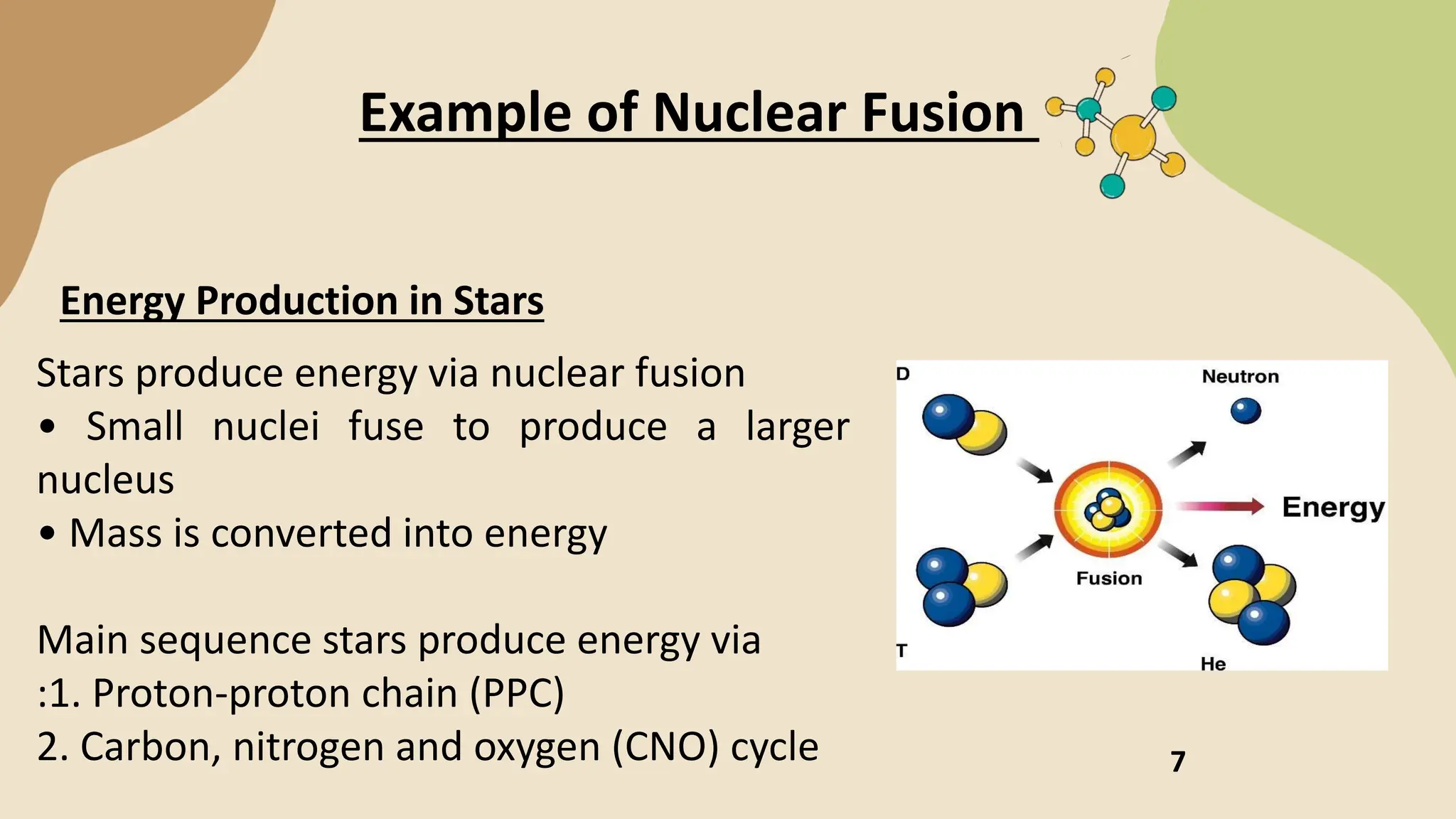
Stars produce energy via nuclear fusion
• Small nuclei fuse to produce a larger
nucleus
• Mass is converted into energy
Main sequence stars produce energy via
:1. Proton-proton chain (PPC)
2. Carbon, nitrogen and oxygen (CNO) cycle
Energy Production in Stars
7
H nucleus = proton
• Step 1: two protons fuse to
produce nucleus
• Step 2: nucleus fuses with a proton to
produce ³He nucleus
• Step 3: two ³He nuclei fuse
to produce nucleus and two protons
Proton-proton Chain
8
9
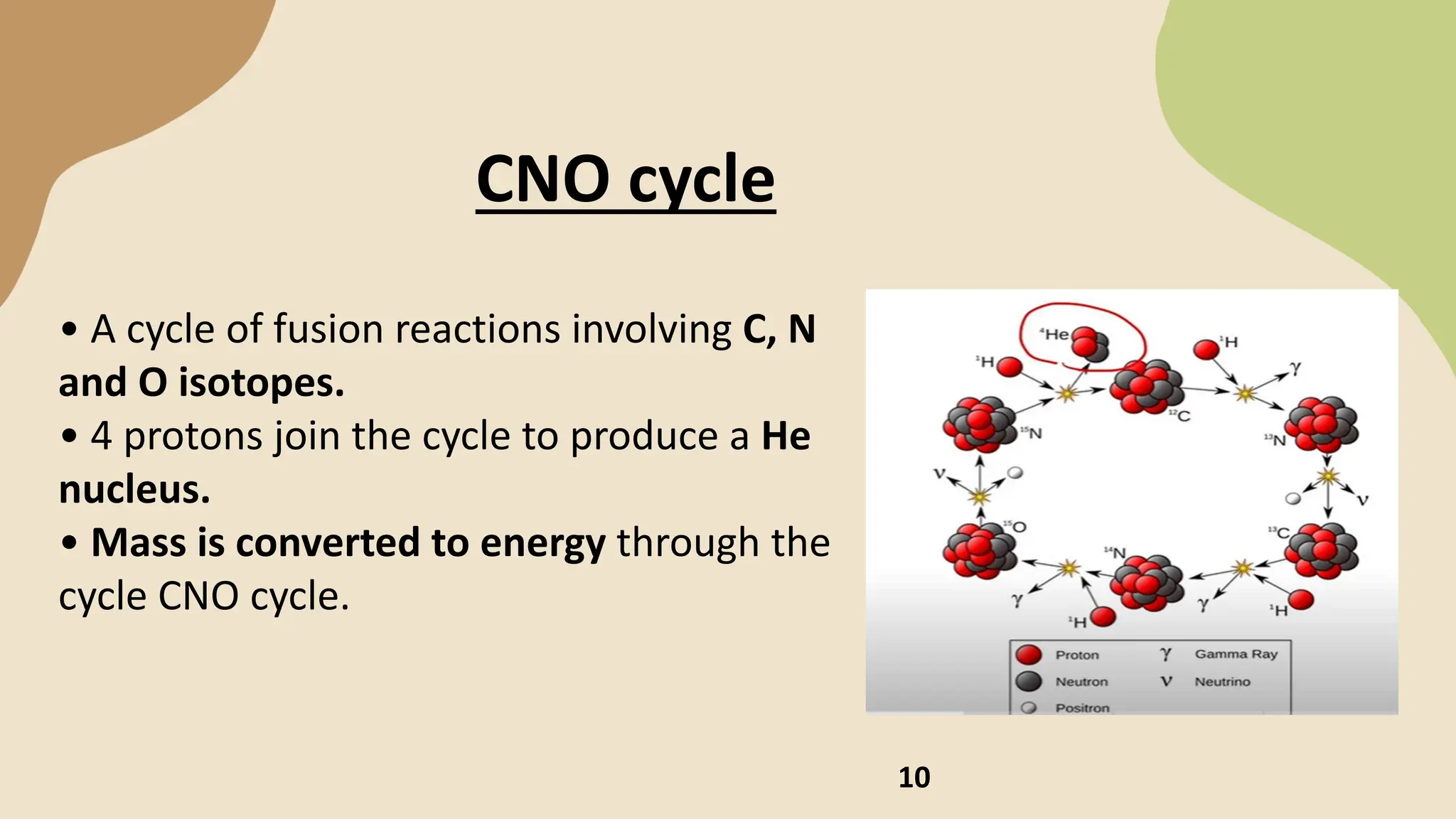
• A cycle of fusion reactions involving C, N
and O isotopes.
• 4 protons join the cycle to produce a He
nucleus.
• Mass is converted to energy through the
cycle CNO cycle.
CNO cycle
10
Two types of energy production:
•Proton-proton chain (smaller main
sequence stars).
•CNO cycle (larger main sequence
stars)Heavier stars have a higher core
temperature.
•Up to 98% of energy produced by the sun is
due to proton-proton chain.
Main Sequence Stars
11
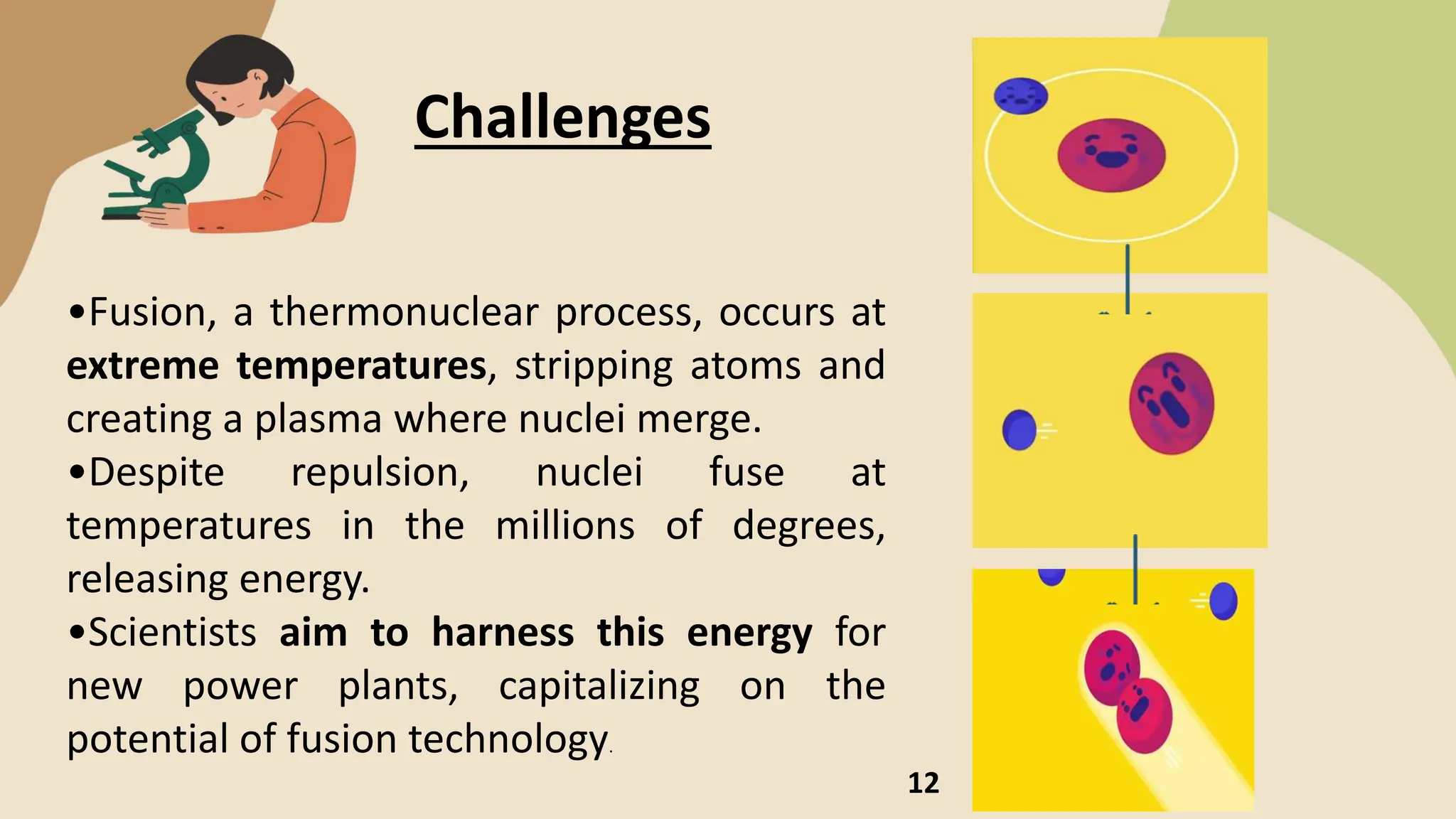
•Fusion, a thermonuclear process, occurs at
extreme temperatures, stripping atoms and
creating a plasma where nuclei merge.
•Despite repulsion, nuclei fuse at
temperatures in the millions of degrees,
releasing energy.
•Scientists aim to harness this energy for
new power plants, capitalizing on the
potential of fusion technology.
Challenges
12
Advancements
Scientists have invented two ways of making plasmas hot enough to fuse:
• The first type of reactor uses a
magnetic field to squeeze a
plasma in a doughnut shaped
chamber where the reactions
take place.
• The second type called "Inertial
confinement" uses pulses from super-
powered lasers to heat the surface of a
pellet of fuel imploding it, briefly making
the fuel hot and dense enough to fuse.
13
• No Greenhouse Gas
Emissions
• High Energy Output
• Abundant Fuel Supply
• Safety
Advantages
14
Nuclear
Fission Reaction
15
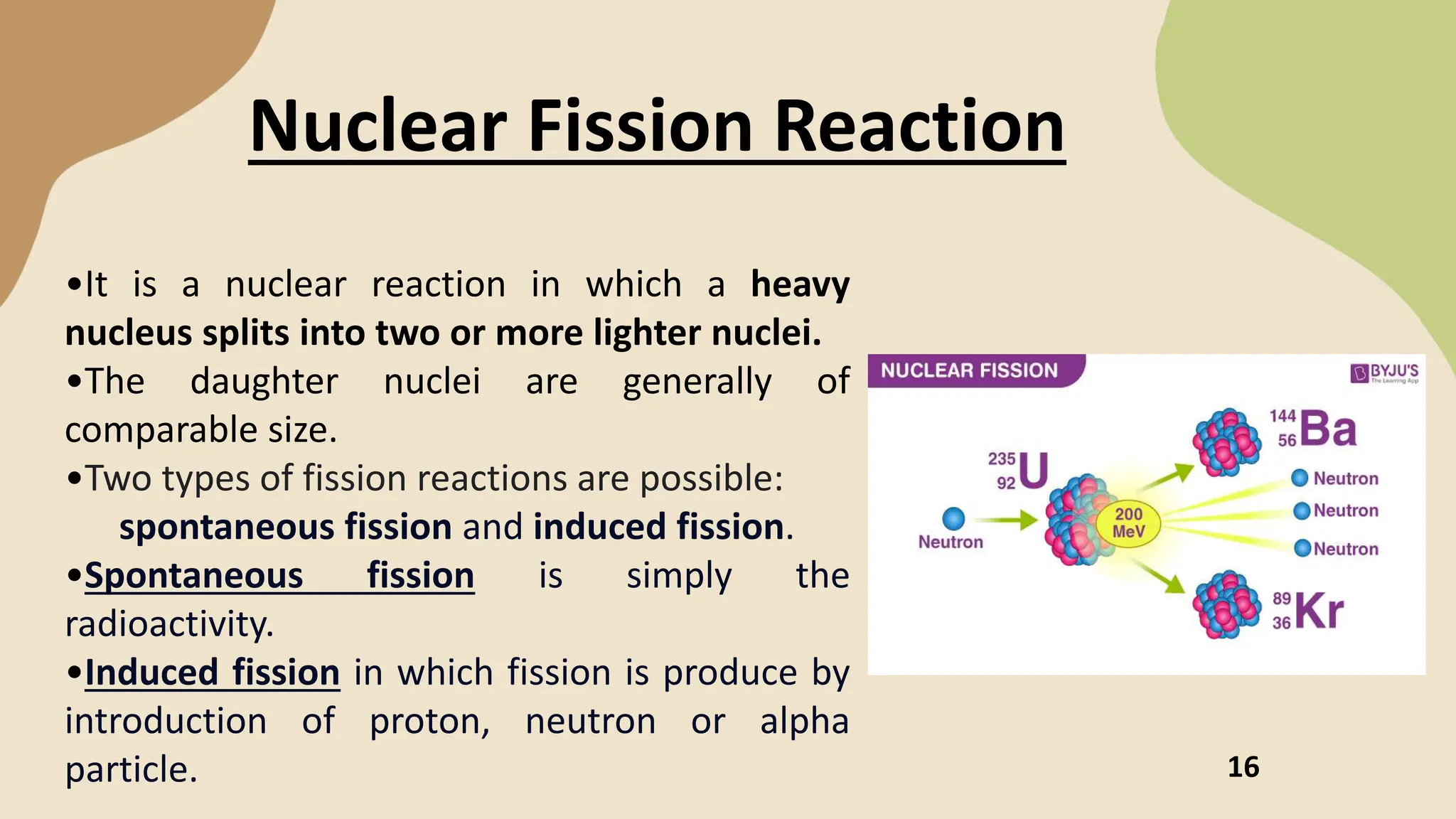
•It is a nuclear reaction in which a heavy
nucleus splits into two or more lighter nuclei.
•The daughter nuclei are generally of
comparable size.
•Two types of fission reactions are possible:
spontaneous fission and induced fission.
•Spontaneous fission is simply the
radioactivity.
•Induced fission in which fission is produce by
introduction of proton, neutron or alpha
particle.
Nuclear Fission Reaction
16
•The fission process often produces free neutrons and gamma photons,
and releases a very large amount of energy.
• Fission is a form of nuclear transmutation because the resulting
fragments are not same element as the original atom.
•In a typical nuclear fission process, a neutron collides with a large atom,
such as uranium-235, and forms a much less stable nuclide that
spontaneously decomposes into two medium sized atoms and 2 or 3
neutrons.
neutron + large nuclide unstable nuclide
unstable nuclide 2 medium sized nuclides + 2 or 3 neutrons
17
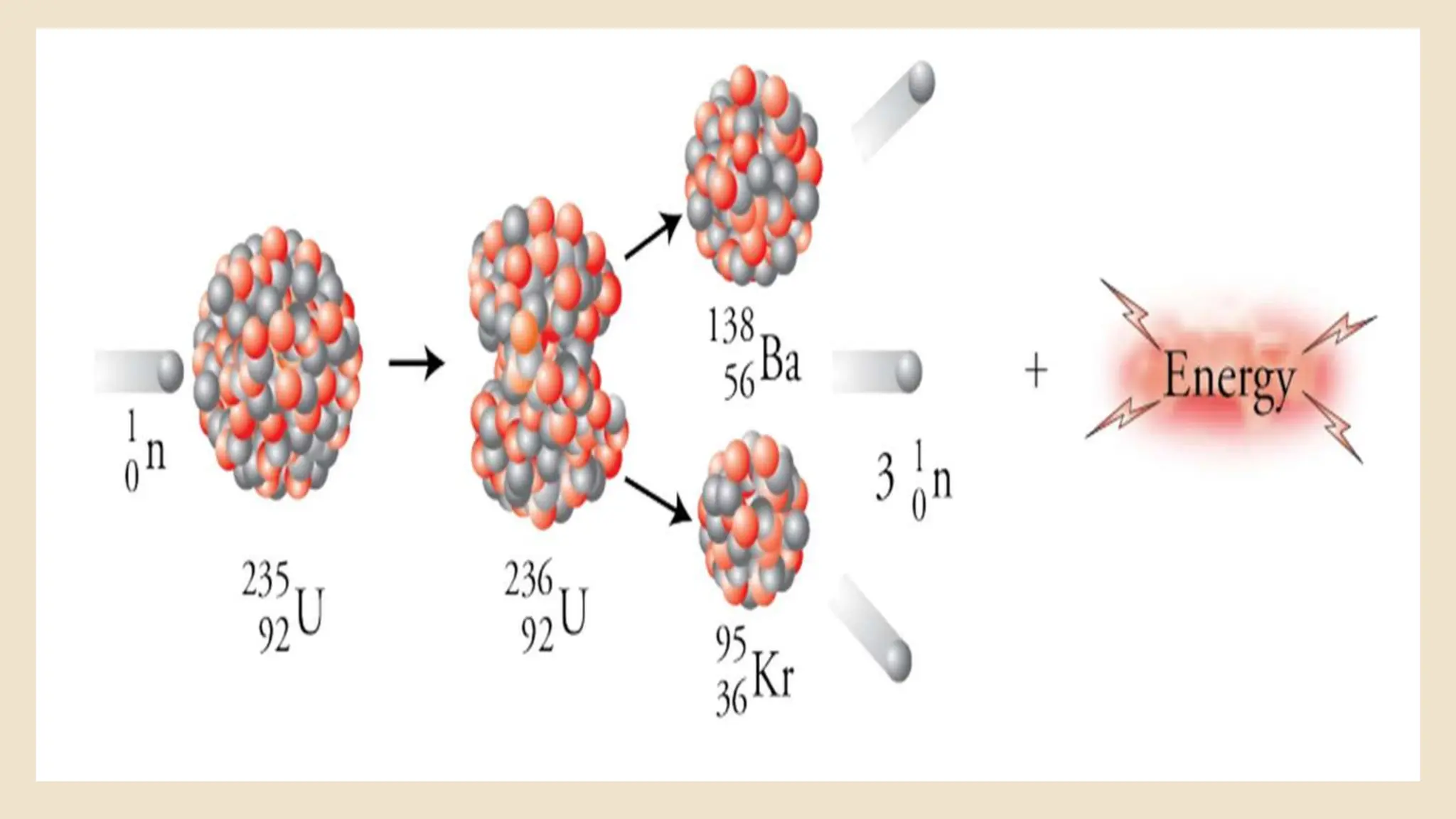
WHEN NEUTRON STRIKES92 U235 CONVERTED TO 92U236;
19
•This process may be represented by the following nuclear
equation:
•92U235+o'n 56Ba141 + 36Kr92 + 30'n + Q
•Where Q is the energy released in this reaction. o When
this is done, the amount of energy typically released in the
case of U-235 is around 200MeV.
21
21
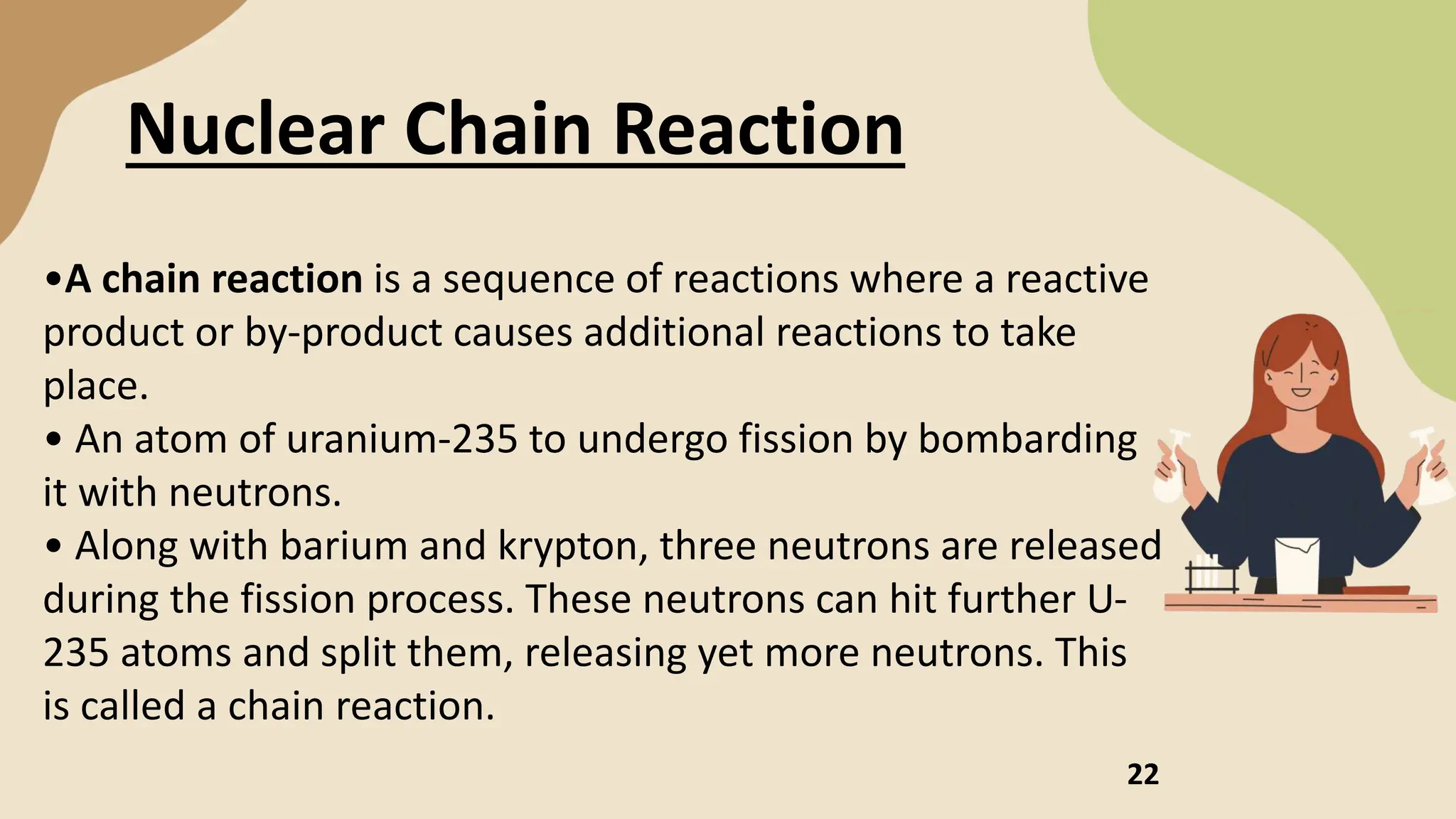
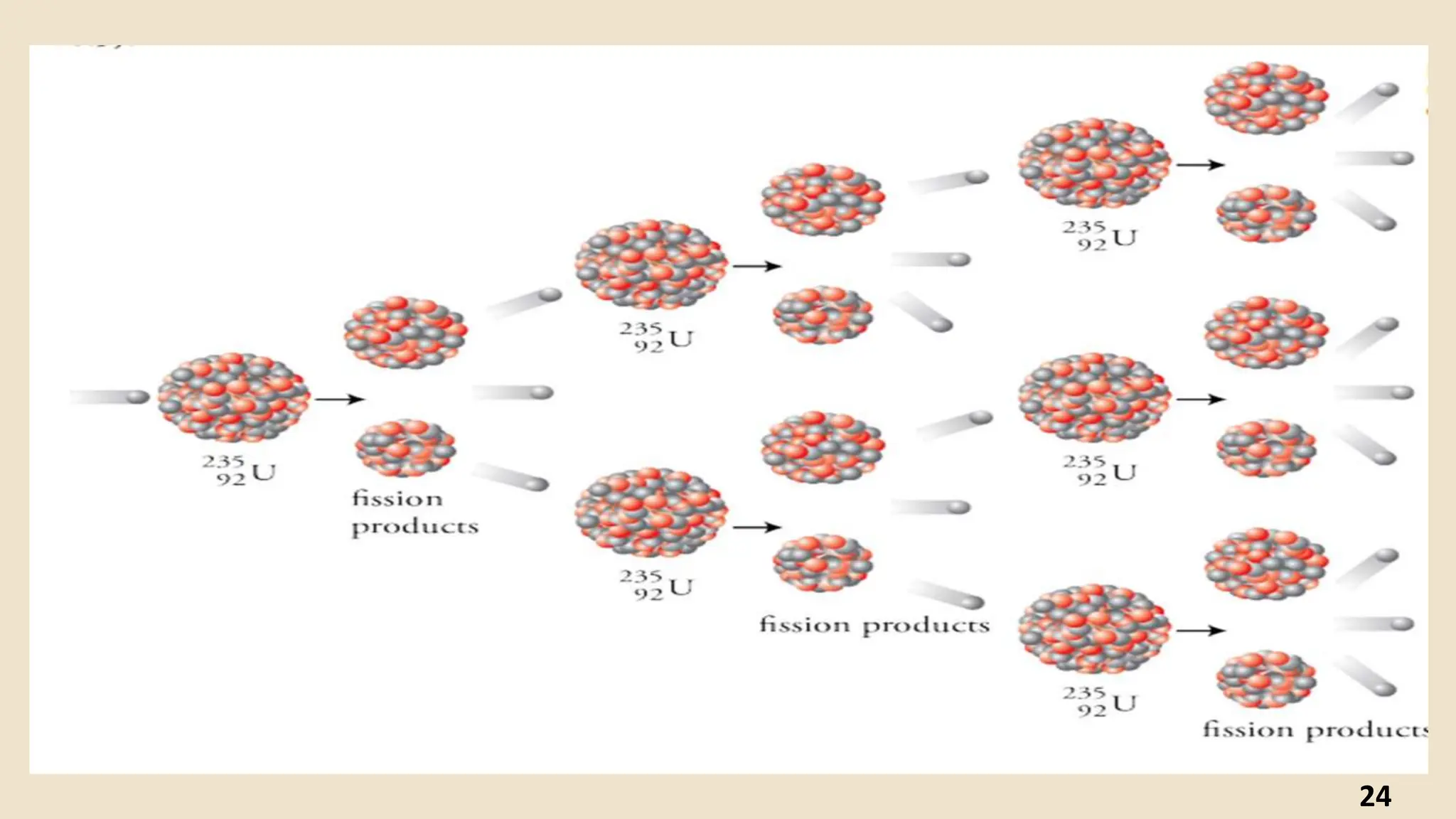
•A chain reaction is a sequence of reactions where a reactive
product or by-product causes additional reactions to take
place.
• An atom of uranium-235 to undergo fission by bombarding
it with neutrons.
• Along with barium and krypton, three neutrons are released
during the fission process. These neutrons can hit further U-
235 atoms and split them, releasing yet more neutrons. This
is called a chain reaction.
Nuclear Chain Reaction
22
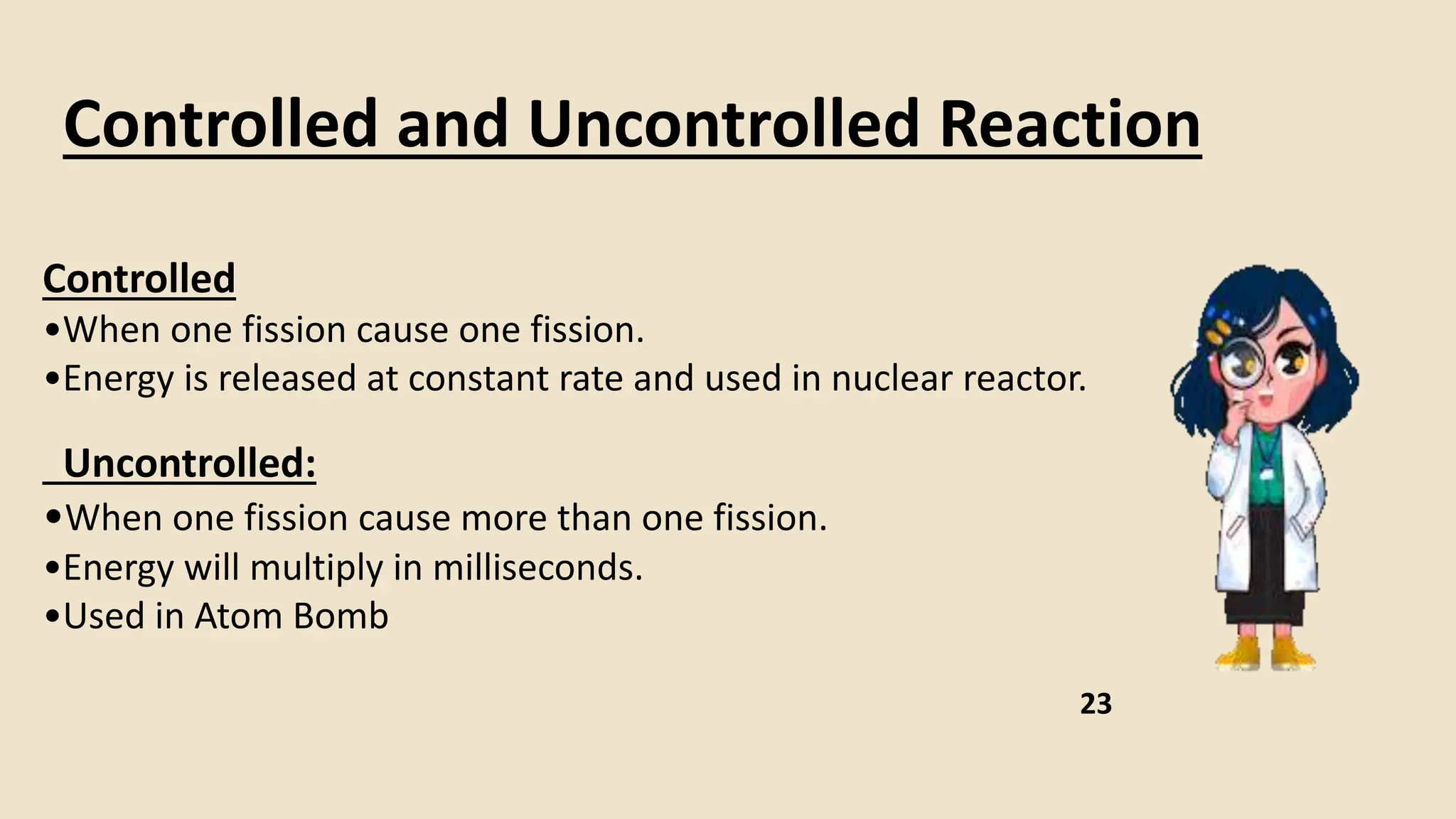
Controlled
•When one fission cause one fission.
•Energy is released at constant rate and used in nuclear reactor.
Uncontrolled:
•When one fission cause more than one fission.
•Energy will multiply in milliseconds.
•Used in Atom Bomb
Controlled and Uncontrolled Reaction
23
24
•Although the half-life of U-235 is a very long time, if we get
enough of the atoms together in one place the chances that any
one of them will undergo spontaneous fission is very, very high.
•Both uranium-235 and uranium-238 absorb fast neutrons, but if
the neutrons are slowed down, they are much more likely to
be absorbed by uranium-235 atoms. Therefore, in a nuclear
reactor, the fuel rods are surrounded by a substance called a
moderator that slows the neutrons as they pass through it.
Several substances have been used as moderators, but normal
water is most common
25
• Additional Neutrons create a chain reaction, which is
controlled by the control rods containing substances such as
cadmium or boron, which are efficient neutron absorbers
26
Conclusion:
In conclusion, both fusion and fission research show
promise in addressing future energy demands and
climate change.
Overcoming challenges through investment and global
cooperation is essential to fully realize the potential of
nuclear energy, offering sustainable and clean
alternatives to fossil fuels
27
Reference:
1) Petrucci, Harwood, Herring, Madura. General Chemistry: Principles &
Modern Applications (9th edition). New Jersey: Pearson Education,
2007.
2) William E. Stephens. Nuclear Fission and Atomic Energy. Inman Press
2007.
3) Badash, L., Hodes, E. and Tiddens, A., 1986. Nuclear fission:
Reaction to the discovery in 1939. Proceedings of the American
Philosophical Society, pp.196-231.
4) Wagemans, C., 1991. The nuclear fission process.
28
Any Questions???
Thank You

Fission and fusion reaction presentation.pptx

  • 1.
    Fission and Fusion Reaction Presentedby:(Group 1) Asad Bukhari Zeeshan Ayyub
  • 2.
    CONTENT LIST Introduction Fusion Reaction •Nuclear Binding energy • Example • Challenges • Advancement • Advantages Fission Reaction • Nuclear Chain reaction • Controlled and uncontrolled reaction Conclusion 2
  • 3.
    Introduction • Nuclear fissionis the splitting of a heavy nucleus into two lighter ones. fission is a chain reaction known as nuclear chain reaction. • Nuclear fusion is the reaction in which two light nuclei combine to produce a heavier, more stable nucleus, is the opposite of nuclear fission.
  • 4.
  • 5.
    Nuclear Fusion Reaction Nuclearfusion is the joining of two nuclei to form a heavier nuclei. The reaction is followed either by a release or absorption of energy. • Fusion of nuclei with lower mass than iron releases energy while fusion of nuclei heavier than iron generally absorbs energy. This phenomenon is known as iron peak​ •Nuclear fusion is applied in nuclear weapons, specifically, a hydrogen bomb. 5 5
  • 6.
    Fusion Reaction NuclearBinding Energy Δm = [ZmH + (A-Z) mn]-M •Greater the binding energy greater will be the stability 6
  • 7.
    Example of NuclearFusion Stars produce energy via nuclear fusion • Small nuclei fuse to produce a larger nucleus • Mass is converted into energy Main sequence stars produce energy via :1. Proton-proton chain (PPC) 2. Carbon, nitrogen and oxygen (CNO) cycle Energy Production in Stars 7
  • 8.
    H nucleus =proton • Step 1: two protons fuse to produce nucleus • Step 2: nucleus fuses with a proton to produce ³He nucleus • Step 3: two ³He nuclei fuse to produce nucleus and two protons Proton-proton Chain 8
  • 9.
  • 10.
    • A cycleof fusion reactions involving C, N and O isotopes. • 4 protons join the cycle to produce a He nucleus. • Mass is converted to energy through the cycle CNO cycle. CNO cycle 10
  • 11.
    Two types ofenergy production: •Proton-proton chain (smaller main sequence stars). •CNO cycle (larger main sequence stars)Heavier stars have a higher core temperature. •Up to 98% of energy produced by the sun is due to proton-proton chain. Main Sequence Stars 11
  • 12.
    •Fusion, a thermonuclearprocess, occurs at extreme temperatures, stripping atoms and creating a plasma where nuclei merge. •Despite repulsion, nuclei fuse at temperatures in the millions of degrees, releasing energy. •Scientists aim to harness this energy for new power plants, capitalizing on the potential of fusion technology. Challenges 12
  • 13.
    Advancements Scientists have inventedtwo ways of making plasmas hot enough to fuse: • The first type of reactor uses a magnetic field to squeeze a plasma in a doughnut shaped chamber where the reactions take place. • The second type called "Inertial confinement" uses pulses from super- powered lasers to heat the surface of a pellet of fuel imploding it, briefly making the fuel hot and dense enough to fuse. 13
  • 14.
    • No GreenhouseGas Emissions • High Energy Output • Abundant Fuel Supply • Safety Advantages 14
  • 15.
  • 16.
    •It is anuclear reaction in which a heavy nucleus splits into two or more lighter nuclei. •The daughter nuclei are generally of comparable size. •Two types of fission reactions are possible: spontaneous fission and induced fission. •Spontaneous fission is simply the radioactivity. •Induced fission in which fission is produce by introduction of proton, neutron or alpha particle. Nuclear Fission Reaction 16
  • 17.
    •The fission processoften produces free neutrons and gamma photons, and releases a very large amount of energy. • Fission is a form of nuclear transmutation because the resulting fragments are not same element as the original atom. •In a typical nuclear fission process, a neutron collides with a large atom, such as uranium-235, and forms a much less stable nuclide that spontaneously decomposes into two medium sized atoms and 2 or 3 neutrons. neutron + large nuclide unstable nuclide unstable nuclide 2 medium sized nuclides + 2 or 3 neutrons 17
  • 19.
    WHEN NEUTRON STRIKES92U235 CONVERTED TO 92U236; 19
  • 21.
    •This process maybe represented by the following nuclear equation: •92U235+o'n 56Ba141 + 36Kr92 + 30'n + Q •Where Q is the energy released in this reaction. o When this is done, the amount of energy typically released in the case of U-235 is around 200MeV. 21 21
  • 22.
    •A chain reactionis a sequence of reactions where a reactive product or by-product causes additional reactions to take place. • An atom of uranium-235 to undergo fission by bombarding it with neutrons. • Along with barium and krypton, three neutrons are released during the fission process. These neutrons can hit further U- 235 atoms and split them, releasing yet more neutrons. This is called a chain reaction. Nuclear Chain Reaction 22
  • 23.
    Controlled •When one fissioncause one fission. •Energy is released at constant rate and used in nuclear reactor. Uncontrolled: •When one fission cause more than one fission. •Energy will multiply in milliseconds. •Used in Atom Bomb Controlled and Uncontrolled Reaction 23
  • 24.
  • 25.
    •Although the half-lifeof U-235 is a very long time, if we get enough of the atoms together in one place the chances that any one of them will undergo spontaneous fission is very, very high. •Both uranium-235 and uranium-238 absorb fast neutrons, but if the neutrons are slowed down, they are much more likely to be absorbed by uranium-235 atoms. Therefore, in a nuclear reactor, the fuel rods are surrounded by a substance called a moderator that slows the neutrons as they pass through it. Several substances have been used as moderators, but normal water is most common 25
  • 26.
    • Additional Neutronscreate a chain reaction, which is controlled by the control rods containing substances such as cadmium or boron, which are efficient neutron absorbers 26
  • 27.
    Conclusion: In conclusion, bothfusion and fission research show promise in addressing future energy demands and climate change. Overcoming challenges through investment and global cooperation is essential to fully realize the potential of nuclear energy, offering sustainable and clean alternatives to fossil fuels 27
  • 28.
    Reference: 1) Petrucci, Harwood,Herring, Madura. General Chemistry: Principles & Modern Applications (9th edition). New Jersey: Pearson Education, 2007. 2) William E. Stephens. Nuclear Fission and Atomic Energy. Inman Press 2007. 3) Badash, L., Hodes, E. and Tiddens, A., 1986. Nuclear fission: Reaction to the discovery in 1939. Proceedings of the American Philosophical Society, pp.196-231. 4) Wagemans, C., 1991. The nuclear fission process. 28
  • 29.