Chapter 23 Sun-Earth-Moon Systems
Earth Properties In comparison to the rest of the solar system, the Earth is rather small. It has an equatorial diameter of approximately 12,756 km. Even though 3 of the other 7 planets in our solar system are smaller (Mercury, Mars, and Venus), the remaining 4 planets (Neptune, Uranus, Saturn, and Jupiter) are much larger.
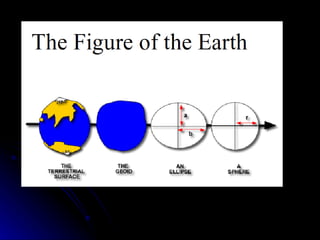
Oblate Spheroid  The Earth is not a perfect sphere.  The true shape of the Earth called an Oblate Spheroid, or a slightly elongated sphere. The diameter from the North Pole to the South Pole (the shortest diameter) is approximately 12,714 km.  The equatorial diameter (the longest diameter) is approximately 12,756 km.  This is proven by the fact that gravity changes on certain places on the Earth.  The further from the center the less something will weigh.
 
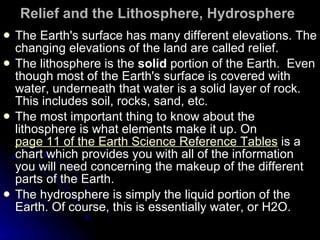
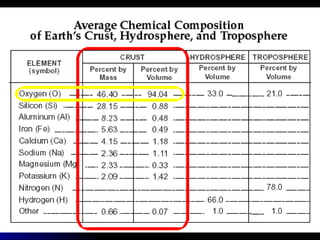
Relief and the Lithosphere, Hydrosphere   The Earth's surface has many different elevations. The changing elevations of the land are called relief.  The lithosphere is the  solid  portion of the Earth.  Even though most of the Earth's surface is covered with water, underneath that water is a solid layer of rock. This includes soil, rocks, sand, etc.  The most important thing to know about the lithosphere is what elements make it up. On  page 11 of the Earth Science Reference Tables  is a chart which provides you with all of the information you will need concerning the makeup of the different parts of the Earth.  The hydrosphere is simply the liquid portion of the Earth. Of course, this is essentially water, or H2O.
 
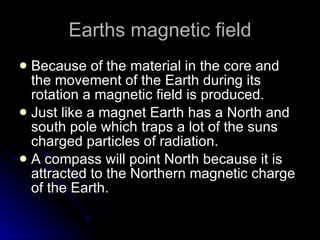
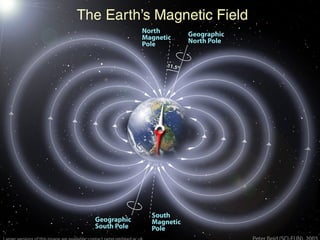
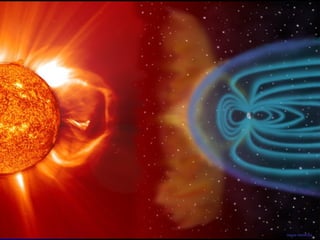
Earths magnetic field Because of the material in the core and the movement of the Earth during its rotation a magnetic field is produced.  Just like a magnet Earth has a North and south pole which traps a lot of the suns charged particles of radiation. A compass will point North because it is attracted to the Northern magnetic charge of the Earth.
 
 
Rotation The Earth’s axis is an imaginary line that cuts directly through the center of the Earth.  At the ends of the axis is the North and South poles.  On this axis the earth spins or rotates . It takes the Earth 23h 56min to go around its axis 360 °.  We round up to 24 hrs. and call this one day on Earth. We orbit or revolve around the sun in 365 days 6 hr, 9min. Earth’s rotation also gives us night and day.  The portion of the sun that is facing the sun will have daylight and the opposite side will have no daylight and will be called night time.
Changes of Seasons The Earth’s orbit around the sun is not a perfect circle its called an ellipse.  And the sun is not in the middle of our elliptical orbit.  Earth is closet to the sun in January. And furthest away in July. We experience climate changes b/c of the Earth’s tilted axis not b/c of the distance from the sun. Earth is tilted 23.5 ° on its axis so the hemisphere that is tilted toward the sun will experience warmer climates and longer days than the hemisphere that is tilted away from the sun. This also causes the facing hemisphere to be exposed to greater radiation from the sun causing hotter temps.
 
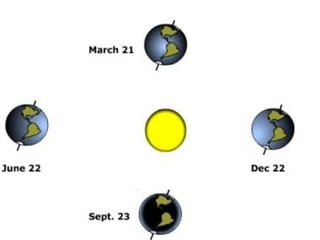
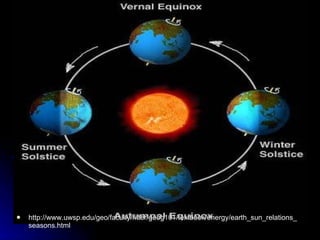
Solstices & Equinoxes The solstice is the day when the Sun reaches its greatest distance north or South of the equator. In the Northern hemisphere the summer solstice is June 21 or 22 (longest days) Winter solstice is December 21 or 22 (shortest days) An equinox is when the sun is directly over the equator of the Earth.  Spring equinox is March 20 or 21 & fall equinox is September 22 or 23 H.W. pg 665 ques 1-4
http://www.uwsp.edu/geo/faculty/ritter/geog101/textbook/energy/earth_sun_relations_seasons.html

Chapter 23-sun,earth,moon system

  • 1.
  • 2.
    Earth Properties Incomparison to the rest of the solar system, the Earth is rather small. It has an equatorial diameter of approximately 12,756 km. Even though 3 of the other 7 planets in our solar system are smaller (Mercury, Mars, and Venus), the remaining 4 planets (Neptune, Uranus, Saturn, and Jupiter) are much larger.
  • 3.
    Oblate Spheroid The Earth is not a perfect sphere. The true shape of the Earth called an Oblate Spheroid, or a slightly elongated sphere. The diameter from the North Pole to the South Pole (the shortest diameter) is approximately 12,714 km. The equatorial diameter (the longest diameter) is approximately 12,756 km. This is proven by the fact that gravity changes on certain places on the Earth. The further from the center the less something will weigh.
  • 4.
  • 5.
    Relief and theLithosphere, Hydrosphere The Earth's surface has many different elevations. The changing elevations of the land are called relief. The lithosphere is the solid portion of the Earth. Even though most of the Earth's surface is covered with water, underneath that water is a solid layer of rock. This includes soil, rocks, sand, etc. The most important thing to know about the lithosphere is what elements make it up. On page 11 of the Earth Science Reference Tables is a chart which provides you with all of the information you will need concerning the makeup of the different parts of the Earth. The hydrosphere is simply the liquid portion of the Earth. Of course, this is essentially water, or H2O.
  • 6.
  • 7.
    Earths magnetic fieldBecause of the material in the core and the movement of the Earth during its rotation a magnetic field is produced. Just like a magnet Earth has a North and south pole which traps a lot of the suns charged particles of radiation. A compass will point North because it is attracted to the Northern magnetic charge of the Earth.
  • 8.
  • 9.
  • 10.
    Rotation The Earth’saxis is an imaginary line that cuts directly through the center of the Earth. At the ends of the axis is the North and South poles. On this axis the earth spins or rotates . It takes the Earth 23h 56min to go around its axis 360 °. We round up to 24 hrs. and call this one day on Earth. We orbit or revolve around the sun in 365 days 6 hr, 9min. Earth’s rotation also gives us night and day. The portion of the sun that is facing the sun will have daylight and the opposite side will have no daylight and will be called night time.
  • 11.
    Changes of SeasonsThe Earth’s orbit around the sun is not a perfect circle its called an ellipse. And the sun is not in the middle of our elliptical orbit. Earth is closet to the sun in January. And furthest away in July. We experience climate changes b/c of the Earth’s tilted axis not b/c of the distance from the sun. Earth is tilted 23.5 ° on its axis so the hemisphere that is tilted toward the sun will experience warmer climates and longer days than the hemisphere that is tilted away from the sun. This also causes the facing hemisphere to be exposed to greater radiation from the sun causing hotter temps.
  • 12.
  • 13.
    Solstices & EquinoxesThe solstice is the day when the Sun reaches its greatest distance north or South of the equator. In the Northern hemisphere the summer solstice is June 21 or 22 (longest days) Winter solstice is December 21 or 22 (shortest days) An equinox is when the sun is directly over the equator of the Earth. Spring equinox is March 20 or 21 & fall equinox is September 22 or 23 H.W. pg 665 ques 1-4
  • 14.