Child Development and
Pedagogy
• Overview of CDP
Child development – 15 questions of 15 Marks
Inclusive education – 5 questions of 5 Marks
Language and pedagogy – 10 questions of 10 Marks
“We must teach the way students learn”
–Pedro Nogeura.
Child Development is overall development of a
child, it entails the biological, psychological and
emotional changes that occur in human beings
between birth and the end of adolescence.
Child development is the field that involves the
scientific study.
AREA OF DEVELOPMENT
1. Physical Development
2. Cognitive Development
3. Personality and Social Development
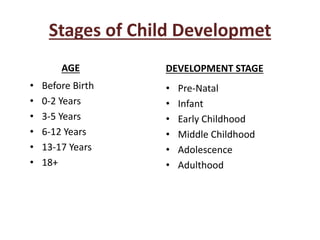
Stages of Child Developmet
AGE
• Before Birth
• 0-2 Years
• 3-5 Years
• 6-12 Years
• 13-17 Years
• 18+
DEVELOPMENT STAGE
• Pre-Natal
• Infant
• Early Childhood
• Middle Childhood
• Adolescence
• Adulthood
Principles of Development
• Development is Continuous process.
• Development progresses in a step-by-step fashion.
• Rates of development vary among children.
• Development Proceeds from General to Specific.
• There is a Constant Interaction Between All Factors of
Development.
• Development is influenced by both heredity and
environment.
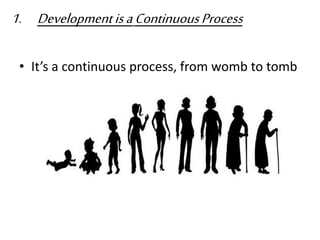
1. DevelopmentisaContinuousProcess
• It’s a continuous process, from womb to tomb
2.Developmentprogressesinastep-by-stepfashion
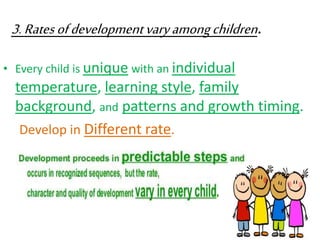
3.Ratesofdevelopmentvaryamongchildren.
• Every child is unique with an individual
temperature, learning style, family
background, and patterns and growth timing.
Develop in Different rate.
4.DevelopmentProceedsfromGeneraltoSpecific
Holding Pen/Pencil
Holding Cube
5.ThereisaConstantInteractionBetweenAllFactorsof
Development.
6.Developmentisinfluencedbybothheredityand
environment
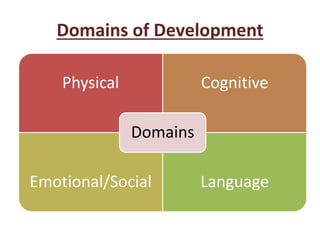
Domains of Development
Physical Cognitive
Emotional/Social Language
Domains
Physical Development
• Physical Development
starts from womb.
• Includes the physical
and motor skills and
abilities that emerge
during the infant and
toddler stages of
development.
GROSS MOTOR SKILL
• Gross Motor (physical)
skills are those which
require whole body
movement and which
involve the large (core
stabilising) muscles of the
body to perform everyday
functions, such as rolling,
crawling, standing, etc.
FINE MOTOR SKILL
• Fine Motor Skill : movements
involving smaller muscle groups
such as those in the hand and
wrist. Children start to use their
hands right at birth to explore
their own bodies and the world
around them.
Cognitive Development
The process of growth and change in intellectual/mental
abilities such as thinking, reasoning and understanding. In
early infancy, children have limited capability to outwardly
express mental understanding.
Emotional/Social Development
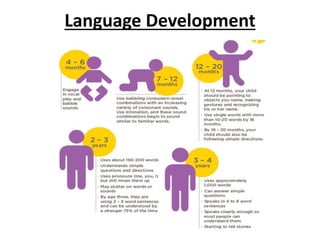
Language Development
Today we Discussed :-
• Development
• Childs Development
• Stages of Development
• Principles of Development
 Development is Continuous process.
 Development progresses in a step-by-step fashion.
 Rates of development vary among children.
 Development Proceeds from General to Specific.
 There is a Constant Interaction Between All Factors of Development.
 Development is influenced by both heredity and environment.
• Domains of Development
 Physical Development
 Cognitive Development
 Emotional/Social Development
 Language Development
Thank You For Watching…
One Positive Thought

Child Development and Pedagogy

  • 1.
    Child Development and Pedagogy •Overview of CDP Child development – 15 questions of 15 Marks Inclusive education – 5 questions of 5 Marks Language and pedagogy – 10 questions of 10 Marks “We must teach the way students learn” –Pedro Nogeura.
  • 3.
    Child Development isoverall development of a child, it entails the biological, psychological and emotional changes that occur in human beings between birth and the end of adolescence. Child development is the field that involves the scientific study. AREA OF DEVELOPMENT 1. Physical Development 2. Cognitive Development 3. Personality and Social Development
  • 4.
    Stages of ChildDevelopmet AGE • Before Birth • 0-2 Years • 3-5 Years • 6-12 Years • 13-17 Years • 18+ DEVELOPMENT STAGE • Pre-Natal • Infant • Early Childhood • Middle Childhood • Adolescence • Adulthood
  • 5.
    Principles of Development •Development is Continuous process. • Development progresses in a step-by-step fashion. • Rates of development vary among children. • Development Proceeds from General to Specific. • There is a Constant Interaction Between All Factors of Development. • Development is influenced by both heredity and environment.
  • 6.
    1. DevelopmentisaContinuousProcess • It’sa continuous process, from womb to tomb
  • 7.
  • 8.
    3.Ratesofdevelopmentvaryamongchildren. • Every childis unique with an individual temperature, learning style, family background, and patterns and growth timing. Develop in Different rate.
  • 9.
  • 10.
  • 11.
  • 12.
    Domains of Development PhysicalCognitive Emotional/Social Language Domains
  • 13.
    Physical Development • PhysicalDevelopment starts from womb. • Includes the physical and motor skills and abilities that emerge during the infant and toddler stages of development.
  • 14.
    GROSS MOTOR SKILL •Gross Motor (physical) skills are those which require whole body movement and which involve the large (core stabilising) muscles of the body to perform everyday functions, such as rolling, crawling, standing, etc. FINE MOTOR SKILL • Fine Motor Skill : movements involving smaller muscle groups such as those in the hand and wrist. Children start to use their hands right at birth to explore their own bodies and the world around them.
  • 15.
    Cognitive Development The processof growth and change in intellectual/mental abilities such as thinking, reasoning and understanding. In early infancy, children have limited capability to outwardly express mental understanding.
  • 16.
  • 17.
  • 18.
    Today we Discussed:- • Development • Childs Development • Stages of Development • Principles of Development  Development is Continuous process.  Development progresses in a step-by-step fashion.  Rates of development vary among children.  Development Proceeds from General to Specific.  There is a Constant Interaction Between All Factors of Development.  Development is influenced by both heredity and environment. • Domains of Development  Physical Development  Cognitive Development  Emotional/Social Development  Language Development
  • 19.
    Thank You ForWatching… One Positive Thought