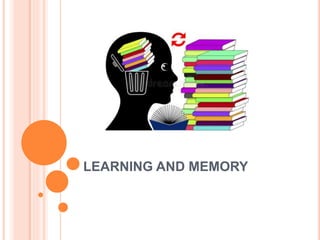
LEARNING AND MEMORY
INTRODUCTION
 learning and memory are closely related concepts.
 Learning involves the acquisition of knowledge while the
memory is expressing what has been acquired through
learning.
 The difference between the two can also be noted.
 If one acquires information slowly and laboriously, this
can be considered as learning.
 On the other hand, if the acquisition occurs instantly this
is then considered to be a memory.
 While teaching, different student have different levels to
which they retain information in their brain.
TYPES OF MEMORY
Memory is of different types.
When stores memory they store
information. What makes the
memory differ is the how long
information is being stored.
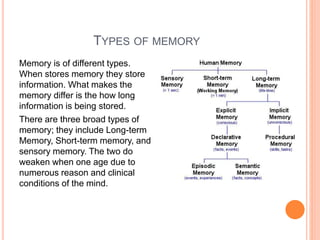
There are three broad types of
memory; they include Long-term
Memory, Short-term memory, and
sensory memory. The two do
weaken when one age due to
numerous reason and clinical
conditions of the mind.
SENSORY MEMORY
 This is considered to be the shortest
term of memory. It entails retaining
sensory information after original
stimuli have ended.
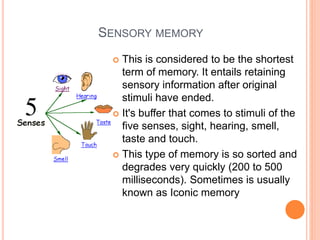
 It's buffer that comes to stimuli of the
five senses, sight, hearing, smell,
taste and touch.
 This type of memory is so sorted and
degrades very quickly (200 to 500
milliseconds). Sometimes is usually
known as Iconic memory
SHORT TERM MEMORY
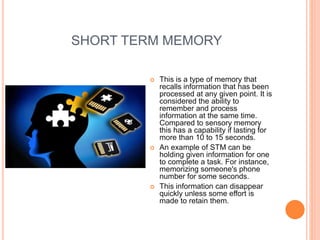
 This is a type of memory that
recalls information that has been
processed at any given point. It is
considered the ability to
remember and process
information at the same time.
Compared to sensory memory
this has a capability if lasting for
more than 10 to 15 seconds.
 An example of STM can be
holding given information for one
to complete a task. For instance,
memorizing someone's phone
number for some seconds.
 This information can disappear
quickly unless some effort is
made to retain them.
LONG TERM MEMORY
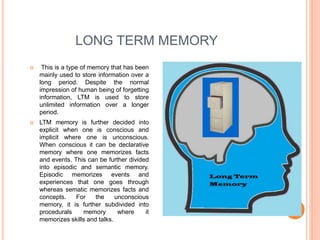
 This is a type of memory that has been
mainly used to store information over a
long period. Despite the normal
impression of human being of forgetting
information, LTM is used to store
unlimited information over a longer
period.
 LTM memory is further decided into
explicit when one is conscious and
implicit where one is unconscious.
When conscious it can be declarative
memory where one memorizes facts
and events. This can be further divided
into episodic and semantic memory.
Episodic memorizes events and
experiences that one goes through
whereas sematic memorizes facts and
concepts. For the unconscious
memory, it is further subdivided into
procedurals memory where it
memorizes skills and talks.
KNOWLEDGE RETENTION
 Using memory, one can use it to
capture knowledge that can be used
later. Retention can be regarded
storage of information in the long-
term memory so that it can be easily
retrieved. Using retention, it can be
used in learning which can be
applied in solving a problem or make
sense of a situation in a different
context
FACTORS AFFECT MEMORY RETENTION IN
THE CLASSROOM
 Conscious effort
 Accountability
 Students should always be
accountable for their notebook.
They should understand the
goals of each lesson
 Reception
 Students should be attentive
and observant of the lessons.
It will assist them in retaining
information
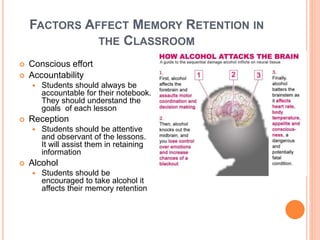
 Alcohol
 Students should be
encouraged to take alcohol it
affects their memory retention
CONT..
 Conscious effort
 Students should be encouraged to be conscious in class
so that they remember what has been; earned. They
should do homework every day.
 Exercise
 Research has shown that student participating in
exercises such as aerobics have a high retention power.
Therefore exercise can be a factor that may cause
retention of information
 Routines
 Without routines, students will forget what they have
learned. They should be encouraged to write down
homework

COLORS
WITHOUT THE USE OF COLOR LEARNING CAN BE BORING
WAYS OF RETENTION OF LEARNING
 Since people have different capabilities of retention
of knowledge one can apply some of the
techniques so that they store information for a long
time. They include;
 Storytelling
 Sharing of key knowledge
 Pair share- this is a strategy where two learners share
something to help them learn new content.
 Repetition or practice – in learning it involves repeating
acts in a particular task. In learning it involves learning
perfectly by repeating them. The greater the number of
times one repeat or practice the better one has the
ability to retention of information.
CONT…
 Motivation- learning should be accompanied by a
motive or a purpose so that one can be able to
retain a particular matter for a long time. Being
motivated in a particular area of learning can assist
the learner to strengthen weaken process of
retention
 Provision of feedback- learners, should be
provided with the results so that they may correct
responses with errors. This may lead to effective
learning thus effective retention
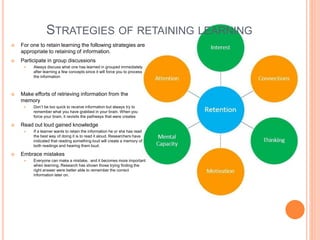
STRATEGIES OF RETAINING LEARNING
 For one to retain learning the following strategies are
appropriate to retaining of information.
 Participate in group discussions
 Always discuss what one has learned in grouped immediately
after learning a few concepts since it will force you to process
the information
 Make efforts of retrieving information from the
memory
 Don’t be too quick to receive information but always try to
remember what you have grabbed in your brain. When you
force your brain, it revisits the pathways that were creates
 Read out loud gained knowledge
 If a learner wants to retain the information he or she has read
the best way of doing it is to read it aloud. Researchers have
indicated that reading something loud will create a memory of
both readings and hearing them loud.
 Embrace mistakes
 Everyone can make a mistake, and it becomes more important
when learning. Research has shown those trying finding the
right answer were better able to remember the correct
information later on.
CONT…
 Revisit
 Always revisit what one has leaned it will ensure that you retain what
has been learned
 Relate new material to what has been learned
 Teach others
 Put it into practice
 Putting what one has learned in practice will cement in one’s
mind since practicing creates a neutral pathway
 Use visual aids
 Engaging more senses will make you recall what you have
learned
 Get a study buddy
 Always don’t find someone to learn with so as you make
learning impactful and fun.
REFERENCES
 Anderson, Scheree, Henke, Jeanette, & McLaughlin, Maureen.
(2000-01). Using Background Music to Enhance Memory and
Improve Learning, MA Research Project, Xavier University,
 Baddeley, Alan. (1982). Your Memory: A User’s Guide, Macmillan
Publishing Co., Inc. Associated Press, “Study Shows Sleep Helps
Memory”, Nov. 21, 2000
 Bennett A.G., Rebello N.S. (2012) Retention and Learning. In:
Seel N.M. (eds) Encyclopedia of the Sciences of Learning.
Springer, Boston, MA
 Bellezza, Francis S. (1982). Improve Your Memory Skills,
Prentice-Hall, Inc.
 Higbee, Kenneth L., Ph.D. (1977). Your Memory/How It Works
and How to Improve It, Prentice-Hall, Inc.
 Gallant, Roy A. (1980). How Memory Works and How to Improve
It, Four Winds Press.
 Yount, Lisa. (1996). Memory, Lucent Overview Series, Lucent
Books, Inc.,

Learning and memory

  • 1.
  • 2.
    INTRODUCTION  learning andmemory are closely related concepts.  Learning involves the acquisition of knowledge while the memory is expressing what has been acquired through learning.  The difference between the two can also be noted.  If one acquires information slowly and laboriously, this can be considered as learning.  On the other hand, if the acquisition occurs instantly this is then considered to be a memory.  While teaching, different student have different levels to which they retain information in their brain.
  • 3.
    TYPES OF MEMORY Memoryis of different types. When stores memory they store information. What makes the memory differ is the how long information is being stored. There are three broad types of memory; they include Long-term Memory, Short-term memory, and sensory memory. The two do weaken when one age due to numerous reason and clinical conditions of the mind.
  • 4.
    SENSORY MEMORY  Thisis considered to be the shortest term of memory. It entails retaining sensory information after original stimuli have ended.  It's buffer that comes to stimuli of the five senses, sight, hearing, smell, taste and touch.  This type of memory is so sorted and degrades very quickly (200 to 500 milliseconds). Sometimes is usually known as Iconic memory
  • 5.
    SHORT TERM MEMORY This is a type of memory that recalls information that has been processed at any given point. It is considered the ability to remember and process information at the same time. Compared to sensory memory this has a capability if lasting for more than 10 to 15 seconds.  An example of STM can be holding given information for one to complete a task. For instance, memorizing someone's phone number for some seconds.  This information can disappear quickly unless some effort is made to retain them.
  • 6.
    LONG TERM MEMORY This is a type of memory that has been mainly used to store information over a long period. Despite the normal impression of human being of forgetting information, LTM is used to store unlimited information over a longer period.  LTM memory is further decided into explicit when one is conscious and implicit where one is unconscious. When conscious it can be declarative memory where one memorizes facts and events. This can be further divided into episodic and semantic memory. Episodic memorizes events and experiences that one goes through whereas sematic memorizes facts and concepts. For the unconscious memory, it is further subdivided into procedurals memory where it memorizes skills and talks.
  • 7.
    KNOWLEDGE RETENTION  Usingmemory, one can use it to capture knowledge that can be used later. Retention can be regarded storage of information in the long- term memory so that it can be easily retrieved. Using retention, it can be used in learning which can be applied in solving a problem or make sense of a situation in a different context
  • 8.
    FACTORS AFFECT MEMORYRETENTION IN THE CLASSROOM  Conscious effort  Accountability  Students should always be accountable for their notebook. They should understand the goals of each lesson  Reception  Students should be attentive and observant of the lessons. It will assist them in retaining information  Alcohol  Students should be encouraged to take alcohol it affects their memory retention
  • 9.
    CONT..  Conscious effort Students should be encouraged to be conscious in class so that they remember what has been; earned. They should do homework every day.  Exercise  Research has shown that student participating in exercises such as aerobics have a high retention power. Therefore exercise can be a factor that may cause retention of information  Routines  Without routines, students will forget what they have learned. They should be encouraged to write down homework 
  • 10.
    COLORS WITHOUT THE USEOF COLOR LEARNING CAN BE BORING
  • 11.
    WAYS OF RETENTIONOF LEARNING  Since people have different capabilities of retention of knowledge one can apply some of the techniques so that they store information for a long time. They include;  Storytelling  Sharing of key knowledge  Pair share- this is a strategy where two learners share something to help them learn new content.  Repetition or practice – in learning it involves repeating acts in a particular task. In learning it involves learning perfectly by repeating them. The greater the number of times one repeat or practice the better one has the ability to retention of information.
  • 12.
    CONT…  Motivation- learningshould be accompanied by a motive or a purpose so that one can be able to retain a particular matter for a long time. Being motivated in a particular area of learning can assist the learner to strengthen weaken process of retention  Provision of feedback- learners, should be provided with the results so that they may correct responses with errors. This may lead to effective learning thus effective retention
  • 13.
    STRATEGIES OF RETAININGLEARNING  For one to retain learning the following strategies are appropriate to retaining of information.  Participate in group discussions  Always discuss what one has learned in grouped immediately after learning a few concepts since it will force you to process the information  Make efforts of retrieving information from the memory  Don’t be too quick to receive information but always try to remember what you have grabbed in your brain. When you force your brain, it revisits the pathways that were creates  Read out loud gained knowledge  If a learner wants to retain the information he or she has read the best way of doing it is to read it aloud. Researchers have indicated that reading something loud will create a memory of both readings and hearing them loud.  Embrace mistakes  Everyone can make a mistake, and it becomes more important when learning. Research has shown those trying finding the right answer were better able to remember the correct information later on.
  • 14.
    CONT…  Revisit  Alwaysrevisit what one has leaned it will ensure that you retain what has been learned  Relate new material to what has been learned  Teach others  Put it into practice  Putting what one has learned in practice will cement in one’s mind since practicing creates a neutral pathway  Use visual aids  Engaging more senses will make you recall what you have learned  Get a study buddy  Always don’t find someone to learn with so as you make learning impactful and fun.
  • 15.
    REFERENCES  Anderson, Scheree,Henke, Jeanette, & McLaughlin, Maureen. (2000-01). Using Background Music to Enhance Memory and Improve Learning, MA Research Project, Xavier University,  Baddeley, Alan. (1982). Your Memory: A User’s Guide, Macmillan Publishing Co., Inc. Associated Press, “Study Shows Sleep Helps Memory”, Nov. 21, 2000  Bennett A.G., Rebello N.S. (2012) Retention and Learning. In: Seel N.M. (eds) Encyclopedia of the Sciences of Learning. Springer, Boston, MA  Bellezza, Francis S. (1982). Improve Your Memory Skills, Prentice-Hall, Inc.  Higbee, Kenneth L., Ph.D. (1977). Your Memory/How It Works and How to Improve It, Prentice-Hall, Inc.  Gallant, Roy A. (1980). How Memory Works and How to Improve It, Four Winds Press.  Yount, Lisa. (1996). Memory, Lucent Overview Series, Lucent Books, Inc.,