Module#7     The Nervous System

Functions:
  Communication
  Coordination
  Control
  Gathering information
Differences between
human and animal NS:
1. Language
2. Judgment
3. Problem solving
4. Creativeness
5. Passing along heritage
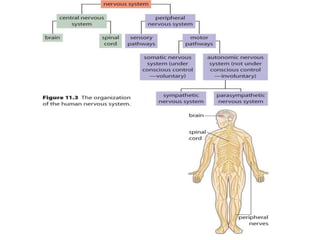
Two Divisions of the NS
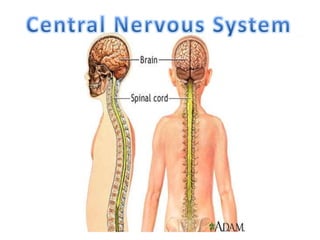
1.Central nervous system (CNS)

• the brain and spinal cord
• is encased in bone (skull and
vertebral column)
Two Divisions of the NS

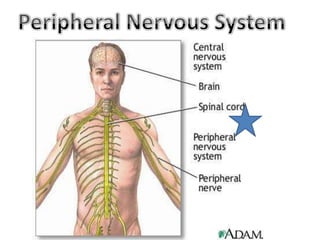
2. Peripheral nervous system
(PNS)
•nerves and ganglia that branch
from the CNS and go to body.
Nerves – bundles of axons and
their sheaths which extend
from the CNS

Ganglia – collections of neuron
cell bodies which are outside
of the CNS
CNS
1. Brain
  •protected by cranium
  •high level thought
  •major organ of the NS
  •Message center
  •Uses info to formulate ideas
  •Makes decisions
  •Communicates with body
CNS
1. Brain


2. Spinal Cord
  Thick bundle nerve fibers
  within spinal cavity
  How brain communicates
  with most of body
  Ends at first lumbar
Peripheral NS
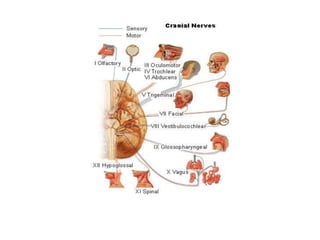
1. Cranial nerves
 Nerves that come from brain
 12 pairs
 Branch from brain stem
 Transmit from/to eyes, ears,
 mouth, face and scalp
Peripheral NS

1.    Cranial nerves


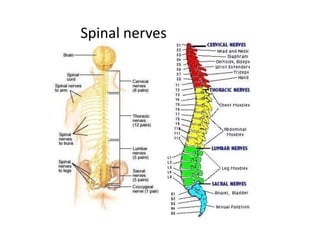
2. Spinal Nerves
     Nerves that come from spinal
     cord
     31 pairs
     Transmit signals to and from
     the rest of the body
Spinal nerves
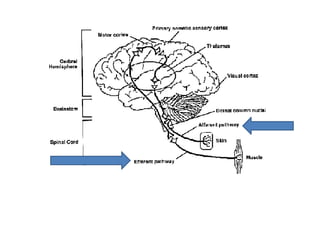
Two divisions of Peripheral NS:
1. Afferent
 sensory pathways - involves the
sensory organs like eyes, ears..
Neurons carry action potential
from sense organs to CNS
Also called sensory division
Two divisions of Peripheral NS:

1. Afferent


2. Efferent
Motor pathways - system that
innervates muscles, effector
organs, and glands.
Also called motor division
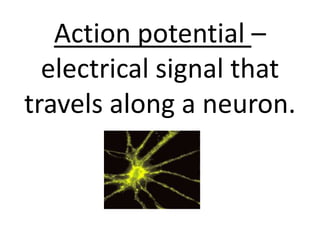
Action potential –
  electrical signal that
travels along a neuron.
Divisions of the Efferent Nervous System:
1. Somatic Motor Nervous
   System (SMNS)
  transmits action potential
 from CNS to skeletal muscles

 conscious, voluntary control
Divisions of the Efferent Nervous System:
1.   Somatic Motor Nervous System (SMNS)


2. Autonomic NS
 carries stimulus from the
CNS to the smooth
muscles, cardiac muscles, and
glands
Involuntary, unconscious
Divisions of the autonomic system:
1.   Sympathetic system

•prepares body for physical activity
•increases heart rate, blood
pressure, blood glucose levels
•Prepares for “flight or fight”
Divisions of the autonomic system:

1.   Sympathetic system


2. Parasympathetic:
Regulates resting and nutritionally
related functions
Includes
digestion, urination, defecation
Slows down heart, etc. after “Fight
or Flight” response
NS at a Cellular level:

2 types of cells:
   1. Neurons = functioning cell
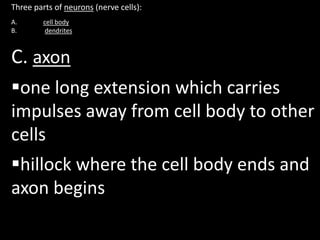
Three parts of neurons (nerve cells):
A. cell body
 contains the nucleus of cell
B. dendrites –
short, branched extensions of cell
body
receive nerve impulses and conduct
them toward the cell body
Three parts of neurons (nerve cells):
A.       cell body
B.        dendrites


C. axon
one long extension which carries
impulses away from cell body to other
cells
hillock where the cell body ends and
axon begins
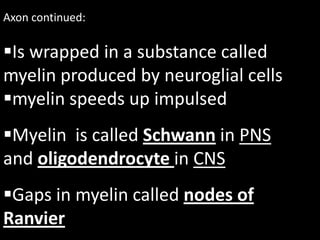
Axon continued:

Is wrapped in a substance called
myelin produced by neuroglial cells
myelin speeds up impulsed
Myelin is called Schwann in PNS
and oligodendrocyte in CNS
Gaps in myelin called nodes of
Ranvier
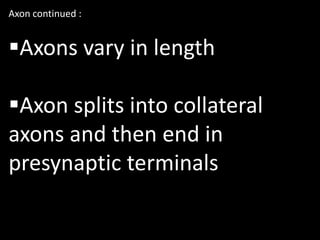
Axon continued :


Axons vary in length

Axon splits into collateral
axons and then end in
presynaptic terminals
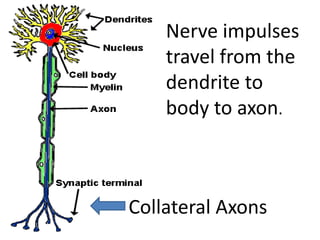
Nerve impulses
    travel from the
    dendrite to
    body to axon.


Collateral Axons
Mature neurons can
not undergo mitosis.

They are parenchyma
permanent cells!!
   TAKE CARE of
      them!!
But, Mrs. Crawford
how can I take care of
them?

Get plenty of
sleep, avoid lots of
TV, avoid
caffeine, alcohol, drug
Well, how many
neurons do I have?

It is believed you have
around 100 billion,
some will die just due
to natural causes
(about 7,000/day)
NS at a Cellular level continued


Can classify neurons based on
 their structure - how many
     processes they have
   (dendrites and axons):
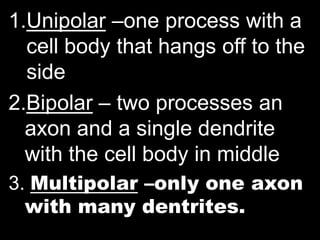
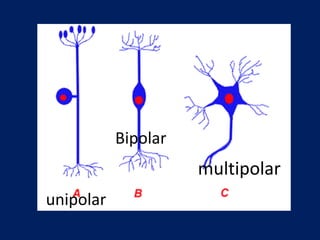
1.Unipolar –one process with a
  cell body that hangs off to the
  side
2.Bipolar – two processes an
  axon and a single dendrite
  with the cell body in middle
3. Multipolar –only one axon
  with many dentrites.
Bipolar
                     multipolar
unipolar
NS at a Cellular level continued


oWhat in the world is a
association neuron Mrs.
Crawford?

A neuron that conducts
 action potentials for
one neuron to another.
    (interneurons)
NS at a Cellular level:
2 types of cells:
        1. Neurons = functioning cell

       2. Neuroglia
Binds, protects and insulates
neurons
Is the majority of cells in
the NS.
They do carry on mitosis!!
Types of Neuroglia :
1.Schwann cells – insulate axons of
  PNS
2. Oligodendrocytes – insulate
axons of CNS
3. Microglia – white blood cells of
brain
Types of Neuroglia :
4. Astrocytes – form blood-brain
barrier regulating what can enter
the brain and what cannot. (Some
toxins pass through such as alcohol
toxins)
Types of Neuroglia :
5. Ependymal cells – two types
    a. non – ciliated – secrete
cerebrospinal fluid
    b. ciliated – move cerebrospinal
fluid around
Wrappings of the Nerve:
Epineurium – wraps the nerve –
white, shiny
Perineurium – wraps the fascicles
Endoneurium – wraps the
Schwann cells of axons
Fascicles are bundles of axons
Nerve anatomy:
Run along with veins and
arteries
Medium sized = shoe string
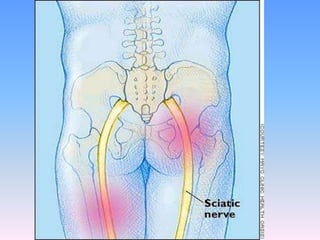
Sciatic nerve –
largest, thickness of index
finger
3 Types of Nerves:
1. Sensory – carries sensory
   messages only (optic
   nerve)
2. Motor – carries messages
   to the muscles (eye
   muscles)
3. Mixed – carries both
Healing in Nervous
System:
•Neurons cannot undergo
mitosis.

•Nerve healing occurs
under certain conditions.
Conditions of nerve
healing:
•Axon is wrapped in Schwann
cells which means only in
PNS

• Axon ends are close and
  pointed in right direction
Conditions of nerve
healing
No healing in CNS, spinal
cord or brain

Can be surgically aided
Why are Schwann cells able
to aide in healing and
oligodendrocytes not?

There are many Schwann
cells per axon in PNS, but
many axons per
oligodendrocyte in the CNS.

A and P 181 191

  • 1.
    Module#7 The Nervous System Functions: Communication Coordination Control Gathering information
  • 2.
    Differences between human andanimal NS: 1. Language 2. Judgment 3. Problem solving 4. Creativeness 5. Passing along heritage
  • 3.
    Two Divisions ofthe NS 1.Central nervous system (CNS) • the brain and spinal cord • is encased in bone (skull and vertebral column)
  • 5.
    Two Divisions ofthe NS 2. Peripheral nervous system (PNS) •nerves and ganglia that branch from the CNS and go to body.
  • 7.
    Nerves – bundlesof axons and their sheaths which extend from the CNS Ganglia – collections of neuron cell bodies which are outside of the CNS
  • 8.
    CNS 1. Brain •protected by cranium •high level thought •major organ of the NS •Message center •Uses info to formulate ideas •Makes decisions •Communicates with body
  • 9.
    CNS 1. Brain 2. SpinalCord Thick bundle nerve fibers within spinal cavity How brain communicates with most of body Ends at first lumbar
  • 10.
    Peripheral NS 1. Cranialnerves Nerves that come from brain 12 pairs Branch from brain stem Transmit from/to eyes, ears, mouth, face and scalp
  • 12.
    Peripheral NS 1. Cranial nerves 2. Spinal Nerves Nerves that come from spinal cord 31 pairs Transmit signals to and from the rest of the body
  • 13.
  • 14.
    Two divisions ofPeripheral NS: 1. Afferent  sensory pathways - involves the sensory organs like eyes, ears.. Neurons carry action potential from sense organs to CNS Also called sensory division
  • 15.
    Two divisions ofPeripheral NS: 1. Afferent 2. Efferent Motor pathways - system that innervates muscles, effector organs, and glands. Also called motor division
  • 17.
    Action potential – electrical signal that travels along a neuron.
  • 18.
    Divisions of theEfferent Nervous System: 1. Somatic Motor Nervous System (SMNS) transmits action potential from CNS to skeletal muscles conscious, voluntary control
  • 19.
    Divisions of theEfferent Nervous System: 1. Somatic Motor Nervous System (SMNS) 2. Autonomic NS  carries stimulus from the CNS to the smooth muscles, cardiac muscles, and glands Involuntary, unconscious
  • 20.
    Divisions of theautonomic system: 1. Sympathetic system •prepares body for physical activity •increases heart rate, blood pressure, blood glucose levels •Prepares for “flight or fight”
  • 21.
    Divisions of theautonomic system: 1. Sympathetic system 2. Parasympathetic: Regulates resting and nutritionally related functions Includes digestion, urination, defecation Slows down heart, etc. after “Fight or Flight” response
  • 23.
    NS at aCellular level: 2 types of cells: 1. Neurons = functioning cell
  • 24.
    Three parts ofneurons (nerve cells): A. cell body  contains the nucleus of cell B. dendrites – short, branched extensions of cell body receive nerve impulses and conduct them toward the cell body
  • 25.
    Three parts ofneurons (nerve cells): A. cell body B. dendrites C. axon one long extension which carries impulses away from cell body to other cells hillock where the cell body ends and axon begins
  • 26.
    Axon continued: Is wrappedin a substance called myelin produced by neuroglial cells myelin speeds up impulsed Myelin is called Schwann in PNS and oligodendrocyte in CNS Gaps in myelin called nodes of Ranvier
  • 27.
    Axon continued : Axonsvary in length Axon splits into collateral axons and then end in presynaptic terminals
  • 28.
    Nerve impulses travel from the dendrite to body to axon. Collateral Axons
  • 29.
    Mature neurons can notundergo mitosis. They are parenchyma permanent cells!! TAKE CARE of them!!
  • 30.
    But, Mrs. Crawford howcan I take care of them? Get plenty of sleep, avoid lots of TV, avoid caffeine, alcohol, drug
  • 31.
    Well, how many neuronsdo I have? It is believed you have around 100 billion, some will die just due to natural causes (about 7,000/day)
  • 32.
    NS at aCellular level continued Can classify neurons based on their structure - how many processes they have (dendrites and axons):
  • 33.
    1.Unipolar –one processwith a cell body that hangs off to the side 2.Bipolar – two processes an axon and a single dendrite with the cell body in middle 3. Multipolar –only one axon with many dentrites.
  • 34.
    Bipolar multipolar unipolar
  • 35.
    NS at aCellular level continued oWhat in the world is a association neuron Mrs. Crawford? A neuron that conducts action potentials for one neuron to another. (interneurons)
  • 36.
    NS at aCellular level: 2 types of cells: 1. Neurons = functioning cell 2. Neuroglia Binds, protects and insulates neurons Is the majority of cells in the NS. They do carry on mitosis!!
  • 37.
    Types of Neuroglia: 1.Schwann cells – insulate axons of PNS 2. Oligodendrocytes – insulate axons of CNS 3. Microglia – white blood cells of brain
  • 38.
    Types of Neuroglia: 4. Astrocytes – form blood-brain barrier regulating what can enter the brain and what cannot. (Some toxins pass through such as alcohol toxins)
  • 39.
    Types of Neuroglia: 5. Ependymal cells – two types a. non – ciliated – secrete cerebrospinal fluid b. ciliated – move cerebrospinal fluid around
  • 40.
    Wrappings of theNerve: Epineurium – wraps the nerve – white, shiny Perineurium – wraps the fascicles Endoneurium – wraps the Schwann cells of axons Fascicles are bundles of axons
  • 42.
    Nerve anatomy: Run alongwith veins and arteries Medium sized = shoe string Sciatic nerve – largest, thickness of index finger
  • 44.
    3 Types ofNerves: 1. Sensory – carries sensory messages only (optic nerve) 2. Motor – carries messages to the muscles (eye muscles) 3. Mixed – carries both
  • 45.
    Healing in Nervous System: •Neuronscannot undergo mitosis. •Nerve healing occurs under certain conditions.
  • 46.
    Conditions of nerve healing: •Axonis wrapped in Schwann cells which means only in PNS • Axon ends are close and pointed in right direction
  • 47.
    Conditions of nerve healing Nohealing in CNS, spinal cord or brain Can be surgically aided
  • 48.
    Why are Schwanncells able to aide in healing and oligodendrocytes not? There are many Schwann cells per axon in PNS, but many axons per oligodendrocyte in the CNS.