An Interactive Lesson
(HUMAN BODY SYSTEM)


    Gloria Ponciano, Ph.D
           Professor
CONTENTS:

A. Interactive Lesson
B. Glossary
C. Pre-Test
D. Post-Test
THE HUMAN BODY
           SYSTEM
SKELETAL SYSTEM      IMMUNE SYSTEM


MUSCULAR SYSTEM ENDOCRINE SYSTEM

RESPIRATORY SYSTEM   NERVOUS SYSTEM


REPRODUCTIVE SYSTEMDIGESTIVE SYSTEM

                 EXCRETORY SYSTEM
CIRCULATORY SYSTEM
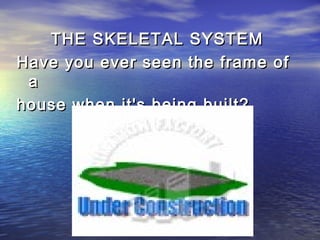
THE SKELETAL SYSTEM
Have you ever seen the frame of
 a
house when it's being built?
A baby have over 300 bones.
By the time you are an
adult, you have 206 bones in your body.
The Skeletal System serves many
  important functions;

a. provides the shape
b. Supports our body
c. Protects the internal organs
d. Allows bodily movement
e. Produces blood for the body
f. Store minerals
Divisions of the
          Skeleton
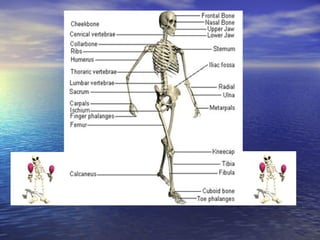
The human skeleton is divided into
two distinct parts:

1. AXIAL SKELETON- It consists of
bones that form the axis of the body
and support and protect the organs of
the head, neck, and trunk.
        The Skull The Sternum
    The RibsThe Vertebral Column
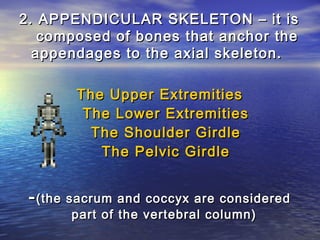
2. APPENDICULAR SKELETON – it is
   composed of bones that anchor the
  appendages to the axial skeleton.

        The Upper Extremities
         The Lower Extremities
          The Shoulder Girdle
           The Pelvic Girdle


 - (the sacrum and coccyx are considered
       part of the vertebral column)
next
       TYPES OF BONES

 1.    LONG BONES
 2.    SHORT BONES
 3.    FLAT BONES
 4.    IRREGULAR BONES
back


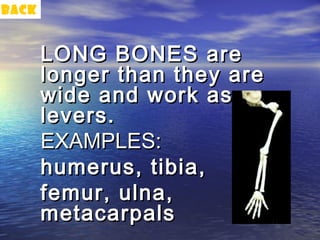
       LONG BONES are
       longer than they are
       wide and work as
       levers.
       EXAMPLES:
       humerus, tibia,
       femur, ulna,
       metacarpals
back


     SHORT BONES
   are short, cube-
   shaped, and found
   in the wrists and
   ankles
back

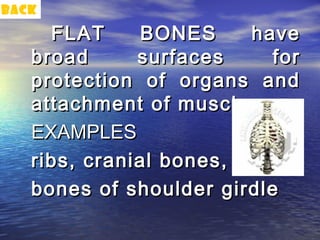
     FLAT     BONES     have
   broad      surfaces     for
   protection of organs and
   attachment of muscles
   EXAMPLES
   ribs, cranial bones,
   bones of shoulder girdle
back

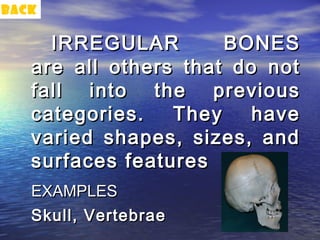
     IRREGULAR        BONES
   are all others that do not
   fall into the previous
   categories.   They    have
   varied shapes, sizes, and
   surfaces features
   EXAMPLES
   Skull, Vertebrae
HOME

Bone Composition

1. COMPACT or DENSE BONE
 - dense, hard, and forms the
 protective exterior portion of all
 bones .
2. SPONGY or CANCELLOUS BONE
 - It is inside the compact bone and
 is very porous (full of tiny holes).
 Spongy bone occurs in most bones.
back


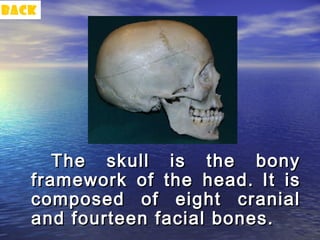
      The skull is the bony
   framework of the head. It is
   composed of eight cranial
   and fourteen facial bones.
back


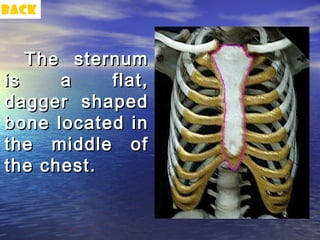
   The sternum
is    a    flat,
dagger shaped
bone located in
the middle of
the chest.
back


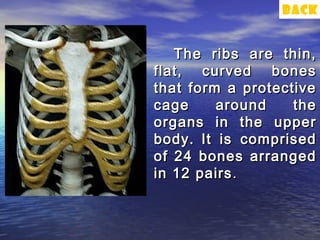
   The ribs are thin,
flat, curved bones
that form a protective
cage     around    the
organs in the upper
body. It is comprised
of 24 bones arranged
in 12 pairs .
back

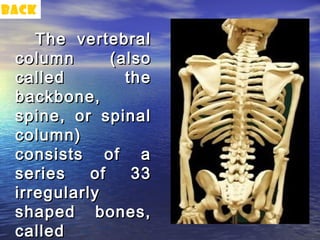
    The vertebral
 column       (also
 called         the
 backbone,
 spine, or spinal
 column)
 consists of a
 series    of    33
 irregularly
 shaped bones,
 called
back


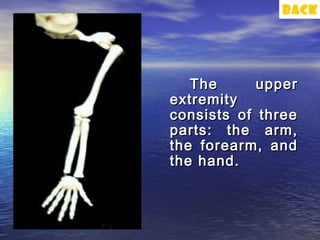
   The      upper
extremity
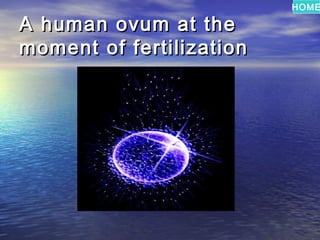
consists of three
parts: the arm,
the forearm, and
the hand.
back


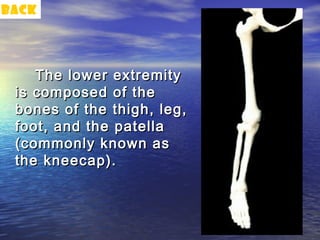
    The lower extremity
 is composed of the
 bones of the thigh, leg,
 foot, and the patella
 (commonly known as
 the kneecap).
back


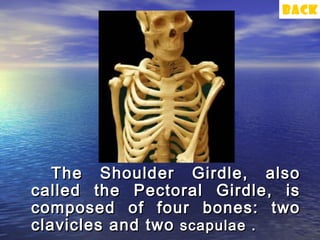
   The Shoulder Girdle, also
called the Pectoral Girdle, is
composed of four bones: two
clavicles and two scapulae .
back


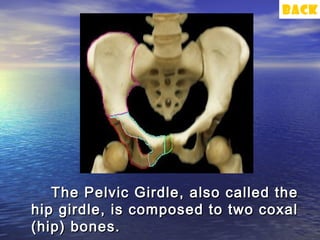
   The Pelvic Girdle, also called the
hip girdle, is composed to two coxal
(hip) bones.
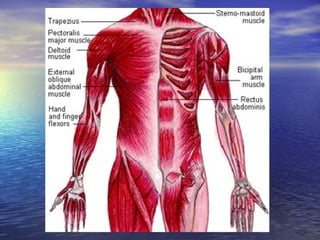
THE MUSCULAR
   SYSTEM
What do muscles do?

• Muscles pull on the joints and bones,
  allowing us to move.
• They help us breathe by working with the
  lungs.
• They help our hearts beat.
• They also help the body perform other
  functions so we can grow and remain
  strong
NEXT
       TYPES OF MUSCLE


  1.   SKELETAL MUSCLE
  2.   SMOOTH MUSCLE
  3.   CARDIAC MUSCLE
back


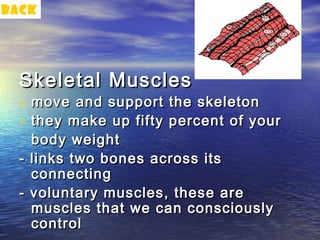
  Skeletal Muscles
  - move and support the skeleton
  - they make up fifty percent of your
    body weight
  - links two bones across its
    connecting
  - voluntary muscles, these are
    muscles that we can consciously
    control
back

   SMOOTH MUSCLES

   - the muscle fibers look
   smooth and not striated
   - involuntary movements
   of the inner organs, e.g.
   the   (peristaltic) bowel
   movement
back
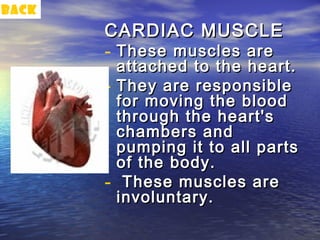
       CARDIAC MUSCLE
       - These muscles are
           attached to the heart.
       -   They are responsible
           for moving the blood
           through the heart's
           chambers and
           pumping it to all parts
           of the body.
       -    These muscles are
           involuntary.
HOME

*     Voluntary muscles are
    muscles that you can move
    whenever you want to.

*     Involuntary     muscles
contract       and      relax
automatically    inside  your
body. We can not control our
involuntary muscles.
The Nervous
  System
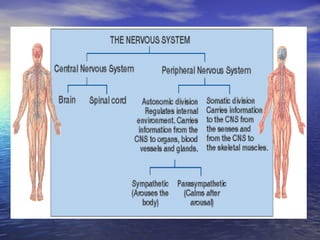
NERVOUS SYSTEM


 Central Nervous System
Peripheral Nervous System
back
   CENTRAL NERVOUS SYSTEM
   (CNS)
   - Its main job is to get the
   information from the body and
   send out instructions.


             BRAIN
          SPINAL CORD
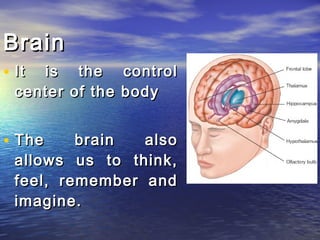
Brain
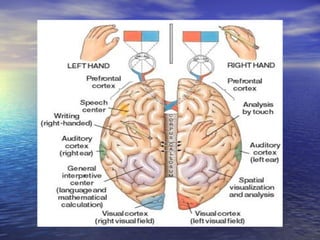
• It is the control
  center of the body


• The     brain  also
  allows us to think,
  feel, remember and
  imagine.
back
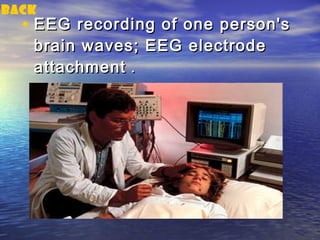
  • EEG recording of one person's
   brain waves; EEG electrode
   attachment .
back
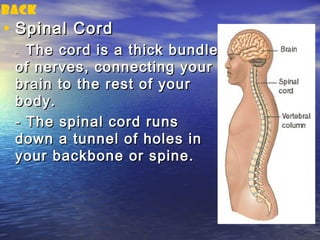
• Spinal Cord
 - The cord is a thick bundle
 of nerves, connecting your
 brain to the rest of your
 body.
 - The spinal cord runs
 down a tunnel of holes in
 your backbone or spine.
The Peripheral Nervous
System
- carries messages to and
  from the central nervous
  system.
- It comprises two parts:
  the somatic and
  the autonomic nervous syste
back
• The Somatic Nervous System

     The somatic nervous system is
  composed of the sensory
  (afferent) neurons that carry
  messages to the central nervous
  system and the motor (efferent)
  neurons that carry messages from
  the central nervous system to the
  skeletal muscles of the body.
back
  Autonomic Nervous System
       The    autonomic  nervous
       system carries messages
       between       the  central
       nervous system and the
       internal organs.
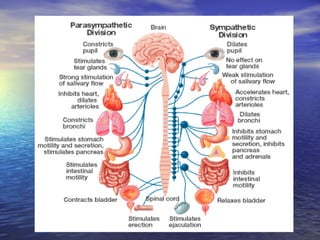
TWO PARTS
1.   sympathetic
2.   parasympathetic


       The first acts primarily to arouse
     the body;
     the second, to relax and restore
     the body to normal levels of
     arousal.
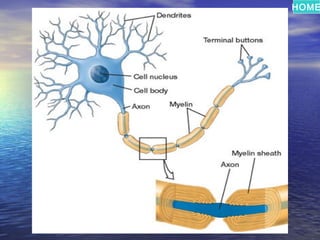
NEURON or NERVE CELL

- The functioning unit of
 the nervous system.
- It carry messages from all
 parts of the body to the
 brain.
HOME
THE HUMAN RESPIRATORY
       SYSTEM
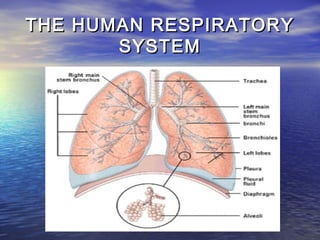
PARTS OF THE HUMAN
  RESPIRATORY SYSTEM
1. NOSTRILS
2. TRACHEA
3.         BRONCHI,
 BRONCHIOLES
4. ALVEOLI
back

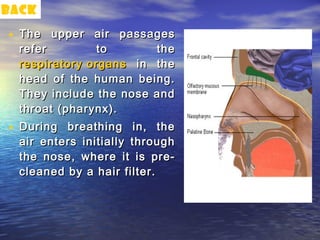
• The upper air passages
  refer         to      the
  respiratory organs in the
  head of the human being.
  They include the nose and
  throat (pharynx).
• During breathing in, the
  air enters initially through
  the nose, where it is pre-
  cleaned by a hair filter.
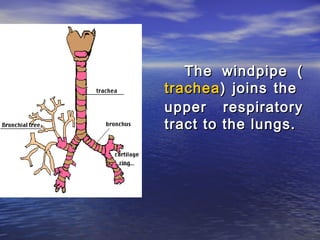
The windpipe (
trachea ) joins the
upper respiratory
tract to the lungs.
back

  • The bottom of the trachea
   splits into two branches
   called bronchi . One enters
   the right lung and one goes
   to the left lung.


  • These divide into twigs
   called bronchioles.
Digestion
   The chemical breakdown of complex biological
   molecules into their component parts.
     Lipids to fatty acids
     Proteins to individual amino acids
     Carbohydrates into simple sugars
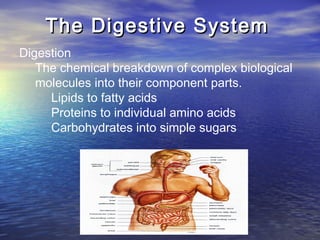
The Digestive System
Digestion
   The chemical breakdown of complex biological
   molecules into their component parts.
     Lipids to fatty acids
     Proteins to individual amino acids
     Carbohydrates into simple sugars
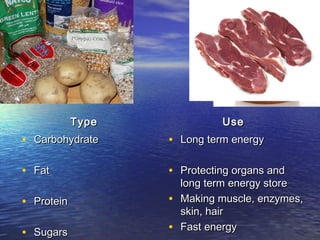
Food


            Type              Use
• Carbohydrate     • Long term energy

• Fat              • Protecting organs and
                       long term energy store
• Protein          •   Making muscle, enzymes,
                       skin, hair

• Sugars           •   Fast energy
• Mechanical digestion           • Chemical digestion
   – Changes the physical form
     of food                        Changes the chemical
      • Chew                          composition of food with
      • Tear                          the aid of digestive
      • Grind                         enzymes
      • Mash                           • Carbohydrate
      • Mix                            • Protein
                                       • Lipid
The Digestive System
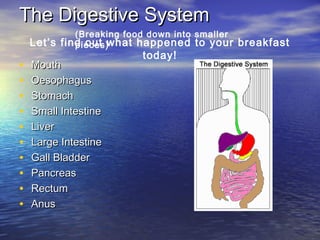
             (Breaking food down into smaller
    Let’s find out what happened to your breakfast
             pieces)
                        today!
•   Mouth
•   Oesophagus
•   Stomach
•   Small Intestine
•   Liver
•   Large Intestine
•   Gall Bladder
•   Pancreas
•   Rectum
•   Anus
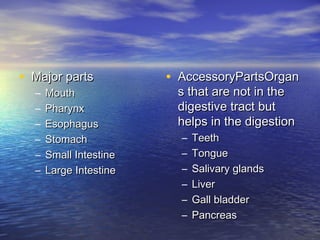
• Major parts           • AccessoryPartsOrgan
  –   Mouth              s that are not in the
  –   Pharynx            digestive tract but
  –   Esophagus          helps in the digestion
  –   Stomach             –   Teeth
  –   Small Intestine     –   Tongue
  –   Large Intestine     –   Salivary glands
                          –   Liver
                          –   Gall bladder
                          –   Pancreas
•   Phases of DigestionIngestion
•   Movement
•   Digestion
•   Absorption
•   Further digestion
Mouth and Teeth

   The mouth and teeth are the first
step in breaking food down. During
the process of chewing, food is
shredded and ground. Powerful
muscles move the mandible , or
lower jaw, while the food is chewed.
The front teeth cut the food and the
back teeth grind the food.
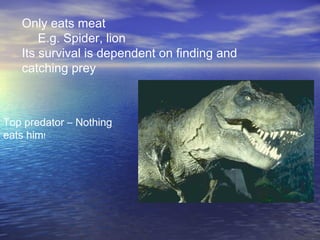
Only eats meat
       E.g. Spider, lion
   Its survival is dependent on finding and
   catching prey


Top predator – Nothing
eats him!
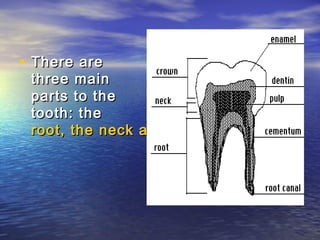
• There are
 three main
 parts to the
 tooth: the
 root, the neck and the crown.
• The root is the part inside
 the jaw.
• The neck is a narrow
 connection between the root
 and the crown.
• The crown of the tooth is
 above the gum.
FOUR TYPES OF TEETH


1.   Incisors
2.   Canines
3.   Premolars
4.   Molars
back

   incisors - are the sharp-
   edged teeth in the front
   of the mouth that bite
   and cut food. We have 8
   of these.
back


   canines - are the
   pointed teeth next to the
   incisors that grip and tear
   food. We have 4 of
   these.
back

   premolars - are the teeth
   just behind the canines. They
   help the canines with chopping
   and assist the molars with
   grinding. There are 8 of these
   in our mouths.
back

   molars - are the teeth in
   the back of the mouth that
   pound, grind and crush food
   into mush so that it can be
   swallowed. We have 12
   molars.
• When food is being chewed,
    saliva is squirted into the
    mouth.
•   Saliva helps to soften the food.
•   It contains an enzyme that
    helps break down the starch in
    the food.
•   The tongue helps push the food
    to the back of the mouth
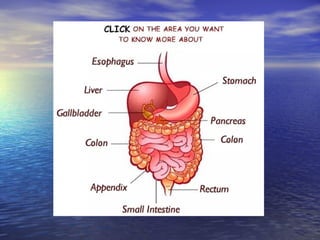
ESOPHAGUS
- it is about ten inches
long.
– the muscles in the
esophagus move the
food down the tube.
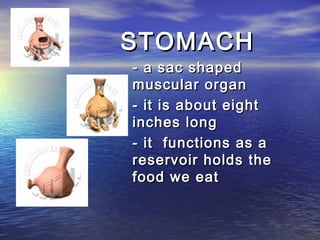
STOMACH
- a sac shaped
muscular organ
- it is about eight
inches long
- it functions as a
reservoir holds the
food we eat
SMALL INTESTINE
  - it is the major site for the digestion
  (breakdown of nutrients from food
  and liquid) and absorption (passage
  into the bloodstream) of nutrients.
  - it is about 10 feet long
           3 parts
1. Duodenum
2. Jejunum
3. Ileum
Duodenum – upper part; about 10 in;
connected to the stomach.
– where the digestive juices from the
pancreas and the liver combine with
chyme making it thin and watery.
Jejunum – about 8 ft
Ileum – about 12 ft
Large Intestine/
 COLON
-Its function is to absorb
water and to solidify the
stool into a formed
bolus which can be
easily passed.
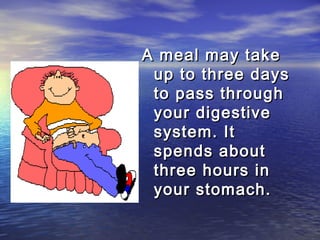
A meal may take
 up to three days
 to pass through
 your digestive
 system. It
 spends about
 three hours in
 your stomach.
APPENDIX
-It is an organ with no
known       function.    It
projects from the rounded
end of the large intestine.
LIVER
 - It is the main warehouse for
 nutrients absorbed from the small
 intestine.
- The liver is a very large organ
 located in the upper right quadrant
 of the abdomen protected by the rib
 cage.
- It also produces bile which is stored
  in the gallbladder.
GALL BLADDER
-   It is a sac which serves
    as a storage reservoir for
    bile .
HOME


PANCREAS
    -   Its main function is to
    secrete digestive enzymes
    into the small intestine in
    order    to   help    digest
    carbohydrates, protein and
    fat.
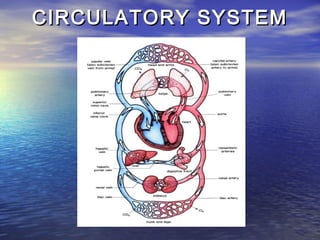
CIRCULATORY SYSTEM
Cardiovascular system
 - it delivers oxygen and
 nutrients throughout the
 body     by   a   complex
 network of vessels
Circulatory pathways
 The blood vessels of the body are
 functionally divided into two
 distinctive circuits:
 1. Pulmonary circuit
 2. Systemic circuit.
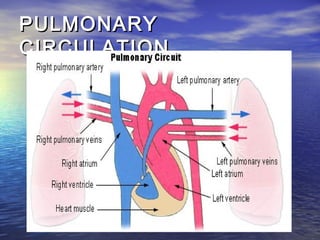
PULMONARY
CIRCULATION
• Pulmonary circuit
 Pulmonary circulation transports
 oxygen-poor blood from the
 right ventricle to the lungs
 where blood picks up a new
 blood supply. Then it returns the
 oxygen-rich blood to the left
 atrium.
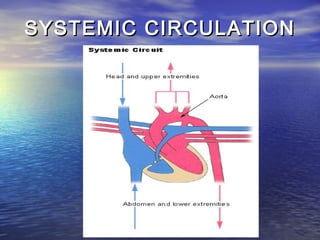
SYSTEMIC CIRCULATION
SYSTEMIC CIRCUIT
• It carries oxygen and nutrients to
  the cells and picks up carbon
  dioxide and waste products.
• Systemic circulation carries
  oxygenated blood from the left
  ventricle, through the arteries, to
  the capillaries in the tissues of the
  body.
• From the tissue capillaries, the
  deoxygenated blood returns through
  a system of veins to the right atrium
  of the heart.
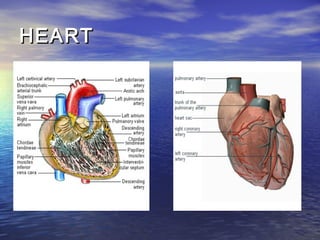
HEART
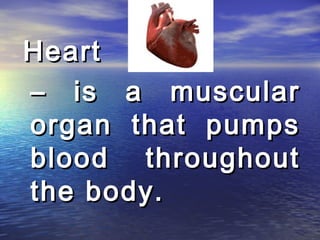
Heart
– is a muscular
organ that pumps
blood throughout
the body.
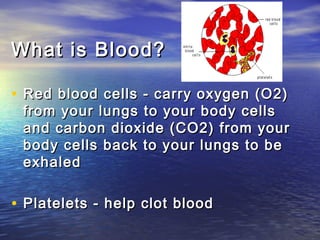
What is Blood?

• Red blood cells - carry oxygen (O2)
 from your lungs to your body cells
 and carbon dioxide (CO2) from your
 body cells back to your lungs to be
 exhaled

• Platelets - help clot blood
• White blood cells - fight
 germs that infect the body


• Plasma - a yellowish
 liquid that consists mostly
 of water
A, B, AB and O blood
types are determined by
the      presence     or
absence     of  antigens
(specific chemicals) on
the red blood cells
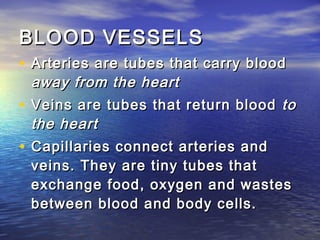
BLOOD VESSELS
• Arteries are tubes that carry blood
  away from the heart
• Veins are tubes that return blood to
  the heart
• Capillaries connect arteries and
  veins. They are tiny tubes that
  exchange food, oxygen and wastes
  between blood and body cells.
HOME


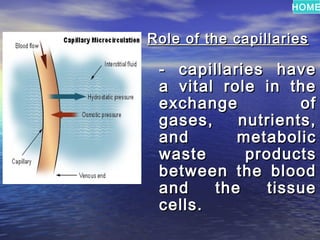
Role of the capillaries

 - capillaries have
 a vital role in the
 exchange          of
 gases,    nutrients,
 and       metabolic
 waste      products
 between the blood
 and    the    tissue
 cells.
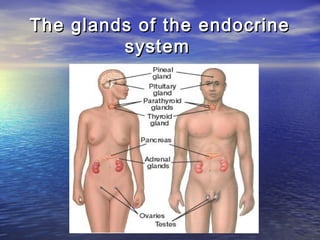
The glands of the endocrine
         system
THE ENDOCRINE SYSTEM


 It produce hormones, chemical
 substances released into the
 bloodstream   to  guide   such
 processes    as    metabolism,
 growth,       and       sexual
 development.
Thyroid gland

  -     secretes    thyroxin,   a
hormone      that   can    reduce
concentration     and   lead   to
irritability
Parathyroid Glands
-    secretes parathormone to
    control and balance the
    levels of calcium and
    phosphate in the blood
    and tissue fluids.
PINEAL GLAND
-A pea-sized gland that
apparently responds to
exposure to light and
regulates activity levels
PANCREAS
- controls    the level of
 sugar in    the blood by
 secreting     insulin and
 glucagon.
PITUITARY GLAND


1. POSTERIOR PITUITARY
  -   It  produces     two hormones:
  vasopressin, which causes blood
  pressure to rise and regulates the
  amount of water in the body's cells,
  and oxytocin, which causes the
  uterus to contract during childbirth
  and lactation to begin.
2 . ANTERIOR PITUITARY
 -  often called the "master
 gland," responds to chemical
 messages from the bloodstream
 to produce numerous hormones
 that trigger the action of other
 endocrine glands .
GONADS
- These are reproductive
glands—the testes in
males and the ovaries
in females.
HOME


ADRENAL GLANDS
-Consists of two parts the
adrenal cortex, and an inner
core, the adrenal medulla.
- Both influence the body's
responses to stress.
EXCRETORY
      SYSTEM

• It removes wastes in the
  body.
• It includes the skin, large
  intestine,    lungs,    and
  kidneys.
SKIN
• to form a protective layer over the
    body to help prevent injury and
    disease
•   to keep moisture in the body (water
    retention)
•   to make vitamin D
•   to regulate body temperature
•   to excrete waste
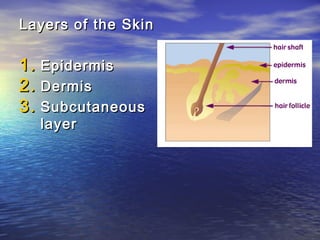
Layers of the Skin

1. Epidermis
2. Dermis
3. Subcutaneous
  layer
back


   EPIDERMIS
   - The thin outer layer of
       the skin which forms its
       epithelium.
back


   DERMIS
       - The thick layer of
       connective tissue which
       contains   hair  follicles,
       hair, nerves (the body's
       sense of touch), sweat
       and oil glands and blood
       vessels.
back


   SUBCUTANEOUS
    LAYER
       - The layer of fatty
       tissue.
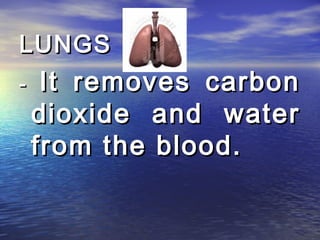
LUNGS
-    It removes carbon
    dioxide and water
    from the blood.
LARGE INTESTINE
- It removes several salts
 from the body.
HOME


LIVER
- It removes urea
produced by the
cells of the liver.
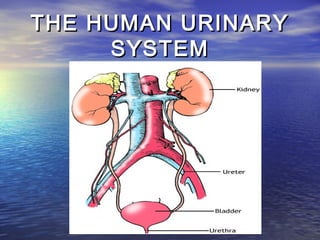
THE HUMAN URINARY
     SYSTEM
URINARY SYSTEM
-   It is a system of simple
    organs, tubes, muscles,
    and nerves that work
    together to create, store,
    and carry urine through
    the urinary system.
HOME


KIDNEYS
- bean shaped organ
- the main organ for
    excretion


NEPHRON
-   The filtering unit of
    kidney
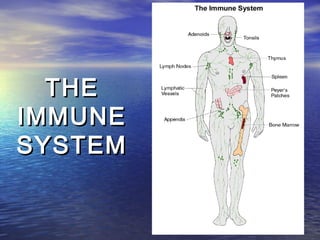
THE
IMMUNE
SYSTEM
IMMUNE SYSTEM
- it is designed to defend
you against millions of
bacteria,         microbes,
viruses,     toxins,   and
parasites. stay there.
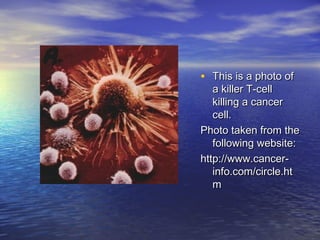
• This is a photo of
   a killer T-cell
   killing a cancer
   cell.
Photo taken from the
   following website:
http://www.cancer-
   info.com/circle.ht
   m
 
HOME


 The immune system is one of
the most important systems in the
human body. The immune system is
also a very easy system to explain
how it works. The immune system
to your body is like batteries to a
walkman. Without batteries, your
walkman will shutdown. The
immune system will do the same
thing to your body.
REPRODUCTIVE
   SYSTEM
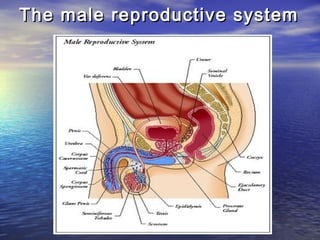
The male reproductive system
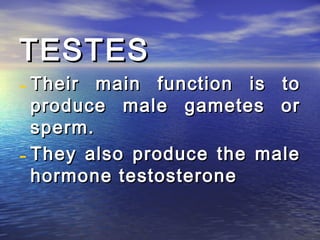
TESTES
- Their main function is to
  produce male gametes or
  sperm.
- They also produce the male
  hormone testosterone
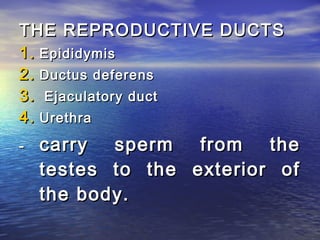
THE REPRODUCTIVE DUCTS
1. Epididymis
2. Ductus deferens
3. Ejaculatory duct
4. Urethra
-   carry  sperm from     the
    testes to the exterior of
    the body.
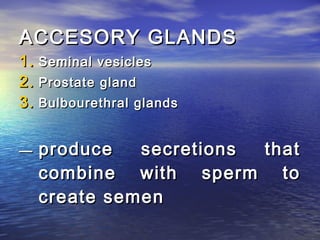
ACCESORY GLANDS
1. Seminal vesicles
2. Prostate gland
3. Bulbourethral glands


—   produce   secretions that
    combine with sperm to
    create semen
EXTERNAL    SEX
 ORGAN


1. Scrotum
2. Penis
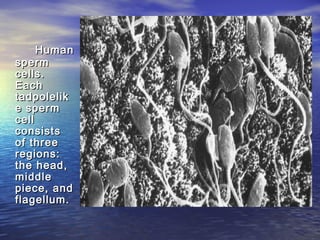
Human
sperm
cells.
Each
tadpolelik
e sperm
cell
consists
of three
regions:
the head,
middle
piece, and
flagellum.
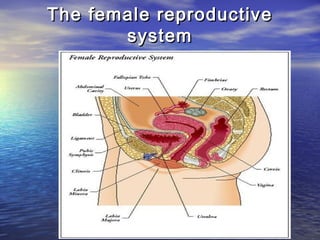
The female reproductive
       system
OVARIES
-     Small flattened,
    elongated  organs
    on both sides of
    uterus.
FALLOPIAN TUBE/
 OVIDUCT
- A pair of duct leading
  from the ovaries to the
  uterus.
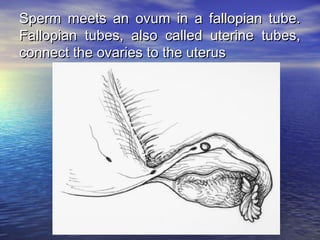
Sperm meets an ovum in a fallopian tube.
Fallopian tubes, also called uterine tubes,
connect the ovaries to the uterus
UTERUS
 - Pear-shaped muscular
  organ.
- It receives and holds the
  fertilized ovum.
CERVIX
-    Neck of the   uterus
    that opens     to the
    vagina.
VAGINA(Birth
 Canal)
-      Passageway       of
    menstrual flow and
    baby to the outside.
HOME

A human ovum at the
moment of fertilization
GLOSSARY

• Acrosome (AK-ro-sohm):
  Tip of the head of a sperm cell that
  contains enzymes to digest the membrane
  of an ovum.
• Amnion (AM-nee-on):
  Fluid-filled sac that surrounds a
  developing embryo/fetus.
• Areola (ah-REE-oh-lah):
  - Circular, darkened area surrounding the
  nipple of each breast.
• Alveolar glands (al-VEE-o-lar
  GLANDZ):
  - Glands within the lobes of mammary
  glands that produce milk.
• Bulbourethral glands (bull-bo-yoo-
  REE-thruhl GLANDZ):
  - Glands located underneath on either
  side of the prostate gland in males that
  secrete fluid that becomes part of semen.
• Cervix (SIR-viks):
    - Lower necklike portion of the uterus
    leading into the vagina.
•   Chromosomes (kro-meh—somes):
    - Threadlike structures found in the
    nucleus of cells that carry the genetic
    material or genes that determine
    heredity.
• Circumcision (sirnkum-SIZH-un):
    - Surgical removal of the prepuce or
    foreskin of the penis.
•   Digestion
    - Process of breaking down food
    particles inside the body
• Ductus deferens (DUK-tus DEF-e-
    renz):
    - Passageway that carries sperm from
    the epididymis to the ejaculatory duct.
•   Ejaculation (ee-jack-you-LAY-
    shun):
    - Sudden ejection of semen from the
    penis.
• Ejaculatory duct (ee-JACK-yoo-la-
 tor-ee DUKT):
 - Duct formed by the union of the
 ductus deferens and the duct of the
 seminal vesicle.
• Epididymis (ep-i-DID-i-mis):
 - Portion of the male reproductive duct
 system in which sperm mature or fully
 develop.
• Estrogens (ES-tro-jenz):
    - Female steroid hormones secreted by the
    ovaries that bring about the secondary sex
    characteristics and regulate the female
    reproductive cycle.
•   Excretion
    - Process of removing waste in the body
•   Fallopian tube (fah-LOH-pee-an TOOB):
    - Tube connecting an ovary to the uterus and
    through which an ovum is transported.
• Gamete (GAM-eat):
    - Female or male reproductive or sex
    cell (egg or sperm).
•   Genitalia (jen-i-TAY-lee-ah):
    - External organs of the reproductive
    system.
•   Gonad (GO-nad):
    - Sex organ in which reproductive
    cells develop.
• Hormones
  - Chemical substances released by glands
  that are responsible for changes in the
  body.
• Mammary glands (MAM-uh-ree
  GLANDZ):
  - Milk-producing glands in female breasts.
• Menarche (meh-NAR-key):
  - Beginning of menstruation or the first
  menstrual period.
• Menopause (MEN-ah-paws):
  - Period in a woman's life when menstrual
  activity ceases.
• Menstruation (men-stroo-A-shun):
  - Also known as menses, periodic
  (monthly) discharge of blood, secretions,
  tissue, and mucus from the female uterus
  in the absence of pregnancy.
• Oocyte (OH-oh-site):
  - Immature or developing egg cell.
• Ova (O-va):
  - Female gametes or eggs (singular:
  ovum).
• Ovarian follicles (o-VAR-ee-an FOL-i-
  kulz):
  - Structures within an ovary consisting of a
  developing egg surrounded by follicle
  cells.
• Ovaries (O-var-eez):
  - Female gonads in which ova
  (eggs) are produced and that
  secrete         estrogens      and
  progesterone.
• Ovulation (ov-yoo-LAY-shun):
  - Release of a mature ovum from an
  ovary.
• Oxytocin (ahk-si-TOE-sin):
  -   Hormone     produced   by   the
  hypothalamus and stored in the
  posterior pituitary that stimulates
  contraction of the uterus during
  childbirth and secretion of milk
  during nursing.
• Penis (PEE-nis):
    - Male organ of reproduction
    and urination.
•   Placenta (plah-SEN-tah):
    -   Temporary     organ   that
    provides nutrients and oxygen
    to a developing fetus, carries
    away wastes, and produces
    hormones such as estrogens
    and progesterone
• Prepuce (PREE-pyus):
    - Also called foreskin, the fold of skin
    over the glans or tip of the penis.
•   Progesterone (pro-JESS-te-rone):
    - Female steroid hormone secreted
    by the ovaries that makes the uterus
    more ready to receive a fertilized
    ovum or egg.
• Prolactin (pro-LAK-tin):
  - Gonadotropic hormone secreted by the
  anterior pituitary that stimulates the
  mammary glands to produce milk.
• Prostate gland (PRAHS-tate GLAND):
  - Muscular gland in males that surrounds
  the first inch of the urethra and secretes a
  fluid that becomes part of semen.
• Scrotum (SKROW-tum):
  - External sac enclosing the testes
• Semen (SEE-men):
    - Thick, whitish, somewhat sticky fluid composed
    of sperm and glandular secretions that is
    propelled out of a male's reproductive tract
    during ejaculation.
•   Seminal vesicles (SEM-i-nuhl VESS-i-kulls):
    - Glands in males located at the base of the
    bladder that secrete fluid that becomes part of
    semen.
•   Seminiferous        tubules    (sem-i-NIFF-er-us
    TOO-byoolz):
    - Tightly coiled tubes within the testes that
    produce sperm.
• Sperm:
  - Mature male sex or reproductive cell.
• Testes (TESS-teez):
  - Male gonads that produce sperm cells
  and secrete testosterone.
• Testosterone (tess-TAHS-ter-ohn):
  - Hormone secreted by the testes that
  spurs the growth of the male reproductive
  organs and secondary sex characteristics.
• Umbilical cord (um-BILL-i-kull
    KORD):
    - Structure that connects the
    embryo/fetus to the placenta.
•   Uterus (YOU-ter-us):
    - Also known as the womb, the
    hollow organ in females that
    receives, retains, and nourishes
    a fertilized ovum or egg.
HOME

• Vagina (vuh-JIGH-nah):
  - Muscular tube in women that extends
  from the cervix of the uterus to the vaginal
  opening.
• Vulva (VUL-vah):
  - Female external genital organs.
• Zygote (ZIE-goat):
  - Fertilized ovum
HOME


       END

Thank you very much!
PRE – TEST
1. What sets up the acidic condition
  in the stomach that is necessary
  for digestion?
  a. bile
  b. hydrochloric acid
  c. chyme
  d. acetic acid
2. What attaches a muscle to a bone?
  a. ligament           c. cartilage
  b. tendon             d. myoglobin

3. Which bone protect the lungs and the
  heart?
  a. rib cage            c. backbone
  b. skull               d. pelvic bone
4. Female sex cell
  a. egg                 c. sperm
  b. testes              d. ovary

5. It is where gas exchange occurs.
  a. lungs               c. nostrils
  b. alveoli             d. trachea
6. Waste materials formed in the liver.
  a. sweat              c. feces
  b. urea               d. liver

7. What makes the blood red?
  a. platelets          c. cholesterol
  b. blood              d. mineral
8. What is
the largest artery in the circulatory system?
                                   a. aorta c.
heart
                                   b. vena
cava d. pulmonary artery

                               9. Which
part of the nervous system is found in all
parts of the body?
                                a. spinal
cord c. nerves
                                b. cerebrum
 d. cerebellum
10. Which body structure links the brain with the
  rest of the body?
  a. backbone                c. meninges
  b. blood vessels           d. motor nerves

11. What important work is carried by the nerves?
  a. to carry blood
  b. to protect the brain
  c. to carry messages
  d. to protect the spinal cord
12. Which hormone affects the growth and
  development of a female adolescent?
  a. egg cell       c. progesterone
  b. sperm cell     d. estrogen

13. What kind of development takes place in
  adolescents?
  a. physical            c. emotional
  b. intellectual d. all of the above
14. Which organ is responsible for the
  exchange of gases?
  a. ovary              c. lungs
  b. artery             d. all of the above

15. Which is the main cause of emphysema
  or collapse of lungs?
  a. smoking             c. liquor
  b. air pollution       d. all of them
16. Which is considered to be the master
  gland?
  a. Adrenal gland       c. Thyroid gland
  b. Pituitary gland     d. Sex glands

17. Which is controlled by the autonomic
  nervous system?
  a. chewing              c. heartbeat
  b. walking              d. none
18. Which serves as the highways in the
  body?
  a. Arteries            c. Capillaries
  b. Veins               d. All of these

19. What does the thoracic basket protect?
  a. lungs              c. liver
  b. heart              d. all
HOME

20. Which is the skeletal muscle?
     a. arm muscle
     b. eye muscle
     c. heart muscle
     d. all of these
POST – TEST
1. What nutrients are needed to make the
   bone healthy?
     a. Vitamins C and D
     b. Phosphorus
     c. Calcium
     d. All
2. What is the main function of the muscle?
    a. protection         c. contraction
    b. attachment         d. locomotion

3. Muscles that move automatically are __.
     a. skeletal muscle c. cardiac muscle
     b. smooth muscle d. b and c
4. Which attaches the muscles to       the
  bones?
  a. tendon          c. cartilage
  b. joint           d. a and c

5. What nutrients do we get from vegetables
  and fruits?
  a. minerals            c. protein
  b. vitamins            d. all
5. Which help make digestion faster?
     a. enzymes         c. hydrochloric
  acid
     b. gastric juices  d. all

6. What process breaks down food into
  simple form?
     a. digestion       c. absorption
     b. small intestine d. defecation
8. Which is affected when the heart pumps?
    a. Blood pressure c. Pulse
    b. Heartbeat         d. All

9. Which does not flow in the blood vessels?
    a. Interstitial fluid c. RBC
    b. Blood plasma       d. WBC
10. The biggest part of the brain__.
     a. cerebrum          c. cerebellum
     b. brain stem        d. none of these

11. Which is considered to be the master
  gland?
  a. Adrenal gland       c. Thyroid gland
  b. Pituitary gland     d. Sex glands
12. Which process is responsible for
  producing new life?
     a. respiration      c. reproduction
     b. excretion        d. none

13. A muscular organ which serves as a
  cradle where the fetus develops.
     a. uterus            c. cervix
     b. fallopian tube    d. ovaries
14. Where does fertilization of egg occurs?
     a. Uterus            c. cervix
     b. fallopian tube    d. ovaries

15. What is contained in the urine?
     a. excess water      c. uric acid
     b. salt              d. all of these
16. Which monitors the quality of blood in
  the body?
     a. heart           c. lungs
     b. Kidney          d. blood vessels

17. Which serves as the highways in the
  body?
  a. Arteries            c. Capillaries
  b. Veins               d. All of these
18. Which organ is responsible for the
  exchange of gases?
  a. ovary              c. lungs
  b. artery             d. all of the above

19. What nutrients do we get           from
  vegetables and fruits?
  a. minerals            c. protein
  b. vitamins            d. all
HOME


20. Which is controlled by the autonomic
  nervous system?
  a. chewing              c. heartbeat
  b. walking              d. none

The human body system

  • 1.
    An Interactive Lesson (HUMANBODY SYSTEM) Gloria Ponciano, Ph.D Professor
  • 2.
    CONTENTS: A. Interactive Lesson B.Glossary C. Pre-Test D. Post-Test
  • 3.
    THE HUMAN BODY SYSTEM SKELETAL SYSTEM IMMUNE SYSTEM MUSCULAR SYSTEM ENDOCRINE SYSTEM RESPIRATORY SYSTEM NERVOUS SYSTEM REPRODUCTIVE SYSTEMDIGESTIVE SYSTEM EXCRETORY SYSTEM CIRCULATORY SYSTEM
  • 4.
    THE SKELETAL SYSTEM Haveyou ever seen the frame of a house when it's being built?
  • 5.
    A baby haveover 300 bones. By the time you are an adult, you have 206 bones in your body.
  • 6.
    The Skeletal Systemserves many important functions; a. provides the shape b. Supports our body c. Protects the internal organs d. Allows bodily movement e. Produces blood for the body f. Store minerals
  • 8.
    Divisions of the Skeleton The human skeleton is divided into two distinct parts: 1. AXIAL SKELETON- It consists of bones that form the axis of the body and support and protect the organs of the head, neck, and trunk. The Skull The Sternum The RibsThe Vertebral Column
  • 9.
    2. APPENDICULAR SKELETON– it is composed of bones that anchor the appendages to the axial skeleton. The Upper Extremities The Lower Extremities The Shoulder Girdle The Pelvic Girdle - (the sacrum and coccyx are considered part of the vertebral column)
  • 10.
    next TYPES OF BONES 1. LONG BONES 2. SHORT BONES 3. FLAT BONES 4. IRREGULAR BONES
  • 11.
    back LONG BONES are longer than they are wide and work as levers. EXAMPLES: humerus, tibia, femur, ulna, metacarpals
  • 12.
    back SHORT BONES are short, cube- shaped, and found in the wrists and ankles
  • 13.
    back FLAT BONES have broad surfaces for protection of organs and attachment of muscles EXAMPLES ribs, cranial bones, bones of shoulder girdle
  • 14.
    back IRREGULAR BONES are all others that do not fall into the previous categories. They have varied shapes, sizes, and surfaces features EXAMPLES Skull, Vertebrae
  • 15.
    HOME Bone Composition 1. COMPACTor DENSE BONE - dense, hard, and forms the protective exterior portion of all bones . 2. SPONGY or CANCELLOUS BONE - It is inside the compact bone and is very porous (full of tiny holes). Spongy bone occurs in most bones.
  • 16.
    back The skull is the bony framework of the head. It is composed of eight cranial and fourteen facial bones.
  • 17.
    back The sternum is a flat, dagger shaped bone located in the middle of the chest.
  • 18.
    back The ribs are thin, flat, curved bones that form a protective cage around the organs in the upper body. It is comprised of 24 bones arranged in 12 pairs .
  • 19.
    back The vertebral column (also called the backbone, spine, or spinal column) consists of a series of 33 irregularly shaped bones, called
  • 20.
    back The upper extremity consists of three parts: the arm, the forearm, and the hand.
  • 21.
    back The lower extremity is composed of the bones of the thigh, leg, foot, and the patella (commonly known as the kneecap).
  • 22.
    back The Shoulder Girdle, also called the Pectoral Girdle, is composed of four bones: two clavicles and two scapulae .
  • 23.
    back The Pelvic Girdle, also called the hip girdle, is composed to two coxal (hip) bones.
  • 24.
  • 26.
    What do musclesdo? • Muscles pull on the joints and bones, allowing us to move. • They help us breathe by working with the lungs. • They help our hearts beat. • They also help the body perform other functions so we can grow and remain strong
  • 27.
    NEXT TYPES OF MUSCLE 1. SKELETAL MUSCLE 2. SMOOTH MUSCLE 3. CARDIAC MUSCLE
  • 28.
    back SkeletalMuscles - move and support the skeleton - they make up fifty percent of your body weight - links two bones across its connecting - voluntary muscles, these are muscles that we can consciously control
  • 29.
    back SMOOTH MUSCLES - the muscle fibers look smooth and not striated - involuntary movements of the inner organs, e.g. the (peristaltic) bowel movement
  • 30.
    back CARDIAC MUSCLE - These muscles are attached to the heart. - They are responsible for moving the blood through the heart's chambers and pumping it to all parts of the body. - These muscles are involuntary.
  • 31.
    HOME * Voluntary muscles are muscles that you can move whenever you want to. * Involuntary muscles contract and relax automatically inside your body. We can not control our involuntary muscles.
  • 32.
  • 34.
    NERVOUS SYSTEM CentralNervous System Peripheral Nervous System
  • 35.
    back CENTRAL NERVOUS SYSTEM (CNS) - Its main job is to get the information from the body and send out instructions. BRAIN SPINAL CORD
  • 36.
    Brain • It isthe control center of the body • The brain also allows us to think, feel, remember and imagine.
  • 38.
    back •EEG recording of one person's brain waves; EEG electrode attachment .
  • 39.
    back • Spinal Cord - The cord is a thick bundle of nerves, connecting your brain to the rest of your body. - The spinal cord runs down a tunnel of holes in your backbone or spine.
  • 40.
    The Peripheral Nervous System -carries messages to and from the central nervous system. - It comprises two parts: the somatic and the autonomic nervous syste
  • 41.
    back • The SomaticNervous System The somatic nervous system is composed of the sensory (afferent) neurons that carry messages to the central nervous system and the motor (efferent) neurons that carry messages from the central nervous system to the skeletal muscles of the body.
  • 42.
    back AutonomicNervous System The autonomic nervous system carries messages between the central nervous system and the internal organs.
  • 43.
    TWO PARTS 1. sympathetic 2. parasympathetic The first acts primarily to arouse the body; the second, to relax and restore the body to normal levels of arousal.
  • 45.
    NEURON or NERVECELL - The functioning unit of the nervous system. - It carry messages from all parts of the body to the brain.
  • 46.
  • 47.
  • 48.
    PARTS OF THEHUMAN RESPIRATORY SYSTEM 1. NOSTRILS 2. TRACHEA 3. BRONCHI, BRONCHIOLES 4. ALVEOLI
  • 49.
    back • The upperair passages refer to the respiratory organs in the head of the human being. They include the nose and throat (pharynx). • During breathing in, the air enters initially through the nose, where it is pre- cleaned by a hair filter.
  • 50.
    The windpipe ( trachea) joins the upper respiratory tract to the lungs.
  • 51.
    back •The bottom of the trachea splits into two branches called bronchi . One enters the right lung and one goes to the left lung. • These divide into twigs called bronchioles.
  • 52.
    Digestion The chemical breakdown of complex biological molecules into their component parts. Lipids to fatty acids Proteins to individual amino acids Carbohydrates into simple sugars
  • 53.
    The Digestive System Digestion The chemical breakdown of complex biological molecules into their component parts. Lipids to fatty acids Proteins to individual amino acids Carbohydrates into simple sugars
  • 54.
    Food Type Use • Carbohydrate • Long term energy • Fat • Protecting organs and long term energy store • Protein • Making muscle, enzymes, skin, hair • Sugars • Fast energy
  • 55.
    • Mechanical digestion • Chemical digestion – Changes the physical form of food Changes the chemical • Chew composition of food with • Tear the aid of digestive • Grind enzymes • Mash • Carbohydrate • Mix • Protein • Lipid
  • 56.
    The Digestive System (Breaking food down into smaller Let’s find out what happened to your breakfast pieces) today! • Mouth • Oesophagus • Stomach • Small Intestine • Liver • Large Intestine • Gall Bladder • Pancreas • Rectum • Anus
  • 57.
    • Major parts • AccessoryPartsOrgan – Mouth s that are not in the – Pharynx digestive tract but – Esophagus helps in the digestion – Stomach – Teeth – Small Intestine – Tongue – Large Intestine – Salivary glands – Liver – Gall bladder – Pancreas
  • 58.
    Phases of DigestionIngestion • Movement • Digestion • Absorption • Further digestion
  • 60.
    Mouth and Teeth The mouth and teeth are the first step in breaking food down. During the process of chewing, food is shredded and ground. Powerful muscles move the mandible , or lower jaw, while the food is chewed. The front teeth cut the food and the back teeth grind the food.
  • 61.
    Only eats meat E.g. Spider, lion Its survival is dependent on finding and catching prey Top predator – Nothing eats him!
  • 62.
    • There are three main parts to the tooth: the root, the neck and the crown.
  • 63.
    • The rootis the part inside the jaw. • The neck is a narrow connection between the root and the crown. • The crown of the tooth is above the gum.
  • 64.
    FOUR TYPES OFTEETH 1. Incisors 2. Canines 3. Premolars 4. Molars
  • 65.
    back incisors - are the sharp- edged teeth in the front of the mouth that bite and cut food. We have 8 of these.
  • 66.
    back canines - are the pointed teeth next to the incisors that grip and tear food. We have 4 of these.
  • 67.
    back premolars - are the teeth just behind the canines. They help the canines with chopping and assist the molars with grinding. There are 8 of these in our mouths.
  • 68.
    back molars - are the teeth in the back of the mouth that pound, grind and crush food into mush so that it can be swallowed. We have 12 molars.
  • 69.
    • When foodis being chewed, saliva is squirted into the mouth. • Saliva helps to soften the food. • It contains an enzyme that helps break down the starch in the food. • The tongue helps push the food to the back of the mouth
  • 70.
    ESOPHAGUS - it isabout ten inches long. – the muscles in the esophagus move the food down the tube.
  • 71.
    STOMACH - a sacshaped muscular organ - it is about eight inches long - it functions as a reservoir holds the food we eat
  • 72.
    SMALL INTESTINE - it is the major site for the digestion (breakdown of nutrients from food and liquid) and absorption (passage into the bloodstream) of nutrients. - it is about 10 feet long 3 parts 1. Duodenum 2. Jejunum 3. Ileum
  • 73.
    Duodenum – upperpart; about 10 in; connected to the stomach. – where the digestive juices from the pancreas and the liver combine with chyme making it thin and watery. Jejunum – about 8 ft Ileum – about 12 ft
  • 74.
    Large Intestine/ COLON -Itsfunction is to absorb water and to solidify the stool into a formed bolus which can be easily passed.
  • 75.
    A meal maytake up to three days to pass through your digestive system. It spends about three hours in your stomach.
  • 76.
    APPENDIX -It is anorgan with no known function. It projects from the rounded end of the large intestine.
  • 77.
    LIVER - Itis the main warehouse for nutrients absorbed from the small intestine. - The liver is a very large organ located in the upper right quadrant of the abdomen protected by the rib cage. - It also produces bile which is stored in the gallbladder.
  • 78.
    GALL BLADDER - It is a sac which serves as a storage reservoir for bile .
  • 79.
    HOME PANCREAS   - Its main function is to secrete digestive enzymes into the small intestine in order to help digest carbohydrates, protein and fat.
  • 80.
  • 81.
    Cardiovascular system -it delivers oxygen and nutrients throughout the body by a complex network of vessels
  • 82.
    Circulatory pathways Theblood vessels of the body are functionally divided into two distinctive circuits: 1. Pulmonary circuit 2. Systemic circuit.
  • 83.
  • 84.
    • Pulmonary circuit Pulmonary circulation transports oxygen-poor blood from the right ventricle to the lungs where blood picks up a new blood supply. Then it returns the oxygen-rich blood to the left atrium.
  • 85.
  • 86.
    SYSTEMIC CIRCUIT • Itcarries oxygen and nutrients to the cells and picks up carbon dioxide and waste products. • Systemic circulation carries oxygenated blood from the left ventricle, through the arteries, to the capillaries in the tissues of the body. • From the tissue capillaries, the deoxygenated blood returns through a system of veins to the right atrium of the heart.
  • 87.
  • 88.
    Heart – is amuscular organ that pumps blood throughout the body.
  • 89.
    What is Blood? •Red blood cells - carry oxygen (O2) from your lungs to your body cells and carbon dioxide (CO2) from your body cells back to your lungs to be exhaled • Platelets - help clot blood
  • 90.
    • White bloodcells - fight germs that infect the body • Plasma - a yellowish liquid that consists mostly of water
  • 91.
    A, B, ABand O blood types are determined by the presence or absence of antigens (specific chemicals) on the red blood cells
  • 92.
    BLOOD VESSELS • Arteriesare tubes that carry blood away from the heart • Veins are tubes that return blood to the heart • Capillaries connect arteries and veins. They are tiny tubes that exchange food, oxygen and wastes between blood and body cells.
  • 93.
    HOME Role of thecapillaries - capillaries have a vital role in the exchange of gases, nutrients, and metabolic waste products between the blood and the tissue cells.
  • 95.
    The glands ofthe endocrine system
  • 96.
    THE ENDOCRINE SYSTEM It produce hormones, chemical substances released into the bloodstream to guide such processes as metabolism, growth, and sexual development.
  • 97.
    Thyroid gland - secretes thyroxin, a hormone that can reduce concentration and lead to irritability
  • 98.
    Parathyroid Glands - secretes parathormone to control and balance the levels of calcium and phosphate in the blood and tissue fluids.
  • 99.
    PINEAL GLAND -A pea-sizedgland that apparently responds to exposure to light and regulates activity levels
  • 100.
    PANCREAS - controls the level of sugar in the blood by secreting insulin and glucagon.
  • 101.
    PITUITARY GLAND 1. POSTERIORPITUITARY - It produces two hormones: vasopressin, which causes blood pressure to rise and regulates the amount of water in the body's cells, and oxytocin, which causes the uterus to contract during childbirth and lactation to begin.
  • 102.
    2 . ANTERIORPITUITARY - often called the "master gland," responds to chemical messages from the bloodstream to produce numerous hormones that trigger the action of other endocrine glands .
  • 103.
    GONADS - These arereproductive glands—the testes in males and the ovaries in females.
  • 104.
    HOME ADRENAL GLANDS -Consists oftwo parts the adrenal cortex, and an inner core, the adrenal medulla. - Both influence the body's responses to stress.
  • 105.
    EXCRETORY SYSTEM • It removes wastes in the body. • It includes the skin, large intestine, lungs, and kidneys.
  • 106.
    SKIN • to forma protective layer over the body to help prevent injury and disease • to keep moisture in the body (water retention) • to make vitamin D • to regulate body temperature • to excrete waste
  • 107.
    Layers of theSkin 1. Epidermis 2. Dermis 3. Subcutaneous layer
  • 108.
    back EPIDERMIS - The thin outer layer of the skin which forms its epithelium.
  • 109.
    back DERMIS - The thick layer of connective tissue which contains hair follicles, hair, nerves (the body's sense of touch), sweat and oil glands and blood vessels.
  • 110.
    back SUBCUTANEOUS LAYER - The layer of fatty tissue.
  • 111.
    LUNGS - It removes carbon dioxide and water from the blood.
  • 112.
    LARGE INTESTINE - Itremoves several salts from the body.
  • 113.
    HOME LIVER - It removesurea produced by the cells of the liver.
  • 114.
  • 115.
    URINARY SYSTEM - It is a system of simple organs, tubes, muscles, and nerves that work together to create, store, and carry urine through the urinary system.
  • 116.
    HOME KIDNEYS - bean shapedorgan - the main organ for excretion NEPHRON - The filtering unit of kidney
  • 117.
  • 118.
    IMMUNE SYSTEM - itis designed to defend you against millions of bacteria, microbes, viruses, toxins, and parasites. stay there.
  • 119.
    • This isa photo of a killer T-cell killing a cancer cell. Photo taken from the following website: http://www.cancer- info.com/circle.ht m  
  • 120.
    HOME The immunesystem is one of the most important systems in the human body. The immune system is also a very easy system to explain how it works. The immune system to your body is like batteries to a walkman. Without batteries, your walkman will shutdown. The immune system will do the same thing to your body.
  • 121.
  • 122.
  • 123.
    TESTES - Their mainfunction is to produce male gametes or sperm. - They also produce the male hormone testosterone
  • 124.
    THE REPRODUCTIVE DUCTS 1.Epididymis 2. Ductus deferens 3. Ejaculatory duct 4. Urethra - carry sperm from the testes to the exterior of the body.
  • 125.
    ACCESORY GLANDS 1. Seminalvesicles 2. Prostate gland 3. Bulbourethral glands — produce secretions that combine with sperm to create semen
  • 126.
    EXTERNAL SEX ORGAN 1. Scrotum 2. Penis
  • 127.
  • 128.
  • 129.
    OVARIES - Small flattened, elongated organs on both sides of uterus.
  • 130.
    FALLOPIAN TUBE/ OVIDUCT -A pair of duct leading from the ovaries to the uterus.
  • 131.
    Sperm meets anovum in a fallopian tube. Fallopian tubes, also called uterine tubes, connect the ovaries to the uterus
  • 132.
    UTERUS - Pear-shapedmuscular organ. - It receives and holds the fertilized ovum.
  • 133.
    CERVIX - Neck of the uterus that opens to the vagina.
  • 134.
    VAGINA(Birth Canal) - Passageway of menstrual flow and baby to the outside.
  • 135.
    HOME A human ovumat the moment of fertilization
  • 136.
    GLOSSARY • Acrosome (AK-ro-sohm): Tip of the head of a sperm cell that contains enzymes to digest the membrane of an ovum. • Amnion (AM-nee-on): Fluid-filled sac that surrounds a developing embryo/fetus.
  • 137.
    • Areola (ah-REE-oh-lah): - Circular, darkened area surrounding the nipple of each breast. • Alveolar glands (al-VEE-o-lar GLANDZ): - Glands within the lobes of mammary glands that produce milk. • Bulbourethral glands (bull-bo-yoo- REE-thruhl GLANDZ): - Glands located underneath on either side of the prostate gland in males that secrete fluid that becomes part of semen.
  • 138.
    • Cervix (SIR-viks): - Lower necklike portion of the uterus leading into the vagina. • Chromosomes (kro-meh—somes): - Threadlike structures found in the nucleus of cells that carry the genetic material or genes that determine heredity.
  • 139.
    • Circumcision (sirnkum-SIZH-un): - Surgical removal of the prepuce or foreskin of the penis. • Digestion - Process of breaking down food particles inside the body
  • 140.
    • Ductus deferens(DUK-tus DEF-e- renz): - Passageway that carries sperm from the epididymis to the ejaculatory duct. • Ejaculation (ee-jack-you-LAY- shun): - Sudden ejection of semen from the penis.
  • 141.
    • Ejaculatory duct(ee-JACK-yoo-la- tor-ee DUKT): - Duct formed by the union of the ductus deferens and the duct of the seminal vesicle. • Epididymis (ep-i-DID-i-mis): - Portion of the male reproductive duct system in which sperm mature or fully develop.
  • 142.
    • Estrogens (ES-tro-jenz): - Female steroid hormones secreted by the ovaries that bring about the secondary sex characteristics and regulate the female reproductive cycle. • Excretion - Process of removing waste in the body • Fallopian tube (fah-LOH-pee-an TOOB): - Tube connecting an ovary to the uterus and through which an ovum is transported.
  • 143.
    • Gamete (GAM-eat): - Female or male reproductive or sex cell (egg or sperm). • Genitalia (jen-i-TAY-lee-ah): - External organs of the reproductive system. • Gonad (GO-nad): - Sex organ in which reproductive cells develop.
  • 144.
    • Hormones - Chemical substances released by glands that are responsible for changes in the body. • Mammary glands (MAM-uh-ree GLANDZ): - Milk-producing glands in female breasts. • Menarche (meh-NAR-key): - Beginning of menstruation or the first menstrual period.
  • 145.
    • Menopause (MEN-ah-paws): - Period in a woman's life when menstrual activity ceases. • Menstruation (men-stroo-A-shun): - Also known as menses, periodic (monthly) discharge of blood, secretions, tissue, and mucus from the female uterus in the absence of pregnancy.
  • 146.
    • Oocyte (OH-oh-site): - Immature or developing egg cell. • Ova (O-va): - Female gametes or eggs (singular: ovum). • Ovarian follicles (o-VAR-ee-an FOL-i- kulz): - Structures within an ovary consisting of a developing egg surrounded by follicle cells.
  • 147.
    • Ovaries (O-var-eez): - Female gonads in which ova (eggs) are produced and that secrete estrogens and progesterone. • Ovulation (ov-yoo-LAY-shun): - Release of a mature ovum from an ovary. • Oxytocin (ahk-si-TOE-sin): - Hormone produced by the hypothalamus and stored in the posterior pituitary that stimulates contraction of the uterus during childbirth and secretion of milk during nursing.
  • 148.
    • Penis (PEE-nis): - Male organ of reproduction and urination. • Placenta (plah-SEN-tah): - Temporary organ that provides nutrients and oxygen to a developing fetus, carries away wastes, and produces hormones such as estrogens and progesterone
  • 149.
    • Prepuce (PREE-pyus): - Also called foreskin, the fold of skin over the glans or tip of the penis. • Progesterone (pro-JESS-te-rone): - Female steroid hormone secreted by the ovaries that makes the uterus more ready to receive a fertilized ovum or egg.
  • 150.
    • Prolactin (pro-LAK-tin): - Gonadotropic hormone secreted by the anterior pituitary that stimulates the mammary glands to produce milk. • Prostate gland (PRAHS-tate GLAND): - Muscular gland in males that surrounds the first inch of the urethra and secretes a fluid that becomes part of semen. • Scrotum (SKROW-tum): - External sac enclosing the testes
  • 151.
    • Semen (SEE-men): - Thick, whitish, somewhat sticky fluid composed of sperm and glandular secretions that is propelled out of a male's reproductive tract during ejaculation. • Seminal vesicles (SEM-i-nuhl VESS-i-kulls): - Glands in males located at the base of the bladder that secrete fluid that becomes part of semen. • Seminiferous tubules (sem-i-NIFF-er-us TOO-byoolz): - Tightly coiled tubes within the testes that produce sperm.
  • 152.
    • Sperm: - Mature male sex or reproductive cell. • Testes (TESS-teez): - Male gonads that produce sperm cells and secrete testosterone. • Testosterone (tess-TAHS-ter-ohn): - Hormone secreted by the testes that spurs the growth of the male reproductive organs and secondary sex characteristics.
  • 153.
    • Umbilical cord(um-BILL-i-kull KORD): - Structure that connects the embryo/fetus to the placenta. • Uterus (YOU-ter-us): - Also known as the womb, the hollow organ in females that receives, retains, and nourishes a fertilized ovum or egg.
  • 154.
    HOME • Vagina (vuh-JIGH-nah): - Muscular tube in women that extends from the cervix of the uterus to the vaginal opening. • Vulva (VUL-vah): - Female external genital organs. • Zygote (ZIE-goat): - Fertilized ovum
  • 155.
    HOME END Thank you very much!
  • 156.
    PRE – TEST 1.What sets up the acidic condition in the stomach that is necessary for digestion? a. bile b. hydrochloric acid c. chyme d. acetic acid
  • 157.
    2. What attachesa muscle to a bone? a. ligament c. cartilage b. tendon d. myoglobin 3. Which bone protect the lungs and the heart? a. rib cage c. backbone b. skull d. pelvic bone
  • 158.
    4. Female sexcell a. egg c. sperm b. testes d. ovary 5. It is where gas exchange occurs. a. lungs c. nostrils b. alveoli d. trachea
  • 159.
    6. Waste materialsformed in the liver. a. sweat c. feces b. urea d. liver 7. What makes the blood red? a. platelets c. cholesterol b. blood d. mineral
  • 160.
    8. What is thelargest artery in the circulatory system? a. aorta c. heart b. vena cava d. pulmonary artery 9. Which part of the nervous system is found in all parts of the body? a. spinal cord c. nerves b. cerebrum d. cerebellum
  • 161.
    10. Which bodystructure links the brain with the rest of the body? a. backbone c. meninges b. blood vessels d. motor nerves 11. What important work is carried by the nerves? a. to carry blood b. to protect the brain c. to carry messages d. to protect the spinal cord
  • 162.
    12. Which hormoneaffects the growth and development of a female adolescent? a. egg cell c. progesterone b. sperm cell d. estrogen 13. What kind of development takes place in adolescents? a. physical c. emotional b. intellectual d. all of the above
  • 163.
    14. Which organis responsible for the exchange of gases? a. ovary c. lungs b. artery d. all of the above 15. Which is the main cause of emphysema or collapse of lungs? a. smoking c. liquor b. air pollution d. all of them
  • 164.
    16. Which isconsidered to be the master gland? a. Adrenal gland c. Thyroid gland b. Pituitary gland d. Sex glands 17. Which is controlled by the autonomic nervous system? a. chewing c. heartbeat b. walking d. none
  • 165.
    18. Which servesas the highways in the body? a. Arteries c. Capillaries b. Veins d. All of these 19. What does the thoracic basket protect? a. lungs c. liver b. heart d. all
  • 166.
    HOME 20. Which isthe skeletal muscle? a. arm muscle b. eye muscle c. heart muscle d. all of these
  • 167.
    POST – TEST 1.What nutrients are needed to make the bone healthy? a. Vitamins C and D b. Phosphorus c. Calcium d. All
  • 168.
    2. What isthe main function of the muscle? a. protection c. contraction b. attachment d. locomotion 3. Muscles that move automatically are __. a. skeletal muscle c. cardiac muscle b. smooth muscle d. b and c
  • 169.
    4. Which attachesthe muscles to the bones? a. tendon c. cartilage b. joint d. a and c 5. What nutrients do we get from vegetables and fruits? a. minerals c. protein b. vitamins d. all
  • 170.
    5. Which helpmake digestion faster? a. enzymes c. hydrochloric acid b. gastric juices d. all 6. What process breaks down food into simple form? a. digestion c. absorption b. small intestine d. defecation
  • 171.
    8. Which isaffected when the heart pumps? a. Blood pressure c. Pulse b. Heartbeat d. All 9. Which does not flow in the blood vessels? a. Interstitial fluid c. RBC b. Blood plasma d. WBC
  • 172.
    10. The biggestpart of the brain__. a. cerebrum c. cerebellum b. brain stem d. none of these 11. Which is considered to be the master gland? a. Adrenal gland c. Thyroid gland b. Pituitary gland d. Sex glands
  • 173.
    12. Which processis responsible for producing new life? a. respiration c. reproduction b. excretion d. none 13. A muscular organ which serves as a cradle where the fetus develops. a. uterus c. cervix b. fallopian tube d. ovaries
  • 174.
    14. Where doesfertilization of egg occurs? a. Uterus c. cervix b. fallopian tube d. ovaries 15. What is contained in the urine? a. excess water c. uric acid b. salt d. all of these
  • 175.
    16. Which monitorsthe quality of blood in the body? a. heart c. lungs b. Kidney d. blood vessels 17. Which serves as the highways in the body? a. Arteries c. Capillaries b. Veins d. All of these
  • 176.
    18. Which organis responsible for the exchange of gases? a. ovary c. lungs b. artery d. all of the above 19. What nutrients do we get from vegetables and fruits? a. minerals c. protein b. vitamins d. all
  • 177.
    HOME 20. Which iscontrolled by the autonomic nervous system? a. chewing c. heartbeat b. walking d. none

Editor's Notes

  • #55 Brainstorm 4 main food types and where they come from Fat and protein meat, fish Sugars fruit, sweet things Crbs from pasta, potatoes etc
  • #57 H/O anticipation guide digestion and absorption H/O vocab square digestion H/O game structure of digestive system Stretch out person until intestine is straight they are 8m long, HORSE 30M! shine torch Ingestion Digestion Absorbtion Egestion