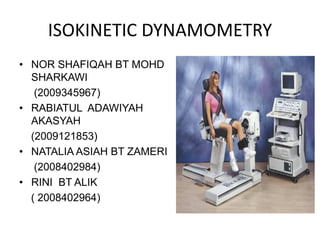
ISOKINETIC DYNAMOMETRY
• NOR SHAFIQAH BT MOHD
SHARKAWI
(2009345967)
• RABIATUL ADAWIYAH
AKASYAH
(2009121853)
• NATALIA ASIAH BT ZAMERI
(2008402984)
• RINI BT ALIK
( 2008402964)
Introduction
- Originally described by Hislop and Perrine (1967)
- Is a relatively recent tool used in rahabilitation
- It capable of providing objective and quantifiable
strength data in :
1) static (isometric)
2) dynamic muscle contraction
Principle of isokinetic system
• Consist of fixed axis with a rotating lever arm
attached to a moveable head.
• The lever arm is driven either hydraulically or
electricity & accomodates the movt generated by the
patient contracting muscle in such a way that the
distal limb segment moves through the joint range at
a constant angular velocity.
• However, this does not take place until the patient’s
limb exceeds the preset angular velocity which has
been programmed into the machine by the
physiotherapist.
Modes of operation
1)Passive mode
• velocity remains constant
• no voluntary force is required by the patient to
initiate movement
• Useful mode to : - familiarize the pt with the
machine
- begin motor relearning
exp: anterior cruciate lig repair
2) Isometric mode (static exs)
• Muscle contract without shortening or lengthening.
• Allow physio to programme a series of isometric hold
angles throughout the patients available ROM
• Exp : weak at 90⁰ of knee flexion
- physio train the quadriceps at these
specific angle by presenting these as
hold angle before starting the exercise.
- Machine passively move patient limb to 90⁰ on kn
flexion & instruct patient (via screen prompt) to
contract the quadriceps for a predertermined time
- Machine then instruct the patient to relax
- Limb is allowed to reposition or is moved to the next
hold angle in inner range and the process repeated
3)Isokinetic mode
• Involve training muscle strength under condition of
constant angular velocity.
• To fix the speed of movt of the exercising muscle
throughout its exercising ROM.
• The external load applied to the moving segment
remains consistent with the maximum capacity of
the muscle throughout the range of either concentric
or eccentric contractionj
4) Isotonic mode
• Exercise velocity is controlled by the patient
and the muscle tension varies throughout the
available ROM
• Maximum effect of the resistance will be
confined to the weakness point in range.
Programme facilities of the
dynamometer
• Dynamometers allow the physiotherapist to
select several other parameters such as the
velocity at which the exercise should take
place, the range of movement in which it
should be performed, the number of
repetitions required, and the moment/force
threshold values and damp setting.
VELOCITY
• The exercise velocity is measured in degrees per second.
Current dynamometer velocities range from 1° to 500°
persecond.
• Angular velocities on current machines are classified into
three categories:
– slow (1° to 60° per second).
– Intermediate (60° to 240° persecond)
– Fast (over 240° persecond)
• The most usual usual clinical testing and training velocities
range between 30 and 240 per second.
RANGE OF MOTION
• The exercising range of movement can be
controlled by programming the desired start
and stop angles into the dynamometer
computer.
• Mechanical stops positioned slightly beyond
these programmed values are also an
additional safety features on some machines.
EXERCISE REPETITION
• The number of repetition can easily be programmed
to suit individual requirements. For example, it is
possible to design an exercise programmed which
consists of five isometric holds, each performed at a
different joint angle, followed by a full-range is
kinetic contraction repeated concentrically and then
eccentrically three times: the whole sequence then
being repeated after a short rest.
MOMENT/FORCE THRESHOLD VALUES.
• All dynamometers have torque limits. Example
the maximum amount of resistance that they
can provide.
• If exceeded, an error message and/or alarm is
activated.
SOURCES OF ERROR IN ISOKINETIC
DYNAMOMETRY
• Three main sources of error which lead to inaccurate
information are reported within the literature and
summarized as:
– Failure to take into account the effect of gravity which may
assist or resist limb motion.
– Torque overshoot.
– Malailgnment of the biological and mechanical axes, and
failure to stabilise the patient on the dynamometer to
ensure localisation of the movement to the joint under-
going or treatment
Advantages and Disadvantages
Advantages
• Testing procedures
– accurate test data
– methods-vital complement to more traditional
methods of physical exam, electromyography, and
radiographic procedures in ass of pt with
neuromusculaskeletal disorders.
• Treatments effectiveness
– produce significance gains in strength, power,
endurance
– positive carry over into increased concentric and
eccentric functional muscle performance.
(Chan, Maffulli & Korkia, 1996)
Cont…
• Properly used- effective means of improving muscle
strength
• Can performed variety of contractions speeds that
approach velocity of jt movement occurred during ADL
• Accommodation to length tension curve and maximum
force output at each point in ROM
• Used to measure force production of various muscle
groups and compare the force of production of injured
with noninjured extremities or agonist with antagonist
(Baratz, Watson & Imbriglia, 1999)
Disadvantages
• Does not afford diagnostic precision obtained through other
methods of exam (MRI, endoscopy)
• It is clinically based, not easily usable in pt’s environment of
function, such as football field/basketball court
• Lack of definitive knowledge on how to apply isokinetic
science to clinical context
(Chan, Maffulli & Korkia, 1996)
• Increased joint compression
• Movement does not approach velocity of motion occurs
during sports activities
• Increased shear forces at low contraction velocity-harmful
following surgical procedures designed to provide joint
stability
(Baratz, Watson & Imbriglia, 1999)
Cont…
• Initially time consuming to learn how to use
• Expertise need to be developed
• Isokinetic movt is artificial constraint. Normal
functional movt does not occur at fixed velo
• Expensive
• Malalignment of axes of rotation of joints and
dynamometer will not provide a true reflection of
muscle performance. Alignments can be difficult when
complex joints involved.
• Eccentric testing predisposes to the phenomenon of
DOMS
(Jones & Barke, 1996)
ISOKINETIC EVALUATION
• Isokinetic evaluation is an objective method that
allows for rapid and reliable comparison of the
relationship between the agonist/antagonist muscle
groups musculature during dynamic exercise.
• By using this evaluation we can measure and
determine muscular performance.
(Linde, Farrés, Oliete, Til & Turmo, 2010)
PARAMETERS TO BE EVALUATED
• For example in knee rehabilitation:
1) Type of load
2) Type of exercise
3) Range of motion applied
4) Maximal or submaximal effort
5) Angular speed of the exercise for agonistic and antagonistic
muscles
6) Number of repetitions and sets
7) Duration of pauses
8) Number of sessions per week
9) Duration of the treatment
ISOKINETIC LOWER LIMB EVALUATION
• The evaluation methodology (Jones, 1996):
1. Assess the patient by both subjective and objective examination
2. Familiarize the patient with the isokinetic dynamometer.
3. Explain the test aims.
4. Ensure that the patient warms up without the dynamometer,
eg:stretches, cycle ergometer
5. Position and stabilize the patient accurately on the dynamometer.
6. Test the contralateral limb first.
7. Align the joint and dynamometer axes of rotation as closely as possible.
8. Use gravity correction if testing in a gravity-dependent position.
9. Select the test type (concentric/eccentric for knee extensor)
10. Select the test velocity (eg: 30 degree per second)
(Tidswell, 1998)
11. Warm up on the dynamometer using the warm up mode.
12. Perform the maximal test at the chosen velocity (eg: perform three
concentric/eccentric repetitions with overlay facility, with a 30 second or 1
minute rest between repetitions).
13. Record test details to ensure replication on retest.
14. Retest at the same time of day as the original evaluation was
performed.
(Tidswell, 1998)
USES OF ISOKINETIC DYNAMOMETER IN CLINICAL
SETTING
• One of the most important features of isokinetic exercise:
- able to perform muscular contractions at a constant angular
speed along the full range of motion
• Thus, the resistance produced by the dynamometer is
proportional to the force exercised by the muscle and this
means that a maximal load can be placed on any point of
the ROM.
• This load is recorded by the isokinetic equipment and
displayed either in graphic form or by a series of numerical
parameters for a clinical evaluation.
• In this way the isokinetic dynamometer:
- provide a wide range of information on the dynamic
muscular contraction, which would otherwise be difficult to
obtain.
(Osternig, 1986)
EXERCISE PROTOCOL IN THE CLINICAL SETTING
• Isokinetic dynamometer – research tool for
quantifiying static, concentric, eccentric muscle
contraction.
• Standard rehabilitation programme are now
becoming available for the treatment of specific
conditions.
• The most popular condition for which programmes
have been designed invovles rehabilitation after
injury and repair of the anterior cruciate ligament.
(Pua, Bryant, Steele, Newton &Wrigley, 2008)
REFERENCES
Linde,X., Farrés,O., Oliete,F., Til, F. & Turmo,A.(2010).
Isokinetic comparison of shoulder internal-external
rotations between waterpolo and volley players.
INTERNATIONAL CONGRESS ON SPORTS REHABILITATION
AND TRAUMATOLOGY. Page 177-178.
Pua,Y., Bryant,A.L., Steele,J.R., Newton,R.U. &Wrigley, T.V.
(2008). Isokinetic Dynamometry in Anterior Cruciate
Ligament Injury and Reconstruction. Annals Academy of
Medicine. Page 330-340.
cont
• Baratz, M., Watson, A. D., & Imbriglia, J. E.,
(1999). Orthopaedic surgery: the essentials,
Thieme Medical Publisher, New York
• Jones, K., & Barke, K., (1996). Human movement
explained, Butterworth-Heinemann, Elsevier
Limited, UK.
• Chan, K. M., Maffulli, N., & Korkia, P., (1996)
Principles and practice of isokinetics in sports
medicine and rehabilitation, Williams & Walkins
Asia Pacific Limited, Hong Kong

66001318-ISOKINETIC-DYNAMOMETRY- 03.pdf

  • 1.
    ISOKINETIC DYNAMOMETRY • NORSHAFIQAH BT MOHD SHARKAWI (2009345967) • RABIATUL ADAWIYAH AKASYAH (2009121853) • NATALIA ASIAH BT ZAMERI (2008402984) • RINI BT ALIK ( 2008402964)
  • 2.
    Introduction - Originally describedby Hislop and Perrine (1967) - Is a relatively recent tool used in rahabilitation - It capable of providing objective and quantifiable strength data in : 1) static (isometric) 2) dynamic muscle contraction
  • 3.
    Principle of isokineticsystem • Consist of fixed axis with a rotating lever arm attached to a moveable head. • The lever arm is driven either hydraulically or electricity & accomodates the movt generated by the patient contracting muscle in such a way that the distal limb segment moves through the joint range at a constant angular velocity. • However, this does not take place until the patient’s limb exceeds the preset angular velocity which has been programmed into the machine by the physiotherapist.
  • 4.
    Modes of operation 1)Passivemode • velocity remains constant • no voluntary force is required by the patient to initiate movement • Useful mode to : - familiarize the pt with the machine - begin motor relearning exp: anterior cruciate lig repair
  • 5.
    2) Isometric mode(static exs) • Muscle contract without shortening or lengthening. • Allow physio to programme a series of isometric hold angles throughout the patients available ROM • Exp : weak at 90⁰ of knee flexion - physio train the quadriceps at these specific angle by presenting these as hold angle before starting the exercise.
  • 6.
    - Machine passivelymove patient limb to 90⁰ on kn flexion & instruct patient (via screen prompt) to contract the quadriceps for a predertermined time - Machine then instruct the patient to relax - Limb is allowed to reposition or is moved to the next hold angle in inner range and the process repeated
  • 7.
    3)Isokinetic mode • Involvetraining muscle strength under condition of constant angular velocity. • To fix the speed of movt of the exercising muscle throughout its exercising ROM. • The external load applied to the moving segment remains consistent with the maximum capacity of the muscle throughout the range of either concentric or eccentric contractionj
  • 8.
    4) Isotonic mode •Exercise velocity is controlled by the patient and the muscle tension varies throughout the available ROM • Maximum effect of the resistance will be confined to the weakness point in range.
  • 9.
    Programme facilities ofthe dynamometer
  • 10.
    • Dynamometers allowthe physiotherapist to select several other parameters such as the velocity at which the exercise should take place, the range of movement in which it should be performed, the number of repetitions required, and the moment/force threshold values and damp setting.
  • 11.
    VELOCITY • The exercisevelocity is measured in degrees per second. Current dynamometer velocities range from 1° to 500° persecond. • Angular velocities on current machines are classified into three categories: – slow (1° to 60° per second). – Intermediate (60° to 240° persecond) – Fast (over 240° persecond) • The most usual usual clinical testing and training velocities range between 30 and 240 per second.
  • 12.
    RANGE OF MOTION •The exercising range of movement can be controlled by programming the desired start and stop angles into the dynamometer computer. • Mechanical stops positioned slightly beyond these programmed values are also an additional safety features on some machines.
  • 13.
    EXERCISE REPETITION • Thenumber of repetition can easily be programmed to suit individual requirements. For example, it is possible to design an exercise programmed which consists of five isometric holds, each performed at a different joint angle, followed by a full-range is kinetic contraction repeated concentrically and then eccentrically three times: the whole sequence then being repeated after a short rest.
  • 14.
    MOMENT/FORCE THRESHOLD VALUES. •All dynamometers have torque limits. Example the maximum amount of resistance that they can provide. • If exceeded, an error message and/or alarm is activated.
  • 15.
    SOURCES OF ERRORIN ISOKINETIC DYNAMOMETRY • Three main sources of error which lead to inaccurate information are reported within the literature and summarized as: – Failure to take into account the effect of gravity which may assist or resist limb motion. – Torque overshoot. – Malailgnment of the biological and mechanical axes, and failure to stabilise the patient on the dynamometer to ensure localisation of the movement to the joint under- going or treatment
  • 16.
  • 17.
    Advantages • Testing procedures –accurate test data – methods-vital complement to more traditional methods of physical exam, electromyography, and radiographic procedures in ass of pt with neuromusculaskeletal disorders. • Treatments effectiveness – produce significance gains in strength, power, endurance – positive carry over into increased concentric and eccentric functional muscle performance. (Chan, Maffulli & Korkia, 1996)
  • 18.
    Cont… • Properly used-effective means of improving muscle strength • Can performed variety of contractions speeds that approach velocity of jt movement occurred during ADL • Accommodation to length tension curve and maximum force output at each point in ROM • Used to measure force production of various muscle groups and compare the force of production of injured with noninjured extremities or agonist with antagonist (Baratz, Watson & Imbriglia, 1999)
  • 19.
    Disadvantages • Does notafford diagnostic precision obtained through other methods of exam (MRI, endoscopy) • It is clinically based, not easily usable in pt’s environment of function, such as football field/basketball court • Lack of definitive knowledge on how to apply isokinetic science to clinical context (Chan, Maffulli & Korkia, 1996) • Increased joint compression • Movement does not approach velocity of motion occurs during sports activities • Increased shear forces at low contraction velocity-harmful following surgical procedures designed to provide joint stability (Baratz, Watson & Imbriglia, 1999)
  • 20.
    Cont… • Initially timeconsuming to learn how to use • Expertise need to be developed • Isokinetic movt is artificial constraint. Normal functional movt does not occur at fixed velo • Expensive • Malalignment of axes of rotation of joints and dynamometer will not provide a true reflection of muscle performance. Alignments can be difficult when complex joints involved. • Eccentric testing predisposes to the phenomenon of DOMS (Jones & Barke, 1996)
  • 21.
  • 22.
    • Isokinetic evaluationis an objective method that allows for rapid and reliable comparison of the relationship between the agonist/antagonist muscle groups musculature during dynamic exercise. • By using this evaluation we can measure and determine muscular performance. (Linde, Farrés, Oliete, Til & Turmo, 2010)
  • 23.
    PARAMETERS TO BEEVALUATED • For example in knee rehabilitation: 1) Type of load 2) Type of exercise 3) Range of motion applied 4) Maximal or submaximal effort 5) Angular speed of the exercise for agonistic and antagonistic muscles 6) Number of repetitions and sets 7) Duration of pauses 8) Number of sessions per week 9) Duration of the treatment
  • 24.
    ISOKINETIC LOWER LIMBEVALUATION • The evaluation methodology (Jones, 1996): 1. Assess the patient by both subjective and objective examination 2. Familiarize the patient with the isokinetic dynamometer. 3. Explain the test aims. 4. Ensure that the patient warms up without the dynamometer, eg:stretches, cycle ergometer 5. Position and stabilize the patient accurately on the dynamometer. 6. Test the contralateral limb first. 7. Align the joint and dynamometer axes of rotation as closely as possible. 8. Use gravity correction if testing in a gravity-dependent position. 9. Select the test type (concentric/eccentric for knee extensor) 10. Select the test velocity (eg: 30 degree per second) (Tidswell, 1998)
  • 25.
    11. Warm upon the dynamometer using the warm up mode. 12. Perform the maximal test at the chosen velocity (eg: perform three concentric/eccentric repetitions with overlay facility, with a 30 second or 1 minute rest between repetitions). 13. Record test details to ensure replication on retest. 14. Retest at the same time of day as the original evaluation was performed. (Tidswell, 1998)
  • 26.
    USES OF ISOKINETICDYNAMOMETER IN CLINICAL SETTING
  • 27.
    • One ofthe most important features of isokinetic exercise: - able to perform muscular contractions at a constant angular speed along the full range of motion • Thus, the resistance produced by the dynamometer is proportional to the force exercised by the muscle and this means that a maximal load can be placed on any point of the ROM. • This load is recorded by the isokinetic equipment and displayed either in graphic form or by a series of numerical parameters for a clinical evaluation. • In this way the isokinetic dynamometer: - provide a wide range of information on the dynamic muscular contraction, which would otherwise be difficult to obtain. (Osternig, 1986)
  • 28.
    EXERCISE PROTOCOL INTHE CLINICAL SETTING • Isokinetic dynamometer – research tool for quantifiying static, concentric, eccentric muscle contraction. • Standard rehabilitation programme are now becoming available for the treatment of specific conditions. • The most popular condition for which programmes have been designed invovles rehabilitation after injury and repair of the anterior cruciate ligament. (Pua, Bryant, Steele, Newton &Wrigley, 2008)
  • 29.
    REFERENCES Linde,X., Farrés,O., Oliete,F.,Til, F. & Turmo,A.(2010). Isokinetic comparison of shoulder internal-external rotations between waterpolo and volley players. INTERNATIONAL CONGRESS ON SPORTS REHABILITATION AND TRAUMATOLOGY. Page 177-178. Pua,Y., Bryant,A.L., Steele,J.R., Newton,R.U. &Wrigley, T.V. (2008). Isokinetic Dynamometry in Anterior Cruciate Ligament Injury and Reconstruction. Annals Academy of Medicine. Page 330-340.
  • 30.
    cont • Baratz, M.,Watson, A. D., & Imbriglia, J. E., (1999). Orthopaedic surgery: the essentials, Thieme Medical Publisher, New York • Jones, K., & Barke, K., (1996). Human movement explained, Butterworth-Heinemann, Elsevier Limited, UK. • Chan, K. M., Maffulli, N., & Korkia, P., (1996) Principles and practice of isokinetics in sports medicine and rehabilitation, Williams & Walkins Asia Pacific Limited, Hong Kong