Manual Muscle Testing
Dr Sreeraj S R, PhD
2
Sreeraj S R
• Muscle strength refers to the ability of a
muscle to exert force.
• It measures how much weight or resistance
one can lift or push in a single effort.
Muscle Strength
3
Sreeraj S R
●Muscle strength testing determines the
capability of muscles or muscle groups to
function and provide stability and support.
Muscle Strength Testing
4
Sreeraj S R
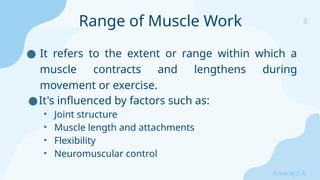
1. Isometric contraction: Tension is developed in the muscle, but no
movement occurs;
2. Isotonic contraction: The muscle develops constant tension against
a load or resistance.
There are two types:
a. Concentric contraction: Tension is developed in the muscle , and the origin
and insertion of the muscle move closer together, so the muscle shortens.
b. Eccentric contraction: Tension is developed in the muscle, and the origin
and insertion of the muscle move further apart; so, the muscle lengthens.
Types of Muscle Contraction
5
Sreeraj S R
Types of Muscle Contraction
6
Sreeraj S R
● It refers to the extent or range within which a
muscle contracts and lengthens during
movement or exercise.
●It's influenced by factors such as:
• Joint structure
• Muscle length and attachments
• Flexibility
• Neuromuscular control
Range of Muscle Work
7
Sreeraj S R
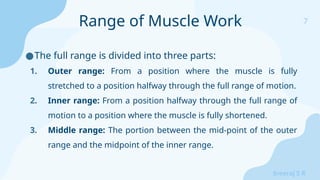
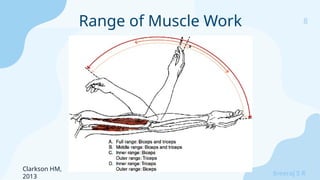
●The full range is divided into three parts:
1. Outer range: From a position where the muscle is fully
stretched to a position halfway through the full range of motion.
2. Inner range: From a position halfway through the full range of
motion to a position where the muscle is fully shortened.
3. Middle range: The portion between the mid-point of the outer
range and the midpoint of the inner range.
Range of Muscle Work
8
Sreeraj S R
Range of Muscle Work
Clarkson HM,
2013
9
Sreeraj S R
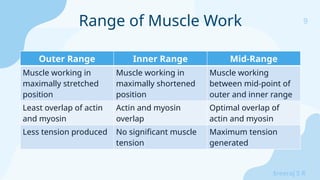
Outer Range Inner Range Mid-Range
Muscle working in
maximally stretched
position
Muscle working in
maximally shortened
position
Muscle working
between mid-point of
outer and inner range
Least overlap of actin
and myosin
Actin and myosin
overlap
Optimal overlap of
actin and myosin
Less tension produced No significant muscle
tension
Maximum tension
generated
Range of Muscle Work
10
Sreeraj S R
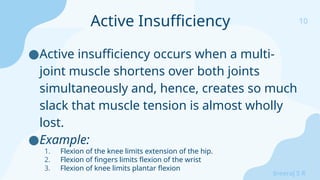
●Active insufficiency occurs when a multi-
joint muscle shortens over both joints
simultaneously and, hence, creates so much
slack that muscle tension is almost wholly
lost.
●Example:
1. Flexion of the knee limits extension of the hip.
2. Flexion of fingers limits flexion of the wrist
3. Flexion of knee limits plantar flexion
Active Insufficiency
11
Sreeraj S R
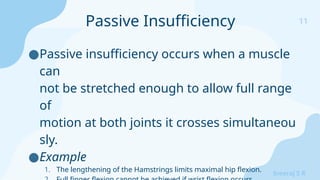
●Passive insufficiency occurs when a muscle
can
not be stretched enough to allow full range
of
motion at both joints it crosses simultaneou
sly.
●Example
1. The lengthening of the Hamstrings limits maximal hip flexion.
Passive Insufficiency
12
Sreeraj S R
●Prime mover or Agonist:
●A muscle or muscle group that makes a
significant contribution to movement at the
joint.
●Example:
●The biceps brachii is a prime mover for
elbow flexion.
Functional Classification of Muscles
13
Sreeraj S R
●Antagonist:
●A muscle or a muscle group that has an opposite
action to the prime movers.
●The antagonist relaxes as the agonist moves the
part through a range of motion.
●Reciprocal inhibition is a physiological
phenomenon where the contraction of one muscle
group causes the relaxation of the opposing
muscle group.
●Example:
● In elbow flexion, the triceps brachii is the antagonist muscle
Functional Classification of Muscles
14
Sreeraj S R
●Synergist:
●A muscle that contracts and works with the
agonist to produce the desired movement.
●They provide additional force or stabilize
the joint to ensure efficient and controlled
motion.
●There are three types of synergists:
1. Neutralizing or counter-acting synergists
2. Conjoint synergists
Functional Classification of Muscles
15
Sreeraj S R
●Neutralizing or counter-acting
synergists:
●Muscles contract to prevent any unwanted
movement produced by the prime mover.
●Example:
●When the long finger flexors contract to
produce finger flexion, the wrist extensors
contract to prevent wrist flexion from
Functional Classification of Muscles
16
Sreeraj S R
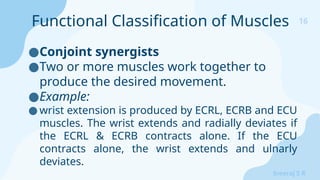
●Conjoint synergists
●Two or more muscles work together to
produce the desired movement.
●Example:
● wrist extension is produced by ECRL, ECRB and ECU
muscles. The wrist extends and radially deviates if
the ECRL & ECRB contracts alone. If the ECU
contracts alone, the wrist extends and ulnarly
deviates.
Functional Classification of Muscles
17
Sreeraj S R
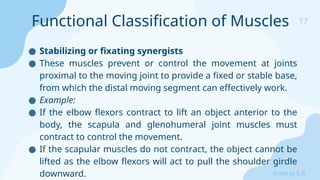
● Stabilizing or fixating synergists
● These muscles prevent or control the movement at joints
proximal to the moving joint to provide a fixed or stable base,
from which the distal moving segment can effectively work.
● Example:
● If the elbow flexors contract to lift an object anterior to the
body, the scapula and glenohumeral joint muscles must
contract to control the movement.
● If the scapular muscles do not contract, the object cannot be
lifted as the elbow flexors will act to pull the shoulder girdle
downward.
Functional Classification of Muscles
18
Sreeraj S R
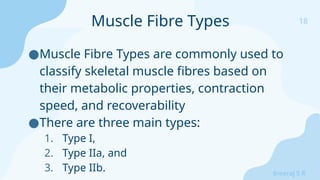
●Muscle Fibre Types are commonly used to
classify skeletal muscle fibres based on
their metabolic properties, contraction
speed, and recoverability
●There are three main types:
1. Type I,
2. Type IIa, and
3. Type IIb.
Muscle Fibre Types
Sreeraj S R
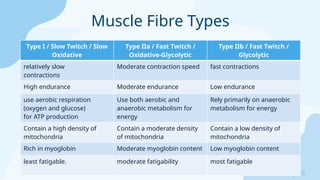
Type I / Slow Twitch / Slow
Oxidative
Type IIa / Fast Twitch /
Oxidative-Glycolytic
Type IIb / Fast Twitch /
Glycolytic
relatively slow
contractions
Moderate contraction speed fast contractions
High endurance Moderate endurance Low endurance
use aerobic respiration
(oxygen and glucose)
for ATP production
Use both aerobic and
anaerobic metabolism for
energy
Rely primarily on anaerobic
metabolism for energy
Contain a high density of
mitochondria
Contain a moderate density
of mitochondria
Contain a low density of
mitochondria
Rich in myoglobin Moderate myoglobin content Low myoglobin content
least fatigable. moderate fatigability most fatigable
Muscle Fibre Types
Sreeraj S R
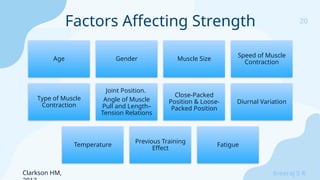
Factors Affecting Strength 20
Age Gender Muscle Size
Speed of Muscle
Contraction
Type of Muscle
Contraction
Joint Position.
Angle of Muscle
Pull and Length–
Tension Relations
Close-Packed
Position & Loose-
Packed Position
Diurnal Variation
Temperature
Previous Training
Effect
Fatigue
Clarkson HM,
21
Sreeraj S R
● Garner JC, Blackburn T, Weimar W, Campbell B. Comparison of
electromyographic activity during eccentrically versus concentrically
loaded isometric contractions. Journal of Electromyography and
Kinesiology [Internet]. 2008 Jun;18(3):466–71. Available from:
https://exss.unc.edu/wp-content/uploads/sites/779/2013/01/garner_
2008_jek.pdf
‌
For concentrically loaded isometric muscle contraction vs
eccentrically loaded isometric muscle contraction
22
Sreeraj S R
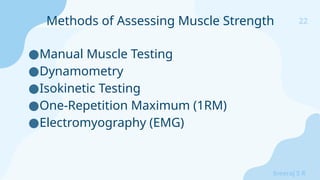
●Manual Muscle Testing
●Dynamometry
●Isokinetic Testing
●One-Repetition Maximum (1RM)
●Electromyography (EMG)
Methods of Assessing Muscle Strength
23
Sreeraj S R
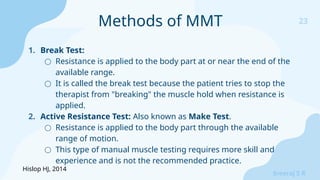
1. Break Test:
○ Resistance is applied to the body part at or near the end of the
available range.
○ It is called the break test because the patient tries to stop the
therapist from "breaking" the muscle hold when resistance is
applied.
2. Active Resistance Test: Also known as Make Test.
○ Resistance is applied to the body part through the available
range of motion.
○ This type of manual muscle testing requires more skill and
experience and is not the recommended practice.
Methods of MMT
Hislop HJ, 2014
24
Sreeraj S R
●The isometric hold (break test) shows the
muscle to have a higher test grade than the
resistance given throughout the range
(make test)
25
Sreeraj S R
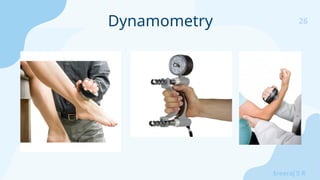
●Dynamometry is a method for measuring
the force exerted by a muscle during a
specific movement.
●It involves using a dynamometer, a
handheld device that records the force
applied.
●Provides numerical data, making it a
reliable measure of muscle strength.
Dynamometry
26
Sreeraj S R
Dynamometry
27
Sreeraj S R
● It is a method of assessing the strength and
function of muscles using an isokinetic
dynamometer.
● It provides constant resistance throughout
the range of motion at a controlled speed.
● More precise, objective and quantitative
assessment.
Isokinetic Testing
28
Sreeraj S R
●1 RM is the maximum weight one can lift for
one repetition of a given exercise.
●It’s a key measure of overall strength and
power in weight training.
●1 RM testing helps athletes and trainers to
assess strength levels, track progress, and
create appropriate training programs.
One-Repetition Maximum (1RM)
29
Sreeraj S R
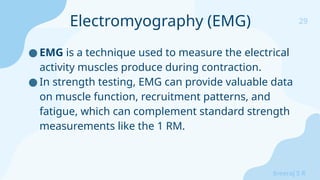
● EMG is a technique used to measure the electrical
activity muscles produce during contraction.
● In strength testing, EMG can provide valuable data
on muscle function, recruitment patterns, and
fatigue, which can complement standard strength
measurements like the 1 RM.
Electromyography (EMG)
MANUAL MUSCLE TEST
31
Sreeraj S R
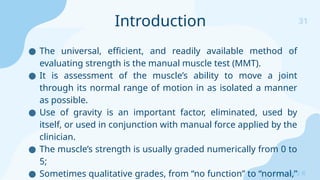
● The universal, efficient, and readily available method of
evaluating strength is the manual muscle test (MMT).
● It is assessment of the muscle’s ability to move a joint
through its normal range of motion in as isolated a manner
as possible.
● Use of gravity is an important factor, eliminated, used by
itself, or used in conjunction with manual force applied by the
clinician.
● The muscle’s strength is usually graded numerically from 0 to
5;
● Sometimes qualitative grades, from “no function” to “normal,”
Introduction
32
Sreeraj S R
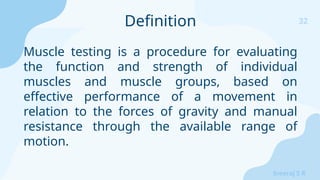
Muscle testing is a procedure for evaluating
the function and strength of individual
muscles and muscle groups, based on
effective performance of a movement in
relation to the forces of gravity and manual
resistance through the available range of
motion.
Definition
33
Sreeraj S R
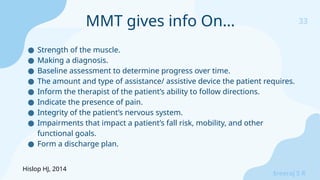
● Strength of the muscle.
● Making a diagnosis.
● Baseline assessment to determine progress over time.
● The amount and type of assistance/ assistive device the patient requires.
● Inform the therapist of the patient’s ability to follow directions.
● Indicate the presence of pain.
● Integrity of the patient’s nervous system.
● Impairments that impact a patient’s fall risk, mobility, and other
functional goals.
● Form a discharge plan.
MMT gives info On…
Hislop HJ, 2014
34
Sreeraj S R
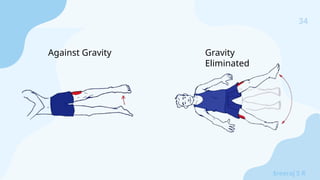
Gravity
Eliminated
Against Gravity
35
Sreeraj S R
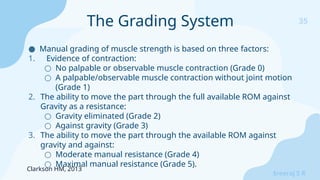
● Manual grading of muscle strength is based on three factors:
1. Evidence of contraction:
○ No palpable or observable muscle contraction (Grade 0)
○ A palpable/observable muscle contraction without joint motion
(Grade 1)
2. The ability to move the part through the full available ROM against
Gravity as a resistance:
○ Gravity eliminated (Grade 2)
○ Against gravity (Grade 3)
3. The ability to move the part through the available ROM against
gravity and against:
○ Moderate manual resistance (Grade 4)
○ Maximal manual resistance (Grade 5).
The Grading System
Clarkson HM, 2013
36
Sreeraj S R
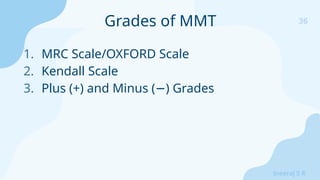
1. MRC Scale/OXFORD Scale
2. Kendall Scale
3. Plus (+) and Minus ( ) Grades
−
Grades of MMT
37
Sreeraj S R
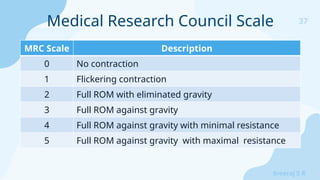
MRC Scale Description
0 No contraction
1 Flickering contraction
2 Full ROM with eliminated gravity
3 Full ROM against gravity
4 Full ROM against gravity with minimal resistance
5 Full ROM against gravity with maximal resistance
Medical Research Council Scale
38
Sreeraj S R
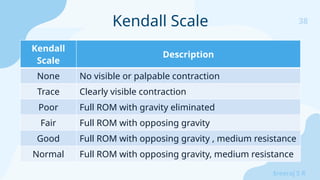
Kendall
Scale
Description
None No visible or palpable contraction
Trace Clearly visible contraction
Poor Full ROM with gravity eliminated
Fair Full ROM with opposing gravity
Good Full ROM with opposing gravity , medium resistance
Normal Full ROM with opposing gravity, medium resistance
Kendall Scale
39
Sreeraj S R
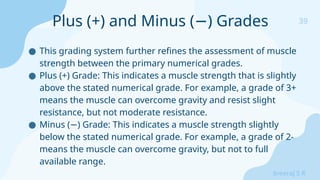
● This grading system further refines the assessment of muscle
strength between the primary numerical grades.
● Plus (+) Grade: This indicates a muscle strength that is slightly
above the stated numerical grade. For example, a grade of 3+
means the muscle can overcome gravity and resist slight
resistance, but not moderate resistance.
● Minus ( ) Grade: This indicates a muscle strength slightly
−
below the stated numerical grade. For example, a grade of 2-
means the muscle can overcome gravity, but not to full
available range.
Plus (+) and Minus ( ) Grades
−
40
Sreeraj S R
Comparison of MMT grades
Medical
Research
Council[4]
Daniels and
Worthingham[5]
Kendall and
McCreary[6]
Explanation
5 Normal(N) 100% Holds test position against
maximal resistance
4+ Good + (G+) Holds test position against moderate
to strong pressure
4 Good(G) 80% Holds test position against
moderate resistance
4- Good – (G-) Holds test position against slight to
moderate pressure
3+ Fair + (F+) Holds test position against slight
resistance
3 Fair (F) 50% Holds test position against
gravity
3- Fair- (F-) Gradual release from test position
2+ Poor + (P+) Moves through partial ROM against
gravity OR Moves through complete
ROM gravity eliminated and holds
against pressure
2 Poor(P) 20% Able to move through full ROM
gravity eliminated
2- Poor – (P-) Moves through partial ROM gravity
eliminated
1 Trace(T) 5% No visible movement; palpable
or observable tendon
prominence/flicker contraction
0 0 0% No palpable or observable
muscle contraction
41
Sreeraj S R
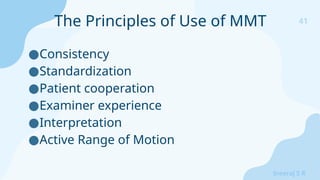
●Consistency
●Standardization
●Patient cooperation
●Examiner experience
●Interpretation
●Active Range of Motion
The Principles of Use of MMT
42
Sreeraj S R
● In trick movements, the patient exploits a strong muscle with
a similar function to compensate for the loss of action of a
weak muscle.
● Common Trick Movements
○ Substitution
○ Using Momentum
○ Using Gravity
○ Overcompensation
● Movements performed rapidly lead to inaccurate or ‘trick
movements’ and full-range movement is rarely achieved.
Trick Movements
43
Sreeraj S R
● Subjective assessment
● Explain the procedure
● Test for gravity resistance
● Position the patient
● Apply no resistance/resistance
● Grade the strength
● Repeat the test
● Document the results
Test Protocol for MMT
44
Sreeraj S R
● Test grades are not consistent from one patient
population to another.
● Suffers from a lack of objectivity
● The experience of the examiner.
● The age of the patient.
● The skill of the examiner
● Requires the tester to exert greater force than the
patient in any given muscle.
Limitations of MMT
Hislop HJ, 2014
45
Sreeraj S R
● To increase the reliability of the assessment of muscle
strength, the MMT should be conducted:
○ At the same time of day to avoid varying levels of fatigue.
○ By the same therapist.
○ In the same environment.
○ Using the same patient position.
○ Following a standard testing protocol to allow for more
accurate comparisons between tests.
○ Nonpainful contacts—nonpainful execution of the test
Limitations of MMT
Clarkson HM, 2013, Hislop HJ, 2014
46
Sreeraj S R
● In the presence of inflammatory conditions and disorders associated with
acute symptoms.
● In the presence of pain as pain will inhibit muscle contraction and accuracy of
assessment
● Unhealed fracture, Dislocation or unstable joint
● Post-surgery immobilisation, as in skin graft.
● Herniation, as in IVDP, is the abdominal wall. (Avoid Valsalva manoeuvre)
● Patients prone to exacerbation of fatigue such as in Extreme debility,
malnutrition, malignancy, COPD, CVD, etc
● Limited range of motion
● Cognitive concerns / decreased ability to complete the test
● Patient refusal or non-consent.
Contraindications and Precautions
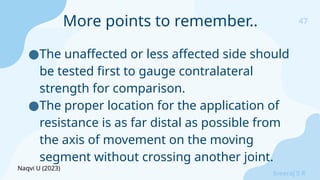
47
Sreeraj S R
●The unaffected or less affected side should
be tested first to gauge contralateral
strength for comparison.
●The proper location for the application of
resistance is as far distal as possible from
the axis of movement on the moving
segment without crossing another joint.
More points to remember..
Naqvi U (2023)
48
Sreeraj S R
1. Houglum PA. Chapter 7. Muscle Strength and Endurance. Therapeutic Exercise for
Musculoskeletal Injuries. 3rd Edition. 2010: pp 199-251
2. Kendall FP, McCreary EK, Provance PG, Rodgers MM, Romani WA. Chapter 1. Fundamental
Concepts. Muscles Testing and Function with Posture and Pain. 5th Edition. Elsevier. 2005: pp 3-47
3. Hislop HJ, Avers D, Brown M. Chapter 1. Principles of Manual Muscle Testing. Daniels and
Worthingham’s Muscle Testing-techniques of Manual Examination and Performance Testing. 9th
Edition. 2014: pp 2-6
4. Hislop HJ, Avers D, Brown M. Chapter 2. Relevance and Limitations of Manual Muscle Testing.
Daniels and Worthingham’s Muscle Testing-techniques of Manual Examination and Performance
Testing. 9th Edition. 2014: pp 12-16
5. Clarkson HM. Principles and Methods. In: Musculoskeletal Assessment: Joint Motion and Muscle
Testing. Philadelphia: Lippincott Williams & Wilkins; 2013. p. 1–54.
6. Naqvi U, Sherman AL. Muscle Strength Grading [Internet]. Nih.gov. StatPearls Publishing; 2023
[cited 2024 Oct 8]. Available from: https://tinyurl.com/y453uwxp
References

Manual Muscle Testing_Understanding the Basics_SRS.pptx

  • 1.
    Manual Muscle Testing DrSreeraj S R, PhD
  • 2.
    2 Sreeraj S R •Muscle strength refers to the ability of a muscle to exert force. • It measures how much weight or resistance one can lift or push in a single effort. Muscle Strength
  • 3.
    3 Sreeraj S R ●Musclestrength testing determines the capability of muscles or muscle groups to function and provide stability and support. Muscle Strength Testing
  • 4.
    4 Sreeraj S R 1.Isometric contraction: Tension is developed in the muscle, but no movement occurs; 2. Isotonic contraction: The muscle develops constant tension against a load or resistance. There are two types: a. Concentric contraction: Tension is developed in the muscle , and the origin and insertion of the muscle move closer together, so the muscle shortens. b. Eccentric contraction: Tension is developed in the muscle, and the origin and insertion of the muscle move further apart; so, the muscle lengthens. Types of Muscle Contraction
  • 5.
    5 Sreeraj S R Typesof Muscle Contraction
  • 6.
    6 Sreeraj S R ●It refers to the extent or range within which a muscle contracts and lengthens during movement or exercise. ●It's influenced by factors such as: • Joint structure • Muscle length and attachments • Flexibility • Neuromuscular control Range of Muscle Work
  • 7.
    7 Sreeraj S R ●Thefull range is divided into three parts: 1. Outer range: From a position where the muscle is fully stretched to a position halfway through the full range of motion. 2. Inner range: From a position halfway through the full range of motion to a position where the muscle is fully shortened. 3. Middle range: The portion between the mid-point of the outer range and the midpoint of the inner range. Range of Muscle Work
  • 8.
    8 Sreeraj S R Rangeof Muscle Work Clarkson HM, 2013
  • 9.
    9 Sreeraj S R OuterRange Inner Range Mid-Range Muscle working in maximally stretched position Muscle working in maximally shortened position Muscle working between mid-point of outer and inner range Least overlap of actin and myosin Actin and myosin overlap Optimal overlap of actin and myosin Less tension produced No significant muscle tension Maximum tension generated Range of Muscle Work
  • 10.
    10 Sreeraj S R ●Activeinsufficiency occurs when a multi- joint muscle shortens over both joints simultaneously and, hence, creates so much slack that muscle tension is almost wholly lost. ●Example: 1. Flexion of the knee limits extension of the hip. 2. Flexion of fingers limits flexion of the wrist 3. Flexion of knee limits plantar flexion Active Insufficiency
  • 11.
    11 Sreeraj S R ●Passiveinsufficiency occurs when a muscle can not be stretched enough to allow full range of motion at both joints it crosses simultaneou sly. ●Example 1. The lengthening of the Hamstrings limits maximal hip flexion. Passive Insufficiency
  • 12.
    12 Sreeraj S R ●Primemover or Agonist: ●A muscle or muscle group that makes a significant contribution to movement at the joint. ●Example: ●The biceps brachii is a prime mover for elbow flexion. Functional Classification of Muscles
  • 13.
    13 Sreeraj S R ●Antagonist: ●Amuscle or a muscle group that has an opposite action to the prime movers. ●The antagonist relaxes as the agonist moves the part through a range of motion. ●Reciprocal inhibition is a physiological phenomenon where the contraction of one muscle group causes the relaxation of the opposing muscle group. ●Example: ● In elbow flexion, the triceps brachii is the antagonist muscle Functional Classification of Muscles
  • 14.
    14 Sreeraj S R ●Synergist: ●Amuscle that contracts and works with the agonist to produce the desired movement. ●They provide additional force or stabilize the joint to ensure efficient and controlled motion. ●There are three types of synergists: 1. Neutralizing or counter-acting synergists 2. Conjoint synergists Functional Classification of Muscles
  • 15.
    15 Sreeraj S R ●Neutralizingor counter-acting synergists: ●Muscles contract to prevent any unwanted movement produced by the prime mover. ●Example: ●When the long finger flexors contract to produce finger flexion, the wrist extensors contract to prevent wrist flexion from Functional Classification of Muscles
  • 16.
    16 Sreeraj S R ●Conjointsynergists ●Two or more muscles work together to produce the desired movement. ●Example: ● wrist extension is produced by ECRL, ECRB and ECU muscles. The wrist extends and radially deviates if the ECRL & ECRB contracts alone. If the ECU contracts alone, the wrist extends and ulnarly deviates. Functional Classification of Muscles
  • 17.
    17 Sreeraj S R ●Stabilizing or fixating synergists ● These muscles prevent or control the movement at joints proximal to the moving joint to provide a fixed or stable base, from which the distal moving segment can effectively work. ● Example: ● If the elbow flexors contract to lift an object anterior to the body, the scapula and glenohumeral joint muscles must contract to control the movement. ● If the scapular muscles do not contract, the object cannot be lifted as the elbow flexors will act to pull the shoulder girdle downward. Functional Classification of Muscles
  • 18.
    18 Sreeraj S R ●MuscleFibre Types are commonly used to classify skeletal muscle fibres based on their metabolic properties, contraction speed, and recoverability ●There are three main types: 1. Type I, 2. Type IIa, and 3. Type IIb. Muscle Fibre Types
  • 19.
    Sreeraj S R TypeI / Slow Twitch / Slow Oxidative Type IIa / Fast Twitch / Oxidative-Glycolytic Type IIb / Fast Twitch / Glycolytic relatively slow contractions Moderate contraction speed fast contractions High endurance Moderate endurance Low endurance use aerobic respiration (oxygen and glucose) for ATP production Use both aerobic and anaerobic metabolism for energy Rely primarily on anaerobic metabolism for energy Contain a high density of mitochondria Contain a moderate density of mitochondria Contain a low density of mitochondria Rich in myoglobin Moderate myoglobin content Low myoglobin content least fatigable. moderate fatigability most fatigable Muscle Fibre Types
  • 20.
    Sreeraj S R FactorsAffecting Strength 20 Age Gender Muscle Size Speed of Muscle Contraction Type of Muscle Contraction Joint Position. Angle of Muscle Pull and Length– Tension Relations Close-Packed Position & Loose- Packed Position Diurnal Variation Temperature Previous Training Effect Fatigue Clarkson HM,
  • 21.
    21 Sreeraj S R ●Garner JC, Blackburn T, Weimar W, Campbell B. Comparison of electromyographic activity during eccentrically versus concentrically loaded isometric contractions. Journal of Electromyography and Kinesiology [Internet]. 2008 Jun;18(3):466–71. Available from: https://exss.unc.edu/wp-content/uploads/sites/779/2013/01/garner_ 2008_jek.pdf ‌ For concentrically loaded isometric muscle contraction vs eccentrically loaded isometric muscle contraction
  • 22.
    22 Sreeraj S R ●ManualMuscle Testing ●Dynamometry ●Isokinetic Testing ●One-Repetition Maximum (1RM) ●Electromyography (EMG) Methods of Assessing Muscle Strength
  • 23.
    23 Sreeraj S R 1.Break Test: ○ Resistance is applied to the body part at or near the end of the available range. ○ It is called the break test because the patient tries to stop the therapist from "breaking" the muscle hold when resistance is applied. 2. Active Resistance Test: Also known as Make Test. ○ Resistance is applied to the body part through the available range of motion. ○ This type of manual muscle testing requires more skill and experience and is not the recommended practice. Methods of MMT Hislop HJ, 2014
  • 24.
    24 Sreeraj S R ●Theisometric hold (break test) shows the muscle to have a higher test grade than the resistance given throughout the range (make test)
  • 25.
    25 Sreeraj S R ●Dynamometryis a method for measuring the force exerted by a muscle during a specific movement. ●It involves using a dynamometer, a handheld device that records the force applied. ●Provides numerical data, making it a reliable measure of muscle strength. Dynamometry
  • 26.
  • 27.
    27 Sreeraj S R ●It is a method of assessing the strength and function of muscles using an isokinetic dynamometer. ● It provides constant resistance throughout the range of motion at a controlled speed. ● More precise, objective and quantitative assessment. Isokinetic Testing
  • 28.
    28 Sreeraj S R ●1RM is the maximum weight one can lift for one repetition of a given exercise. ●It’s a key measure of overall strength and power in weight training. ●1 RM testing helps athletes and trainers to assess strength levels, track progress, and create appropriate training programs. One-Repetition Maximum (1RM)
  • 29.
    29 Sreeraj S R ●EMG is a technique used to measure the electrical activity muscles produce during contraction. ● In strength testing, EMG can provide valuable data on muscle function, recruitment patterns, and fatigue, which can complement standard strength measurements like the 1 RM. Electromyography (EMG)
  • 30.
  • 31.
    31 Sreeraj S R ●The universal, efficient, and readily available method of evaluating strength is the manual muscle test (MMT). ● It is assessment of the muscle’s ability to move a joint through its normal range of motion in as isolated a manner as possible. ● Use of gravity is an important factor, eliminated, used by itself, or used in conjunction with manual force applied by the clinician. ● The muscle’s strength is usually graded numerically from 0 to 5; ● Sometimes qualitative grades, from “no function” to “normal,” Introduction
  • 32.
    32 Sreeraj S R Muscletesting is a procedure for evaluating the function and strength of individual muscles and muscle groups, based on effective performance of a movement in relation to the forces of gravity and manual resistance through the available range of motion. Definition
  • 33.
    33 Sreeraj S R ●Strength of the muscle. ● Making a diagnosis. ● Baseline assessment to determine progress over time. ● The amount and type of assistance/ assistive device the patient requires. ● Inform the therapist of the patient’s ability to follow directions. ● Indicate the presence of pain. ● Integrity of the patient’s nervous system. ● Impairments that impact a patient’s fall risk, mobility, and other functional goals. ● Form a discharge plan. MMT gives info On… Hislop HJ, 2014
  • 34.
  • 35.
    35 Sreeraj S R ●Manual grading of muscle strength is based on three factors: 1. Evidence of contraction: ○ No palpable or observable muscle contraction (Grade 0) ○ A palpable/observable muscle contraction without joint motion (Grade 1) 2. The ability to move the part through the full available ROM against Gravity as a resistance: ○ Gravity eliminated (Grade 2) ○ Against gravity (Grade 3) 3. The ability to move the part through the available ROM against gravity and against: ○ Moderate manual resistance (Grade 4) ○ Maximal manual resistance (Grade 5). The Grading System Clarkson HM, 2013
  • 36.
    36 Sreeraj S R 1.MRC Scale/OXFORD Scale 2. Kendall Scale 3. Plus (+) and Minus ( ) Grades − Grades of MMT
  • 37.
    37 Sreeraj S R MRCScale Description 0 No contraction 1 Flickering contraction 2 Full ROM with eliminated gravity 3 Full ROM against gravity 4 Full ROM against gravity with minimal resistance 5 Full ROM against gravity with maximal resistance Medical Research Council Scale
  • 38.
    38 Sreeraj S R Kendall Scale Description NoneNo visible or palpable contraction Trace Clearly visible contraction Poor Full ROM with gravity eliminated Fair Full ROM with opposing gravity Good Full ROM with opposing gravity , medium resistance Normal Full ROM with opposing gravity, medium resistance Kendall Scale
  • 39.
    39 Sreeraj S R ●This grading system further refines the assessment of muscle strength between the primary numerical grades. ● Plus (+) Grade: This indicates a muscle strength that is slightly above the stated numerical grade. For example, a grade of 3+ means the muscle can overcome gravity and resist slight resistance, but not moderate resistance. ● Minus ( ) Grade: This indicates a muscle strength slightly − below the stated numerical grade. For example, a grade of 2- means the muscle can overcome gravity, but not to full available range. Plus (+) and Minus ( ) Grades −
  • 40.
    40 Sreeraj S R Comparisonof MMT grades Medical Research Council[4] Daniels and Worthingham[5] Kendall and McCreary[6] Explanation 5 Normal(N) 100% Holds test position against maximal resistance 4+ Good + (G+) Holds test position against moderate to strong pressure 4 Good(G) 80% Holds test position against moderate resistance 4- Good – (G-) Holds test position against slight to moderate pressure 3+ Fair + (F+) Holds test position against slight resistance 3 Fair (F) 50% Holds test position against gravity 3- Fair- (F-) Gradual release from test position 2+ Poor + (P+) Moves through partial ROM against gravity OR Moves through complete ROM gravity eliminated and holds against pressure 2 Poor(P) 20% Able to move through full ROM gravity eliminated 2- Poor – (P-) Moves through partial ROM gravity eliminated 1 Trace(T) 5% No visible movement; palpable or observable tendon prominence/flicker contraction 0 0 0% No palpable or observable muscle contraction
  • 41.
    41 Sreeraj S R ●Consistency ●Standardization ●Patientcooperation ●Examiner experience ●Interpretation ●Active Range of Motion The Principles of Use of MMT
  • 42.
    42 Sreeraj S R ●In trick movements, the patient exploits a strong muscle with a similar function to compensate for the loss of action of a weak muscle. ● Common Trick Movements ○ Substitution ○ Using Momentum ○ Using Gravity ○ Overcompensation ● Movements performed rapidly lead to inaccurate or ‘trick movements’ and full-range movement is rarely achieved. Trick Movements
  • 43.
    43 Sreeraj S R ●Subjective assessment ● Explain the procedure ● Test for gravity resistance ● Position the patient ● Apply no resistance/resistance ● Grade the strength ● Repeat the test ● Document the results Test Protocol for MMT
  • 44.
    44 Sreeraj S R ●Test grades are not consistent from one patient population to another. ● Suffers from a lack of objectivity ● The experience of the examiner. ● The age of the patient. ● The skill of the examiner ● Requires the tester to exert greater force than the patient in any given muscle. Limitations of MMT Hislop HJ, 2014
  • 45.
    45 Sreeraj S R ●To increase the reliability of the assessment of muscle strength, the MMT should be conducted: ○ At the same time of day to avoid varying levels of fatigue. ○ By the same therapist. ○ In the same environment. ○ Using the same patient position. ○ Following a standard testing protocol to allow for more accurate comparisons between tests. ○ Nonpainful contacts—nonpainful execution of the test Limitations of MMT Clarkson HM, 2013, Hislop HJ, 2014
  • 46.
    46 Sreeraj S R ●In the presence of inflammatory conditions and disorders associated with acute symptoms. ● In the presence of pain as pain will inhibit muscle contraction and accuracy of assessment ● Unhealed fracture, Dislocation or unstable joint ● Post-surgery immobilisation, as in skin graft. ● Herniation, as in IVDP, is the abdominal wall. (Avoid Valsalva manoeuvre) ● Patients prone to exacerbation of fatigue such as in Extreme debility, malnutrition, malignancy, COPD, CVD, etc ● Limited range of motion ● Cognitive concerns / decreased ability to complete the test ● Patient refusal or non-consent. Contraindications and Precautions
  • 47.
    47 Sreeraj S R ●Theunaffected or less affected side should be tested first to gauge contralateral strength for comparison. ●The proper location for the application of resistance is as far distal as possible from the axis of movement on the moving segment without crossing another joint. More points to remember.. Naqvi U (2023)
  • 48.
    48 Sreeraj S R 1.Houglum PA. Chapter 7. Muscle Strength and Endurance. Therapeutic Exercise for Musculoskeletal Injuries. 3rd Edition. 2010: pp 199-251 2. Kendall FP, McCreary EK, Provance PG, Rodgers MM, Romani WA. Chapter 1. Fundamental Concepts. Muscles Testing and Function with Posture and Pain. 5th Edition. Elsevier. 2005: pp 3-47 3. Hislop HJ, Avers D, Brown M. Chapter 1. Principles of Manual Muscle Testing. Daniels and Worthingham’s Muscle Testing-techniques of Manual Examination and Performance Testing. 9th Edition. 2014: pp 2-6 4. Hislop HJ, Avers D, Brown M. Chapter 2. Relevance and Limitations of Manual Muscle Testing. Daniels and Worthingham’s Muscle Testing-techniques of Manual Examination and Performance Testing. 9th Edition. 2014: pp 12-16 5. Clarkson HM. Principles and Methods. In: Musculoskeletal Assessment: Joint Motion and Muscle Testing. Philadelphia: Lippincott Williams & Wilkins; 2013. p. 1–54. 6. Naqvi U, Sherman AL. Muscle Strength Grading [Internet]. Nih.gov. StatPearls Publishing; 2023 [cited 2024 Oct 8]. Available from: https://tinyurl.com/y453uwxp References