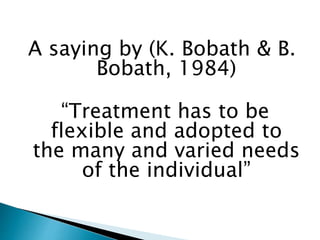
A saying by (K. Bobath & B.
Bobath, 1984)
“Treatment has to be
flexible and adopted to
the many and varied needs
of the individual”
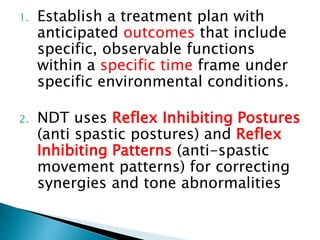
1. Establish a treatment plan with
anticipated outcomes that include
specific, observable functions
within a specific time frame under
specific environmental conditions.
2. NDT uses Reflex Inhibiting Postures
(anti spastic postures) and Reflex
Inhibiting Patterns (anti-spastic
movement patterns) for correcting
synergies and tone abnormalities
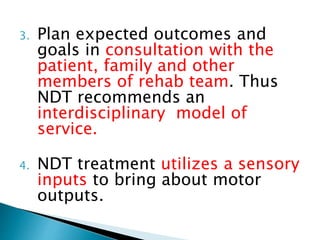
3. Plan expected outcomes and
goals in consultation with the
patient, family and other
members of rehab team. Thus
NDT recommends an
interdisciplinary model of
service.
4. NDT treatment utilizes a sensory
inputs to bring about motor
outputs.
5. Handling is an important intervention
method used in NDT to help the
patient achieve independent function.
Handling always occurs at key points
of control. As per Bobath we have:
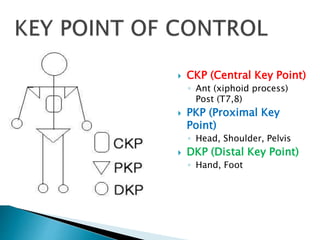
 Central key points of control
 Proximal key points of control
 Distal key points of control
6. Facilitation – A method of therapeutic
handling that makes posture and
movement easy or likely to occur.
 CKP (Central Key Point)
◦ Ant (xiphoid process)
Post (T7,8)
 PKP (Proximal Key
Point)
◦ Head, Shoulder, Pelvis
 DKP (Distal Key Point)
◦ Hand, Foot
7. Inhibition – Used to restrict the
patients’ atypical posture and
movement that prevent efficient
performance.
8. Treatment strategies often
include preparation and
simulation of critical
foundational components of a
task as well as practice of the
whole task.
9. NDT intervention is designed
to obtain active response
from the client in goal
directed activities. Design a
therapy program to use the
patient’s potentials.
10. NDT intervention allows the
client to learn from errors and
identify his own errors that
occur during movement.
11. Therapist must have Knowledge
of the development of posture
and movement components
used in designing treatment
strategies.
12. Repetition is an important
component in motor learning.
13. Create an environment that is
conducive to co-operative
participation and support of the
client’s efforts. NDT sessions
provide motivation and purpose
to engage the client fully.
14. A single treatment session
progresses from activities in
which the client is most
capable to activities that are
more challenging. Therefore
individual treatment sessions
are designed.
15. NDT intervention methods
include modifying the task,
or the environment, to take
into account the current level
of the client’s performance
and capacity for function.
______________X________________

2. NDT_Principles- stroke rehabilitation.ppt

  • 2.
    A saying by(K. Bobath & B. Bobath, 1984) “Treatment has to be flexible and adopted to the many and varied needs of the individual”
  • 3.
    1. Establish atreatment plan with anticipated outcomes that include specific, observable functions within a specific time frame under specific environmental conditions. 2. NDT uses Reflex Inhibiting Postures (anti spastic postures) and Reflex Inhibiting Patterns (anti-spastic movement patterns) for correcting synergies and tone abnormalities
  • 4.
    3. Plan expectedoutcomes and goals in consultation with the patient, family and other members of rehab team. Thus NDT recommends an interdisciplinary model of service. 4. NDT treatment utilizes a sensory inputs to bring about motor outputs.
  • 5.
    5. Handling isan important intervention method used in NDT to help the patient achieve independent function. Handling always occurs at key points of control. As per Bobath we have:  Central key points of control  Proximal key points of control  Distal key points of control 6. Facilitation – A method of therapeutic handling that makes posture and movement easy or likely to occur.
  • 6.
     CKP (CentralKey Point) ◦ Ant (xiphoid process) Post (T7,8)  PKP (Proximal Key Point) ◦ Head, Shoulder, Pelvis  DKP (Distal Key Point) ◦ Hand, Foot
  • 7.
    7. Inhibition –Used to restrict the patients’ atypical posture and movement that prevent efficient performance. 8. Treatment strategies often include preparation and simulation of critical foundational components of a task as well as practice of the whole task.
  • 8.
    9. NDT interventionis designed to obtain active response from the client in goal directed activities. Design a therapy program to use the patient’s potentials.
  • 9.
    10. NDT interventionallows the client to learn from errors and identify his own errors that occur during movement. 11. Therapist must have Knowledge of the development of posture and movement components used in designing treatment strategies.
  • 10.
    12. Repetition isan important component in motor learning. 13. Create an environment that is conducive to co-operative participation and support of the client’s efforts. NDT sessions provide motivation and purpose to engage the client fully.
  • 11.
    14. A singletreatment session progresses from activities in which the client is most capable to activities that are more challenging. Therefore individual treatment sessions are designed.
  • 12.
    15. NDT interventionmethods include modifying the task, or the environment, to take into account the current level of the client’s performance and capacity for function. ______________X________________