 Muscle Strength
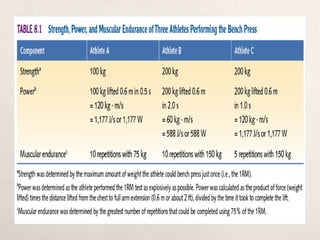
 Maximal force that a muscle or muscle group can generate.
 Muscle Power
 Rate of the performing muscle, thus the product of the force
and velocity.
 Explosive aspect of strength, the product of strength and
speed of movement.
 Power = Force X Distance / Time
 Where (force = strength) and (distance/ Time = speed)
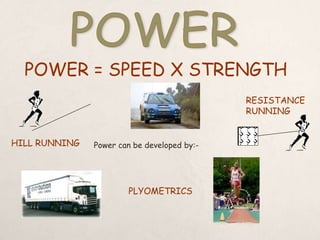
POWER = SPEED X STRENGTH
Power can be developed by:-
RESISTANCE
RUNNING
HILL RUNNING
PLYOMETRICS
 Muscular Endurance
 The capacity to sustain repeated muscular contractions or a
single static contraction.
 Aerobic Power
 Rate of energy release by cellular metabolic processes that
depend upon the availability and involvement of oxygen.
 Maximal aerobic power refers to the maximal capacity for
aerobic resynthesis of ATP.
 Equivalent to aerobic capacity and maximal oxygen uptake
(VO2max).
 Best lab test is a graded exercise test to exhaustion.
 Anaerobic Power
 Rate of energy release by cellular metabolic processes that
function without the involvement of oxygen.
 Maximum anaerobic power / anaerobic capacity – maximal
capacity for the anaerobic system to produce ATP
 Tests: None universally accepted
 Critical Power Test
 Wingate anaerobic Test
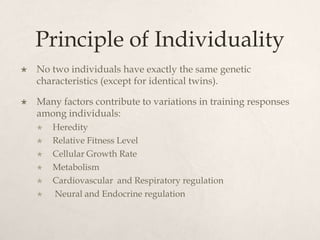
Principle of Individuality
 No two individuals have exactly the same genetic
characteristics (except for identical twins).
 Many factors contribute to variations in training responses
among individuals:
 Heredity
 Relative Fitness Level
 Cellular Growth Rate
 Metabolism
 Cardiovascular and Respiratory regulation
 Neural and Endocrine regulation
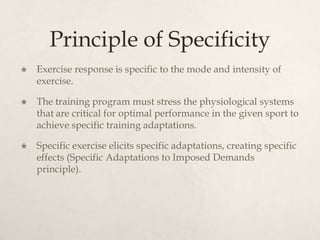
Principle of Specificity
 Exercise response is specific to the mode and intensity of
exercise.
 The training program must stress the physiological systems
that are critical for optimal performance in the given sport to
achieve specific training adaptations.
 Specific exercise elicits specific adaptations, creating specific
effects (Specific Adaptations to Imposed Demands
principle).
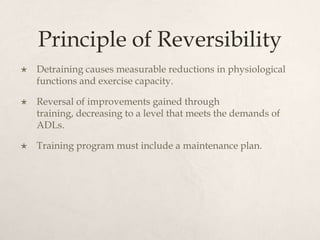
Principle of Reversibility
 Detraining causes measurable reductions in physiological
functions and exercise capacity.
 Reversal of improvements gained through
training, decreasing to a level that meets the demands of
ADLs.
 Training program must include a maintenance plan.
Principle of Progressive
Overload
 Overload and progressive training form the foundation of
all training.
 Exercising @ intensities greater than normal induces a
variety of highly specific adaptations that enables the body
to function more efficiently.
 Achieving the appropriate overload requires manipulating
combinations of training:
 Frequency
 Intensity
 Duration
 Exercise Mode
Principle of Hard/Easy
 Training Hard
 Training each day @ high intensities or for long durations or
both.
 Training Easy
 Provides a day active recovery so that the body is prepared for
future hard training.
Principle of Periodization
 Periodization is the gradual cycling of
specificity, intensity, and volume of training to achieve peak
levels of fitness for competition.
 Macrocycle
 Mesocycle
 Preparation
 Competition
 Transition
 Microcycle
Training Needs Analysis
 Should include the following assessment:
 What major muscle groups need to be trained?
 What type of training should be used?
 What energy system should be stressed?
 What are the primary sites of concern for injury prevention?
 Prescriptions should entail:
 Exercises to be performed.
 Order in which they will be performed.
 Number of sets for each exercise.
 Rest period for between each set and between exercises.
 Intensity or load.
 Number of repetitions.
 Velocity of movement to be used.
Selecting the Appropriate
Resistance and Repetitions
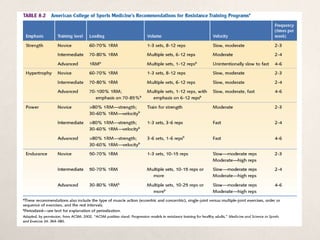
 The resistance to be used is generally expressed as a percentage of
the maximal capacity.
 Strength development is optimized by moderate to high resistance
(60 – 80% of 1RM) with low to moderate repetitions (6- 12 reps).
 Muscular endurance is optimized by low to moderate resistance
(30 – 70% of the 1RM) and moderate to high repetitions (10 – 25
reps).
 Power is optimized by alternating low to moderate resistance (30 –
60% of 1 RM) and low repetition (3 – 6 reps) at an explosive
velocity with the traditional strength training recommendations.
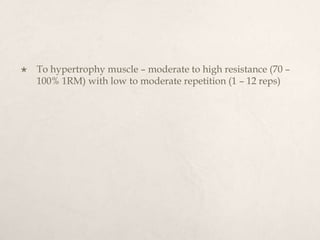
 To hypertrophy muscle – moderate to high resistance (70 –
100% 1RM) with low to moderate repetition (1 – 12 reps)
Selecting the Appropriate
Number of Sets
 Single set versus multiple sets.
 Single set used for untrained persons or those needing to
maintain a basic level of muscular fitness and not interested
in further improvements.
 Multiple sets used for additional gains in:
 Strength
 Endurance
 Power
 Hypertrophy
Periodization
 Refers to changes or variations in the resistance program
that are implemented over the course of a specific period of
time (eg. a year).
 It varies the exercise stimulus to keep the individual from
overtraining or becoming stale.
 Two forms of periodization:
 Classic Strength and Power Periodization
 Undulating Periodization
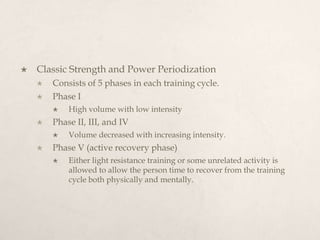
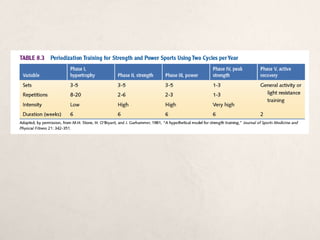
 Classic Strength and Power Periodization
 Consists of 5 phases in each training cycle.
 Phase I
 High volume with low intensity
 Phase II, III, and IV
 Volume decreased with increasing intensity.
 Phase V (active recovery phase)
 Either light resistance training or some unrelated activity is
allowed to allow the person time to recover from the training
cycle both physically and mentally.
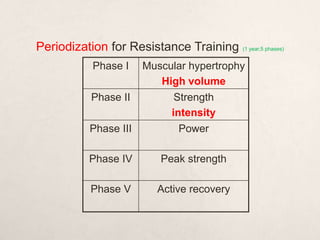
Periodization for Resistance Training (1 year,5 phases)
Phase I Muscular hypertrophy
High volume
Phase II Strength
intensity
Phase III Power
Phase IV Peak strength
Phase V Active recovery
 Undulating Periodization
 Has more variations to accommodate the unique demands of
each sport.
Resistance Training
 Types of Resistance Training
 Isometric Training
 Facilitate recovery and reduce muscle atrophy and strength loss
 Free Weights
 Resistance used is limited by the weakest point in the range of
motion.
 More motor recruitment
 Gain control of the free weight
 Stabilize the weight
 Maintain body balance
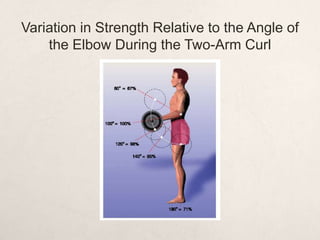
Variation in Strength Relative to the Angle of
the Elbow During the Two-Arm Curl
 Eccentric Training
 Maximize gains in strength and size
 Variable Resistance Training
 Resistance reduced at weakest points and increased at strongest
points.
 Isokinetic Training
 Motion speed is kept constant throughout.
 Contract at maximal force at all points in the range of motion (if
properly motivated).
A Variable-Resistance Training
Device
© Human Kinetics
 Plyometrics / Stretch Shortening Cycle Exercises
 Proposed to bridge the gap between speed and strength training.
 Utilizes the stretch reflex to facilitate recruitment of motor units.
 Stores energy in the elastic and contractile components of muscle
during the eccentric contraction (stretch) that can be recovered
during the concentric contraction
 Electrical Stimulation Training
 Reduce loss of strength and muscle size
Plyometric Box Jumping
Resistance Training
Programs
Key Points
 Low-repetition, high-resistance training enhances strength
development
 High-repetition, low-resistance training optimizes muscular
endurance
 Periodization is important to prevent overtraining and
burnout
 A typical periodization cycle has 4 active phases, each
emphasizing a different muscular fitness component, plus
an active recovery
(continued)
Resistance Training Programs
(continued)
Key Points
 Resistance training can use static or dynamic
contractions
 Eccentric training appears to be essential to
maximizing hypertrophy
 Electrical stimulation can be successfully used in
rehabilitating athletes
Adaptations to Resistance
Training
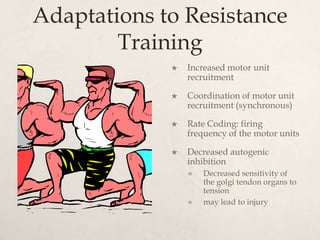
 Increased motor unit
recruitment
 Coordination of motor unit
recruitment (synchronous)
 Rate Coding: firing
frequency of the motor units
 Decreased autogenic
inhibition
 Decreased sensitivity of
the golgi tendon organs to
tension
 may lead to injury
Adaptations to Resistance
Training
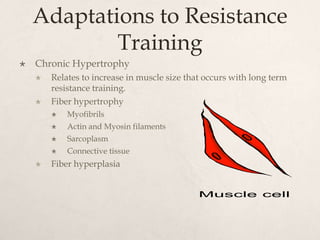
 Chronic Hypertrophy
 Relates to increase in muscle size that occurs with long term
resistance training.
 Fiber hypertrophy
 Myofibrils
 Actin and Myosin filaments
 Sarcoplasm
 Connective tissue
 Fiber hyperplasia
Adaptations to Resistance
Training
 Transient Hypertrophy
 Due to increased blood flow to the muscles during exercise.
 Fluid accumulation in the interstitial and extracellular spaces that
comes from the blood plasma.
 Lasts for a short time, as fluid returns to the blood within hours
after exercise.
Adaptations to Resistance
Training
 Fiber Type Alterations
 muscle fibers begin to take
on certain characteristics of
the opposite fiber type after
opposing training occurs.
 chronic stimulation of FT
motor units with low
frequency nerve stimulation
transforms FT motor units
into ST motor units within a
matter of weeks!
 extreme, prolonged training
may produce skeletal muscle
fiber type conversion.
Muscular Response to
Resistance Training
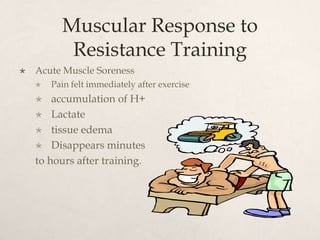
 Acute Muscle Soreness
 Pain felt immediately after exercise
 accumulation of H+
 Lactate
 tissue edema
 Disappears minutes
to hours after training.
Muscular Response to
Resistance Training
 Delayed Onset Muscle Soreness
 muscle and connective tissue damage
 inflammation (macrophages, white blood cells)
 increased chemical mediators (bradykinin)
 Edema
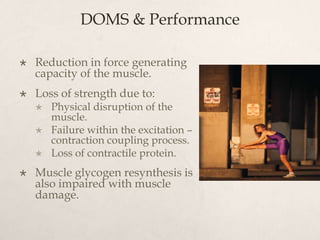
DOMS & Performance
 Reduction in force generating
capacity of the muscle.
 Loss of strength due to:
 Physical disruption of the
muscle.
 Failure within the excitation –
contraction coupling process.
 Loss of contractile protein.
 Muscle glycogen resynthesis is
also impaired with muscle
damage.
Aerobic and Anaerobic
Training
Aerobic (endurance) training
 Improved central and peripheral blood flow
• Enhances the capacity of muscle fibers to generate
ATP
Anaerobic training
• Increased short-term, high-intensity endurance
capacity
• Increased anaerobic metabolic function
• Increased tolerance for acid–base imbalances during
highly intense effort
Endurance
Muscular endurance: the ability of a single muscle or
muscle group to sustain high-intensity repetitive or
static exercise
Cardiorespiratory endurance: the entire body’s
ability to sustain prolonged, dynamic exercise using
large muscle groups
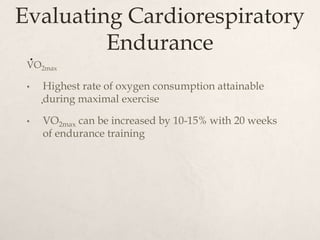
Evaluating Cardiorespiratory
Endurance
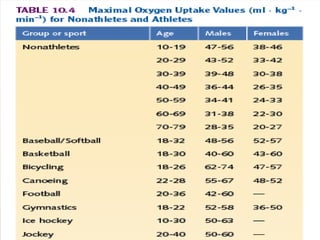
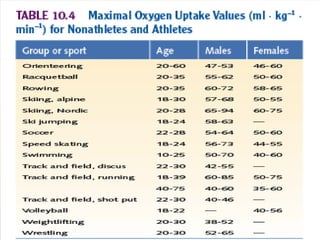
VO2max
• Highest rate of oxygen consumption attainable
during maximal exercise
• VO2max can be increased by 10-15% with 20 weeks
of endurance training
.
.
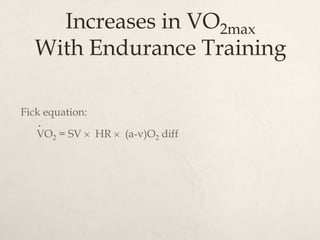
Increases in VO2max
With Endurance Training
Fick equation:
VO2 = SV HR (a-v)O2 diff
.
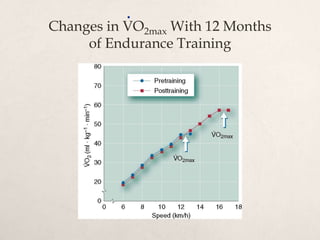
Changes in VO2max With 12 Months
of Endurance Training
.
Cardiovascular Adaptation
to Training
• Heart size
• Stroke volume
• Heart rate
• Cardiac output
• Blood flow
• Blood pressure
• Blood volume
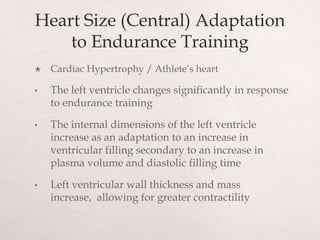
Heart Size (Central) Adaptation
to Endurance Training
 Cardiac Hypertrophy / Athlete’s heart
• The left ventricle changes significantly in response
to endurance training
• The internal dimensions of the left ventricle
increase as an adaptation to an increase in
ventricular filling secondary to an increase in
plasma volume and diastolic filling time
• Left ventricular wall thickness and mass
increase, allowing for greater contractility
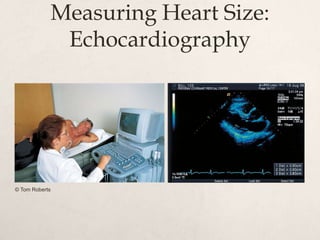
Measuring Heart Size:
Echocardiography
© Tom Roberts
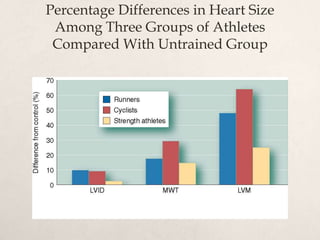
Percentage Differences in Heart Size
Among Three Groups of Athletes
Compared With Untrained Group
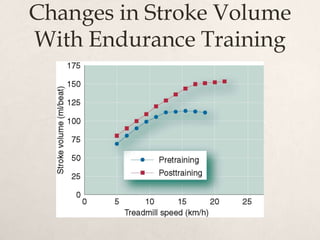
Changes in Stroke Volume
With Endurance Training
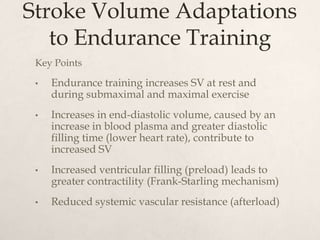
Stroke Volume Adaptations
to Endurance Training
Key Points
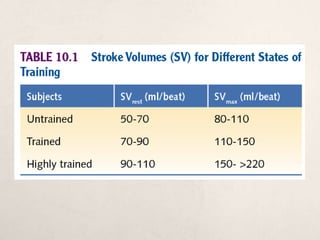
• Endurance training increases SV at rest and
during submaximal and maximal exercise
• Increases in end-diastolic volume, caused by an
increase in blood plasma and greater diastolic
filling time (lower heart rate), contribute to
increased SV
• Increased ventricular filling (preload) leads to
greater contractility (Frank-Starling mechanism)
• Reduced systemic vascular resistance (afterload)
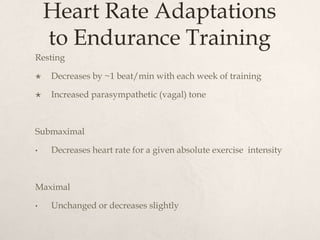
Heart Rate Adaptations
to Endurance Training
Resting
 Decreases by ~1 beat/min with each week of training
 Increased parasympathetic (vagal) tone
Submaximal
• Decreases heart rate for a given absolute exercise intensity
Maximal
• Unchanged or decreases slightly
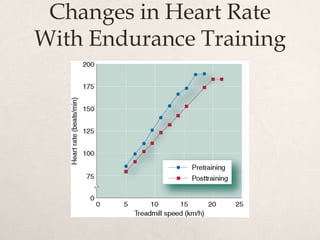
Changes in Heart Rate
With Endurance Training
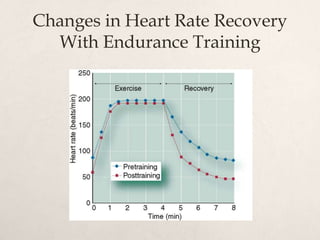
Heart Rate Recovery
• The time it takes the heart to return to its resting rate
after exercise
• Faster rate of recovery after training
• Indirect index of cardiorespiratory fitness
• Prolonged by certain environments (heat, altitude)
• Can be used as a tool to track the progress of
endurance training
Changes in Heart Rate Recovery
With Endurance Training
Cardiac Output Adaptations
to Endurance Training
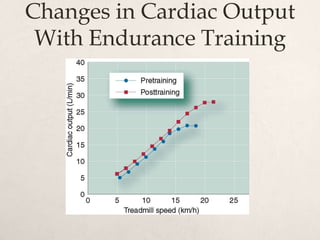
Q = HR x SV
 Does not change at rest or during submaximal exercise
(may decrease slightly)
 Maximal cardiac output increases due largely to an
increase in stroke volume
.
Changes in Cardiac Output
With Endurance Training
Cardiac Output Adaptations
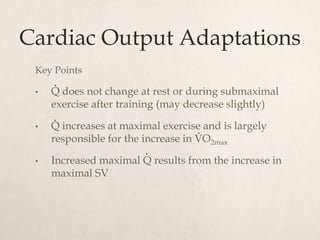
Key Points
• Q does not change at rest or during submaximal
exercise after training (may decrease slightly)
• Q increases at maximal exercise and is largely
responsible for the increase in VO2max
• Increased maximal Q results from the increase in
maximal SV
.
.
.
.
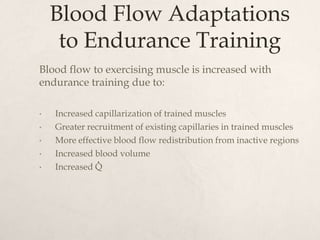
Blood Flow Adaptations
to Endurance Training
Blood flow to exercising muscle is increased with
endurance training due to:
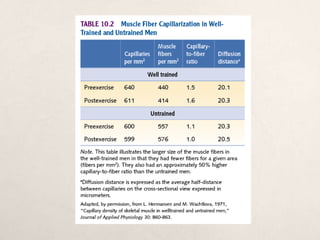
• Increased capillarization of trained muscles
• Greater recruitment of existing capillaries in trained muscles
• More effective blood flow redistribution from inactive regions
• Increased blood volume
• Increased Q
.
Blood Pressure (BP) Adaptations
to Endurance Training
 Resting BP decreases in borderline and hypertensive
individuals (6-7 mmHg reduction)
 Mean arterial pressure is reduced at a given
submaximal exercise intensity (↓ SBP, ↓ DBP)
 At maximal exercise (↑ SBP, ↓ DBP)
Blood Volume (BV) Adaptations
to Endurance Training
 BV increases rapidly with endurance training
 Plasma volume increases due to:
 Increased plasma proteins (albumin)
 Increased antidiuretic hormone and aldosterone
 Red blood cell volume increases
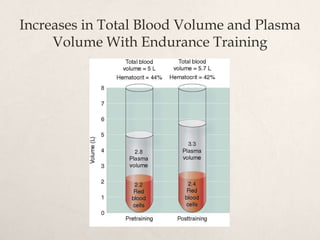
Increases in Total Blood Volume and Plasma
Volume With Endurance Training
Blood Flow, Pressure, and Volume
Adaptations to Endurance Training
Key Points
• Blood flow to active muscles is increased due to:
– ↑ Capillarization
– ↑ Capillary recruitment
– More effective redistribution
– ↑ Blood volume
• Blood pressure at rest as well as during
submaximal exercise is reduced, but not at
maximal exercise
(continued)
Blood Flow, Pressure, and Volume
Adaptations to Endurance Training
(continued)
Key Points
• Blood volume increases
• Plasma volume increases through increased protein
content and by fluid conservation hormones
• Red blood cell volume and hemoglobin increase
• Blood viscosity decreases due to the increase in plasma
volume
Respiratory Adaptations
to Endurance Training
Key Points
• Little effect on lung structure and function at rest
• Increase in pulmonary ventilation during maximal
exercise
• ↑ Tidal volume
• ↑ Respiratory rate
• Pulmonary diffusion increases at maximal exercise due
to increased ventilation and lung perfusion
• (a-v)O2 difference increases with training, reflecting
increased extraction of oxygen at the tissues
Adaptations in Muscle
to Endurance Training
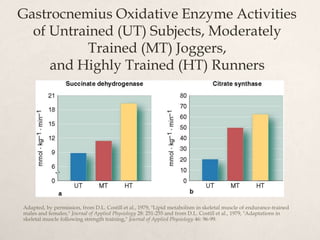
• Increased size (cross-sectional area) of type I fibers
• Transition of type IIx → type IIa fiber characteristics
• Transition of type II → type I fiber characteristics
• Increased number of capillaries per muscle fiber and for a
given cross-sectional area of muscle
• Increased myoglobin content of muscle by 75% to 80%
• Increased number, size, and oxidative enzyme activity of
mitochondria
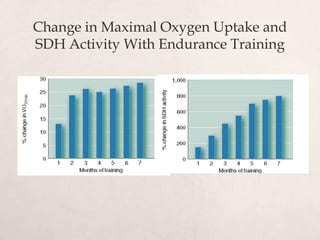
Change in Maximal Oxygen Uptake and
SDH Activity With Endurance Training
Gastrocnemius Oxidative Enzyme Activities
of Untrained (UT) Subjects, Moderately
Trained (MT) Joggers,
and Highly Trained (HT) Runners
Adapted, by permission, from D.L. Costill et al., 1979, "Lipid metabolism in skeletal muscle of endurance-trained
males and females," Journal of Applied Physiology 28: 251-255 and from D.L. Costill et al., 1979, "Adaptations in
skeletal muscle following strength training," Journal of Applied Physiology 46: 96-99.
Adaptations in Muscle With
Training
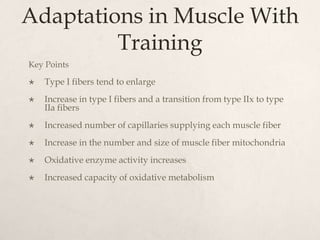
Key Points
 Type I fibers tend to enlarge
 Increase in type I fibers and a transition from type IIx to type
IIa fibers
 Increased number of capillaries supplying each muscle fiber
 Increase in the number and size of muscle fiber mitochondria
 Oxidative enzyme activity increases
 Increased capacity of oxidative metabolism
Metabolic Adaptations to
Training
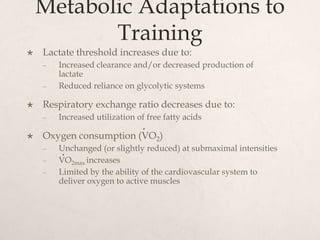
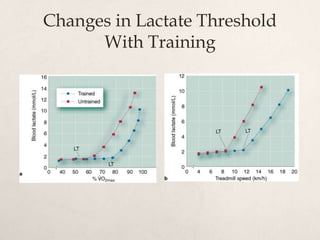
 Lactate threshold increases due to:
– Increased clearance and/or decreased production of
lactate
– Reduced reliance on glycolytic systems
 Respiratory exchange ratio decreases due to:
– Increased utilization of free fatty acids
 Oxygen consumption (VO2)
– Unchanged (or slightly reduced) at submaximal intensities
– VO2max increases
– Limited by the ability of the cardiovascular system to
deliver oxygen to active muscles
.
.
Changes in Lactate Threshold
With Training
Changes in Race Pace With Continued
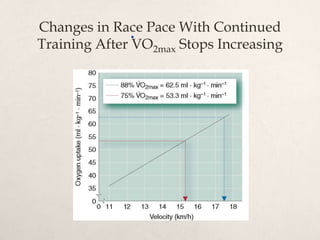
Training After VO2max Stops Increasing
.
Increased Performance
After VO2max Has Peaked
 Once an athlete has achieved their genetically
determined peak VO2max, they can still increase their
endurance performance due to the body’s ability to
perform at increasingly higher percentages of that
VO2max for extended periods. The increase in
performance without an increase in VO2max is a result
of an increase in lactate threshold.
.
.
.
.
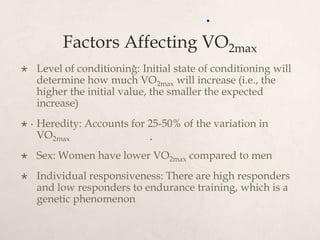
Factors Affecting VO2max
 Level of conditioning: Initial state of conditioning will
determine how much VO2max will increase (i.e., the
higher the initial value, the smaller the expected
increase)
 Heredity: Accounts for 25-50% of the variation in
VO2max
 Sex: Women have lower VO2max compared to men
 Individual responsiveness: There are high responders
and low responders to endurance training, which is a
genetic phenomenon
.
.
.
.
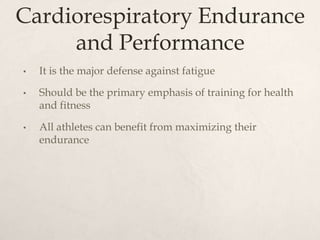
Cardiorespiratory Endurance
and Performance
• It is the major defense against fatigue
• Should be the primary emphasis of training for health
and fitness
• All athletes can benefit from maximizing their
endurance
Adaptations to Aerobic Training
Key Points
• Although VO2max has an upper limit, endurance
performance can continue to improve
• An individual’s genetic makeup predetermines a range for
his or her VO2max and accounts for 25-50% of the variance
in VO2max
• Heredity largely explains an individual’s response to
training
• Highly conditioned female endurance athletes have
VO2max values about 10% lower than their male
counterparts
• All athletes can benefit from maximizing their
cardiorespiratory endurance
.
.
.
.
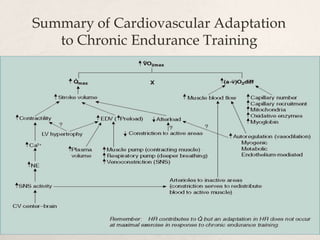
Summary of Cardiovascular Adaptation
to Chronic Endurance Training
Muscle Adaptations
to Anaerobic Training
• Increased muscle fiber recruitment
• Increased cross-sectional area of type IIa and type IIx
muscle fibers
Energy System Adaptations
to Anaerobic Training
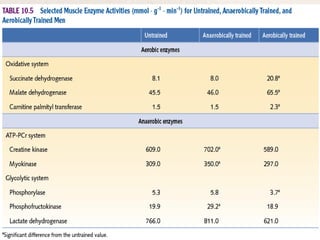
 Increased ATP-PCr system enzyme activity
 Increased activity of several key glycolytic enzymes
 No effect on oxidative enzyme activity
Anaerobic Training
Key Points
 Anaerobic training bouts improve both anaerobic
power and anaerobic capacity
 Increased performance with anaerobic training is
attributed to strength gains
 Increases ATP-PCr and glycolytic enzymes
Exercise physiology 8

Exercise physiology 8

  • 2.
     Muscle Strength Maximal force that a muscle or muscle group can generate.  Muscle Power  Rate of the performing muscle, thus the product of the force and velocity.  Explosive aspect of strength, the product of strength and speed of movement.  Power = Force X Distance / Time  Where (force = strength) and (distance/ Time = speed)
  • 3.
    POWER = SPEEDX STRENGTH Power can be developed by:- RESISTANCE RUNNING HILL RUNNING PLYOMETRICS
  • 4.
     Muscular Endurance The capacity to sustain repeated muscular contractions or a single static contraction.  Aerobic Power  Rate of energy release by cellular metabolic processes that depend upon the availability and involvement of oxygen.  Maximal aerobic power refers to the maximal capacity for aerobic resynthesis of ATP.  Equivalent to aerobic capacity and maximal oxygen uptake (VO2max).  Best lab test is a graded exercise test to exhaustion.
  • 5.
     Anaerobic Power Rate of energy release by cellular metabolic processes that function without the involvement of oxygen.  Maximum anaerobic power / anaerobic capacity – maximal capacity for the anaerobic system to produce ATP  Tests: None universally accepted  Critical Power Test  Wingate anaerobic Test
  • 8.
    Principle of Individuality No two individuals have exactly the same genetic characteristics (except for identical twins).  Many factors contribute to variations in training responses among individuals:  Heredity  Relative Fitness Level  Cellular Growth Rate  Metabolism  Cardiovascular and Respiratory regulation  Neural and Endocrine regulation
  • 9.
    Principle of Specificity Exercise response is specific to the mode and intensity of exercise.  The training program must stress the physiological systems that are critical for optimal performance in the given sport to achieve specific training adaptations.  Specific exercise elicits specific adaptations, creating specific effects (Specific Adaptations to Imposed Demands principle).
  • 10.
    Principle of Reversibility Detraining causes measurable reductions in physiological functions and exercise capacity.  Reversal of improvements gained through training, decreasing to a level that meets the demands of ADLs.  Training program must include a maintenance plan.
  • 11.
    Principle of Progressive Overload Overload and progressive training form the foundation of all training.  Exercising @ intensities greater than normal induces a variety of highly specific adaptations that enables the body to function more efficiently.  Achieving the appropriate overload requires manipulating combinations of training:  Frequency  Intensity  Duration  Exercise Mode
  • 12.
    Principle of Hard/Easy Training Hard  Training each day @ high intensities or for long durations or both.  Training Easy  Provides a day active recovery so that the body is prepared for future hard training.
  • 13.
    Principle of Periodization Periodization is the gradual cycling of specificity, intensity, and volume of training to achieve peak levels of fitness for competition.  Macrocycle  Mesocycle  Preparation  Competition  Transition  Microcycle
  • 15.
    Training Needs Analysis Should include the following assessment:  What major muscle groups need to be trained?  What type of training should be used?  What energy system should be stressed?  What are the primary sites of concern for injury prevention?
  • 16.
     Prescriptions shouldentail:  Exercises to be performed.  Order in which they will be performed.  Number of sets for each exercise.  Rest period for between each set and between exercises.  Intensity or load.  Number of repetitions.  Velocity of movement to be used.
  • 17.
    Selecting the Appropriate Resistanceand Repetitions  The resistance to be used is generally expressed as a percentage of the maximal capacity.  Strength development is optimized by moderate to high resistance (60 – 80% of 1RM) with low to moderate repetitions (6- 12 reps).  Muscular endurance is optimized by low to moderate resistance (30 – 70% of the 1RM) and moderate to high repetitions (10 – 25 reps).  Power is optimized by alternating low to moderate resistance (30 – 60% of 1 RM) and low repetition (3 – 6 reps) at an explosive velocity with the traditional strength training recommendations.
  • 18.
     To hypertrophymuscle – moderate to high resistance (70 – 100% 1RM) with low to moderate repetition (1 – 12 reps)
  • 19.
    Selecting the Appropriate Numberof Sets  Single set versus multiple sets.  Single set used for untrained persons or those needing to maintain a basic level of muscular fitness and not interested in further improvements.  Multiple sets used for additional gains in:  Strength  Endurance  Power  Hypertrophy
  • 21.
    Periodization  Refers tochanges or variations in the resistance program that are implemented over the course of a specific period of time (eg. a year).  It varies the exercise stimulus to keep the individual from overtraining or becoming stale.
  • 22.
     Two formsof periodization:  Classic Strength and Power Periodization  Undulating Periodization
  • 23.
     Classic Strengthand Power Periodization  Consists of 5 phases in each training cycle.  Phase I  High volume with low intensity  Phase II, III, and IV  Volume decreased with increasing intensity.  Phase V (active recovery phase)  Either light resistance training or some unrelated activity is allowed to allow the person time to recover from the training cycle both physically and mentally.
  • 24.
    Periodization for ResistanceTraining (1 year,5 phases) Phase I Muscular hypertrophy High volume Phase II Strength intensity Phase III Power Phase IV Peak strength Phase V Active recovery
  • 26.
     Undulating Periodization Has more variations to accommodate the unique demands of each sport.
  • 27.
    Resistance Training  Typesof Resistance Training  Isometric Training  Facilitate recovery and reduce muscle atrophy and strength loss  Free Weights  Resistance used is limited by the weakest point in the range of motion.  More motor recruitment  Gain control of the free weight  Stabilize the weight  Maintain body balance
  • 28.
    Variation in StrengthRelative to the Angle of the Elbow During the Two-Arm Curl
  • 29.
     Eccentric Training Maximize gains in strength and size  Variable Resistance Training  Resistance reduced at weakest points and increased at strongest points.  Isokinetic Training  Motion speed is kept constant throughout.  Contract at maximal force at all points in the range of motion (if properly motivated).
  • 30.
  • 31.
     Plyometrics /Stretch Shortening Cycle Exercises  Proposed to bridge the gap between speed and strength training.  Utilizes the stretch reflex to facilitate recruitment of motor units.  Stores energy in the elastic and contractile components of muscle during the eccentric contraction (stretch) that can be recovered during the concentric contraction  Electrical Stimulation Training  Reduce loss of strength and muscle size
  • 32.
  • 33.
    Resistance Training Programs Key Points Low-repetition, high-resistance training enhances strength development  High-repetition, low-resistance training optimizes muscular endurance  Periodization is important to prevent overtraining and burnout  A typical periodization cycle has 4 active phases, each emphasizing a different muscular fitness component, plus an active recovery (continued)
  • 34.
    Resistance Training Programs (continued) KeyPoints  Resistance training can use static or dynamic contractions  Eccentric training appears to be essential to maximizing hypertrophy  Electrical stimulation can be successfully used in rehabilitating athletes
  • 35.
    Adaptations to Resistance Training Increased motor unit recruitment  Coordination of motor unit recruitment (synchronous)  Rate Coding: firing frequency of the motor units  Decreased autogenic inhibition  Decreased sensitivity of the golgi tendon organs to tension  may lead to injury
  • 36.
    Adaptations to Resistance Training Chronic Hypertrophy  Relates to increase in muscle size that occurs with long term resistance training.  Fiber hypertrophy  Myofibrils  Actin and Myosin filaments  Sarcoplasm  Connective tissue  Fiber hyperplasia
  • 37.
    Adaptations to Resistance Training Transient Hypertrophy  Due to increased blood flow to the muscles during exercise.  Fluid accumulation in the interstitial and extracellular spaces that comes from the blood plasma.  Lasts for a short time, as fluid returns to the blood within hours after exercise.
  • 38.
    Adaptations to Resistance Training Fiber Type Alterations  muscle fibers begin to take on certain characteristics of the opposite fiber type after opposing training occurs.  chronic stimulation of FT motor units with low frequency nerve stimulation transforms FT motor units into ST motor units within a matter of weeks!  extreme, prolonged training may produce skeletal muscle fiber type conversion.
  • 39.
    Muscular Response to ResistanceTraining  Acute Muscle Soreness  Pain felt immediately after exercise  accumulation of H+  Lactate  tissue edema  Disappears minutes to hours after training.
  • 40.
    Muscular Response to ResistanceTraining  Delayed Onset Muscle Soreness  muscle and connective tissue damage  inflammation (macrophages, white blood cells)  increased chemical mediators (bradykinin)  Edema
  • 41.
    DOMS & Performance Reduction in force generating capacity of the muscle.  Loss of strength due to:  Physical disruption of the muscle.  Failure within the excitation – contraction coupling process.  Loss of contractile protein.  Muscle glycogen resynthesis is also impaired with muscle damage.
  • 43.
    Aerobic and Anaerobic Training Aerobic(endurance) training  Improved central and peripheral blood flow • Enhances the capacity of muscle fibers to generate ATP Anaerobic training • Increased short-term, high-intensity endurance capacity • Increased anaerobic metabolic function • Increased tolerance for acid–base imbalances during highly intense effort
  • 44.
    Endurance Muscular endurance: theability of a single muscle or muscle group to sustain high-intensity repetitive or static exercise Cardiorespiratory endurance: the entire body’s ability to sustain prolonged, dynamic exercise using large muscle groups
  • 45.
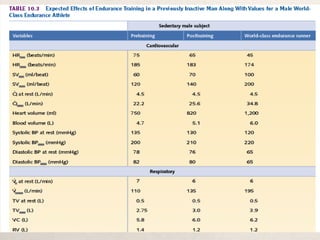
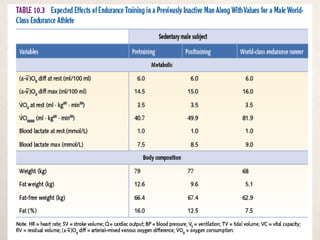
    Evaluating Cardiorespiratory Endurance VO2max • Highestrate of oxygen consumption attainable during maximal exercise • VO2max can be increased by 10-15% with 20 weeks of endurance training . .
  • 46.
    Increases in VO2max WithEndurance Training Fick equation: VO2 = SV HR (a-v)O2 diff .
  • 47.
    Changes in VO2maxWith 12 Months of Endurance Training .
  • 48.
    Cardiovascular Adaptation to Training •Heart size • Stroke volume • Heart rate • Cardiac output • Blood flow • Blood pressure • Blood volume
  • 49.
    Heart Size (Central)Adaptation to Endurance Training  Cardiac Hypertrophy / Athlete’s heart • The left ventricle changes significantly in response to endurance training • The internal dimensions of the left ventricle increase as an adaptation to an increase in ventricular filling secondary to an increase in plasma volume and diastolic filling time • Left ventricular wall thickness and mass increase, allowing for greater contractility
  • 50.
  • 51.
    Percentage Differences inHeart Size Among Three Groups of Athletes Compared With Untrained Group
  • 52.
    Changes in StrokeVolume With Endurance Training
  • 54.
    Stroke Volume Adaptations toEndurance Training Key Points • Endurance training increases SV at rest and during submaximal and maximal exercise • Increases in end-diastolic volume, caused by an increase in blood plasma and greater diastolic filling time (lower heart rate), contribute to increased SV • Increased ventricular filling (preload) leads to greater contractility (Frank-Starling mechanism) • Reduced systemic vascular resistance (afterload)
  • 55.
    Heart Rate Adaptations toEndurance Training Resting  Decreases by ~1 beat/min with each week of training  Increased parasympathetic (vagal) tone Submaximal • Decreases heart rate for a given absolute exercise intensity Maximal • Unchanged or decreases slightly
  • 56.
    Changes in HeartRate With Endurance Training
  • 57.
    Heart Rate Recovery •The time it takes the heart to return to its resting rate after exercise • Faster rate of recovery after training • Indirect index of cardiorespiratory fitness • Prolonged by certain environments (heat, altitude) • Can be used as a tool to track the progress of endurance training
  • 58.
    Changes in HeartRate Recovery With Endurance Training
  • 59.
    Cardiac Output Adaptations toEndurance Training Q = HR x SV  Does not change at rest or during submaximal exercise (may decrease slightly)  Maximal cardiac output increases due largely to an increase in stroke volume .
  • 60.
    Changes in CardiacOutput With Endurance Training
  • 61.
    Cardiac Output Adaptations KeyPoints • Q does not change at rest or during submaximal exercise after training (may decrease slightly) • Q increases at maximal exercise and is largely responsible for the increase in VO2max • Increased maximal Q results from the increase in maximal SV . . . .
  • 62.
    Blood Flow Adaptations toEndurance Training Blood flow to exercising muscle is increased with endurance training due to: • Increased capillarization of trained muscles • Greater recruitment of existing capillaries in trained muscles • More effective blood flow redistribution from inactive regions • Increased blood volume • Increased Q .
  • 64.
    Blood Pressure (BP)Adaptations to Endurance Training  Resting BP decreases in borderline and hypertensive individuals (6-7 mmHg reduction)  Mean arterial pressure is reduced at a given submaximal exercise intensity (↓ SBP, ↓ DBP)  At maximal exercise (↑ SBP, ↓ DBP)
  • 65.
    Blood Volume (BV)Adaptations to Endurance Training  BV increases rapidly with endurance training  Plasma volume increases due to:  Increased plasma proteins (albumin)  Increased antidiuretic hormone and aldosterone  Red blood cell volume increases
  • 66.
    Increases in TotalBlood Volume and Plasma Volume With Endurance Training
  • 67.
    Blood Flow, Pressure,and Volume Adaptations to Endurance Training Key Points • Blood flow to active muscles is increased due to: – ↑ Capillarization – ↑ Capillary recruitment – More effective redistribution – ↑ Blood volume • Blood pressure at rest as well as during submaximal exercise is reduced, but not at maximal exercise (continued)
  • 68.
    Blood Flow, Pressure,and Volume Adaptations to Endurance Training (continued) Key Points • Blood volume increases • Plasma volume increases through increased protein content and by fluid conservation hormones • Red blood cell volume and hemoglobin increase • Blood viscosity decreases due to the increase in plasma volume
  • 69.
    Respiratory Adaptations to EnduranceTraining Key Points • Little effect on lung structure and function at rest • Increase in pulmonary ventilation during maximal exercise • ↑ Tidal volume • ↑ Respiratory rate • Pulmonary diffusion increases at maximal exercise due to increased ventilation and lung perfusion • (a-v)O2 difference increases with training, reflecting increased extraction of oxygen at the tissues
  • 70.
    Adaptations in Muscle toEndurance Training • Increased size (cross-sectional area) of type I fibers • Transition of type IIx → type IIa fiber characteristics • Transition of type II → type I fiber characteristics • Increased number of capillaries per muscle fiber and for a given cross-sectional area of muscle • Increased myoglobin content of muscle by 75% to 80% • Increased number, size, and oxidative enzyme activity of mitochondria
  • 71.
    Change in MaximalOxygen Uptake and SDH Activity With Endurance Training
  • 72.
    Gastrocnemius Oxidative EnzymeActivities of Untrained (UT) Subjects, Moderately Trained (MT) Joggers, and Highly Trained (HT) Runners Adapted, by permission, from D.L. Costill et al., 1979, "Lipid metabolism in skeletal muscle of endurance-trained males and females," Journal of Applied Physiology 28: 251-255 and from D.L. Costill et al., 1979, "Adaptations in skeletal muscle following strength training," Journal of Applied Physiology 46: 96-99.
  • 73.
    Adaptations in MuscleWith Training Key Points  Type I fibers tend to enlarge  Increase in type I fibers and a transition from type IIx to type IIa fibers  Increased number of capillaries supplying each muscle fiber  Increase in the number and size of muscle fiber mitochondria  Oxidative enzyme activity increases  Increased capacity of oxidative metabolism
  • 74.
    Metabolic Adaptations to Training Lactate threshold increases due to: – Increased clearance and/or decreased production of lactate – Reduced reliance on glycolytic systems  Respiratory exchange ratio decreases due to: – Increased utilization of free fatty acids  Oxygen consumption (VO2) – Unchanged (or slightly reduced) at submaximal intensities – VO2max increases – Limited by the ability of the cardiovascular system to deliver oxygen to active muscles . .
  • 75.
    Changes in LactateThreshold With Training
  • 78.
    Changes in RacePace With Continued Training After VO2max Stops Increasing .
  • 79.
    Increased Performance After VO2maxHas Peaked  Once an athlete has achieved their genetically determined peak VO2max, they can still increase their endurance performance due to the body’s ability to perform at increasingly higher percentages of that VO2max for extended periods. The increase in performance without an increase in VO2max is a result of an increase in lactate threshold. . . . .
  • 80.
    Factors Affecting VO2max Level of conditioning: Initial state of conditioning will determine how much VO2max will increase (i.e., the higher the initial value, the smaller the expected increase)  Heredity: Accounts for 25-50% of the variation in VO2max  Sex: Women have lower VO2max compared to men  Individual responsiveness: There are high responders and low responders to endurance training, which is a genetic phenomenon . . . .
  • 83.
    Cardiorespiratory Endurance and Performance •It is the major defense against fatigue • Should be the primary emphasis of training for health and fitness • All athletes can benefit from maximizing their endurance
  • 84.
    Adaptations to AerobicTraining Key Points • Although VO2max has an upper limit, endurance performance can continue to improve • An individual’s genetic makeup predetermines a range for his or her VO2max and accounts for 25-50% of the variance in VO2max • Heredity largely explains an individual’s response to training • Highly conditioned female endurance athletes have VO2max values about 10% lower than their male counterparts • All athletes can benefit from maximizing their cardiorespiratory endurance . . . .
  • 85.
    Summary of CardiovascularAdaptation to Chronic Endurance Training
  • 86.
    Muscle Adaptations to AnaerobicTraining • Increased muscle fiber recruitment • Increased cross-sectional area of type IIa and type IIx muscle fibers
  • 87.
    Energy System Adaptations toAnaerobic Training  Increased ATP-PCr system enzyme activity  Increased activity of several key glycolytic enzymes  No effect on oxidative enzyme activity
  • 88.
    Anaerobic Training Key Points Anaerobic training bouts improve both anaerobic power and anaerobic capacity  Increased performance with anaerobic training is attributed to strength gains  Increases ATP-PCr and glycolytic enzymes

Editor's Notes

  • #3 1 RM – maximal weight one can lift just once.
  • #24 Cycles can vary in duration from 1 cycle per year to two or three per year.
  • #26 Main idea is to gradually decrease volume while gradually increasing intensity.
  • #27 Sports vary in length of season, demand during the season, needs for peaking of strength and power for major competitions.
  • #30 ET – The muscles ability to resist force is considerably greater than with concentric contractions.
  • #32 Plyoeg. – To develop knee extensor strength a person goes from standing upright to a deep squat (eccentric contraction), and then jumps up unto a box (concentric contraction), landing in a squat position on the box. Then jump from box to ground, landing in a squat position. Repeat
  • #39 Fiber type conversion is possible under conditions of cross innervation, where type II motor units artificially innervates a type I motor unit (vice versa). More recent studies have shown that a combination of high intensity resistance training and short interval speed work can lead to a conversion of type I to type IIa fibers.