1
MANUAL MUSCLE TESTING
Definition:
Manual muscle testing is a procedure for the evaluation of the function and
strength of individual muscles and muscles group based on effective
performance of a movement in relation to the forces of gravity and manual
resistance through the available ROM.
The purpose of muscle test:
1. To assess muscle strength
2. To provide information that may be of assistance to several health
professionals in differential diagnosis, treatment planning and prognosis.
3. A consistent method of manually testing muscle strength is essential to
assess accurately a patient's present status, progress, and the effectiveness,
of the treatment program.
The requirements of muscle test: The therapist must have a sound
knowledge of:
1. Anatomy (including joint motions, muscle origin and insertion, and
muscle function).
2. Surface anatomy (to knowwhere a muscle or its tendon is best palpated).
3. The therapist must be a keen observer and be experienced in muscle
testing to detect minimal muscle contraction, movement, and/or muscle
wasting and substitutions or trick movements.
Terminology related to muscle test:
1. Muscular strength: The maximal amount of tension or force that a
muscle or muscle group can voluntarily exert in one maximal effort, when
type of muscle contraction, limb velocity, and joint angle are specified.
Factors Affecting Strength:
The therapist must consider these factors when assessing a patient's
strength.
1. Age: A decrease in strength occurs with increasing age due to
deterioration in muscle mass. Muscle fibers decrease in size and
number, there is an increase in connective tissue and fat, and the
respiratory capacity of the muscle decreases.
2
2. Sex: Males are generally stronger than females.
3. Type of muscle contraction: More tension can be developed during
an eccentric contraction than during an isometric contraction. The
concentric contraction has the smallest tension capability.
4. Muscle size: The larger the cross-sectional area of a muscle, the
greater the strength of the muscle. When testing a muscle that is small,
the therapist would expect less tension to be developed than if testing
a large, thick muscle.
5. Speed of muscle contraction: When a muscle contracts
concentricity the force of contraction decreases as the speed of
contraction increases. The patient is instructed to perform each muscle
test movement at a moderate pace.
6. Previous training effect: Strength performance depends up on the
ability of the nervous system to activate the muscle mass. Strength may
increase as one becomes familiar with and learns the test situation. The
therapist must instruct the patient well and give the patient an
opportunity to move through or be passively moved through the test
movement at least once before strength is assessed.
7. Joint position: Angle of muscle pull and Length tension relation:
The tension developed within a muscle depends up on the initial length
of the muscle. Regardless of the type of muscle contraction, a muscle
contracts with more force when it is stretched that when it is shortened.
The greatest amount of tension is developed when the muscle is
stretched to the greatest length possible within the body that is if the
muscle is in full outer range.
8. Fatigue: As the patient fatigues, muscle strength decreases. The
therapist determines the strength of muscle using as few repetitions as
possible to avoid fatigue.
9. Others: The patient's level of motivation, level of pain, body type,
occupation, and dominance are other factors that may affect strength.
2. Muscular Endurance: The ability of a muscle or a muscle group to
perform repeated contractions, against resistance, or maintain an isometric
contraction for a period.
3- Muscle power
Is defined as the generate as much force as fast as possible, require strength
and speed to develop force quickly.
3
Functional classification of muscle: Muscles may be categorized as
follows, according to the major role of the muscles in producing the
movement.
A. Prime Mover or agonist: A muscle or muscle group that makes the
major contribution to movement at the joint.
B. Antagonist: A muscle or a muscle group that has an opposite action to
the prime movers. The antagonist relaxes as the agonist moves the part
through a ROM.
C. Synergist: A muscle that contracts and works a long with the agonist
to produce the desired movement.
Three types of synergists are described:
a. Neutralizing or counter acting synergists: Muscles contracted to
prevent unwanted movements produced by the prime mover.
For example, when the long finger flexors contract to produce finger
flexion the wrist extensors contract to prevent wrist flexion from
occurring.
b. Conjoint synergists: Two or more muscles that work together to
produce the desired movement. The muscles contracting alone would
be unable to produce the movement.
For example, wrist extension is produced by contraction of extensor
carpiradialis longus and brives and extensor carpiulnaris. If the
extensor carpiradialis longus or brevis contract a lone the wrist extends
and radially deviates, if the extensor carpiulnaris contracts alone the
wrist extends and ulnar deviates. When the muscles contract as a group
the deviation actions cancel out and the common action of wrist results
(extension).
c. Stabilizing or Fixating Synergists: Muscle that prevent movement or
control the movement at joints proximal to the moving joint to provide
a fixed or stable base from which the distal moving segment can
effectively work.
For example, if the elbow flexors contract to lift an object off a table
anterior to the body, the muscles of the scapula and glenohumeral joint
must contract to either allow slow controlled movement or no
movement to occur at the scapula and glenohumeral joint to provide
the elbow flexors with a fixed origin from which to pull. If the scapular
4
muscles did not contract the object could not be lifted as the elbow
flexors would act to pull the shoulder girdle downward toward the
tabletop.
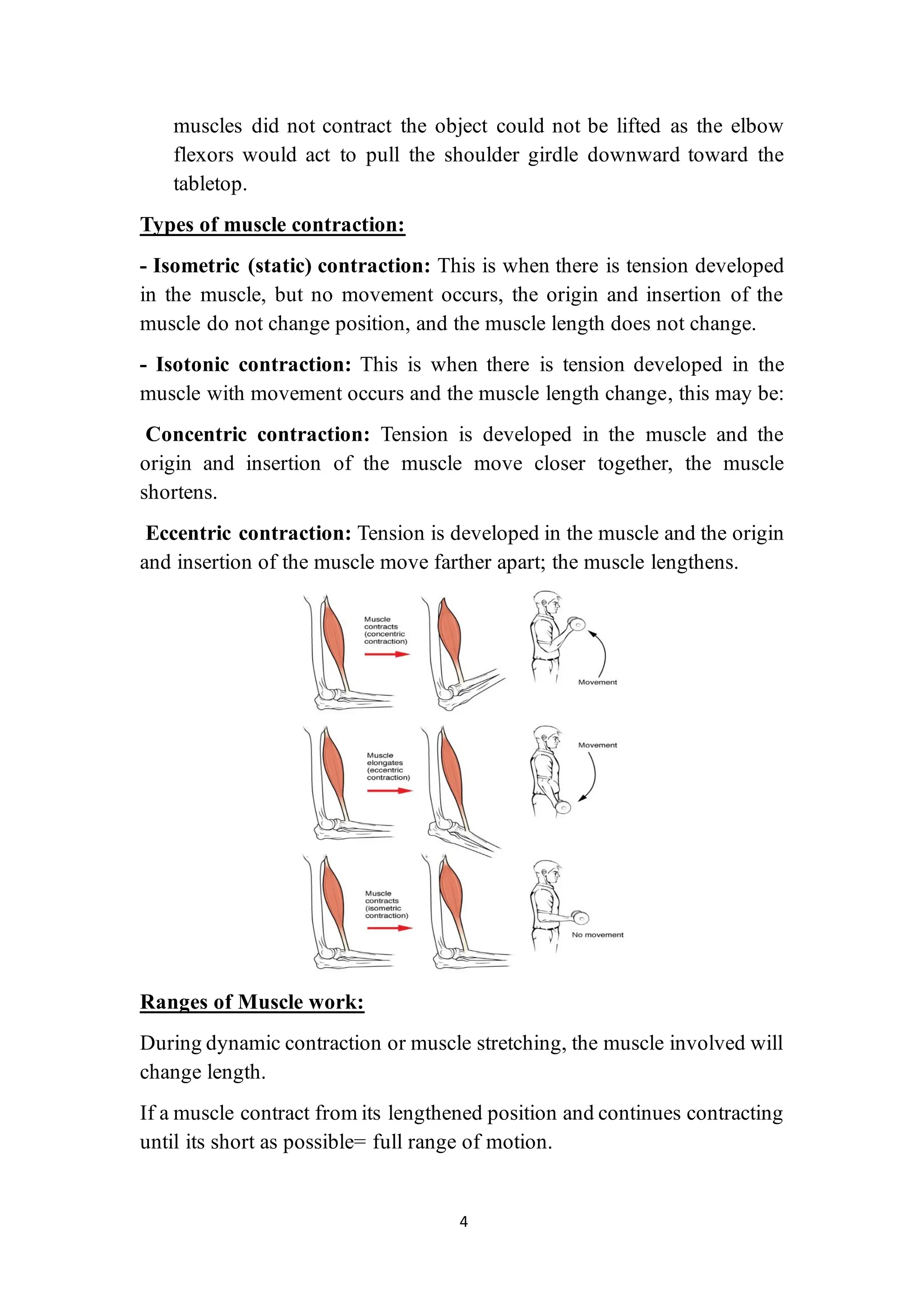
Types of muscle contraction:
- Isometric (static) contraction: This is when there is tension developed
in the muscle, but no movement occurs, the origin and insertion of the
muscle do not change position, and the muscle length does not change.
- Isotonic contraction: This is when there is tension developed in the
muscle with movement occurs and the muscle length change, this may be:
Concentric contraction: Tension is developed in the muscle and the
origin and insertion of the muscle move closer together, the muscle
shortens.
Eccentric contraction: Tension is developed in the muscle and the origin
and insertion of the muscle move farther apart; the muscle lengthens.
Ranges of Muscle work:
During dynamic contraction or muscle stretching, the muscle involved will
change length.
If a muscle contract from its lengthened position and continues contracting
until its short as possible= full range of motion.
5
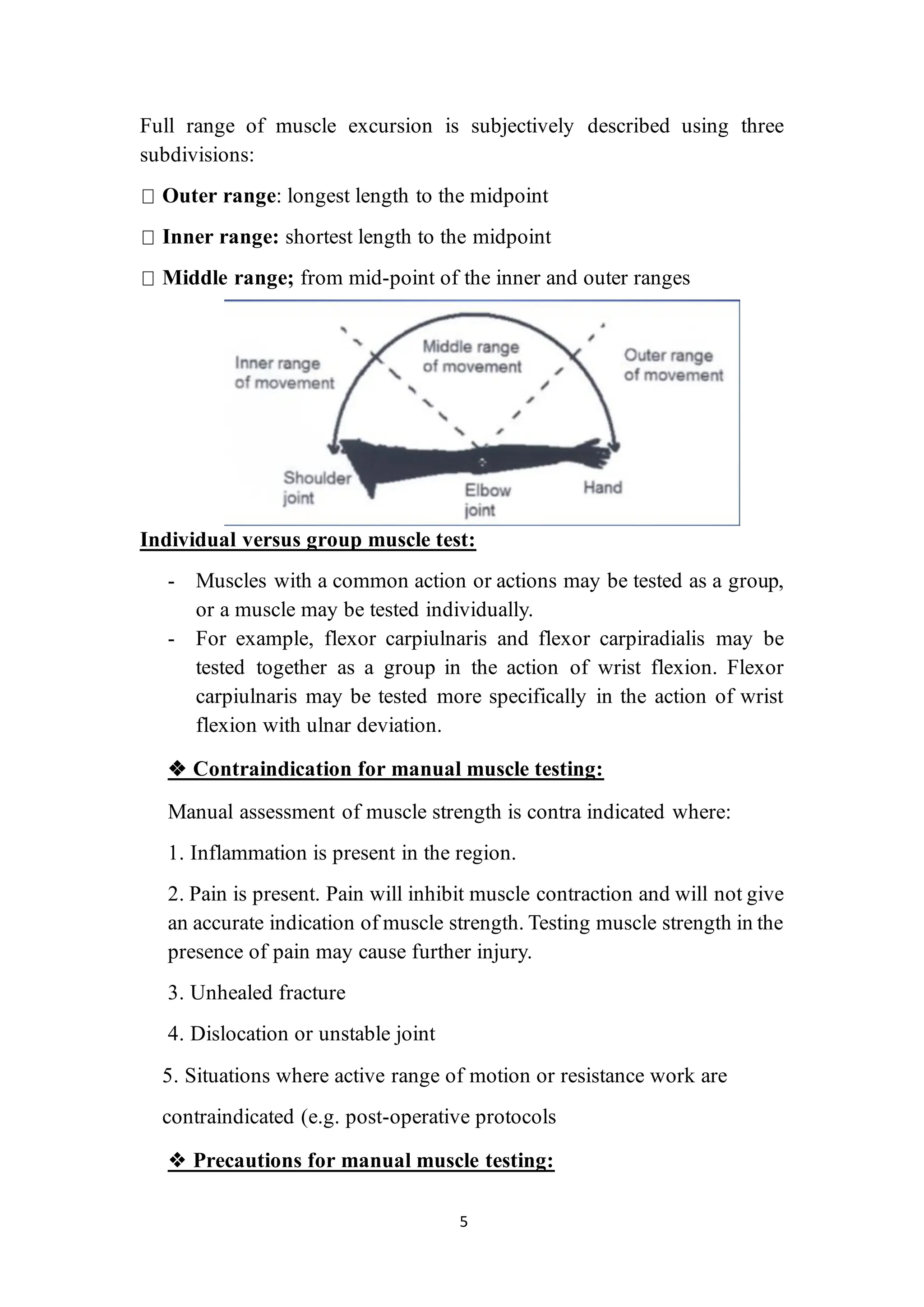
Full range of muscle excursion is subjectively described using three
subdivisions:
Outer range: longest length to the midpoint
Inner range: shortest length to the midpoint
Middle range; from mid-point of the inner and outer ranges
Individual versus group muscle test:
- Muscles with a common action or actions may be tested as a group,
or a muscle may be tested individually.
- For example, flexor carpiulnaris and flexor carpiradialis may be
tested together as a group in the action of wrist flexion. Flexor
carpiulnaris may be tested more specifically in the action of wrist
flexion with ulnar deviation.
❖ Contraindication for manual muscle testing:
Manual assessment of muscle strength is contra indicated where:
1. Inflammation is present in the region.
2. Pain is present. Pain will inhibit muscle contraction and will not give
an accurate indication of muscle strength. Testing muscle strength in the
presence of pain may cause further injury.
3. Unhealed fracture
4. Dislocation or unstable joint
5. Situations where active range of motion or resistance work are
contraindicated (e.g. post-operative protocols
❖ Precautions for manual muscle testing:
6
Extra care must be taken where resisted movements might aggravate
the condition: Such as:
1. In patient with a history of or at risk of having cardiovascular
problems.
2. In patients who have experienced abdominal surgery or patients with
herniation of the abdominal wall to avoid unsafe level stress on the
abdominal wall.
3. In situations where fatigue may be detrimental to or exacerbate the
patient's condition. Patients with extreme debility, for example
malnutrition, malignancy, and sever chronic obstructive pulmonary
disease. These patients do not have the energy to carry out strenuous
testing.
Principles of Assessment
Some overall guiding principles when assessing muscle strength are as
follows:
1- Compare the unaffected side with the affected side Where possible,
assess the unaffected limb's active range of motion first.
- This shows the patient's willingness to move and provides a
baseline for normal movement of the joint being tested.
- It also shows the patient what to expect, which increases patient
confidence and reduces apprehension when testing the affected
side.
2- Any movements that are painful should be completed last. This helps
to minimize the risk of overflow of painful symptoms to the next
movement.
Preparation
- Determine whether there are contraindications or precautions and
what joints, muscles and motions need to be tested.
- Organize the testing sequence by body position to minimize
changes in positioning.
Communication
- Briefly explain the procedure for manual muscle testing to the
patient.
7
- Explain and demonstrate the movement to be performed and/or
passively move the patient’s limb through the test movement.
- Explain and demonstrate the examiner’s and patient's roles and
confirm the patient understands and is willing to participate.
Expose the Area
- Explain and demonstrate anatomical landmarks and why they need
to be exposed. Adequately expose the area and drape the patient as
required.
Positioning
- Proper positioning of the patient ensures that the appropriate
muscle is tested. It also helps prevent substitution
movements/actions by other muscles.
- Aim to isolate the action of a specific muscle to minimize the
influence of other muscles when testing
- Place the patient in the starting position.
- Make sure the patient is comfortable and properly supported.
- The muscle or muscle group tested can be placed in full outer
range when testing strength through range.
❖ Factors That May Cause Inaccurate Muscle Testing
1. The subject becomes distracted during testing.
2. The subject experiences pain during testing.
3. The subject is positioned improperly.
4. The body part being tested is not adequately stabilized.
5. Inability of the subject to understand the test requirements/commands
because of poor comprehension or cultural and language barriers.
6. The subject does not have the coordination to perform the test
adequately.
7. Inadequate understanding of basic anatomy/kinesiology by the
clinician.
8. Poor awareness of basic substitution patterns by the clinician.
8
9. “Over grading” or “under grading” a muscle because of clinician
inexperience.
10. Inconsistency in timing, pressure, and positioning by the clinician.
11. The use of gloves by the clinician may alter the ability to palpate a
muscle contraction accurately.
12. External devices or equipment in the environment may limit the
clinician’s ability to adequately test a body part.
THE GRADING SYSTEM
Grades for a manual muscle test are recorded as numerical scores
ranging from zero (0), which represents no activity, to five (5), which
represents a "nor mal" or best-possible response to the test or as great
a response as can be evaluated by a manual muscle test. The 5 to 0
system of grading is the most used convention.
❖ CONVENTIONAL GRADING Of MMT
9
Methods of MMT:
- The Break Test
Manual resistance is applied to a limb or other body part after it has
completed its range of movement or after it has been placed at end range
by the examiner.
- Active Resistance Test
An alternative to the break test is the application of manual resistance
against an actively contracting muscle or muscle group (i.e., against the
direction of the movement as if to prevent that movement). This may be
called an "active resistance" test. During the motion, the examiner
gradually increases the amount of manual resistance until it reaches the
maximal level the subject can tolerate and motion ceases.
Instrumentation used for muscle testing:
1- Dynamometer
Dynamometer is a more precise and objective measurement of the force
that a muscle can exert. It allows the assessor to compare strength on each
side and measures strength changes during a rehabilitation program. It
typically uses the same positioning as manual muscle testing but provides
more quantifiable data.
Benefits of dynamometry:
• more sensitive than manual muscle testing
10
It depends on principle of compression,Application of external force to the
dynamometer, compress a steel spring & moves a pointer.
2- Pinch Gauge
Pinch gauges are used to test the pinch strength of patients.
Pinch strength is often used by physical therapists and other medical
professionals in conjunction with grip strength testing to assess injuries and
disabilities. It is also used by physiologists and research to understand
relationships between finger/hand strength and other health functions of
the body.
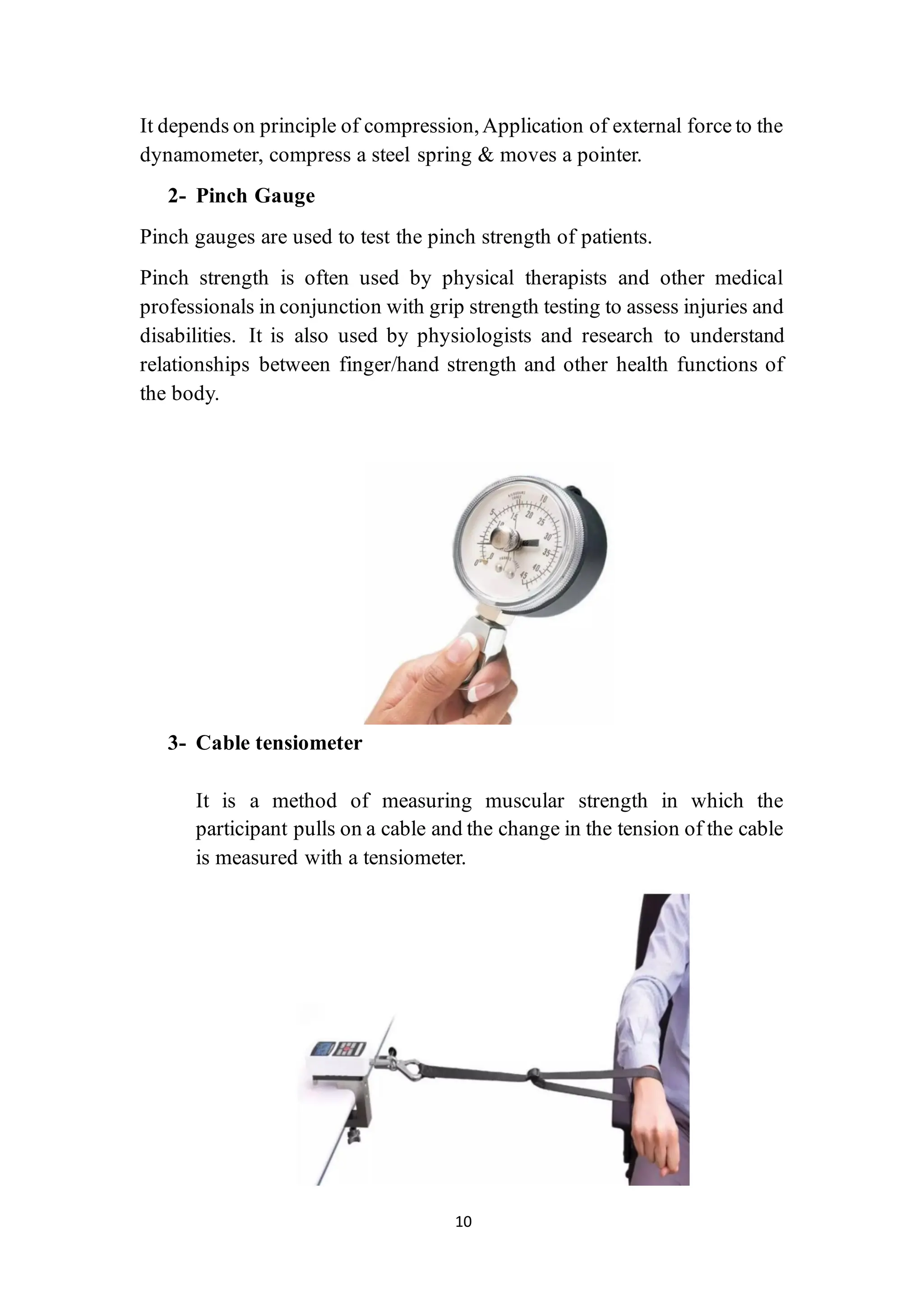
3- Cable tensiometer
It is a method of measuring muscular strength in which the
participant pulls on a cable and the change in the tension of the cable
is measured with a tensiometer.

Introduction to maual muscle test(1).pdf

  • 1.
    1 MANUAL MUSCLE TESTING Definition: Manualmuscle testing is a procedure for the evaluation of the function and strength of individual muscles and muscles group based on effective performance of a movement in relation to the forces of gravity and manual resistance through the available ROM. The purpose of muscle test: 1. To assess muscle strength 2. To provide information that may be of assistance to several health professionals in differential diagnosis, treatment planning and prognosis. 3. A consistent method of manually testing muscle strength is essential to assess accurately a patient's present status, progress, and the effectiveness, of the treatment program. The requirements of muscle test: The therapist must have a sound knowledge of: 1. Anatomy (including joint motions, muscle origin and insertion, and muscle function). 2. Surface anatomy (to knowwhere a muscle or its tendon is best palpated). 3. The therapist must be a keen observer and be experienced in muscle testing to detect minimal muscle contraction, movement, and/or muscle wasting and substitutions or trick movements. Terminology related to muscle test: 1. Muscular strength: The maximal amount of tension or force that a muscle or muscle group can voluntarily exert in one maximal effort, when type of muscle contraction, limb velocity, and joint angle are specified. Factors Affecting Strength: The therapist must consider these factors when assessing a patient's strength. 1. Age: A decrease in strength occurs with increasing age due to deterioration in muscle mass. Muscle fibers decrease in size and number, there is an increase in connective tissue and fat, and the respiratory capacity of the muscle decreases.
  • 2.
    2 2. Sex: Malesare generally stronger than females. 3. Type of muscle contraction: More tension can be developed during an eccentric contraction than during an isometric contraction. The concentric contraction has the smallest tension capability. 4. Muscle size: The larger the cross-sectional area of a muscle, the greater the strength of the muscle. When testing a muscle that is small, the therapist would expect less tension to be developed than if testing a large, thick muscle. 5. Speed of muscle contraction: When a muscle contracts concentricity the force of contraction decreases as the speed of contraction increases. The patient is instructed to perform each muscle test movement at a moderate pace. 6. Previous training effect: Strength performance depends up on the ability of the nervous system to activate the muscle mass. Strength may increase as one becomes familiar with and learns the test situation. The therapist must instruct the patient well and give the patient an opportunity to move through or be passively moved through the test movement at least once before strength is assessed. 7. Joint position: Angle of muscle pull and Length tension relation: The tension developed within a muscle depends up on the initial length of the muscle. Regardless of the type of muscle contraction, a muscle contracts with more force when it is stretched that when it is shortened. The greatest amount of tension is developed when the muscle is stretched to the greatest length possible within the body that is if the muscle is in full outer range. 8. Fatigue: As the patient fatigues, muscle strength decreases. The therapist determines the strength of muscle using as few repetitions as possible to avoid fatigue. 9. Others: The patient's level of motivation, level of pain, body type, occupation, and dominance are other factors that may affect strength. 2. Muscular Endurance: The ability of a muscle or a muscle group to perform repeated contractions, against resistance, or maintain an isometric contraction for a period. 3- Muscle power Is defined as the generate as much force as fast as possible, require strength and speed to develop force quickly.
  • 3.
    3 Functional classification ofmuscle: Muscles may be categorized as follows, according to the major role of the muscles in producing the movement. A. Prime Mover or agonist: A muscle or muscle group that makes the major contribution to movement at the joint. B. Antagonist: A muscle or a muscle group that has an opposite action to the prime movers. The antagonist relaxes as the agonist moves the part through a ROM. C. Synergist: A muscle that contracts and works a long with the agonist to produce the desired movement. Three types of synergists are described: a. Neutralizing or counter acting synergists: Muscles contracted to prevent unwanted movements produced by the prime mover. For example, when the long finger flexors contract to produce finger flexion the wrist extensors contract to prevent wrist flexion from occurring. b. Conjoint synergists: Two or more muscles that work together to produce the desired movement. The muscles contracting alone would be unable to produce the movement. For example, wrist extension is produced by contraction of extensor carpiradialis longus and brives and extensor carpiulnaris. If the extensor carpiradialis longus or brevis contract a lone the wrist extends and radially deviates, if the extensor carpiulnaris contracts alone the wrist extends and ulnar deviates. When the muscles contract as a group the deviation actions cancel out and the common action of wrist results (extension). c. Stabilizing or Fixating Synergists: Muscle that prevent movement or control the movement at joints proximal to the moving joint to provide a fixed or stable base from which the distal moving segment can effectively work. For example, if the elbow flexors contract to lift an object off a table anterior to the body, the muscles of the scapula and glenohumeral joint must contract to either allow slow controlled movement or no movement to occur at the scapula and glenohumeral joint to provide the elbow flexors with a fixed origin from which to pull. If the scapular
  • 4.
    4 muscles did notcontract the object could not be lifted as the elbow flexors would act to pull the shoulder girdle downward toward the tabletop. Types of muscle contraction: - Isometric (static) contraction: This is when there is tension developed in the muscle, but no movement occurs, the origin and insertion of the muscle do not change position, and the muscle length does not change. - Isotonic contraction: This is when there is tension developed in the muscle with movement occurs and the muscle length change, this may be: Concentric contraction: Tension is developed in the muscle and the origin and insertion of the muscle move closer together, the muscle shortens. Eccentric contraction: Tension is developed in the muscle and the origin and insertion of the muscle move farther apart; the muscle lengthens. Ranges of Muscle work: During dynamic contraction or muscle stretching, the muscle involved will change length. If a muscle contract from its lengthened position and continues contracting until its short as possible= full range of motion.
  • 5.
    5 Full range ofmuscle excursion is subjectively described using three subdivisions: Outer range: longest length to the midpoint Inner range: shortest length to the midpoint Middle range; from mid-point of the inner and outer ranges Individual versus group muscle test: - Muscles with a common action or actions may be tested as a group, or a muscle may be tested individually. - For example, flexor carpiulnaris and flexor carpiradialis may be tested together as a group in the action of wrist flexion. Flexor carpiulnaris may be tested more specifically in the action of wrist flexion with ulnar deviation. ❖ Contraindication for manual muscle testing: Manual assessment of muscle strength is contra indicated where: 1. Inflammation is present in the region. 2. Pain is present. Pain will inhibit muscle contraction and will not give an accurate indication of muscle strength. Testing muscle strength in the presence of pain may cause further injury. 3. Unhealed fracture 4. Dislocation or unstable joint 5. Situations where active range of motion or resistance work are contraindicated (e.g. post-operative protocols ❖ Precautions for manual muscle testing:
  • 6.
    6 Extra care mustbe taken where resisted movements might aggravate the condition: Such as: 1. In patient with a history of or at risk of having cardiovascular problems. 2. In patients who have experienced abdominal surgery or patients with herniation of the abdominal wall to avoid unsafe level stress on the abdominal wall. 3. In situations where fatigue may be detrimental to or exacerbate the patient's condition. Patients with extreme debility, for example malnutrition, malignancy, and sever chronic obstructive pulmonary disease. These patients do not have the energy to carry out strenuous testing. Principles of Assessment Some overall guiding principles when assessing muscle strength are as follows: 1- Compare the unaffected side with the affected side Where possible, assess the unaffected limb's active range of motion first. - This shows the patient's willingness to move and provides a baseline for normal movement of the joint being tested. - It also shows the patient what to expect, which increases patient confidence and reduces apprehension when testing the affected side. 2- Any movements that are painful should be completed last. This helps to minimize the risk of overflow of painful symptoms to the next movement. Preparation - Determine whether there are contraindications or precautions and what joints, muscles and motions need to be tested. - Organize the testing sequence by body position to minimize changes in positioning. Communication - Briefly explain the procedure for manual muscle testing to the patient.
  • 7.
    7 - Explain anddemonstrate the movement to be performed and/or passively move the patient’s limb through the test movement. - Explain and demonstrate the examiner’s and patient's roles and confirm the patient understands and is willing to participate. Expose the Area - Explain and demonstrate anatomical landmarks and why they need to be exposed. Adequately expose the area and drape the patient as required. Positioning - Proper positioning of the patient ensures that the appropriate muscle is tested. It also helps prevent substitution movements/actions by other muscles. - Aim to isolate the action of a specific muscle to minimize the influence of other muscles when testing - Place the patient in the starting position. - Make sure the patient is comfortable and properly supported. - The muscle or muscle group tested can be placed in full outer range when testing strength through range. ❖ Factors That May Cause Inaccurate Muscle Testing 1. The subject becomes distracted during testing. 2. The subject experiences pain during testing. 3. The subject is positioned improperly. 4. The body part being tested is not adequately stabilized. 5. Inability of the subject to understand the test requirements/commands because of poor comprehension or cultural and language barriers. 6. The subject does not have the coordination to perform the test adequately. 7. Inadequate understanding of basic anatomy/kinesiology by the clinician. 8. Poor awareness of basic substitution patterns by the clinician.
  • 8.
    8 9. “Over grading”or “under grading” a muscle because of clinician inexperience. 10. Inconsistency in timing, pressure, and positioning by the clinician. 11. The use of gloves by the clinician may alter the ability to palpate a muscle contraction accurately. 12. External devices or equipment in the environment may limit the clinician’s ability to adequately test a body part. THE GRADING SYSTEM Grades for a manual muscle test are recorded as numerical scores ranging from zero (0), which represents no activity, to five (5), which represents a "nor mal" or best-possible response to the test or as great a response as can be evaluated by a manual muscle test. The 5 to 0 system of grading is the most used convention. ❖ CONVENTIONAL GRADING Of MMT
  • 9.
    9 Methods of MMT: -The Break Test Manual resistance is applied to a limb or other body part after it has completed its range of movement or after it has been placed at end range by the examiner. - Active Resistance Test An alternative to the break test is the application of manual resistance against an actively contracting muscle or muscle group (i.e., against the direction of the movement as if to prevent that movement). This may be called an "active resistance" test. During the motion, the examiner gradually increases the amount of manual resistance until it reaches the maximal level the subject can tolerate and motion ceases. Instrumentation used for muscle testing: 1- Dynamometer Dynamometer is a more precise and objective measurement of the force that a muscle can exert. It allows the assessor to compare strength on each side and measures strength changes during a rehabilitation program. It typically uses the same positioning as manual muscle testing but provides more quantifiable data. Benefits of dynamometry: • more sensitive than manual muscle testing
  • 10.
    10 It depends onprinciple of compression,Application of external force to the dynamometer, compress a steel spring & moves a pointer. 2- Pinch Gauge Pinch gauges are used to test the pinch strength of patients. Pinch strength is often used by physical therapists and other medical professionals in conjunction with grip strength testing to assess injuries and disabilities. It is also used by physiologists and research to understand relationships between finger/hand strength and other health functions of the body. 3- Cable tensiometer It is a method of measuring muscular strength in which the participant pulls on a cable and the change in the tension of the cable is measured with a tensiometer.