T he S econd Great A wakening:
F oundation of R eform
“Spiritual Reform From Within”
[Religious Revivalism]

Labor

Social Reforms & Redefining the
Ideal of Equality

Temperance

Education

Abolitionism
Asylum &
Prison Reform

Women’s
Rights
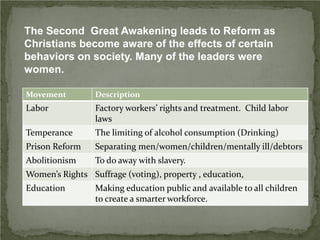
The Second Great Awakening leads to Reform as
Christians become aware of the effects of certain
behaviors on society. Many of the leaders were
women.
Movement

Description

Labor

Factory workers’ rights and treatment. Child labor
laws

Temperance

The limiting of alcohol consumption (Drinking)

Prison Reform

Separating men/women/children/mentally ill/debtors

Abolitionism

To do away with slavery.

Women’s Rights Suffrage (voting), property , education,
Education

Making education public and available to all children
to create a smarter workforce.
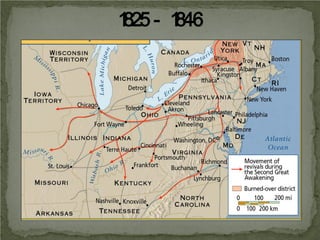
1 - 1
825 846
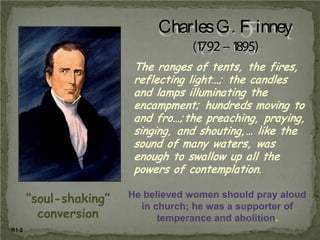
Charles G. F inney
(1 – 1
792 895)
The ranges of tents, the fires,
reflecting light…; the candles
and lamps illuminating the
encampment; hundreds moving to
and fro…; the preaching, praying,
singing, and shouting, … like the
sound of many waters, was
enough to swallow up all the
powers of contemplation.

“soul-shaking”
conversion
R1-2

He believed women should pray aloud
in church; he was a supporter of
temperance and abolition.
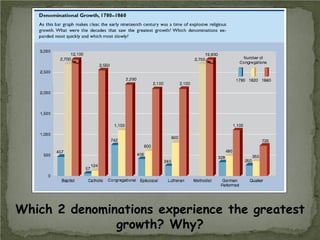
Which 2 denominations experience the greatest
growth? Why?
N ew R eligious
D enominations also begin as a
result of

nd Great
the 2

A wakening
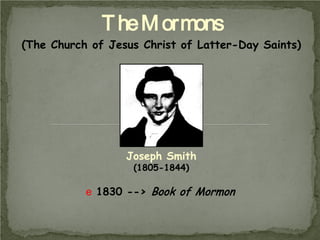
T he M ormons
(The Church of Jesus Christ of Latter-Day Saints)

Joseph Smith
(1805-1844)

e 1830 --> Book of Mormon
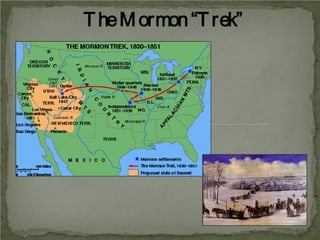
T he M ormon “T rek”
T he M ormons
(The Church of Jesus Christ of Latter-Day Saints)

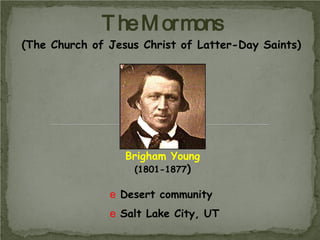
Brigham Young
(1801-1877)
e Desert community
e Salt Lake City, UT
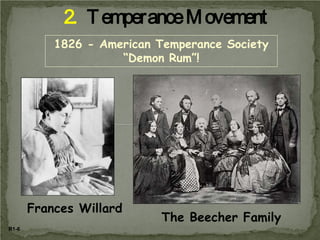
2. T emperance M ovement
1826 - American Temperance Society
“Demon Rum”!

Frances Willard
R1-6

The Beecher Family
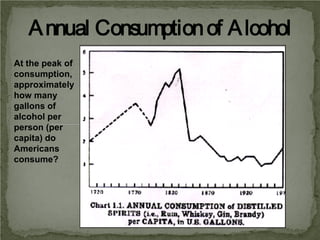
A nnual Consumption of A lcohol
At the peak of
consumption,
approximately
how many
gallons of
alcohol per
person (per
capita) do
Americans
consume?
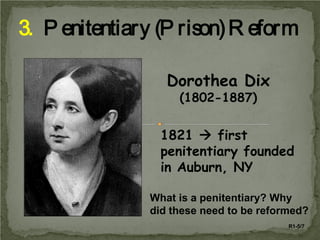
3. P enitentiary (P rison) R eform
Dorothea Dix
(1802-1887)

1821  first
penitentiary founded
in Auburn, NY
What is a penitentiary? Why
did these need to be reformed?
R1-5/7
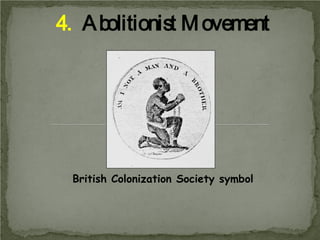
4. A bolitionist M ovement

British Colonization Society symbol
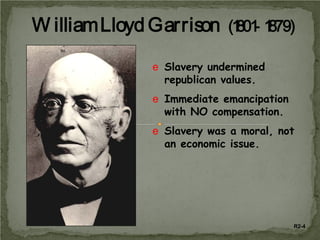
W illiam Lloyd Garrison (1 - 1
801 879)
e Slavery undermined
republican values.
e Immediate emancipation
with NO compensation.
e Slavery was a moral, not
an economic issue.

R2-4
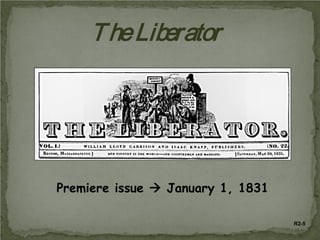
T he Liberator

Premiere issue  January 1, 1831
R2-5
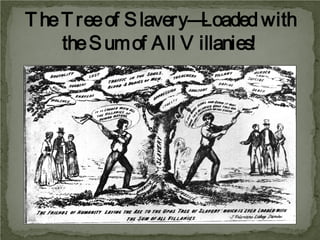
T he T ree of S lavery—
Loaded with
the S um of A ll V illanies!
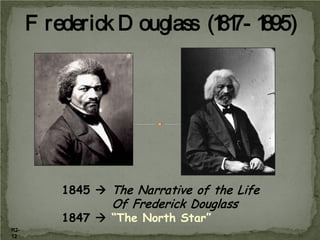
F rederick D ouglass (1 7- 1
81 895)

1845  The Narrative of the Life

Of Frederick Douglass

1847  “The North Star”
R212
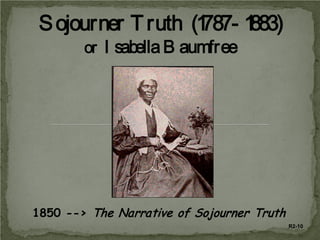
S ojourner T ruth (1
787- 1
883)
or I sabella B aumfree

1850 --> The Narrative of Sojourner Truth
R2-10
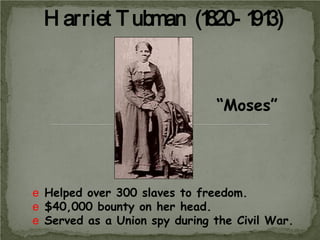
H arriet T ubman (1
820- 1 3)
91

“Moses”

e Helped over 300 slaves to freedom.
e $40,000 bounty on her head.
e Served as a Union spy during the Civil War.
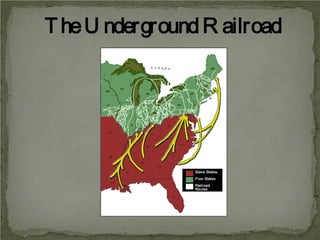
T he U nderground R ailroad
5. W omen’s R ights
e A woman’s “sphere” was in the home (it was a
refuge from the cruel world outside).
e Her role was to “civilize” her husband and
family.
e An 1830s MA minister:

“The power of woman is her dependence. A
woman who gives up that dependence on man to
become a reformer yields the power God has given
her for her protection, and her character
becomes unnatural!”
E arly

th century
1
9

W omen

1. Couldn’t make wills, sign a
contract, or bring suit in court
without her husband’s permission.
2. Unable to vote.
3. Legal status of a minor.
4. Single  could own her own
property.
5. Married  no control over her
property or her children.
6. Could not initiate divorce.
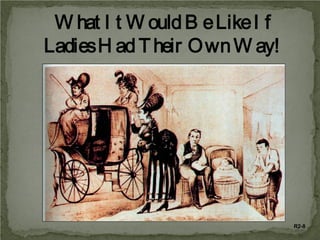
W hat I t W ould B e Like I f
Ladies H ad T heir O wn W ay!

R2-8
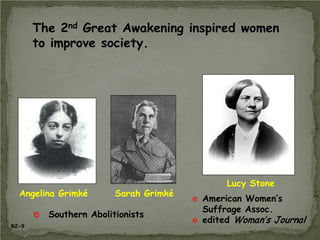
The 2nd Great Awakening inspired women
to improve society.

Angelina Grimké

Sarah Grimké

e Southern Abolitionists
R2-9

Lucy Stone
e American Women’s
Suffrage Assoc.
e edited Woman’s Journal
R2-6/7

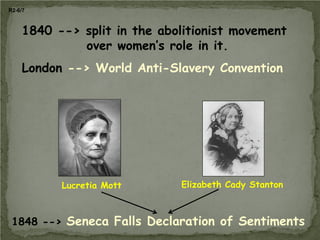
1840 --> split in the abolitionist movement
over women’s role in it.
London --> World Anti-Slavery Convention

Lucretia Mott

Elizabeth Cady Stanton

1848 --> Seneca Falls Declaration of Sentiments
6. T ranscendentalism
(E uropean R omanticism)
e “Liberation from understanding and
the cultivation of reasoning.”
e “Transcend” the limits of intellect
and allow the emotions, the SOUL,
to create an original relationship
with the Universe.
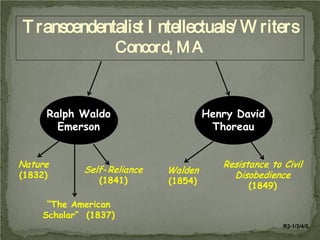
T ranscendentalist I ntellectuals/ W riters
Concord, M A

Ralph Waldo
Emerson
Nature
(1832)

Self- Reliance
(1841)

Henry David
Thoreau

Walden
(1854)

Resistance to Civil
Disobedience
(1849)

“The American
Scholar” (1837)
R3-1/3/4/5
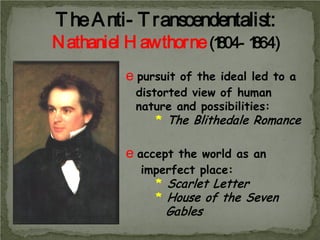
T he A nti- T ranscendentalist:
N athaniel H awthorne (1 1
804- 864)
e pursuit of the ideal led to a

distorted view of human
nature and possibilities:
* The Blithedale Romance

e accept the world as an

imperfect place:
* Scarlet Letter
* House of the Seven

Gables
7. E ducational R eform
e MA

e By

 always on the forefront of public
educational reform
* 1st state to establish tax support for
local public schools.

1860 every state offered free public
education to whites.
* US had one of the highest literacy rates.
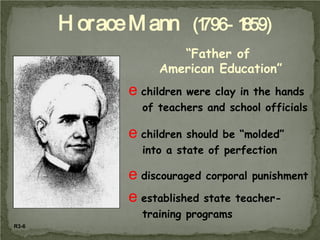
H orace M ann (1 1
796- 859)
“Father of
American Education”

e children were clay in the hands
of teachers and school officials

e children should be “molded”
into a state of perfection

e discouraged corporal punishment
e established state teachertraining programs
R3-6
P urpose of E ducation?
According to reformers, what was the purpose
of education?

What is the purpose of education today?

What are some differences between 19th
century schools and 21st century schools?
 Factories continued to spread in the 1800s
 A wave of immigration in the 1840s brought in new

people willing to work for low pay.
 Skilled workers faced low wages, long hours, and
the fear of losing their jobs.
 Many workers formed trade unions to improve pay
and working conditions.
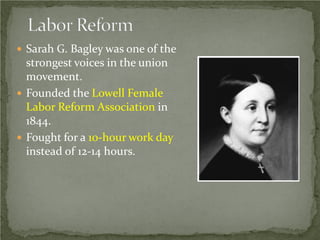
 Sarah G. Bagley was one of the

strongest voices in the union
movement.
 Founded the Lowell Female
Labor Reform Association in
1844.
 Fought for a 10-hour work day
instead of 12-14 hours.
Legacy of R eform
•How did these reformers change America?
•What reforms (if any) do you see evidence of
in America today?
•Are they similar or different from those in the
19th century?

Reform movement

  • 2.
    T he Second Great A wakening: F oundation of R eform “Spiritual Reform From Within” [Religious Revivalism] Labor Social Reforms & Redefining the Ideal of Equality Temperance Education Abolitionism Asylum & Prison Reform Women’s Rights
  • 3.
    The Second GreatAwakening leads to Reform as Christians become aware of the effects of certain behaviors on society. Many of the leaders were women. Movement Description Labor Factory workers’ rights and treatment. Child labor laws Temperance The limiting of alcohol consumption (Drinking) Prison Reform Separating men/women/children/mentally ill/debtors Abolitionism To do away with slavery. Women’s Rights Suffrage (voting), property , education, Education Making education public and available to all children to create a smarter workforce.
  • 4.
  • 5.
    Charles G. Finney (1 – 1 792 895) The ranges of tents, the fires, reflecting light…; the candles and lamps illuminating the encampment; hundreds moving to and fro…; the preaching, praying, singing, and shouting, … like the sound of many waters, was enough to swallow up all the powers of contemplation. “soul-shaking” conversion R1-2 He believed women should pray aloud in church; he was a supporter of temperance and abolition.
  • 6.
    Which 2 denominationsexperience the greatest growth? Why?
  • 7.
    N ew Religious D enominations also begin as a result of nd Great the 2 A wakening
  • 8.
    T he Mormons (The Church of Jesus Christ of Latter-Day Saints) Joseph Smith (1805-1844) e 1830 --> Book of Mormon
  • 9.
    T he Mormon “T rek”
  • 10.
    T he Mormons (The Church of Jesus Christ of Latter-Day Saints) Brigham Young (1801-1877) e Desert community e Salt Lake City, UT
  • 11.
    2. T emperanceM ovement 1826 - American Temperance Society “Demon Rum”! Frances Willard R1-6 The Beecher Family
  • 12.
    A nnual Consumptionof A lcohol At the peak of consumption, approximately how many gallons of alcohol per person (per capita) do Americans consume?
  • 13.
    3. P enitentiary(P rison) R eform Dorothea Dix (1802-1887) 1821  first penitentiary founded in Auburn, NY What is a penitentiary? Why did these need to be reformed? R1-5/7
  • 14.
    4. A bolitionistM ovement British Colonization Society symbol
  • 15.
    W illiam LloydGarrison (1 - 1 801 879) e Slavery undermined republican values. e Immediate emancipation with NO compensation. e Slavery was a moral, not an economic issue. R2-4
  • 16.
    T he Liberator Premiereissue  January 1, 1831 R2-5
  • 17.
    T he Tree of S lavery— Loaded with the S um of A ll V illanies!
  • 18.
    F rederick Douglass (1 7- 1 81 895) 1845  The Narrative of the Life Of Frederick Douglass 1847  “The North Star” R212
  • 19.
    S ojourner Truth (1 787- 1 883) or I sabella B aumfree 1850 --> The Narrative of Sojourner Truth R2-10
  • 20.
    H arriet Tubman (1 820- 1 3) 91 “Moses” e Helped over 300 slaves to freedom. e $40,000 bounty on her head. e Served as a Union spy during the Civil War.
  • 21.
    T he Underground R ailroad
  • 22.
    5. W omen’sR ights e A woman’s “sphere” was in the home (it was a refuge from the cruel world outside). e Her role was to “civilize” her husband and family. e An 1830s MA minister: “The power of woman is her dependence. A woman who gives up that dependence on man to become a reformer yields the power God has given her for her protection, and her character becomes unnatural!”
  • 23.
    E arly th century 1 9 Women 1. Couldn’t make wills, sign a contract, or bring suit in court without her husband’s permission. 2. Unable to vote. 3. Legal status of a minor. 4. Single  could own her own property. 5. Married  no control over her property or her children. 6. Could not initiate divorce.
  • 24.
    W hat It W ould B e Like I f Ladies H ad T heir O wn W ay! R2-8
  • 25.
    The 2nd GreatAwakening inspired women to improve society. Angelina Grimké Sarah Grimké e Southern Abolitionists R2-9 Lucy Stone e American Women’s Suffrage Assoc. e edited Woman’s Journal
  • 26.
    R2-6/7 1840 --> splitin the abolitionist movement over women’s role in it. London --> World Anti-Slavery Convention Lucretia Mott Elizabeth Cady Stanton 1848 --> Seneca Falls Declaration of Sentiments
  • 27.
    6. T ranscendentalism (European R omanticism) e “Liberation from understanding and the cultivation of reasoning.” e “Transcend” the limits of intellect and allow the emotions, the SOUL, to create an original relationship with the Universe.
  • 28.
    T ranscendentalist Intellectuals/ W riters Concord, M A Ralph Waldo Emerson Nature (1832) Self- Reliance (1841) Henry David Thoreau Walden (1854) Resistance to Civil Disobedience (1849) “The American Scholar” (1837) R3-1/3/4/5
  • 29.
    T he Anti- T ranscendentalist: N athaniel H awthorne (1 1 804- 864) e pursuit of the ideal led to a distorted view of human nature and possibilities: * The Blithedale Romance e accept the world as an imperfect place: * Scarlet Letter * House of the Seven Gables
  • 30.
    7. E ducationalR eform e MA e By  always on the forefront of public educational reform * 1st state to establish tax support for local public schools. 1860 every state offered free public education to whites. * US had one of the highest literacy rates.
  • 31.
    H orace Mann (1 1 796- 859) “Father of American Education” e children were clay in the hands of teachers and school officials e children should be “molded” into a state of perfection e discouraged corporal punishment e established state teachertraining programs R3-6
  • 32.
    P urpose ofE ducation? According to reformers, what was the purpose of education? What is the purpose of education today? What are some differences between 19th century schools and 21st century schools?
  • 33.
     Factories continuedto spread in the 1800s  A wave of immigration in the 1840s brought in new people willing to work for low pay.  Skilled workers faced low wages, long hours, and the fear of losing their jobs.  Many workers formed trade unions to improve pay and working conditions.
  • 34.
     Sarah G.Bagley was one of the strongest voices in the union movement.  Founded the Lowell Female Labor Reform Association in 1844.  Fought for a 10-hour work day instead of 12-14 hours.
  • 35.
    Legacy of Reform •How did these reformers change America? •What reforms (if any) do you see evidence of in America today? •Are they similar or different from those in the 19th century?