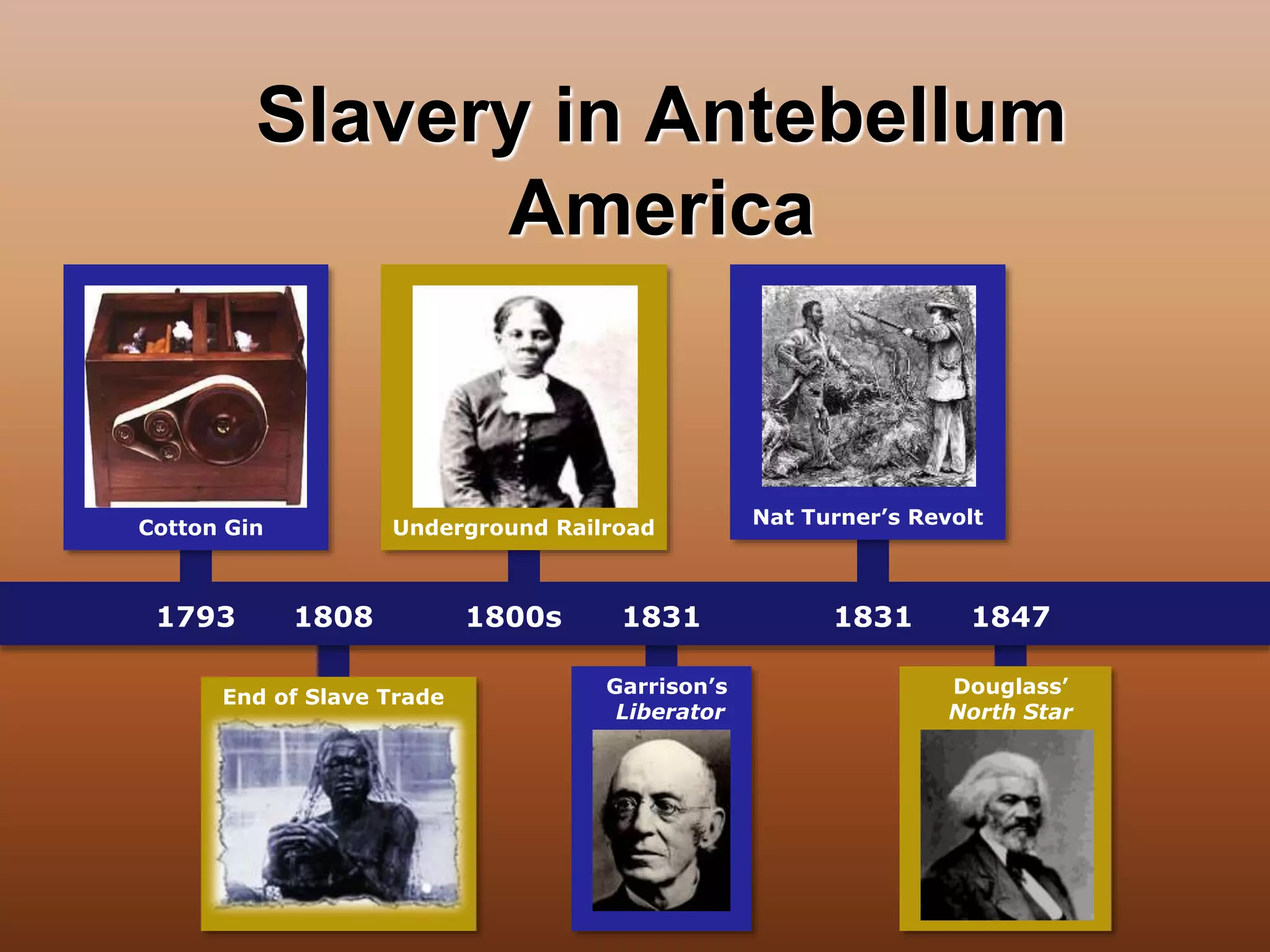
Slavery in Antebellum 
Cotton Gin Underground Railroad 
Nat Turner’s Revolt 
1793 1808 1800s 1847 
Garrison’s 
Liberator 
1831 
1831 
Douglass’ 
North Star 
America 
End of Slave Trade
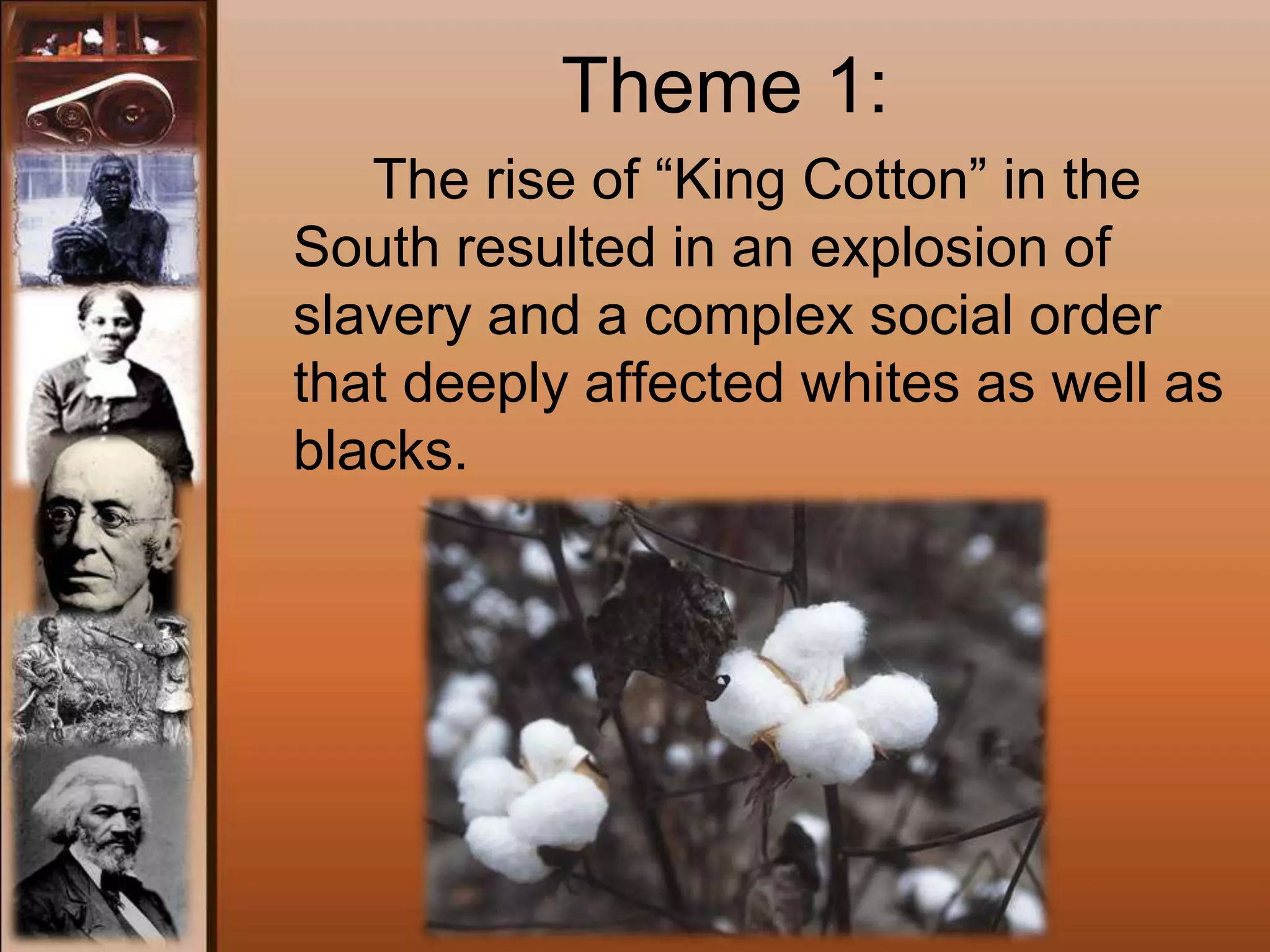
Theme 1: 
The rise of “King Cotton” in the 
South resulted in an explosion of 
slavery and a complex social order 
that deeply affected whites as well as 
blacks.
I. Rise of “King Cotton” 
A. Slavery prior to 1793 
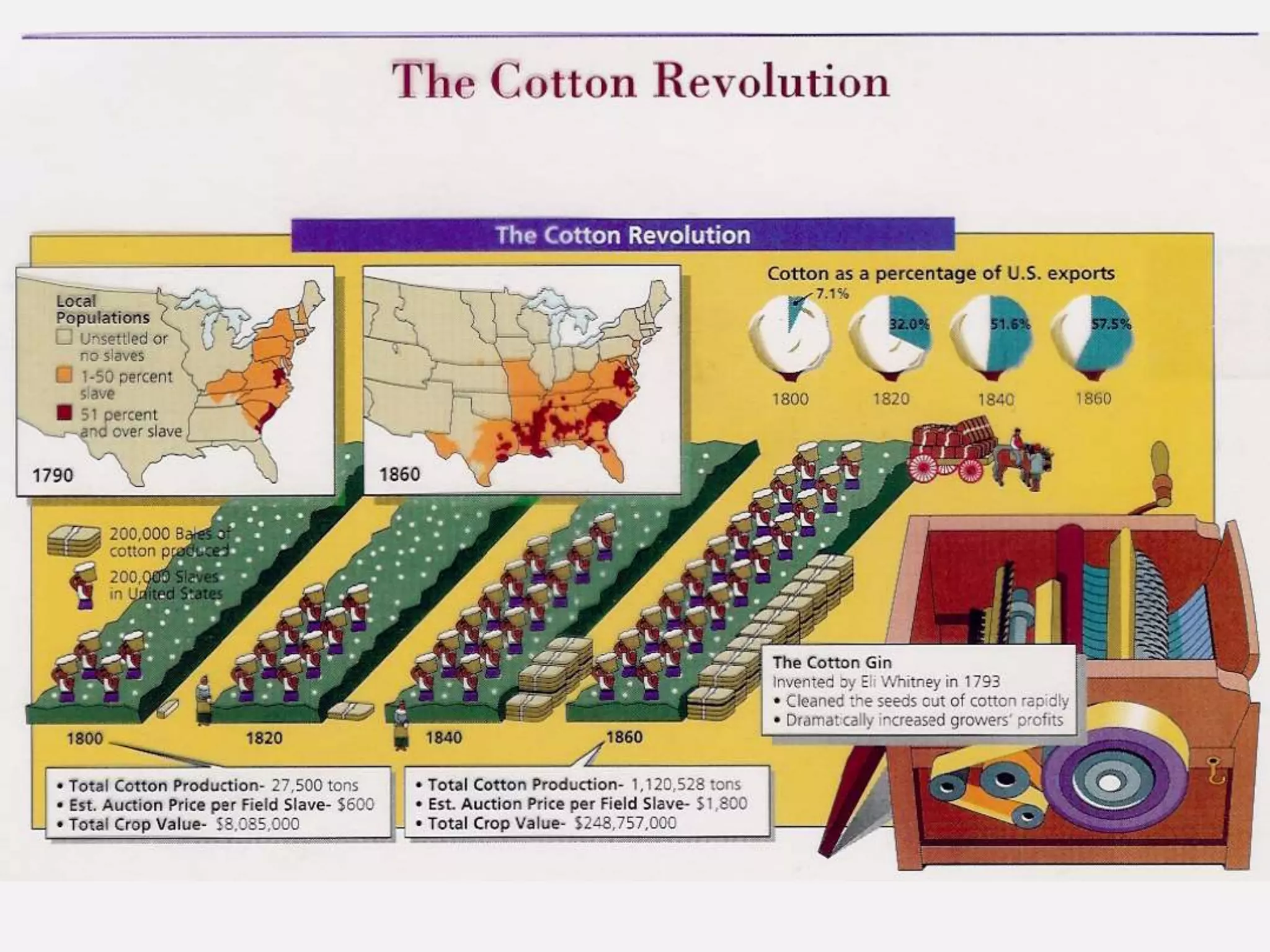
B. Eli Whitney’s cotton gin 
1. Impact: resulted in the 
explosion of slavery 
2. Cotton 
kingdom 
developed 
into a huge 
agricultural 
factory
Cotton Exports from the U.S., 
1815-1860
DISTRIBUTION OF SLAVES, 1860
3. Huge domestic slave trade 
emerged
-- Importation of 
slaves from 
Africa had been 
abolished in 
1808
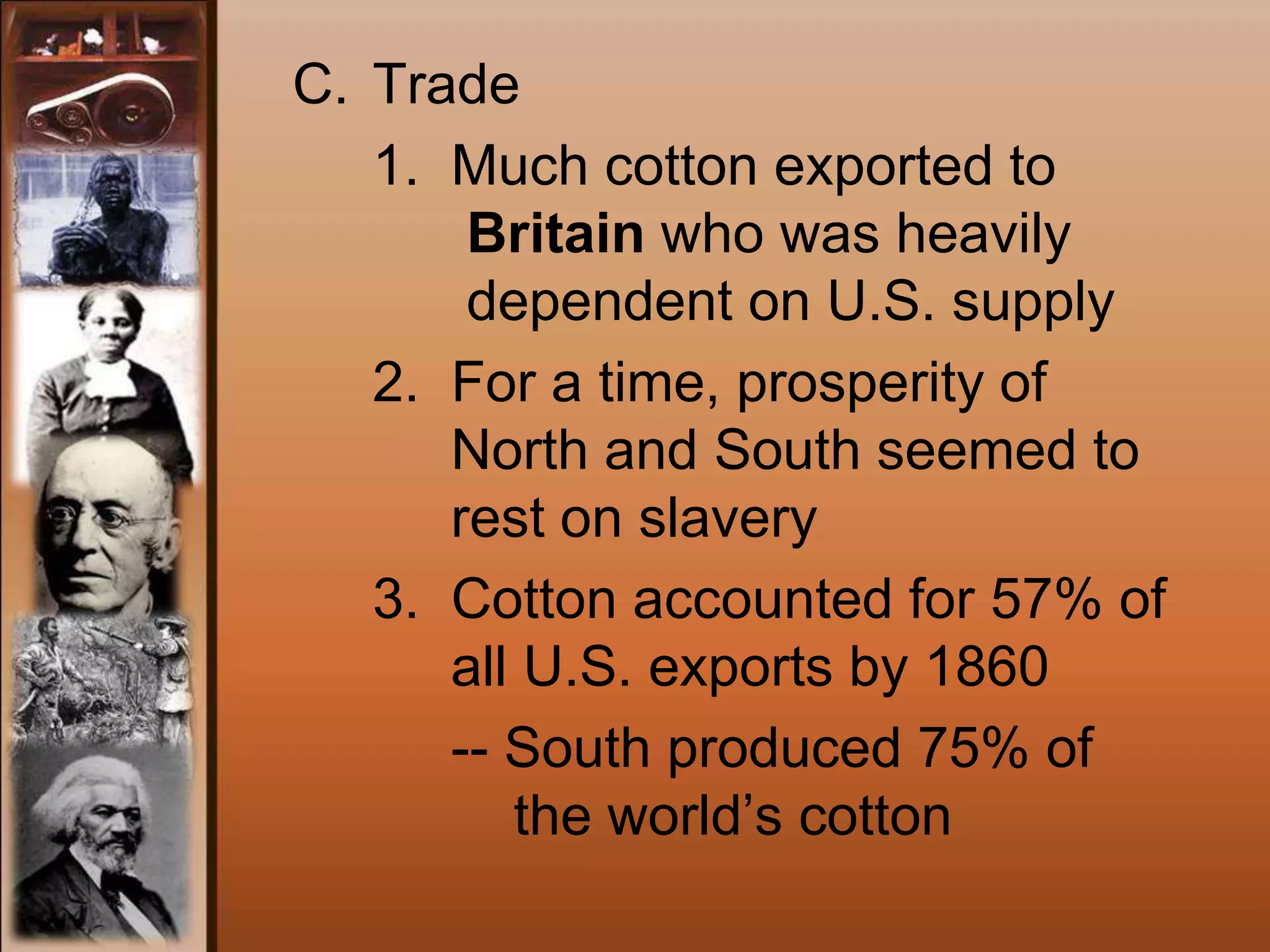
C. Trade 
1. Much cotton exported to 
Britain who was heavily 
dependent on U.S. supply 
2. For a time, prosperity of 
North and South seemed to 
rest on slavery 
3. Cotton accounted for 57% of 
all U.S. exports by 1860 
-- South produced 75% of 
the world’s cotton
“Peculiar Institution” 
A. The planter aristocracy 
1. Planters dominated 
politically and 
economically 
2. Carried on early 
“Cavalier” tradition of 
early Virginia
B. Plantation system 
1. Enormous investment of 
capital in slaves 
-- Risks 
2. One-crop economy 
3. Attracted few European 
immigrants
II. The Three South's: Slaves of the 
Slave System 
A. Generalizations 
1. Further north, the cooler 
climate meant fewer slaves; 
less commitment to 
maintaining slavery 
2. Further south, the warmer 
climate meant more slaves; 
heavy commitment to 
maintaining slavery
3. Mountain whites along Appalachian 
Mountain range were the least 
committed to slavery 
4. Southward flow of slaves continued 
from 1790 to 1860 
5. The South was NOT a monolithic 
political and cultural entity 
-- Only interference from outsiders 
tended to unify southerners
The Three Souths
B. Border South: DE, MD, KY, MO 
1. Fewer plantations than in 
lower south (tobacco) 
-- Cotton plantations scarce 
2. Unionists overcame 
disunionists during the Civil 
War 
3. Fewest # of slaves in the 
South: 17% of population 
4. 22% of white families owned 
slaves
C. Middle South: VA, NC, TN, AK 
1. Each state: 1 sect like Border; 1 
section like Lower South 
2. Unionists prevailed when Lincoln 
was elected; Disunionists 
prevailed when the war began 
3. Slaves = 30% of population 
4. 36% of white families owned 
slaves
D. Lower South: SC, FL, GA, AL, 
MS, LA,TX Known as the Black 
Belt 
1. Most slaves concentrated in 
“cotton belt” along river valleys 
2. Cotton was king; also sugar & 
rice 
3. Disunionists prevailed after 
Lincoln was elected in 1860 
4. Slaves = 47% of population 
5. 43% of white families owned 
slaves
G. The White Majority 
1. Feared more slave revolts 
2. Infuriated by abolitionist 
propaganda 
3. Belief in racial superiority
. The White Majority 
A. Only 25% owned slaves by 1860 
B. 75% were non-slaveowners 
1. Location & type of farming 
2. Conditions 
3. Why defend slavery? 
C. Mountain whites 
1. Location & farming 
2. Political affiliation
Free Blacks:Slaves without Masters 
A. 250,000 in the South in 1860 
-- Border South had the most 
B. Discrimination in the South 
C. 250,000 in the North in 1860 
-- Philadelphia 
D. Discrimination in the North 
-- Often denied education and 
suffrage; segregation existed 
in some states
D. Afro-American slave culture 
1. West-African culture 
2. Family 
3. Oral traditions 
4. Religion 
5. Music
C. Plantation slavery 
1. Nearly 4 million slaves by 1860 
a. Slave trade abolished in 1808 
b. Increase in slave population 
due to natural reproduction 
2. Slaves seen as valuable 
“property” 
a. Slave auctions 
b. Floggings and Breakers
The Value of the Stock of 
Slaves in the U.S., 1805-1860
Value of Slaves in 2004 
Dollars 
Year 2004 (adjusted for 
inflation) 
1810 - $316, $4,490 
1820 - $610, $11,100 
1830 - $577, $12,000 
1840 - $997 $19,300 
1850 - $1,286, $25,300 
1860 - $3,059 $55,900
3. Brutal punishments 
4. New western areas were the 
harshest
E. Burdens of the slave system 
1. Denial of individual dignity 
2. Slaves denied education 
3. Slaves at times sabotaged the 
master’s plantation 
4. Many tried to 
escape
F. Slave revolts 
1. Stono Rebellion, 1739 
2. Gabriel Prosser, 1800 
3. Denmark Vesey, 1822 
4. Nat Turner, 1831
Theme 2: 
The abolitionist movement in 
the North proved unpopular in 
both the North and the South. 
Eventually the movement 
appealed to a growing minority 
of northerners who came to see 
slavery as a moral evil and 
sought to prevent the spread of 
slavery into the western 
territories.
VI. Early Abolitionism 
A. First abolition movements: 
Quakers in 
Pennsylvania 
This is the cover page to the 
"Constitution and Minutes of 
the Pennsylvania Society for 
promoting the Abolition of 
Slavery and the relief of Free 
Negroes unlawfully held in 
Bondage" (PAS) when it 
reorganized in 1787.
Early Emancipation in the North
Legal Status of Slavery, 1861
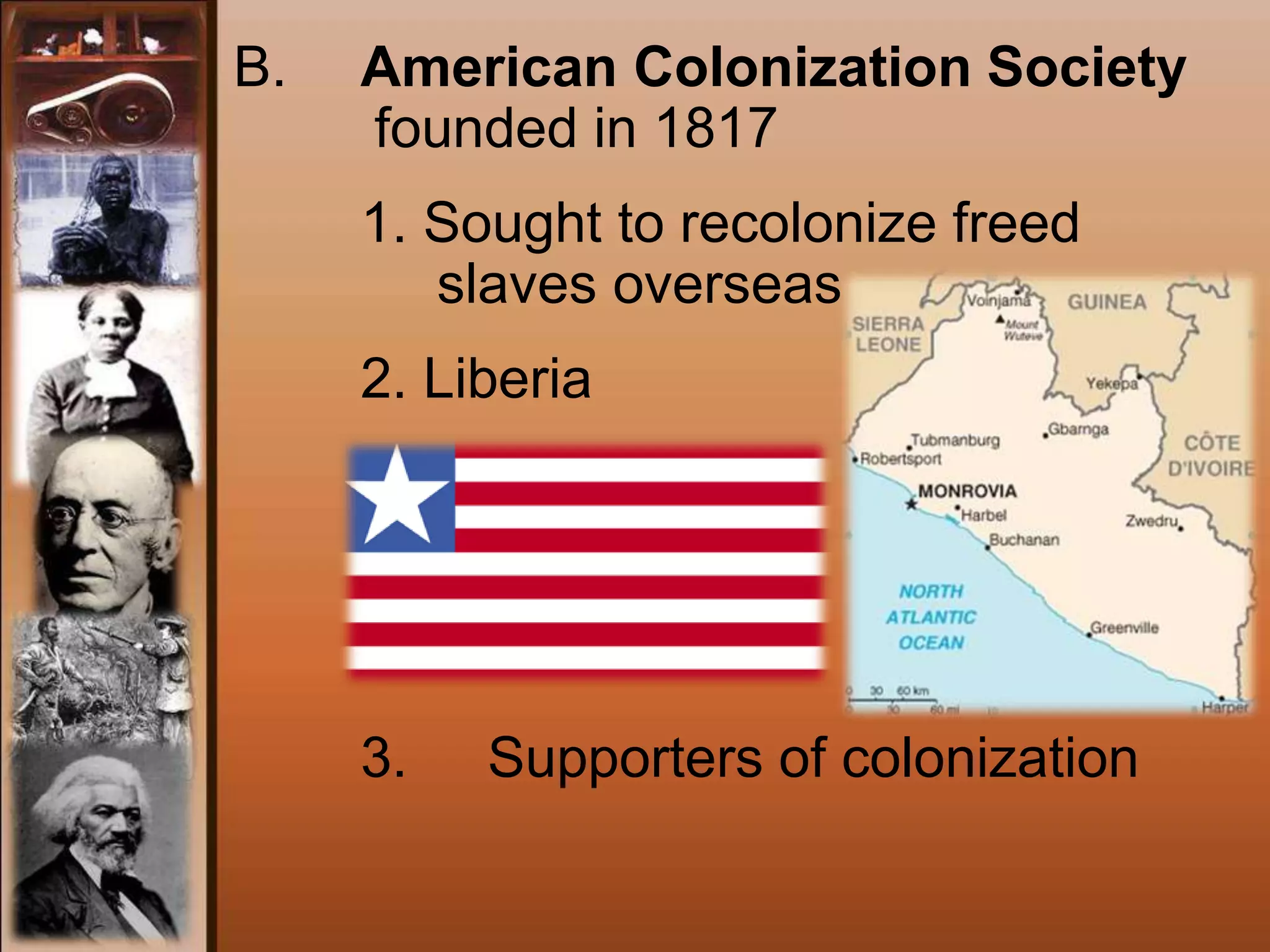
B. American Colonization Society 
founded in 1817 
1. Sought to recolonize freed 
slaves overseas 
2. Liberia 
3. Supporters of colonization
C. Rise of abolitionism in 1830’s 
1. Most important reform 
movement of the Second Great 
Awakening 
-- Reformers saw slavery as a 
sin 
2. Abolitionists 
were inspired by 
Britain’s freeing 
of its slaves in 
1833
Radical abolitionism 
1. Sought immediate and 
uncompensated abolition of 
slavery 
2. William Lloyd Garrison 
a. The Liberator, 1831 
b. Views
“I am in earnest -- I will not 
equivocate -- I will not excuse -- I will 
not retreat a single inch -- AND I 
WILL BE HEARD.” 
-- William Lloyd Garrison, 1831
3. American Anti-Slavery Society 
a. Founded by radical 
abolitionists 
b. Theodore Weld 
-- American Slavery As It Is 
(1839) 
Icon of the American Anti- 
Slavery Society (1832- 
1865)
c. Wendell Phillips 
(“abolition’s golden trumpet”)
d. Angelina and Sarah Grimke 
i. Only white southern female 
abolitionists 
ii. Some traditionalists were 
opposed to females playing 
a public role in the 
movement 
e. Arthur and Lewis Tappan 
-- Funded the American Anti- 
Slavery Society and the 
Liberator 
f. The movement eventually split 
along gender lines
3. David Walker: Appeal to the 
Colored Citizens of the World 
(1829) 
4. Sojourner Truth 
5. Elijah Lovejoy 
6. Martin Delaney 
Wood engraving 
of a mob in Alton, 
Illinois destroying 
the warehouse 
containing 
Lovejoy’s printing 
press
7. Frederick Douglass 
a. Greatest of the black 
abolitionists 
-- North Star 
b. Narrative of the Life of 
Frederick Douglass (1845) 
c. Sought practical 
approach compared to 
radical abolitionists 
d. Looked to politics 
to end slavery
8. Eventually, most abolitionists 
favored war to end slavery
The South lashes back 
A. Pre-1830s, more abolitionism 
in South than North 
B. Abolitionism silenced after 1830 
C. Causes for southern concern 
1. Nat Turner 
2. Nullification crisis of 1832 
3. Increased abolitionist 
literature circulating in the 
South
D. Abolitionist literature was 
banned in the Southern mail 
system 
E. Defense of slavery 
1. Bible & Aristotle 
2. Good for “barbaric” Africans 
3. Master-slave relationships 
resembled family
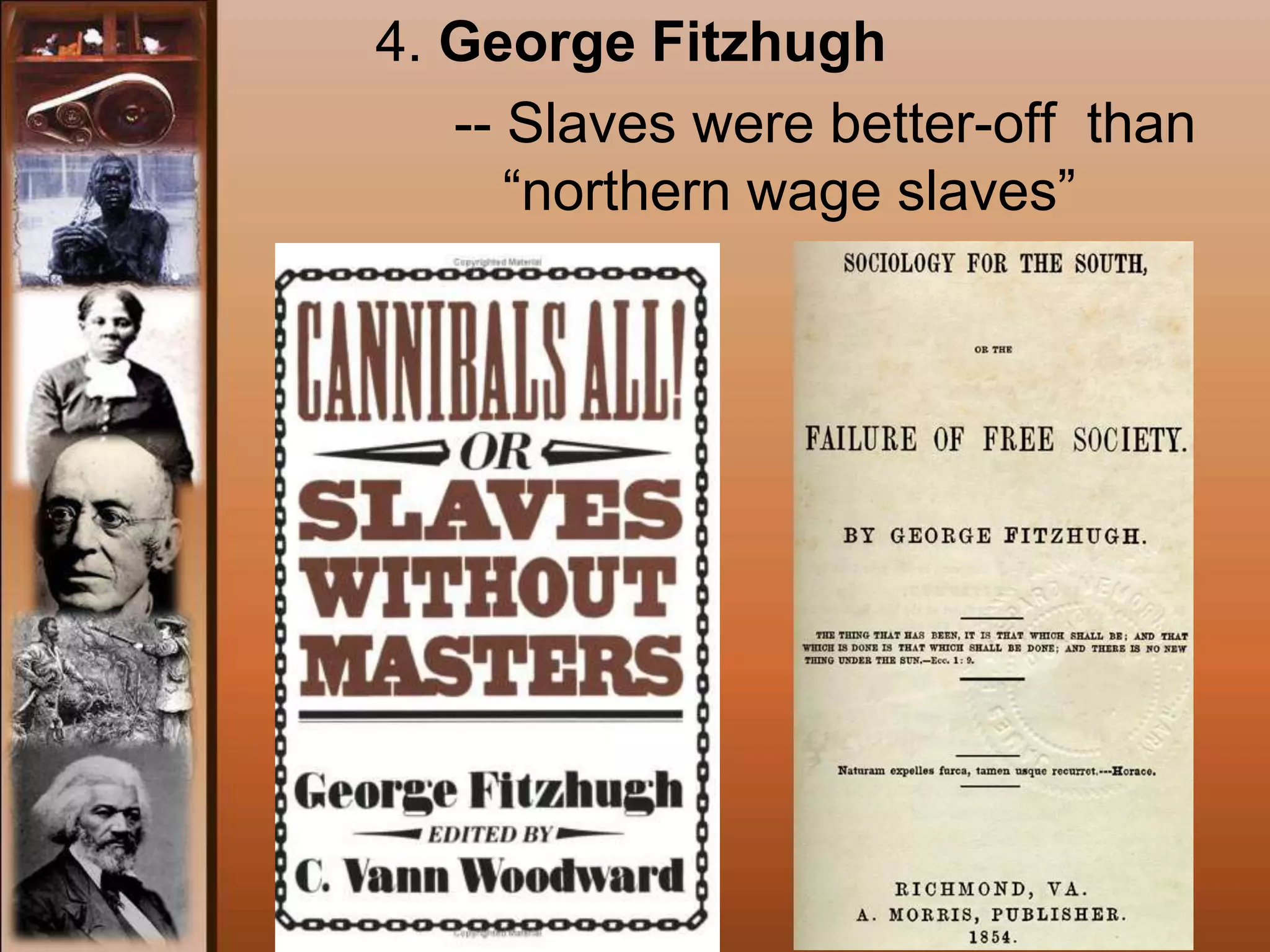
4. George Fitzhugh 
-- Slaves were better-off than 
“northern wage slaves”
F. Gag resolution, 1836 
U.S. Congressman 
and former president 
John Quincy Adams 
led the eight-year 
fight to kill the Gag 
Resolution
Abolitionist impact in the North 
A. Abolitionists unpopular in many 
parts of the North 
1. Reverence for Constitution 
2. Ideal of Union 
3. Economic dependence on 
South 
B. Mob outbursts in response to 
extreme abolitionists
C. Most politicians avoided the issue 
of abolitionism. Why? 
D. Effect on northern mind by 1850 
1. A significant minority saw 
slavery as a moral evil and 
undemocratic 
2. The “Free-Soil” Party emerged 
by 1848 based on the anti-extension 
of slavery into the 
western territories 
-- “ Free-soil” movement 
morphed into the Republican 
part in the 1850s
3. Prigg v. Pennsylvania (1842) 
-- “personal liberty laws 
4. By 1850, southerners 
demanded a new stronger 
fugitive slave law
E. Underground Railroad 
1. Chain of anti-slavery homes 
used to aid 
runaway slaves 
2. Harriet Tubman
Slavery in antebellum america

Slavery in antebellum america

  • 1.
    Slavery in Antebellum Cotton Gin Underground Railroad Nat Turner’s Revolt 1793 1808 1800s 1847 Garrison’s Liberator 1831 1831 Douglass’ North Star America End of Slave Trade
  • 2.
    Theme 1: Therise of “King Cotton” in the South resulted in an explosion of slavery and a complex social order that deeply affected whites as well as blacks.
  • 3.
    I. Rise of“King Cotton” A. Slavery prior to 1793 B. Eli Whitney’s cotton gin 1. Impact: resulted in the explosion of slavery 2. Cotton kingdom developed into a huge agricultural factory
  • 5.
    Cotton Exports fromthe U.S., 1815-1860
  • 6.
  • 7.
    3. Huge domesticslave trade emerged
  • 8.
    -- Importation of slaves from Africa had been abolished in 1808
  • 10.
    C. Trade 1.Much cotton exported to Britain who was heavily dependent on U.S. supply 2. For a time, prosperity of North and South seemed to rest on slavery 3. Cotton accounted for 57% of all U.S. exports by 1860 -- South produced 75% of the world’s cotton
  • 11.
    “Peculiar Institution” A.The planter aristocracy 1. Planters dominated politically and economically 2. Carried on early “Cavalier” tradition of early Virginia
  • 12.
    B. Plantation system 1. Enormous investment of capital in slaves -- Risks 2. One-crop economy 3. Attracted few European immigrants
  • 13.
    II. The ThreeSouth's: Slaves of the Slave System A. Generalizations 1. Further north, the cooler climate meant fewer slaves; less commitment to maintaining slavery 2. Further south, the warmer climate meant more slaves; heavy commitment to maintaining slavery
  • 14.
    3. Mountain whitesalong Appalachian Mountain range were the least committed to slavery 4. Southward flow of slaves continued from 1790 to 1860 5. The South was NOT a monolithic political and cultural entity -- Only interference from outsiders tended to unify southerners
  • 15.
  • 16.
    B. Border South:DE, MD, KY, MO 1. Fewer plantations than in lower south (tobacco) -- Cotton plantations scarce 2. Unionists overcame disunionists during the Civil War 3. Fewest # of slaves in the South: 17% of population 4. 22% of white families owned slaves
  • 17.
    C. Middle South:VA, NC, TN, AK 1. Each state: 1 sect like Border; 1 section like Lower South 2. Unionists prevailed when Lincoln was elected; Disunionists prevailed when the war began 3. Slaves = 30% of population 4. 36% of white families owned slaves
  • 18.
    D. Lower South:SC, FL, GA, AL, MS, LA,TX Known as the Black Belt 1. Most slaves concentrated in “cotton belt” along river valleys 2. Cotton was king; also sugar & rice 3. Disunionists prevailed after Lincoln was elected in 1860 4. Slaves = 47% of population 5. 43% of white families owned slaves
  • 19.
    G. The WhiteMajority 1. Feared more slave revolts 2. Infuriated by abolitionist propaganda 3. Belief in racial superiority
  • 20.
    . The WhiteMajority A. Only 25% owned slaves by 1860 B. 75% were non-slaveowners 1. Location & type of farming 2. Conditions 3. Why defend slavery? C. Mountain whites 1. Location & farming 2. Political affiliation
  • 21.
    Free Blacks:Slaves withoutMasters A. 250,000 in the South in 1860 -- Border South had the most B. Discrimination in the South C. 250,000 in the North in 1860 -- Philadelphia D. Discrimination in the North -- Often denied education and suffrage; segregation existed in some states
  • 22.
    D. Afro-American slaveculture 1. West-African culture 2. Family 3. Oral traditions 4. Religion 5. Music
  • 23.
    C. Plantation slavery 1. Nearly 4 million slaves by 1860 a. Slave trade abolished in 1808 b. Increase in slave population due to natural reproduction 2. Slaves seen as valuable “property” a. Slave auctions b. Floggings and Breakers
  • 24.
    The Value ofthe Stock of Slaves in the U.S., 1805-1860
  • 25.
    Value of Slavesin 2004 Dollars Year 2004 (adjusted for inflation) 1810 - $316, $4,490 1820 - $610, $11,100 1830 - $577, $12,000 1840 - $997 $19,300 1850 - $1,286, $25,300 1860 - $3,059 $55,900
  • 26.
    3. Brutal punishments 4. New western areas were the harshest
  • 27.
    E. Burdens ofthe slave system 1. Denial of individual dignity 2. Slaves denied education 3. Slaves at times sabotaged the master’s plantation 4. Many tried to escape
  • 28.
    F. Slave revolts 1. Stono Rebellion, 1739 2. Gabriel Prosser, 1800 3. Denmark Vesey, 1822 4. Nat Turner, 1831
  • 31.
    Theme 2: Theabolitionist movement in the North proved unpopular in both the North and the South. Eventually the movement appealed to a growing minority of northerners who came to see slavery as a moral evil and sought to prevent the spread of slavery into the western territories.
  • 32.
    VI. Early Abolitionism A. First abolition movements: Quakers in Pennsylvania This is the cover page to the "Constitution and Minutes of the Pennsylvania Society for promoting the Abolition of Slavery and the relief of Free Negroes unlawfully held in Bondage" (PAS) when it reorganized in 1787.
  • 33.
  • 34.
    Legal Status ofSlavery, 1861
  • 35.
    B. American ColonizationSociety founded in 1817 1. Sought to recolonize freed slaves overseas 2. Liberia 3. Supporters of colonization
  • 36.
    C. Rise ofabolitionism in 1830’s 1. Most important reform movement of the Second Great Awakening -- Reformers saw slavery as a sin 2. Abolitionists were inspired by Britain’s freeing of its slaves in 1833
  • 37.
    Radical abolitionism 1.Sought immediate and uncompensated abolition of slavery 2. William Lloyd Garrison a. The Liberator, 1831 b. Views
  • 38.
    “I am inearnest -- I will not equivocate -- I will not excuse -- I will not retreat a single inch -- AND I WILL BE HEARD.” -- William Lloyd Garrison, 1831
  • 39.
    3. American Anti-SlaverySociety a. Founded by radical abolitionists b. Theodore Weld -- American Slavery As It Is (1839) Icon of the American Anti- Slavery Society (1832- 1865)
  • 40.
    c. Wendell Phillips (“abolition’s golden trumpet”)
  • 41.
    d. Angelina andSarah Grimke i. Only white southern female abolitionists ii. Some traditionalists were opposed to females playing a public role in the movement e. Arthur and Lewis Tappan -- Funded the American Anti- Slavery Society and the Liberator f. The movement eventually split along gender lines
  • 42.
    3. David Walker:Appeal to the Colored Citizens of the World (1829) 4. Sojourner Truth 5. Elijah Lovejoy 6. Martin Delaney Wood engraving of a mob in Alton, Illinois destroying the warehouse containing Lovejoy’s printing press
  • 43.
    7. Frederick Douglass a. Greatest of the black abolitionists -- North Star b. Narrative of the Life of Frederick Douglass (1845) c. Sought practical approach compared to radical abolitionists d. Looked to politics to end slavery
  • 44.
    8. Eventually, mostabolitionists favored war to end slavery
  • 45.
    The South lashesback A. Pre-1830s, more abolitionism in South than North B. Abolitionism silenced after 1830 C. Causes for southern concern 1. Nat Turner 2. Nullification crisis of 1832 3. Increased abolitionist literature circulating in the South
  • 46.
    D. Abolitionist literaturewas banned in the Southern mail system E. Defense of slavery 1. Bible & Aristotle 2. Good for “barbaric” Africans 3. Master-slave relationships resembled family
  • 47.
    4. George Fitzhugh -- Slaves were better-off than “northern wage slaves”
  • 48.
    F. Gag resolution,1836 U.S. Congressman and former president John Quincy Adams led the eight-year fight to kill the Gag Resolution
  • 49.
    Abolitionist impact inthe North A. Abolitionists unpopular in many parts of the North 1. Reverence for Constitution 2. Ideal of Union 3. Economic dependence on South B. Mob outbursts in response to extreme abolitionists
  • 50.
    C. Most politiciansavoided the issue of abolitionism. Why? D. Effect on northern mind by 1850 1. A significant minority saw slavery as a moral evil and undemocratic 2. The “Free-Soil” Party emerged by 1848 based on the anti-extension of slavery into the western territories -- “ Free-soil” movement morphed into the Republican part in the 1850s
  • 51.
    3. Prigg v.Pennsylvania (1842) -- “personal liberty laws 4. By 1850, southerners demanded a new stronger fugitive slave law
  • 52.
    E. Underground Railroad 1. Chain of anti-slavery homes used to aid runaway slaves 2. Harriet Tubman

Editor's Notes

  • #3 Image: Wikipedia Commons
  • #5 NOT FOR PUBLICATION
  • #6 http://eh.net/encyclopedia/article/ransom.civil.war.us
  • #7 http://polsci307.files.wordpress.com/2011/11/m2-slave-conc1.jpeg
  • #9 Image in the public domain
  • #16 Map Courtesy of Cal State Humboldt University http://users.humboldt.edu/ogayle/hist110/unit4/SectionalIssues.html
  • #25 http://eh.net/encyclopedia/article/ransom.civil.war.us
  • #26 Source: Foundations for Teaching Economics workshop on "Economic Forces in American History:  The Economics of Slavery" by Dr. Dan Benjamin:
  • #27 Images courtesy of the Library of Congress
  • #28 Source: Library of Congress
  • #29 Images are in the public domain
  • #30 CREDIT: “Horrid massacre in Virginia,” 1831(?). Prints and Photographs Division, Library of Congress. Reproduction Number LC-USZ62-38902.
  • #31 http://www.slaveryinamerica.org/geography/slave_insurrections.htm
  • #33 Courtesy of the Historical Society of Pennsylvania
  • #34 Wikipedia Commons
  • #35 Wikipedia Commons
  • #36 Source: U.S. State Department
  • #37 Wikipedia Commons "To the friends of Negro Emancipation", celebrating the abolition of slavery in the British Empire http://www.portcities.org.uk/london/server/show/conMediaFile.5566/To-the-friends-of-Negro-Emancipation-(Negros-rejoicing-at-their-freedom).html
  • #43 Wikipedia Commons
  • #45 Poster is in the public domain
  • #49 Photo is in the public domain
  • #52 Poster is in the public domai
  • #53 Image of Harriet Tubman Wikipedia Commons Illustration: public domain
  • #54 http://www.slaveryinamerica.org/geography/ugrr_1860.htm