Democracy 
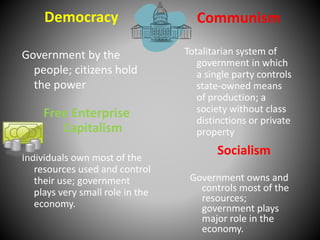
Government by the 
people; citizens hold 
the power 
Communism 
Totalitarian system of 
government in which 
a single party controls 
state-owned means 
of production; a 
society without class 
distinctions or private 
property 
Free Enterprise 
Capitalism 
Individuals own most of the 
resources used and control 
their use; government 
plays very small role in the 
economy. 
Socialism 
Government owns and 
controls most of the 
resources; 
government plays 
major role in the 
economy.
ORIGINS OF THE COLD WAR 
WWII Alliance of Britain and U.S. with Soviet Union 
was pragmatic “marriage of convenience” to defeat 
Germany 
1. Lack of trust of Stalin. 
• unified wartime command 
• atomic bomb 
2. Soviets believed western allies not sharing load 
3. Soviet mistreatment of eastern Europeans 
during WWII
ORIGINS OF THE COLD WAR: Wartime 
Diplomacy 
“Big Three” Allied leaders were consistently unable to resolve their basic 
disagreements over the structure of post-war Europe 
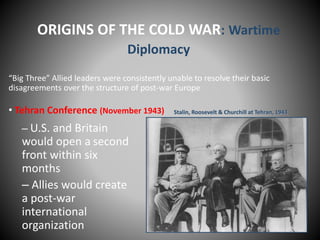
• Tehran Conference (November 1943) 
– U.S. and Britain 
would open a second 
front within six 
months 
– Allies would create 
a post-war 
international 
organization 
Stalin, Roosevelt & Churchill at Tehran, 1943
ORIGINS OF THE COLD WAR : Wartime 
Diplomacy 
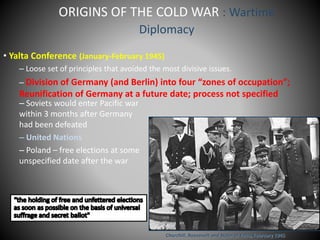
• Yalta Conference (January-February 1945) 
– Loose set of principles that avoided the most divisive issues. 
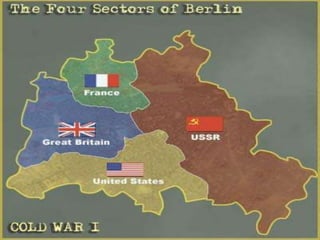
– Division of Germany (and Berlin) into four “zones of occupation”; 
Reunification of Germany at a future date; process not specified 
– Soviets would enter Pacific war 
within 3 months after Germany 
had been defeated 
– United Nations 
– Poland – free elections at some 
unspecified date after the war 
Churchill, Roosevelt and Stalin at Yalta, February 1945
ORIGINS OF THE COLD WAR : Wartime 
Diplomacy 
• United Nations Formed (April 1945) 
– Security Council 
• 11 members 
• Permanent seats with veto power for U.S., Britain, 
France, China and USSR 
– General Assembly 
– Secretariat 
• Secretary-General 
– International Court of Justice
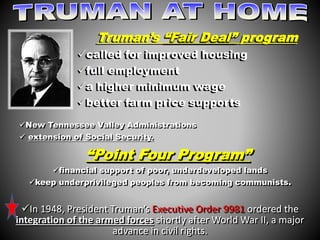
Truman’s “Fair Deal” program 
called for improved housing 
full employment 
a higher minimum wage 
better farm price supports 
New Tennessee Valley Administrations 
 extension of Social Security. 
“Point Four Program” 
financial support of poor, underdeveloped lands 
keep underprivileged peoples from becoming communists. 
In 1948, President Truman’s Executive Order 9981 ordered the 
integration of the armed forces shortly after World War II, a major 
advance in civil rights.
ORIGINS OF THE COLD WAR : Wartime 
Diplomacy 
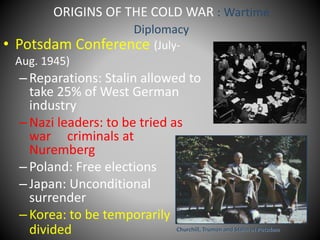
• Potsdam Conference (July- 
Aug. 1945) 
– Reparations: Stalin allowed to 
take 25% of West German 
industry 
– Nazi leaders: to be tried as 
war criminals at 
Nuremberg 
– Poland: Free elections 
– Japan: Unconditional 
surrender 
– Korea: to be temporarily 
divided Churchill, Truman and Stalin at Potsdam
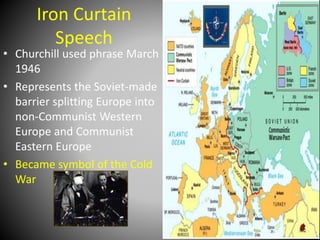
Iron Curtain 
Speech 
• Churchill used phrase March 
1946 
• Represents the Soviet-made 
barrier splitting Europe into 
non-Communist Western 
Europe and Communist 
Eastern Europe 
• Became symbol of the Cold 
War
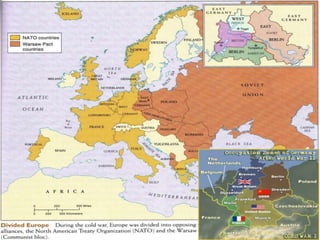
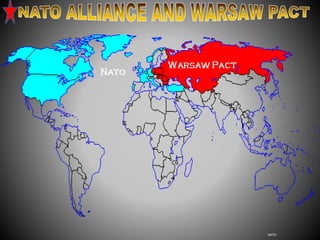
NATO
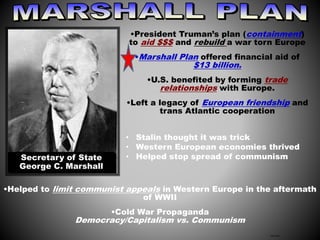
•President Truman’s plan (containment) 
to aid $$$ and rebuild a war torn Europe 
•Marshall Plan offered financial aid of 
$13 billion. 
•U.S. benefited by forming trade 
relationships with Europe. 
•Left a legacy of European friendship and 
trans Atlantic cooperation 
• Stalin thought it was trick 
• Western European economies thrived 
• Helped stop spread of communism 
marshall 
Secretary of State 
George C. Marshall 
•Helped to limit communist appeals in Western Europe in the aftermath 
of WWII 
•Cold War Propaganda 
Democracy/Capitalism vs. Communism
marshall 
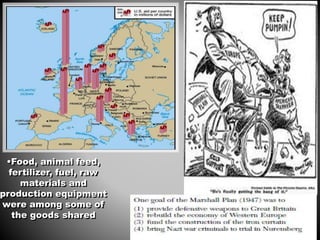
•Food, animal feed, 
fertilizer, fuel, raw 
materials and 
production equipment 
were among some of 
the goods shared
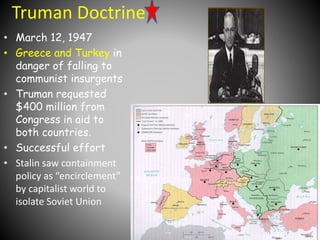
Truman Doctrine 
• March 12, 1947 
• Greece and Turkey in 
danger of falling to 
communist insurgents 
• Truman requested 
$400 million from 
Congress in aid to 
both countries. 
• Successful effort 
• Stalin saw containment 
policy as “encirclement” 
by capitalist world to 
isolate Soviet Union
Truman Doctrine/Marshall Plan 3.59
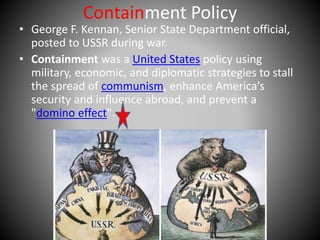
Containment Policy 
• George F. Kennan, Senior State Department official, 
posted to USSR during war. 
• Containment was a United States policy using 
military, economic, and diplomatic strategies to stall 
the spread of communism, enhance America’s 
security and influence abroad, and prevent a 
"domino effect".
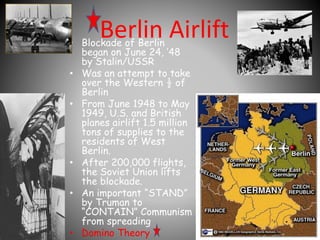
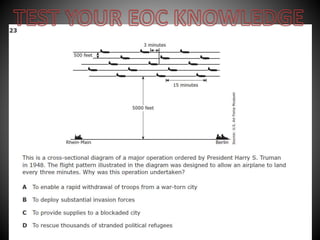
Berlin Airlift • Blockade of Berlin 
began on June 24, ’48 
by Stalin/USSR 
• Was an attempt to take 
over the Western ½ of 
Berlin 
• From June 1948 to May 
1949, U.S. and British 
planes airlift 1.5 million 
tons of supplies to the 
residents of West 
Berlin. 
• After 200,000 flights, 
the Soviet Union lifts 
the blockade. 
• An important “STAND” 
by Truman to 
“CONTAIN” Communism 
from spreading 
• Domino Theory
Berlin Airlift and NATO 5.00
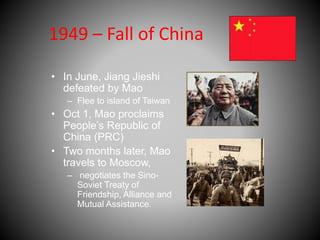
1949 – Fall of China 
• In June, Jiang Jieshi 
defeated by Mao 
– Flee to island of Taiwan 
• Oct 1, Mao proclaims 
People’s Republic of 
China (PRC) 
• Two months later, Mao 
travels to Moscow, 
– negotiates the Sino- 
Soviet Treaty of 
Friendship, Alliance and 
Mutual Assistance.
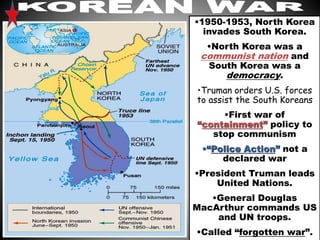
•1950-1953, North Korea 
invades South Korea. 
•North Korea was a 
communist nation and 
South Korea was a 
democracy. 
•Truman orders U.S. forces 
to assist the South Koreans 
•First war of 
“containment” policy to 
stop communism 
•“Police Action” not a 
declared war 
•President Truman leads 
United Nations. 
•General Douglas 
MacArthur commands US 
and UN troops. 
•Called “forgotten war”.
1950s music
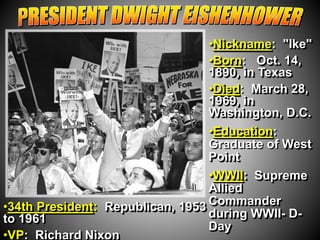
•Nickname: "Ike" 
•Born: Oct. 14, 
1890, in Texas 
•Died: March 28, 
1969, in 
Washington, D.C. 
•Education: 
Graduate of West 
Point 
•WWII: Supreme 
Allied 
Commander 
during WWII- D-Day 
•34th President: Republican, 1953 
to 1961 
•VP: Richard Nixon
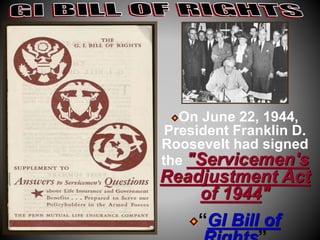
On June 22, 1944, 
President Franklin D. 
Roosevelt had signed 
the "Servicemen's 
Readjustment Act 
of 1944" 
“GI Bill of 
Rights”
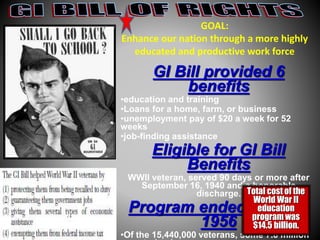
GOAL: 
Enhance our nation through a more highly 
educated and productive work force 
GI Bill provided 6 
benefits 
•education and training 
•Loans for a home, farm, or business 
•unemployment pay of $20 a week for 52 
weeks 
•job-finding assistance 
Eligible for GI Bill 
Benefits 
WWII veteran, served 90 days or more after 
September 16, 1940 and a honorable 
discharge. 
Total cost of the 
World War II 
Program ended July 25, 
1956 
education 
program was 
$14.5 billion. 
•Of the 15,440,000 veterans, some 7.8 million 
were trained.
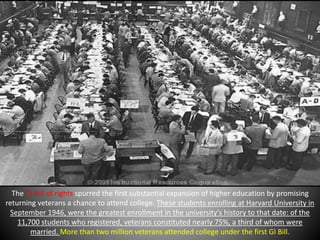
The GI Bill of rights spurred the first substantial expansion of higher education by promising 
returning veterans a chance to attend college. These students enrolling at Harvard University in 
September 1946, were the greatest enrollment in the university's history to that date: of the 
11,700 students who registered, veterans constituted nearly 75%, a third of whom were 
married. More than two million veterans attended college under the first GI Bill.
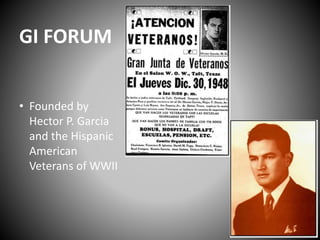
GI FORUM 
• Founded by 
Hector P. Garcia 
and the Hispanic 
American 
Veterans of WWII
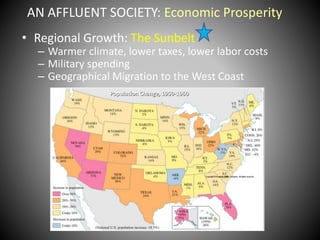
AN AFFLUENT SOCIETY: Economic Prosperity 
• Regional Growth: The Sunbelt 
– Warmer climate, lower taxes, lower labor costs 
– Military spending 
– Geographical Migration to the West Coast 
Population Change, 1950-1960
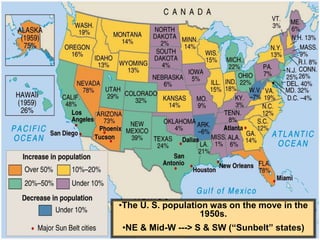
The Culture of the Car 
•The U. S. population was on the move in the 
1950s. 
•NE & Mid-W ---> S & SW (“Sunbelt” states)
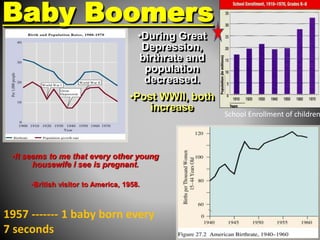
Baby Boomers 
•During Great 
Depression, 
birthrate and 
population 
decreased. 
•Post WWII, both 
increase 
School Enrollment of children 
•It seems to me that every other young 
housewife I see is pregnant. 
•British visitor to America, 1958. 
1957 ------- 1 baby born every 
7 seconds
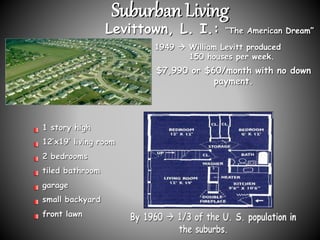
Suburban Living 
Levittown, L. I.: “The American Dream” 
1949  William Levitt produced 
150 houses per week. 
$7,990 or $60/month with no down 
payment.
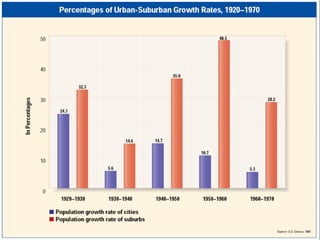
Suburban Living 
SHIFTS IN POPULATION DISTRIBUTION, 
1940-1970 
1940 1950 1960 1970 
Central Cities 31.6% 32.3% 32.6% 32.0% 
Suburbs 19.5% 23.8% 30.7% 41.6% 
Rural Areas/ 48.9% 43.9% 36.7% 26.4% 
Small Towns 
U. S. Bureau of the Census.
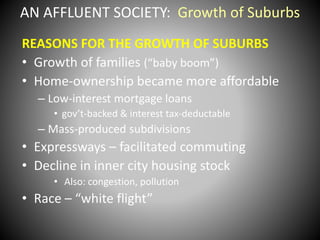
AN AFFLUENT SOCIETY: Growth of Suburbs 
REASONS FOR THE GROWTH OF SUBURBS 
• Growth of families (“baby boom”) 
• Home-ownership became more affordable 
– Low-interest mortgage loans 
• gov’t-backed & interest tax-deductable 
– Mass-produced subdivisions 
• Expressways – facilitated commuting 
• Decline in inner city housing stock 
• Also: congestion, pollution 
• Race – “white flight”
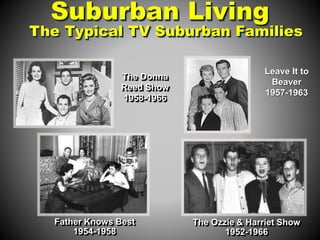
Suburban Living 
The Typical TV Suburban Families 
The Donna 
Reed Show 
1958-1966 
Leave It to 
Beaver 
1957-1963 
Father Knows Best 
1954-1958 
The Ozzie & Harriet Show 
1952-1966
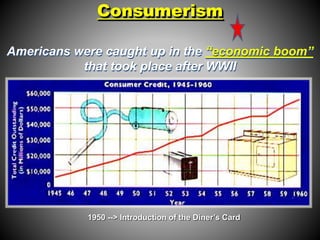
Consumerism 
Americans were caught up in the “economic boom” 
that took place after WWII 
1950 --> Introduction of the Diner’s Card
What were people buying? LIST at least 5
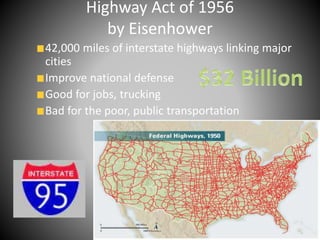
Highway Act of 1956 
by Eisenhower 
42,000 miles of interstate highways linking major 
cities 
Improve national defense 
Good for jobs, trucking 
Bad for the poor, public transportation
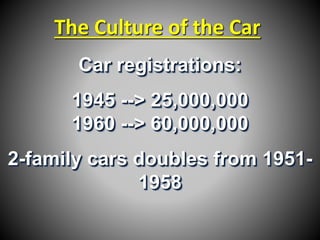
The Culture of the Car 
Car registrations: 
1945 --> 25,000,000 
1960 --> 60,000,000 
2-family cars doubles from 1951- 
1958
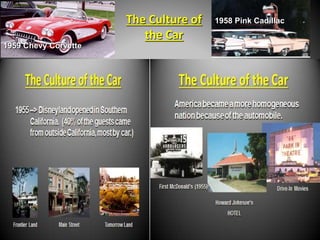
The Culture of 
the Car 
1959 Chevy Corvette 
1958 Pink Cadillac
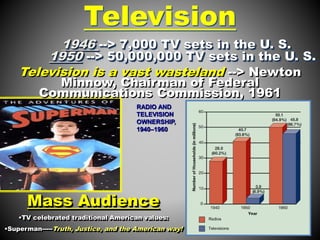
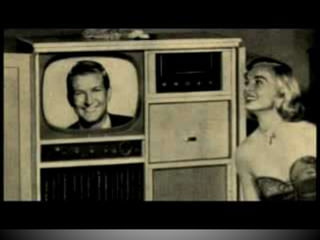
Television 
1946 --> 7,000 TV sets in the U. S. 
1950 --> 50,000,000 TV sets in the U. S. 
Television is a vast wasteland --> Newton 
Minnow, Chairman of Federal 
Communications Commission, 1961 
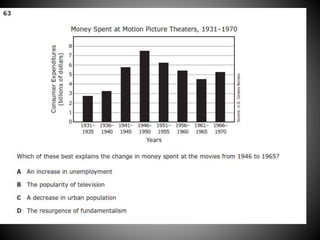
RADIO AND 
TELEVISION 
OWNERSHIP, 
1940–1960 
Mass Audience 
•TV celebrated traditional American values: 
•Superman-----Truth, Justice, and the American way!
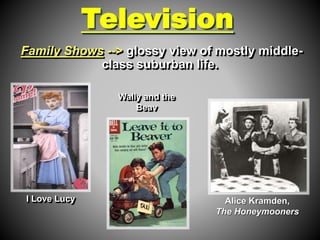
Television 
Family Shows --> glossy view of mostly middle-class 
suburban life. 
I Love Lucy Alice Kramden, 
The Honeymooners 
Wally and the 
Beav
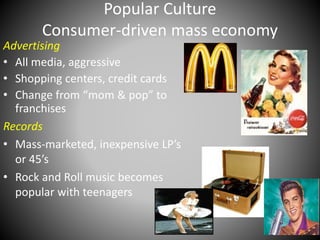
Popular Culture 
Consumer-driven mass economy 
Advertising 
• All media, aggressive 
• Shopping centers, credit cards 
• Change from “mom & pop” to 
franchises 
Records 
• Mass-marketed, inexpensive LP’s 
or 45’s 
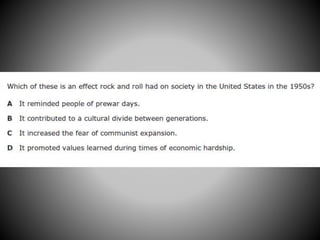
• Rock and Roll music becomes 
popular with teenagers
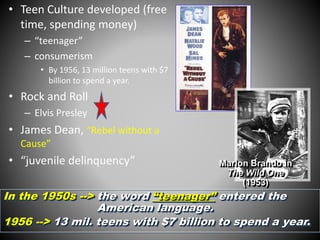
• Teen Culture developed (free 
time, spending money) 
– “teenager” 
– consumerism 
• By 1956, 13 million teens with $7 
billion to spend a year. 
• Rock and Roll 
– Elvis Presley 
• James Dean, “Rebel without a 
Cause” 
• “juvenile delinquency” 
Marlon Brando in 
The Wild One 
(1953) 
In the 1950s --> the word “teenager” entered the 
American language. 
1956 --> 13 mil. teens with $7 billion to spend a year.
Stop after beat generation 1.50
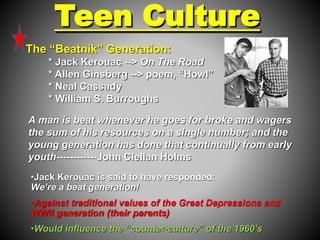
Teen Culture 
The “Beatnik” Generation: 
* Jack Kerouac --> On The Road 
* Allen Ginsberg --> poem, “Howl” 
* Neal Cassady 
* William S. Burroughs 
A man is beat whenever he goes for broke and wagers 
the sum of his resources on a single number; and the 
young generation has done that continually from early 
youth------------John Clellan Holms 
•Jack Kerouac is said to have responded: 
We’re a beat generation! 
•Against traditional values of the Great Depressions and 
WWII generation (their parents) 
•Would influence the “counter-culture” of the 1960’s
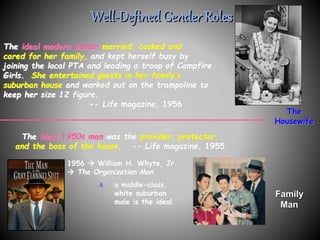
Well-Defined Gender Roles 
The ideal modern woman married, cooked and 
cared for her family, and kept herself busy by 
joining the local PTA and leading a troop of Campfire 
Girls. She entertained guests in her family’s 
suburban house and worked out on the trampoline to 
keep her size 12 figure. 
-- Life magazine, 1956 
The 
Housewife 
The ideal 1950s man was the provider, protector, 
and the boss of the house. -- Life magazine, 1955 
1956  William H. Whyte, Jr. 
 The Organization Man 
A a middle-class, 
white suburban 
male is the ideal. 
Family 
Man
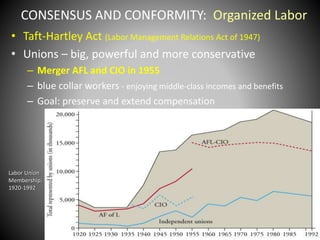
CONSENSUS AND CONFORMITY: Organized Labor 
• Taft-Hartley Act (Labor Management Relations Act of 1947) 
• Unions – big, powerful and more conservative 
– Merger AFL and CIO in 1955 
– blue collar workers - enjoying middle-class incomes and benefits 
– Goal: preserve and extend compensation 
Labor Union 
Membership, 
1920-1992
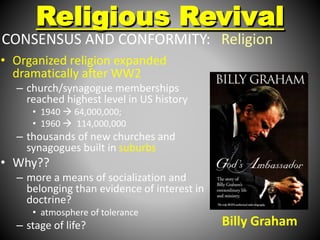
Religious Revival 
CONSENSUS AND CONFORMITY: Religion 
• Organized religion expanded 
dramatically after WW2 
– church/synagogue memberships 
reached highest level in US history 
• 1940  64,000,000; 
• 1960  114,000,000 
– thousands of new churches and 
synagogues built in suburbs 
• Why?? 
– more a means of socialization and 
belonging than evidence of interest in 
doctrine? 
• atmosphere of tolerance 
– stage of life? 
Billy Graham
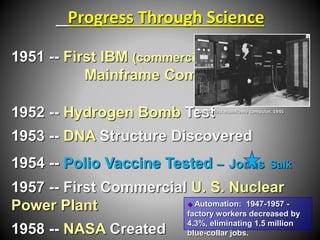
Progress Through Science 
1951 -- First IBM (commercial) 
Mainframe Computer 
1952 -- Hydrogen Bomb Test 
ENIAC, first mainframe computer, 1945 
1953 -- DNA Structure Discovered 
1954 -- Polio Vaccine Tested – Jonas Salk 
1957 -- First Commercial U. S. Nuclear 
Power Plant 
1958 -- NASA Created 
 Automation: 1947-1957 - 
factory workers decreased by 
4.3%, eliminating 1.5 million 
blue-collar jobs.
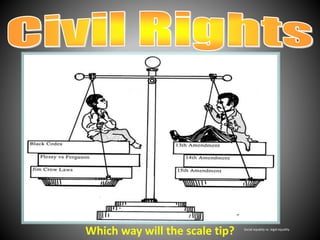
Social equality vs. legal equality Which way will the scale tip?
Sweatt vs. Painter
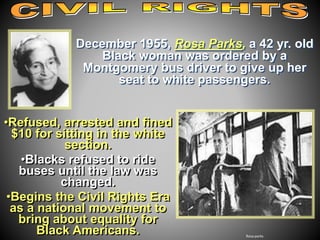
December 1955, Rosa Parks, a 42 yr. old 
Black woman was ordered by a 
Montgomery bus driver to give up her 
seat to white passengers. 
Rosa parks 
•Refused, arrested and fined 
$10 for sitting in the white 
section. 
•Blacks refused to ride 
buses until the law was 
changed. 
•Begins the Civil Rights Era 
as a national movement to 
bring about equality for 
Black Americans.
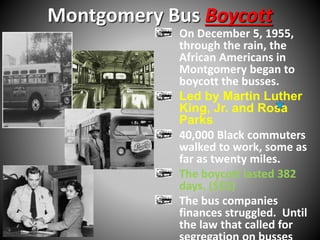
Montgomery Bus Boycott 
On December 5, 1955, 
through the rain, the 
African Americans in 
Montgomery began to 
boycott the busses. 
Led by Martin Luther 
King, Jr. and Rosa 
Parks 
40,000 Black commuters 
walked to work, some as 
far as twenty miles. 
The boycott lasted 382 
days. ($$$) 
The bus companies 
finances struggled. Until 
the law that called for 
segregation on busses
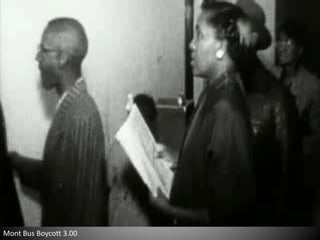
Mont Bus Boycott 3.00
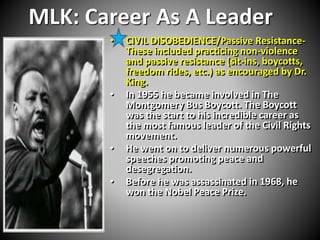
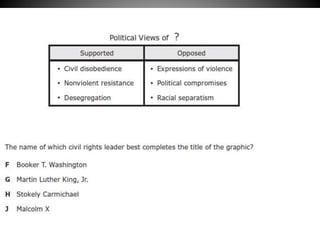
MLK: Career As A Leader 
• CIVIL DISOBEDIENCE/Passive Resistance- 
These included practicing non-violence 
and passive resistance (sit-ins, boycotts, 
freedom rides, etc.) as encouraged by Dr. 
King. 
• In 1955 he became involved in The 
Montgomery Bus Boycott. The Boycott 
was the start to his incredible career as 
the most famous leader of the Civil Rights 
movement. 
• He went on to deliver numerous powerful 
speeches promoting peace and 
desegregation. 
• Before he was assassinated in 1968, he 
won the Nobel Peace Prize.
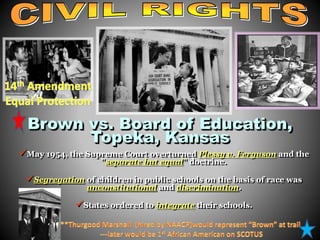
Brown vs. Board of Education, 
Topeka, Kansas 
May 1954, the Supreme Court overturned Plessy v. Ferguson and the 
"separate but equal" doctrine. 
Segregation of children in public schools on the basis of race was 
unconstitutional and discrimination. 
States ordered to integrate their schools. 
Brown vs. board
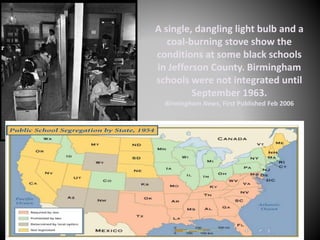
A single, dangling light bulb and a 
coal-burning stove show the 
conditions at some black schools 
in Jefferson County. Birmingham 
schools were not integrated until 
September 1963. 
Birmingham News, First Published Feb 2006
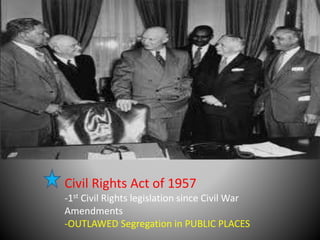
Civil Rights Act of 1957 
-1st Civil Rights legislation since Civil War 
Amendments 
-OUTLAWED Segregation in PUBLIC PLACES
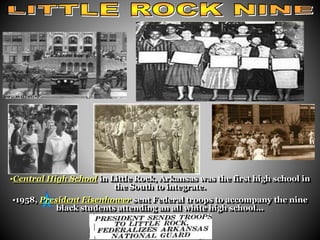
little rock 
•Central High School in Little Rock, Arkansas was the first high school in 
the South to integrate. 
•1958, President Eisenhower sent Federal troops to accompany the nine 
black students attending an all white high school...
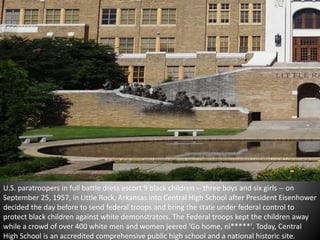
U.S. paratroopers in full battle dress escort 9 black children -- three boys and six girls -- on 
September 25, 1957, in Little Rock, Arkansas into Central High School after President Eisenhower 
decided the day before to send federal troops and bring the state under federal control to 
protect black children against white demonstrators. The Federal troops kept the children away 
while a crowd of over 400 white men and women jeered 'Go home, ni*****'. Today, Central 
High School is an accredited comprehensive public high school and a national historic site.
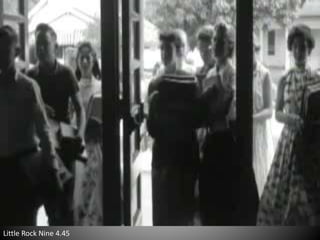
Little Rock Nine 4.45
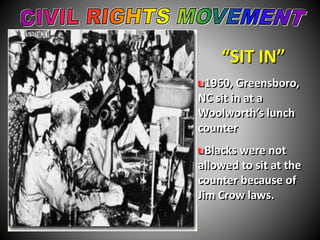
“SIT IN” 
1960, Greensboro, 
NC sit in at a 
Woolworth’s lunch 
counter 
Blacks were not 
allowed to sit at the 
counter because of 
Jim Crow laws.
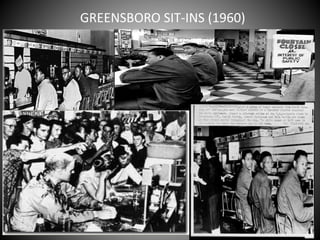
GREENSBORO SIT-INS (1960)
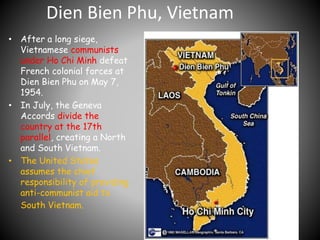
Dien Bien Phu, Vietnam 
• After a long siege, 
Vietnamese communists 
under Ho Chi Minh defeat 
French colonial forces at 
Dien Bien Phu on May 7, 
1954. 
• In July, the Geneva 
Accords divide the 
country at the 17th 
parallel, creating a North 
and South Vietnam. 
• The United States 
assumes the chief 
responsibility of providing 
anti-communist aid to 
South Vietnam.
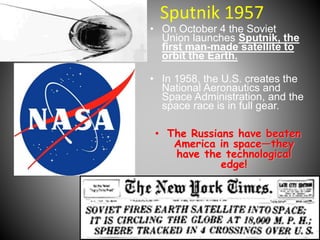
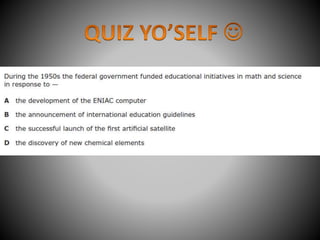
Sputnik 1957 
• On October 4 the Soviet 
Union launches Sputnik, the 
first man-made satellite to 
orbit the Earth. 
• In 1958, the U.S. creates the 
National Aeronautics and 
Space Administration, and the 
space race is in full gear. 
• The Russians have beaten 
America in space—they 
have the technological 
edge!
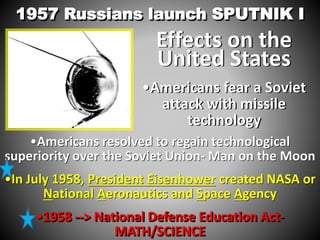
1957 Russians launch SPUTNIK I 
Effects on the 
United States 
•Americans fear a Soviet 
attack with missile 
technology 
•Americans resolved to regain technological 
superiority over the Soviet Union- Man on the Moon 
•In July 1958, President Eisenhower created NASA or 
National Aeronautics and Space Agency 
•1958 --> National Defense Education Act- 
MATH/SCIENCE
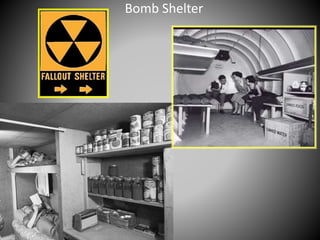
Bomb Shelter
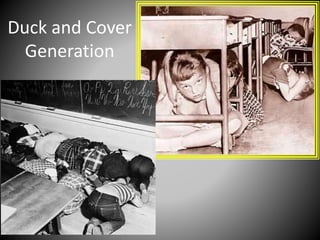
Duck and Cover 
Generation
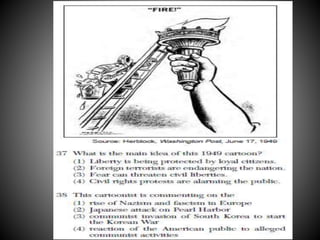
Red scare/HUAC 5.32
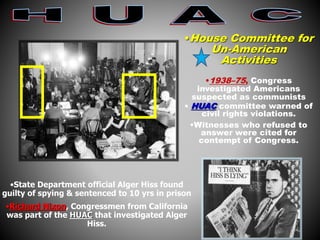
•House Committee for 
Un-American 
Activities 
•1938–75, Congress 
investigated Americans 
suspected as communists 
• HUAC committee warned of 
civil rights violations. 
•Witnesses who refused to 
answer were cited for 
contempt of Congress. 
•State Department official Alger Hiss found 
guilty of spying & sentenced to 10 yrs in prison 
•Richard Nixon, Congressmen from California 
was part of the HUAC that investigated Alger 
Hiss.
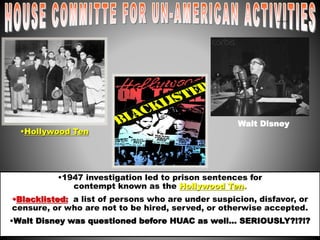
•Hollywood Ten 
Walt Disney 
•1947 investigation led to prison sentences for 
contempt known as the Hollywood Ten. 
red scare3 
•Blacklisted: a list of persons who are under suspicion, disfavor, or 
censure, or who are not to be hired, served, or otherwise accepted. 
•Walt Disney was questioned before HUAC as well… SERIOUSLY?!?!?
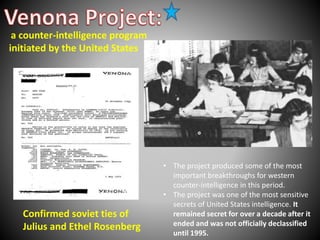
• The project produced some of the most 
important breakthroughs for western 
counter-intelligence in this period. 
• The project was one of the most sensitive 
secrets of United States intelligence. It 
remained secret for over a decade after it 
ended and was not officially declassified 
until 1995. 
a counter-intelligence program 
initiated by the United States 
Confirmed soviet ties of 
Julius and Ethel Rosenberg
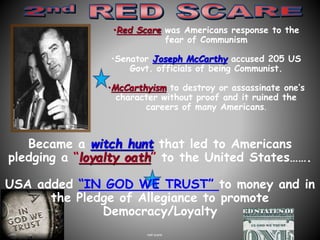
•Red Scare was Americans response to the 
fear of Communism 
•Senator Joseph McCarthy accused 205 US 
Govt. officials of being Communist. 
•McCarthyism to destroy or assassinate one’s 
character without proof and it ruined the 
careers of many Americans. 
Became a witch hunt that led to Americans 
pledging a “loyalty oath” to the United States……. 
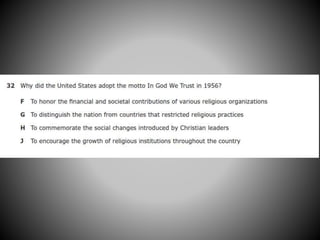
USA added “IN GOD WE TRUST” to money and in 
the Pledge of Allegiance to promote 
Democracy/Loyalty 
red scare
McCarthyism… stop at 4.30
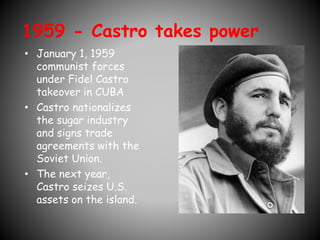
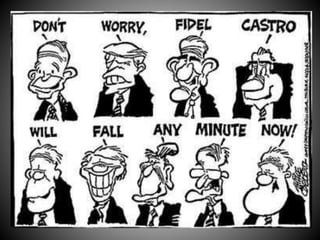
1959 - Castro takes power 
• January 1, 1959 
communist forces 
under Fidel Castro 
takeover in CUBA 
• Castro nationalizes 
the sugar industry 
and signs trade 
agreements with the 
Soviet Union. 
• The next year, 
Castro seizes U.S. 
assets on the island.
18 truman and ike 3day

18 truman and ike 3day

  • 1.
    Democracy Government bythe people; citizens hold the power Communism Totalitarian system of government in which a single party controls state-owned means of production; a society without class distinctions or private property Free Enterprise Capitalism Individuals own most of the resources used and control their use; government plays very small role in the economy. Socialism Government owns and controls most of the resources; government plays major role in the economy.
  • 2.
    ORIGINS OF THECOLD WAR WWII Alliance of Britain and U.S. with Soviet Union was pragmatic “marriage of convenience” to defeat Germany 1. Lack of trust of Stalin. • unified wartime command • atomic bomb 2. Soviets believed western allies not sharing load 3. Soviet mistreatment of eastern Europeans during WWII
  • 3.
    ORIGINS OF THECOLD WAR: Wartime Diplomacy “Big Three” Allied leaders were consistently unable to resolve their basic disagreements over the structure of post-war Europe • Tehran Conference (November 1943) – U.S. and Britain would open a second front within six months – Allies would create a post-war international organization Stalin, Roosevelt & Churchill at Tehran, 1943
  • 4.
    ORIGINS OF THECOLD WAR : Wartime Diplomacy • Yalta Conference (January-February 1945) – Loose set of principles that avoided the most divisive issues. – Division of Germany (and Berlin) into four “zones of occupation”; Reunification of Germany at a future date; process not specified – Soviets would enter Pacific war within 3 months after Germany had been defeated – United Nations – Poland – free elections at some unspecified date after the war Churchill, Roosevelt and Stalin at Yalta, February 1945
  • 6.
    ORIGINS OF THECOLD WAR : Wartime Diplomacy • United Nations Formed (April 1945) – Security Council • 11 members • Permanent seats with veto power for U.S., Britain, France, China and USSR – General Assembly – Secretariat • Secretary-General – International Court of Justice
  • 7.
    Truman’s “Fair Deal”program called for improved housing full employment a higher minimum wage better farm price supports New Tennessee Valley Administrations  extension of Social Security. “Point Four Program” financial support of poor, underdeveloped lands keep underprivileged peoples from becoming communists. In 1948, President Truman’s Executive Order 9981 ordered the integration of the armed forces shortly after World War II, a major advance in civil rights.
  • 8.
    ORIGINS OF THECOLD WAR : Wartime Diplomacy • Potsdam Conference (July- Aug. 1945) – Reparations: Stalin allowed to take 25% of West German industry – Nazi leaders: to be tried as war criminals at Nuremberg – Poland: Free elections – Japan: Unconditional surrender – Korea: to be temporarily divided Churchill, Truman and Stalin at Potsdam
  • 10.
    Iron Curtain Speech • Churchill used phrase March 1946 • Represents the Soviet-made barrier splitting Europe into non-Communist Western Europe and Communist Eastern Europe • Became symbol of the Cold War
  • 11.
  • 12.
    •President Truman’s plan(containment) to aid $$$ and rebuild a war torn Europe •Marshall Plan offered financial aid of $13 billion. •U.S. benefited by forming trade relationships with Europe. •Left a legacy of European friendship and trans Atlantic cooperation • Stalin thought it was trick • Western European economies thrived • Helped stop spread of communism marshall Secretary of State George C. Marshall •Helped to limit communist appeals in Western Europe in the aftermath of WWII •Cold War Propaganda Democracy/Capitalism vs. Communism
  • 13.
    marshall •Food, animalfeed, fertilizer, fuel, raw materials and production equipment were among some of the goods shared
  • 14.
    Truman Doctrine •March 12, 1947 • Greece and Turkey in danger of falling to communist insurgents • Truman requested $400 million from Congress in aid to both countries. • Successful effort • Stalin saw containment policy as “encirclement” by capitalist world to isolate Soviet Union
  • 15.
  • 16.
    Containment Policy •George F. Kennan, Senior State Department official, posted to USSR during war. • Containment was a United States policy using military, economic, and diplomatic strategies to stall the spread of communism, enhance America’s security and influence abroad, and prevent a "domino effect".
  • 17.
    Berlin Airlift •Blockade of Berlin began on June 24, ’48 by Stalin/USSR • Was an attempt to take over the Western ½ of Berlin • From June 1948 to May 1949, U.S. and British planes airlift 1.5 million tons of supplies to the residents of West Berlin. • After 200,000 flights, the Soviet Union lifts the blockade. • An important “STAND” by Truman to “CONTAIN” Communism from spreading • Domino Theory
  • 19.
  • 21.
    1949 – Fallof China • In June, Jiang Jieshi defeated by Mao – Flee to island of Taiwan • Oct 1, Mao proclaims People’s Republic of China (PRC) • Two months later, Mao travels to Moscow, – negotiates the Sino- Soviet Treaty of Friendship, Alliance and Mutual Assistance.
  • 22.
    •1950-1953, North Korea invades South Korea. •North Korea was a communist nation and South Korea was a democracy. •Truman orders U.S. forces to assist the South Koreans •First war of “containment” policy to stop communism •“Police Action” not a declared war •President Truman leads United Nations. •General Douglas MacArthur commands US and UN troops. •Called “forgotten war”.
  • 23.
  • 24.
    •Nickname: "Ike" •Born:Oct. 14, 1890, in Texas •Died: March 28, 1969, in Washington, D.C. •Education: Graduate of West Point •WWII: Supreme Allied Commander during WWII- D-Day •34th President: Republican, 1953 to 1961 •VP: Richard Nixon
  • 25.
    On June 22,1944, President Franklin D. Roosevelt had signed the "Servicemen's Readjustment Act of 1944" “GI Bill of Rights”
  • 26.
    GOAL: Enhance ournation through a more highly educated and productive work force GI Bill provided 6 benefits •education and training •Loans for a home, farm, or business •unemployment pay of $20 a week for 52 weeks •job-finding assistance Eligible for GI Bill Benefits WWII veteran, served 90 days or more after September 16, 1940 and a honorable discharge. Total cost of the World War II Program ended July 25, 1956 education program was $14.5 billion. •Of the 15,440,000 veterans, some 7.8 million were trained.
  • 27.
    The GI Billof rights spurred the first substantial expansion of higher education by promising returning veterans a chance to attend college. These students enrolling at Harvard University in September 1946, were the greatest enrollment in the university's history to that date: of the 11,700 students who registered, veterans constituted nearly 75%, a third of whom were married. More than two million veterans attended college under the first GI Bill.
  • 28.
    GI FORUM •Founded by Hector P. Garcia and the Hispanic American Veterans of WWII
  • 29.
    AN AFFLUENT SOCIETY:Economic Prosperity • Regional Growth: The Sunbelt – Warmer climate, lower taxes, lower labor costs – Military spending – Geographical Migration to the West Coast Population Change, 1950-1960
  • 30.
    The Culture ofthe Car •The U. S. population was on the move in the 1950s. •NE & Mid-W ---> S & SW (“Sunbelt” states)
  • 31.
    Baby Boomers •DuringGreat Depression, birthrate and population decreased. •Post WWII, both increase School Enrollment of children •It seems to me that every other young housewife I see is pregnant. •British visitor to America, 1958. 1957 ------- 1 baby born every 7 seconds
  • 32.
    Suburban Living Levittown,L. I.: “The American Dream” 1949  William Levitt produced 150 houses per week. $7,990 or $60/month with no down payment.
  • 33.
    Suburban Living SHIFTSIN POPULATION DISTRIBUTION, 1940-1970 1940 1950 1960 1970 Central Cities 31.6% 32.3% 32.6% 32.0% Suburbs 19.5% 23.8% 30.7% 41.6% Rural Areas/ 48.9% 43.9% 36.7% 26.4% Small Towns U. S. Bureau of the Census.
  • 34.
    AN AFFLUENT SOCIETY:Growth of Suburbs REASONS FOR THE GROWTH OF SUBURBS • Growth of families (“baby boom”) • Home-ownership became more affordable – Low-interest mortgage loans • gov’t-backed & interest tax-deductable – Mass-produced subdivisions • Expressways – facilitated commuting • Decline in inner city housing stock • Also: congestion, pollution • Race – “white flight”
  • 35.
    Suburban Living TheTypical TV Suburban Families The Donna Reed Show 1958-1966 Leave It to Beaver 1957-1963 Father Knows Best 1954-1958 The Ozzie & Harriet Show 1952-1966
  • 37.
    Consumerism Americans werecaught up in the “economic boom” that took place after WWII 1950 --> Introduction of the Diner’s Card
  • 38.
    What were peoplebuying? LIST at least 5
  • 39.
    Highway Act of1956 by Eisenhower 42,000 miles of interstate highways linking major cities Improve national defense Good for jobs, trucking Bad for the poor, public transportation
  • 40.
    The Culture ofthe Car Car registrations: 1945 --> 25,000,000 1960 --> 60,000,000 2-family cars doubles from 1951- 1958
  • 41.
    The Culture of the Car 1959 Chevy Corvette 1958 Pink Cadillac
  • 42.
    Television 1946 -->7,000 TV sets in the U. S. 1950 --> 50,000,000 TV sets in the U. S. Television is a vast wasteland --> Newton Minnow, Chairman of Federal Communications Commission, 1961 RADIO AND TELEVISION OWNERSHIP, 1940–1960 Mass Audience •TV celebrated traditional American values: •Superman-----Truth, Justice, and the American way!
  • 43.
    Television Family Shows--> glossy view of mostly middle-class suburban life. I Love Lucy Alice Kramden, The Honeymooners Wally and the Beav
  • 44.
    Popular Culture Consumer-drivenmass economy Advertising • All media, aggressive • Shopping centers, credit cards • Change from “mom & pop” to franchises Records • Mass-marketed, inexpensive LP’s or 45’s • Rock and Roll music becomes popular with teenagers
  • 47.
    • Teen Culturedeveloped (free time, spending money) – “teenager” – consumerism • By 1956, 13 million teens with $7 billion to spend a year. • Rock and Roll – Elvis Presley • James Dean, “Rebel without a Cause” • “juvenile delinquency” Marlon Brando in The Wild One (1953) In the 1950s --> the word “teenager” entered the American language. 1956 --> 13 mil. teens with $7 billion to spend a year.
  • 48.
    Stop after beatgeneration 1.50
  • 49.
    Teen Culture The“Beatnik” Generation: * Jack Kerouac --> On The Road * Allen Ginsberg --> poem, “Howl” * Neal Cassady * William S. Burroughs A man is beat whenever he goes for broke and wagers the sum of his resources on a single number; and the young generation has done that continually from early youth------------John Clellan Holms •Jack Kerouac is said to have responded: We’re a beat generation! •Against traditional values of the Great Depressions and WWII generation (their parents) •Would influence the “counter-culture” of the 1960’s
  • 51.
    Well-Defined Gender Roles The ideal modern woman married, cooked and cared for her family, and kept herself busy by joining the local PTA and leading a troop of Campfire Girls. She entertained guests in her family’s suburban house and worked out on the trampoline to keep her size 12 figure. -- Life magazine, 1956 The Housewife The ideal 1950s man was the provider, protector, and the boss of the house. -- Life magazine, 1955 1956  William H. Whyte, Jr.  The Organization Man A a middle-class, white suburban male is the ideal. Family Man
  • 52.
    CONSENSUS AND CONFORMITY:Organized Labor • Taft-Hartley Act (Labor Management Relations Act of 1947) • Unions – big, powerful and more conservative – Merger AFL and CIO in 1955 – blue collar workers - enjoying middle-class incomes and benefits – Goal: preserve and extend compensation Labor Union Membership, 1920-1992
  • 53.
    Religious Revival CONSENSUSAND CONFORMITY: Religion • Organized religion expanded dramatically after WW2 – church/synagogue memberships reached highest level in US history • 1940  64,000,000; • 1960  114,000,000 – thousands of new churches and synagogues built in suburbs • Why?? – more a means of socialization and belonging than evidence of interest in doctrine? • atmosphere of tolerance – stage of life? Billy Graham
  • 54.
    Progress Through Science 1951 -- First IBM (commercial) Mainframe Computer 1952 -- Hydrogen Bomb Test ENIAC, first mainframe computer, 1945 1953 -- DNA Structure Discovered 1954 -- Polio Vaccine Tested – Jonas Salk 1957 -- First Commercial U. S. Nuclear Power Plant 1958 -- NASA Created  Automation: 1947-1957 - factory workers decreased by 4.3%, eliminating 1.5 million blue-collar jobs.
  • 57.
    Social equality vs.legal equality Which way will the scale tip?
  • 59.
  • 60.
    December 1955, RosaParks, a 42 yr. old Black woman was ordered by a Montgomery bus driver to give up her seat to white passengers. Rosa parks •Refused, arrested and fined $10 for sitting in the white section. •Blacks refused to ride buses until the law was changed. •Begins the Civil Rights Era as a national movement to bring about equality for Black Americans.
  • 61.
    Montgomery Bus Boycott On December 5, 1955, through the rain, the African Americans in Montgomery began to boycott the busses. Led by Martin Luther King, Jr. and Rosa Parks 40,000 Black commuters walked to work, some as far as twenty miles. The boycott lasted 382 days. ($$$) The bus companies finances struggled. Until the law that called for segregation on busses
  • 62.
  • 63.
    MLK: Career AsA Leader • CIVIL DISOBEDIENCE/Passive Resistance- These included practicing non-violence and passive resistance (sit-ins, boycotts, freedom rides, etc.) as encouraged by Dr. King. • In 1955 he became involved in The Montgomery Bus Boycott. The Boycott was the start to his incredible career as the most famous leader of the Civil Rights movement. • He went on to deliver numerous powerful speeches promoting peace and desegregation. • Before he was assassinated in 1968, he won the Nobel Peace Prize.
  • 64.
    Brown vs. Boardof Education, Topeka, Kansas May 1954, the Supreme Court overturned Plessy v. Ferguson and the "separate but equal" doctrine. Segregation of children in public schools on the basis of race was unconstitutional and discrimination. States ordered to integrate their schools. Brown vs. board
  • 65.
    A single, danglinglight bulb and a coal-burning stove show the conditions at some black schools in Jefferson County. Birmingham schools were not integrated until September 1963. Birmingham News, First Published Feb 2006
  • 66.
    Civil Rights Actof 1957 -1st Civil Rights legislation since Civil War Amendments -OUTLAWED Segregation in PUBLIC PLACES
  • 67.
    little rock •CentralHigh School in Little Rock, Arkansas was the first high school in the South to integrate. •1958, President Eisenhower sent Federal troops to accompany the nine black students attending an all white high school...
  • 68.
    U.S. paratroopers infull battle dress escort 9 black children -- three boys and six girls -- on September 25, 1957, in Little Rock, Arkansas into Central High School after President Eisenhower decided the day before to send federal troops and bring the state under federal control to protect black children against white demonstrators. The Federal troops kept the children away while a crowd of over 400 white men and women jeered 'Go home, ni*****'. Today, Central High School is an accredited comprehensive public high school and a national historic site.
  • 69.
  • 70.
    “SIT IN” 1960,Greensboro, NC sit in at a Woolworth’s lunch counter Blacks were not allowed to sit at the counter because of Jim Crow laws.
  • 71.
  • 73.
    Dien Bien Phu,Vietnam • After a long siege, Vietnamese communists under Ho Chi Minh defeat French colonial forces at Dien Bien Phu on May 7, 1954. • In July, the Geneva Accords divide the country at the 17th parallel, creating a North and South Vietnam. • The United States assumes the chief responsibility of providing anti-communist aid to South Vietnam.
  • 74.
    Sputnik 1957 •On October 4 the Soviet Union launches Sputnik, the first man-made satellite to orbit the Earth. • In 1958, the U.S. creates the National Aeronautics and Space Administration, and the space race is in full gear. • The Russians have beaten America in space—they have the technological edge!
  • 75.
    1957 Russians launchSPUTNIK I Effects on the United States •Americans fear a Soviet attack with missile technology •Americans resolved to regain technological superiority over the Soviet Union- Man on the Moon •In July 1958, President Eisenhower created NASA or National Aeronautics and Space Agency •1958 --> National Defense Education Act- MATH/SCIENCE
  • 76.
  • 77.
    Duck and Cover Generation
  • 78.
  • 79.
    •House Committee for Un-American Activities •1938–75, Congress investigated Americans suspected as communists • HUAC committee warned of civil rights violations. •Witnesses who refused to answer were cited for contempt of Congress. •State Department official Alger Hiss found guilty of spying & sentenced to 10 yrs in prison •Richard Nixon, Congressmen from California was part of the HUAC that investigated Alger Hiss.
  • 80.
    •Hollywood Ten WaltDisney •1947 investigation led to prison sentences for contempt known as the Hollywood Ten. red scare3 •Blacklisted: a list of persons who are under suspicion, disfavor, or censure, or who are not to be hired, served, or otherwise accepted. •Walt Disney was questioned before HUAC as well… SERIOUSLY?!?!?
  • 81.
    • The projectproduced some of the most important breakthroughs for western counter-intelligence in this period. • The project was one of the most sensitive secrets of United States intelligence. It remained secret for over a decade after it ended and was not officially declassified until 1995. a counter-intelligence program initiated by the United States Confirmed soviet ties of Julius and Ethel Rosenberg
  • 82.
    •Red Scare wasAmericans response to the fear of Communism •Senator Joseph McCarthy accused 205 US Govt. officials of being Communist. •McCarthyism to destroy or assassinate one’s character without proof and it ruined the careers of many Americans. Became a witch hunt that led to Americans pledging a “loyalty oath” to the United States……. USA added “IN GOD WE TRUST” to money and in the Pledge of Allegiance to promote Democracy/Loyalty red scare
  • 83.
  • 87.
    1959 - Castrotakes power • January 1, 1959 communist forces under Fidel Castro takeover in CUBA • Castro nationalizes the sugar industry and signs trade agreements with the Soviet Union. • The next year, Castro seizes U.S. assets on the island.