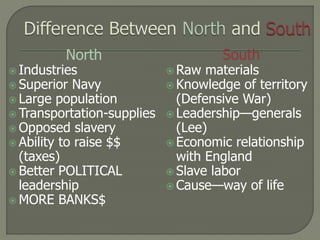
North 
 Industries 
 Superior Navy 
 Large population 
Transportation-supplies 
 Opposed slavery 
 Ability to raise $$ 
(taxes) 
 Better POLITICAL 
leadership 
MORE BANKS$ 
South 
Raw materials 
 Knowledge of territory 
(Defensive War) 
 Leadership—generals 
(Lee) 
 Economic relationship 
with England 
 Slave labor 
 Cause—way of life
Industrial_Rev_Cause_War_1min29
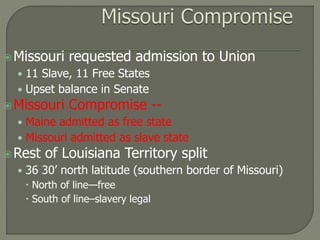
Missouri requested admission to Union 
• 11 Slave, 11 Free States 
• Upset balance in Senate 
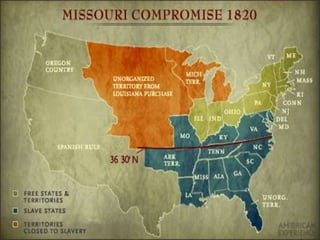
Missouri Compromise -- 
• Maine admitted as free state 
• Missouri admitted as slave state 
Rest of Louisiana Territory split 
• 36 30’ north latitude (southern border of Missouri) 
 North of line—free 
 South of line–slavery legal
Tariffs on Imports 1824 & 1828 
 Hurt Southern economy 
• Loss of inexpensive British imports 
• Forced to buy expensive Northern goods 
• Felt North getting rich off South 
 John Calhoun developed nullification theory 
• Constitution established by sovereign states 
• States still sovereign 
 Have right to determine Congressional acts unconstitutional 
 South Carolina declares tariffs null and void within 
state 
• Couldn’t get support from other Southern states 
• South Carolina did get tariffs lowered 
 Proved a single state could force its will on Congress
 Was started because 
Polk said Mexico had 
illegally crossed into 
American Territory 
 Whigs (led by Abe 
Lincoln) opposed 
Mexican War 
 Treaty of Guadalupe 
Hidalgo 
• ended war 
• Gained (present day) 
California, Nevada, New 
Mexico, Utah, Arizona 
Colorado and Wyoming- 
RioGrande was boundary 
• Wilmot Proviso-prohibited 
SLAVERY in land 
acquired from 
Mexico 
 House passed 2x, 
Senate rejected 
 Angered the South because 
it was in disagreement of 
Missouri Compromise
Gold Rush caused California population to grow 
Applied for statehood as free state 
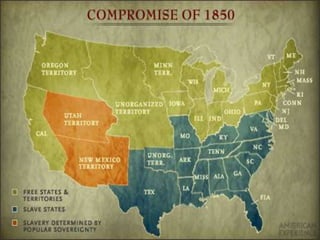
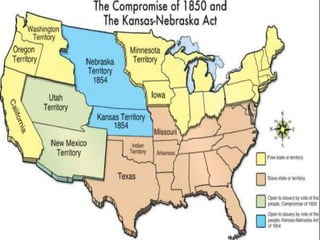
Compromise of 1850 
• California admitted as free 
• No slavery restrictions on rest of Mexican cession 
• Slave trade abolished D.C., not slavery 
• New fugitive slave law passed 
• *UTAH/NEW MEXICO left up to popular sovereignty* 
Threats of southern secession became more 
frequent
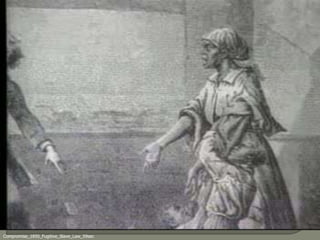
Compromise_1850_Fugitive_Slave_Law_59sec
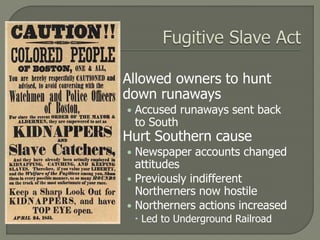
Allowed owners to hunt 
down runaways 
• Accused runaways sent back 
to South 
Hurt Southern cause 
• Newspaper accounts changed 
attitudes 
• Previously indifferent 
Northerners now hostile 
• Northerners actions increased 
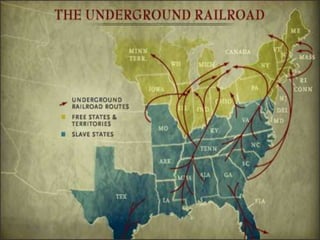
 Led to Underground Railroad
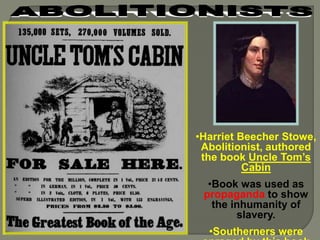
•Harriet Beecher Stowe, 
Abolitionist, authored 
the book Uncle Tom’s 
Cabin 
•Book was used as 
propaganda to show 
the inhumanity of 
slavery. 
•Southerners were 
enraged by this book
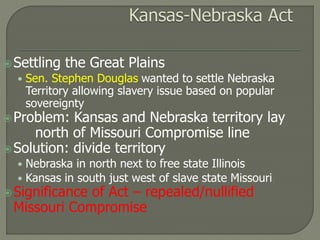
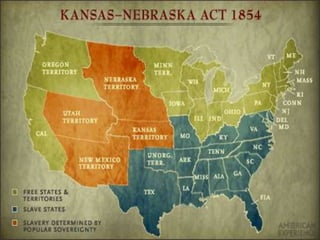
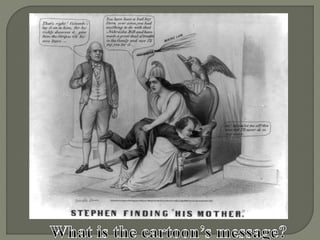
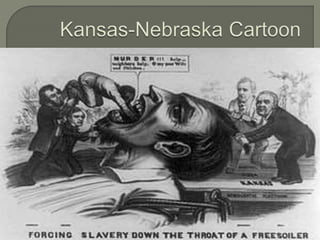
Settling the Great Plains 
• Sen. Stephen Douglas wanted to settle Nebraska 
Territory allowing slavery issue based on popular 
sovereignty 
Problem: Kansas and Nebraska territory lay 
north of Missouri Compromise line 
Solution: divide territory 
• Nebraska in north next to free state Illinois 
• Kansas in south just west of slave state Missouri 
Significance of Act – repealed/nullified 
Missouri Compromise
Kansas_Nebraska_Act_44sec
Dred Scott 
• slave living in Missouri 
• taken by owner to free states to live for a while 
• returned to Missouri 
1854 sued in federal court for freedom 
• believed since had lived in free territory, should be free 
• federal court ruled against him 
Appealed to Supreme Court 
• ruled against him 
 since not a citizen, did not have right to use court 
system 
 living in free state does not make him free
Abolitionist John Brown planned insurrection 
• Help slaves break free from masters 
• Needed weapons to give to slaves 
Oct. 16, 1859 led a band of men into Harpers 
Ferry, Virginia 
• goal to seize the federal arsenal and start a slave 
uprising 
Federal troops put down rebellion 
• authorities tried Brown and sentenced to death by 
hanging Last statement: “I, John Brown, am 
now quite certain that the crimes of 
this guilty land can never be purged 
away but with blood.”
Effects: 
• Strengthened abolitionists feeling in 
North 
• Boosted abolitionist movement 
• Turning point for South 
Viewed as proof Northerners were 
plotting to murder slave holders 
Caused South to plan for war
1860 Presidential election 
• Abraham Lincoln, Republican candidate 
• pledge to halt the further spread of slavery 
• reassured the Southerners that he would not “interfere 
with their slaves, or with them, about their slaves” 
• Viewed as enemy by many Southerners 
 Lincoln’s victory leads to Southern secession 
• less than half the popular votes 
• no electoral votes from the South 
 saw his victory as a loss of political voice in national gov’t
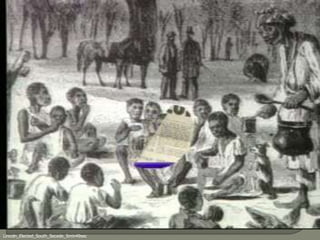
Lincoln_Elected_South_Secede_5min49sec
South Carolina seceded Dec. 20, 1860 
• Mississippi, Florida, Alabama, Georgia, Louisiana, and 
Texas 
Formed the Confederate States of America 
• Jefferson Davis elected President 
Fort Sumter, South Carolina 
• Confederacy demanded Union troops leave fort 
• Confederates attacked fort April 1861 
 forced Union to surrender 
 marks beginning of Civil War
First Battle of Bull Run 
• Significance 
Made it clear North needed large, well-trained 
army to defeat the South
Antietam 
• Significance 
• Early Turning Point of WAR- Union 
victory convinced GB and France to 
remain neutral 
• Bloodiest 1-day battle in American 
History; convinced Lincoln time 
had come to end slavery
Vicksburg 
• Significance 
• Essential to the ANACONDA PLAN 
• Cut the Confederacy in two by taking 
over the Mississippi River
Gettysburg 
• Significance 
• Turning point in East; Union victory 
ensured Britain not recognize 
Confederacy as nation 
• Stopped Lee’s advancement North
 Sept 1862 Lincoln issued the Emancipation 
Proclamation 
• Freed all enslaved persons in states still at war with the 
Union after Jan 1, 1863 
• Only applied to those states within Confederacy 
• Border states could still have slaves 
 Maryland, Kentucky, Missouri, and Delaware were slave states that 
remained in the Union 
 Proclamation gave war moral purpose 
• Moving away from secession issues to a war to free slaves
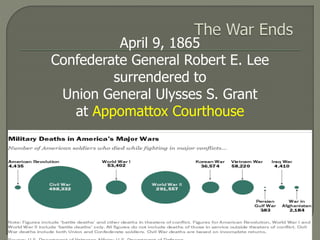
April 9, 1865 
Confederate General Robert E. Lee 
surrendered to 
Union General Ulysses S. Grant 
at Appomattox Courthouse
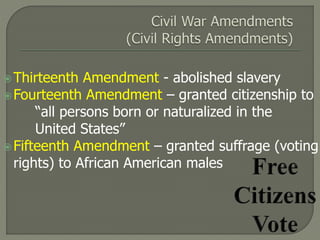
Thirteenth Amendment - abolished slavery 
Fourteenth Amendment – granted citizenship to 
“all persons born or naturalized in the 
United States” 
 Fifteenth Amendment – granted suffrage (voting 
rights) to African American males
Lincoln found that the war required active 
and PROMPT presidential action during 
wartime 
Lincoln suspended the writ of habeas 
corpus for everyone living between 
Washington DC & Philadelphia 
Lincoln explanation: It was necessary to set 
aside small provisions of the Constitution 
during wartime in order to save the Union
• Death of Abraham Lincoln on April 14, 
1865 at Ford’s theatre 
• VP Andrew Johnson assumes presidency 
until 1868 
• President Grant is elected 1868, due to 
strong abolitionist loyalties
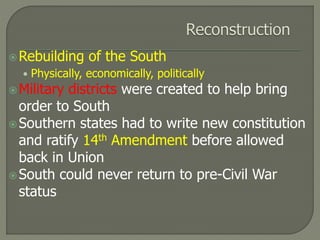
Rebuilding of the South 
• Physically, economically, politically 
 Military districts were created to help bring 
order to South 
Southern states had to write new constitution 
and ratify 14th Amendment before allowed 
back in Union 
South could never return to pre-Civil War 
status
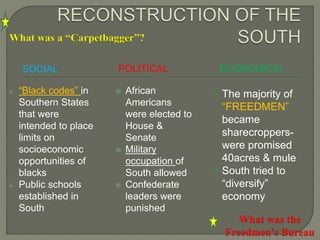
SOCIAL POLITICAL 
 “Black codes” in 
Southern States 
that were 
intended to place 
limits on 
socioeconomic 
opportunities of 
blacks 
 Public schools 
established in 
South 
 African 
Americans 
were elected to 
House & 
Senate 
 Military 
occupation of 
South allowed 
 Confederate 
leaders were 
punished 
ECONOMICAL 
 The majority of 
“FREEDMEN” 
became 
sharecroppers-were 
promised 
40acres & mule 
 South tried to 
“diversify” 
economy 
What was the 
Freedmen’s Bureau 
What was a “Carpetbagger”?
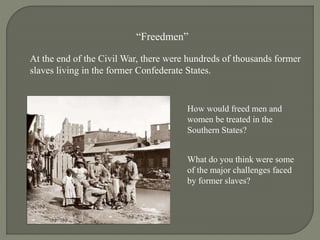
“Freedmen” 
At the end of the Civil War, there were hundreds of thousands former 
slaves living in the former Confederate States. 
How would freed men and 
women be treated in the 
Southern States? 
What do you think were some 
of the major challenges faced 
by former slaves?
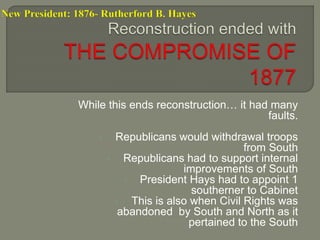
New President: 1876- Rutherford B. Hayes 
While this ends reconstruction… it had many 
faults. 
• Republicans would withdrawal troops 
from South 
• Republicans had to support internal 
improvements of South 
• President Hays had to appoint 1 
southerner to Cabinet 
• This is also when Civil Rights was 
abandoned by South and North as it 
pertained to the South
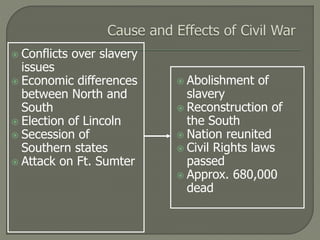
 Conflicts over slavery 
issues 
 Economic differences 
between North and 
South 
 Election of Lincoln 
 Secession of 
Southern states 
 Attack on Ft. Sumter 
 Abolishment of 
slavery 
 Reconstruction of 
the South 
 Nation reunited 
 Civil Rights laws 
passed 
 Approx. 680,000 
dead

7 civil war 3 days

  • 2.
    North  Industries  Superior Navy  Large population Transportation-supplies  Opposed slavery  Ability to raise $$ (taxes)  Better POLITICAL leadership MORE BANKS$ South Raw materials  Knowledge of territory (Defensive War)  Leadership—generals (Lee)  Economic relationship with England  Slave labor  Cause—way of life
  • 3.
  • 4.
    Missouri requested admissionto Union • 11 Slave, 11 Free States • Upset balance in Senate Missouri Compromise -- • Maine admitted as free state • Missouri admitted as slave state Rest of Louisiana Territory split • 36 30’ north latitude (southern border of Missouri)  North of line—free  South of line–slavery legal
  • 6.
    Tariffs on Imports1824 & 1828  Hurt Southern economy • Loss of inexpensive British imports • Forced to buy expensive Northern goods • Felt North getting rich off South  John Calhoun developed nullification theory • Constitution established by sovereign states • States still sovereign  Have right to determine Congressional acts unconstitutional  South Carolina declares tariffs null and void within state • Couldn’t get support from other Southern states • South Carolina did get tariffs lowered  Proved a single state could force its will on Congress
  • 7.
     Was startedbecause Polk said Mexico had illegally crossed into American Territory  Whigs (led by Abe Lincoln) opposed Mexican War  Treaty of Guadalupe Hidalgo • ended war • Gained (present day) California, Nevada, New Mexico, Utah, Arizona Colorado and Wyoming- RioGrande was boundary • Wilmot Proviso-prohibited SLAVERY in land acquired from Mexico  House passed 2x, Senate rejected  Angered the South because it was in disagreement of Missouri Compromise
  • 8.
    Gold Rush causedCalifornia population to grow Applied for statehood as free state Compromise of 1850 • California admitted as free • No slavery restrictions on rest of Mexican cession • Slave trade abolished D.C., not slavery • New fugitive slave law passed • *UTAH/NEW MEXICO left up to popular sovereignty* Threats of southern secession became more frequent
  • 10.
  • 11.
    Allowed owners tohunt down runaways • Accused runaways sent back to South Hurt Southern cause • Newspaper accounts changed attitudes • Previously indifferent Northerners now hostile • Northerners actions increased  Led to Underground Railroad
  • 13.
    •Harriet Beecher Stowe, Abolitionist, authored the book Uncle Tom’s Cabin •Book was used as propaganda to show the inhumanity of slavery. •Southerners were enraged by this book
  • 14.
    Settling the GreatPlains • Sen. Stephen Douglas wanted to settle Nebraska Territory allowing slavery issue based on popular sovereignty Problem: Kansas and Nebraska territory lay north of Missouri Compromise line Solution: divide territory • Nebraska in north next to free state Illinois • Kansas in south just west of slave state Missouri Significance of Act – repealed/nullified Missouri Compromise
  • 18.
  • 20.
    Dred Scott •slave living in Missouri • taken by owner to free states to live for a while • returned to Missouri 1854 sued in federal court for freedom • believed since had lived in free territory, should be free • federal court ruled against him Appealed to Supreme Court • ruled against him  since not a citizen, did not have right to use court system  living in free state does not make him free
  • 21.
    Abolitionist John Brownplanned insurrection • Help slaves break free from masters • Needed weapons to give to slaves Oct. 16, 1859 led a band of men into Harpers Ferry, Virginia • goal to seize the federal arsenal and start a slave uprising Federal troops put down rebellion • authorities tried Brown and sentenced to death by hanging Last statement: “I, John Brown, am now quite certain that the crimes of this guilty land can never be purged away but with blood.”
  • 22.
    Effects: • Strengthenedabolitionists feeling in North • Boosted abolitionist movement • Turning point for South Viewed as proof Northerners were plotting to murder slave holders Caused South to plan for war
  • 23.
    1860 Presidential election • Abraham Lincoln, Republican candidate • pledge to halt the further spread of slavery • reassured the Southerners that he would not “interfere with their slaves, or with them, about their slaves” • Viewed as enemy by many Southerners  Lincoln’s victory leads to Southern secession • less than half the popular votes • no electoral votes from the South  saw his victory as a loss of political voice in national gov’t
  • 24.
  • 25.
    South Carolina secededDec. 20, 1860 • Mississippi, Florida, Alabama, Georgia, Louisiana, and Texas Formed the Confederate States of America • Jefferson Davis elected President Fort Sumter, South Carolina • Confederacy demanded Union troops leave fort • Confederates attacked fort April 1861  forced Union to surrender  marks beginning of Civil War
  • 26.
    First Battle ofBull Run • Significance Made it clear North needed large, well-trained army to defeat the South
  • 28.
    Antietam • Significance • Early Turning Point of WAR- Union victory convinced GB and France to remain neutral • Bloodiest 1-day battle in American History; convinced Lincoln time had come to end slavery
  • 29.
    Vicksburg • Significance • Essential to the ANACONDA PLAN • Cut the Confederacy in two by taking over the Mississippi River
  • 30.
    Gettysburg • Significance • Turning point in East; Union victory ensured Britain not recognize Confederacy as nation • Stopped Lee’s advancement North
  • 31.
     Sept 1862Lincoln issued the Emancipation Proclamation • Freed all enslaved persons in states still at war with the Union after Jan 1, 1863 • Only applied to those states within Confederacy • Border states could still have slaves  Maryland, Kentucky, Missouri, and Delaware were slave states that remained in the Union  Proclamation gave war moral purpose • Moving away from secession issues to a war to free slaves
  • 32.
    April 9, 1865 Confederate General Robert E. Lee surrendered to Union General Ulysses S. Grant at Appomattox Courthouse
  • 33.
    Thirteenth Amendment -abolished slavery Fourteenth Amendment – granted citizenship to “all persons born or naturalized in the United States”  Fifteenth Amendment – granted suffrage (voting rights) to African American males
  • 34.
    Lincoln found thatthe war required active and PROMPT presidential action during wartime Lincoln suspended the writ of habeas corpus for everyone living between Washington DC & Philadelphia Lincoln explanation: It was necessary to set aside small provisions of the Constitution during wartime in order to save the Union
  • 35.
    • Death ofAbraham Lincoln on April 14, 1865 at Ford’s theatre • VP Andrew Johnson assumes presidency until 1868 • President Grant is elected 1868, due to strong abolitionist loyalties
  • 36.
    Rebuilding of theSouth • Physically, economically, politically  Military districts were created to help bring order to South Southern states had to write new constitution and ratify 14th Amendment before allowed back in Union South could never return to pre-Civil War status
  • 37.
    SOCIAL POLITICAL “Black codes” in Southern States that were intended to place limits on socioeconomic opportunities of blacks  Public schools established in South  African Americans were elected to House & Senate  Military occupation of South allowed  Confederate leaders were punished ECONOMICAL  The majority of “FREEDMEN” became sharecroppers-were promised 40acres & mule  South tried to “diversify” economy What was the Freedmen’s Bureau What was a “Carpetbagger”?
  • 38.
    “Freedmen” At theend of the Civil War, there were hundreds of thousands former slaves living in the former Confederate States. How would freed men and women be treated in the Southern States? What do you think were some of the major challenges faced by former slaves?
  • 39.
    New President: 1876-Rutherford B. Hayes While this ends reconstruction… it had many faults. • Republicans would withdrawal troops from South • Republicans had to support internal improvements of South • President Hays had to appoint 1 southerner to Cabinet • This is also when Civil Rights was abandoned by South and North as it pertained to the South
  • 40.
     Conflicts overslavery issues  Economic differences between North and South  Election of Lincoln  Secession of Southern states  Attack on Ft. Sumter  Abolishment of slavery  Reconstruction of the South  Nation reunited  Civil Rights laws passed  Approx. 680,000 dead